
Huidu vs Colorlight vs Novastar LED Control System: Which Brand Fits Your Project?
UnifyLED · LED Control System Guide · Updated August 2026
The Huidu vs Colorlight vs Novastar LED control system question is the first one integrators ask when a project moves from planning to procurement — and the answer is not “which brand is best” but “which brand fits this project’s budget, content and ecosystem.” This guide compares all three brands at the model level — synchronous processors, async players, receiving cards and price — using the official data on this site, and it ends with a decision table you can take into the quote.
Short answer: Choose Huidu for budget-conscious async-first projects — advertising screens, signage and small full-color walls where scheduled playback and one-card simplicity matter (USD 67–329 across the line); choose Colorlight for mid-range rental and event systems with a strong receiving-card ecosystem; choose Novastar for premium synchronous installations — broadcast, stadiums and mission-critical walls where reliability justifies the price. All three share the same 655,360-pixels-per-port loading math, and none of them can be mixed with another brand’s receiving cards — the compatibility rule that decides entire projects before a single quote is written.
Where Do Huidu, Colorlight and Novastar LED Control Systems Stand on Brand Positioning?
Three brands, three positions — and the positions are stable enough to drive the whole decision:
Huidu — the budget async leader
Huidu’s strength is asynchronous control done cheaply and simply: the HD-A3 async player, the HD-A5 dual-mode box, the C16C/C36C one-card control cards and the VP210-to-VP830 sync processors — twelve documented products across four architectures, covered in the Huidu control system selection guide on this site. Its edge is price and async simplicity: the cheapest full-color async path in the industry, with Wi-Fi and cloud management as standard.
Colorlight — the mid-range rental innovator
Colorlight sits between the two, with a strong reputation in rental and events — panels that are assembled and disassembled constantly. Its X2 through X8m processors and the i5A-905/i9 receiving-card family are documented across sixteen pages on this site, including the two-brand comparison that this guide extends to three. The 5A-75B is one of the most widely used receiving cards in the world.
NovaStar — the premium sync benchmark
NovaStar is the industry benchmark for professional synchronous control — roughly 70% of the global sync market, per industry estimates — with the MCTRL300 through VX1000 line, the Taurus players and the receiving-card range covered on this site. It is the most expensive of the three and the safest choice for broadcast, stadiums and installations where a dark screen is not an option.
The software story reinforces the positions. Huidu runs HDPlayer and the cloud platform — free, simple, async-first, the subject of a dedicated guide later in this series. Colorlight runs LEDVision, the standard tool for its rental ecosystem. NovaStar runs NovaLCT with the VNNOX cloud — the most feature-complete of the three, at the cost of the heaviest learning curve. For an integrator, the software is not a footnote: it is the interface you will live in for the life of the installation, and the three brands’ software personalities match their hardware positions exactly.
How Do Huidu vs Colorlight vs Novastar LED Control Systems Compare on Synchronous Processors?
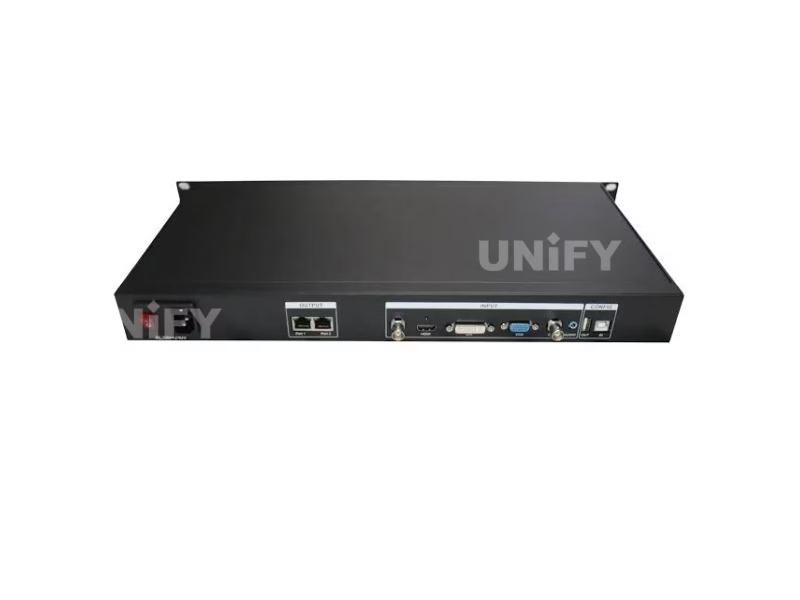
The synchronous class is where the three brands overlap most directly, and where the model-level comparison replaces the brand-level chatter:
The shared arithmetic is worth stating once: all three brands drive roughly 655,360 pixels per Gigabit port — Huidu’s official documents print it (V2.1 on the VP620, V3.0 on the A3), and the class conventions line up across the board. The practical differences are packaging (Huidu’s 3-in-1 processors fold the sending card in), ecosystem (each brand wants its own receiving cards) and price (Huidu undercuts at every rung). The official Huidu video below shows the sync mode working in the family.
Reading the table row by row: in the 1.3M class, the HD-VP210 at USD 115 is a 3-in-1 box — processor, sending card and USB player in one unit — where the X2 and MCTRL300 are sending-box class devices that assume a separate processing path. In the 2.3M class, the HD-VP410 brings four ports at USD 179–199, and in the 3.9M+ class the HD-VP620 adds 4K input while the HD-VP830 adds SDI, three windows and RS232 — features that sit at the premium tier in the other two lines. The class-by-class detail belongs to the next guide in this series, which takes the synchronous processors head to head.
Huidu Official — how synchronous mode works in Huidu LED player box
How Do Huidu, Colorlight and Novastar LED Control Systems Compare on Asynchronous Players?
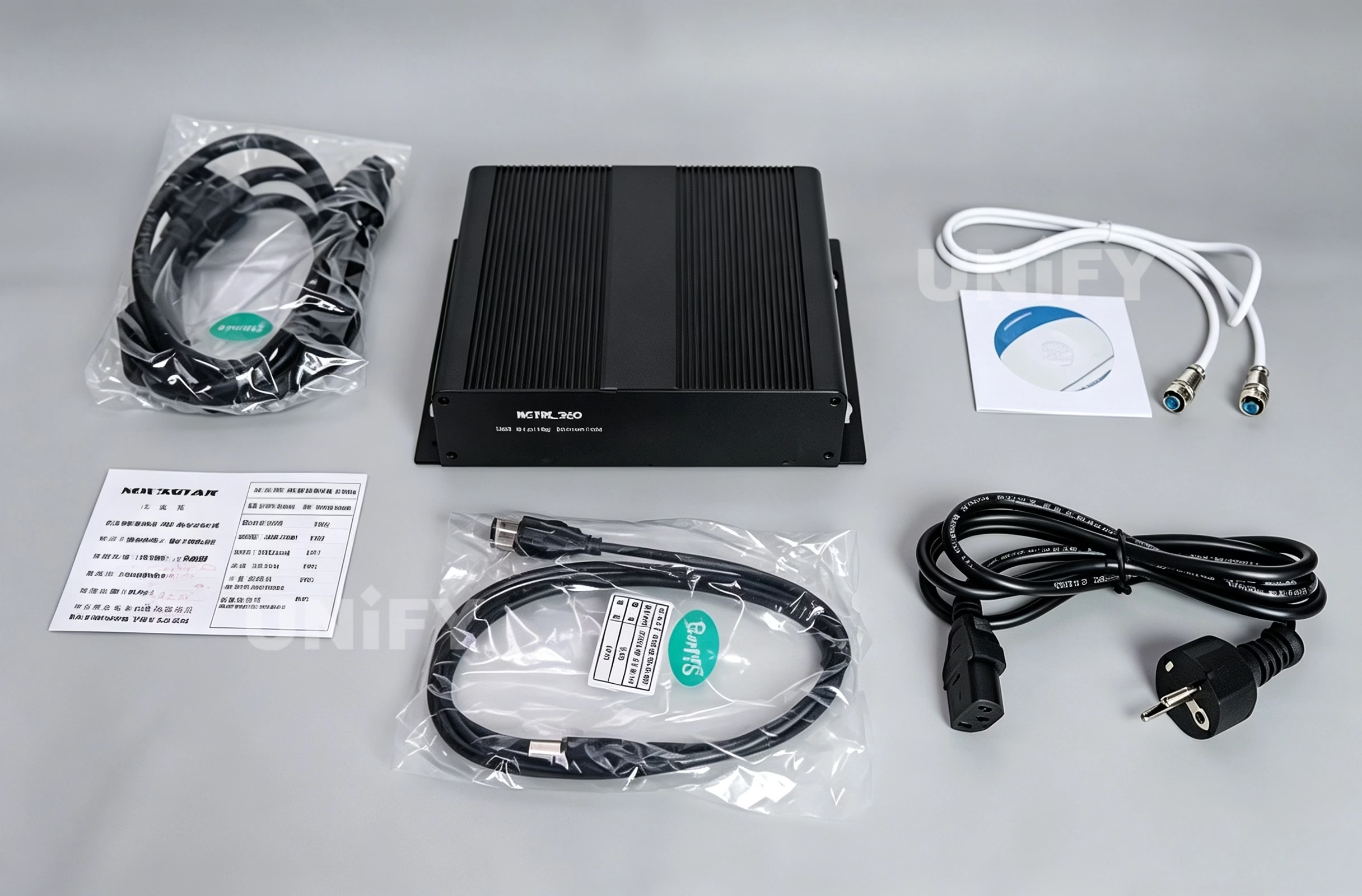
The async class is where the brands diverge sharply. Huidu built its name on it: the HD-A3 plays 655,360 pixels from storage with Wi-Fi and cloud management standard, the HD-A5 adds HDMI sync, and the HD-A6L tops out with splicing and casting. NovaStar answers with the Taurus players and the TB series — solid, but positioned as accessories to the sync ecosystem rather than as the core strength. Colorlight has no async player box of the same class. For pure scheduled content at the lowest cost, Huidu’s async line is the answer, and its one-card control cards (C16C/C36C) have no direct equivalent in the other two lines.
The async comparison also changes the operating model, not just the hardware. A Huidu async screen runs unattended: content updates over Wi-Fi or the cloud, the built-in relay switches power on a schedule, and a fleet of screens is managed from one dashboard. The NovaStar Taurus and TB players match parts of that story, but they are accessories to a sync-first ecosystem; Colorlight’s async coverage is thinner still. For an advertising network running fifty screens, the async-first architecture is not a feature — it is the business model, and that is the gap Huidu fills.
Huidu Official — configuration tutorial of HD-A3 and receiving card in HDPlayer
NovaStar Official — the Taurus multimedia player
Which LED Control System Brand Has the Best Receiving Cards: Huidu, Colorlight or Novastar?
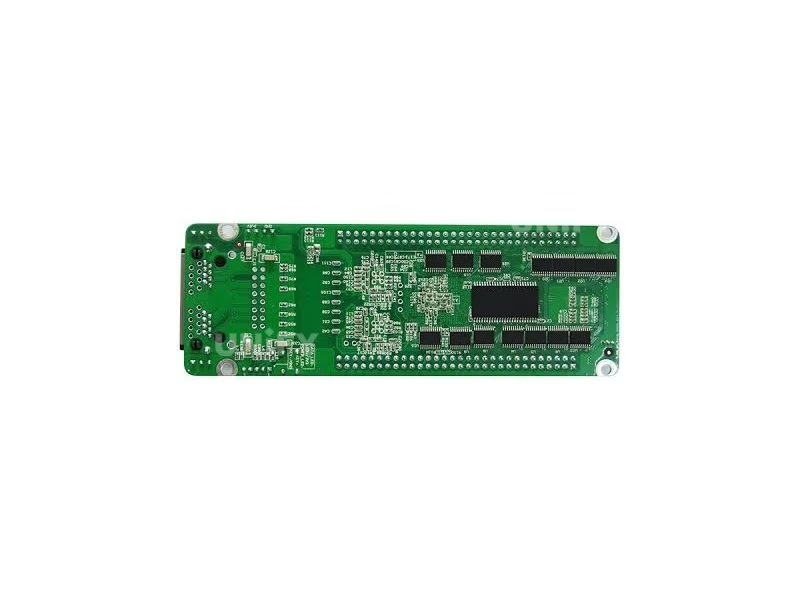
The receiving card is where the ecosystem decision gets real, because the card must match the sending side. Colorlight’s i5A-905, i5A-F, i9, i9+ and i6 family is documented page by page on this site; NovaStar’s A5s/A8s/DH-series range is covered by the Novastar receiving card guide; Huidu’s R-series pairs with its own controllers. The honest answer: all three lines are mature, and the best card is the one that matches the sending side you already chose — mixing brands is not an option.
What the receiving-card decision actually hinges on: loading per card (Colorlight’s i5A series and NovaStar’s A5s-class cards sit in the 512×512-pixel standard), grayscale depth (16-bit across the majors), refresh support and the HUB interface that matches the modules. Huidu’s R-series follows the same class conventions. The i9+ and i6 pages on this site give the per-card specs; the Novastar receiving card guide covers the A5s/A8s/DH range. Once the ecosystem is chosen, the card selection is a spec-matching exercise — which is exactly how it should be.
Colorlight Official — configure the LED display for Colorlight i5A-F LED card
What Do Huidu vs Colorlight vs Novastar LED Control Systems Cost?
Price is where the positioning becomes concrete. In the 1.3M synchronous class, Huidu’s HD-VP210 lists at USD 115, the Colorlight X2 and Novastar MCTRL300 price above it — the Novastar premium is typically 50–100% over the equivalent Huidu rung. In the async class the gap widens: Huidu’s C16C card at USD 67–130 replaces a sending card plus a receiving card plus Wi-Fi on one board, a configuration neither competitor matches at the price. The Colorlight price report and the upcoming Huidu price report on this site track the full ranges.
The price delta is not a quality judgment — it buys different things. The Novastar premium buys the benchmark reliability, the global support network and the feature depth that broadcast and stadium contracts demand; a dark screen on a live broadcast is not measured in dollars. The Colorlight middle ground buys the rental ecosystem — cards that handle constant assembly and disassembly — at a price between the two. The Huidu economy buys the async business model: screens that run themselves, at the lowest cost per screen in the industry. Match the premium to the consequence of failure, not to the brand name. The same logic applies at the receiving-card level: a card that costs 15–30 more per unit across a fifty-cabinet wall is a rounding error in the project budget, while a card that fails on a rented stage during an event is measured in contracts, not currency. Price the whole ecosystem, and let the failure consequence set the tier.
Colorlight Official — X100 Pro video processor
Can You Mix Hardware Across Huidu, Colorlight and Novastar LED Control Systems?
No — and this is the rule that saves projects. The three brands use different communication protocols between the sending side and the receiving cards; a Colorlight receiving card requires a Colorlight sending side, and the same applies to Huidu and Novastar. Third-party converters exist, but mixing brands is strongly discouraged because stability and support risk land on the integrator. The practical consequence: choose the ecosystem first, then every subsequent purchase — processor, receiving cards, spares — stays inside it. The official NovaStar Taurus video below shows one brand’s ecosystem working end to end.
Three field rules follow from the compatibility law. First, quote the receiving cards in the same email as the processor — a “compatible with all brands” receiving card claim is the first thing to verify, because the protocol is the lock. Second, order spares from the same brand as the installed fleet; a mixed spare shelf is a trap when the site calls at midnight. Third, when a project inherits an existing wall, identify the installed receiving cards before quoting the sending side — the brand of the cards already in the cabinets decides the brand of everything else.
NovaStar Official — Taurus multimedia player operation
How to Choose the Right Huidu vs Colorlight vs Novastar LED Control System: Final Verdict
The Huidu vs Colorlight vs Novastar LED control system decision, compressed:
Unify LED is an LED screen manufacturer in Changsha, China, supplying all three ecosystems at factory level — tell us the project type, the pixel budget and the receiving-card preference, and we will quote the right ecosystem with the right models. The next guide in this series takes the synchronous processors head to head across the three brands, model by model.
One closing reminder that ties the three-brand decision back to the architecture guide: the brand choice is the second decision, not the first. The first decision is still the architecture — async, dual-mode or sync — because the Huidu control system selection guide applies to every brand. Choose the architecture the project needs, then pick the brand whose ecosystem fits the budget and the consequence of failure, then confirm the receiving cards in the same order. The three-step order — architecture, brand, ecosystem — is the one that survives contact with a real quote.
Related: browse the full Huidu LED controller catalog — 12 models across four product lines, free HDSet / HDPlayer / HD Show software, cloud remote control without a subscription, and factory-direct pricing.