How Much Do Colorlight Controllers and Receiving Cards Cost in 2026?
Published: August 2026 | 12 min read | UnifyLED Engineering Team
The Colorlight controller price question is the one buyers ask first and answer last — because the numbers circulating online mix generations, channels and accessories into a single unverifiable blur. This guide publishes the price bands we verified in August 2026 listings across the ten products we document, states which models have no reliable public price, and shows the framework for budgeting a complete control chain rather than a single box.
Short answer: Colorlight receiving cards start around $10 (i5A-905) and $37 (i5A-F); sending controllers run roughly $145–$350 for the X2, $324–$380 for the X4, $612–$755 for the X8m, and $1,500–$1,700 for the X16; the Z6 family starts near $16,000 at the prior generation. Several current models — the i6, i9, i9+ and Z6 PRO-G2 — have no reliable public street price, and honest suppliers quote them factory-direct. Budget the accessories and cabling separately: they frequently match the controller cost on large walls.
- Quick fact — verified bands: $10–$18 receiving cards → $145–$350 entry controllers → $324–$755 mid-range → $1,500–$1,700 flagship → ~$16,000 super-controller family.
- Quick fact — factory-quote models: i6, i9, i9+ and Z6 PRO-G2 have no verified street price; we do not publish unverified numbers for them.
- Quick fact — what moves the price: generation, input-card configuration, purchase channel and batch size — not the marketing percentage.
- Quick fact — market context: the control-system market reached US$659 million in 2025, growing at 13.6% CAGR (QYResearch).
What Drives Colorlight Controller Prices in 2026?
Colorlight controller pricing follows four drivers, and knowing them explains most of the spread between two quotes for the same model. First, generation: when two generations share a name — the i9 and i9+, the Z6 Pro and Z6 PRO-G2 — the older platform trades at older-platform prices, and listings that fail to state the generation are pricing blind. Second, input-card configuration: on the Z6 PRO-G2’s four card slots, the mix of HDMI 2.0, DP 1.2 and 12G-SDI cards changes the unit price materially — a quote without the card mix is a guess. Third, channel: sample, project and volume tiers carry different margins, and batch pricing moves at 50- and 500-card thresholds on receiving cards. Fourth, accessories: fiber transceivers, multifunction cards and cabling are separate line items that frequently match the controller cost on large walls.
The market context that keeps these drivers stable: the LED display control system market reached US$659 million in 2025, projected at 13.6% CAGR to US$1.59 billion by 2032 (QYResearch, Global LED Display Control System Market Report). Receiving and sending cards are the two largest segments, which is why per-card pricing compounds across a wall’s card count — the category scales by volume, not by scarcity. For the control-chain fundamentals behind the hardware, see LED video processor.
Colorlight’s official company introduction:
Colorlight Official — Colorlight Introduction Video
How Much Do Entry Colorlight Controllers Cost?
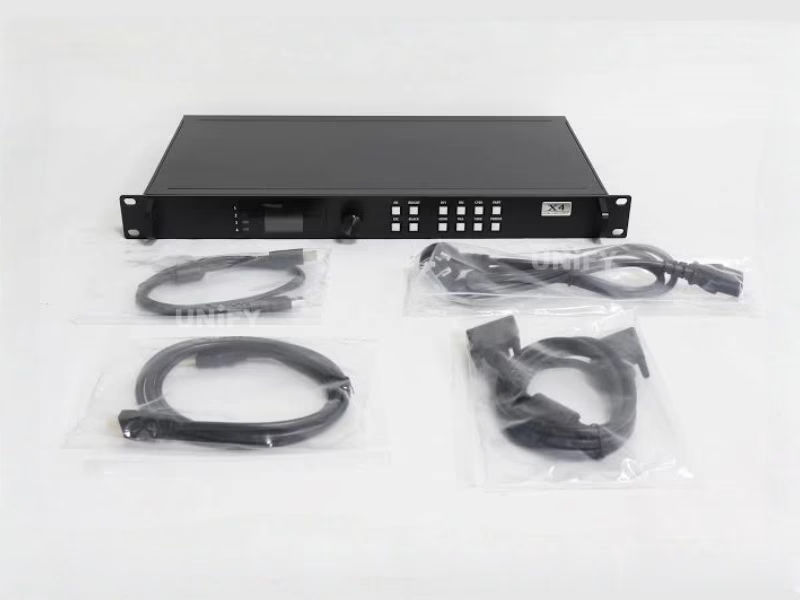
The entry tier starts with the Colorlight X2 LED Video Controller, and the verified band in our August 2026 listing research is $145–$350 — the spread is channel margin and volume tier, not hardware differences. The same controller sits at both ends of that range. The X2’s official profile — 1.3 million pixels, 2 Gigabit Ethernet outputs, five inputs — makes it the standard shopfront and small-wall unit, and the tier’s price reflects that volume position. Other listings put the X1 class around $105–$122; the X2’s additional inputs and pixel capacity justify the step. For the full X2 specification, the product page has the official manual figures.
The entry-tier buying logic follows the tier’s economics: at this price point the channel matters more than the dollar difference. A $145 quote without a test report and a stated manual revision is not the same product as a $350 quote with both — and on a 20-unit rollout the delta between a verified channel and an unverified listing exceeds the entire hardware saving. The entry tier is where the verification habit pays first.
How Much Do Mid-Range Colorlight Controllers Cost?
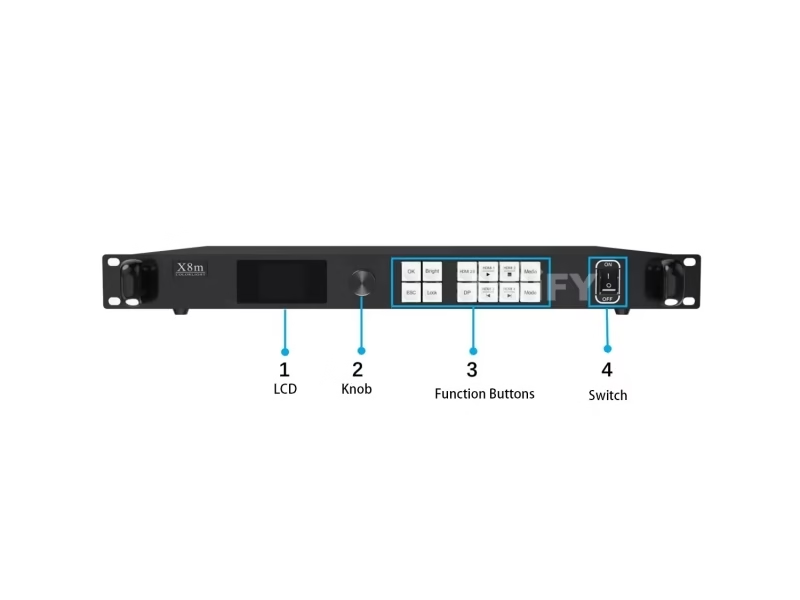
The mid-range splits into two verified bands. The Colorlight X4 LED Video Controller traded at $324–$380 — the 2.3M-pixel, 4-port unit that drives a complete 1080p wall from one box. The Colorlight X8m LED Video Processor traded at $612–$755 — the 5.24M-pixel, 8-port tier with 4K60 inputs, six windows and Genlock, where the processor features start. Between the two, the X6 class appears in other listings around $610, and the X12m around $893 — reference points that confirm the X8m’s band sits correctly in the line. Each product page documents the official specification behind the number.
The mid-range is where the price question gets precise, because the two bands separate cleanly by capability. The X4’s $324–$380 band buys the smallest unit that runs a full 1080p wall alone; the X8m’s $612–$755 band buys the 4K60 inputs, six windows and Genlock the processor tier adds. Between the two, the X6 class appears in other listings around $610, and the X12m around $893 — reference points that confirm the X8m’s band sits correctly in the line. Each product page documents the official specification behind the number.
Colorlight’s official processor-series overview:
Colorlight Official — ISLE 2025 Professional Processor Series video
How Much Do Flagship Colorlight Controllers Cost?
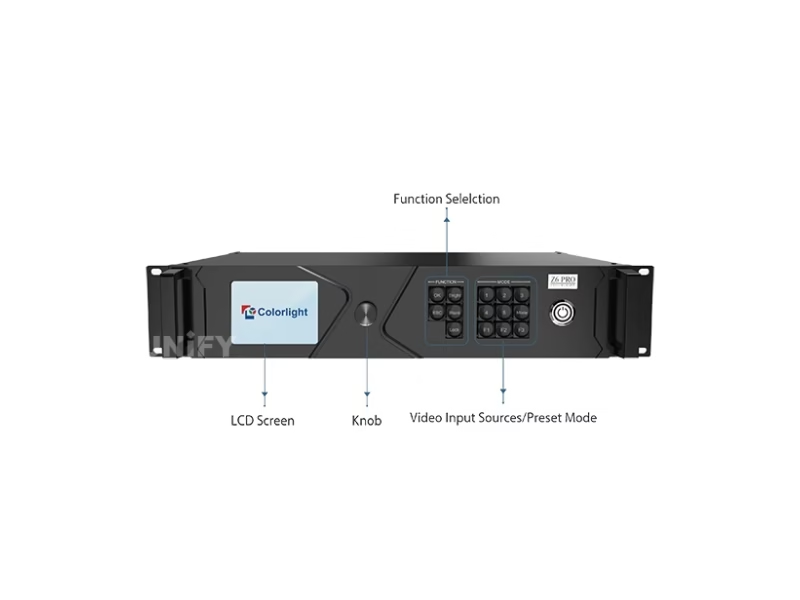
The flagship tier starts with the Colorlight X16 LED Video Controller at a verified $1,500–$1,700 — the 8.88M-pixel, 16-port unit with Genlock and HDCP 2.2. Above it, the Z6 family begins near $16,000 at the prior Z6 Pro generation, which remains the useful reference for the family’s positioning. The current Z6 PRO-G2 has no reliable public street price in the listings we reviewed — with its four 4K input card slots, the card mix defines the price, and honest suppliers quote it factory-direct with the configuration stated. Other flagship references circulating online: VX10 around $1,654, Z5 around $3,399, X40m around $3,500, VX20 around $4,869 — numbers from listings we did not verify against official documents, listed here only as market context.
Colorlight’s official VX10 introduction:
Colorlight Official — Introduction of Professional Processor VX10 EP01 video
Colorlight’s official VX20 introduction:
Colorlight Official — Introduction of VX 20 Professional LED Video Processor video
How Much Do Colorlight Receiving Cards Cost?
The receiving card side has two verified bands and three honest blanks. The i5A-905 traded at $10–$18 — the volume line of the category. The i5A-F traded at $37–$55, reflecting the dual-mode 2Gbit memory and built-in sensors. The i6, i9 and i9+ have no reliable public prices in our August 2026 review — the same listing pollution that mislabels their specs also poisons their prices, and we do not publish numbers we cannot verify. Those three are factory-quote items, and the quote should state the generation and the specification revision. Older 5A-series cards appear in listings at $20–$45, which sets the market floor context.
The per-cabinet math is the receiving card’s real price story: a 100-cabinet wall carries hundreds of cards, so a two-dollar per-card delta compounds into hundreds of dollars, and the batch thresholds turn that delta into a negotiation. The card count, not the unit price, is the number to bring to a quote — and the multifunction-card saving on cards that build the sensors in (the i5A-F) belongs in the same arithmetic.
Colorlight’s official high-end receiving card showcase:
Colorlight Official — ISLE 2026 High-End Receiving Cards video
What Hidden Costs Should You Budget With a Colorlight Controller?
Three hidden costs change the real budget. Accessories first: fiber transceivers ($80–$150 per pair), multifunction cards ($40–$80) and CAT6 cabling ($10–$25 per port) are separate line items that frequently match the controller cost on large walls — on a 20-cabinet wall, receiving cards alone are a four-figure line. Power second, using the official figures: 20W for the X2/X4 class, 52W for the X8m, 150W for the Z6 PRO-G2 with all cards installed — small per-unit, meaningful across a rack running 24/7. A 20W controller running around the clock costs a few dollars a year in electricity; a rack of 150W super-controllers in an always-on control room is a line item worth writing down. Third, the correction-driven costs: a freight quote built on the 0.5kg phantom weight of the i5A-905 over-orders shipping seven-fold, and a mislabeled generation means paying newer-platform prices for older hardware. The countermeasure for all three is the same verification habit the product pages document — see the receiving card selection guide for the checklist.
How Do You Buy a Colorlight Controller at the Best Price?
The best-price playbook has four steps. Quote by count and configuration: the quote must state the model, the generation (i9 vs i9+), the input-card mix on card-slot models, and the quantity tier — sample (1–49), project (50–499) or volume (500+), with batch pricing moving most on receiving cards. Skip the marketing percentage: the “Colorlight is 20–35% cheaper” figure circulating in comparison articles is unverified — budget with the dated bands above, not the percentage. Bundle the chain: controllers, receiving cards and cabling quoted together close the gap between a box price and a system price. And verify the revision: a quote that cannot name the specification revision it is based on is quoting a listing, not a product — the rule applies to prices exactly as it applies to specs.
The three-tier structure works because the quantity changes the unit economics, not the product: a sample-tier card with a test report, a project-tier batch with pre-loaded parameters and engineering support, and a volume-tier contract with annual frame pricing are the same hardware at three different prices — the difference is what travels with it. On receiving cards the thresholds bite at 50 and 500 units; on controllers the project tier carries commissioning support that a parts-only channel cannot match. The best price is rarely the lowest unit price; it is the lowest total cost of a commissioned, verified chain.
For the ecosystem decision behind the purchase, see Colorlight vs Novastar; for the model selection, the receiving card selection guide and the X series guide cover both sides of the chain.
What Questions Do Buyers Ask About Colorlight Controller Prices?
Conclusion: How Much Should You Budget for a Colorlight Control System?
Budget the Colorlight control chain by tier, not by brand feeling: $10–$55 per receiving card depending on the model, $145–$350 for an entry controller, $324–$755 for the mid-range, $1,500–$1,700 for the flagship, and the Z6 family in five figures — then add accessories, cabling and the batch discount your quantity earns. Where no verified price exists, treat the factory quote as the price and the specification revision as the receipt. Buy the chain from a verified LED screen manufacturer that quotes by count and configuration — and the price question stops being the first one you ask, because the number finally came with the product attached to it.