
Huidu C-Series · Full Color Async Card · 524,288 Pixels · Relay Power Control
Huidu HD-C36C LED Control CARD
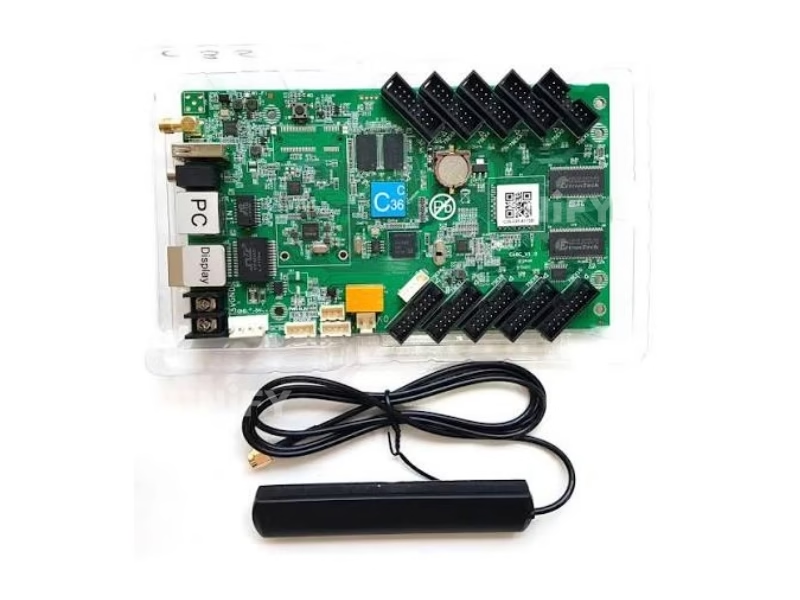
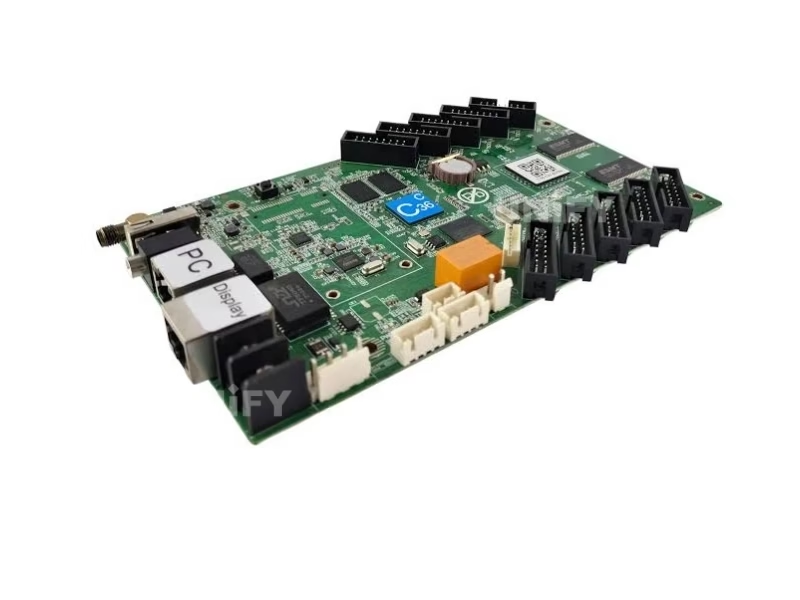
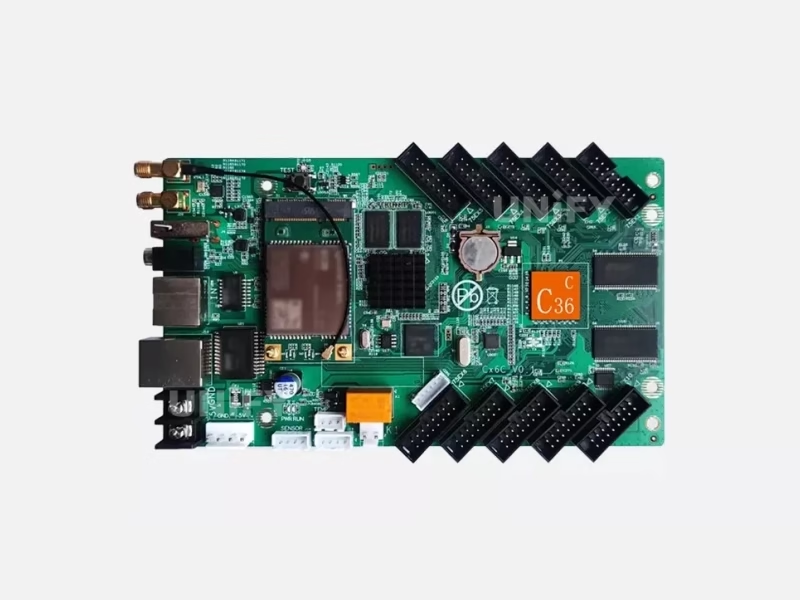
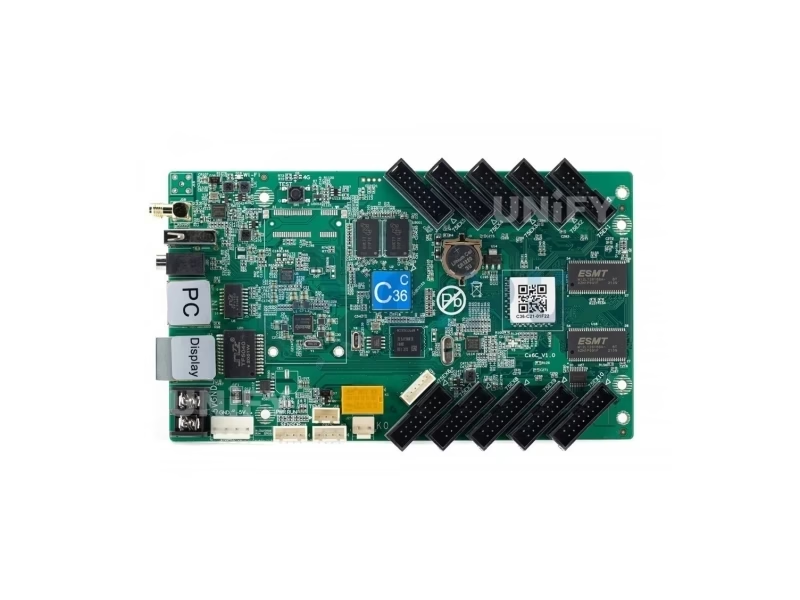
The Huidu HD-C36C LED Control CARD is a full-color asynchronous control card that integrates sending-card, receiving-card and Wi-Fi functions on one PCB — 524,288 pixels across ten HUB75E interfaces, 4 GB storage, a built-in relay for remote power control, and the same one-card architecture as its sibling, the HD-C16C, at two and a half times the loading.
Product Overview
What Is the Huidu HD-C36C LED Control CARD?
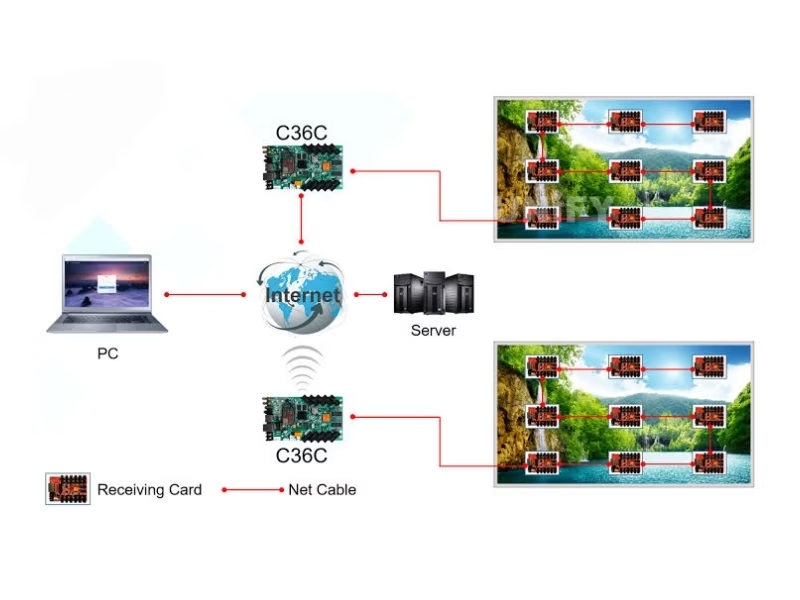
The HD-C36C is a full-color asynchronous LED control card that integrates sending-card, receiving-card and Wi-Fi functions on a single PCB, per Huidu Specification V0.1 (20210408). It drives up to 524,288 pixels (1024×512, widest 8192), carries ten HUB75E interfaces so it drives a small or medium screen as its own receiving card, and manages content through the HDPlayer software, the PingZhangKong mobile app and Huidu’s cloud platform — the same one-card architecture as the HD-C16C, at two and a half times the loading.
Short answer: The Huidu HD-C36C is a one-card control system for small and medium full-color LED screens: sending card + receiving card + Wi-Fi on one PCB, 524,288 pixels (1024×512, widest 8192), ten HUB75E interfaces, 4 GB storage with U-disk expansion, a built-in relay for remote power control, the PingZhangKong app and cloud platform, 17-format video decoding at 60 Hz, 8 W draw, conformal-coated PCB, CE/FCC/RoHS — priced at USD 95.
The C36C is the middle rung of Huidu’s full-color card ladder: the HD-C16C at 204,800 pixels for small screens, the HD-C36C at 524,288 for small-and-medium screens, and the newer C16L generation above. Beside the cards, the HD-A3 player boxes cover the external-box form factor, and the HD-W62 cards cover single-dual color. Unify LED is an LED screen manufacturer supplying Huidu control systems at factory level — this page uses the official HD-C36C Specification V0.1 as its data source.
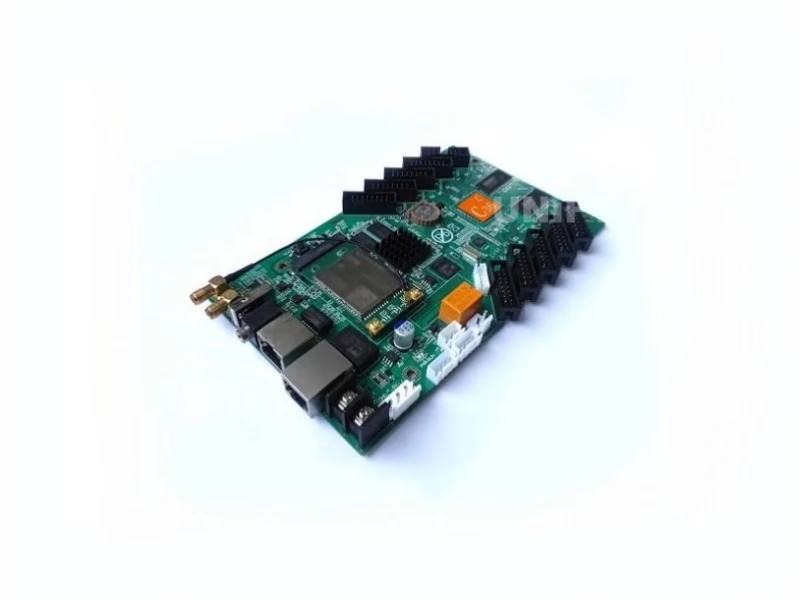
Huidu Official — C16C and C36C Wi-Fi LED controller new products
Specifications
What Are the HD-C36C LED Control CARD Specifications?
Specifications from the official Huidu HD-C36C Specification V0.1 (20210408).
Core Specifications (Official V0.1)
Software: HDPlayer (Windows), PingZhangKong mobile app, Huidu cloud platform (clouds.huidu.cn). Official downloads mirrored on our Huidu system software downloads page.
Data Note — Exclusive
Why Is the HD-C36C Spec Cleaner Than the C16C’s?
On the HD-C16C page, we documented the first “official vs official” conflict on this site: the C16C’s V0.1 datasheet lists 120,000 pixels while the current Huidu page lists 204,800 — a firmware evolution. The C36C has no such conflict:
The reading is straightforward: the C36C shipped at its full loading from the start — 1024 × 512 = 524,288, and 8192 × 64 = 524,288 exactly — so there was no later upgrade to create the version split the C16C experienced. The two remaining listing variations are minor: a few sellers quote the working temperature as -30°C to +70°C (official V0.1: -20°C to +80°C) and a weight of 0.3 kg (official ~0.12 kg). Official V0.1 wins both.
One market note that does deserve attention: at least one listing marks the C36C as discontinued. Huidu’s official sources make no such note, and the C-series has grown newer generations (C16L and beyond) — treat the status as “current per official sources, confirm availability at order” and ask us for the live position before quoting a large order.
Comparison
Which Full Color Control Card Do You Need: HD-C36C or HD-C16C?
The two cards share one architecture; the difference is the loading budget:
Table A — The Full-Color Card Ladder (Official Specs)
Table B — Card vs Box vs Single-Dual (same site map)
Selection guide: up to 204,800 pixels — the HD-C16C; up to 524,288 pixels or an 8192-wide lintel — the HD-C36C; beyond that or an external box — the HD-A3 family. The step from C16C to C36C costs roughly USD 10–30 in the market range and buys 2.56× the pixels — the cheapest loading upgrade in the Huidu line.
Core Features
What Does the HD-C36C LED Control CARD Do?
Six capabilities from the official V0.1 define how the C36C behaves in the field:
🧩 One card, three roles
Sending card + receiving card + Wi-Fi on one PCB — a small or medium screen runs from one card, no separate receiver, no Wi-Fi module.
📏 524,288 pixels, 8192 wide
Two and a half times the C16C: a 4.10 m × 2.05 m P4 screen, or an 8192-wide ultra-long lintel at 64 pixels high.
🔌 Ten HUB75E interfaces
Ten universal 2×8 interfaces drive modules directly as a receiving card — the single-card solution for medium screens.
⚡ Remote power control
A relay group is standard: switch the screen’s power on and off remotely — no timer hardware, remote power-down saves energy.
📱 PingZhangKong + cloud
The mobile app manages content over Wi-Fi; Huidu’s cloud platform adds Web-based fleet management over the internet.
🛡️ Conformal-coated PCB
Three-proof coating protects against dust and condensation — designed to live inside the cabinet; keep it out of direct rain.
Interface
Which Ports Are on the HD-C36C LED Control CARD?
Board interfaces from the official V0.1:
- 5 V DC power — single low-voltage feed, 8 W draw.
- 100 Mbps RJ45 input — program updates and LAN/cloud access.
- USB 2.0 — U-disk updates and storage expansion.
- Test button — module test patterns.
- Sensor port — temperature, humidity, brightness.
- GPS port — location services (optional).
- 1 Gbps RJ45 output — cascade to HD-R receiving cards for larger screens.
- Stereo audio output — 3.5 mm standard.
- 10× HUB75E — module interfaces; the card works as its own receiving card.
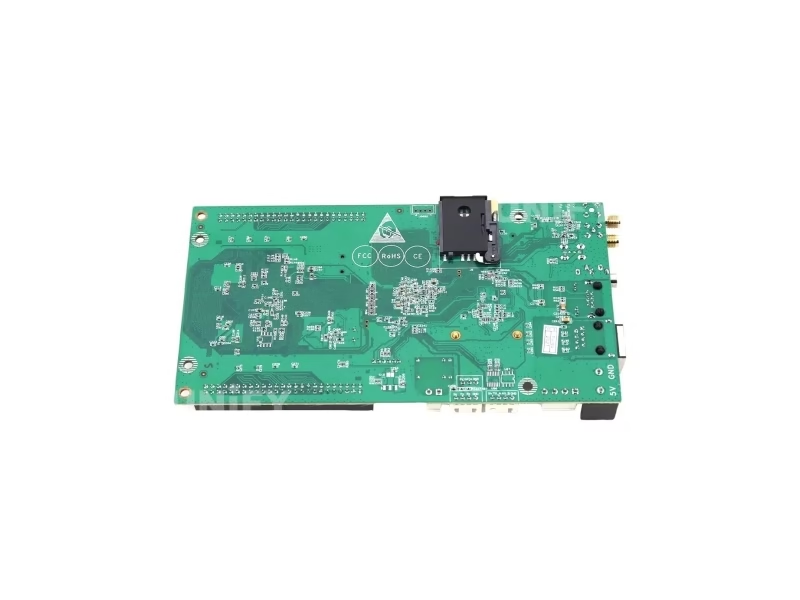
- Relay terminals — remote power control wiring.
Mounting note: like the C16C, the C36C has no enclosure — the conformal-coated PCB lives inside the LED cabinet, protected from direct rain, dust and condensation.
Loading Capacity
How Big a Screen Can the HD-C36C Control Card Drive?
The official budget is 524,288 pixels in a 1024×512 configuration, widest 8192, highest 1024. The width limit divides exactly: 8192 × 64 = 524,288. Translated into real screens (UnifyLED conversion):
The extreme shape is the C36C’s signature: an 8192-pixel ultra-long lintel — at P4, 32.77 m wide × 0.26 m tall, driven by one card. That is the configuration the official ultra-long lintel case demonstrates, and it is the reason integrators step past the C16C (whose 8192-wide budget leaves only 64 pixels of headroom at 204,800 ÷ 8192 = 25 high).
The per-port arithmetic, one more time: the 1 Gbps output port carries the receiving-card chain at the 655,360-pixel-per-port ceiling documented across this site — the C36C’s 524,288 loading is what the ten HUB75E interfaces handle directly. Larger canvases step to the HD-A3 player box.
Screen power planning belongs to our LED display power consumption guide.
Setup Tutorial
How Do You Set Up the Huidu HD-C36C Control Card?
Channel A — HDPlayer. Install HDPlayer on a Windows PC; the C36C auto-detects by ID — no complex network setup, plug-and-play. The official 2:14 tutorial below walks the C36C software workflow.
Huidu Official — HDPlayer software for the LED screen controller C36C
Channel B — U-disk. Export the program batch to a USB drive and insert it — the path for sites with no network.
Channel C — PingZhangKong app. The Wi-Fi module is standard; pair the card with the mobile app to change content from the floor.
Channel D — relay power control. Wire the relay terminals into the screen power path; then switch the screen on and off remotely from the app or the cloud — no timer hardware, and a remote power-down on a 24/7 screen is an instant energy saving.
Full mounting and network context: our LED screen installation guide, plus the playlists and schedules guide for the program side.
Applications
Where Is the HD-C36C Control Card Used?
The C36C serves the small-and-medium full-color screens that live inside cabinets — and the lintel class where the 8192 width limit pays off:
- Door lintel screens — the classic C36C install; the official 0:15 case shows a standard lintel, and the 0:20 ultra-long case shows the 8192-wide budget in action.
- Small and medium commercial screens — the official 0:33 case covers the class from poster displays to mid-size signage.
- Storefront and window displays — one card, one cabinet, Wi-Fi content updates from the app.
- Multi-store synchronization — the RF module keeps several C36C screens on the same program across stores.
- Remote-managed signage fleets — relay power control plus cloud management turns a fleet of screens into one dashboard.
Huidu Official — ultra long door lintel screen controller HD-C36C case
Huidu Official — HD-C36C used for door lintel screen
Huidu Official — C36C use for small and medium LED screen
Factory & Quality Control
How Is the HD-C36C Control Card Supplied and Guaranteed?
Unify LED buys Huidu control systems at factory level, tests each unit before dispatch and backs them with a 2-year warranty:
- Factory-direct pricing — no distributor markup; bulk discounts from 10 pcs.
- 100% functional test before dispatch — every card powered and run against a test panel before packing.
- Availability confirmed at order — we confirm the live model status against the current Huidu line before quoting large orders.
- 2-year warranty — free replacement for manufacturing defects; field care in our LED screen maintenance guide.
Pricing
How Much Does the Huidu HD-C36C Control Card Cost?
Published prices verified 2026-08-26:
The upgrade economics: at USD 95, the C36C costs roughly USD 10–30 more than the HD-C16C (USD 67–130) for 2.56× the pixels — the cheapest loading upgrade in the Huidu line. Like the C16C, it replaces a sending card plus a receiving card plus a Wi-Fi module plus a timer/relay on a medium screen. Our 2026 LED display price report tracks the wider market.
Factory-direct pricing from Unify LED applies from single units; request a quote for your quantity and destination.
FAQ
HD-C36C LED Control CARD: Frequently Asked Questions
Q1. What is the HD-C36C? A full-color asynchronous control card that integrates sending card, receiving card and Wi-Fi on one PCB: 524,288 pixels, ten HUB75E interfaces, 4 GB storage, relay power control, the PingZhangKong app and Huidu’s cloud platform.
Q2. How many pixels can the HD-C36C drive? 524,288 (1024×512), widest 8192, highest 1024 — per the official V0.1. The width limit divides exactly: 8192 × 64 = 524,288.
Q3. What is the difference between HD-C36C and HD-C16C? Loading: 524,288 vs 204,800 pixels (2.56×). The architecture is identical — ten HUB75E interfaces, relay, Wi-Fi, 4 GB, 8 W. The C36C also leaves more headroom for 8192-wide lintel screens.
Q4. Can the HD-C36C drive ultra-long lintel screens? Yes — the 8192-pixel width limit at 64 pixels high is exactly 524,288, and the official ultra-long lintel case demonstrates it. At P4 that is a 32.77 m × 0.26 m banner from one card.
Q5. How do I control the power remotely? Wire the built-in relay into the screen power path, then switch power on and off from the PingZhangKong app or the cloud — no timer hardware, and remote power-down saves energy on 24/7 screens.
Q6. Is the HD-C36C discontinued? Official Huidu sources make no such note; one marketplace listing does. The C-series has grown newer generations — treat the status as “current per official sources, confirm at order” and ask us for the live position before quoting a large order.
More control-card questions: our async playback troubleshooting guide and LED display FAQ.
Certifications
Which Certificates Does the HD-C36C Control Card Carry?
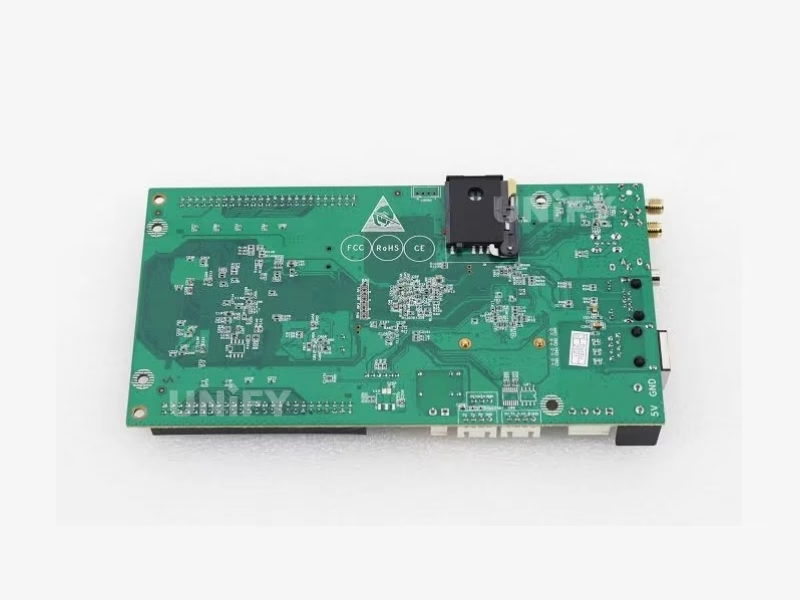
The C36C carries CE, FCC and RoHS per Huidu’s documentation; copies ship with every order. Warranty terms in our warranty guide.
Get HD-C36C Bulk Pricing from the Factory
Genuine Huidu control cards, 100% pre-tested, 2-year warranty, shipped worldwide. Tell us your pixel budget, screen count and destination — quote within 24 hours.
Deep Blog
Huidu HD-C36C LED Control CARD: The Complete Buying Guide (2026)
The Huidu HD-C36C LED Control CARD is the middle rung of Huidu’s full-color card ladder — and the cleanest spec sheet in the family: its V0.1 datasheet lists 524,288 pixels and every marketplace agrees, which is exactly the opposite of the sibling HD-C16C, whose datasheet and current page disagree. This guide rebuilds the C36C from the official V0.1 document, explains the one-card architecture and the 8192-wide lintel capability, walks the C16C-to-C36C upgrade decision, and positions it against the player-box and single-dual-card lines on this site.
Chapter 1 — The Full-Color Card Ladder
Huidu’s full-color card line climbs three rungs: the HD-C16C at 204,800 pixels for small screens, the HD-C36C at 524,288 for small-and-medium screens, and the newer C16L generation above. The ladder is a pure loading decision, because the architecture is identical across the rungs: sending card plus receiving card plus Wi-Fi on one PCB, ten HUB75E interfaces, 4 GB storage, relay power control, 8 W draw. The C36C is the rung most lintel and storefront projects land on — it covers the 1024×512 class outright, and its 8192-pixel width limit is what makes ultra-long lintels a one-card job.
The C36C also marks the point where Huidu’s card line and box line start to overlap: a 524,288-pixel canvas fits either a C36C card inside the cabinet or an HD-A3 box outside it. The card wins on part count and cabinet cleanliness; the box wins on serviceability and the path to HDMI sync. The async player guide walks the mounting trade-off; this page covers the card side.
Chapter 2 — The Clean Spec Story: Why the C36C Has No Version Split
On the HD-C16C page we documented the first “official vs official” conflict on this site: the C16C’s V0.1 datasheet lists 120,000 pixels while the current Huidu page lists 204,800 — a firmware evolution that still confuses listings. The C36C has none of that: the V0.1 datasheet lists 524,288 (1024×512) and marketplace listings agree. The arithmetic is exact in both readings: 1024 × 512 = 524,288, and 8192 × 64 = 524,288. The C36C simply shipped at its full loading from the start, so there was no later upgrade to split the record. The only variations that survive are minor — a -30°C to +70°C temperature reading on some listings (official V0.1: -20°C to +80°C) and a 0.3 kg weight (official ~0.12 kg). Official V0.1 wins both.
The lesson the two cards teach together is worth carrying into every Huidu quote: when a datasheet and the live product page agree, the spec is the product; when they disagree, the version history explains it. The C16C’s split was a firmware evolution, the C36C’s consistency was a launch at full spec — and both are documented on this site, so a buyer checking either page gets the same discipline: read the current official page, treat the datasheet as the baseline, confirm the live figure at order time.
Chapter 3 — 524,288 Pixels: The Arithmetic and the Screens
The C36C’s numbers are the same per-port arithmetic that anchors every Huidu document on this site. The 1 Gbps output port carries the receiving-card chain at the 655,360-pixel-per-port ceiling; the C36C’s own 524,288 loading is what the ten HUB75E interfaces handle directly. In meters: 4.10 m × 2.05 m at P4, 5.12 m × 2.56 m at P5, 8.19 m × 4.10 m at P8, or 10.24 m × 5.12 m at P10. The extreme shape is the signature: 8192 pixels of width at 64 high — at P4 that is a 32.77 m ultra-long lintel driven by one card, the configuration the official ultra-long lintel case demonstrates.
The storage planning follows the same discipline as the C16C: 4 GB onboard holds roughly four hours of HD video per gigabyte, and the U-disk port extends it as far as the drive goes. A lintel running full-width promotions with occasional full-video loops fits comfortably in 4 GB; image-heavy campaigns plug in a U-disk as part of the storage budget. The 8 W draw means the control side of the screen costs less than a single LED module to run — the same number at twice the loading of the C16C.
Chapter 4 — One Card, Three Roles: Same Architecture, More Loading
The C36C collapses three devices onto one PCB exactly as the C16C does. As a sending card, it stores programs in 4 GB of flash and pushes content to HD-R receiving cards over the 1 Gbps output. As a receiving card, its ten HUB75E interfaces drive modules directly. As a Wi-Fi module, it is standard, with the PingZhangKong app. The one-card economics scale with the screen: a medium lintel install replaces a sending card, a receiving card, a Wi-Fi module and a timer/relay — and the relay removes the timer device most installs bolt on anyway. The 8 W draw means the control side costs less than a single LED module to run.
Chapter 5 — The Lintel Class: Where the 8192 Limit Pays Off
The C36C’s practical home is the lintel class — door-top banners, storefront fascias and the ultra-long screens that run full-width promotions. The 8192-pixel width limit at 64 high is exactly 524,288, so an ultra-long lintel uses the card’s full budget with zero waste; the C16C, at 204,800, can only drive 25 pixels of height at that width, which is too thin for most content. The official case videos show both the standard and the ultra-long lintel installs. For width-hungry projects, the width limit — not the pixel count — is the binding constraint, and the C36C is the rung that clears it.
Two lintel field notes from installers. First, the height budget at 8192 wide is exactly 64 pixels — a full-width lintel is a single-row-plus design, so content should be built for a thin banner (text, logo strips and tickers), not full video. Second, the HUB75E wiring on a 8192-wide screen spreads the canvas across the ten interfaces in columns; keep the ribbon assignments matched to the cabinet layout and the smart-setting wizard handles the rest. The test button cycles the module test patterns before any content is sent — run it first, the way the C16C guide recommends.
Huidu Official — C36C application case
Chapter 6 — The Upgrade Decision: C16C or C36C?
The step from the HD-C16C to the C36C is the cheapest loading upgrade in the Huidu line: roughly USD 10–30 in the market range for 2.56× the pixels. Three conditions justify it: the screen plan crosses 204,800 pixels; the project is an 8192-wide lintel where the C16C leaves only 25 pixels of height; or the integrator wants the same one-card architecture with headroom for future content. Below 204,800 pixels with no lintel ambitions, the C16C saves the money. Above 524,288, the HD-A3 player box or the C16L generation takes over.
The RF sync option applies to the C36C exactly as it does to the C16C: a fleet of lintel screens across stores runs one campaign from a master, with no network at each site. For a retail chain standardizing on the C36C, the RF module plus the cloud platform gives two independent fleet paths — RF for same-network sync, cloud for internet management — and the relay closes the loop by powering the fleet down overnight. The same one-card economics multiply across the fleet: every additional lintel adds one card and nothing else.
Chapter 7 — The Market Note: Discontinued or Not?
One marketplace listing marks the C36C as discontinued; Huidu’s official sources make no such note. The practical reading for a buyer: even in the worst case — the C36C aging out of the line — the same one-card architecture survives in the C16L generation, and the 10× HUB75E wiring, the HDPlayer workflow and the PingZhangKong app carry over unchanged. The card you standardize on today is not a dead end even if the model number rotates. The honest reading: the C-series has grown newer generations (C16L and beyond), and sellers sometimes mark older SKUs as discontinued when the newer line launches — without the manufacturer confirming it. The buying discipline is the same as every Huidu product on this site: confirm availability against the current official line at order time, and ask for the live position before quoting a large order. Unify LED confirms the model status with the factory at every quote.
One more buying note specific to the C-series: the older C36 (without the C suffix) uses a 2-wire 50-pin HUB interface, while the C36C uses the ten-wire HUB75E universal interface — listings that mix the two describe different boards. When a spec sheet says “C36C,” check the HUB interface matches HUB75E; that single detail decides whether the card plugs into the modules you already have.
Chapter 8 — Price, Warranty and the Buying Checklist
Verified August 2026 pricing: USD 95 at jekazled.com, factory-direct on request. Unify LED is an LED screen manufacturer in Changsha, China, supplying control systems alongside modules, cabinets and power supplies as one assembly — the C36C ships tested against the modules it is specified for, with a 2-year warranty and the CE/FCC/RoHS copies on request.
Final checklist for the procurement email: (1) state the pixel budget and shape — 524,288 at 1024×512 with the 8192-wide limit decides the C36C vs the C16C or the A3 tier; (2) confirm the model is current with the factory before large orders; (3) state the module type and interface so the HUB75E wiring is planned; (4) confirm whether the relay power control will be used and the power-path wiring; (5) list any sensors (temperature, humidity, brightness) and the GPS option; (6) state the screen count — fleets order the RF sync module for multi-store campaigns; (7) order one spare per ten installed — the card is the cheapest component in the chain and the spare beats the site visit.
The spare logic is the same as the C16C but the fleet is usually bigger: a chain of lintel screens loses one display per failed card, and at USD 95 the spare is cheaper than the service call to diagnose it. Because every C36C in a fleet runs the same configuration surface, one spare stands in for any screen in the network — ten minutes of swap, zero missed programming. For a chain running fifty lintels, two spares and a bench test on arrival is the standard operating procedure we recommend.
Conclusion. The Huidu HD-C36C LED Control CARD is the middle rung of Huidu’s full-color card ladder — and the cleanest spec sheet in the family: 524,288 pixels (1024×512, widest 8192) with no version split, ten HUB75E interfaces that make it its own receiving card, 4 GB storage, relay power control, Wi-Fi and cloud management, 8 W draw and a conformal-coated PCB built for the cabinet. It is the C16C’s architecture with 2.56× the loading, at the cheapest upgrade price in the Huidu line — the card for the lintel class and the medium screen. Confirm availability at order, wire the relay for the energy win, plan the 8192-wide content as a thin banner, and the C36C runs the lintel fleet on one card per screen.
LED Control System Range
Which LED Controllers Should You Explore Next?
Huidu, Colorlight and Novastar control products, receiving card guides and free software resources on UnifyLED.
Novastar Media Players
Guides & Resources
Where Can You Download HD-C36C Resources?
The official Huidu HD-C36C Specification V0.1 (Chinese) — the data source for every figure on this page.
Related: browse the full Huidu LED controller catalog — 12 models across four product lines, free HDSet / HDPlayer / HD Show software, cloud remote control without a subscription, and factory-direct pricing.