
NovaStar MCTRL Flagship
Novastar MCTRL4K LED Display Controller
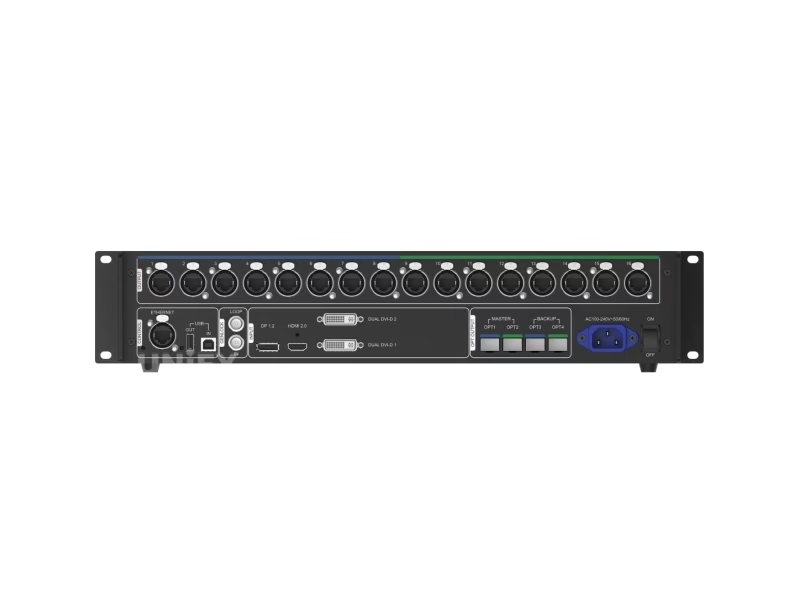
NovaStar’s flagship 4K independent controller — 8.8 million pixel capacity, true 4096×2160@60Hz resolution, 16 Gigabit Ethernet ports, 4 optical fiber outputs, DP 1.2 + HDMI 2.0 + dual DVI inputs, HDR10-Optima & HLG support, 3D display, GENLOCK with adjustable offset, Mosaic/Multi-Card dual-mode architecture. Engineered for the world’s largest LED installations.
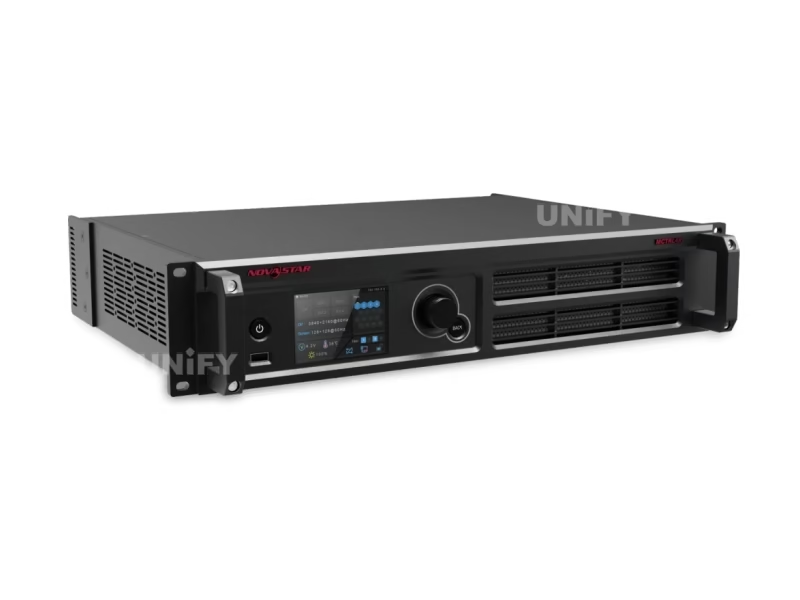
Product Overview
What Is the Novastar MCTRL4K?
The Novastar MCTRL4K LED display controller is NovaStar’s flagship independent sending box — the only MCTRL-series controller capable of driving a true 4K LED display (4096×2160@60Hz) from a single unit. With 8.8 million pixel loading capacity across 16 Gigabit Ethernet ports and 4 optical fiber outputs, it is purpose-built for the largest and most demanding LED installations: stadium scoreboards, broadcast studio walls, XR virtual production volumes, control room video walls, and large-format outdoor digital billboards. It supports DP 1.2, HDMI 2.0, and dual DVI inputs with custom resolutions up to 7680 pixels wide or 7680 pixels tall, HDR10-Optima and HLG high dynamic range formats, 3D display with frame-sequential and side-by-side modes, GENLOCK synchronization with adjustable offset, and a unique dual-mode architecture that allows it to operate as either a single high-capacity controller (Mosaic mode) or two independent sending cards (Multi-Card mode). Awarded “Best Video Processor” at InfoComm, the MCTRL4K represents the ceiling of NovaStar’s standalone controller technology. For architecture comparison, see synchronous vs asynchronous LED control.
Flagship positioning: The MCTRL4K is the only MCTRL controller that supports true 4K resolution, HDR formats, 3D display, and 16 Ethernet outputs. It is approximately 10× more capable than the MCTRL660 PRO and priced at $2,000–$5,000+. For installations exceeding 2.3M pixels or requiring 4K, HDR, or 3D, the MCTRL4K is the only MCTRL-series option.
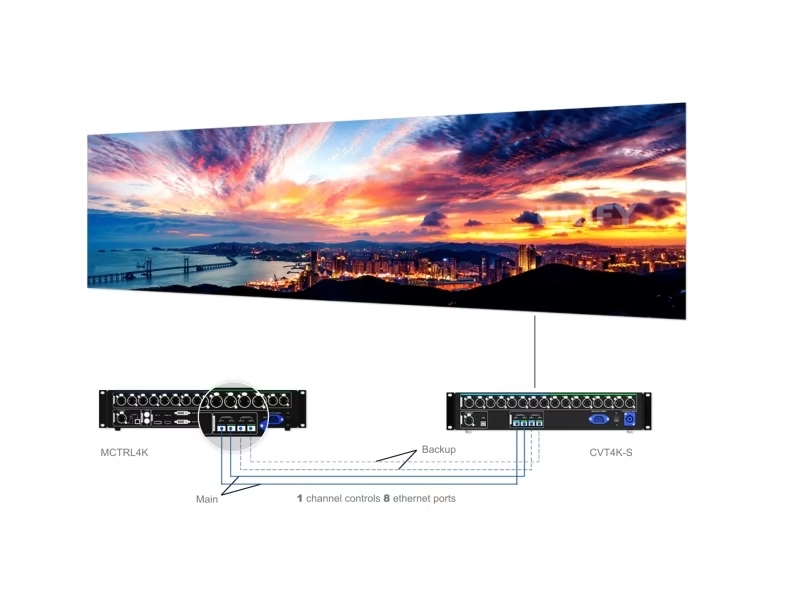
Specifications
Technical Specifications
Video Input & Output
Physical & Environmental
The 2U rack-mount chassis accommodates 16 Ethernet ports, 4 SFP+ cages, and advanced FPGA processing. At 30W, active cooling with dual thermostatic fans rated for 50,000h MTBF. See LED display power consumption.
Engineering Advantages
Key Features
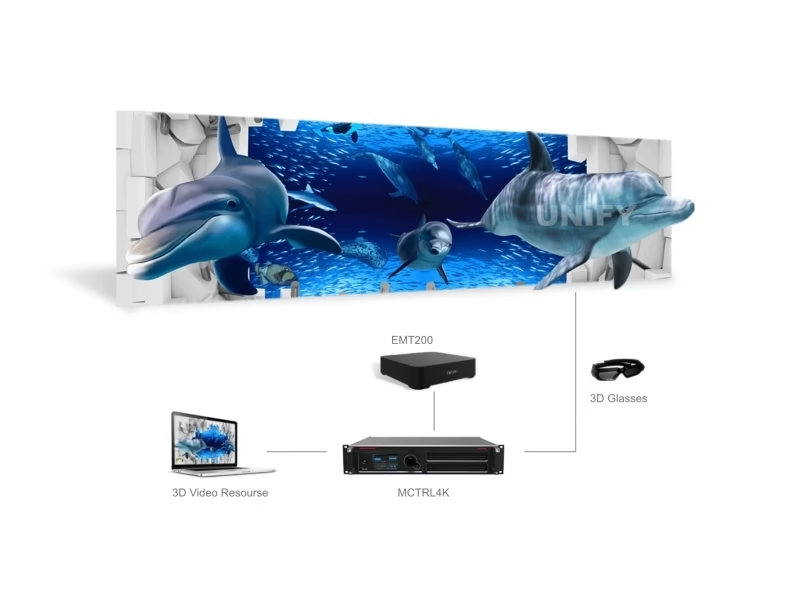
True 4K@60Hz — 8.8M Pixels
4096×2160@60Hz native resolution — not scaled, not cropped. Custom resolutions up to 7680 pixels wide or tall. Single-unit loading eliminates the multi-controller complexity required by lower-tier MCTRL models for large displays.
HDR10-Optima + HLG + 3D
HDR10-Optima and HLG formats deliver wider color gamut and higher dynamic range. 3D supports frame-sequential, side-by-side, and top-and-bottom modes. The only MCTRL controller with HDR and 3D capability.
16 ETH + 4 Fiber + Sync Splice
16 Ethernet ports and 4 fiber outputs provide unmatched topology flexibility. Sync Splice mode frame-synchronizes multiple MCTRL4K units for oversized displays — no external sync hardware required.
Mosaic + Multi-Card Dual Mode
Mosaic mode: one controller drives the entire 4K display. Multi-Card mode: the controller splits into two independent sending cards — each with its own input and output. Unprecedented flexibility in a single 2U chassis.
Architecture
Mosaic Mode vs Multi-Card Mode
The MCTRL4K’s unique dual-mode architecture — selectable from the front panel or NovaLCT — makes it two controllers in one chassis. This is the only NovaStar sending box with this capability.
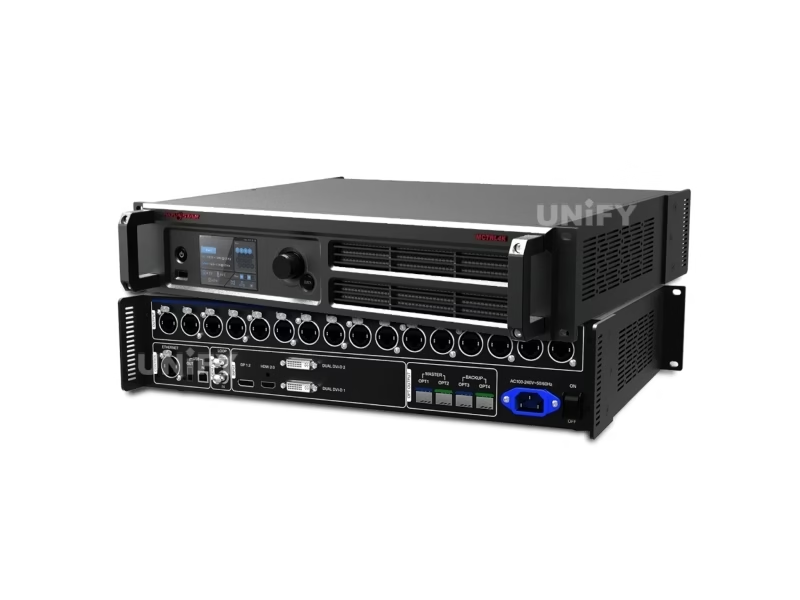
Mosaic Mode — One Controller, One Display
All 16 Ethernet ports and 4 fiber outputs are combined to drive a single large LED display. One video input (DP, HDMI, or DVI) feeds the entire wall. The controller’s FPGA divides the 4K canvas across all output ports according to the NovaLCT port mapping. Use Mosaic mode for: single large 4K displays, stadium screens, broadcast studio walls, control room video walls — anywhere one unified display surface is required.
Multi-Card Mode — Two Independent Sending Cards
The MCTRL4K splits into two logical sending cards (Card A and Card B), each with its own video input (e.g., DP → Card A, HDMI → Card B) and its own set of Ethernet/fiber outputs. Each card drives an independent section of the display or a separate display entirely. Use Multi-Card mode for: main screen + side screen from one chassis, dual independent LED walls, complex multi-surface stage designs where two separate video sources must be processed by a single hardware unit.
Configuration
NovaLCT, Web Browser & LCD Configuration
The MCTRL4K supports three configuration methods: NovaLCT software (USB/Ethernet), web browser (HTTP via Ethernet), and front-panel LCD with knob. The official NCE training below covers the NovaLCT workflow.
NovaStar Official — NovaStar Official — Basic Configuration of NovaLCT NCE 2022 Training
Custom Resolution & Scaling
The MCTRL4K supports custom resolutions up to 7680 pixels in width or 7680 pixels in height — enabling ultra-wide (7680×1080) and ultra-tall (1080×7680) display formats that no other MCTRL controller can drive from a single unit. The internal scaler accepts input resolutions from 800×600 to 4096×2160 and scales them to the configured output. Pixel-level brightness and chroma calibration via NovaCLB ensures uniformity across the entire 8.8M-pixel canvas. See LED display configuration and LED display refresh rate.
Controller Comparison
NovaStar Sending Box Family
Official NovaStar overview of all MCTRL models, followed by specification comparison with the MCTRL4K column highlighted.
NovaStar Official — NovaStar Official — ENHANCE YOUR ARSENAL Complete Sending Box Lineup
The MCTRL4K is the only MCTRL controller supporting true 4K, HDR, and 3D. Its 16 Ethernet ports and 4 fiber outputs provide nearly 4× the connectivity of the next-closest model. See our LED video processor guide.
Applications
Where Only the MCTRL4K Will Do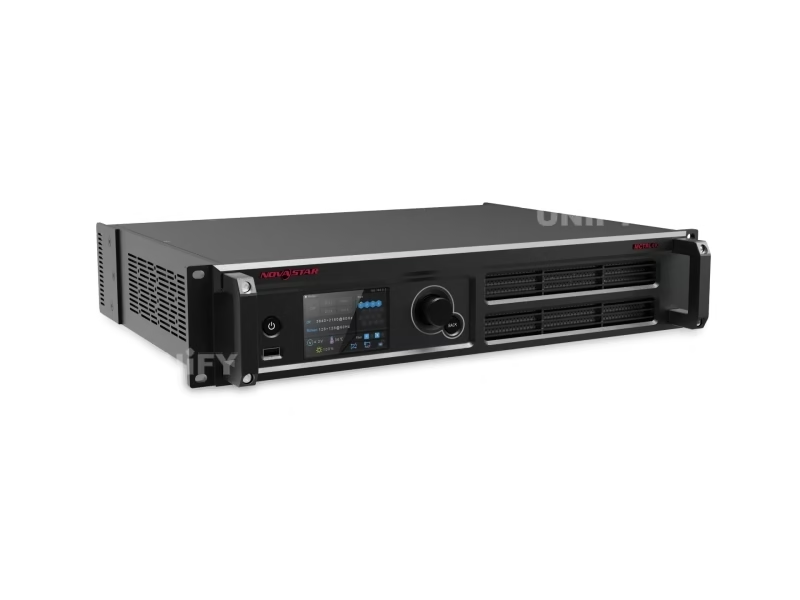
XR Virtual Production
4K@60Hz resolution with HDR10-Optima and GENLOCK adjustable offset for camera-to-wall sync. Free rotation with A10s Plus-N for curved LED volumes. Sync Splice mode for multi-controller oversized installations. See LED screen for events.
Broadcast & Sports
16 Ethernet ports drive stadium scoreboards and perimeter displays from a single controller. GENLOCK ensures frame-accurate sync with broadcast cameras. HDR formats for live HDR production.
Control Rooms & NOC
Drive massive video walls from a single 4K input without multi-controller complexity. Multi-Card mode splits one chassis into two independent displays — e.g., main wall + auxiliary monitoring display.
Large Outdoor Billboards
Single-unit 8.8M pixel capacity replaces multiple cascaded controllers. 4 fiber outputs for long-distance runs from control room. Custom resolutions for ultra-wide DOOH formats.
B2B Procurement
MCTRL4K Price & Sourcing
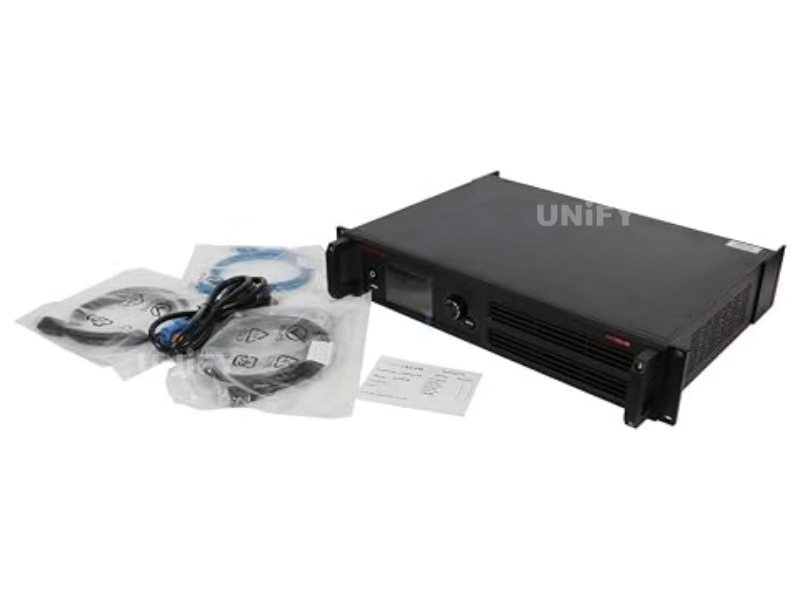
CE, FCC, IC, CB, RoHS certified. InfoComm “Best Video Processor” award winner. Source from LED screen manufacturer authorized channels. Includes: power cord, Ethernet cable, USB cable, DP cable, HDMI cable, DVI cable.
FAQ
Frequently Asked Questions
Ready to Source the MCTRL4K?
Factory-direct pricing, global logistics, 4K system design consultation.
unifyledscreen@gmail.com | +86-191-18802497
Technical Deep-Dive
Novastar MCTRL4K LED Display Controller: 4K Engineering & Large-Display Architecture
Published: July 2026 | 15 min read | UnifyLED Engineering Team
The Novastar MCTRL4K LED display controller represents a step-change in NovaStar’s standalone controller architecture — not merely a scaled-up MCTRL660 with more ports, but a fundamentally different FPGA platform designed around a 4K video pipeline with HDR tone-mapping, 3D frame processing, and a dual-mode architecture that can reconfigure the hardware into either a single 8.8M-pixel controller or two independent sending cards. Understanding when the MCTRL4K is necessary — versus when the MCTRL660 PRO or cascaded MCTRL660 units can achieve the same result at lower cost — requires analyzing the pixel budget, the input signal chain, and the display topology. This article provides that analysis.
The 4K Pixel Budget: When 2.3M Pixels Is Not Enough
Every MCTRL controller except the MCTRL4K has a hard pixel loading limit of 2.3 million pixels. This limit is not arbitrary — it is determined by the FPGA’s frame buffer capacity and the per-port Ethernet bandwidth ceiling. For the vast majority of LED deployments — a 6m×4m P3.91 rental wall (1,536×1,024 = 1.57M px), a corporate lobby display, a worship center screen — 2.3M pixels is more than sufficient. The MCTRL4K becomes necessary when the pixel count crosses 2.3M, which occurs in these common scenarios: (1) A 4K-resolution LED wall (3840×2160 = 8.29M px), (2) an ultra-wide format exceeding 2.3M pixels (e.g., 3840×1200 = 4.6M px), (3) a large P2.6 or finer-pitch display intended for close viewing where the pixel density per square meter is high enough that even a modest physical size exceeds 2.3M pixels. For pixel pitch calculations, see LED pixel pitch.
The alternative to a single MCTRL4K is cascading multiple standard MCTRL660 or MCTRL660 PRO units. For a 3840×2160 display (8.3M px), this requires 4 units (8.3M ÷ 2.3M = 3.6 → 4). At $350–$550 per MCTRL660, four units cost $1,400–$2,200 — comparable to a single factory-direct MCTRL4K at $2,000–$3,500. However, four cascaded MCTRL660 units require a 4-output video distribution system (one HDMI/DVI per controller) and introduce the complexity of synchronizing four independent controllers — each with its own configuration, its own firmware, and its own potential failure point. The MCTRL4K eliminates all of that: one video input, one configuration, one firmware version, one point of failure. The TCO advantage of the MCTRL4K over cascaded alternatives becomes clear at 3+ lower-tier controllers.
HDR Workflow: HDR10-Optima and HLG in LED Display Applications
The MCTRL4K is the only MCTRL controller supporting HDR (High Dynamic Range) formats — specifically HDR10-Optima (NovaStar’s optimized implementation of the HDR10 standard) and HLG (Hybrid Log-Gamma, the broadcast HDR standard used by BBC and NHK). HDR on LED displays is not the same as HDR on consumer televisions. On an LED wall, HDR extends the perceptible contrast range in two ways: increasing peak brightness (LED walls can achieve 5,000–6,000 nits — well beyond the 1,000-nit HDR10 target) and improving shadow detail through the electro-optical transfer function (EOTF) that maps input signal levels to LED drive currents.
The HDR processing pipeline in the MCTRL4K accepts HDR-encoded input (PQ or HLG curve), performs tone-mapping to adapt the HDR signal to the LED wall’s actual brightness capability, and outputs the tone-mapped signal through the standard 8/10/12-bit pipeline to receiving cards. For broadcast applications, HLG is the preferred HDR format because it is backward-compatible with SDR displays — the same signal displays correctly on both HDR-capable and SDR-only LED walls, with the MCTRL4K handling the conversion. For cinema and pre-recorded content applications, HDR10-Optima provides per-scene metadata for optimal tone-mapping. For further reading on display technologies, see LED screen brightness.
3D Display Architecture: Frame-Sequential Processing at 120Hz
The MCTRL4K’s 3D capability supports three input formats: frame-sequential (left and right eye frames alternated at 120Hz), side-by-side (both eye views compressed into a single frame horizontally), and top-and-bottom (vertically stacked). In frame-sequential mode — the highest quality 3D format — the controller accepts a 1920×2160@120Hz input (each eye at 1920×1080), extracts the left and right frames, and outputs them sequentially at 120Hz with a synchronization signal to active shutter glasses or a polarization modulator. This requires receiving cards that support 120Hz refresh and LED driver ICs capable of the corresponding data rate. The MCTRL4K is the only NovaStar standalone controller supporting this pipeline — all other MCTRL models require external 3D processing hardware. For XR virtual production applications, 3D LED volumes are emerging as an alternative to traditional LED volumes for depth-critical camera tracking scenarios. See LED display refresh rate for high-refresh requirements.
Sync Splice: Multi-Controller Synchronization for Oversized Displays
For LED displays exceeding 8.8M pixels — the largest stadium screens, mega-DOOH billboards, championship arena displays — even a single MCTRL4K is insufficient. The Sync Splice mode enables multiple MCTRL4K units to operate as a single logical display by frame-synchronizing their output through an Ethernet-based sync protocol (no external GENLOCK hardware required). Each MCTRL4K drives a defined section of the overall canvas. The sync protocol ensures that every unit outputs its frame at the exact same video timing — eliminating the visible seams and timing skew that would appear if the controllers operated independently. This is the architecture behind the world’s largest LED displays, including Olympic stadium installations and championship arena systems. For installation guidance, see LED screen installation.
Procurement Decision: The MCTRL4K Threshold
The MCTRL4K’s price of $2,000–$5,000+ places it in a different procurement category from the rest of the MCTRL lineup. The decision to invest in an MCTRL4K should be triggered by one or more of four non-negotiable technical requirements: (1) The display exceeds 2.3M pixels — calculate your total pixel count (width × height); if it exceeds 2,300,000, the MCTRL4K is required. (2) The project requires 4K input resolution — lower-tier controllers cannot accept 4K signals. (3) HDR or 3D is required — these are MCTRL4K-exclusive features. (4) The complexity of cascading 3+ lower-tier controllers exceeds the operational simplicity of a single MCTRL4K. If none of these conditions apply, the MCTRL660 or MCTRL660 PRO delivers equivalent core video quality at substantially lower cost. For procurement from a verified source, contact a LED screen manufacturer with NovaStar authorization. For maintenance planning, see LED screen maintenance.
Conclusion
The Novastar MCTRL4K LED display controller is not a general-purpose upgrade — it is a specialized tool for LED deployments that exceed the 2.3M-pixel ceiling of every other MCTRL controller. Its value proposition is defined by four exclusive capabilities: 8.8M-pixel loading capacity, true 4K@60Hz input, HDR10-Optima and HLG processing, and 3D display support. For the 10–15% of professional LED deployments that require one or more of these capabilities, the MCTRL4K is the only standalone controller in NovaStar’s lineup that can deliver. For the remaining 85–90%, the MCTRL660 or MCTRL660 PRO provides the same core video quality, the same calibration tools, and the same NovaLCT software ecosystem at a fraction of the cost. The art of controller selection is knowing which deployment you have — and the MCTRL4K’s deployment profile is 4K, large-format, and HDR, not universal.
MCTRL Series
Explore the Complete NovaStar Controller Range
From Taurus multimedia players to VX all-in-one controllers and MCTRL sending boxes.
VX All-in-One
Resources
>
Download MCTRL4K Resources
Official NovaStar MCTRL4K specifications and user manual.