
LED Display Types: The Complete Guide to Every LED Screen Technology & Application (2026)
Published: 2026-07-20 | Reading time: 15 min | UnifyLED Engineering Team
The phrase LED display types actually means two different things — and confusing them is the #1 mistake buyers make. To a consumer electronics engineer, “LED display types” means panel technologies: OLED vs LCD vs Mini-LED vs Micro-LED. To a commercial AV buyer, it means engineering classifications: indoor vs outdoor, rental vs fixed, SMD vs COB, fine-pitch vs large-pitch. Both are correct. Neither alone is complete. This guide covers both layers in one place — first the panel technologies that define how light is generated, then the commercial engineering types that determine where and how an LED screen is deployed. As a LED screen manufacturer, UnifyLED produces displays across every commercial type covered in this guide.
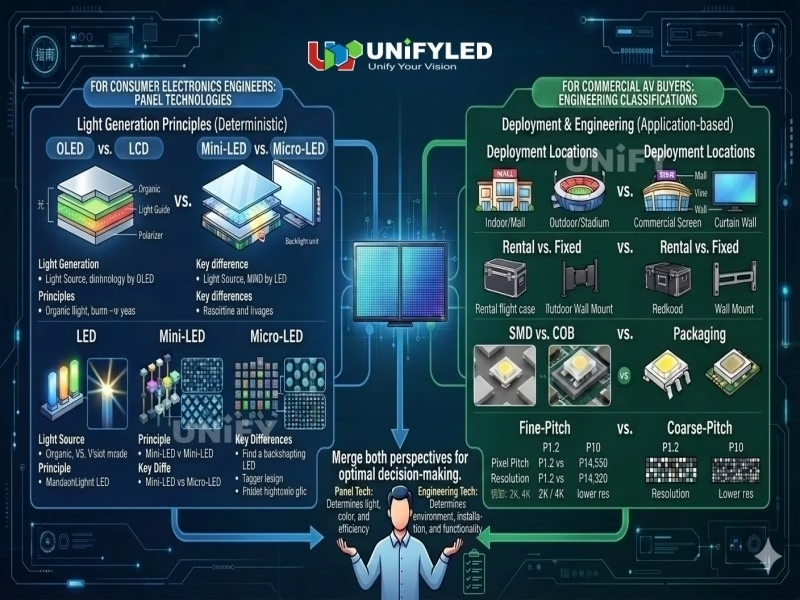
Part A: Display Panel Technologies — How the Light Is Generated
Before a single pixel reaches a viewer’s eye, a fundamental engineering choice has already been made: what technology generates the light? This layer — the panel technology — determines the ceiling of what any display can achieve in contrast, brightness, thinness, and cost. Understanding these five technologies is the prerequisite to understanding every commercial LED display type that follows.
1. OLED Displays: Self-Emissive Perfection
OLED (Organic Light Emitting Diode) displays are fundamentally different from every other technology on this list: each pixel is its own light source. There is no backlight. When a pixel needs to show black, it simply turns off — producing a true, absolute black that no backlight-based technology can match. This self-emissive architecture delivers infinite contrast ratios, perfect per-pixel lighting control, and the ability to build displays that are thinner than a credit card. OLED dominates the premium TV and smartphone markets for exactly these reasons.
Limitations for commercial use: OLED panels suffer from burn-in — static content displayed for extended periods permanently degrades the organic compounds, leaving ghost images. Maximum brightness is typically 600-1,000 nits, insufficient for outdoor or brightly-lit commercial environments. Panel sizes top out around 97 inches, making large-format video walls impractical. For commercial LED display applications requiring 24/7 operation, high brightness, or large sizes, OLED is not the answer — which is why direct-view LED exists.
2. LCD with LED Backlight: The Mainstream Workhorse
LCD (Liquid Crystal Display) is not an LED display technology in the strictest sense — the liquid crystals do not emit light. Instead, an LED backlight shines through a layer of liquid crystals that either block or pass light to form the image. For a detailed comparison, see our guide to LCD vs LED displays. This is the dominant technology in computer monitors, consumer televisions, and digital signage under 86 inches. It is mature, cost-effective, and LCD vs LED comparison shows the fundamental differences. It available in resolutions up to 8K. For most indoor applications where cost per screen is the primary constraint, LCD with LED backlight is the default choice.
Limitations: LCD panels have bezels — visible borders between panels that create a grid pattern when tiled into a video wall. Even the narrowest bezels (0.44mm) are visible at close range. Brightness typically maxes out at 700 nits. Panel sizes are limited to 98 inches. For applications requiring seamless large-format displays, high brightness, or custom aspect ratios, LCD is physically incapable — direct-view LED is required.
3. Mini-LED: Better Backlight Control
Mini-LED is an evolution of LCD backlight technology, not a separate display type. Instead of a few dozen large LEDs behind the LCD panel, Mini-LED uses thousands of tiny LEDs — each smaller than 0.2mm — arranged in a dense grid. This enables far more local dimming zones (hundreds to thousands instead of dozens), dramatically improving contrast and reducing the halo effect where bright objects bleed light into dark areas. Mini-LED TVs and monitors approach OLED-level contrast at a lower price point, without burn-in risk.
Limitations: Mini-LED is still an LCD with a backlight — it cannot achieve per-pixel black levels. The technology is confined to consumer and prosumer displays; it has no presence in the large-format commercial LED display market where direct-view LED dominates.
4. Micro-LED: The Holy Grail (Still Emerging)
Micro-LED takes the architecture of OLED — self-emissive pixels, no backlight — but replaces organic compounds with inorganic gallium nitride (GaN) LEDs shrunk to microscopic size. The result combines OLED’s perfect blacks and per-pixel control with LED’s brightness (potentially 5,000+ nits), longevity (100,000 hours), and zero burn-in risk. Micro-LED is widely considered the ultimate display technology: it has no fundamental technical weakness.
Current reality: Micro-LED manufacturing yields are low and costs are astronomical. A 110-inch Micro-LED TV costs over $100,000. Mass production at consumer price points is years away. For now, Micro-LED exists in ultra-premium luxury displays and as a technology demonstration — not as a commercially viable option for the vast majority of buyers. The commercial LED display industry achieves similar results at far lower cost through mature SMD and COB direct-view LED technology.
5. Direct-View LED (DVLED): The Commercial Standard
Direct-View LED — also called DVLED, direct-view fine-pitch LED, or simply “LED display” in commercial contexts — uses individual RGB LEDs as the actual pixels. There is no LCD layer, no backlight, no organic compound. Each pixel is a physical LED that emits light directly toward the viewer. This architecture enables three capabilities that no other panel technology can match: unlimited size (cabinets tile together to form displays measured in meters, not inches), extreme brightness (5,000–10,000 nits for outdoor visibility), and complete bezel-free seams (modules connect with zero visible gap). These three properties — size, brightness, seamlessness — are why direct-view LED is the only technology used for outdoor billboards, stadium screens, concert stage backdrops, control room video walls, and every other large-format commercial display application. For purchasing guidance, contact a qualified LED screen manufacturer for application-specific recommendations.
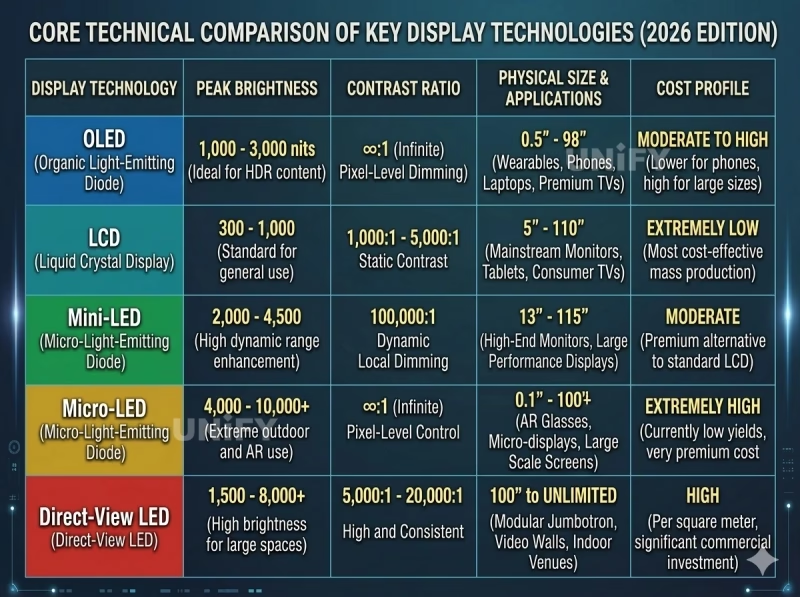
Part B: Commercial LED Display Engineering Types — How LED Screens Are Classified for Real-World Use
Once you have chosen direct-view LED as the panel technology — which is the correct choice for any display larger than 100 inches or brighter than 1,000 nits — the next question is: what type of LED display fits your specific application? The commercial LED display industry classifies screens across nine independent dimensions. A single display can be simultaneously described as an “outdoor, fixed-installation, SMD, full-color, P10, flat, synchronous, rear-service LED billboard” — and every word in that description is a discrete engineering choice. Understanding each dimension prevents costly specification errors.
6. By LED Packaging Technology: SMD, DIP, COB, GOB, and MiP
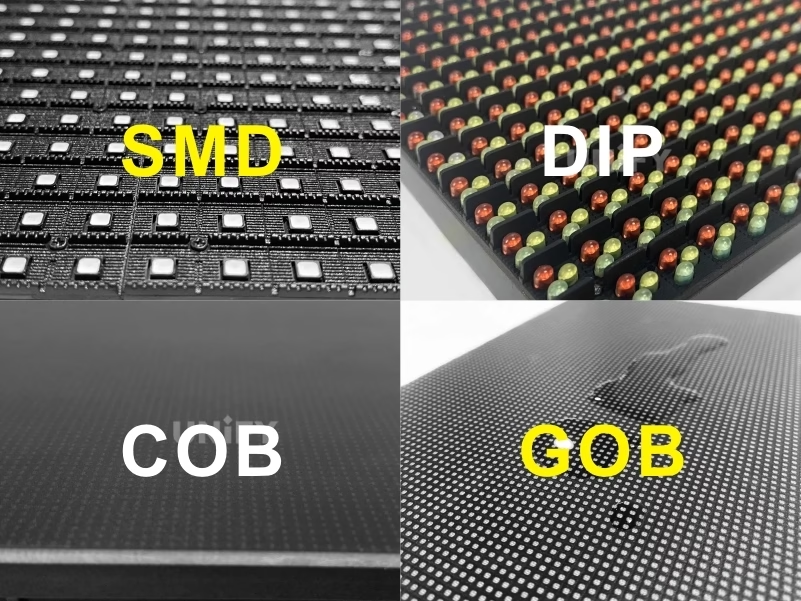
SMD (Surface-Mount Device) is the industry standard, accounting for approximately 85% of global LED display production. RGB LED chips are packaged into a single surface-mount component, then soldered onto the PCB. SMD delivers wide viewing angles (140-160°), good color uniformity, and a mature, cost-effective supply chain. Available in pixel pitches from P0.9 to P16, SMD serves both indoor and outdoor applications. Module-level repair is straightforward — individual modules can be swapped in minutes.
DIP (Dual In-line Package) is the legacy technology: individual red, green, and blue LED lamps are inserted through holes in the PCB. DIP produces the highest raw brightness (8,000+ nits) and extreme durability, making it suitable for highway billboards and long-distance outdoor signage. However, DIP cannot achieve pixel pitches below P10, produces narrower viewing angles, and consumes more power than SMD. It is increasingly rare in new installations.
COB (Chip-on-Board) mounts bare LED dies directly onto the PCB and encapsulates the entire array under a continuous resin layer. For a detailed comparison, see our SMD vs COB vs GOB LED display guide and LED packaging technology overview. No individual LED packages exist — the module surface is a single sealed unit. COB delivers superior impact resistance, better contrast (the uniform dark surface between pixels absorbs ambient light), and higher reliability in harsh environments. It is the preferred technology for fine-pitch indoor displays (P1.5 and below), control rooms, and premium corporate applications. The trade-off: COB costs 30-50% more than equivalent SMD, and field repair of individual pixels is difficult — a failed pixel typically requires replacing the entire module.
GOB (Glue-on-Board) is an enhanced version of SMD: a transparent protective resin is applied over the SMD module surface. This adds impact resistance, dust protection, and moisture sealing without the cost premium of full COB. GOB is popular for rental displays (frequent handling), interactive floor displays, and public-area installations where accidental contact is likely.
MiP (Micro-LED in Package) is an emerging approach that packages Micro-LED dies into a surface-mount format, bridging the gap between COB’s performance and SMD’s manufacturing scalability. Currently in early commercialization; primarily relevant for ultra-fine-pitch applications below P1.0.
7. By Application Environment: Indoor, Outdoor, and Semi-Outdoor
Indoor LED displays operate in controlled environments with moderate ambient light and no weather exposure. Typical brightness: 600–1,200 nits. IP rating: IP20–IP31. Indoor displays prioritize resolution, color accuracy, and slim design. Common pixel pitches: P1.2–P3.91 for close viewing (conference rooms, retail, control rooms), P4–P6 for medium-distance viewing (auditoriums, event halls). Weight is typically 5–7 kg per 500×500mm cabinet. Indoor displays do not require waterproofing or sun-readability.
Outdoor LED displays face direct sunlight, rain, dust, temperature extremes, and wind loading. Brightness: 4,500–10,000 nits. IP rating: IP65 minimum on the front face (dust-tight, water jet protection), IP54 minimum on the rear. Outdoor displays use larger, more robust LED packages (SMD2727, SMD3535) driven at higher currents. Cabinets are constructed from die-cast aluminum or galvanized steel with integrated weather seals, drainage channels, and UV-resistant gaskets. Pixel pitches range from P2.9–P4.81 (close-viewing storefront displays) to P6–P16 (highway billboards).
Semi-outdoor LED displays occupy a middle ground: covered but not fully enclosed spaces such as railway platforms, open-air atriums, and covered walkways. These environments require higher brightness than indoor (2,000–4,000 nits) and moderate weather protection (IP43–IP54), but not full outdoor specifications. For outdoor specifications, see our outdoor LED screen guide and indoor vs outdoor LED displays comparison. Semi-outdoor is an application-driven compromise that reduces cost vs full outdoor while providing necessary environmental protection.
8. By Installation Method: Fixed, Rental, and Mobile
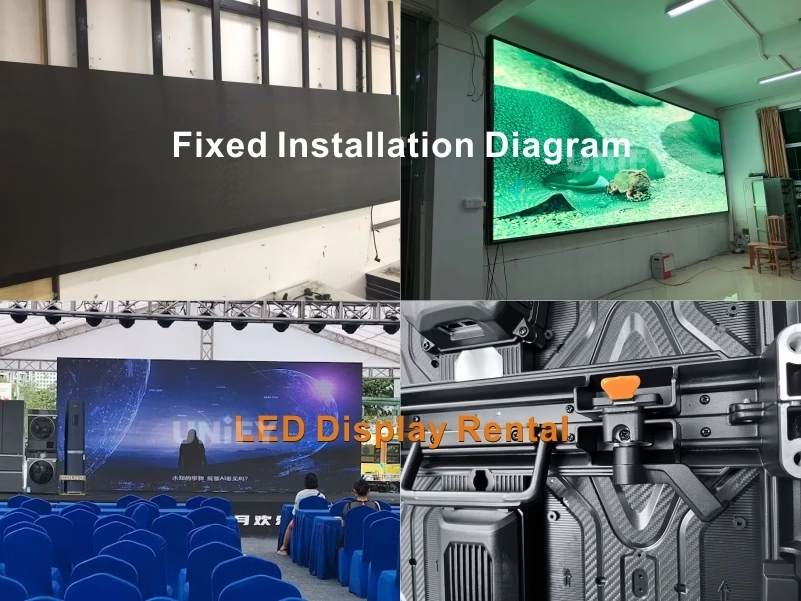
Fixed LED displays are permanently installed — bolted to building facades, mounted on steel structures, or integrated into architectural designs. Cabinets prioritize long-term reliability, slim profile, and structural mounting compatibility. Common sizes: 640×480mm, 960×960mm. Materials: extruded aluminum or rolled steel. Fixed installations dominate outdoor advertising, retail, corporate lobbies, control rooms, and sports venues. Once installed, fixed displays are expected to operate for 7–10 years with minimal structural intervention.
Rental LED displays are designed for temporary deployment — concerts, trade shows, conferences, weddings, touring productions. The defining characteristics are lightweight die-cast aluminum cabinets (6.5–7.5 kg per 500×500mm panel), fast-lock mechanisms enabling assembly in hours, front and rear service access, and flight case compatibility. Rental cabinets are built for repeated assembly and disassembly — the mechanical connections, not the LEDs, are the primary wear point. Standard sizes: 500×500mm and 500×1000mm. Rental displays use magnetic front-attached modules for tool-less field replacement.
Mobile LED displays are mounted on vehicles or trailers for advertising that moves. They integrate the display, power system (generator or battery), control system, and sometimes audio into a self-contained mobile unit. Common in outdoor advertising campaigns, political rallies, sports events, and public information dissemination. Pixel pitch is typically larger (P4–P10) due to viewing distance from moving vehicles.
9. By Color Type: Monochrome, Dual-Color, and Full-Color RGB
Monochrome LED displays use a single LED color — most commonly red, but also available in amber, green, blue, or white. Each pixel contains one LED. Applications: stock tickers, queue management, highway variable message signs, industrial status displays. Monochrome displays are the most economical LED type, costing 30–50% less than full-color equivalents. Outdoor monochrome displays achieve 5,000–8,000 nits.
Dual-color LED displays use two LED colors per pixel — typically red and green — producing red, green, and yellow/orange output. Applications: basic advertising signage, sports scoreboards, factory production monitoring, retail promotional displays. Dual-color provides significantly more visual impact than monochrome at approximately 70–80% of full-color cost.
Full-color RGB LED displays use red, green, and blue LEDs at each pixel position. With 14-bit to 16-bit grayscale control per channel (16,384 to 65,536 intensity levels per color), they reproduce the complete visible color spectrum. This is the standard for professional LED display applications — advertising, entertainment, broadcast, control rooms, and any scenario where photographic or video content is displayed. Full-color RGB is the default choice for all modern commercial LED display installations.
10. By Pixel Pitch: Fine-Pitch, Standard, and Large-Pitch
Pixel pitch — the center-to-center distance between adjacent LED pixels, measured in millimeters — is the single most important specification for any LED display. It directly determines the minimum viewing distance, the resolution at a given screen size, and the cost. The rule of thumb: minimum viewing distance in meters = pixel pitch in millimeters. For a complete explanation, see our LED pixel pitch guide and LED display viewing distance calculator. A P2.5 display is suitable for viewing at 2.5 meters or greater.. A P2.5 display is suitable for viewing at 2.5 meters or greater.
Fine-pitch (P0.9–P2.5): Designed for close viewing distances of 1–3 meters. Typical resolution: 160,000 to 1,234,567 pixels per square meter. These displays use SMD or COB technology and require precise calibration. Applications: boardrooms, broadcast studios, control rooms, luxury retail, virtual production volumes. Fine-pitch displays command the highest price per square meter due to component density and manufacturing precision requirements.
Standard pitch (P3–P6): The most widely deployed category, balancing resolution and cost. Suitable for viewing distances of 3–6 meters. Applications: retail stores, conference halls, event stages, indoor advertising, corporate lobbies. This category represents the largest segment of LED display sales by volume.
Large-pitch (P8 and above): Optimized for long-distance viewing — 8 meters and beyond. Resolution ranges from 15,625 pixels/m² (P8) to 3,906 pixels/m² (P16). These displays prioritize brightness and weather resistance over resolution. Applications: highway billboards, stadium perimeter boards, building-wrap displays, and any installation where viewers are far from the screen. Large-pitch displays are the most cost-effective per square meter.
11. By Screen Shape: Flat, Curved, Sphere, and Creative
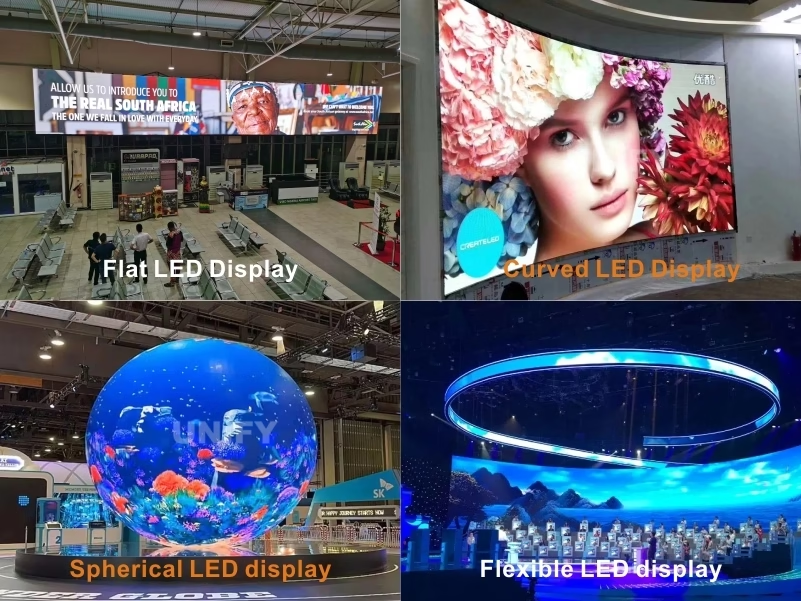
Flat LED displays are the standard rectangular format covering over 90% of installations. Standard aspect ratios include 16:9 (video content), 4:3 (legacy), and custom ratios for architectural integration. Flat panels are the most cost-effective and simplest to install.
Curved LED displays use cabinets with angled side edges or flexible modules to form concave or convex surfaces. Concave curves wrap around viewers for immersive experiences; convex curves wrap around building columns or architectural features. Curved displays require custom structural engineering and more complex content mapping.
Sphere and 3D LED displays are fully custom-engineered structures — spherical, cubic, or free-form shapes built from specially fabricated cabinets and flexible modules. Common in landmark installations, museums, and brand experience centers. These are high-cost, high-impact projects requiring specialized design, content production, and installation teams.
Flexible and creative LED displays use bendable PCB substrates to conform to non-flat surfaces. Flexible modules can wrap around columns, form wavy ribbon displays, or create undulating architectural media surfaces. Minimum bend radius is typically 200mm. These displays enable creative freedom but require more complex control system configuration to map standard rectangular video sources onto non-rectangular physical layouts.
12. By Control System: Synchronous vs Asynchronous
Synchronous LED control systems display content in real-time from a connected video source — a PC, media server, or camera. The sending controller (such as a NovaStar MCTRL series) receives a live video signal via HDMI, DVI, DP, or SDI and distributes pixel data to receiving cards in real time. Synchronous control is required for: live video feeds, broadcast applications, stage backdrops, sports venue displays, and any scenario where content changes dynamically or must match an external video source. The connection between source and controller is continuous; if the source stops, the display goes dark (or displays a pre-stored fallback image).
Asynchronous LED control systems store content locally on the display controller and play it back independently — no continuous connection to a source device is required. Content is uploaded via USB, Ethernet, Wi-Fi, or 4G, then played in a loop from internal memory. Asynchronous control is ideal for: digital signage that displays LED signage for outdoor marketing, the same content rotation for days or weeks, remote locations without reliable internet the same content rotation for days or weeks, remote locations without reliable internet, traffic information boards, and retail displays where simplicity and reliability outweigh the need for live content. Asynchronous systems are lower cost and simpler to operate but cannot display live video. For more details, see our guide to synchronous vs asynchronous LED control.
13. By Maintenance Access: Front Service, Rear Service, and Dual Service
Front-service LED displays allow modules, power supplies, and receiving cards to be accessed and replaced entirely from the front face. This is critical for wall-mounted installations, displays integrated into building facades, and any scenario where rear access is impossible or would require expensive structural provisions. Front-service modules typically use magnetic attachment or tool-less latches for rapid removal. The cabinet depth is minimized (often under 80mm) because no rear access clearance is required.
Rear-service LED displays require access behind the display for maintenance. This is standard for large outdoor billboards, stadium displays, and freestanding structures where a maintenance corridor exists behind the screen. Rear service is typically simpler and less expensive to engineer than front service, but it demands adequate clearance behind the display — a constraint that makes it unsuitable for wall-mounted or space-limited installations. For maintenance best practices, see our LED screen maintenance guide..
Dual-service LED displays support both front and rear access, providing maximum flexibility. These are common in rental deployments where the access direction depends on the specific installation configuration of each event.
14. Special LED Display Types
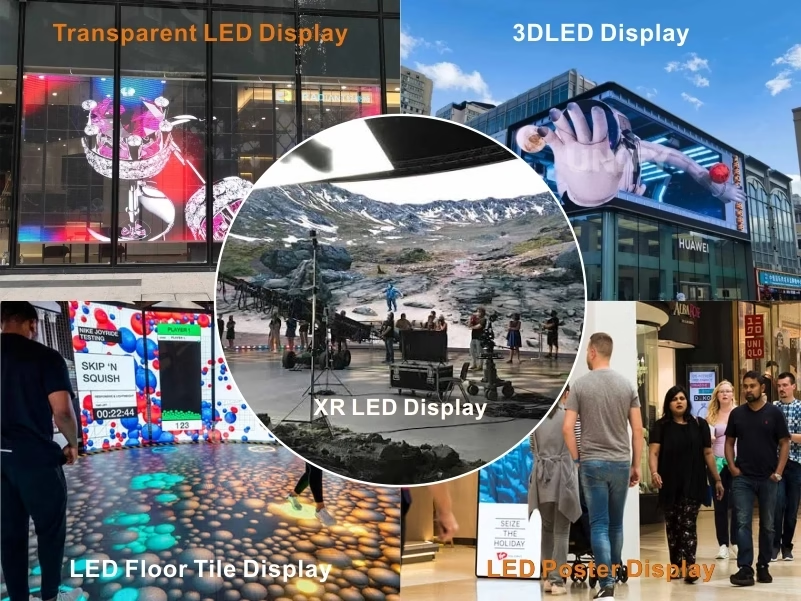
Transparent LED displays achieve 50–90% transparency by spacing LED strips apart, allowing light and visibility to pass through the gaps. They are installed on glass facades, retail windows, and building atriums — places where a conventional opaque LED display would block daylight and views. The trade-off is lower resolution (larger effective pixel pitch) and reduced brightness compared to conventional displays of the same area. Content must be designed for the transparent medium — dark backgrounds with bright elements work best.
Naked-eye 3D LED displays use perspective techniques, optical illusions, and corner-curved cabinets to create three-dimensional visuals without requiring 3D glasses. Most famously demonstrated on curved corner screens in city squares and shopping districts (the “3D billboard” effect). The 3D effect is viewpoint-dependent — it works best from specific angles — and requires custom 3D content production.
LED floor displays are engineered for foot traffic — reinforced panels with load-bearing capacity, anti-slip surface treatment, and impact-resistant LED protection (typically GOB or heavy-duty COB). Used in interactive dance floors, stage flooring, exhibition spaces, and immersive installations. Floor displays require the highest level of physical durability of any LED display type.
LED poster displays are slim, portable, self-contained digital signage units — essentially a thin LED screen in a floor-standing frame. Common in retail stores, hotel lobbies, and event entrances for promotional content. They include built-in media players and are designed for single-person setup and relocation. Typical sizes: 55–86 inches diagonal.
XR virtual production LED volumes are large curved LED walls used as in-camera backgrounds for film and television production. They require ultra-high refresh rates (7,680Hz+), GENLOCK synchronization, HDR support, and sub-1ms latency. Pixel pitches of P1.5–P2.6 are standard for close-range filming. This is the most technically demanding LED display application, popularized by productions such as The Mandalorian.
Part C: How to Choose the Right LED Display Type
15. Quick Decision Matrix: Match Your Application to the Correct LED Display Type
The fastest way to select the correct LED display type is to start from your application and work backward through each classification dimension:
| Application | Environment | Installation | Technology | Pixel Pitch | Color | Control System | Service Access |
| Outdoor billboard | Outdoor | Fixed | SMD or DIP | P6–P16 | Full-Color | Synchronous | Rear Service |
| Concert stage backdrop | Indoor/Outdoor | Rental | SMD | P2.6–P4.8 | Full-Color | Synchronous | Dual Service |
| Conference room | Indoor | Fixed | SMD or COB | P0.9–P2.5 | Full-Color | Synchronous | Front Service |
| Retail window display | Indoor | Fixed | SMD | Transparent | Full-Color | Asynchronous | Front Service |
| Stadium scoreboard | Outdoor | Fixed | SMD or DIP | P10–P16 | Full-Color | Synchronous | Rear Service |
| Control room video wall | Indoor | Fixed | COB | P0.9–P1.5 | Full-Color | Synchronous | Front Service |
| Trade show booth | Indoor | Rental | SMD | P2.5–P3.91 | Full-Color | Synchronous | Front Service |
| Church sanctuary | Indoor | Fixed | SMD | P2.5–P4.8 | Full-Color | Synchronous | Front or Rear |
| Highway VMS sign | Outdoor | Fixed | DIP | P10–P25 | Monochrome or Dual | Asynchronous | Rear Service |
16. Key Specifications to Verify Before Purchase
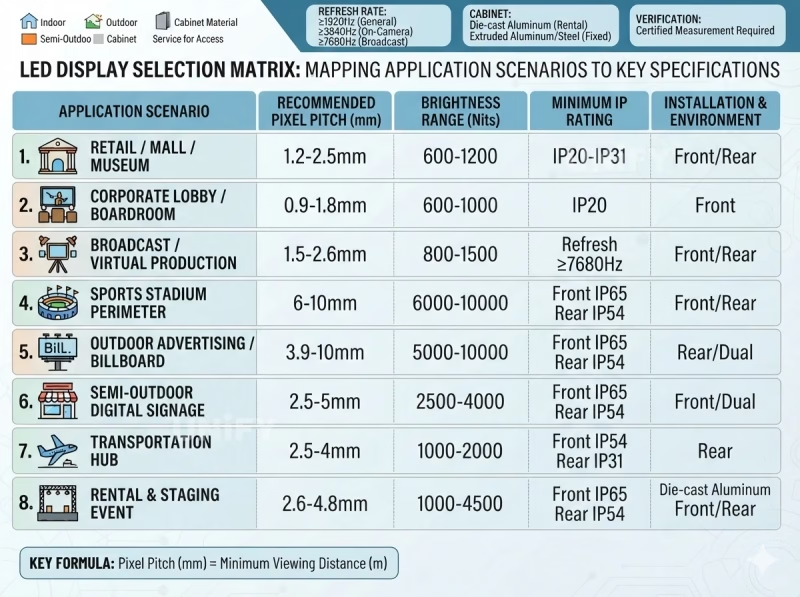
Brightness (nits): Indoor: 600–1,200. Outdoor: 4,500–10,000. Semi-outdoor: 2,000–4,000. Verify with a certified measurement, not the manufacturer’s claimed specification.
IP rating: Outdoor front face must be IP65 minimum. Outdoor rear must be IP54 minimum. Indoor: IP20–IP31 is sufficient.
Refresh rate: Minimum 1,920Hz for flicker-free viewing. 3,840Hz for camera-facing applications. 7,680Hz for broadcast and virtual production.
Pixel pitch: Match to minimum viewing distance using the rule: pixel pitch (mm) = minimum viewing distance (m). A P3 display is viewable from 3m.
Cabinet material: Die-cast aluminum for rental. Extruded aluminum or steel for fixed. Verify corrosion resistance for coastal or high-humidity environments.
Service access: Front service for wall-mounted. Rear service for freestanding with rear clearance. Dual service for maximum flexibility.
Power consumption: Calculate average (not maximum) power for operational cost estimation. Common-cathode technology reduces consumption by 15–25%.
17. Conclusion: Two Layers, One Decision
The world of LED display types makes sense once you separate it into two layers. The panel technology layer — OLED, LCD, Mini-LED, Micro-LED, Direct-View LED — determines how light is generated and sets the ceiling for what the display can achieve. For any application requiring more than 100 inches of screen, more than 1,000 nits of brightness, or a completely seamless surface, direct-view LED is the only viable technology. The commercial engineering layer — packaging, environment, installation, color, pixel pitch, shape, control, maintenance, and special types — determines how that direct-view LED display is configured for a specific real-world deployment. A correctly specified LED display is the intersection of one panel technology choice and nine engineering classification decisions. Get both layers right, and the display performs for a decade. Miss one dimension — wrong IP rating, wrong pixel pitch, wrong service access — and the display becomes a liability. For application-specific guidance from a qualified LED screen manufacturer, contact UnifyLED’s engineering team for a free consultation and specification review.
Need Help Selecting the Right LED Display Type?
Factory-direct LED displays with pre-configured specifications for your exact application. Free technical consultation and specification review.
legidatechled@gmail.com | +86-191-18802497