
LED Display Power Supplies · The Three-Brand Catalog
LED Display Power Supply
Every LED display power supply brand we stock, in one catalog — Mean Well, CZCL and G-Energy — with 27 model pages across 150–1008 W, verified 2026 street prices from $11.99, the dual-rail common-cathode options and the load math, all one click apart.
System Overview
What Is an LED Display Power Supply?
Short answer: an LED display power supply converts single-phase AC mains into the regulated low-voltage DC rails an LED wall runs on — typically 5 V at 40–100 A per cabinet, or dual 4.x V + 3.x V rails for common-cathode energy-saving modules. Three brands cover this catalog: Mean Well prices the universal-input premium tier, CZCL owns the datasheet-grade mid-band, and G-Energy holds the price floor with the widest multi-voltage rail menu. Verified 2026 street prices run from $11.99 to about $95.
An LED display power supply is the component that turns wall power into pixels: it rectifies and regulates single-phase AC into 5 V (or 4.x V, or 12 V and up) DC at tens of amps, feeding the modules, receiving cards and hub boards inside each cabinet. Three architectures split the catalog: standard screens run one 5 V rail through constant-current driver ICs, common-cathode energy-saving modules split their wiring into two independent buses, and kilowatt-class builds step up to 12 V-and-up rails with parallel sharing. The power consumption math sizes how many units a wall takes, the industry-standard 80% loading rule sets the usable budget of each, and the diagnostics workflow keeps a failed unit from becoming a dark cabinet.
Brand Catalog
Which Brand Makes the Right LED Display Power Supply?
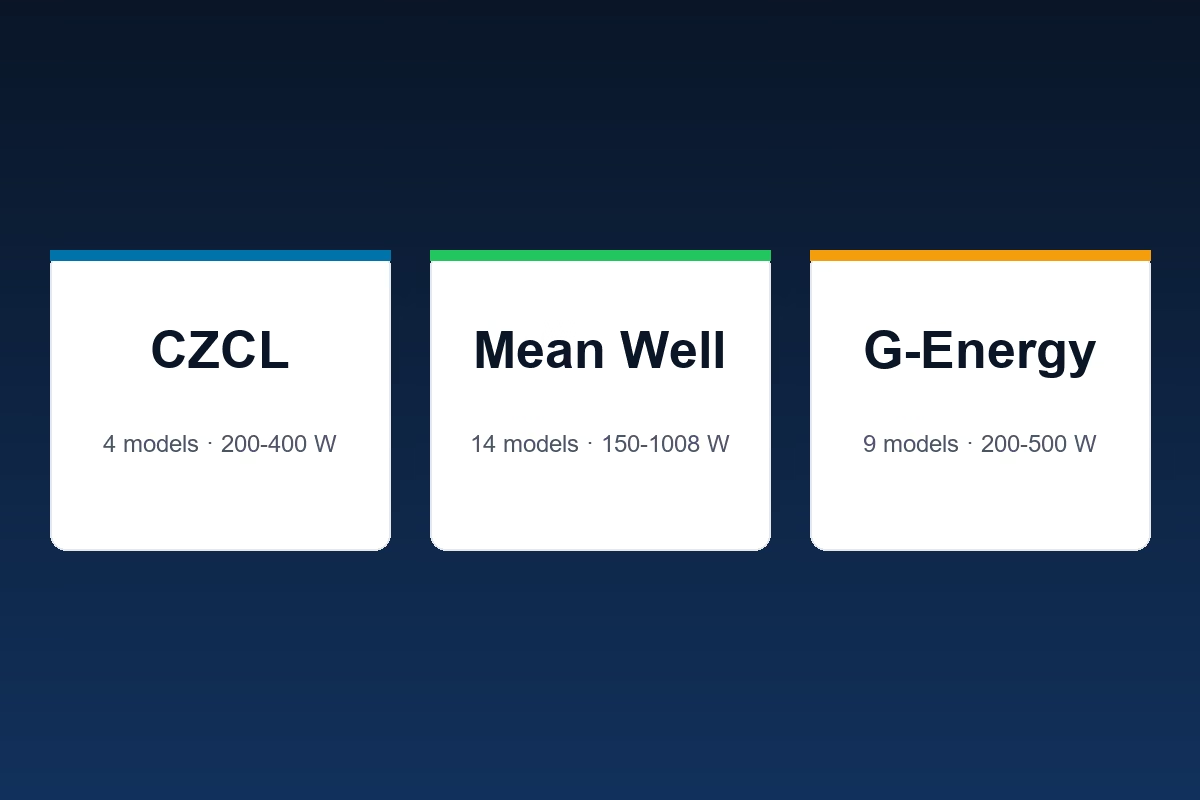
Three brands cover the catalog, each with its own hub page and full model line. Every card links that brand’s complete catalog on this site.
The Three Core LED Display Power Supply Brands
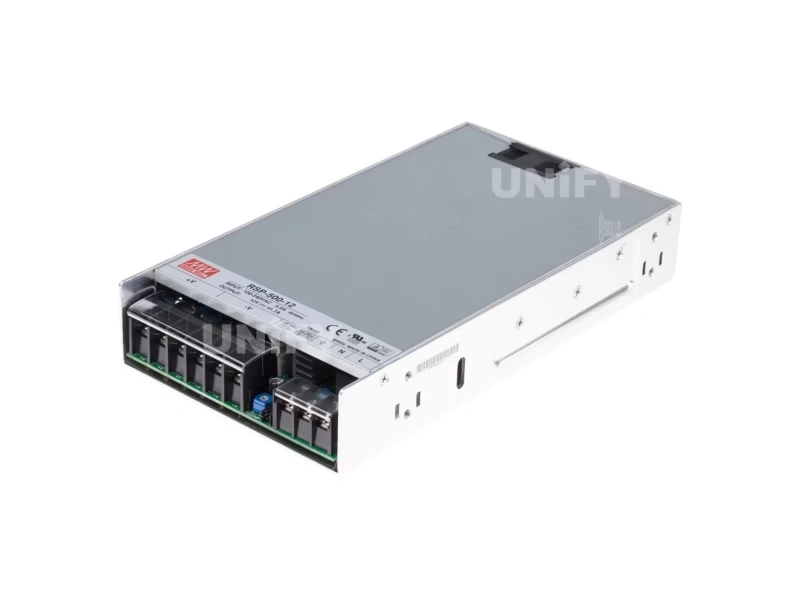
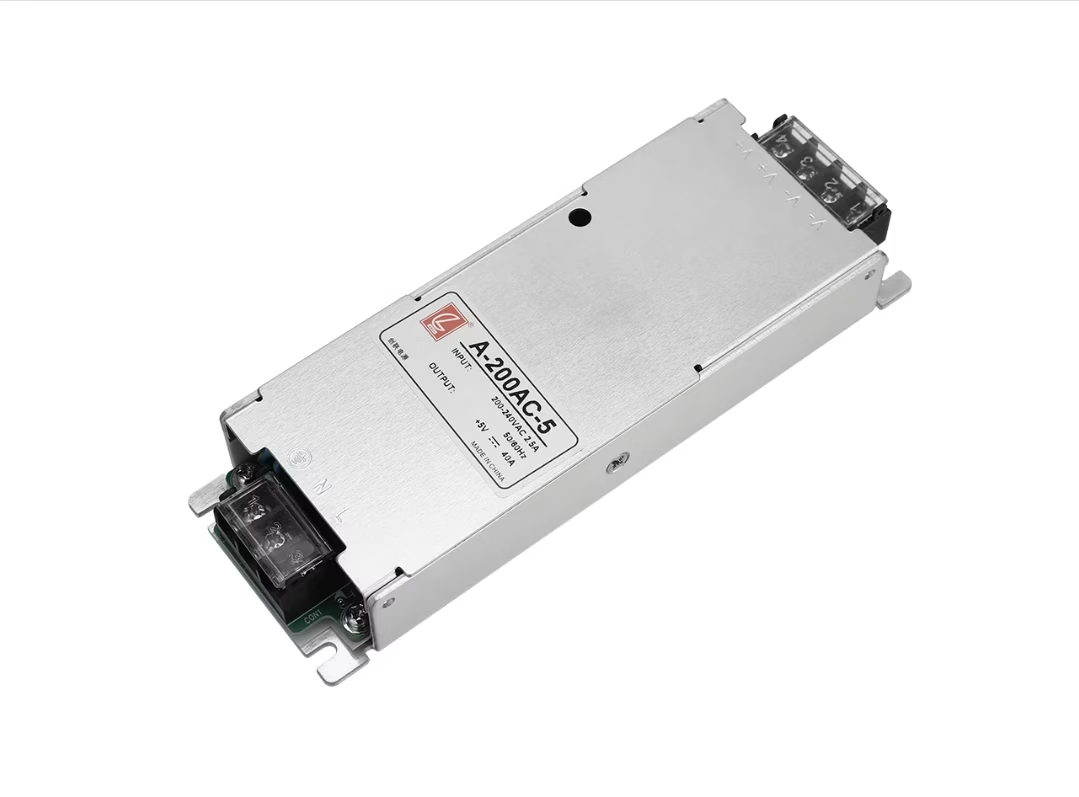
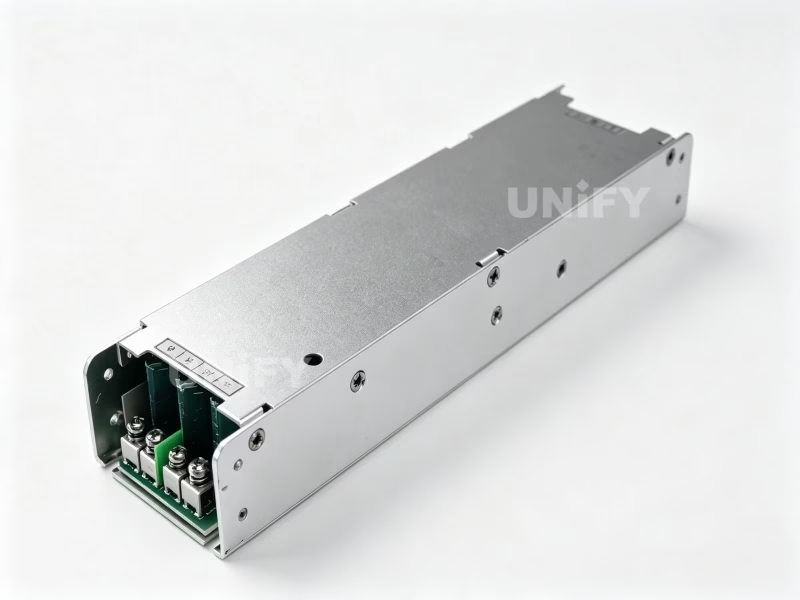
The rule that sorts this catalog: match the supply to the rail voltage your modules were designed for — 5 V for standard screens, the module’s declared dual rails for common-cathode builds — then match the input window to the grid. A mixed-brand cabinet is normal (each bus just needs the right rail); a mixed rail voltage is not.
Five differences decide which unit to pull from the rack:
- Positioning: Mean Well prices capability and paper, CZCL prices the datasheet-grade mid-band, G-Energy prices the floor.
- Input window: the Mean Well RSP/UHP/NEL lines run 90–264 VAC continuous with active PFC; the G-Energy JPS400P V5.0 joins them; most CZCL and G-Energy value units are 176–264 V or 200–240 V designs.
- Rail architecture: standard 5 V single-rail everywhere; common-cathode dual-rail on the CZCL B-200AF and the G-Energy JPS V4.x pair; 12 V-and-up kilowatt rails on the RSP-1000.
- Redundancy: the Mean Well RSP-1000 parallels four units (3+1) and the UHP R-builds two; no CZCL or G-Energy display unit current-shares.
- Paper trail: dual-method MTBF and EN 60335-1 appliance marks on Mean Well, full 62368-1 certificate sets on CZCL’s flagship, distributor-listed specs on G-Energy — match the paper to the tender.
2026 Prices
How Much Does an LED Display Power Supply Cost?
Verified street bands from our September 2026 listing research, brand by brand — every figure dated in the linked catalog pages.
Five pricing rules hold across the table:
- Watts set the floor: 200 W-class units run $11.99–36 across all three brands, and the cabinet count multiplies that line fast.
- PFC prices the input: universal 90–264 VAC windows with active PFC command the premium — the CZCL A-400JQ-5P at $25.14 and the Mean Well lines above $36 both buy it.
- The mid-band is the value pocket: 300–400 W at $23–52 covers most cabinet designs — G-Energy’s JPS400P V5.0 and CZCL’s A-400JQ-5P fight there.
- Features price the top: remote sense, DC OK signals, redundancy builds and the 450–1008 W ratings move units from the $50s toward $95.
- The tag hides two lines: wiring hardware (bus bars, sense pairs) and the spare-unit stock a touring fleet carries — both scale with the cabinet count.
Per-brand catalogs with dated figures: Mean Well · CZCL · G-Energy
Every Mean Well model has a full page: RSP-150 · RSP-200 · RSP-320 · RSP-500 · RSP-1000 · LRS-150 · LRS-200 · LRS-350 · LRS-450 · LRS-600 · NEL-400 · UHP-200 · UHP-350 · UHP-500.
Architecture Types
Which LED Display Power Supply Architecture Fits Your Project?
Three architectures cover every wall in this catalog — the choice is about how the modules draw their power, not about brand:
One 5 V bus feeds modules and receiving cards together through constant-current driver ICs. The default for indoor fixed walls, rental cabinets and retail builds. PFC or economy input by budget; 200–500 W per unit, 80% loading.
Energy-saving modules split the wiring: a lower LED-bus rail (3.8–4.2 V) plus an independent driver-bus rail (2.8–3.2 V), so the difference voltage stops burning inside the drivers. One chassis, two regulated outputs — label both buses at harness stage.
12 V module rows, high-power peripheral bays and parallel banks step past the 5 V ceiling: the RSP-1000 carries 720–1008 W alone and parallels four units toward 4000 W with a hot spare. The only current-sharing platform in the catalog.
Quick Reference
How Do You Match Your Project to an LED Display Power Supply?
Eight project profiles, routed across the three brands — this is the table to screenshot before ordering:
Cabinet power first, brand second: the power consumption guide sizes the draw, and how many power supplies an LED screen needs turns it into a unit count.
Selection Guides
Where Are the LED Display Power Supply Selection Guides?
Brand Comparisons
Which LED Display Power Supply Comparison Answers Your Question?
Datasheets & Support
Where Do You Get LED Display Power Supply Datasheets and Support?
Mean Well 14-model catalog · CZCL four-series catalog · G-Energy rail-menu catalog — each carries its models’ spec tables
diagnostics & replacement · uneven brightness · flicker fixes · master troubleshooting guide
unit-count math · consumption & breakers · common-cathode rails · screen calculator
control-system six-brand catalog — the receiving cards and processors that ride on these 5 V rails
Videos
What Do Real LED Display Power Supply Installs Look Like in Action?
One official clip from the Mean Well channel plus our own bench and cabinet footage — the rail-voltage test and the swap workflow every fleet should know.
Mean Well — UHP-500 ultra-thin platform (official channel)
UnifyLED — replacing a failed switching power supply in a live screen
UnifyLED — rail-voltage testing on a suspect supply
FAQ
LED Display Power Supply FAQ
Q: What does an LED display power supply do? It converts single-phase AC mains into the regulated low-voltage DC rails an LED wall runs on — typically 5 V at 40–100 A per cabinet for standard screens, or dual 4.x V + 3.x V rails for common-cathode energy-saving modules. The 80% loading rule sets how much of each unit’s rating you actually plan with.
Q: How much does an LED display power supply cost in 2026? From $11.99 (G-Energy N200 V5, 200 W) to about $95 (Mean Well RSP-500-5, 450 W verified retail). CZCL sits mid-band at $12.50–29.99 for 200–300 W units, G-Energy spans $11.99–51.99, and Mean Well runs $36–95 for its premium lines. Every figure is dated in the linked catalog pages above.
Q: Which brand should I pick: CZCL, Mean Well or G-Energy? Budget-led builds on stable 220 V grids pick G-Energy; tender files, 110 V grids and generator sites pick Mean Well (90–264 VAC universal with active PFC across the RSP/UHP lines); CZCL wins the mid-band with datasheet-grade specs and the B-200AF dual-rail for common-cathode screens.
Q: Can I run an LED display power supply on 110 V in the US? Yes on the Mean Well RSP, UHP and NEL lines (90–264 VAC universal) and the G-Energy JPS400P V5.0 (90–264 VAC). The G-Energy N and J400 series (200–240 V / 176–240 V) and most CZCL A-series (176–264 V) are higher-grid designs — check each page’s input table before ordering.
Q: What size power supply does my LED screen need? Total the cabinet’s maximum module draw plus 3–5 W per receiving card, divide by 0.8, and pick the unit whose rating covers it — a 500 × 500 mm indoor cabinet at roughly 150 W needs one 200 W-class unit. The worked examples live in the unit-count guide and the consumption guide.
Q: Can I parallel two power supplies for more current? Only three builds share load: the Mean Well RSP-1000 links four units (3+1) through an active current-sharing bus, and the Mean Well UHP-200R/350R/500R builds parallel two units with automatic takeover. Base RSP, LRS, NEL, CZCL and G-Energy display units do not current-share — split the bus by cabinet instead.
LED Display Power Supply Sourcing Guarantees
Every unit ships with original packaging and full documentation, whichever brand you pick from this catalog.
Ready to Source an LED Display Power Supply?
Units, load math and spares quoted as one line item — factory-direct pricing, one support contact, whichever brand wins the job.
unifyledscreen@gmail.com | +86-191-18802497
Technical Deep-Dive
LED Display Power Supply Explained: Brands, Rails and 2026 Prices
Published: September 2026 | 12 min read | UnifyLED Engineering Team
Chapter 1 — Three Brands, One LED Display Power Supply Market
The LED display power supply market reads as one ladder with three rungs. Mean Well is the premium reference, founded in 1982 in Taiwan, whose RSP ladder pairs a 90–264 VAC universal input and active PFC with ratings from 150 W to the 1008 W RSP-1000 kilowatt platform — and whose UHP slim line pushes efficiency to 95% in 26–31 mm. CZCL is the datasheet-grade mid-band specialist, founded in 2000 in Changzhou, whose A-series steps 200 to 400 W and whose B-200AF answers common-cathode screens with independent 3.8 V + 2.8 V rails. G-Energy is the LED-screen-native price-floor brand from Shenzhen, whose JPS platform stretches one 400 W chassis across more output voltages than any rival here. Each brand’s catalog on this site documents its rung: Mean Well, CZCL and G-Energy.
Chapter 2 — The Power Chain: How an LED Display Power Supply Works
Every unit on this page, whatever the logo, runs the same four-stage chain. Stage one rectifies: an EMI filter and bridge turn AC mains into a DC bus — on PFC lines an active stage shapes the input current first, which is why the 90–264 VAC window and EN 61000-3-2 harmonics compliance come as a pair. Stage two switches: a PWM stage chops the bus at tens of kilohertz into the transformer. Stage three regulates: rectified, filtered output rails are sensed at the output, with OVP, OTP and overload supervision deciding between hiccup recovery, constant-current limiting and latch-off — the protection-behavior table in the diagnostics guide tells you which is which in the field. Stage four delivers: the DC bus feeds modules and receiving cards together, and the consumption math decides how many cabinets share it.
Chapter 3 — The 2026 Price Ladder for LED Display Power Supplies
Put the three bands on one axis and the market’s shape appears. The floor is 200 W money: the G-Energy N200 V5 at $11.99–16.99 and the CZCL A-200AC-5 at $12.50–29.99 serve the same single-cabinet job a dollar apart at the bottom. The middle is the 300–400 W pocket where input windows start to matter: $22.99–51.99 buys the G-Energy JPS400P V5.0 with its universal window, and the CZCL A-400JQ-5P at $25.14 adds active PFC. The top is premium money: the Mean Well UHP-200-5 near $36 and the RSP-500-5 at $94.60 (Mouser, verified retail) buy the paper trail — dual-method MTBF, full certificate sets, redundancy options — as much as the watts. Three crossings are worth memorizing: the price-per-watt falls as ratings rise inside every brand, the 110 V capability exists only above the economy tier, and the common-cathode dual-rail units price against single-rail units of the same wattage at barely a premium — which is why the common-cathode architecture keeps taking cabinet share.
Chapter 4 — Selection in Practice: Four LED Display Power Supply Profiles
Profile one, the budget indoor fixed wall on a stable 220 V grid: G-Energy N-series singles at the floor price, one unit per 500 × 500 mm cabinet by the 80% rule. Profile two, the dense indoor or rental wall that crosses grids: the Mean Well RSP ladder or the CZCL A-series with PFC — the Mean Well hub’s input tables sort the two in a minute. Profile three, the common-cathode energy-saving screen: a dual-rail unit per cabinet’s two buses — G-Energy JPS V4.0-3.2 or the CZCL B-200AF — with the bus labeling discipline from the architecture guide. Profile four, the kilowatt bay: the RSP-1000 alone or banked four units toward 4000 W, with the DC OK signal wired to the cabinet’s fault line. Each profile is the same 80% arithmetic with a different ceiling, which is why the unit-count guide comes before the brand decision.
Chapter 5 — Boundaries: Inputs, Rails and Where the Help Lives
Three boundaries close the guide. The input boundary: 110 V grids live on the Mean Well RSP/UHP/NEL lines and the G-Energy JPS400P V5.0; brownout-prone sites want the continuous windows and PFC, and the consumption guide carries the breaker and cable math. The rail boundary: 5 V single-rail units cannot feed common-cathode modules, dual-rail buses must not be swapped at harness stage, and the technology guide explains why the wrong rail kills driver ICs. And the failure boundary: most field faults are rail faults, not brand faults — the diagnostics workflow, the brightness fixes and the flicker fixes resolve them before a service call. Unify LED is the LED screen manufacturer behind this catalog, stocking all three brands and quoting the power side as one line item — the general FAQ and the warranty terms cover the commercial side.
Open the Three Brand Catalogs