
MEAN WELL LRS Series · 150 W Single Output · 5 DC Voltages · Fanless 1U · 3-Year Warranty
Mean Well LRS-150 Switching Power Supply
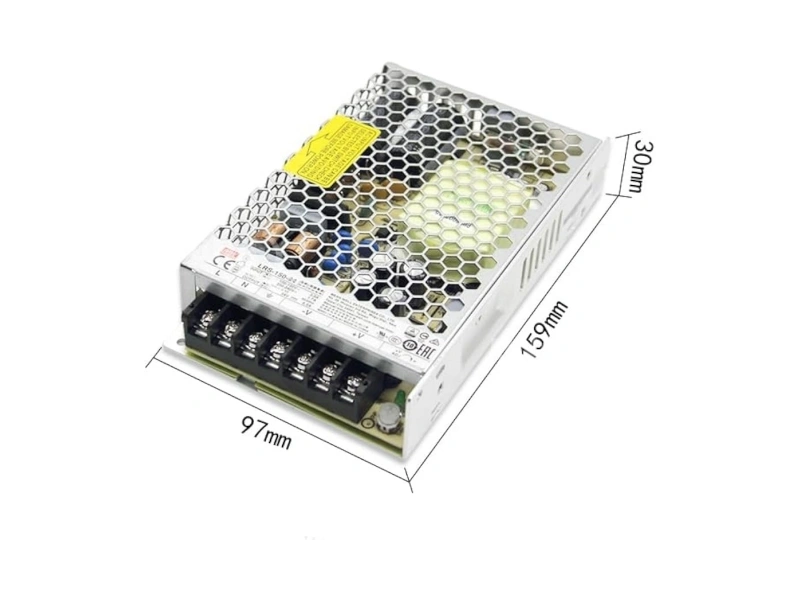
The Mean Well LRS-150 is the 150 W workhorse of the world’s best-selling enclosed switching power supply family: five DC outputs from one 159 × 97 × 30 mm fanless chassis, switch-selectable 85–264 VAC input, hiccup-mode protection and a 3-year warranty — the supply that fits where a screen’s 12 V, 24 V and 48 V electronics live.
📱 / WhatsApp: +86-191-18802497 · Shenzhen, China · GMT+8
12–48 V
5 output voltages, one chassis
150–158.4 W
Rated power per the datasheet
87.5–90%
Published efficiency, all models
−30 to +70°C
Working window, fanless
3 Years
Manufacturer warranty
Short answer
The Mean Well LRS-150 is a 150 W-class single-output enclosed switching power supply offered in five DC voltages — 12 V/12.5 A, 15 V/10 A, 24 V/6.5 A, 36 V/4.3 A and 48 V/3.3 A — from a fanless 159 × 97 × 30 mm, 0.42 kg chassis with a 100–132/170–264 VAC input selected by a physical switch. Per the official datasheet (2025-04-07 revision) the series runs at 87.5–90% efficiency, protects with hiccup-mode short-circuit and overload shutdown that recovers automatically, tolerates a 300 VAC input surge for 5 seconds, carries UL/EN 62368-1 and EN 60335-1 household-appliance safety approvals, and is backed by a 3-year warranty. It does not make 5 V, so LED display modules are fed by other supplies — the LRS-150 owns the 12–48 V side of a screen system: control cabinets, vehicle and pole-mounted signs, lightbox and strip-light walls, and the auxiliary electronics around a display.
What Is the Mean Well LRS-150 Switching Power Supply?
The Mean Well LRS-150 is a single-output enclosed-type AC-DC switching power supply rated for 150 W continuous output, positioned by the manufacturer as the low-profile member of the LRS family: the entire series fits a 30 mm-high, 1U-compatible case with cooling by free air convection only — no fan, no airflow slots to keep clear, no bearing to wear out. The order code reads the output directly: LRS-150-12 is 12 V, LRS-150-24 is 24 V, and so on across the five-voltage line.
The manufacturer is MEAN WELL Enterprises, founded in Taiwan in 1982 and now one of the few standard-power-supply makers operating at true global scale, with manufacturing and service branches across China, Europe, the Americas and Asia. Two numbers explain the brand’s grip on the industrial market. First, the datasheet’s own efficiency column is filled in for every model — 87.5% to 90% — which is unusually transparent for a supply at this price. Second, the reliability claim is published under two counting methods at once: 2,707.7 thousand hours minimum MTBF per Telcordia SR-332 (Bellcore) and 558.2 thousand hours minimum per MIL-HDBK-217F at 25°C. The two figures are not contradictory — they are the same hardware scored under different models — but only like-for-like comparisons mean anything, a point this page returns to below.
Five voltages, one footprint
Every LRS-150 model shares the same 159 × 97 × 30 mm case, the same terminal layout and the same protection set — so a panel design standardized on one voltage migrates to another without redrawing the enclosure.
Standards reach beyond industrial
UL 62368-1 and TUV BS EN/EN 62368-1 for AV/IT equipment plus BS EN/EN 60335-1 and EN 61558-1/-2-16 for household appliances put the LRS-150 inside commercial signage and consumer-adjacent builds that a bare industrial supply cannot enter.
Traceable, warrantied stock
Each unit carries a serial number traceable on the MEAN WELL website and a 3-year manufacturer warranty — the practical answer to the clone problem this series attracts, covered in the buying section below.
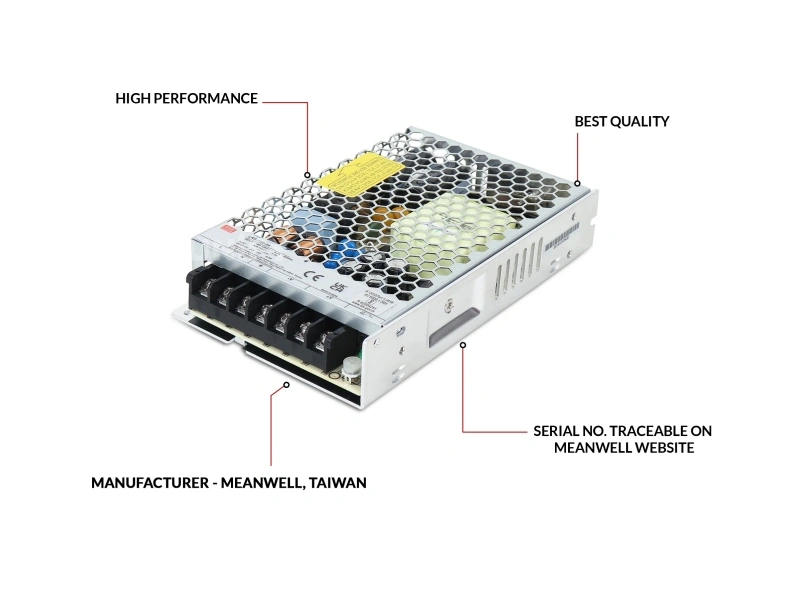
Serial traceability is the buying safeguard: every genuine LRS-150 checks out on the MEAN WELL site
Mean Well’s own introduction to the LRS platform is worth 90 seconds before you spec it:
In an LED display build, the LRS-150 answers a different question than the 5 V supplies that feed the modules themselves. Screens live inside cabinets full of auxiliary electronics — control cabinets, distribution boxes, ventilation and lighting, vehicle signs, strip-light and lightbox walls — and that is the 12–48 V territory this series owns. For the 5 V module bus, see the CZCL LED display power supply family, which covers the screen side; the common cathode LED technology explainer shows why those two buses must stay separate.
What Are the Mean Well LRS-150 Specifications?
All figures come from the official MEAN WELL LRS-150 specification sheet (2025-04-07 revision). One correction most listings get wrong before the table: only the 12 V and 15 V models are rated exactly 150 W — the 24 V model is rated 156 W, the 36 V model 154.8 W, and the 48 V model 158.4 W in the datasheet’s own output table.
| Model | Output | Rated power | Adj. range | Ripple max | Efficiency |
|---|---|---|---|---|---|
| LRS-150-12 | 12 V / 12.5 A | 150 W | 10.2–13.8 V | 150 mVp-p | 87.5% |
| LRS-150-15 | 15 V / 10 A | 150 W | 13.5–18 V | 150 mVp-p | 88.5% |
| LRS-150-24 | 24 V / 6.5 A | 156 W | 21.6–28.8 V | 200 mVp-p | 89% |
| LRS-150-36 | 36 V / 4.3 A | 154.8 W | 32.4–39.6 V | 200 mVp-p | 89% |
| LRS-150-48 | 48 V / 3.3 A | 158.4 W | 43.2–52.8 V | 200 mVp-p | 90% |
| Parameter | LRS-150 series |
|---|---|
| Input voltage range | 85–132 VAC / 170–264 VAC selected by switch; 240–370 VDC with switch on 230 VAC |
| Input frequency / current | 47–63 Hz; 3 A at 115 VAC, 1.7 A at 230 VAC (typ.) |
| Inrush / surge endurance | 60 A cold start at 230 VAC; survives a 300 VAC surge for 5 s |
| Leakage current | <0.75 mA at 240 VAC |
| Setup / rise / hold-up time | 500 ms / 30 ms full load; hold-up 40 ms at 230 VAC, 35 ms at 115 VAC (typ.) |
| No-load power draw | <0.5 W |
| Voltage tolerance / regulation | ±1.0% total; line and load ±0.5%; temp. coefficient ±0.03%/°C |
| Protections | Short circuit and overload 110–140%: hiccup, auto-recovery; overvoltage and overtemperature: shutdown, re-power to reset |
| Withstand / insulation | I/P-O/P 4 kVAC; I/P-FG 2 kVAC; O/P-FG 1.25 kVAC; 100 MΩ at 500 VDC |
| Working environment | −30 to +70°C, 20–90% RH non-condensing (derating curve applies); storage −40 to +85°C |
| Vibration / altitude | 10–500 Hz at 5 G, 60 min per axis; full load to 2,000 m, −5°C per 1,000 m above; operation to 5,000 m derated |
| MTBF | 2,707.7K hrs min. (Telcordia SR-332); 558.2K hrs min. (MIL-HDBK-217F, 25°C) |
| Dimensions / weight | 159 × 97 × 30 mm (case 241A); 0.42 kg; 30 pcs per 13.8 kg carton |
| Safety standards | UL 62368-1; TUV BS EN/EN 62368-1; BS EN/EN 60335-1; BS EN/EN 61558-1/-2-16; GB 4943.1; BSMI CNS15598-1; EAC TP TC 004; BIS IS 13252; AS/NZS 62368.1 |
| EMC | Emission: EN 55032 Class B, EN 55014, EN 61000-3-2 Class A (≤75% load), EN 61000-3-3. Immunity: EN 61000-4-2/3/4/5/6/8/11, EN 61000-6-2, EN 55035 — heavy industry level |
| Build and warranty | 100% full-load burn-in; 65 kHz switching; LED power indicator; 3-year warranty |
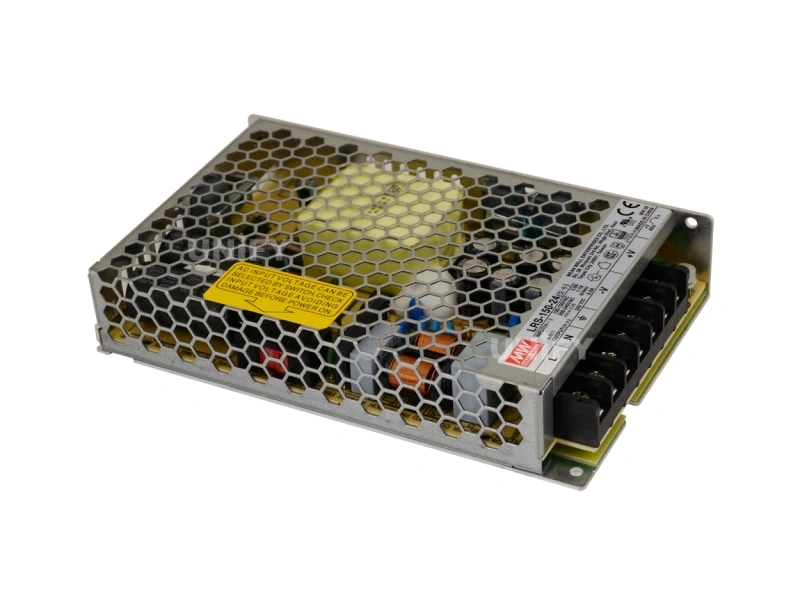
One chassis across the series: 159 × 97 × 30 mm, 0.42 kg, 1U-friendly low profile
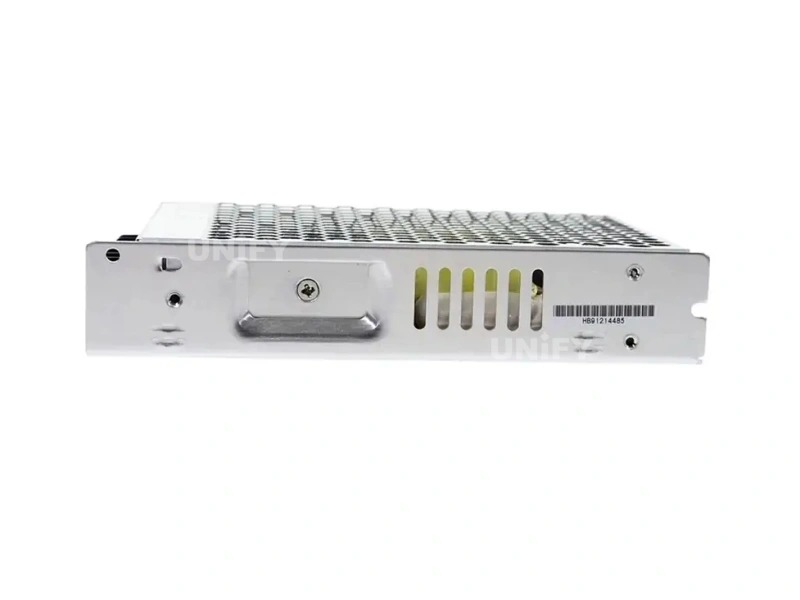
The 30 mm profile is the whole point: convection cooling needs no fan depth
Three field notes most listings skip
First, the wattage trap: catalogs repeat “150 W” across the series, but the datasheet rates the 24 V unit at 156 W and the 48 V unit at 158.4 W — and some listings round the 24 V current down to 6.3 A when the official figure is 6.5 A. Order against the datasheet numbers, not the category name. Second, hold-up time is 40 ms (typical) — comfortable for LED loads, but not the supply to bet on riding through generator changeover gaps. Third, the harmonic compliance EN 61000-3-2 Class A is valid at up to 75% load per the datasheet note — running a unit pinned at 100% in a harmonics-sensitive installation is outside the tested condition.
Which Mean Well LRS-150 Voltage Should You Order?
Match the supply to the load’s nominal voltage first — the five models exist because the ecosystem around a screen runs on different DC buses, not because one is better:
12 V — LRS-150-12 (12.5 A)
Strip-light walls, lightbox edging, LED signs built from 12 V modules, vehicle and taxi-top displays fed from a 12 V battery bus, camera and accessory racks.
24 V — LRS-150-24 (6.5 A)
Pole-mounted and smart-city signs sharing a 24 V battery/solar bus, industrial control cabinets, longer cable runs where halving the current cuts voltage drop.
15 V / 36 V / 48 V
Niche and OEM buses: 48 V powers telecom-style hardware and high-voltage LED arrays; 15 V and 36 V serve instrument and specialty loads. Order the exact match — do not approximate with the adjustment pot.
Not 5 V — and that is by design
The LRS-150 makes no 5 V output, so it cannot feed display modules or receiving cards directly. That bus belongs to dedicated 5 V supplies — the CZCL A-200AC-5 LED switching power at 5 V/40 A is the same cabinet’s other half.
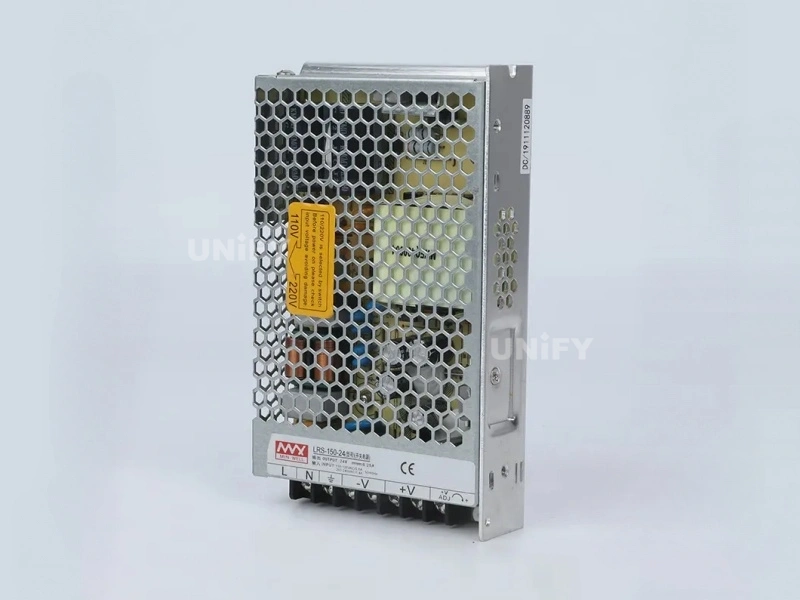
LRS-150-12: the 12 V / 12.5 A workhorse
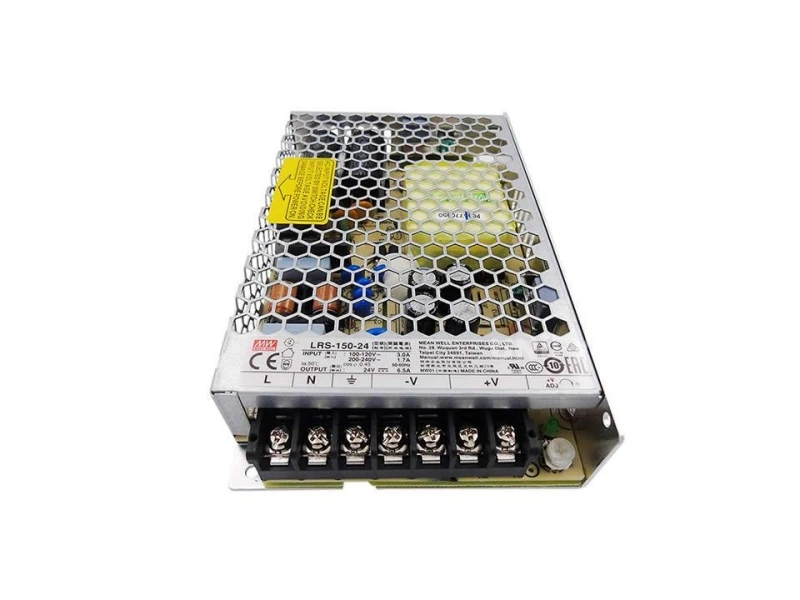
LRS-150-24: rated 156 W, not 150 W
Two rules keep the choice honest. The adjustment potentiometer covers ±10–20% trim (10.2–13.8 V on the 12 V model, for example) — it exists to compensate cable drop and fine-tune brightness, not to convert a 12 V supply into a 15 V one. And if the load list mixes voltages, size each bus separately and let one chassis carry one bus; the sizing walkthrough in the LED power supply selection guide applies to any brand’s units, including this one.
How Much LED Load Can a Mean Well LRS-150 Carry?
Apply the 80% rule — the standard derating that leaves room for inrush, ambient heat and aging — to each model’s rated power:
| Model | Rated | 80% usable power | Usable current |
|---|---|---|---|
| LRS-150-12 | 150 W | 120 W | 10.0 A at 12 V |
| LRS-150-15 | 150 W | 120 W | 8.0 A at 15 V |
| LRS-150-24 | 156 W | 124.8 W | 5.2 A at 24 V |
| LRS-150-36 | 154.8 W | 123.8 W | 3.44 A at 36 V |
| LRS-150-48 | 158.4 W | 126.7 W | 2.64 A at 48 V |
Notice what the math produces: every model lands within a 120–127 W usable window. The five voltages buy you bus compatibility, not capacity — if a quoting sheet claims one LRS-150 variant carries meaningfully more than another, someone is reading the nameplate, not the derating. For a worked example, a 12 V strip-light wall drawing 8 W per meter covers 15 meters of run on one LRS-150-12’s 120 W budget; a 24 V cabinet load of 100 W fits inside the 24 V model with a fifth of headroom to spare. The screen-level version of this arithmetic — modules, peak wattage and duty cycle — is laid out in the LED display power consumption guide, and the per-cabinet counting method is in how many power supplies an LED screen needs.
One layout caution: the derating curve ties full output to ambient temperature and input voltage. Inside a sealed cabinet at 50–60°C, plan against the curve rather than the nameplate — the same discipline the 5 V screen supplies follow, for the same physics.
How Does the Mean Well LRS-150 Input Switch Work?
The LRS-150’s single most dangerous feature is also printed in its own name: the input range is selected by a physical slide switch, not detected automatically. One position covers 85–132 VAC (Japan, Taiwan, North America 120 V grids), the other 170–264 VAC (China, Europe, most of Asia and the Middle East). The selector is hidden under the case shell by design — open the shell, check the switch position against your grid before the first energization, and re-check after any unit swap.
Switch on 115, grid at 230 V
Overvoltage on the input stage — at best the protection trips, at worst the unit dies on energization. This is the classic failure of units shipped from a 230 V market into a 120 V one and re-energized unchecked.
Switch on 230, grid at 115 V
No damage, but the output sags or never comes up — the supply cannot regulate from half its design input. Symptom looks like a dead unit; the fix is a screwdriver, not a warranty claim.
The flip side is surge toughness: the datasheet’s 300 VAC input surge endurance for 5 seconds gives the 230 V position real headroom against grid events, and the 60 A cold-start inrush at 230 VAC is handled by the front-end without external parts. The input draws 1.7 A at 230 VAC (3 A at 115 VAC), so a 6 A circuit breaker per unit is generous even with several supplies sharing a phase — the breaker-side math for screen builds is worked through in the PSU counting guide.
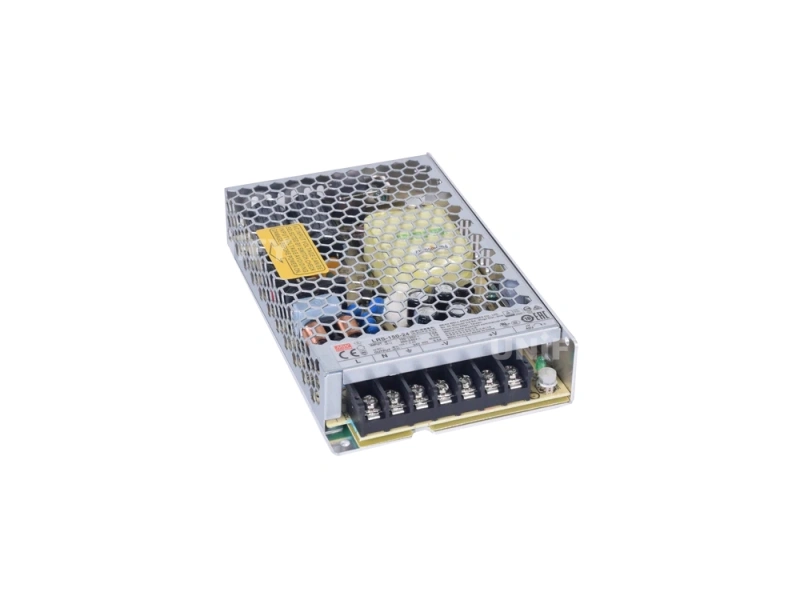
The LRS-150-12 label block: input switch position is under the shell — verify before energizing
What Protections and Certifications Does the Mean Well LRS-150 Carry?
Four protection layers, three of them self-recovering:
Short circuit — hiccup, auto-recovery
A shorted output pulses rather than latching: the supply retries continuously and resumes the moment the fault clears. A wiring mistake on a live cabinet becomes a blinking fault instead of a dead supply.
Overload 110–140% — hiccup, auto-recovery
Loads beyond 140% of rating trip the same pulsing behavior. The band gives momentary peaks (motor starts, lamp cold-start) room before protection engages.
Overvoltage — shutdown, manual reset
If the output runs past the OVP window (13.8–16.2 V on the 12 V model, for instance), the supply latches off and requires a re-power cycle — deliberate, because a runaway voltage kills the load it feeds.
Overtemperature — shutdown, manual reset
Thermal shutdown latches the same way. In a fanless design this is the last line behind the derating curve — if it trips, the enclosure ventilation is the thing to fix.
The certification stack is unusually wide for a 150 W industrial-class unit: UL 62368-1 and TUV BS EN/EN 62368-1 (AV/IT), BS EN/EN 60335-1 and EN 61558-1/-2-16 (household appliances — the approvals that let the series inside commercial and consumer-adjacent signage), GB 4943.1, BSMI, EAC and BIS marks, plus EMC emission at EN 55032 Class B and immunity to heavy industry level under EN 61000-6-2. Isolation is specified at 4 kVAC input-to-output with 100 MΩ insulation resistance.
Ripple and noise — 150 mVp-p on the 12/15 V models, 200 mVp-p on 24/36/48 V — is the number that decides whether a supply annoys sensitive LED drivers and camera equipment down the cable. Mean Well publishes the measurement method it uses:
How Does the Mean Well LRS-150 Compare With CZCL Display Power Supplies?
These supplies are not substitutes — they are the two halves of a cabinet’s power architecture. The comparison that matters is which bus each one feeds:
| Dimension | Mean Well LRS-150 | CZCL display family (A/B series) |
|---|---|---|
| Output bus | 12 / 15 / 24 / 36 / 48 V single rail | 5 V single rail (40/60/80 A) or 3.8 V + 2.8 V dual rail |
| Feeds what | Control cabinets, strip/lightbox walls, vehicle and pole signs, industrial loads | LED display modules and receiving cards — the screen itself |
| Rated power | 150–158.4 W | 170–400 W |
| Efficiency (published) | 87.5–90%, every model | 90% on the A-400JQ-5P; not stated on others |
| MTBF (MIL-HDBK-217F, 25°C) | 558.2K hours (plus Telcordia 2,707.7K) | 100K–250K hours on published models |
| Input | 85–132 / 170–264 VAC by switch | 180–264 VAC fixed windows (230 V markets) |
| Working temperature | −30 to +70°C | −40 to +70°C across the family |
| Warranty | 3 years, serial-traceable | Project-dependent (ask with the quote) |
Two honest readings of that table. On reliability, compare like with like: under the same MIL-HDBK-217F method the LRS-150’s 558.2K hours leads the CZCL family’s published 100K–250K figures — though CZCL’s dual-rail B-200AF serves a bus the LRS-150 cannot touch at any rating. On input flexibility, the LRS-150’s switch covers 115 V markets out of the box, where the CZCL screen supplies are 230 V-market units; a US or Japan build needs the switch-capable side for its auxiliary loads. The full 5 V screen-side lineup sits in the CZCL power supply collection, with the dual-rail specialist on its own page: CZCL B-200AF LED switching power, and the 400 W PFC flagship at CZCL A-400JQ-5P.
How Do You Install and Wire a Mean Well LRS-150 Safely?
Six steps cover a clean installation. The terminal block runs AC-in (L, N, FG ground) on one end and DC-out (+V, −V) plus the +ADJ trim pot on the other; the FG terminal must be earthed — it is the return path for the EMI filter, not an optional stud.
1Set the input switch first. Open the shell, confirm the 115/230 selector matches the grid you are connecting, and mark the unit’s config on the install sheet.
2Mount metal-to-metal. The case is the heatsink: fix all M3 flanges against a clean metal plate inside the enclosure, orientation horizontal, and respect the derating curve above 50°C ambient.
3Earth FG before anything else. Ground first, then L/N, then DC. Never fast-ride the supply by hot-plugging DC into a live harness.
4Torque and dress the DC runs. Keep +V/−V pairs twisted and short; on long runs, use the +ADJ pot to lift output against cable drop rather than oversizing the supply.
5Verify before load. Energize unloaded, meter the output against the +ADJ marking, then connect the load — the habit that separates a commissioning from a troubleshooting call.
6Respect the IP20 case. The chassis is open-frame-perforated: it belongs inside a dry enclosure, never directly in an outdoor cabinet without sealing — see the LED screen cabinet guide for enclosure planning.
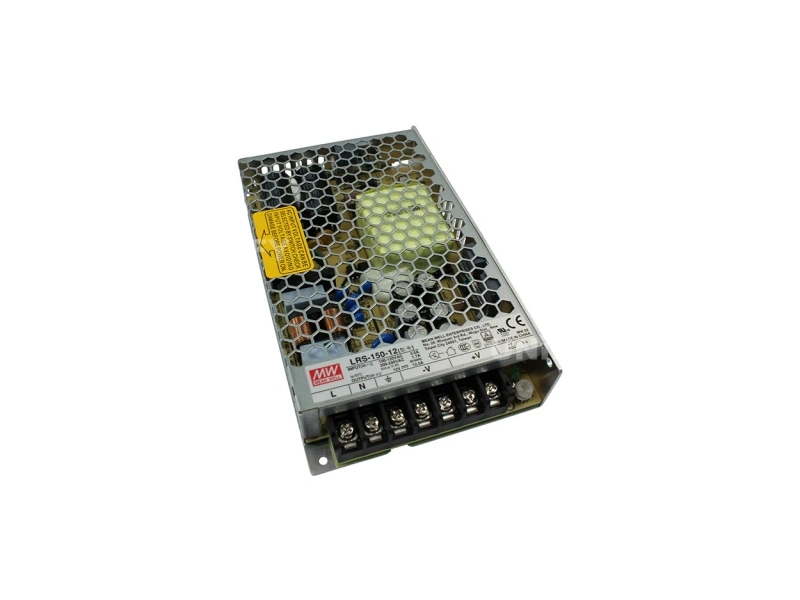
Terminal layout on the LRS-150-24: AC-in (L, N, FG) left, DC-out (+V, −V) and +ADJ right
Where Does the LRS-150 Fit in an LED Display System?
Picture a screen build as two power domains. The 5 V domain is the display surface: modules and receiving cards, fed by high-current 5 V supplies sized per cabinet. The 12–48 V domain is everything that makes the surface deployable, and that is where the LRS-150 earns its slot:
Auxiliary and control cabinets
Distribution boxes, controllers, media players, routers, sensors and cabinet lighting — the electronics that run on industrial 12/24 V rails rather than the module bus.
Vehicle and pole-mounted signs
Taxi tops, bus interiors and smart-pole signage live on 12 V or 24 V battery/solar buses — the LRS-150’s −30°C floor and 5 G vibration rating are written for exactly these mounts.
Strip-light and lightbox walls
Retail channel-letter walls, lightbox grids and LED strip scenery built on 12/24 V constant-voltage loads — the classic high-volume use the series is priced for.
On the reliability side, remember the two MTBF figures name the same unit under two standards: 2,707.7K hours by Telcordia SR-332 and 558.2K hours by MIL-HDBK-217F at 25°C. Use the Telcordia number within Mean Well’s own catalog, and the MIL number when benchmarking against other makers’ MIL-rated supplies — the same discipline as comparing efficiencies at one load point, not across marketing tables.
What Problems Does a Failing Power Supply Cause?
Auxiliary-rail failures announce themselves downstream — here is what each symptom points at before you pull a cabinet apart:
🔌 Cameras, fans and sensors rebooting
A sagging 12 V rail dropping below reset thresholds under load. Meter the rail at full draw; a supply that reads fine unloaded and sags loaded has aged past its electrolytics.
💡 Strip and lightbox sections dimming or flickering
Shared-rail voltage drop or a tripping overload protection pulsing the output. If sections brighten when neighbors power off, the supply — not the strip — is undersized. Symptom mapping continues in LED screen flickering and uneven brightness troubleshooting.
⚡ A unit that hums, then goes quiet
Hiccup-mode cycling on a developing short — audibly a slow click, visually a load that blinks at a steady rhythm. Kill power and meter the output side before retry.
Diagnosing one supply at a time beats shotgun-swapping units — the voltage-test habit in our own teardown video is the 60-second version:
The full replacement workflow — isolation, metering, swap order and post-swap verification — is in the power supply diagnostics and replacement guide.
How Much Does the Mean Well LRS-150 Cost?
As a standard catalog part sold through global distribution, the LRS-150 is one of the few power supplies with a genuinely public street price — and that price is stable in a way that matters against the 2026 component-cost story covered in the LED display supply chain price surge analysis. Current published distributor pricing:
| Model | Unit price (qty 1) | Volume price | Source |
|---|---|---|---|
| LRS-150-12 | $12.75 | $11.46 at 100+ pcs | StepperOnline (US) |
| LRS-150-15 | $12.90 | Tiered by qty | TME (EU/US) |
| LRS-150-24 | $20.39 | $18.54 at 10+ pcs | TRC Electronics (US) |
| LRS-150-48 | $20.39 | Tiered by qty | TME (EU/US) |
Read that table as a bracket, not a quote: distributor list for the popular models runs $11.50–$20.50 depending on voltage and quantity, European houses list in the €13–€18 band before VAT, and project pricing through an integrator lands below retail with warranty handling included. The CZCL family’s pricing logic — what each watt actually costs — is broken down in the CZCL power supply price guide, and the same per-watt math applies here: at $12.75 for 150 W rated, an LRS-150-12 costs about 8.5 cents per rated watt at unit quantity, dropping toward 7.7 cents at the 100-piece price.
One buying caution specific to this series: the LRS-150 is the most cloned Mean Well line in the market. Genuine units carry a serial number traceable on the MEAN WELL website and the 3-year warranty behind it — a clone’s few dollars of discount buys you an unverified isolation barrier on a mains-connected device, which is the wrong side to economize on.
Mean Well LRS-150: Frequently Asked Questions
Can the Mean Well LRS-150 output 5 V for LED display modules?
No. The series spans 12, 15, 24, 36 and 48 V and has no 5 V model, so it cannot feed display modules or receiving cards directly. The 5 V module bus belongs to dedicated screen supplies such as the CZCL A/B family — the LRS-150 covers the 12–48 V side of the same system.
Why is the LRS-150-24 rated 156 W instead of 150 W?
The series name carries the nominal rating, but the datasheet’s own output table rates each model exactly: 150 W at 12/15 V, 156 W at 24 V, 154.8 W at 36 V and 158.4 W at 48 V. Order against the table — and note that some listings also round the 24 V current down to 6.3 A when the official figure is 6.5 A.
What happens if the 115/230 VAC input switch is set wrong?
Switch set to 115 with a 230 V grid connected risks destroying the input stage at energization. Switch set to 230 on a 115 V grid is harmless but the supply cannot regulate — it appears dead. Check the switch under the shell before first power-on and after every unit swap.
Can I parallel two LRS-150 units for more power?
No. The series has no current-sharing design, so paralleled units will not divide the load evenly and one will carry most of it. Add a second supply feeding a separate load group instead, or move up a power class in the LRS range.
How many LED modules can one LRS-150-12 run?
Apply the 80% rule: 150 W × 80% = 120 W usable, or 10 A at 12 V. Divide that by each module’s draw — 30 W modules give four per supply, an 8 W/m strip wall covers 15 meters. Keep the same rule per bus and the supply stays inside its derating curve.
Is the LRS-150 suitable for outdoor LED cabinets?
Only inside a sealed enclosure — the perforated IP20 case is convection-cooled and not weather-sealed. The −30 to +70°C window and 5 G vibration rating suit outdoor equipment enclosures and vehicle mounts, provided the unit stays dry and mounted metal-to-metal for heat transfer.
How do I verify a genuine Mean Well LRS-150?
Every genuine unit carries a serial number traceable on the MEAN WELL website, plus the full label block with model, input split and approvals. Counterfeits of this series are common; serial verification takes seconds and is the difference between a 3-year warranty and an unverified mains device.
What is the real MTBF of the LRS-150?
Both published figures are real — they are the same hardware scored under different reliability models: 2,707.7 thousand hours minimum by Telcordia SR-332 (Bellcore) and 558.2 thousand hours minimum by MIL-HDBK-217F at 25°C. Use the MIL figure when comparing against other manufacturers’ MIL-rated supplies and the Telcordia figure within Mean Well’s own catalog.
Related Power Pages and Guides
CZCL Display Power Supply Hub
The 5 V screen-side family: four CZCL supplies compared, sized and linked to their spec pages.
How Many Power Supplies Does an LED Screen Need?
Per-cabinet counting, breaker math and the 80% rule applied to a full wall.
Power Supply Diagnostics & Replacement
From symptom to swapped unit: isolation, metering and verification workflow.
CZCL B-200AF (Dual Rail 3.8 V + 2.8 V)
The common-cathode specialist the LRS-150 cannot substitute: two rails, one fanless chassis.
LED Display Power Supply (Mother Catalog)
The three-brand mother catalog: 27 model pages, 2026 price bands, architecture map and the 80% load math — start here.
UnifyLED LED Display Solutions
The full build picture: indoor and outdoor screens, control systems, cabinets and power architecture.
Need Mean Well LRS-150 Units for Your Project?
Tell us the load list and grid voltage — we will confirm the model, quantity and input-switch config, and quote genuine serial-traceable stock with the 3-year warranty intact.