
3 Series · 9 Models · 200–500 W · Multi-Voltage Rails for Common-Cathode · From $11.99
G-Energy LED Display Power Supply
The G-Energy LED display power supply catalog: nine models across three lines — the JPS box platform that steps one 400 W chassis across 5.0 V, 4.5 V, 4.2 V and dual-rail 4.0 V + 3.2 V outputs for common-cathode screens, the slim J400 rail at 5 V / 80 A, and the budget N series from $11.99. Distributor-listed specs, per-cabinet load math and pricing, all in one place.
📱 / WhatsApp: +86-191-18802497 · Shenzhen, China · GMT+8
3
Lines on this page
9
Models cataloged
4.0 + 3.2 V
Dual-rail common-cathode
90–264 VAC
Universal (JPS V5.0)
$11.99
Entry street price
Short answer
A G-Energy LED display power supply is a switching-mode AC/DC unit from G-Energy (巨能伟业, a Shenzhen-based, LED-screen-native power brand) that converts mains into the low-voltage DC rails an LED screen runs on. The catalog on this page covers three lines: the JPS box platform — one 400 W chassis stepped across 5.0 V / 80 A single-rail, dual-rail 4.0 V + 3.2 V and 3.8 V + 2.8 V outputs for common-cathode energy-saving screens, plus 250 W and 500 W-class variants — the slim J400 rail delivering 5 V / 80 A / 400 W, and the budget N series (5 V / 40 A and 5 V / 60 A) that starts near $11.99. Specs below are distributor-listed; request the factory datasheet for tender-grade paperwork.
What Is a G-Energy LED Display Power Supply?
A G-Energy LED display power supply is the component that turns wall power into the low-voltage DC buses an LED screen actually runs on: it rectifies and regulates single-phase AC mains into 4.x V and 5 V DC at tens of amps, feeding LED modules, receiving cards and hub boards inside each cabinet. G-Energy (巨能伟业, Shenzhen) is an LED-screen-native power brand — display supplies are the core business rather than a sideline — and its units ship into screen factories and rental fleets alongside the CZCL and Mean Well families documented on this site.
The catalog divides by what the cabinet asks for. What makes the brand distinctive is the multi-voltage rail strategy: the same JPS box platform ships as a 5.0 V single-rail unit for standard screens and as dual-rail 4.0 V + 3.2 V (or 3.8 V + 2.8 V) units for common-cathode energy-saving screens, where the LED string and the driver ICs each get their own regulated bus. The slim J400 rail covers compact bays at 400 W, and the N series undercuts the market on price for budget-led builds.
What Are the Three G-Energy LED Display Power Supply Series?
Three lines cover the display lineup. Every figure below is signed to the distributor listings (ledscreenparts.com, observed September 2026) — request the factory datasheet for tender-grade specs.
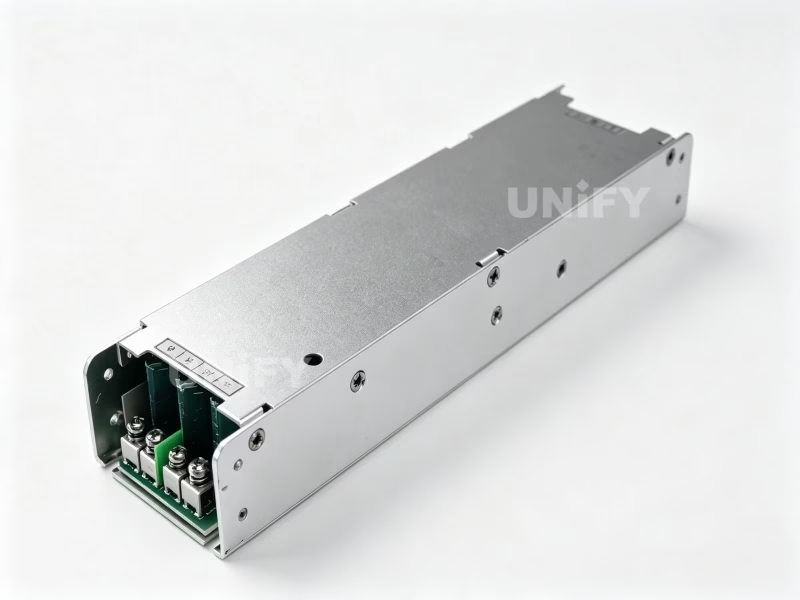
JPS · Multi-Voltage Box Platform
One 400 W chassis, many rails: 5.0 V / 80 A single-rail on a 90–264 VAC window at 26.5 mm, dual-rail 4.0 V + 3.2 V and 3.8 V + 2.8 V for common-cathode screens, a 4.5 V / 50 A variant, and 500 W-class builds.
Best for: common-cathode energy-saving screens, mixed fleets, one-platform stocking.
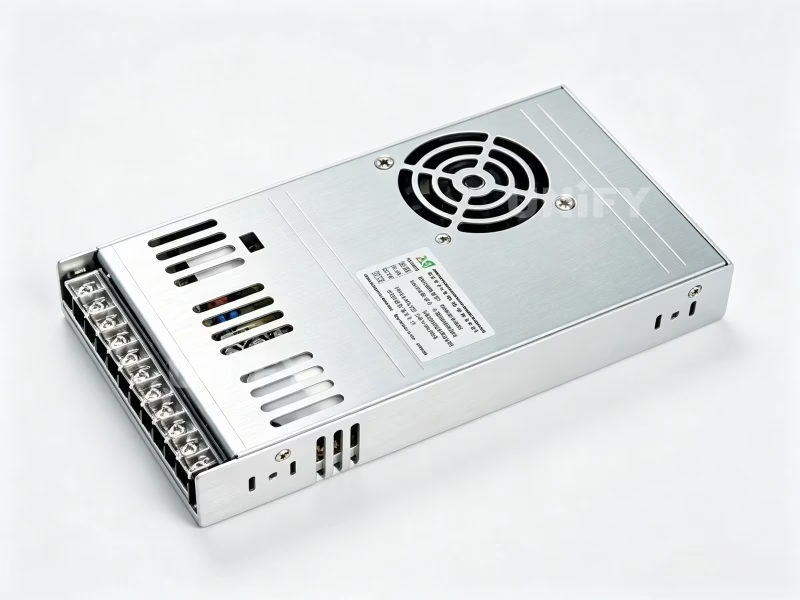
J400 · Slim Rail 400 W
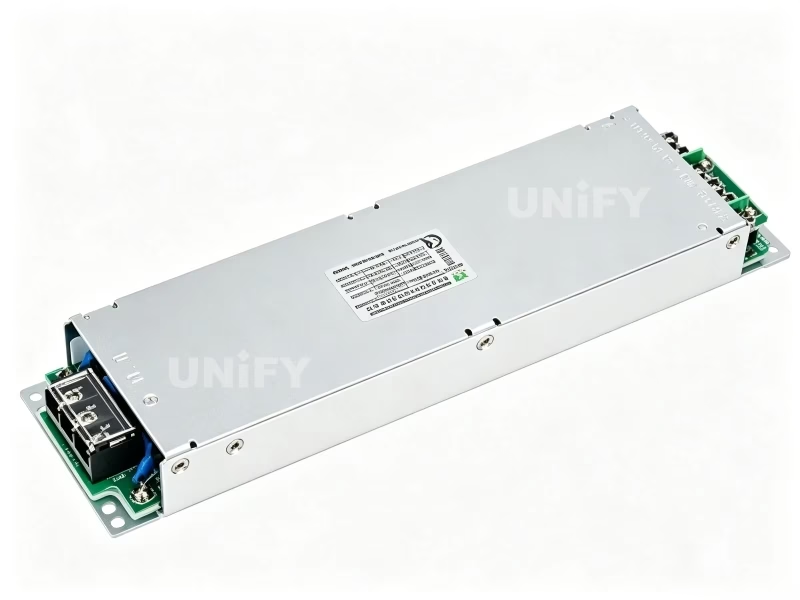
A slim 212 × 60 × 30 mm rail delivering 5 V / 80 A / 400 W with ventilation cooling — the compact-bay answer when a box will not fit.
Best for: tight power bays, cabinet retrofits, 400 W single-rail density.
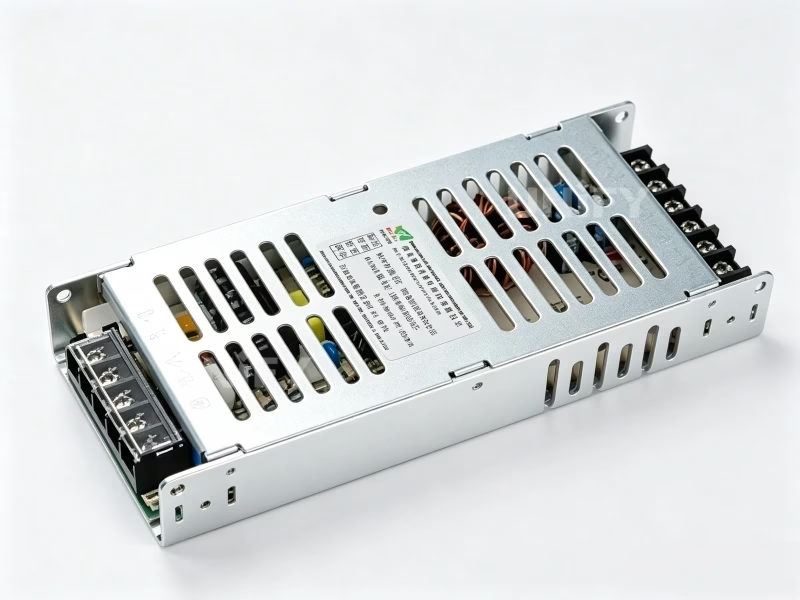
N · Budget Mesh Series
Mesh-ventilated slim rails at the market’s floor pricing: 5 V / 40 A / 200 W (N200) and 5 V / 60 A / 300 W (N300) on a 200–240 VAC input window.
Best for: budget-led builds on stable 220 V grids, cost-per-watt bidding.
| Model | Output | Input window | Form / cooling | Street price |
|---|---|---|---|---|
| JPS400P V5.0 | 5 V / 0–80 A / 400 W, ≥90%, ≤250 mVp-p | 90–264 VAC universal | Box, natural cooling, 220 × 52 × 26.5 mm, −40 to +70°C | $22.99–49.99 |
| JPS400P V5.0A43 | V5.0 platform, A43 variant | 90–264 VAC | Box, natural cooling | Quote |
| JPS400P V4.0-3.2A39 | Dual: 4.0 V @ 60 A + 3.2 V @ 40 A (176–240 V); 48 A + 32 A (100–175 V) | 100–240 VAC, 5.0 A max | Box, dual output | $51.99 |
| JPS400P V3.8-2.8A1 | Dual: 3.8 V + 2.8 V (common-cathode) | Wide input | Box, natural cooling | $49.99–51.99 |
| JPS250P V4.5-EC | 4.5 V / 50 A (225 W) | 100–240 VAC wide | Box with signal header | $32.99–49.99 |
| JPS500P V4.2 (A67-EC) | 500 W-class, 4.2 V rail (dual-rail family) | Per variant | Box, fan-cooled | Quote |
| J400P V5.0A7 | 5 V / 80 A / 400 W | 176–240 VAC, 3.0 A max | Slim rail, ventilation cooling, 212 × 60 × 30 mm | $41.99–51.99 |
| J400 V5.0 | 5 V, up to 80 A / 400 W class | Per variant | Slim rail | $26.99–49.00 |
| N200 V5 (-BN-EC) | 5 V / 40 A / 200 W, 2.5 A max input | 200–240 VAC, 47–63 Hz | Mesh slim rail | $11.99–16.99 |
| N300 V5 (-A) | 5 V / 60 A / 300 W | 200–240 VAC | Mesh slim rail | $17.99–29.99 |
Street prices are single-piece distributor listings; project and volume tiers step down sharply.
Which G-Energy LED Display Power Supply Fits Your Screen?
Match the supply to the cabinet in three questions: what rail does the module architecture demand, how much power does the cabinet actually draw, and what does the grid at the site look like. The quick table reads left to right:
| Your screen | Pick | Why |
|---|---|---|
| Standard 5 V screen, budget tender | N200 V5 / N300 V5 | 160–240 W usable budgets at the market’s floor pricing — on a stable 220 V grid. |
| Standard 5 V screen, mixed grids | JPS400P V5.0 | The one universal-input unit (90–264 VAC): 320 W usable in a 26.5 mm chassis. |
| Common-cathode energy-saving modules | JPS400P V4.0-3.2 / V3.8-2.8 | Dual independent rails from one chassis — LED bus and driver bus each regulated. |
| Tight power bay, 400 W single rail | J400P V5.0A7 | 80 A in a 212 × 60 × 30 mm ventilated rail. |
| High-density 4.x V architecture | JPS250P V4.5 / JPS500P V4.2 | 4.5 V / 50 A and 500 W-class 4.2 V builds for low-voltage module rows. |
Mixing is normal: a screen can run JPS400P V5.0 units on standard rows and JPS dual-rail units on common-cathode sections, as long as every bus carries the rail voltage its modules were designed for. The one wrong mix is architecture — a single-rail 5 V unit cannot feed a common-cathode screen, and vice versa.
How Much Load Can Each G-Energy LED Display Power Supply Carry?
Every supply obeys the industry-standard 80% loading rule. Plan cabinets against these usable budgets:
| Model | Rated | Usable at 80% | Typical coverage |
|---|---|---|---|
| N200 V5 | 200 W / 40 A | 160 W / 32 A | One 500 × 500 mm indoor cabinet (4 P2.5-class modules + receiving card) |
| N300 V5 | 300 W / 60 A | 240 W / 48 A | A dense 500 × 1000 mm indoor cabinet |
| JPS250P V4.5 | 225 W / 50 A (4.5 V) | 180 W / 40 A | A 4.5 V rail cabinet section |
| JPS400P V5.0 / J400 V5.0 | 400 W / 80 A | 320 W / 64 A | Fewest-supply designs; two small cabinets concentrated |
| JPS400P V4.0-3.2A39 (dual) | 4.0 V @ 60 A + 3.2 V @ 40 A | 48 A + 32 A per rail | One common-cathode cabinet’s two buses |
| JPS500P V4.2 | 500 W-class | 400 W-class | Bright common-cathode rows; quote per variant |
Turn these budgets into module counts with the per-module draws in our LED display power consumption guide — average program material for indoor P2.5 sits near 10–15 W, outdoor P4.81 nearer 20–30 W, and receiving cards take 3–5 W apiece on the same rail. The per-cabinet count logic lives in how many power supplies an LED screen needs.
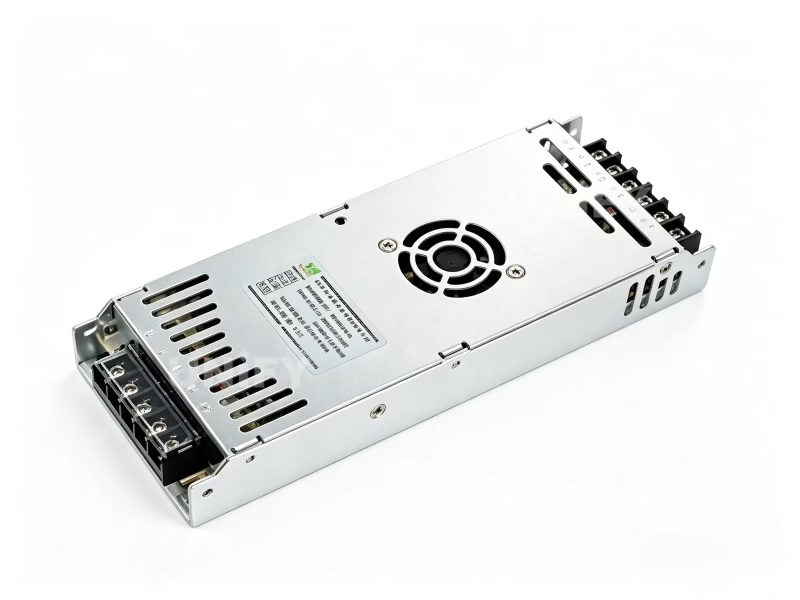
Which Input Grids Do G-Energy LED Display Power Supplies Cover?
The three lines sit on three different input tiers — check the grid before the harness is built, because only one line crosses both world grids:
| Line | Input window | Meaning |
|---|---|---|
| JPS V5.0 | 90–264 VAC universal | One window for 110 V and 220 V grids alike — the only G-Energy unit on this page rated for 110 V grids |
| JPS dual-rail / V4.5 | 100–240 VAC | Wide window that still crosses both grids; the dual-rail unit derates its current below 175 V (48 A + 32 A instead of 60 A + 40 A) |
| J400 V5.0 | 176–240 VAC | 220 V-grid design center; excludes 110 V grids outright |
| N series | 200–240 VAC | Narrow window for stable 220–240 V grids — the budget trade behind the $11.99 floor |
US, Canada, Japan: one unit qualifies
Only the JPS400P V5.0 (90–264 VAC universal) accepts 100–120 V grids in this catalog. The dual-rail common-cathode units start at 100 VAC but derate below 175 V, and the J400 and N series shut 110 V grids out. For 110 V-market projects, see the Mean Well family — its RSP and UHP lines carry 90–264 VAC windows across the board.
Why Does G-Energy Build Multi-Voltage Rails for Common-Cathode Screens?
Most power brands sell one output voltage and move on. G-Energy’s JPS platform instead steps a single 400 W chassis across an entire voltage ladder — 5.0 V, 4.6 V, 4.5 V, 4.2 V, dual-rail 4.0 V + 3.2 V, dual-rail 3.8 V + 2.8 V — and the reason sits inside the module:
Standard screens: one 5 V bus
Conventional modules drive their LEDs from a 5 V rail through constant-current driver ICs — the JPS400P V5.0 (5 V / 80 A) and the N series serve them.
Common-cathode screens: two buses
Energy-saving modules split the wiring: the LED string runs from a lower positive rail sized near its forward voltage, and the driver ICs run from an even lower independent rail — the difference voltage stops burning as heat inside the drivers.
The G-Energy answer: rails to match
The V4.0-3.2A39 delivers 4.0 V for the LED bus plus 3.2 V for the driver bus from one chassis; the V3.8-2.8A1 steps the pair lower still. One platform, both screen architectures.
The wiring discipline matters: on the dual-rail units, label the two buses at harness stage and never swap them — feeding the driver bus from the LED rail (or the reverse) is the fastest way to darken a cabinet. The architecture explainer lives in our common cathode LED technology guide, and the CZCL family’s dual-rail answer is the B-200AF (3.8 V + 2.8 V from a fanless chassis).
G-Energy vs CZCL vs Mean Well: Which 200-400 W Supply Wins?
At the 5 V display point, three names share most bill-of-materials. The honest comparison, model-for-model:
- Price position: G-Energy holds the floor — the N200 V5 lists at $11.99–16.99 against the CZCL A-200AC-5 at $12.50–29.99 and the Mean Well UHP-200-5 near $36.
- Multi-voltage rails: G-Energy’s JPS platform carries the widest rail menu in this comparison (5.0 / 4.6 / 4.5 / 4.2 V single-rail plus 4.0+3.2 V and 3.8+2.8 V dual-rail); CZCL counters with the B-200AF dual-rail; Mean Well’s display lines stay single-rail 5 V (or 12 V+ on the RSP-1000).
- Input window: Mean Well wins outright — 90–264 VAC continuous with active PFC across the RSP/UHP lines; G-Energy’s universal unit is the single JPS400P V5.0, and the N series stops at 200–240 VAC.
- Documentation: CZCL and Mean Well publish datasheet-grade specs and MTBF figures; G-Energy’s display units are distributor-listed — request the factory datasheet for tender work.
- Where each wins: budget-led builds on stable 220 V grids pick G-Energy; common-cathode projects pick G-Energy or CZCL by rail menu; 110 V grids, generator sites and tender files pick Mean Well.
Full family detail on the competitors: the Mean Well LED display power supply hub carries fourteen models, and the CZCL LED display power supply hub carries four series with datasheet-level specs.
How Much Does a G-Energy LED Display Power Supply Cost?
Observed single-piece distributor pricing, September 2026, signed to source; project and volume tiers step down sharply from these singles:
| Model | Street price | Source |
|---|---|---|
| N200 V5 (-BN-EC) | $11.99–16.99 | ledscreenparts.com |
| N300 V5 | $17.99–29.99 | ledscreenparts.com |
| JPS400P V5.0 | $22.99–49.99 | ledscreenparts.com |
| JPS250P V4.5-EC | $32.99–49.99 | ledscreenparts.com |
| J400 series | $26.99–51.99 | ledscreenparts.com |
| JPS400P dual-rail / JPS500P | $49.99–51.99 / quote | ledscreenparts.com / project channel |
Sample · 1–10 pcs
Repairs, prototypes, trial cabinets — shipped from distributor stock with the nameplate batch visible.
Project · 10–500 pcs
Whole-screen quantities with per-cabinet (or per-rail) load math and factory datasheets for the inspection file.
Volume · 500+ pcs
Production-line pricing with container freight planning and batch date-code consistency.
Which Applications Use G-Energy LED Display Power Supplies?
Four scenarios cover most of the family’s deployment map — each links to a screen build where the same math applies:
Budget indoor fixed walls
N200/N300 density math per cabinet at the market’s floor pricing — for lobbies, churches and retail on stable 220 V grids.
Common-cathode energy-saving screens
JPS dual-rail units feed the LED bus and driver bus independently — the architecture that cuts the cabinet’s power bill.
Slim and retrofitted bays
The J400 rail packs 80 A into 30 mm of profile for bays that reject box-format supplies.
Mixed-architecture fleets
One JPS platform stocks 5 V, 4.5 V, 4.2 V and dual-rail variants — one spares shelf across both screen architectures.
How Do You Install and Wire G-Energy LED Display Power Supplies Safely?
The family shares one installation discipline, with one per-series twist. Common to all: mount on the flanges, bond FG to cabinet earth, meter polarity before the first power-up, and size every unit to the 80% budget.
1 · Match the input window to the grid
Only the JPS400P V5.0 takes 110 V grids; the J400 needs 176–240 V and the N series 200–240 V. Catching that at survey stage is free; catching it at commissioning is not.
2 · Wire AC, earth, then DC — and meter before power
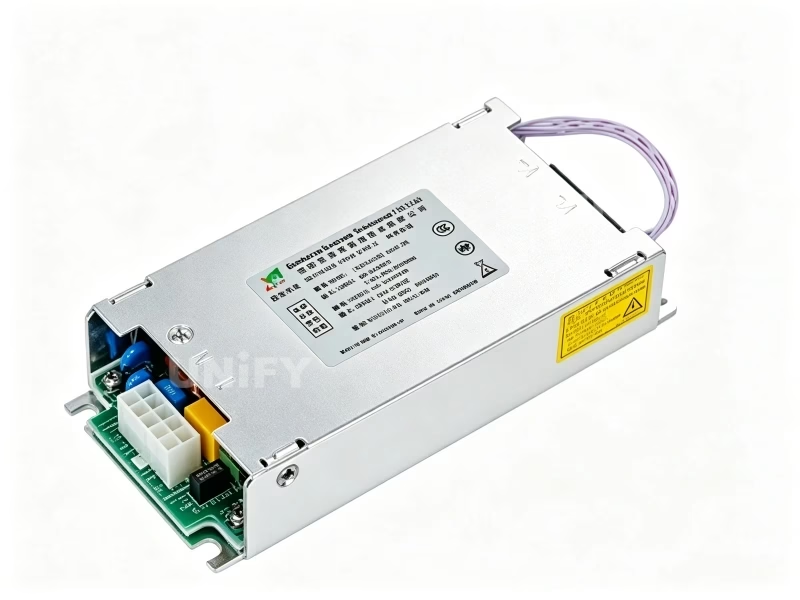
Follow the terminal map on each unit; the JPS platform’s screw terminals and signal header follow the same layout across the voltage variants.
3 · On dual-rail units, label both buses
The V4.0-3.2 and V3.8-2.8 outputs are independent: mark the LED bus and the driver bus at harness stage, and never swap them.
4 · Load-test and log the fleet
Full white for ten minutes, rail voltage verified at the bus far end, serials onto the cabinet map. Our bench workflow:
When a unit does fail, the LED display power supply diagnostics and replacement guide carries the full test-and-swap workflow — and our bench rail-voltage test:
What Problems Do Failing LED Power Supplies Cause?
Power trouble wears disguises — three signatures cover most field calls across this family:
Dim or uneven brightness, one cabinet
Aging capacitors sag the rail under load; the cabinet corner looks tired at full white while neighbors shine.
Flicker on camera or under load spikes
Frame-by-frame rail dips track bright content — suspect the supply before the module.
Cabinet reboots or dead sections
Protection cycling reads as “random” dead cabinets; on dual-rail builds, a swapped bus pair reads the same. Measure both rails during the dropout.
G-Energy LED Display Power Supply: Frequently Asked Questions
Who makes G-Energy LED display power supplies?
G-Energy (巨能伟业) is a Shenzhen-based, LED-screen-native power brand — display supplies are its core business. The specs on this page are distributor-listed (ledscreenparts.com, observed September 2026); request the factory datasheet for tender-grade paperwork.
What do the V4.5, V5.0 and V4.0-3.2 suffixes mean?
Output voltage variants of the same JPS platform: V5.0 is a single 5.0 V rail, V4.5 a 4.5 V rail, and V4.0-3.2 (or V3.8-2.8) a dual-rail build with two independent outputs for common-cathode screens. The trailing A-code marks the variant batch.
Which G-Energy supply should I use for a standard 5 V LED screen?
Match the cabinet’s 80% budget: N200 V5 (160 W usable) for one typical indoor cabinet, N300 V5 (240 W) for dense builds, and JPS400P V5.0 or J400 (320 W usable) when you want the fewest supplies — the JPS V5.0 if the site grid varies.
Which models feed common-cathode screens?
The JPS dual-rail builds: V4.0-3.2A39 (4.0 V @ 60 A + 3.2 V @ 40 A on 176–240 V) and V3.8-2.8A1 (3.8 V + 2.8 V). The JPS500P V4.2 family extends the low-voltage rail menu to 500 W-class. Single-rail 5 V units cannot feed common-cathode modules.
Can G-Energy supplies run on 110 V in the US?
Only one: the JPS400P V5.0 (90–264 VAC universal). The dual-rail units start at 100 VAC but derate below 175 V; the J400 needs 176–240 V and the N series 200–240 V. For 110 V-market projects, the Mean Well RSP and UHP lines carry 90–264 VAC windows across the board.
How much can one unit carry at the 80% loading rule?
N200 V5: 160 W (32 A). N300 V5: 240 W (48 A). JPS400P V5.0 or J400: 320 W (64 A). JPS400P V4.0-3.2A39: 48 A on the 4.0 V rail plus 32 A on the 3.2 V rail. JPS500P: 400 W-class usable.
What warranty do G-Energy display supplies carry?
The distributor listings do not state a warranty term — confirm it per batch with the factory datasheet at order time, and keep the cabinet map with serials for the claim.
CZCL, G-Energy or Mean Well for my screen?
Budget-led builds on stable 220 V grids pick G-Energy (from $11.99) or CZCL ($12.50 up); common-cathode rail menus pick G-Energy or the CZCL B-200AF; 110 V grids, generator sites and tender files pick Mean Well. The Mean Well hub and CZCL hub carry both competitor families in full.
Quote the G-Energy Power Chain With the Load Math Done
Tell us the screen, the modules and the site; we return the model mix, per-cabinet budgets and a matched quote from a LED screen manufacturer that ships worldwide.
📱 / WhatsApp: +86-191-18802497 · Shenzhen, China · GMT+8
Related LED Display Power Resources
LED Display Power Supply (Mother Catalog)
The three-brand mother catalog: 27 model pages, 2026 price bands, architecture map and the 80% load math — start here.
Mean Well LED Display Power Supply
Fourteen models in four lines with 90–264 VAC windows, dual-method MTBF and redundancy options.
CZCL LED Display Power Supply
Four CZCL series with datasheet-level specs and the dual-rail B-200AF for common-cathode screens.
LED Display Power Consumption
Screen-level power math: module draw, brightness settings, breaker sizing and cable gauges.
Common Cathode LED Technology
The dual-bus architecture the JPS dual-rail units are built to power, and the modules that need it.