
CZCL A Series · 5V 40A · 200W Fanless · 26 mm Slim Shell
CZCL A-200AC-5 LED Switching Power
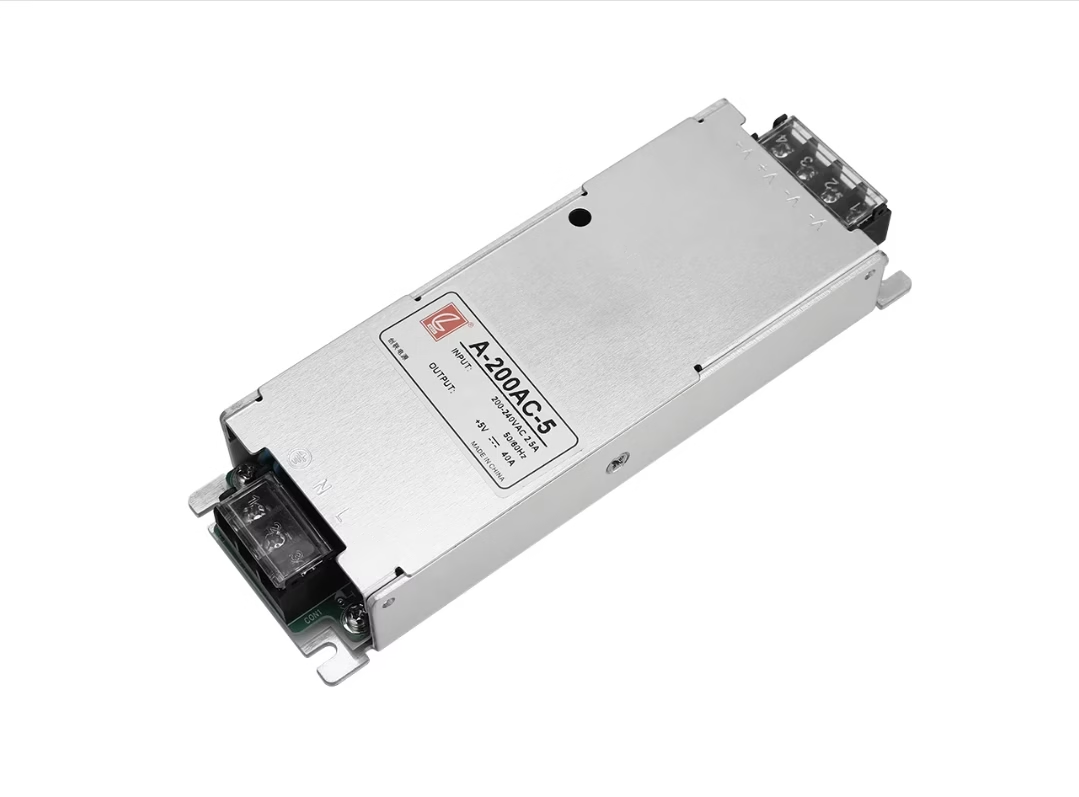
The CZCL A-200AC-5 LED switching power supply turns a 190–264 VAC mains input into a regulated 5 V DC, 40 A output for LED display modules and receiving cards — in a fanless aluminum shell just 26 mm tall that slides into slim rental and fixed cabinets.
📱 / WhatsApp: +86-191-18802497 · Shenzhen, China · GMT+8
200 W
Rated output power
5 V / 40 A
DC output rail
190–264 VAC
Input range
26 mm
Shell height
Fanless
Natural convection
Short answer
The CZCL A-200AC-5 is a 200 W fanless switching power supply for LED screens: 190–264 VAC in, 5 V DC at 40 A out, ±1% regulation, in a 165 × 56 × 26 mm aluminum case weighing 0.3 kg. It is the 5 V member of the A-200AC family (3.8 / 4.2 / 4.5 / 5 V rails), rated for −40 to +70°C with short-circuit and overload protection. Run it at 80% load — about 160 W or 32 A — and it drives the modules and receiving card of one typical indoor cabinet.
What Is the CZCL A-200AC-5 LED Switching Power Supply?
The CZCL A-200AC-5 is a 200 W switching-mode power supply (SMPS) built for LED display cabinets: it rectifies and converts a 190–264 VAC mains feed into a tightly regulated 5 V DC bus at up to 40 A, which powers LED modules, receiving cards, hub boards and fans inside a screen. It belongs to the A-200AC series — CZCL’s ultra-thin, fanless LED display driver family that ships in four output rails: 3.8 V, 4.2 V, 4.5 V and 5 V.
Behind the part number stands a power-supply specialist. CZCL is the brand of Changzhou Chuanglian Power Supply Technology Corporation, founded in 2000, with a 22,000 m² factory in Changzhou, Jiangsu, six SMT lines, a daily output of 30,000 pieces, and a reported annual average failure rate below 0.2% — figures from the company’s own 2021 industrial power supply catalogue. Every unit passes a 100% high-temperature burn-in test before shipment, and the platform carries ISO 9001, ISO 14001 and QC 080000 factory certification with UL, CB, CE, CCC, KC and BIS product approvals.
Position in the power chain
Mains → A-200AC-5 → 5 V bus → LED modules + receiving card. One unit typically feeds a single indoor cabinet or a small group of outdoor modules; larger walls stack several supplies and feed each from its own breaker.
Built for cabinets, not benches
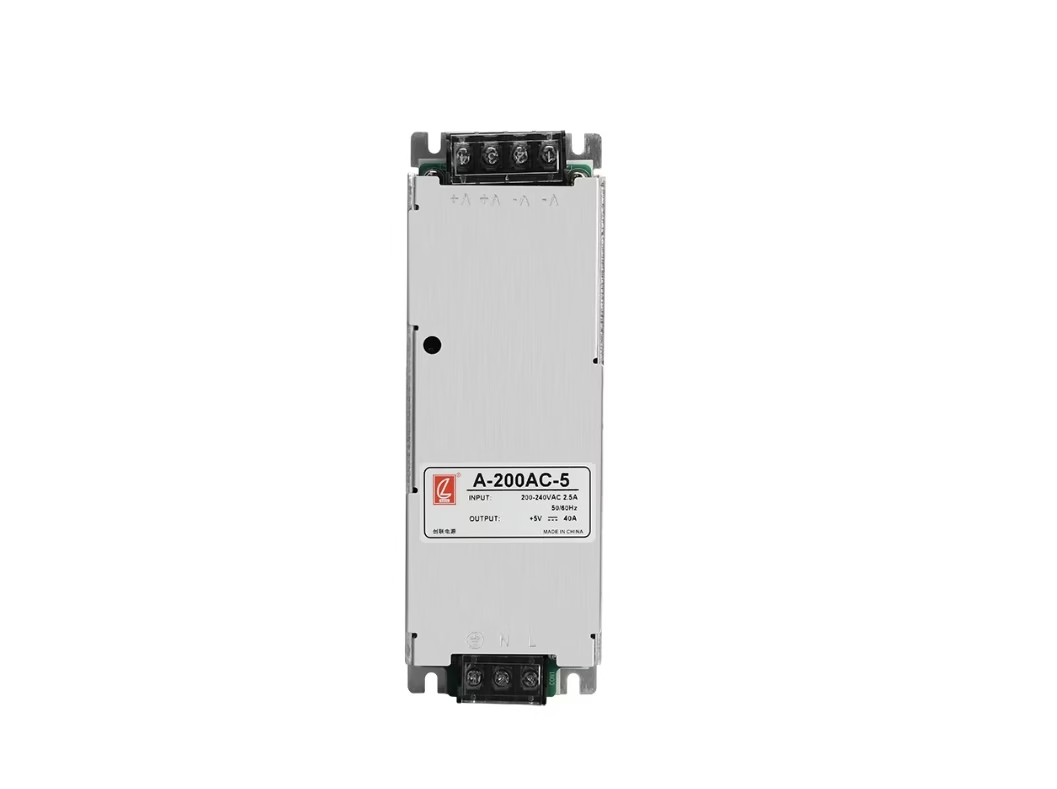
Screw-mount flanges on both ends, screw-clamp terminal blocks for AC-in and DC-out, and a perforated aluminum shell that dumps heat into cabinet airflow instead of a fan.
Who specifies it
Rental staging crews, fixed-install integrators and screen factory production lines — anywhere a slim, quiet, maintenance-free 5 V rail has to live inside a tight cabinet.
If you are sizing the electrical side of a whole screen — from module wattage through breaker counts — pair this page with our LED display power consumption guide, and for the control end of the same cabinet see our LED screen display control system catalog.
What Are the CZCL A-200AC-5 Specifications?
The table below consolidates the official CZCL product description, the factory’s parametric database and the unit nameplate. Where reseller listings disagree with the factory, the factory data wins — and one of those disagreements matters enough to get its own warning box.
| Parameter | CZCL A-200AC-5 |
|---|---|
| Rated output power | 200 W |
| Output voltage | +5 V DC |
| Output current | 40 A max |
| Voltage tolerance | ±1% |
| Input voltage range | 190–264 VAC (nameplate: 200–264 VAC, 2.5 A) |
| Input frequency | 47–63 Hz |
| Efficiency | 88% typical |
| Setup / rise time | 3000 ms / 50 ms at 230 VAC full load |
| Protections | Short circuit; overload at 120–150% of rated power |
| Cooling | Fanless, natural convection (self-cooling) |
| Working temperature | −40°C to +70°C (output derates above +50°C per factory curve) |
| Working humidity | 10–95% RH, non-condensing |
| Dimensions | 165 × 56 × 26 mm (L × W × H) |
| Weight | 0.3 kg |
| Current sharing / backup | None (single-rail unit; CZCL’s current-sharing series covers N+1 designs) |
| Series output rails | A-200AC-3.8 / -4.2 / -4.5 / -5 |
| Factory approvals | UL / CB / CE / CCC / KC / BIS; UL 62368, EN 62368, IEC 62368, EN 55011, EN 55032 |
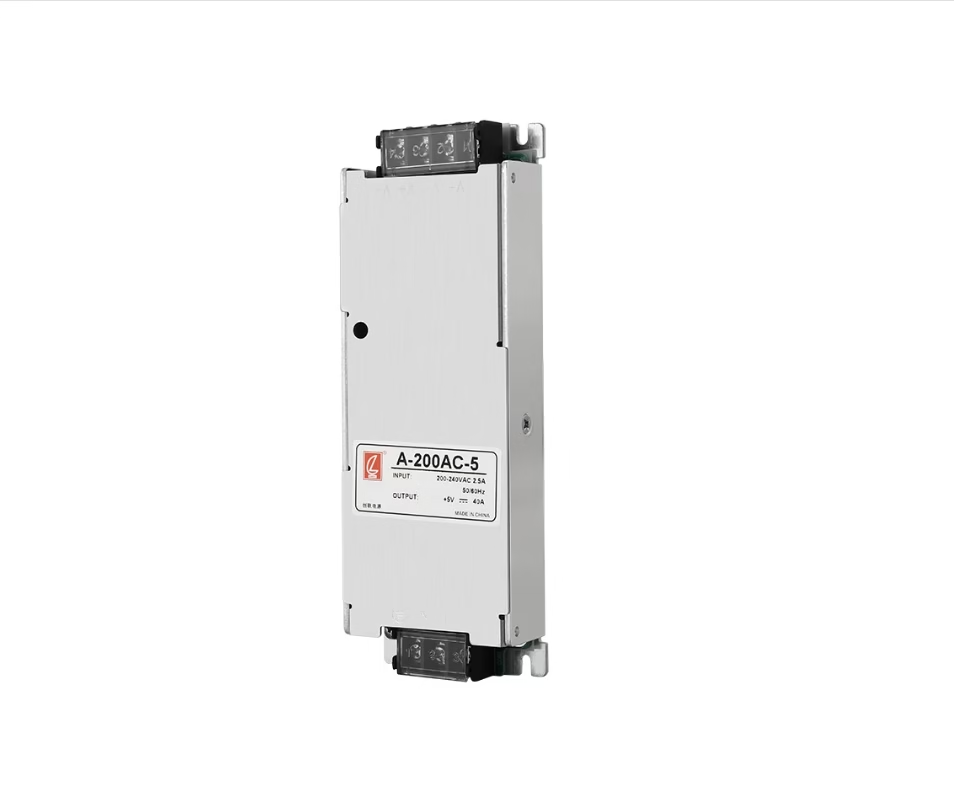
Unit nameplate: INPUT 200–264 VAC 2.5 A, 50/60 Hz · OUTPUT +5 V, 40 A
Spec correction most listings get wrong
Reseller pages across the market copy an older draft that reads “180–264 VAC” and describes the shell as 30 mm tall. The current official CZCL product page states 190–264 VAC, and the factory parameter database and the physical nameplate both confirm the 165 × 56 × 26 mm shell. Buy against the factory numbers, not the copied ones.
How Many LED Modules Can the A-200AC-5 Power?
The honest answer comes from one rule: never load a switching power supply above 80% of its rating. Derating leaves headroom for inrush, voltage sag and hot summers, and it is the single habit that separates screens that run a decade from screens that cook their supplies in year three.
Power budget
200 W × 80% = 160 W usable per unit
Current budget
40 A × 80% = 32 A usable per unit
Apply that budget to the modules your screen uses. Average draw depends on module type, brightness setting and program content — full-white test patterns pull far more than normal material — so treat the table below as installer-grade planning values and verify against your module datasheet:
| Typical load | Average draw | Max per A-200AC-5 at 160 W |
|---|---|---|
| Indoor P2.5 module (320 × 160 mm) | ~10–15 W | ~10–13 modules |
| Rental P3.91 module (250 × 250 mm) | ~15–20 W | ~8–10 modules |
| Outdoor P4.81 module (250 × 250 mm) | ~20–30 W | ~5–8 modules |
| Receiving card (Novastar / Colorlight class) | ~3–5 W | Shares the same 5 V rail |
So a common 500 × 500 mm indoor rental cabinet carrying four P2.5-class modules plus its receiving card lands at roughly 50–65 W average — one A-200AC-5 covers it with room to spare, and a second unit picks up the next cabinet. If you are choosing power supplies for outdoor screens at full brightness, work from the module’s maximum draw instead of the average, and cross-check the whole screen with our LED display power consumption walkthrough.
Why Choose a Fanless LED Switching Power Supply for Your LED Screen?
The A-200AC-5 cools by natural convection through its perforated shell — there is no fan inside. For a power supply that lives inside a sealed LED cabinet for ten hours a day, that design choice removes the two shortest-lived components in a cabinet: the fan bearing and the dust cake the fan collects.
Zero acoustic noise
Churches, studios, conference rooms and broadcast control rooms hear no fan whine rising out of the wall as the screen warms up.
No dust intake
A sealed convection path does not pull road dust, desert sand or stage haze through the electronics — a real failure driver for outdoor and rental fleets.
One fewer service item
No fan to replace means the supply’s service schedule matches the screen’s, not a two-year fan-swap cycle.
The trade-off is thermal, and the factory is explicit about it: the unit carries a −40°C to +70°C operating window with an output derating curve above +50°C. Practically, that means a fully loaded A-200AC-5 needs cabinet airflow and should not be buried behind cabling in a sun-struck outdoor cabinet at 100% white. In exchange, every unit that leaves Changzhou has passed a 100% high-temperature burn-in test, and the factory’s published annual failure rate stays under 0.2%.
How Does the 26 mm Profile Fit Slim LED Cabinets?
At 165 × 56 × 26 mm and 0.3 kg, the A-200AC-5 is one of the lowest-profile 200 W supplies in the LED display market. That height exists for a reason: modern die-cast aluminum rental cabinets and slim fixed-installation enclosures allocate barely 30 mm of depth behind the module row, and a standard 30 mm-tall industrial supply either scrapes the housing or forces a redesign.
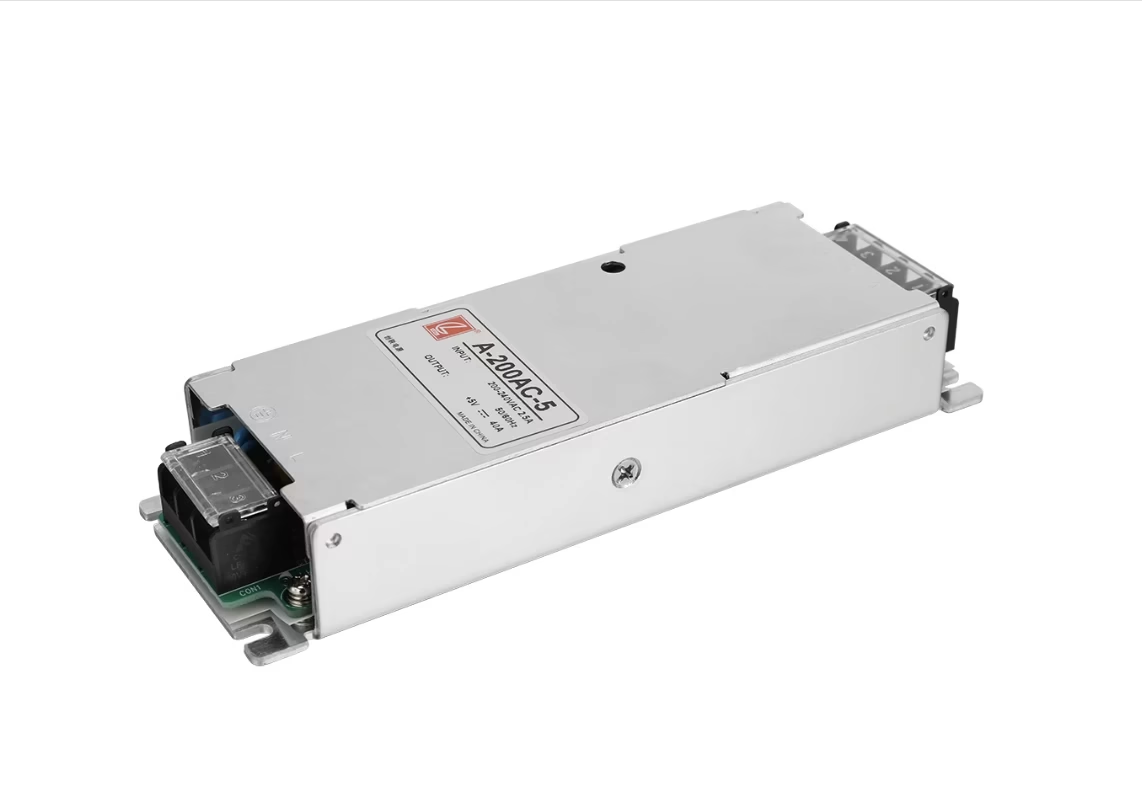
Mounting uses the screw tabs on both end flanges — two screws per end into the cabinet’s power-bay rails — and the screw-clamp terminals accept the cabinet’s pre-crimped harness. Rental houses in particular favor this format because the supply sits flat against the cabinet’s back skin, keeping the weight distribution low and leaving the service loop accessible. For a closer look at the enclosures it drops into, see our LED screen cabinet guide.
Which Input Voltage Does the CZCL A-200AC-5 Support?
The factory specifies a 190–264 VAC input window at 47–63 Hz, drawing up to 2.5 A. That window covers single-phase grids where the line-to-neutral voltage sits at 220–240 V nominal — Europe, the Middle East, Africa, most of Asia, Australia and parts of South America — and it tolerates the sags and swells those grids see in practice, from a brownout at 190 V to an off-peak swell at 264 V.
Buying for a 110–120 V grid? Stop here.
The A-200AC-5 does not accept 100–120 VAC. Plugging it into a US, Canadian, Japanese or Taiwanese wall either trips the protection or runs the converter out of its specified window — and neither is a warranty claim you will enjoy. For those markets you need a wide-input (universal 100–240 VAC) supply or a step-up transformer; we quote the matching CZCL wide-input models on request.
One more field detail from the nameplate: the input is labeled 200–264 VAC, 2.5 A — slightly narrower than the 190–264 VAC datasheet window. Treat 200–240 V nominal as the design center and you are safe under either reading.
Why Does the A-200AC Series Come in 3.8 V, 4.2 V, 4.5 V and 5 V?
The four rails of the A-200AC family map directly onto how modern LED modules manage power. Standard LED display modules drive their LEDs from a 5 V rail through switched constant-current driver ICs, which is why the A-200AC-5 is the volume seller. Energy-saving and common-cathode designs, by contrast, run the LED string from a lower rail so the driver IC burns less voltage headroom as heat.
| Model | Output rail | Max current (200 W ÷ V) | Typical use |
|---|---|---|---|
| A-200AC-3.8 | 3.8 V | ~52 A | Common-cathode energy-saving modules |
| A-200AC-4.2 | 4.2 V | ~47 A | Power-saving fixed installations |
| A-200AC-4.5 | 4.5 V | ~44 A | Reduced-heat indoor walls |
| A-200AC-5 | 5.0 V | 40 A | Standard modules + receiving cards |
Current figures above are derived from the 200 W rating, not separate factory datasheets — confirm against the datasheet of the exact variant before you buy. If your screen spec calls out a common-cathode power architecture, read our common cathode LED technology explainer before choosing the rail.
How Does the A-200AC-5 Compare With G-Energy and Meanwell 200 W Units?
At the 5 V / 40 A / 200 W point, three names dominate LED screen bill-of-materials: CZCL, G-Energy and Meanwell. They are closer than marketing suggests, and the right pick is usually about cabinet fit and price, not brand loyalty.
- Profile: the A-200AC-5 is 26 mm tall — the slimmest class in this power bracket — while most 200 W competitors sit in the 30 mm class and above.
- Price position: street prices run from about $12 to $30 for the CZCL unit depending on channel, with G-Energy equivalents starting near $7 and Meanwell’s UHP-200-5 near $36 (sources below).
- Input window: the A-200AC-5 targets 220–240 V grids; Meanwell’s UHP family and several G-Energy models also publish 220 V-class windows, so check input range before cross-brand substitution.
- Redundancy: none of the three base 200 W units current-share; N+1 designs move up to dedicated current-sharing series (CZCL and G-Energy both sell them).
- Brand DNA: CZCL is a power-supply-first manufacturer (national-level “little giant” specialty enterprise per the factory), Meanwell is an industrial PSU generalist, and G-Energy is an LED-screen-native brand — all three ship into LED display production lines.
| Unit (5 V / 40 A / 200 W class) | Street price | Source |
|---|---|---|
| CZCL A-200AC-5 | $12.50; $22.99–$29.99 (series) | leddisplaysupply.com; ledscreenparts.com |
| G-Energy N200V5-C | $7.30; $15.99 | leddisplaysupply.com; ledscreenparts.com |
| G-Energy J200V5 | $29.00 | leddisplaysupply.com |
| Meanwell UHP-200-5 | $36.00 | leddisplaysupply.com |
Prices observed September 2026; they move with shipping and volume. They are listed to frame the market, not as our quotes.
How Do You Install and Wire the CZCL A-200AC-5 Safely?
Wiring is conventional for an LED cabinet supply — the risk lives in skipped torque checks and overloaded rails, not in exotic electronics.
1 · Verify the grid
Confirm the cabinet feed is 200–240 V nominal and the breaker feeding the cabinet is sized for the full screen, not for one supply.
2 · Mount the unit
Fix both flanges with M3-class screws into the cabinet power-bay rail. Leave clearance above the shell for convection airflow.
3 · Wire AC first
Line, neutral and protective earth into the screw-clamp input block, tightened and tugged. Ground the cabinet back-plane — a floating cabinet is the classic cause of dead pixels and damaged driver ICs.
4 · Wire the 5 V bus
+V and −V out to the module and receiving-card bus, keeping pairs matched and polarity double-checked — reversed DC is the fastest way to destroy a receiving card.
5 · Set and verify voltage
Set the output with the V-ADJ trim to 5.0 V at the far end of the DC bus under load, then confirm each cabinet measures the same within a few tenths.
6 · Load-test and re-torque
Run the screen at full white for ten minutes, feel for hot spots, and re-check terminal torque before closing the cabinet.
Do not parallel the outputs
The A-200AC series is a non-current-sharing design (per the factory parameter database). Paralleling two units to fake an 80 A rail will not share load evenly — one supply runs hot while the other idles. If a bay needs more than 200 W, use a higher-rated single unit or the current-sharing series.
For the afterlife of the unit — diagnosing a suspect supply, swapping one safely inside a live screen, and what to check first — our LED display power supply diagnostics and replacement guide walks the whole workflow.
What Problems Does a Failing LED Power Supply Cause?
Power problems wear disguises. Before blaming a control card or a module, check which of these three signatures your screen shows:
Dim or uneven brightness, one cabinet
Aging capacitors sag the rail under load; the cabinet’s corner looks tired while its neighbors shine. Full-white test patterns make it obvious.
Flicker on camera or under load spikes
An overloaded or failing rail drops voltage for a frame at a time. If the flicker correlates with bright content, suspect the supply first.
Cabinet reboots or dead sections
Overload protection cycling on and off reads as “random” dead cabinets. Measure the rail during the dropout before replacing modules.
How Much Does the CZCL A-200AC-5 Cost?
Single units retail in the $12–$30 band depending on channel and region (benchmark table above). Volume pricing moves down sharply from there — this is a part screen factories buy by the carton — and freight class often costs more per cabinet than the supply itself.
Sample · 1–10 pcs
For repairs, prototypes and one-off cabinets. Shipped from stock with the 190–264 VAC nameplate you see above.
Project · 10–500 pcs
Whole-screen and rental-fleet quantities, matched to your module datasheets and cabinet bays, with per-cabinet load math included.
Volume · 500+ pcs
Production-line pricing direct from CZCL stock with container freight planning and batch date-code consistency.
Tell us the module types, modules-per-cabinet and total cabinet count, and the quote comes back with the load math attached — from an LED screen manufacturer that stocks the full chain from power to control.
CZCL A-200AC-5 LED Switching Power: Frequently Asked Questions
Can I run the CZCL A-200AC-5 on a 110 V outlet in the US?
No. The input window is 190–264 VAC (nameplate 200–264 VAC), which covers 220–240 V nominal grids only. For 100–120 V markets you need a wide-input supply or a step-up transformer.
How many LED modules can one A-200AC-5 drive?
Apply the 80% rule: 160 W or 32 A usable. A typical indoor P2.5 module draws about 10–15 W of average program material, so one supply covers roughly 10–13 such modules plus the receiving card — always verify against your module’s datasheet and brightness profile.
What is the difference between A-200AC-5 and A-200AC-4.5?
Only the output rail: 5.0 V versus 4.5 V, with the same 200 W, fanless shell and input window. The lower rails serve common-cathode and energy-saving module designs that run LEDs from a reduced bus to cut driver-IC heat.
Does the A-200AC-5 have a fan?
No — it is fully fanless and cools by convection through the perforated shell. It runs silently, does not ingest dust, and carries a −40 to +70°C operating window with derating above +50°C.
Why is one cabinet of my LED screen dimmer than the rest?
A sagging power supply is the most common cause when a single cabinet dims under load — aging output capacitors can no longer hold the 5 V rail. Confirm by measuring the rail at the far end of the cabinet bus during a full-white pattern.
Can I parallel two A-200AC-5 units for more current?
No. The factory rates the series as non-current-sharing, so two paralleled units will not divide load evenly. Use a single higher-rated supply or CZCL’s current-sharing series for redundant designs.
Which certifications does the A-200AC platform carry?
The factory is ISO 9001 / ISO 14001 / QC 080000 certified, and the platform carries UL, CB, CE, CCC, KC and BIS approvals to UL 62368 / EN 62368 / IEC 62368, with EN 55011 and EN 55032 EMC. Ask for the certificate copy of the exact variant you order.
What warranty and failure rate does CZCL publish?
CZCL’s 2021 catalogue reports an annual average failure rate below 0.2% and 100% burn-in testing before shipment; warranty terms run two to three years depending on the series. Confirm the term for your batch at order time.
Quote the CZCL A-200AC-5 With the Load Math Done
Send your module types and cabinet count; we return per-cabinet power sizing and a matched quote from a LED screen manufacturer that ships worldwide.
📱 / WhatsApp: +86-191-18802497 · Shenzhen, China · GMT+8
Related LED Display Power Resources
LED Display Power Consumption
Screen-level power math: module draw, brightness settings, breaker sizing and cable gauges.
Power Supply Diagnostics & Replacement
Test a suspect supply, swap it inside a live screen, and root-cause repeat failures.
LED Screen Display Control System
The control-side catalog: sending cards, receiving cards and processors that ride on the 5 V rail.
The CZCL display power family — four supplies, four jobs
Step up the single rail (fan-cooled 300 W A-300AB-5, 400 W A-400JQ-5P with active PFC) or split rails entirely: the dual-output B-200AF is CZCL’s common-cathode specialist with a 250,000 h MTBF.
CZCL LED Power Supply Guides
Four deep-dives from the CZCL power series – the count math, the selection flow, the pricing and the head-to-head verdicts.