
CZCL Common-Cathode Series · Dual Rail 3.8V + 2.8V · Fanless · MTBF 250,000 h
CZCL B-200AF LED Switching Power
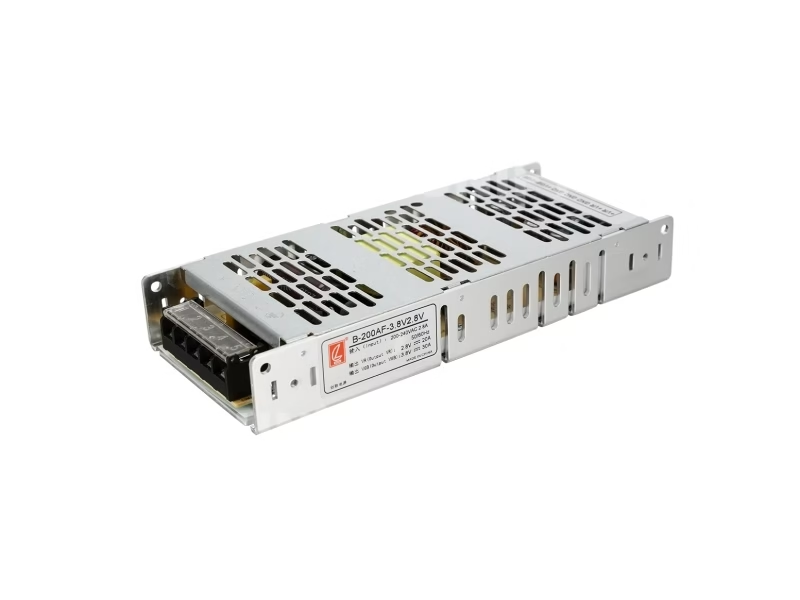
The CZCL B-200AF LED switching power supply is the common-cathode specialist of CZCL’s display family: two independent rails from one fanless chassis — 3.8 V at 30 A for the LED bus and 2.8 V at 20 A for the driver bus — built for energy-saving screens that waste heat on single-rail supplies.
📱 / WhatsApp: +86-191-18802497 · Shenzhen, China · GMT+8
3.8 V / 30 A
Rail V1 · 114 W LED bus
2.8 V / 20 A
Rail V2 · 56 W driver bus
180–264 VAC
Input range
Fanless
Self-cooling, 30 mm shell
250,000 h
MTBF at 25°C (MIL-217)
Short answer
The CZCL B-200AF is a dual-output, fanless switching power supply for common-cathode LED screens: 180–264 VAC in; rail V1 delivers 3.8 V at 30 A (114 W) for the LED bus while rail V2 delivers 2.8 V at 20 A (56 W) for the driver bus — 170 W of combined continuous output from a 194 × 82 × 30 mm, 0.55 kg chassis. Short-circuit faults trigger hiccup mode with automatic recovery, the datasheet rates it at 250,000 hours MTBF (MIL-217, 25°C) — the highest in CZCL’s display family — and a −40°C low-temperature start build is available. Keep each rail at or below 80% load and one unit carries the two buses of a common-cathode cabinet that would otherwise need two separate supplies.
What Is the CZCL B-200AF LED Switching Power Supply?
The CZCL B-200AF is a 200 W-class switching-mode power supply purpose-built for common-cathode LED display screens: instead of one 5 V rail, it produces two independent outputs — V1 at 3.8 V / 30 A and V2 at 2.8 V / 20 A — matching the two-bus wiring of common-cathode modules, where the LED string and the driver ICs are fed at different voltages. The full order code reads B-200AF-3.8V2.8V, and the “AF” in the series name marks the fanless, self-cooling design. CZCL positions the platform explicitly as its common-cathode display series — the datasheet title reads “display power supply, common-cathode series.”
The manufacturer is Changzhou Chuanglian Power Supply Technology Corporation (CZCL), founded in 2000, with a 22,000 m² factory, six SMT lines, 30,000 units of daily output and ISO 9001 / ISO 14001 / QC 080000 certification. On this platform the reliability numbers lead the datasheet: MTBF of 250,000 hours at 25°C (MIL-217 method), a −30 to +60°C working window, vibration and shock ratings of 2 G and 20 G, and build options that include double three-proofing (conformal coating), a terminal cover, and a −40°C low-temperature start variant for cold-region outdoor installations.
Two buses, one chassis
A common-cathode cabinet no longer juggles two single-rail supplies: V1 feeds the LED string bus, V2 feeds the driver/logic bus, both regulated independently from one 180–264 VAC input.
Built for cold starts
The −40°C low-temperature start option and double three-proofing coating make the B-200AF the family’s pick for unheated outdoor cabinets in continental winters and coastal salt air.
Family-best service life
250,000 hours MTBF at 25°C per MIL-217 — the longest published figure across CZCL’s LED display supplies — plus hiccup-mode short-circuit recovery.
Before ordering, make sure your modules actually are common-cathode — the common cathode LED technology explainer covers the architecture, and the LED display power consumption guide covers the screen-level math this page applies per rail.
What Are the CZCL B-200AF Specifications?
All figures come from the official CZCL B-200AF specification sheet. One honesty note before the table: the “200 W” in the model name is the series rating, while the datasheet’s own per-rail table adds to 170 W of continuous combined output (114 W + 56 W) — plan loads against 170 W, and most competitor listings never mention the difference.
| Parameter | CZCL B-200AF |
|---|---|
| Series rating | 200 W class (170 W combined continuous per the datasheet rail table) |
| Output V1 (LED bus) | 3.8 V DC, 30 A rated, 114 W |
| Output V2 (driver bus) | 2.8 V DC, 20 A rated, 56 W |
| Ripple and noise | 200 mVp-p per rail |
| Line / load regulation / accuracy | ±0.5% / ±2.0% / ±2.0% |
| Input voltage range | 180–264 VAC (nameplate: 230 VAC, 2.8 A) |
| Input frequency | 47–63 Hz |
| Inrush / leakage current | 40 A cold start at 230 VAC / <3.5 mA at 240 VAC |
| Setup / rise / hold-up time | 3000 ms / 50 ms at 230 VAC full load / 5 ms hold-up |
| Efficiency | Not stated in the datasheet (request bench figures for your batch) |
| Protections | Short circuit: hiccup mode, automatic recovery; overload protection on V1 |
| Cooling | Self-cooling, fanless |
| Working temperature | −30°C to +60°C, 20–95% RH non-condensing (derating curve applies) |
| Storage temperature | −40°C to +85°C |
| Vibration / shock / altitude | 10–500 Hz at 2 G / 20 G, 11 ms / 2,000 m with derating above |
| MTBF | 250,000 hours at 25°C (MIL-217 method) |
| Dimensions / weight | 194 × 82 × 30 mm; 0.55 kg; 30 pieces per 17 kg carton |
| Standards (design reference) | EN 55024 (immunity); GB 17625.1, EN 61000-3-2/-3 (harmonics); insulation 100 MΩ |
| Build options | Double three-proofing; terminal cover; −40°C low-temperature start |
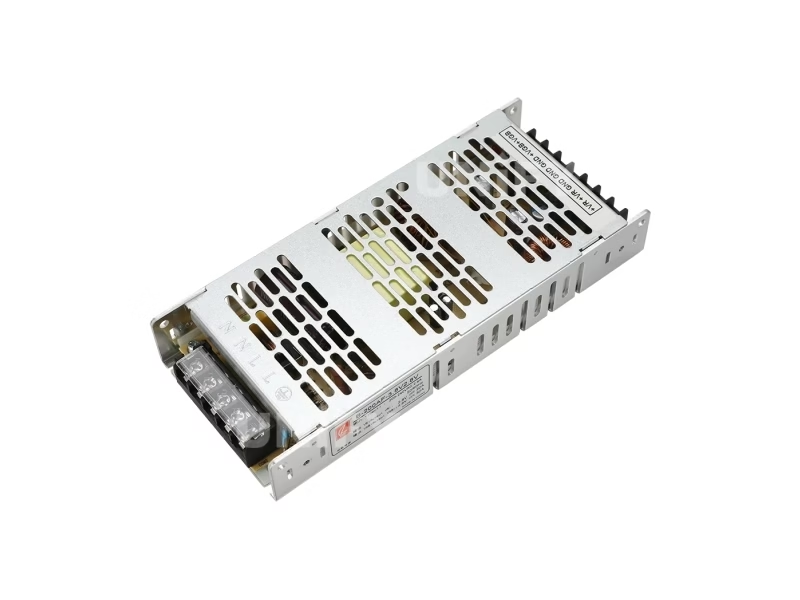
Fanless self-cooling shell: 194 × 82 × 30 mm, 0.55 kg, perforated both faces for convection
Three field notes most listings skip
First, the 5 ms hold-up time is the shortest in the family — fine for LED cabinets, but do not expect this unit to ride through mains gaps the way the A-400JQ-5P’s 20 ms design does. Second, efficiency is not published for this model; ask for batch test data rather than trusting a reseller’s guessed number. Third, the datasheet input window is 180–264 VAC — nothing here supports a 100–120 V grid, and continuous full-load use requires the 400 × 400 × 3 mm auxiliary aluminum plate per the datasheet notes.
How Do the Two Outputs of the B-200AF Split the Load?
Apply the 80% rule per rail, because each output is regulated and protected on its own:
Rail V1 budget
114 W × 80% = 91 W usable (24 A at 3.8 V) for the LED bus
Rail V2 budget
56 W × 80% = 45 W usable (16 A at 2.8 V) for the driver bus
Mapped onto a real cabinet: a common-cathode fine-pitch indoor module typically splits its draw with roughly two-thirds on the LED rail and one-third on the driver rail. Against those budgets, one B-200AF covers about 91 W of LED-rail load plus 45 W of driver-rail load per cabinet — which is how the two-bus wiring of a dense common-cathode wall collapses into one supply per cabinet instead of two. The factory’s own sizing note applies here too: leave at least 30% headroom against the device’s requirement (a 100 W device wants a 130 W-plus supply).
Two cautions keep the math honest. Do not parallel rails or units — the B-200AF has no current-sharing design, and cross-feeding V1 onto a 5 V input is a disposal event for the module. And if your screen mixes common-cathode and standard modules, the standard ones belong on a single-rail sibling: the CZCL A-200AC-5 LED switching power at 5 V / 40 A, sized with the power consumption walkthrough.
What Is Common-Cathode Wiring and Why Does It Need Two Rails?
In a conventional LED display module, the LEDs share the positive 5 V rail and each driver IC drops the difference between 5 V and the LED’s forward voltage — that difference turns into heat inside the driver, which is why conventional cabinets run warm. The common-cathode architecture flips the logic: the LEDs’ cathodes are tied to a common negative, the LED string is fed from a lower positive rail (here 3.8 V) sized close to the actual forward-voltage requirement, and the driver ICs run from an even lower, independent rail (here 2.8 V). Less voltage across the driver means less heat, lower module temperatures, and measurably lower power draw at the wall.
That architecture is exactly why a single 5 V supply cannot serve it cleanly: feeding 5 V to a rail designed for 3.8 V burns the savings the architecture exists to deliver. The B-200AF’s two rails exist to track that split precisely — and the full walkthrough of the design, its efficiency logic and its module families lives in our common cathode LED technology guide.
Rail V1 · 3.8 V / 30 A
The LED string bus. Sized near the forward voltage, so the driver ICs stop absorbing the surplus as heat.
Rail V2 · 2.8 V / 20 A
The driver/logic bus. Independent regulation keeps scan-and-drive electronics stable while the LED rail carries its own load swings.
Why Choose a Fanless Supply for a Common-Cathode Screen?
The B-200AF cools by natural convection through perforated faces — no fan, no filter, no dust path. For the screens this supply targets (fine-pitch indoor walls, corporate lobbies, control rooms, broadcast sets), silence is part of the specification: a wall you can stand next to in a meeting room without hearing it breathe. Fanless construction also deletes the one component with a shorter service interval than the supply itself, which is how this platform backs a 250,000-hour MTBF figure with a mechanism, not just a number.
The environmental window is the widest cold-side envelope in the family: −30 to +60°C operating, storage to −85°C on the top end and −40°C on the bottom, plus the factory’s −40°C low-temperature start build option checked in the datasheet’s own extension table. Cold-region outdoor cabinets and unheated seasonal installs are the use case — pair the option with the double three-proofing conformal coating where condensation or salt air is in play. Continuous full-load operation still asks for the datasheet’s 400 × 400 × 3 mm auxiliary aluminum plate, same discipline as the rest of the family.
Which Protections and Reliability Ratings Does the B-200AF Carry?
Protection behavior follows the family pattern: a short-circuit event triggers hiccup mode with automatic recovery once the fault clears, and the V1 rail carries overload protection per the datasheet. The protection list here is shorter than the A-400JQ-5P’s — no published over-voltage or over-temperature trip specs — which is one more reason the 30% headroom rule is not optional on this platform.
Reliability is where the datasheet leans in: MTBF of 250,000 hours at 25°C (MIL-217), verified across 10–500 Hz vibration at 2 G and 20 G shock on three axes, with immunity design referenced to EN 55024 and harmonic limits to GB 17625.1 / EN 61000-3-2/-3. Isolation resistance measures 100 MΩ across input-to-output, input-to-case and output-to-case. Every unit passes 100% full-load burn-in at the factory before shipment, per CZCL’s platform QC process.
How Does the B-200AF Compare With the A-200AC-5?
The two 200 W-class CZCL supplies look similar on a shelf and serve different screens. The comparison decides it in one row: single 5 V rail versus dual common-cathode rails.
| Parameter | B-200AF | A-200AC-5 |
|---|---|---|
| Output | Dual: 3.8 V / 30 A + 2.8 V / 20 A (170 W combined) | Single: 5 V / 40 A / 200 W |
| Screen type | Common-cathode modules | Standard modules + receiving cards |
| Cooling | Fanless, self-cooling | Fanless, self-cooling |
| Working temperature | −30 to +60°C | −40 to +70°C |
| Dimensions | 194 × 82 × 30 mm, 0.55 kg | 165 × 56 × 26 mm, 0.3 kg |
| MTBF | 250,000 h (MIL-217) | Not published |
The wider family adds two more rungs: the fan-cooled CZCL A-300AB-5 LED switching power at 300 W / 60 A and the PFC-equipped CZCL A-400JQ-5P LED switching power at 400 W / 80 A — both single-rail 5 V units for standard screens.
How Do You Install and Wire the CZCL B-200AF Safely?
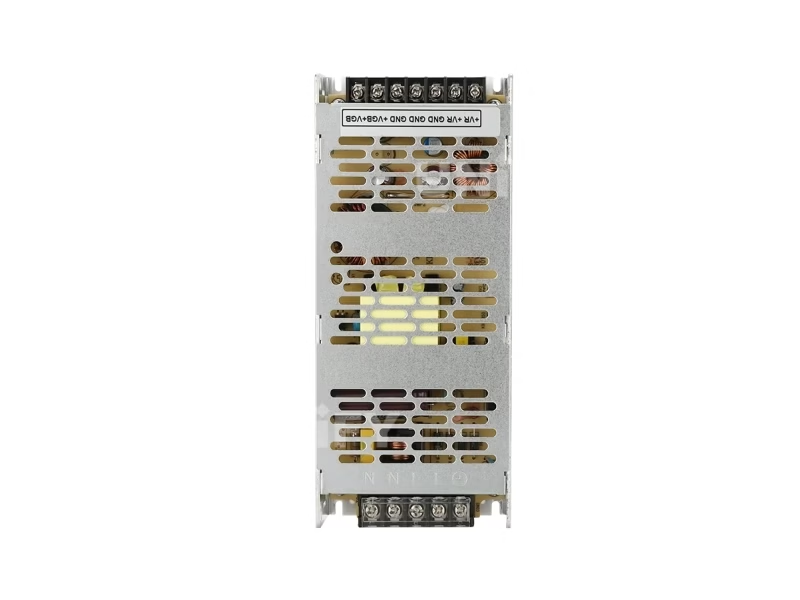
The datasheet’s installation warnings set the rules; the dual-bus terminal order on the unit itself (photo below) dictates the wiring sequence.
1 · Mount within the screw limits
M3 × 6 mm screws with penetration no deeper than 3 mm into the housing; plan the 400 × 400 × 3 mm auxiliary aluminum plate if the unit will run at continuous full load.
2 · Wire the two buses separately
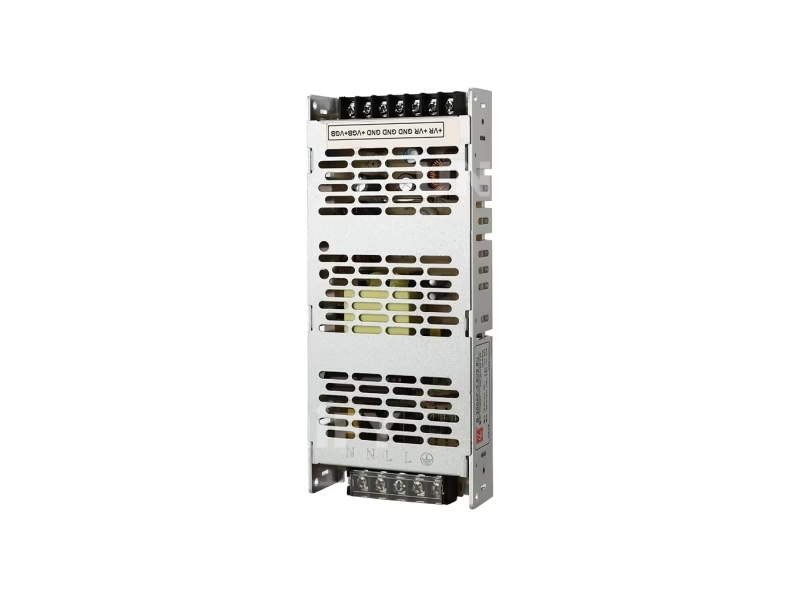
Follow the terminal marking: +V1 / −V1 (with shared GND) to the module’s LED bus, +V2 / −V2 to the driver bus. Never cross-feed — the 3.8 V and 2.8 V rails are not interchangeable, and neither substitutes for a 5 V rail.
3 · Verify before power
Meter-check AC versus DC terminals and both polarities, and test for shorts on the mains side and both output rails before switch-on — the factory instructions call for an unloaded start.
4 · Ground it properly
Ground wire heavier than AWG 18, terminated reliably — the factory ties this to both safety and interference control.
5 · Respect the ratings
Stay inside the nameplate values; output-parameter changes go through the factory technical department first, and faults go to the service line at 86-519-85215050 — no field repair.
6 · Load-test both rails
Run a full-white pattern and verify V1 and V2 separately at the far end of each bus — a dual-rail unit doubles the measurement points, and both must land within a few tenths of a volt.
Common-cathode wrong-rail warning
Feeding rail V2 (2.8 V) to a 3.8 V LED bus starves the screen; feeding V1 (3.8 V) or any 5 V sibling supply to the 2.8 V driver bus kills driver ICs. Label both buses at the cabinet harness stage — dual-rail wiring mistakes are the number-one commissioning fault on this platform.
Field failures and swaps follow the LED display power supply diagnostics and replacement workflow.
What Problems Does a Failing LED Power Supply Cause?
Power trouble wears disguises — check these three signatures before blaming a module or a control card:
Dim or uneven brightness, one cabinet
A sagging LED rail shows up first as a tired corner at full white — on a dual-rail unit, measure V1 before replacing modules.
Flicker on camera or under load spikes
A rail that dips frame-by-frame under bright content points at the supply first — and on this platform, at whichever rail carries the load step.
Cabinet reboots or dead sections
Hiccup cycling reads as “random” dead cabinets — with a 5 ms hold-up, also check the AC feed quality before condemning the unit.
How Much Does the CZCL B-200AF Cost?
Unlike the A-series siblings, the B-200AF is a factory- and OEM-oriented part with little street retail presence — which is exactly why a transparent quote with the rail math attached beats a guessed marketplace number. Budget context from the family: single-rail 200 W–400 W CZCL units street between roughly $13 and $25, and this dual-rail platform prices as a project part against that band.
Sample · 1–10 pcs
Trial cabinets and common-cathode retrofits — specify the −40°C start or three-proofing build options at sample stage, not after.
Project · 10–500 pcs
Whole-screen quantities with per-rail load math matched to your module’s common-cathode split.
Volume · 500+ pcs
Production-line pricing on CZCL stock with container freight planning and batch date-code consistency.
Send module types, modules-per-cabinet and total cabinet count — the quote returns with both rail budgets calculated, from an LED screen manufacturer stocking the full chain from power to control.
CZCL B-200AF LED Switching Power: Frequently Asked Questions
Can I use the B-200AF on a standard (non-common-cathode) LED screen?
No. Its rails are 3.8 V and 2.8 V, matched to common-cathode module buses. Standard modules and receiving cards run on 5 V — use a single-rail sibling like the A-200AC-5 for those cabinets.
Why does a “200 W” supply only deliver 170 W?
200 W is the series rating; the datasheet’s own rail table adds to 170 W of continuous combined output (114 W on V1 + 56 W on V2). Plan loads against 170 W with the 30% headroom the factory asks for — and note that most reseller listings skip this distinction.
Can I run the CZCL B-200AF on a 110 V outlet in the US?
No. The input window is 180–264 VAC, which covers 200–240 V nominal grids only. For 100–120 V markets you need a wide-input supply or a step-up transformer.
Does the B-200AF have a fan?
No — the “AF” in the name marks the fanless, self-cooling design. It is silent, sealed against dust, and relies on convection through its perforated shell plus the auxiliary aluminum plate at continuous full load.
What happens if I swap the two rails by mistake?
At best the screen starves (2.8 V on a 3.8 V bus); at worst the driver ICs die (3.8 V or 5 V on a 2.8 V bus). Label both buses at the harness stage and meter both rails before first power-on — cross-fed rails are the top commissioning fault on this platform.
Can I parallel two B-200AF units for more power?
No. The platform has no current-sharing design, so paralleled units will not divide load evenly. Add a second supply feeding a separate group of modules, or consult CZCL’s current-sharing series for redundant designs.
Which B-200AF build options matter for outdoor screens?
The −40°C low-temperature start option for unheated winter cabinets, and the double three-proofing conformal coating for condensation, dust or salt air. Both are factory extension options listed in the datasheet — order them at purchase, they are not field retrofits.
What reliability rating does CZCL publish for the B-200AF?
An MTBF of 250,000 hours at 25°C (MIL-217 method) — the highest published figure in CZCL’s LED display family — with a −30 to +60°C working window, 2 G vibration and 20 G shock ratings, and 100% full-load burn-in before shipment.
Quote the CZCL B-200AF With Both Rail Budgets Done
Send your module types and cabinet count; we return the V1/V2 split per cabinet and a matched quote from a LED screen manufacturer that ships worldwide.
📱 / WhatsApp: +86-191-18802497 · Shenzhen, China · GMT+8
Related LED Display Power Resources
LED Display Power Supply (Mother Catalog)
The three-brand mother catalog: 27 model pages, 2026 price bands, architecture map and the 80% load math — start here.
CZCL A-200AC-5 (Fanless 200 W)
Single-rail sibling for standard screens: 5 V / 40 A / 200 W in a 26 mm fanless shell.
CZCL A-300AB-5 (Fan-Cooled 300 W)
5 V / 60 A / 300 W with hiccup auto-recovery and a 200,000 h MTBF.
CZCL A-400JQ-5P (PFC 400 W)
5 V / 80 A / 400 W with active PFC at 0.95 in a 26 mm fanless shell.
Common Cathode LED Technology
The architecture this supply is built for: dual-bus wiring, efficiency logic and module families.
The full CZCL LED display power supply catalog
This dual-rail unit is one of four: compare the 200 W, 300 W and 400 W single-rail siblings, their input windows and pricing on the family catalog page.
CZCL LED Power Supply Guides
Four deep-dives from the CZCL power series – the count math, the selection flow, the pricing and the head-to-head verdicts.