
Mean Well RSP Series · Kilowatt Platform · 12–48 V · Active PFC · Parallel to 4000 W
Mean Well RSP-1000 Switching Power Supply
The Mean Well RSP-1000 switching power supply pairs five rails from 12 V to 48 V (up to 1008 W) with a 90–264 VAC universal input, active PFC and the family’s only parallel function — active current sharing that links up to four units toward a 4000 W bank with one unit in hot standby.
📱 / WhatsApp: +86-191-18802497 · Shenzhen, China · GMT+8
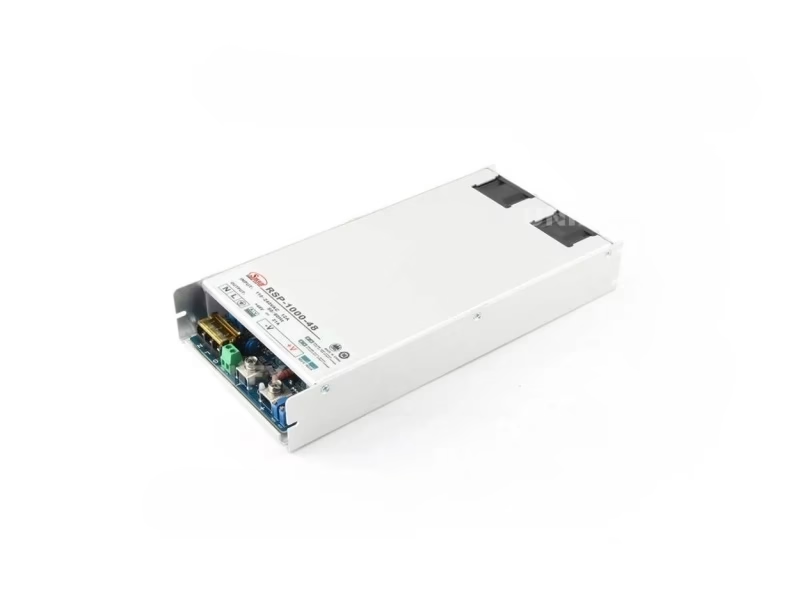
1008 W
Max rated (48 V rail)
12–48 V
Five rails, 60 A top
90–264 VAC
Universal input + PFC
4000 W
Parallel bank (3+1)
5 Years
Warranty (939.4K h MTBF)
Short answer
The Mean Well RSP-1000 is a 1000 W-class single-output enclosed AC/DC switching power supply with a 90–264 VAC universal input, built-in active PFC and twin speed-controlled DC fans in a 295 × 127 × 41 mm 1U chassis. The series spans five rails — 12 V/60 A, 15 V/50 A, 24 V/40 A, 27 V/37 A and 48 V/21 A (up to 1008 W) — and it is the only Mean Well screen supply on this site that parallels: active current sharing links up to four units toward a 4000 W bank (3+1). A 0.5 V remote sense, a DC OK signal, 40–110% output voltage programming and a 5-year warranty round out the platform.
What Is the Mean Well RSP-1000 Switching Power Supply?
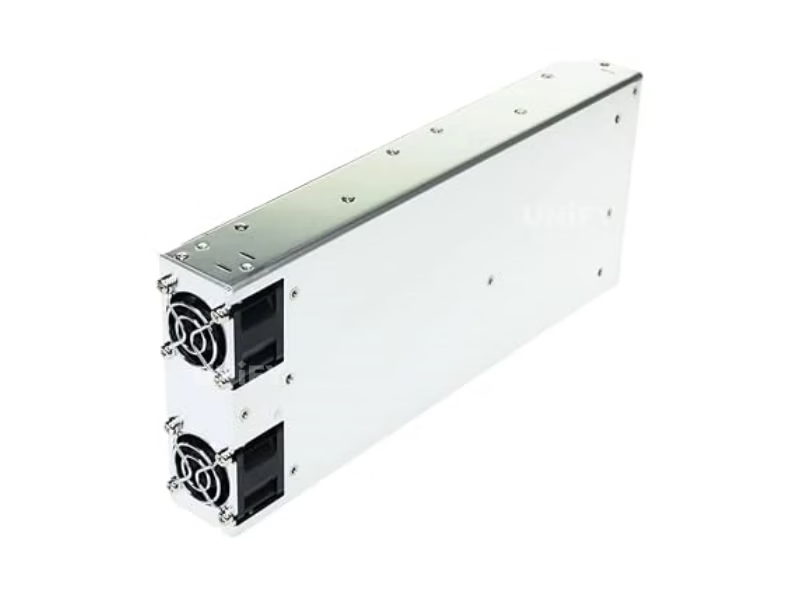
The Mean Well RSP-1000 is a 1000 W single-output enclosed AC/DC switching power supply (SMPS) that converts a 90–264 VAC mains feed into one regulated DC rail. The series carries five rails — 12, 15, 24, 27 and 48 V — with the 48 V model rated 1008 W and the 12 V model delivering 60 A. Cooling comes from twin built-in DC fans with speed control, inside a 295 × 127 × 41 mm 1U chassis weighing 1.95 kg.
Within the Mean Well screen ladder the RSP-1000 is the kilowatt platform — and it plays a different role from its 5 V siblings. The RSP-150 through RSP-500 feed 5 V module bays; the RSP-1000 carries the 12 V-and-up loads: 12 V module architectures, 24 V peripheral and cooling banks, special-format rails and long-run distribution. It is also the family’s only parallel-capable unit and the only one with a 5-year warranty. Approvals span UL 62368-1, TUV, CCC, EAC, BSMI and BIS, with a dual-method MTBF of 939,400 hours minimum (Telcordia SR-332) plus 116,500 hours minimum (MIL-HDBK-217F, 25°C).
48 A usable on 12 V
A 576 W budget at the 80% rule — the 12 V / 60 A rail feeding module rows, cooling banks and control boxes outright.
Parallels to 4000 W
Active current sharing on the CS pin links up to four units (3+1) — the only supply in the Mean Well screen set that can.
5-year warranty
The longest cover in the family — the RSP-150 through RSP-500 carry three years. Tender paperwork writes itself.
Planning a screen’s full electrical side? Pair this page with the LED display power consumption guide, and for the control end of the same cabinet see the LED screen display control system catalog.
What Are the Mean Well RSP-1000 Switching Power Supply Specifications?
Every figure below comes from the official Mean Well RSP-1000 specification sheet (8 pages, revision dated 2024-12-23). The five-rail table first, then the platform parameters:
| Model | Rail / current | Rated power | Adj. range | Tolerance | Ripple (max.) | Efficiency |
|---|---|---|---|---|---|---|
| RSP-1000-12 | 12 V / 60 A | 720 W | 10–13.5 V | ±1.0% | 150 mVp-p | 83% |
| RSP-1000-15 | 15 V / 50 A | 750 W | 13.5–16.5 V | ±1.0% | 150 mVp-p | 85% |
| RSP-1000-24 | 24 V / 40 A | 960 W | 20–26.4 V | ±1.0% | 150 mVp-p | 88% |
| RSP-1000-27 | 27 V / 37 A | 999 W | 24–30 V | ±1.0% | 150 mVp-p | 88% |
| RSP-1000-48 | 48 V / 21 A | 1008 W | 43–55 V | ±1.0% | 150 mVp-p | 90% |
| Common to all five rails | Value |
|---|---|
| Input voltage range | 90–264 VAC / 127–370 VDC, 47–63 Hz (nameplate: 100–240 V, 12 A) |
| Power factor | Active PFC: PF > 0.95 at 230 VAC; PF > 0.98 at 115 VAC, full load |
| Line / load regulation | ±0.5% line, ±0.5% load; ±1.0% tolerance incl. setup |
| Setup / hold-up time | 300 ms, 50 ms at full load; hold-up 16 ms at 230 VAC and 115 VAC |
| AC current / inrush | 12 A at 115 VAC, 6 A at 230 VAC / 25 A at 115 VAC, 40 A at 230 VAC (Typ., cold start) |
| Leakage current | <2.0 mA at 240 VAC |
| Protections | Overload 105–125%: constant current limiting, auto-recovery; OVP: shut down, re-power on to recover; OTP: shut down, auto-recovery; short circuit |
| Remote control / sense | CN50 (HRS DF11-12DP-2DS): remote ON/OFF (short = ON, open = OFF); remote sense compensates up to 0.5 V of load-wiring drop |
| Monitoring / auxiliary | DC OK open-collector signal (ON 0–1 V, OFF 3.3–5.6 V); 5 V / 0.5 A auxiliary power, isolated from the output |
| Output programming | 40–110% of nominal via external voltage or resistance (Vco–Vca factory-shorted when unused) |
| Parallel function | Active current sharing up to 4000 W or (3+1) units; max current = rated per unit × units × 0.9 |
| Cooling | Twin built-in DC fans with speed control, forced air |
| Working temperature | −20°C to +60°C with derating curve (full load to 50°C); 20–90% RH; 5°C per 1000 m above 2000 m altitude |
| MTBF | 939.4K hrs min. (Telcordia SR-332); 116.5K hrs min. (MIL-HDBK-217F, 25°C) |
| Dimensions / packing | 295 × 127 × 41 mm (Case 952B) / 1.95 kg, 6 pcs per carton |
| Safety / EMC | UL 62368-1, CSA C22.2 No. 62368-1, TUV BS EN/EN 62368-1, CCC GB 4943.1, BSMI CNS 15598-1, AS/NZS 62368.1, IS 13252, EAC TP TC 004; EN 55032 Class B (conducted) / Class A (radiated), EN 61000-3-2/-3, EN 55035, EN 61000-6-2 |
| Warranty | 5 years |
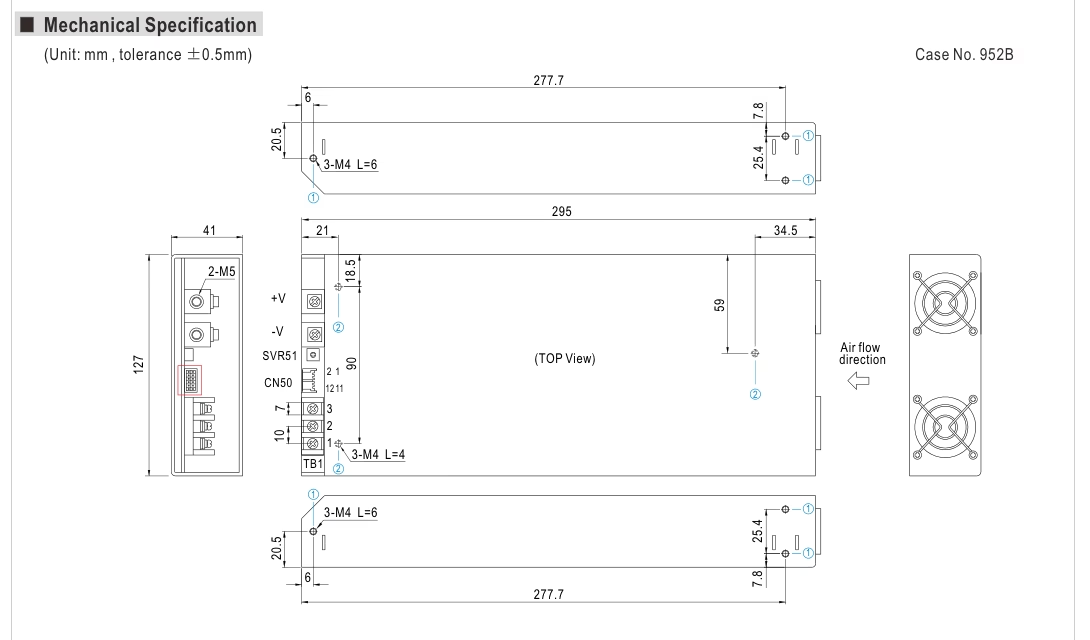
Factory mechanical drawing: 295 × 127 × 41 mm, Case 952B, TB1 and CN50 marked, twin-fan airflow path
Field notes before you buy
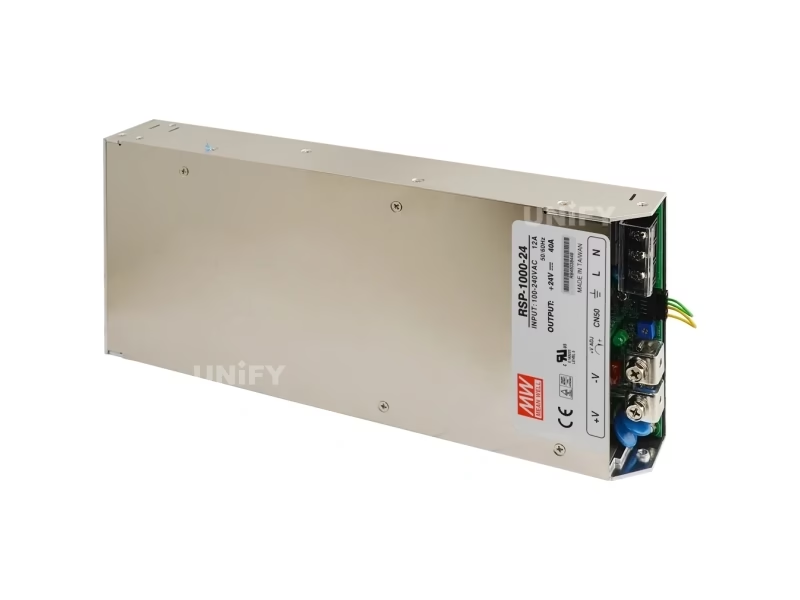
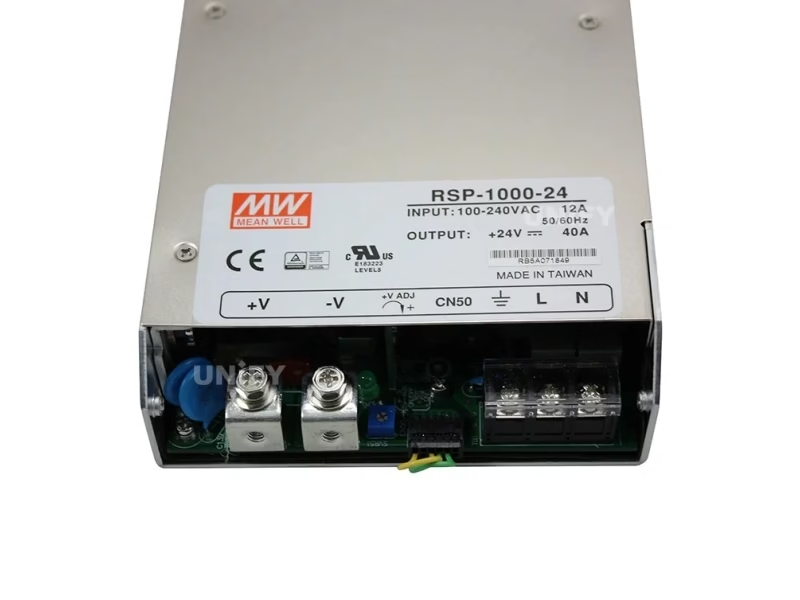
First, input range: the datasheet specifies 90–264 VAC while the production nameplate reads 100–240 V, 12 A (the 24 V model photographed below) — the factory curve gives full rated load from 100 VAC upward and 90% at the 90 VAC floor. Second, the two DC fans are part of the thermal design, not an afterthought — this is not a fanless chassis, so plan the bay airflow along the marked direction. Third, an over-voltage trip latches the output off until the AC feed is cycled — an RSP-1000 that “won’t restart” is usually doing exactly what its protection stage was told to do. Fourth, the EMC tests were executed with the unit mounted on a 360 × 360 mm, 1 mm metal plate; the final cabinet needs its own re-confirmation for tender work.
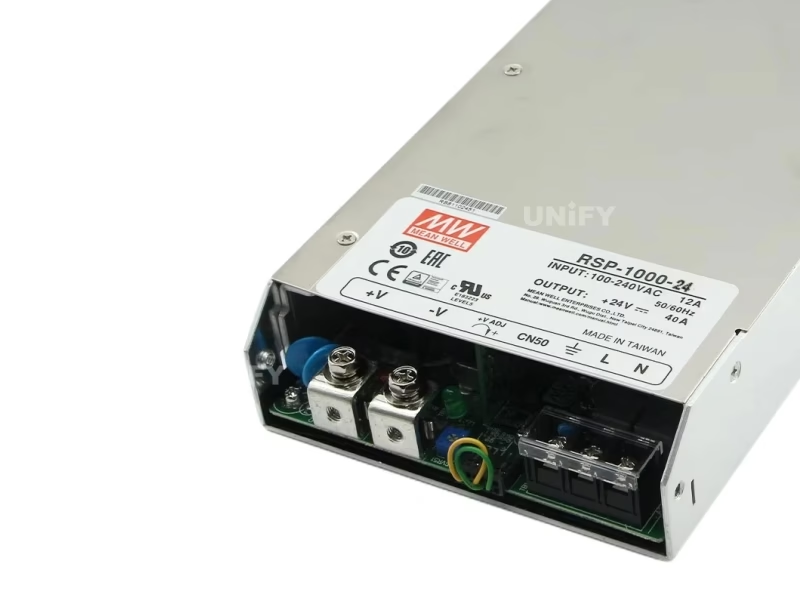
Production nameplate: INPUT 100–240 VAC, 12 A · OUTPUT +24 V, 40 A · +V ADJ, CN50, L and N at the block ends
The RSP-1000 tops the same universal-input, active-PFC enclosed platform MEAN WELL’s own channel introduces here — the family our five RSP pages document rail by rail:
Which LED Display Loads Fit the Mean Well RSP-1000 Rails?
Apply the industry-standard 80% loading rule and the two screen-relevant rails give you four budgets:
12 V rail budget
60 A × 80% = 48 A usable · 720 W × 80% = 576 W usable per unit
24 V rail budget
40 A × 80% = 32 A usable · 960 W × 80% = 768 W usable per unit
Mapped onto typical cabinet loads (average draws under normal program material — full-white patterns run higher, so verify against your module datasheet):
| Typical load | Rail | Average draw | Per RSP-1000 at 80% |
|---|---|---|---|
| 12 V module rows (outdoor industrial, transportation, perimeter formats) | 12 V | ~10–15 W per module | ~38–57 modules |
| Cabinet cooling and ventilation banks | 24 V | ~5–10 W per fan | Inside the 768 W budget |
| Control boxes, light sensors, relay banks | 24 V | ~5–15 W each | Shares the 24 V rail |
| Special-format and long-run rails | 15 / 27 / 48 V | Per module datasheet | 750 / 999 / 1008 W rail caps |
Running a 5 V module bay? The kilowatt platform is the wrong ladder step — the 5 V chain starts at the Mean Well RSP-500 (90 A / 450 W) and tops out at the LRS-600 (100 A / 500 W), with the full derating math in our power consumption walkthrough and per-cabinet count logic in how many power supplies an LED screen needs.
How Does the Mean Well RSP-1000 Parallel Up to 4000 W?
Current sharing is the RSP-1000’s signature function — and the reason this page reads differently from the rest of the family. The RSP-500 page carries a plain warning: do not parallel its outputs, because without a sharing bus one unit runs hot while the other idles. The RSP-1000 has an active current-sharing stage on the CS pin (CN50 pin 7): link the CS pins between units and the units divide load current actively instead of fighting each other.
1 · Link CS, +S and −S between units
The factory diagram parallels +S, −S and CS mutually across every unit in the bank — these three signals are the sharing bus.
2 · Match outputs within 0.2 V first
Set each unit’s +V ADJ at the load end and confirm the spread across units stays under 0.2 V before the bus ties together.
3 · Size the bank with the factory formula
Maximum continuous output current = rated current per unit × number of units × 0.9. The 0.9 factor is the sharing-accuracy allowance — do not design past it.
4 · Stay above 5% of bank rating
When total draw falls under 5% of the bank’s rated current, the datasheet warns sharing may drift out of balance — split the bus instead of over-banking a small load.
5 · Parallel short, feed the load
Tie the units together with short, large-diameter wiring, then run a single feed to the load — the factory diagram’s own wiring rule.
| Bank (same model throughout) | Active units | Continuous current (×0.9) | Continuous power |
|---|---|---|---|
| RSP-1000-24, 3+1 (one hot standby) | 3 | 40 A × 3 × 0.9 = 108 A | 2592 W at 24 V |
| RSP-1000-24, 4 units | 4 | 40 A × 4 × 0.9 = 144 A | 3456 W at 24 V |
| RSP-1000-12, 3+1 (one hot standby) | 3 | 60 A × 3 × 0.9 = 162 A | 1944 W at 12 V |
| RSP-1000-12, 4 units | 4 | 60 A × 4 × 0.9 = 216 A | 2592 W at 12 V |
Every other supply page in this family — the RSP-500, RSP-320, RSP-200 and RSP-150 — lists no current-sharing feature. The RSP-1000 is where the Mean Well screen set gets a genuine parallel option.
What Do Remote ON/OFF, Sense and DC OK Add to the Mean Well RSP-1000?
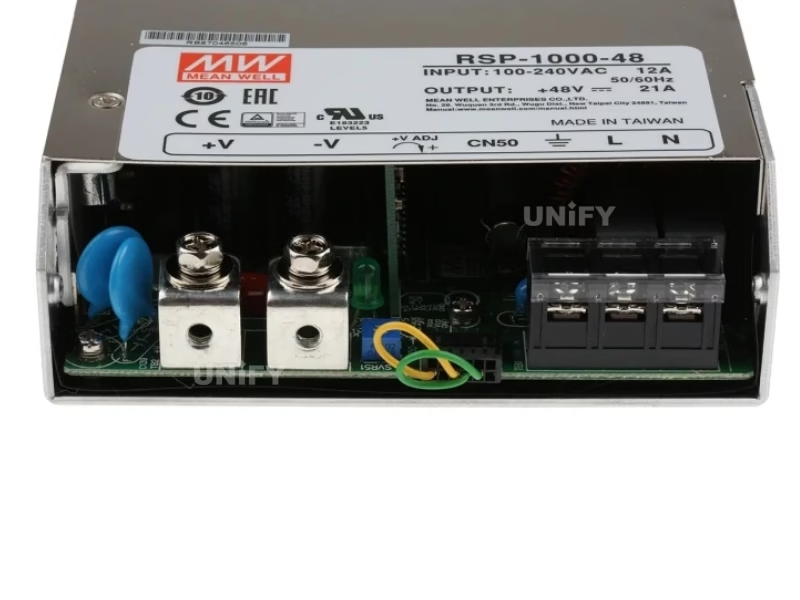
The CN50 connector carries three functions that change how a cabinet is operated and monitored — the same connector family the RSP-500 uses, with the kilowatt unit’s sense window opened wider:
Remote ON/OFF (pin 6 to pin 2)
Short the pair and the unit powers ON; open it and the unit powers OFF. It ships shorted by connector. Wire it to a timer, light sensor or room controller to blank the screen on schedule without touching mains. To switch several units together, join +S to +V and −S to −V across the units.
Remote sense (+S / −S, pins 1–2)
Run thin twisted sense wires to the far end of the DC bus and the regulation loop compensates up to 0.5 V of cable drop — more than the RSP-500’s 0.3 V. At 60 A on the 12 V rail, harness and bus-bar resistance can shave tenths of a volt; sense wiring recovers it, fixing the bright-center, dim-corner cabinet.
DC OK (pin 5, open collector)
The pin pulls low (0–1 V) while the output is up and sits at 3.3–5.6 V when it drops. Sink ≤10 mA, external voltage ≤5.6 V. Wire it to a PLC input or the controller’s fault line and the cabinet reports a dead rail before operators see a black section.
A fourth pin rounds out the block: a 5 V / 0.5 A auxiliary output (pins 3–4, G-AUX/5V-AUX), isolated from the main rail and independent of the ON/OFF control — a standing feed for indicators and monitoring gear that must live even when the screen is dark.
How Does Output Voltage Programming Work on the Mean Well RSP-1000?
Beyond the +V ADJ trimmer, the CN50 connector accepts a programming input that moves the rail across 40–110% of nominal — margin testing for tender benches, seasonal brightness trim, or a controlled bias during burn-in. Two methods, both from the factory function manual:
External voltage (Vci)
Apply 1–6 VDC between Vci (pin 9) and −S (pin 2). The response is non-linear — roughly 1 V sits near the 40% floor and 6 V near the 110% ceiling — so read the factory curve before scripting a set point.
External resistance (R1 / R2)
A 1/8 W resistor from 390 Ω to open (R1) pulls the rail down; one from open to 7.5 kΩ (R2) pulls it up. Fixed trims without a controller — pick the resistor from the two factory curves, not by trial.
Keep Vco and Vca shorted unless you are programming
The Vco (pin 8) and Vca (pin 10) pair ships shorted by connector, and the factory manual is explicit: leave the function unused with the jumper off and the supply will have no output at all. Whatever you program, the OVP threshold sits near 120% of nominal (typ.) — a 110% set point leaves margin, a mis-trim toward the ceiling does not.
One more wiring rule from the same manual: when you activate the programming input, +S must tie to +V and −S to −V on CN50 — the sense pair doubles as the programming return path.
Which Input Grids Can the Mean Well RSP-1000 Run On?
The 90–264 VAC universal window spans 110–120 V and 220–240 V networks alike, with the active PFC holding power factor at 0.98 at 115 VAC and 0.95 at 230 VAC under full load:
| Grid | Verdict on the RSP-1000 |
|---|---|
| 220–240 V (EU, UK, Middle East, Asia, AU) | Full rated load; the design center the nameplate quotes (100–240 V, 12 A) |
| 110–120 V (US, Canada, Japan, Taiwan) | Full rated load at 12 A AC input — no transformer caveat for these grids |
| 90–100 V (brownout-prone grids) | Runs at 90% of rated per the factory static-characteristics table — 12 V drops to 54 A / 648 W, 24 V to 36 A / 864 W, 48 V to 18.9 A / 907.2 W |
The corrected input also pairs naturally with generator-fed event sites and long temporary distribution — the same argument the RSP-200 and RSP-150 make, now at kilowatt scale. One environment note from the datasheet: above 2000 m altitude, derate the working temperature by 5°C per 1000 m for this fan-cooled series.
Mean Well RSP-1000 vs RSP-500: Which Ladder Step Does Your Screen Need?
These two top the RSP ladder from opposite ends of the rail map — and both already have full pages on this site:
- Rail map: the RSP-500 spans eight rails from 3.3 V up, with its 5 V model carrying 90 A / 450 W; the RSP-1000 starts at 12 V and tops out at 48 V / 21 A / 1008 W. 5 V module bays pick the RSP-500; 12 V-and-up bays pick the RSP-1000.
- Parallel: the RSP-1000 has active current sharing (up to 4 units, 3+1); the RSP-500 lists no sharing feature and its page says so plainly — do not parallel it.
- Remote sense: 0.5 V of compensation on the RSP-1000 versus 0.3 V on the RSP-500 — both fix cable drop; the kilowatt unit absorbs more of it.
- Warranty: 5 years versus 3 years — the RSP-1000 carries the longest cover in the Mean Well screen set.
- Chassis: 295 × 127 × 41 mm / 1.95 kg with twin fans versus 230 × 127 × 40.5 mm / 1.3 kg — plan the deeper bay and the airflow.
| Parameter | Mean Well RSP-1000 | Mean Well RSP-500 |
|---|---|---|
| Rails | 12 / 15 / 24 / 27 / 48 V (five) | 3.3–48 V incl. 5 V (eight) |
| Screen-relevant output | 12 V / 60 A / 720 W | 5 V / 90 A / 450 W |
| Max rail power | 1008 W (48 V rail) | 504 W (24 / 48 V rails) |
| PFC | Active, PF > 0.98 at 115 VAC | Active, PF > 0.98 at 115 VAC |
| Current sharing | Up to 4 units (3+1), rated × N × 0.9 | None — do not parallel |
| Remote sense | 0.5 V | 0.3 V |
| Warranty | 5 years | 3 years |
| Dimensions / weight | 295 × 127 × 41 mm / 1.95 kg | 230 × 127 × 40.5 mm / 1.3 kg |
| MTBF | 939.4K h Telcordia + 116.5K h MIL | 1,372.4K h Telcordia + 187.9K h MIL |
Pick by rail voltage first, then by feature. The RSP line now covers both ends of a screen’s power architecture on the same universal-input, active-PFC platform:
RSP-150 · 5 V 30 A
120 W budget, fanless chassis with remote ON/OFF — the single-bay entry.
RSP-200 · 5 V 40 A
160 W budget, fanless 1U, twelve rails down to 2.5 V.
RSP-320 · 5 V 60 A
240 W budget with a speed-controlled fan — the dense indoor cabinet unit.
RSP-500 · 5 V 90 A
360 W budget with remote sense — the top of the 5 V chain.
RSP-1000 · 12 V 60 A
576 W budget, parallel to 4000 W, 5-year warranty — the kilowatt platform above the 5 V chain.
How Do You Install and Wire the Mean Well RSP-1000 Safely?
One AC block, one DC block and the 12-pin control connector define the wiring workflow:
| Block / pin | Assignment |
|---|---|
| TB1 · 1 / 2 / 3 | AC/N · AC/L · FG (frame ground) — 18 Kgf-cm max |
| DC output · +V / −V | Module and peripheral bus — 10 Kgf-cm max |
| CN50 · 1 / 2 | +S · −S (remote sense, twisted pair) |
| CN50 · 3 / 4 | G-AUX · 5V-AUX (0.5 A auxiliary, isolated) |
| CN50 · 5 | DC_OK (open collector, referenced to GND pins 11–12) |
| CN50 · 6 | Remote ON/OFF (short to −S = ON; ships shorted) |
| CN50 · 7 | CS (current-sharing bus for parallel banks) |
| CN50 · 8 / 9 / 10 | Vco · Vci · Vca (output voltage programming) |
| CN50 · 11 / 12 | GND (negative terminal return, DC OK reference) |
1 · Mount on the flanges
M4 screws with 6 mm maximum penetration at the base holes and 4 mm at the sides, torqued 7–11 Kgf-cm. Keep the marked airflow path open — the twin fans are the thermal design.
2 · Wire AC, DC and ground
Mains into TB1 (18 Kgf-cm), the DC bus across +V/−V (10 Kgf-cm), FG bonded to cabinet earth. Check polarity with a meter before the first power-up.
3 · Optional: control and sense wiring
Run the +S/−S pair to the far end of the bus, the ON/OFF pair to your controller, DC_OK to a PLC input. Keep sense wires twisted and away from the switch-node wiring. For parallel banks, tie CS, +S and −S across units.
4 · Set the rail with +V ADJ
Trim at the load end under full load — the 12 V model adjusts 10–13.5 V, the 24 V model 20–26.4 V — then confirm each cabinet measures the same within a few tenths.
5 · Load-test and monitor
Run a full-white pattern for ten minutes, feel for hot spots, confirm the fans respond to load and DC_OK sits low (output up), then re-torque before closing the cabinet.
Two latches to respect
OVP: after an over-voltage trip the output stays down until the AC feed is cycled — find the upstream cause before restarting the screen. PV jumper: keep Vco–Vca shorted when the programming function is unused — without the jumper the supply has no output at all.
When a unit does fail in the field, our LED display power supply diagnostics and replacement guide walks the test-and-swap workflow end to end. On our own cabinets, the swap is designed to take minutes:
What Problems Does a Failing Mean Well RSP-1000 Power Supply Cause?
Power trouble wears disguises — check these three signatures before blaming a module or a control card:
Cabinet reboots or dead sections
A latched OVP reads as dead-until-repower; constant-current overload reads as a dimmed bus. Measure the rail during the dropout before replacing modules.
Dim corners, one cabinet
Aging capacitors or an unsensed long run sag the far end of the bus. The +S/−S pair exists for exactly this cabinet — enable it before rewiring.
Flicker on camera or under load spikes
An overloaded rail dips for a frame at a time. Flicker that tracks bright content points at the supply first — recheck the 80% budget before touching the modules.
How Much Does the Mean Well RSP-1000 Cost?
The kilowatt platform sits a step above the 500 W ladder: expect the single-unit authorized-distributor price to sit above the $94.60 reference the RSP-500-5 carries (Mouser, observed September 2026), with the exact figure moving by rail and by market. Mean Well packs this series 6 pieces to a carton, and volume pricing for screen-production quantities steps down from list.
Sample · 1–10 pcs
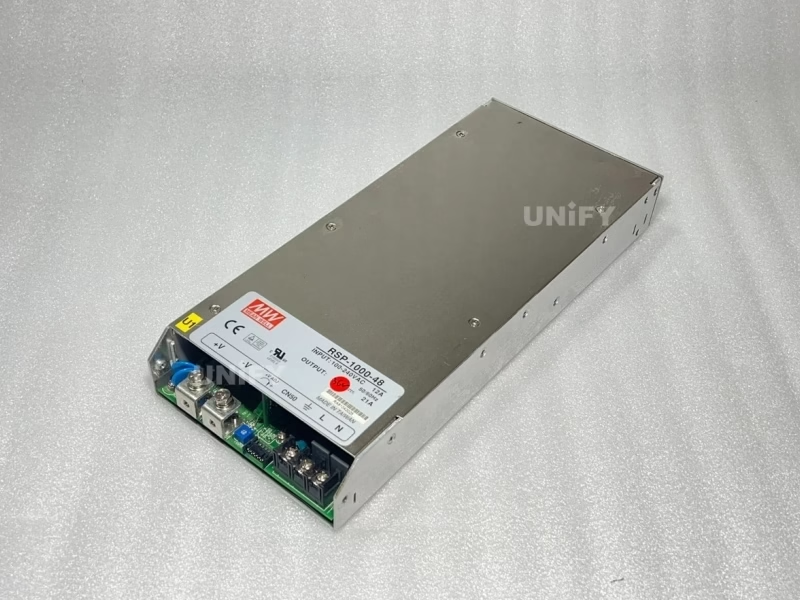
For repairs, prototypes and trial cabinets — shipped from stock with the nameplate you see above.
Project · 10–500 pcs
Whole-screen and fleet quantities with per-cabinet load math and the parallel-bank wiring planned into the harness.
Volume · 500+ pcs
Production-line pricing with container freight planning and batch date-code consistency.
Send the module types, modules-per-cabinet and total cabinet count, and the quote comes back with the load math attached — from an LED screen manufacturer that stocks the full chain from power to control.
Mean Well RSP-1000 Switching Power Supply: Frequently Asked Questions
Can the RSP-1000 run on a 110 V outlet in the US?
Yes. The 90–264 VAC universal input carries full rated load across 110–120 V grids (12 A AC input at 115 VAC); only the 90–100 V band asks for the 10% derating the factory static-characteristics table specifies. No step-up transformer is needed for US, Canadian or Japanese grids.
How many LED modules can one RSP-1000-12 drive?
At the 80% loading rule: 576 W or 48 A usable on the 12 V rail. Typical 12 V module rows draw about 10–15 W of average program material, so one unit covers roughly 38–57 such modules plus the cabinet’s cooling and control loads — verify against your module datasheet. For 5 V module bays, step down to the RSP-500 or LRS-600 instead.
Can I parallel RSP-1000 units for more current?
Yes — it is the only supply in the Mean Well screen set with a sharing feature. Link the CS, +S and −S pins across units, match outputs within 0.2 V first, and size the bank by the factory formula: maximum continuous current = rated current per unit × number of units × 0.9. Up to four units (3+1); keep total draw above 5% of the bank rating. The RSP-150 through RSP-500 have no sharing and must not be paralleled.
What does the DC OK signal do and how do I wire it?
DC OK (CN50 pin 5) is an open-collector status output referenced to GND (pins 11–12): it pulls to 0–1 V while the output is up and sits at 3.3–5.6 V when the output drops. The transistor sinks up to 10 mA from an external circuit at 5.6 V maximum. Wire it to a PLC input or the controller’s fault line so the cabinet reports a dead rail immediately.
Why did my RSP-1000 shut off and not come back?
Check which protection tripped. Overload (105–125%) recovers by itself through constant current limiting, and over-temperature recovers once the chassis cools. Over-voltage is the exception: it latches the output off until the unit is re-powered — cycle the AC feed, then find the upstream cause before restarting the screen. And if the output never comes up at all, check that the Vco–Vca jumper is in place when the programming function is unused.
What warranty and service life does Mean Well publish?
A 5-year warranty — the longest in the RSP family, where the smaller members carry three — with a dual-method MTBF: 939,400 hours minimum by Telcordia SR-332 plus 116,500 hours minimum by MIL-HDBK-217F at 25°C.
RSP-1000 or RSP-500 for my screen?
Pick by rail voltage. The RSP-500-5 feeds 5 V module bays with 90 A / 450 W; the RSP-1000 carries 12 V-and-up bays with up to 1008 W, adds the parallel function, wider 0.5 V sense window and a 5-year warranty. A mixed cabinet — 5 V modules plus 24 V cooling and control banks — legitimately uses both.
Can I trim or program the output voltage?
Both. The +V ADJ trimmer covers the rail’s adjustment window (the 12 V model 10–13.5 V, the 24 V model 20–26.4 V), and the programming input extends the range to 40–110% of nominal via an external 1–6 VDC source or a 1/8 W resistor. Keep the Vco–Vca jumper in place whenever the function is unused — without it the supply has no output — and stay clear of the OVP threshold near 120% of nominal.
Quote the Mean Well RSP-1000 With the Load Math Done
Send your module types and cabinet count; we return per-cabinet power sizing and a matched quote from a LED screen manufacturer that ships worldwide.
📱 / WhatsApp: +86-191-18802497 · Shenzhen, China · GMT+8
More Mean Well Switching Power Supply and LED Display Power Resources
LED Display Power Supply (Mother Catalog)
The three-brand mother catalog: 27 model pages, 2026 price bands, architecture map and the 80% load math — start here.
Mean Well RSP-500 (5 V 90 A)
The 5 V counterpart: 450 W with remote sense on CN100 — the top of the 5 V chain.
Mean Well LRS-600 (500 W)
The economy ladder top: 5 V / 100 A / 500 W across seven rails.
Mean Well NEL-400 (400 W)
The slim alternative: 5 V / 80 A in a 30 mm chassis with conformal coating standard.
Mean Well RSP-320 (300 W)
The 5 V step below: 60 A across twelve rails with universal PFC.
Mean Well RSP-200 (200 W)
Fanless 1U: 5 V / 40 A / 200 W with active PFC and no moving parts.
Mean Well RSP-150 (150 W)
Small-bay option: 5 V / 30 A / 150 W in a fanless chassis, the site’s 110 V-native page.
LED Display Power Consumption
Screen-level power math: module draw, brightness settings, breaker sizing and cable gauges.
Power Supply Diagnostics & Replacement
Test a suspect supply, swap it inside a live screen, and root-cause repeat failures.