
MEAN WELL LRS Series · 200 W Single Output · 8 Voltages 3.3–48 V · Fanless 1U · 3-Year Warranty
Mean Well LRS-200 Switching Power Supply
The Mean Well LRS-200 is the 200 W step-up of the world’s best-selling enclosed supply family — and the first LRS to reach the display module bus itself: eight outputs from 3.3 V to 48 V, including a 5 V / 40 A model built for LED screen modules, plus a 4.2 V rail for common-cathode screens, all from one 30 mm fanless chassis.
📱 / WhatsApp: +86-191-18802497 · Shenzhen, China · GMT+8
3.3–48 V
8 output voltages, one chassis
5 V / 40 A
The LED module bus model
132–212.4 W
Rated power per the datasheet
150% × 1 s
Peak load, 12–48 V models
3 Years
Manufacturer warranty
Short answer
The Mean Well LRS-200 is a 200 W-class single-output enclosed switching power supply offered in eight DC voltages — 3.3 V/40 A, 4.2 V/40 A, 5 V/40 A, 12 V/17 A, 15 V/14 A, 24 V/8.8 A, 36 V/5.9 A and 48 V/4.4 A — from a fanless 215 × 115 × 30 mm, 0.66 kg chassis with a 90–132/180–264 VAC input selected by a physical switch. Per the official datasheet (2025-09-12 revision) the models run at 83–90% efficiency, carry 110–140% overload protection plus a 150% peak-load capability for 1 second on the 12–48 V models, and ship with a 3-year warranty. The 5 V model feeds LED display modules directly at 40 A — the same rating as CZCL’s A-200AC-5 — while the 4.2 V model serves common-cathode screens and the 12–48 V models cover control cabinets and auxiliary buses. One compliance note separates it from the LRS-150: the series does not meet EN 61000-3-2 harmonic limits, which restricts some EU lighting applications.
What Is the Mean Well LRS-200 Switching Power Supply?
The Mean Well LRS-200 is a single-output enclosed-type AC-DC switching power supply rated for 200 W continuous output, the mid-size member of the LRS family: 30 mm high, 1U-compatible, cooled by free air convection with no fan. The order code reads out in three parts — series name, output power, output voltage — so LRS-200-5 is the 200 W unit delivering 5 V, and the series stretches from a 3.3 V rail all the way to 48 V.
What makes this model matter to LED display builders is the low-voltage end of the lineup. The LRS-150 series stops at 12 V, but the LRS-200 adds 3.3 V, 4.2 V and 5 V at 40 A each — the three voltages that LED screen hardware actually runs on. A 5 V / 40 A rail is the standard module-bus supply for an indoor cabinet; 4.2 V is the LED-bus voltage of common-cathode screens; 3.3 V serves newer low-voltage designs. That means for the first time a standard Mean Well catalog supply can carry the display bus itself, not just the electronics around it.
40 A, three connections deep
The ±V output uses three screw terminals per pole on the low-voltage models — the 40 A bus lands across all three, a layout the smaller LRS-150 does not need at 12.5 A.
Peak headroom on 12–48 V
Datasheet Note 7 builds in a 150% peak-load capability for up to 1 second on the 12–48 V models — motor starts and relay inrush ride through; over a second, hiccup protection takes over.
Serial-traceable, 3-year warranty
Same buying safeguards as the rest of the family: serial number verifiable on the MEAN WELL website, 100% full-load burn-in, 3-year manufacturer warranty.
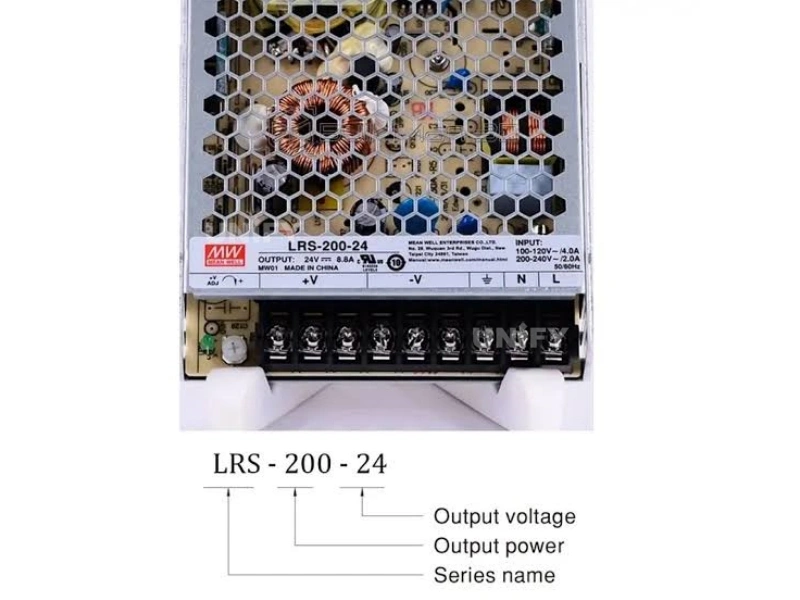
Model code on the label: LRS-200-24 = series 200 W class, 24 V output
MEAN WELL’s official introduction to the LRS platform shows the family concept this model extends:
Where the LRS-200 sits in a build: the 5 V and 4.2 V models are screen-bus candidates, and everything from 12 V up mirrors the auxiliary territory the Mean Well LRS-150 switching power supply already covers — control cabinets, strip and lightbox walls, vehicle signs. The two pages are siblings, not substitutes.
What Are the Mean Well LRS-200 Specifications?
All figures come from the official MEAN WELL LRS-200 specification sheet (2025-09-12 revision). The series name says 200 W, but only the 5 V model is rated exactly 200 W — the 3.3 V model delivers 132 W, and the 24/36/48 V models reach 211.2–212.4 W in the datasheet’s own table.
| Model | Output | Rated power | Adj. range | Ripple max | Efficiency |
|---|---|---|---|---|---|
| LRS-200-3.3 | 3.3 V / 40 A | 132 W | 2.97–3.6 V | 150 mVp-p | 83% |
| LRS-200-4.2 | 4.2 V / 40 A | 168 W | 3.6–4.4 V | 150 mVp-p | 86% |
| LRS-200-5 | 5 V / 40 A | 200 W | 4.5–5.5 V | 150 mVp-p | 87% |
| LRS-200-12 | 12 V / 17 A | 204 W | 10.2–13.8 V | 150 mVp-p | 87.5% |
| LRS-200-15 | 15 V / 14 A | 210 W | 13.5–18 V | 150 mVp-p | 88% |
| LRS-200-24 | 24 V / 8.8 A | 211.2 W | 21.6–28.8 V | 200 mVp-p | 89.5% |
| LRS-200-36 | 36 V / 5.9 A | 212.4 W | 32.4–39.6 V | 200 mVp-p | 89.5% |
| LRS-200-48 | 48 V / 4.4 A | 211.2 W | 43.2–52.8 V | 200 mVp-p | 90% |
| Parameter | LRS-200 series |
|---|---|
| Input voltage range | 90–132 VAC / 180–264 VAC selected by switch; 240–370 VDC with switch on 230 VAC |
| Input frequency / current | 47–63 Hz; 4 A at 115 VAC, 2.2 A at 230 VAC (typ.) |
| Inrush / leakage | 60 A cold start at 115 and 230 VAC; <2 mA at 240 VAC |
| Setup / rise / hold-up time | 1500 ms / 50 ms full load; hold-up 16 ms at 230 VAC, 12 ms at 115 VAC (typ.) |
| No-load power draw | <0.75 W |
| Overload | 110–140% rated power; 150% peak for 1 s built in (12–48 V models, Note 7) |
| Overvoltage / overtemperature | 3.3–36 V models: hiccup, auto-recovery; 48 V model: shutdown, re-power to reset |
| Short circuit | Hiccup mode, recovers automatically after the fault clears |
| Withstand / insulation | I/P-O/P 3.75 kVAC; I/P-FG 2 kVAC; O/P-FG 0.5 kVAC; 100 MΩ at 500 VDC |
| Working environment | −25 to +70°C, 20–90% RH non-condensing (derating curve applies); storage −40 to +85°C |
| Vibration / altitude | 10–500 Hz at 5 G, 60 min per axis; full load to 2,000 m, −5°C per 1,000 m above; operation to 5,000 m derated |
| MTBF | 2,346.6K hrs min. (Telcordia SR-332); 279.4K hrs min. (MIL-HDBK-217F, 25°C) |
| Dimensions / weight | 215 × 115 × 30 mm (case 207); 0.66 kg; 15 pcs per 10.9 kg carton |
| Safety standards | IEC/UL 62368-1; BSMI CNS15598-1; EAC TP TC 004; KC 62368-1 (-12/-24); GB 4943.1; BIS IS 13252; BS EN/EN 61558-1/-2-16 |
| EMC | Immunity: BS EN/EN 55035 heavy-industry references; BSMI CNS15936. Harmonics: does not meet BS EN/EN 61000-3-2 (datasheet Note 10 — see compliance section) |
| Build and warranty | 100% full-load burn-in; 65 kHz switching; LED power indicator; 3-year warranty |
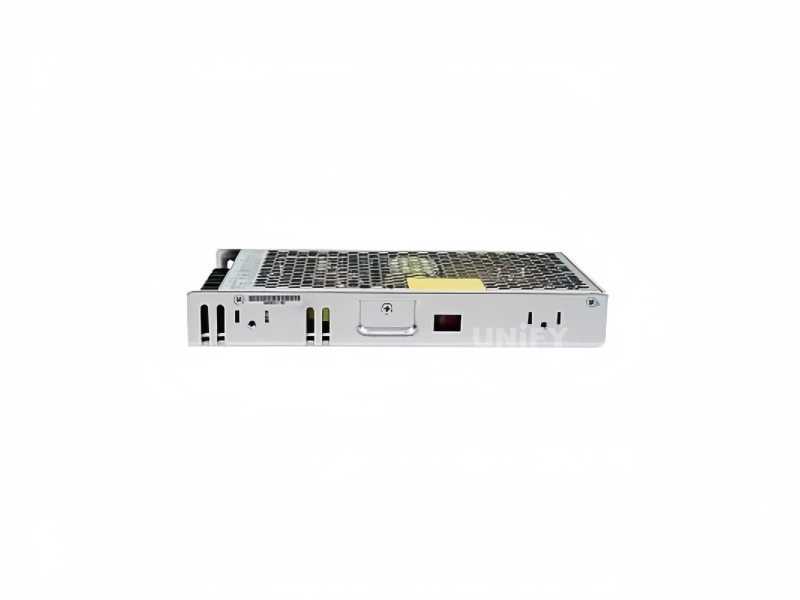
215 × 115 × 30 mm, 0.66 kg: bigger than the LRS-150 but still fanless 1U
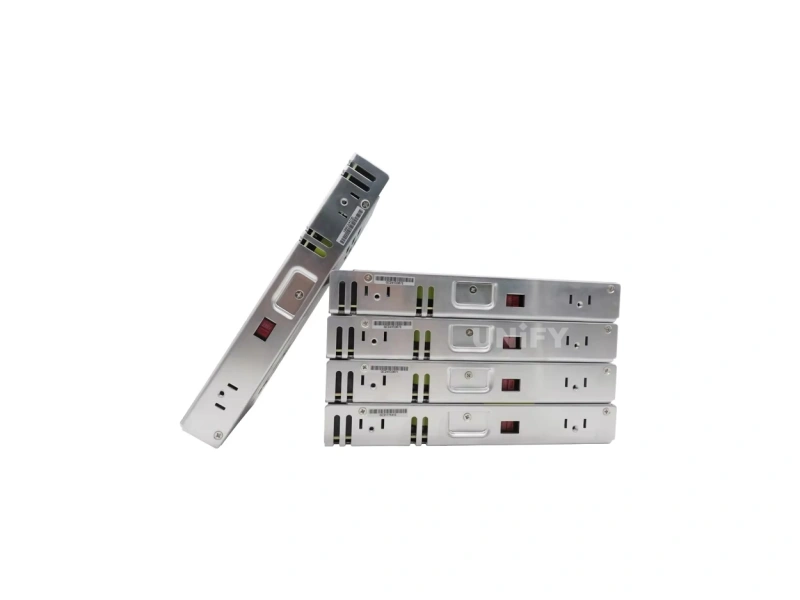
Mounting flanges on both sides: 15 pieces per carton for panel builds
Three field notes most listings skip
First, the peak-load clause is voltage-specific: 150% for 1 second applies to the 12–48 V models only per Note 7 — do not promise it on a 5 V module bus. Second, hold-up time is 16 ms at 230 VAC, the shortest in the LRS family so far — fine for LED loads on stable grids, thin for generator changeover. Third, the 4.2 V model carries the widest tolerance in the series (±4.0% total, ±2.5% load) — a deliberate trade in the common-cathode rail, but read it before promising ±1%-class stability to a client.
Which Mean Well LRS-200 Voltage Should You Order?
The eight models split into two families with different jobs:
3.3 / 4.2 / 5 V — the screen bus
40 A each. 5 V feeds standard LED display modules; 4.2 V feeds common-cathode LED rails; 3.3 V serves low-voltage designs. These three put the LRS-200 in direct competition with display-market specialists — the comparison below is where it earns or loses the slot.
12 / 15 / 24 / 36 / 48 V — the ecosystem
Control cabinets, strip-light and lightbox walls, vehicle and pole signs, industrial loads — the same territory as the LRS-150, with 50 W more headroom and the 1-second peak capability.
Trim discipline applies as everywhere in the LRS line: the +ADJ potentiometer exists for cable-drop compensation and fine-tuning (4.5–5.5 V on the 5 V model), not for converting between voltage classes. And because the low-voltage models are the ones touching the screen, their adjustment window matters more — a 4.2 V rail trimmed to 4.4 V to chase brightness is 60 mV per LED string of extra stress across a whole wall, which is why the common cathode LED technology guide keeps trim inside the module maker’s window.
How Does the Mean Well LRS-200-5 Compare With the CZCL A-200AC-5?
This is the head-to-head the LRS-200’s low-voltage models invite: the CZCL A-200AC-5 is also a 5 V / 40 A / 200 W supply built for LED display modules. Same electrical job, two engineering cultures:
| Dimension | Mean Well LRS-200-5 | CZCL A-200AC-5 |
|---|---|---|
| Output | 5 V / 40 A / 200 W | 5 V / 40 A / 200 W |
| Efficiency (published) | 87% (typ., datasheet) | Not stated (ask for batch data) |
| Input | 90–132 / 180–264 VAC by switch | 190–264 VAC fixed (230 V markets) |
| Working temperature | −25 to +70°C | −40 to +70°C |
| Harmonics (EN 61000-3-2) | Not met (Note 10 restrictions) | Compliant (GB 17625.1 / EN 61000-3-2) |
| Dimensions | 215 × 115 × 30 mm, 0.66 kg | 165 × 56 × 26 mm (per CZCL datasheet) |
| Output terminals | 3 per pole (9-pin block) | 2 per pole |
| Warranty | 3 years, serial-traceable | Project-dependent (ask with the quote) |
Read the table as a fit decision, not a verdict. The LRS-200-5 wins on published efficiency, global distribution with a public street price, the 115 V input switch, and the 3-year warranty — the honest pick for distributed buys, tight cabinets where a documented spec sheet matters, and mixed 5 V + 24 V cabinets that want one brand across both buses. The CZCL A-200AC-5 wins on footprint — roughly 40% of the LRS-200-5’s volume, which matters in slim indoor cabinets — on the −40°C cold floor, and on harmonic compliance that keeps EU public-grid lighting-adjacent installs clean. The full screen-side lineup sits in the CZCL power supply collection, with the A-200AC-5 spec’d on its own page: CZCL A-200AC-5 LED switching power.
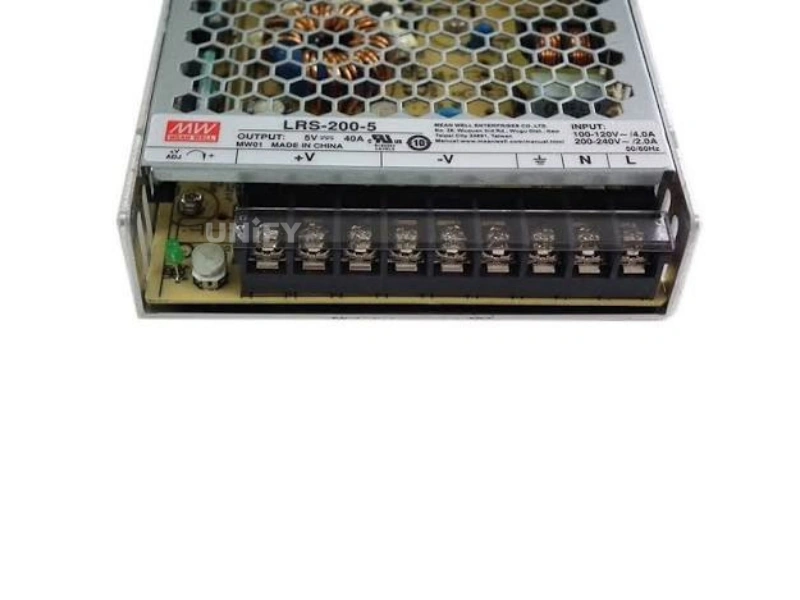
LRS-200-5 label: 5 V • 40 A — the module-bus rating
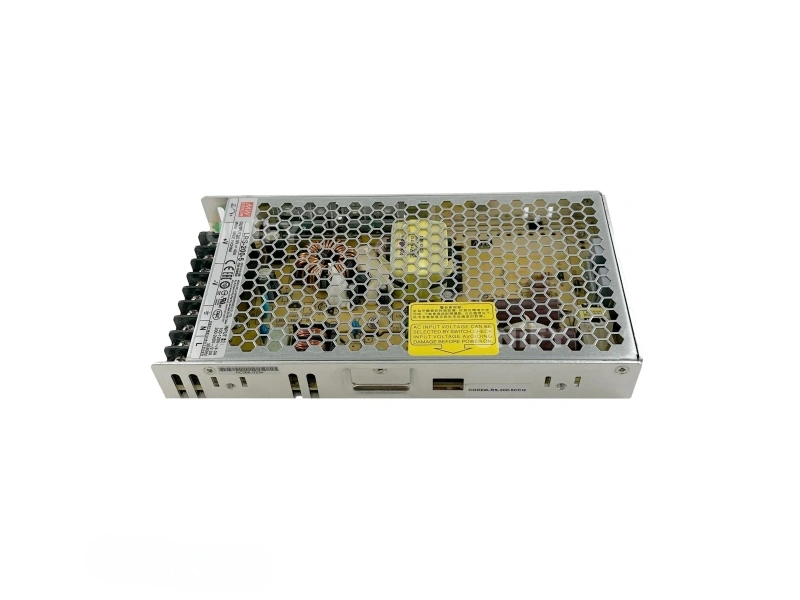
LRS-200-5 top view: same chassis across all eight voltages
How Much LED Load Can a Mean Well LRS-200 Carry?
Apply the 80% rule — the standard derating that leaves room for inrush, ambient heat and aging — to each model’s rated power:
| Model | Rated | 80% usable power | Usable current |
|---|---|---|---|
| LRS-200-3.3 | 132 W | 105.6 W | 32.0 A at 3.3 V |
| LRS-200-4.2 | 168 W | 134.4 W | 32.0 A at 4.2 V |
| LRS-200-5 | 200 W | 160 W | 32.0 A at 5 V |
| LRS-200-12 | 204 W | 163.2 W | 13.6 A at 12 V |
| LRS-200-15 | 210 W | 168 W | 11.2 A at 15 V |
| LRS-200-24 | 211.2 W | 169 W | 7.04 A at 24 V |
| LRS-200-36 | 212.4 W | 169.9 W | 4.72 A at 36 V |
| LRS-200-48 | 211.2 W | 169 W | 3.52 A at 48 V |
The split matters more than the totals: the three screen-bus voltages land at 106–160 W usable, the five ecosystem voltages at 163–170 W. On the 5 V module bus that 160 W budget sizes cabinets the same way the CZCL page teaches — a module string drawing 280 W wants two LRS-200-5 units feeding separate groups, not one at 140%. The screen-level arithmetic — modules, peak wattage, duty cycle — is worked through in the LED display power consumption guide and the per-cabinet counting method.
Peak-load honesty, one more time: the 150%-for-1-second capability is a 12–48 V feature. On the 3.3/4.2/5 V models the overload band is the ordinary 110–140% with hiccup recovery — size module buses against 160 W usable, not against 300 W peak stories.
What Protections and Certifications Does the Mean Well LRS-200 Carry?
Short circuit and overload pulse in hiccup mode and recover automatically; the series splits overvoltage and overtemperature behavior by voltage class: 3.3–36 V models pulse and self-recover, while the 48 V model latches off and needs a re-power cycle. The split is worth knowing before you commission: a tripped 5 V rail comes back on its own once the fault clears, a tripped 48 V rail waits for an operator.
Isolation is specified at 3.75 kVAC input-to-output with 100 MΩ insulation resistance, and immunity references the heavy-industry level of the family. Ripple and noise — 150 mVp-p on the low-voltage models, 200 mVp-p from 24 V up — is measured per the published method:
Compliance note the datasheet puts in writing — and most listings leave out
Per datasheet Note 10, the LRS-200 does not meet BS EN/EN 61000-3-2 harmonic-current limits, and the note spells out where that bites: end-devices used within the European Union, connected to public mains at 220 V or greater, where the supply delivers an average or continuous input power above 75 W or forms part of a lighting system. Exceptions exist (professional equipment above 1,000 W total, symmetrically controlled heating up to 200 W), but the practical reading is this: for EU public-grid lighting work — channel letters, lightboxes, architectural strips — the LRS-150 or a PFC-equipped series such as the CZCL A-400JQ-5P LED switching power is the compliant choice, while industrial cabinets, professional equipment and display systems outside the lighting classification are where this series belongs. The CZCL screen supplies carry the GB 17625.1 / EN 61000-3-2 compliance the LRS-200 lacks.
Safety approvals center on IEC/UL 62368-1 (AV/IT), BS EN/EN 61558-1 and -2-16, GB 4943.1, BIS, BSMI and EAC — an industrial/AV list. Unlike the LRS-150 there is no EN 60335-1 household-appliance approval, so consumer-adjacent builds stay on the 150.
How Do You Install and Wire a Mean Well LRS-200 Safely?
The 9-pin terminal block runs AC-in (L, N, FG ground) and DC-out in one row: pins 1–2 are AC L/N, pin 3 is FG, pins 4–6 are −V and pins 7–9 are +V. On the 40 A low-voltage models the DC bus lands across all three terminals per pole — landing the full current on one screw is a heat call waiting to happen.
1Set the input switch first. Confirm the 115/230 selector matches the grid before first energization — wrong-setting symptoms mirror the LRS-150: dead on 230-position-at-115 V, damaged on the reverse.
2Mount on all four M4 flanges. Case 207 fixes with 4-M4 screws per side; metal-to-metal against a clean plate, horizontal orientation, derating curve respected above 50°C ambient.
3Earth FG first. Ground, then L/N, then DC — the FG terminal carries the EMI filter’s return path and the chassis safety bond.
4Spread the DC bus across all three terminals. Twist and shorten +V/−V pairs; on long 5 V runs lift output with +ADJ rather than oversizing the supply.
5Verify unloaded, then load. Energize bare, meter the output against the +ADJ marking, then connect the module string — the habit shown in the replacement video below.
6Keep it dry. Perforated IP20 chassis inside a sealed enclosure only — the LED screen cabinet guide covers enclosure planning and drainage.
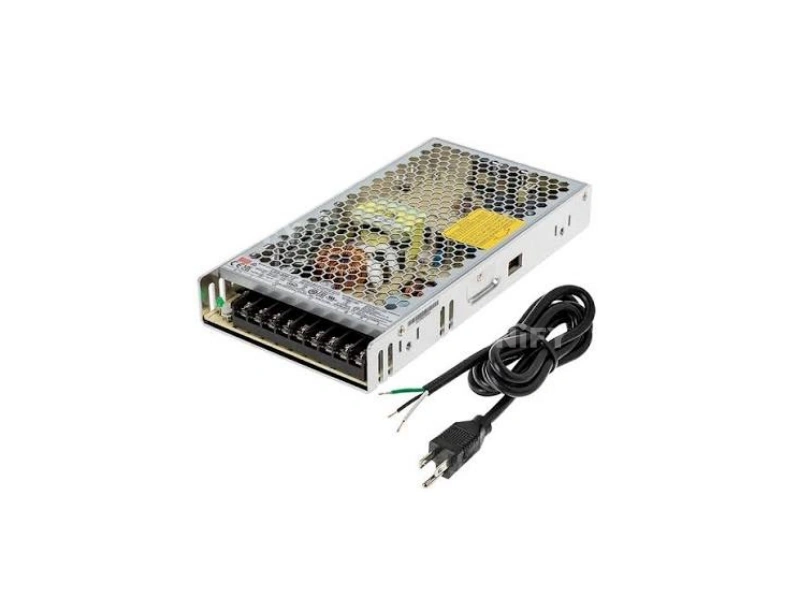
The full 9-pin row: AC L/N and FG on the right, −V and +V triples on the left, +ADJ at the far end
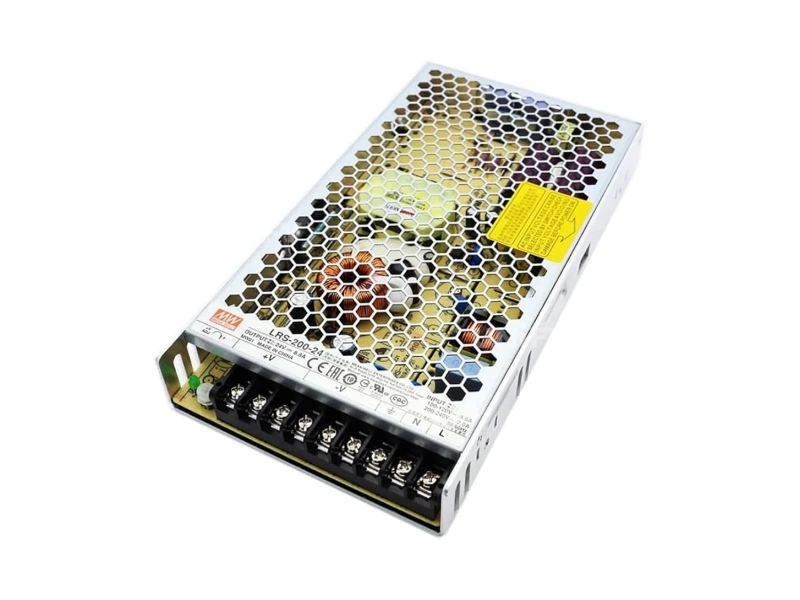
Base plate: the convection surface that must sit metal-to-metal on the mounting plate
Where Does the Mean Well LRS-200 Fit in an LED Display System?
With the low-voltage trio, the LRS-200 covers both power domains of a screen build from one catalog:
Module bus (5 V)
Indoor fine-pitch and rental cabinets on standard 5 V modules: 160 W usable per unit, ~40% of the volume of the CZCL equivalent, at a public street price — the trade the head-to-head above prices out.
Common-cathode rail (4.2 V)
Energy-saving screens whose LED bus sits near 4.2 V. Note what this is not: the dual-rail architecture of the CZCL B-200AF LED switching power pairs 3.8 V with a separate 2.8 V driver rail — a single 4.2 V unit serves only the LED bus side of that wiring.
Auxiliary and ecosystem (12–48 V)
Control cabinets, strip and lightbox walls, vehicle and pole signs — with the 1-second peak capability and the EU lighting caveat from the compliance section applied to the lightbox case.
Specifying across brands is normal at this level: many cabinets run Mean Well on the ecosystem bus and CZCL on the module bus, or the reverse. The honest rule is per-bus sourcing — pick each rail’s supply on fit, not on brand loyalty, and keep the sizing discipline of the LED power supply selection guide regardless of the label.
How Does the Mean Well LRS-200 Compare With the LRS-150?
Same family, same 30 mm fanless concept, different callings:
| Dimension | Mean Well LRS-200 | Mean Well LRS-150 |
|---|---|---|
| Voltages | 8: 3.3 / 4.2 / 5 / 12 / 15 / 24 / 36 / 48 V | 5: 12 / 15 / 24 / 36 / 48 V (no 5 V) |
| Rated power | 132–212.4 W | 150–158.4 W |
| Peak capability | 150% for 1 s (12–48 V) | Not specified |
| Efficiency range | 83–90% | 87.5–90% |
| Hold-up time (230 VAC) | 16 ms (typ.) | 40 ms (typ.) |
| Working temperature | −25 to +70°C | −30 to +70°C |
| Dimensions / weight | 215 × 115 × 30 mm, 0.66 kg | 159 × 97 × 30 mm, 0.42 kg |
| MTBF (MIL-HDBK-217F) | 279.4K hours | 558.2K hours |
| EN 61000-3-2 harmonics | Not met (Note 10) | Class A at ≤75% load |
| EN 60335-1 (household) | Not covered | Covered |
The pattern is clear: the LRS-200 buys you the low-voltage screen bus, 50 W more ecosystem headroom and the 1-second peak — and pays with a shorter hold-up time, a 5°C warmer cold floor, a lower MIL-method MTBF figure, and the loss of both harmonic compliance and the household-appliance approval. For pure 12–48 V auxiliary work in EU-visible installs, the LRS-150 stays the safer catalog pick; for anything touching the 5 V module bus, the LRS-200 is the only LRS in the game.
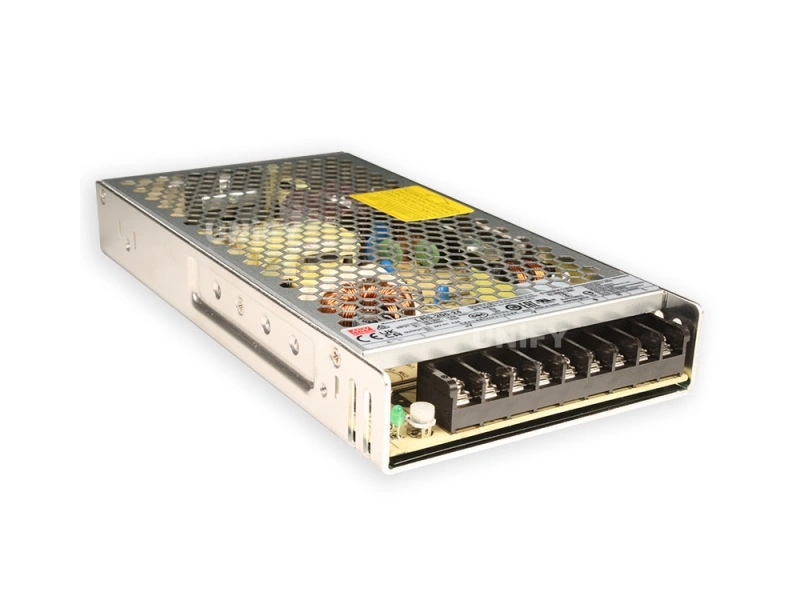
Same family look, different callings: the 200 reaches the module bus, the 150 keeps the compliance edge
What Problems Does a Failing Power Supply Cause?
Auxiliary and module-rail failures announce themselves downstream — here is what each symptom points at before you pull a cabinet apart:
🔌 Module rows going dark in patches
A 5 V rail sagging under load or hiccup-pulsing on a developing short. Meter at full draw: a rail that reads 5.1 V unloaded and drops under load has aged past its electrolytics.
💡 Brightness drifting across a wall
Unequal rail voltages between supplies trimming differently under cable drop. Map the uneven brightness symptom to its rail before turning any +ADJ screw, and check the flickering guide when camera footage is involved.
⚡ A 48 V rail that stays down after a fault
Remember the protection split: the 48 V model latches off on overvoltage or overtemperature and waits for a re-power cycle. If the bus is dead but the breaker is fine, cycle input power before swapping hardware.
The swap-order discipline that keeps a repair from becoming a second fault — isolation, metering, replacement, verification — is the 60-second version in our own video:
The full workflow is in the power supply diagnostics and replacement guide.
How Much Does the Mean Well LRS-200 Cost?
Like the rest of the LRS family, the LRS-200 is a standard catalog part with genuinely public pricing — stable against the 2026 component-cost story in the LED display supply chain price surge analysis. Current published distributor pricing:
| Model | Unit price (qty 1) | Volume price | Source |
|---|---|---|---|
| LRS-200-24 | $15.52 | $14.32 at 50+ pcs | StepperOnline (US) |
| LRS-200-24 | $24.50 | $22.30 at 10+ pcs | DigiKey (US) |
| LRS-200-5 | ~$24.50 | Tiered by qty | DigiKey / Mouser (US) |
| LRS-200-12 | ~$24.50 | Tiered by qty | DigiKey (US) |
Read it as a bracket: high-volume distributors list the popular models from $14.30 to $24.50 depending on channel and quantity. The per-watt arithmetic from the CZCL power supply price guide applies here: at $15.52 for the 24 V model’s 211.2 W rated, an LRS-200-24 costs about 7.3 cents per rated watt at unit quantity, dropping toward 6.8 cents at 50 pieces — and the 5 V module-bus model at $24.50 for 200 W works out near 12.3 cents, the premium you pay for the screen-bus rating.
The buying caution carries over from the family page: verify the serial number on the MEAN WELL website before deploying, because the LRS line is the most cloned series in the segment — and on a 40 A module bus, an unverified isolation barrier is not a saving.
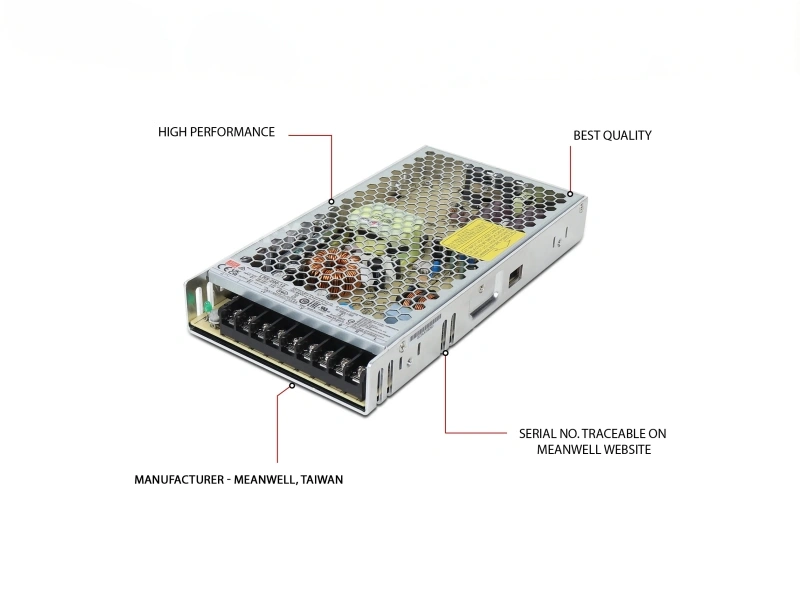
Serial traceability is the anti-clone check: every genuine LRS-200 verifies on the MEAN WELL site
Mean Well LRS-200: Frequently Asked Questions
Does the Mean Well LRS-200 have a 5 V output for LED display modules?
Yes – the LRS-200-5 delivers 5 V at 40 A (200 W), the standard module-bus rating, and it is the only LRS series with 5 V. The lineup also adds 3.3 V and 4.2 V at 40 A, covering low-voltage and common-cathode screen rails that the LRS-150 cannot serve.
Is the 150% peak-load capability available on the 5 V model?
No. Datasheet Note 7 scopes the 150%-for-1-second capability to the 12-48 V models. On the 3.3/4.2/5 V models the overload band is the ordinary 110-140% with hiccup recovery – size module buses against 160 W usable, not against peak stories.
Why does the datasheet say the LRS-200 does not meet EN 61000-3-2?
Note 10 states it directly: the series does not meet the harmonic-current limits, and restricts EU public-grid use at 220 V or greater where the supply delivers more than 75 W continuously or forms part of a lighting system. Industrial cabinets, professional equipment and display systems outside the lighting classification remain the intended applications; EU lighting work belongs on the LRS-150 or a PFC series.
Can the LRS-200-4.2 replace the CZCL B-200AF on a common-cathode screen?
Not on its own. The B-200AF is a dual-rail supply: 3.8 V for the LED bus plus 2.8 V for the driver bus from one chassis. The LRS-200-4.2 is a single 4.2 V rail – it can serve the LED bus of a common-cathode screen only where the driver bus is fed separately, and only if the module maker’s window allows 4.2 V.
What happens if the 115/230 VAC input switch is set wrong?
Switch set to 115 with a 230 V grid connected risks destroying the input stage at energization; switch set to 230 on a 115 V grid is harmless but the supply cannot regulate and appears dead. Check the selector under the shell before first power-on and after every unit swap.
Why does the LRS-200-5 have three terminals per output pole?
The 40 A bus exceeds what one screw terminal carries reliably, so pins 4-6 are -V and pins 7-9 are +V: land the bus across all three per pole. Landing 40 A on a single terminal is a heat call waiting to happen.
How many LED modules can one LRS-200-5 run?
Apply the 80% rule: 200 W x 80% = 160 W usable, or 32 A at 5 V. A module string drawing 280 W wants two units on separate groups, not one at 140%. The same per-bus discipline from the sizing guides applies at any voltage.
How does the LRS-200 differ from the LRS-150 in reliability terms?
Under the same MIL-HDBK-217F method at 25 degrees C the LRS-200 publishes 279.4 thousand hours minimum against the LRS-150’s 558.2 thousand – half the figure, and the hold-up time drops from 40 ms to 16 ms. The 200 buys the low-voltage bus and peak capability; the 150 keeps the reliability and compliance edge. Compare within one method, never across the two.
Related Power Pages and Guides
Mean Well LRS-150 (12–48 V)
The auxiliary-bus sibling: five voltages, longer hold-up, harmonic-compliant – the EU-lighting-safe pick.
CZCL A-200AC-5 (5 V / 40 A)
The same-spec rival on the module bus: 40% smaller, −40°C floor, EN 61000-3-2 compliant.
How Many Power Supplies Does an LED Screen Need?
Per-cabinet counting, breaker math and the 80% rule applied to a full wall.
CZCL Display Power Supply Hub
The 5 V screen-side family from the other culture: four CZCL supplies spec’d and linked.
LED Display Power Supply (Mother Catalog)
The three-brand mother catalog: 27 model pages, 2026 price bands, architecture map and the 80% load math — start here.
UnifyLED LED Display Solutions
The full build picture: indoor and outdoor screens, control systems, cabinets and power architecture.
Need Mean Well LRS-200 Units for Your Project?
Tell us the load list, grid voltage and target market – we will confirm the voltage class, the EN 61000-3-2 fit for EU sites, and quote genuine serial-traceable stock with the 3-year warranty intact.