
CZCL JQ-P Series · 5V 80A · 400W · Active PFC · 26 mm Ultrathin
CZCL A-400JQ-5P LED Switching Power
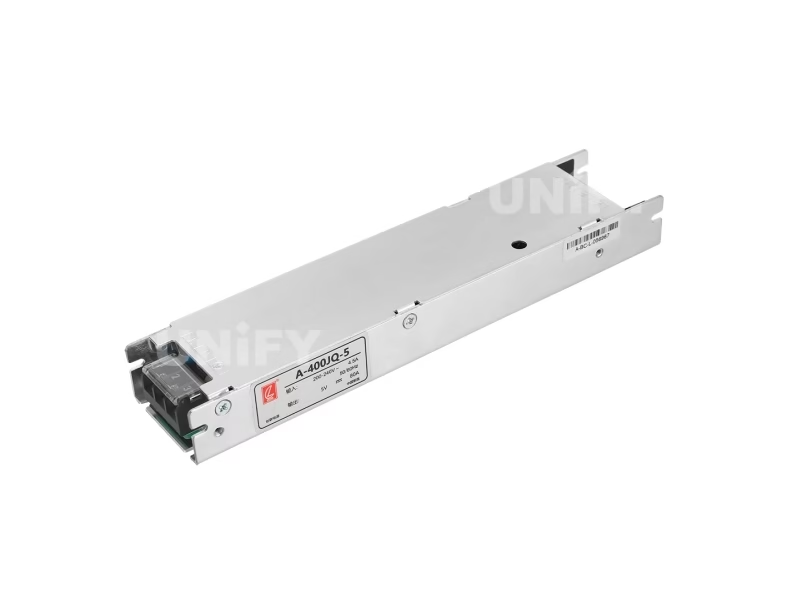
The CZCL A-400JQ-5P LED switching power supply packs 400 W — a full 5 V at 80 A — into the same 26 mm ultrathin shell as a 200 W unit, and it is the only supply in CZCL’s display family with built-in active PFC: power factor 0.95, 90% efficiency, and hiccup-mode protection that recovers on its own.
📱 / WhatsApp: +86-191-18802497 · Shenzhen, China · GMT+8
400 W
Rated output power
5 V / 80 A
DC output rail
PF 0.95
Active PFC built in
90%
Efficiency at 230 VAC
26 mm
Shell height, fanless
Short answer
The CZCL A-400JQ-5P is a 400 W fanless switching power supply for LED screens with active PFC: 180–264 VAC in (200–240 VAC rated), 5 V DC at up to 80 A out, 90% efficiency and a 0.95 power factor, in a 220 × 48 × 26 mm shell weighing 340 g. Overload and short-circuit faults trigger hiccup mode with automatic recovery; the platform carries UL / CSA / EN / IEC 62368-1 and CCC approvals, works from −20 to +70°C, and must be mounted on an aluminum plate or metal cabinet skin with thermal paste per the factory datasheet. At the 80% rule that is a 320 W / 64 A budget — two of the heaviest cabinets in a screen can share one rail.
What Is the CZCL A-400JQ-5P LED Switching Power Supply?
The CZCL A-400JQ-5P is a 400 W AC/DC switching-mode power supply for LED display cabinets: it converts a 180–264 VAC mains feed into a regulated 5 V DC bus rated 0–80 A, serving high-density module arrays, receiving cards and hub boards in screens that outgrow 200 W and 300 W supplies. The suffix “P” marks the series’ defining feature — a built-in active power factor correction stage, which no other supply in CZCL’s LED display family carries at this writing. The datasheet is the newest of the family (revision R1.0, dated October 2024), and the series spans four rails: 3.8, 4.2, 4.5 and 5 V, all rated to 400 W.
The manufacturer is Changzhou Chuanglian Power Supply Technology Corporation (CZCL), founded in 2000 and self-described as one of China’s three largest standard switching power supply manufacturers, with a 22,000 m² factory, six SMT lines, 30,000 units of daily output and ISO 9001 / ISO 14001 / QC 080000 certification. This JQ-P platform is engineered to the modern IEC/EN/UL 62368-1 hazard-based safety standard plus GB 4943.1, and ships with a 2-year warranty.
400 W in a 26 mm shell
Double the power of the fanless A-200AC-5 at the identical 26 mm height. Where a cabinet row once needed three supplies, two A-400JQ-5P units now carry the load — fewer mounting points, fewer DC junctions, fewer failure candidates.
Grid-friendly active PFC
Power factor 0.95 at full load trims harmonic current on the mains side — the difference between a 40-cabinet screen that trips breakers and one that runs clean, measured against EN 61000 harmonics limits.
Self-recovering, standard-safe
Hiccup-mode overload and short-circuit protection recover automatically, 3,000 VAC input-to-output isolation, and a 62368-1 certificate set that satisfies North American, European and Chinese inspectors alike.
Sizing a full screen? Work through the LED display power consumption guide, then close the loop with the LED screen display control system catalog that rides on the same 5 V rail.
What Are the CZCL A-400JQ-5P Specifications?
All figures come from the official CZCL A-400JQ specification sheet, revision R1.0 (October 2024) — the freshest datasheet in the family. Two field notes follow the table: the nameplate reading, and a correction for reseller listings that understate this model.
| Parameter | CZCL A-400JQ-5P |
|---|---|
| Rated output power | 400 W |
| Output voltage | +5.0 V DC |
| Output current | 0–80 A |
| Output accuracy / line / load regulation | ±2.0% / ±1.0% / ±2.0% |
| Ripple and noise | 400 mVp-p |
| Input voltage range | 180–264 VAC (rated 200–240 VAC; nameplate 200–240 VAC, 5.0 A) |
| Input frequency | 47–63 Hz |
| Max input current | 4.5 A at 200 VAC full load |
| Active PFC | Power factor 0.95 typical at 200–240 VAC full load |
| Efficiency at 230 VAC | 89–90% (5 V rail); 87–89% across the series |
| Inrush / leakage current | 70 A cold start at 240 VAC / 1 mA at 240 VAC |
| Startup / rise time | 3000 ms / 100 ms at 200–240 VAC full load |
| Load transient response | Overshoot ±5% (25–75% steps), ±10% (25–100% steps) at 1 A/µs slew |
| Protections | Overload 120–150% and short circuit: hiccup mode, automatic recovery |
| Cooling | Natural conduction cooling with auxiliary heatsink plate (fanless) |
| Working temperature | −20°C to +70°C, 20–90% RH non-condensing (derating curve applies) |
| Storage temperature | −40°C to +85°C; temperature coefficient ±0.02%/°C |
| Isolation / insulation | I/P-O/P 3000 VAC; I/P-case 1800 VAC; O/P-case 500 VAC; 100 MΩ at 500 VDC |
| MTBF | 100,000 hours at 25°C (MIL-HDBK-217F) |
| Dimensions / weight | 220 × 48 × 26 mm; 340 g net; 40 pieces per 18 kg carton |
| Safety standards | UL 62368-1, CAN/CSA C22.2 No. 62368-1, EN 62368-1, IEC 62368-1, GB 4943.1 |
| EMS immunity | EN 61000-4-2/-3/-4/-5/-6/-8/-11 (Criteria B; interruption Criteria C) |
| Series rails | A-400JQ-3.8P / -4.2P / -4.5P / -5P (all 400 W) |
| Warranty | 2 years (factory datasheet) |
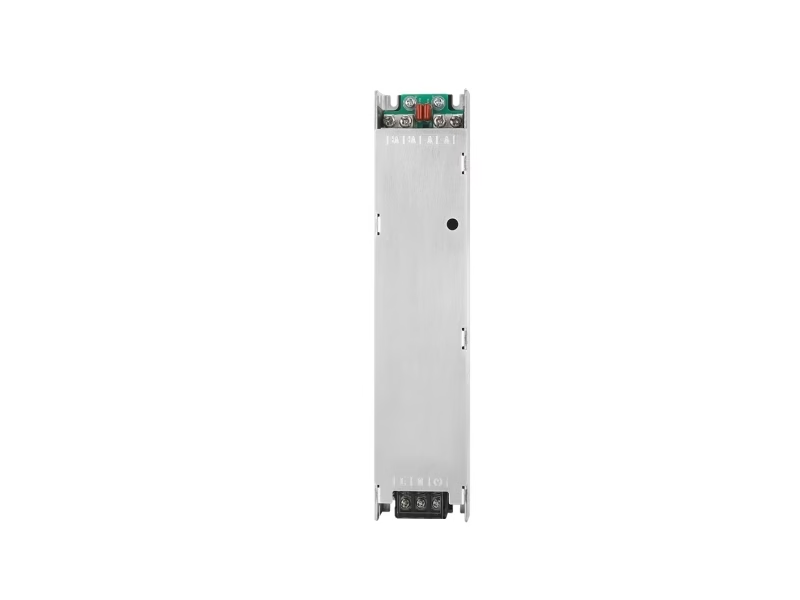
Terminal layout: screw-clamp blocks for AC-in (L / N / earth) and the 5 V DC output (V+ / V−)
Two corrections before you order elsewhere
Some reseller listings describe this series as “300 W” — the official R1.0 datasheet and CZCL’s own parameter database both rate it 400 W. And as with every CZCL display supply, the datasheet window (180–264 VAC) is wider than the production nameplate (200–240 VAC, 5.0 A, shown below); design around 200–240 V nominal and you satisfy both documents. Nothing in either reading supports a 100–120 V grid.
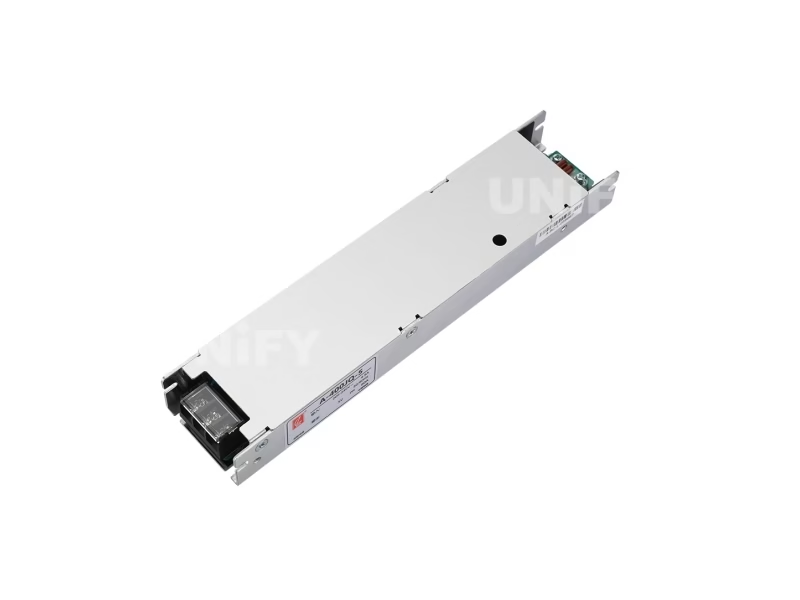
Production nameplate: INPUT 200–240 VAC 5.0A · OUTPUT +5V, 80A
How Much Load Can a 5V 80A 400W LED Switching Power Supply Carry?
Same discipline as the rest of the family: the datasheet asks for at least 30% power headroom (a 100 W device gets a 130 W-plus supply), and installer practice caps switching supplies at 80% loading. Take the stricter reading and the A-400JQ-5P budget looks like this:
Power budget
400 W × 80% = 320 W usable per unit
Current budget
80 A × 80% = 64 A usable per unit
Against typical module loads (average program material; full-white patterns run higher — verify against your module datasheet):
| Typical load | Average draw | Max per A-400JQ-5P at 320 W |
|---|---|---|
| Indoor P2.5 module (320 × 160 mm) | ~10–15 W | ~21–32 modules |
| Rental P3.91 module (250 × 250 mm) | ~15–20 W | ~16–21 modules |
| Outdoor P4.81 module (250 × 250 mm) | ~20–30 W | ~10–16 modules |
| Receiving card (Novastar / Colorlight class) | ~3–5 W | Shares the same 5 V rail |
Where this budget changes real decisions: a bright outdoor face planned as a P3 outdoor LED display can concentrate two to three cabinets on one A-400JQ-5P instead of scattering five smaller supplies through the support structure — fewer AC feeds to certify, fewer DC busses to dress. Run the full screen through the power consumption walkthrough before you commit the count.
What Does Active PFC Do for a Large LED Video Wall?
Power factor correction is the quiet feature that separates this model from its siblings. Without PFC, a switching supply draws current in sharp pulses near the voltage peak; with the A-400JQ-5P’s active stage, the input current waveform tracks the voltage at a 0.95 power factor. Three consequences matter on a real install:
Lower harmonic current
Pulsed, non-PFC inputs pile third and fifth harmonics onto the neutral conductor. PFC smooths the draw, keeping the installation in line with EN 61000-3-2 harmonic expectations — relevant wherever an inspector asks.
Smaller electrical infrastructure
Real power and RMS current converge at PF 0.95, so breakers, feeder cables and distribution panels size closer to the honest wattage instead of carrying penalty current for dozens of supplies at once.
Stability on weak grids
Generator-fed sites and long feeder runs see less voltage distortion from the screen’s own load — fewer mystery reboots that get blamed on control systems.
The efficiency story compounds it: at 90% on the 5 V rail, a full-load A-400JQ-5P dissipates roughly 44 W as heat versus about 55 W for an 86% unit — 11 W less heat per supply, multiplied across a 40-supply screen, is a fan or two you do not have to run in the electrical room.
Why Does the A-400JQ-5P Require an Aluminum Mounting Plate?
This is the one installation step the datasheet states as a requirement, not a suggestion: the supply must be mounted on an aluminum plate or metal cabinet skin, screwed tight at the plate center, with thermal grease applied between the surfaces. The cooling concept is natural conduction — heat flows from the internal assembly through the 26 mm shell into the plate, and the plate convects it away. No fan, no airflow path to keep clear, no dust ingested.
The datasheet’s own EMC and derating tables reference a 400 × 400 × 3 mm metal plate as the reference mounting, and the curve charts tie output load to ambient temperature and input voltage — at +70°C ambient the load derates, and below 180 VAC input the available load falls with the line. Screw discipline completes the pattern: M3 mounting screws torqued to 4 Kgf·cm (0.4 N·m), with penetration into the housing limited to 3 mm. In a sealed or enclosed bay the factory asks you to consult its engineers before deployment — conduction cooling needs a conduction path, and a supply floating on plastic standoffs has none.
Operationally that trades the A-300AB-5’s fan service for a one-time mounting discipline — and buys a −20 to +70°C window with nothing in the cabinet to listen to.
Which Protections and Safety Standards Does the A-400JQ-5P Carry?
Protection behavior matches the A-300AB-5 generation: overload (120–150% of rated current) and short-circuit events both trigger hiccup mode with automatic recovery — the supply folds back, retries, and resumes by itself once the fault clears, so a transient overload blinks the cabinet rather than darkening it until someone cycles power.
The standards file is where this model separates from older CZCL families. It is certified to the hazard-based 62368-1 generation across four regimes, plus Chinese CCC:
| Mark | Region | Standard |
|---|---|---|
| UL / CUL | USA / Canada | UL 62368-1; CAN/CSA C22.2 No. 62368-1:19 |
| CE | Europe | EN 62368-1 |
| CB | CB member states | IEC 62368-1 |
| CCC | China | GB 4943.1 |
Isolation margins back the safety file with numbers an inspector can measure: 3,000 VAC input-to-output withstand (one minute, <10 mA), 1,800 VAC input-to-case, 500 VAC output-to-case, and 100 MΩ insulation at 500 VDC. The EMS table (EN 61000-4-2/-3/-4/-5/-6/-8/-11) is published per criterion in the datasheet — useful when the screen’s CE file gets audited.
Which Output Rail Fits Your LED Screen: 3.8V to 5V?
The JQ-P series ships four rails, each rated 400 W with a 0–80 A envelope — voltage, current and efficiency scale together per the model list:
| Model | Rail | Current | Power | Efficiency @230 VAC |
|---|---|---|---|---|
| A-400JQ-3.8P | 3.8 V | 0–80 A | 400 W | 87% |
| A-400JQ-4.2P | 4.2 V | 0–80 A | 400 W | 88% |
| A-400JQ-4.5P | 4.5 V | 0–80 A | 400 W | 89% |
| A-400JQ-5P | 5.0 V | 0–80 A | 400 W | 90% |
The 5 V rail serves standard modules and receiving cards; the 3.8–4.5 V rails serve common-cathode and energy-saving architectures. Match the rail to the module datasheet and read the common cathode LED technology explainer before ordering a lower-rail variant — a 5 V supply on a 3.8 V rail is not a dimmer, it is a disposal event.
How Does the A-400JQ-5P Compare With the A-200AC-5 and A-300AB-5?
The three CZCL supplies divide the 5 V display market by power class, cooling and grid behavior — screens routinely mix all three in one installation:
- Current class: 40 A → 60 A → 80 A; the A-400JQ-5P carries double the A-200AC-5’s load per unit.
- Cooling: fanless convection (A-200AC-5) → built-in fan (A-300AB-5) → fanless conduction with mandatory plate (A-400JQ-5P).
- Power factor: active PFC at 0.95 exists only on the JQ-P — the pick for large screens, generator sites and audited installs.
- Profile: 26 mm / 31.2 mm / 26 mm — the A-400JQ-5P doubles the A-200AC-5’s power at the same height.
- Safety file: the A-400JQ-5P carries the full UL/CSA/EN/IEC 62368-1 set plus CCC; the A-300AB-5 datasheet references UL 1012/GB 4943, the A-200AC-5 platform UL/EN/IEC 62368.
| Parameter | A-200AC-5 | A-300AB-5 | A-400JQ-5P |
|---|---|---|---|
| Output | 5 V / 40 A / 200 W | 5 V / 60 A / 300 W | 5 V / 80 A / 400 W |
| Cooling | Fanless convection | Built-in fan | Fanless conduction + plate |
| Active PFC | — | — | PF 0.95 |
| Efficiency | 88% | ≥86% | 90% |
| Input range | 190–264 VAC | 176–264 VAC | 180–264 VAC |
| Dimensions | 165 × 56 × 26 mm | 212 × 81.5 × 31.2 mm | 220 × 48 × 26 mm |
| Protection | Short circuit / overload | Hiccup, auto-recovery | Hiccup, auto-recovery |
| Working temperature | −40 to +70°C | −25 to +60°C | −20 to +70°C |
| MTBF | Not published | 200,000 h (MIL-217) | 100,000 h (MIL-HDBK-217F) |
Detail pages: the slim silent CZCL A-200AC-5 LED switching power and the fan-cooled CZCL A-300AB-5 LED switching power.
How Do You Install and Wire the CZCL A-400JQ-5P Safely?
The datasheet’s installation requirements set the rules; this sequence folds them into commissioning order.
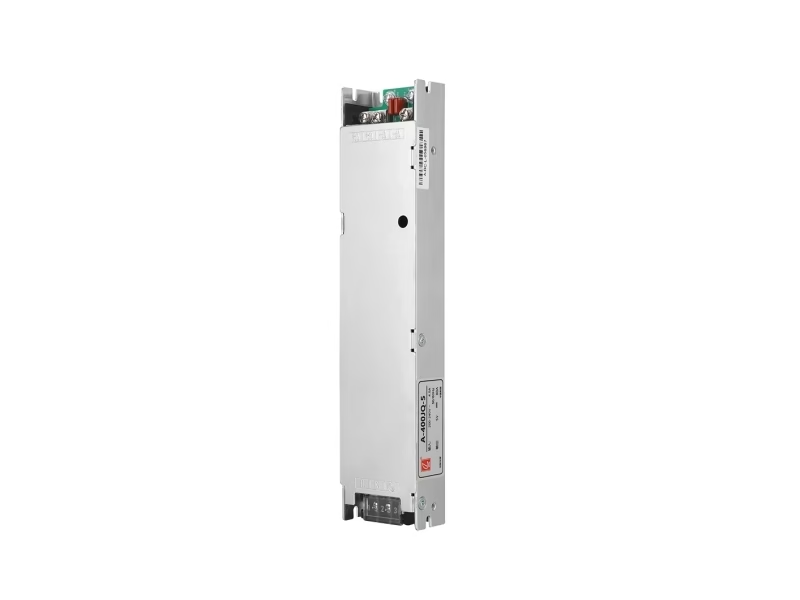
1 · Build the conduction path first
Fix the unit at the center of an aluminum plate or bare metal cabinet skin with thermal grease between the surfaces — the datasheet makes this a requirement for meeting the published electrical specs. Reference plate: 400 × 400 × 3 mm.
2 · Torque within limits
M3 mounting screws at 4 Kgf·cm (0.4 N·m), penetration into the housing no deeper than 3 mm.
3 · Wire AC, earth and DC
Line, neutral and protective earth to the input block; V+ / V− to the module bus with polarity checked twice. A floating cabinet skin defeats both the earthing and the conduction cooling.
4 · Verify the grid
200–240 V nominal per the nameplate. Below 180 VAC the load derates with the line — long feeder runs on weak grids deserve a voltage measurement under load, not at open circuit.
5 · Load-test and thermally check
Ten minutes of full white, rail voltage verified at the far end of the bus, plate temperature checked by hand at the mounting screws — warm is correct; too hot to hold means the conduction path is not engaged.
6 · Log the batch
Record serials and date codes with the cabinet map — the 40-piece carton packing means fleets share one production batch, and the map shortens any future warranty conversation.
Do not parallel the outputs
The JQ-P series is not a current-sharing design (CZCL’s own parameter database lists it non-uniform-flow). For N+1 redundancy use the dedicated current-sharing series — or split the load across more supplies.
Field failures and swaps follow the same workflow as the rest of the family — see the LED display power supply diagnostics and replacement guide.
What Problems Does a Failing LED Power Supply Cause?
Power trouble wears disguises — check these three signatures before blaming a module or a control card:
Dim or uneven brightness, one cabinet
Aging output capacitors sag the rail under load; one cabinet corner looks tired while its neighbors shine. Full-white patterns expose it.
Flicker on camera or under load spikes
A rail that dips frame-by-frame under bright content points at the supply before the module.
Cabinet reboots or dead sections
Hiccup cycling reads as “random” dead cabinets — measure the rail during the dropout; the cause is usually thermal or upstream.
How Much Does the CZCL A-400JQ-5P Cost?
Single units sit near $25 on component marketplaces — AliExpress lists the A-400JQ-5P at US $25.14 (observed September 2026) — and volume pricing steps down sharply from there, with the 40-pieces-per-carton packing marking this as a fleet part.
Sample · 1–10 pcs
Repairs, prototypes and trial bays — shipped from stock with the 200–240 VAC nameplate you see above.
Project · 10–500 pcs
Whole-screen quantities with per-cabinet load math, rail matching to module datasheets, and the 62368-1 certificate copies your inspector asks for.
Volume · 500+ pcs
Production-line pricing on CZCL stock with container freight planning and batch date-code consistency.
Send module types, modules-per-cabinet and total cabinet count — the quote returns with the load math attached, from an LED screen manufacturer stocking the full chain from power to control.
CZCL A-400JQ-5P LED Switching Power: Frequently Asked Questions
Can I run the CZCL A-400JQ-5P on a 110 V outlet in the US?
No. The datasheet window is 180–264 VAC and the nameplate reads 200–240 VAC, 5.0 A — neither supports 100–120 V grids. For US and Canadian sites choose a wide-input PFC model or feed the screen through a step-up source.
How many LED modules can one A-400JQ-5P drive?
At the 80% rule: 320 W or 64 A usable. A typical indoor P2.5 module draws about 10–15 W of average program material, so one unit covers roughly 21–32 such modules plus receiving cards — confirm against your module’s datasheet and brightness profile.
Does the A-400JQ-5P have a fan?
No — it cools by natural conduction into the mounting surface, which is why the datasheet requires an aluminum plate or metal cabinet skin with thermal grease. Done right, it is silent and sealed against dust; done wrong (floating on standoffs), it overheats.
What does the “P” in A-400JQ-5P mean?
PFC — active power factor correction. The stage shapes the input current to a 0.95 power factor, cutting harmonic current on the mains side. It is the only series in CZCL’s LED display lineup with built-in active PFC.
What is the difference between the A-400JQ-5P and the A-300AB-5?
Power class, cooling and grid behavior: 400 W / 80 A fanless-with-plate versus 300 W / 60 A fan-cooled, plus active PFC and the full UL/CSA/EN/IEC 62368-1 certificate set on the JQ-P. The AB-5 rides deeper brownouts (176 VAC floor) and publishes a higher MTBF (200,000 h vs 100,000 h).
Can I parallel two A-400JQ-5P units for more current?
No. The series is not a current-sharing design, so paralleled units will not divide load evenly. Split the load across more supplies or move up to CZCL’s dedicated current-sharing series for redundant bays.
Which certifications does the A-400JQ-5P carry?
UL 62368-1 and CAN/CSA C22.2 No. 62368-1 for North America, EN 62368-1 for Europe, IEC 62368-1 for CB-member states, and GB 4943.1 for China CCC — with EN 61000-4-series immunity results published in the datasheet.
What warranty and service life does CZCL publish?
A 2-year warranty and an MTBF of 100,000 hours at 25°C (MIL-HDBK-217F), with design-level derating curves published for ambient temperature and input voltage. Certificate copies ship with project orders on request.
Quote the CZCL A-400JQ-5P With the Load Math Done
Send your module types and cabinet count; we return per-cabinet power sizing and a matched quote from a LED screen manufacturer that ships worldwide.
📱 / WhatsApp: +86-191-18802497 · Shenzhen, China · GMT+8
Related LED Display Power Resources
LED Display Power Supply (Mother Catalog)
The three-brand mother catalog: 27 model pages, 2026 price bands, architecture map and the 80% load math — start here.
CZCL A-200AC-5 (Fanless 200 W)
The silent slim sibling: 5 V / 40 A / 200 W in a 26 mm fanless convection shell.
CZCL A-300AB-5 (Fan-Cooled 300 W)
The middle sibling: 5 V / 60 A / 300 W with hiccup auto-recovery and a 200,000 h MTBF.
LED Display Power Consumption
Screen-level power math: module draw, brightness settings, breaker sizing and cable gauges.
Power Supply Diagnostics & Replacement
Test a suspect supply, swap it inside a live screen, and root-cause repeat failures.
Split rails? Meet the CZCL B-200AF
For common-cathode screens this single-rail flagship is the wrong tool: the dual-output B-200AF feeds 3.8 V and 2.8 V buses independently from one fanless chassis, with the family’s highest MTBF.
CZCL LED Power Supply Guides
Four deep-dives from the CZCL power series – the count math, the selection flow, the pricing and the head-to-head verdicts.