
Mooncell Receiving Card Selection Guide: A712 or A10X?
The Mooncell receiving card selection question comes down to two cards and one interface decision: the A712 and the A10X are the receiving tier of the Mooncell family, and the choice between them is decided by the cabinet’s module interface, the pixel budget and the grayscale depth the content demands. This guide walks the selection with the official specification data (A712 V4.0 and A10X V4.0), the loading math that sizes the card count, and the cross-brand context that places the two cards against Colorlight and Novastar.
Short answer: Choose the Mooncell A712 LED Receiving Card (12× HUB75E, 512×512 PWM, 18-bit with HDR10 + HLG, about $12.70) for standard HUB75E modules; choose the Mooncell A10X LED Receiving Card (120-pin connector, 512×640 PWM, 22-bit grayscale, about $27) for compact narrow-frame cabinets that need the deepest low-gray rendering. Both load 655,360-per-port-class chains, cascade to 1,000 cards per port, and pair with every Mooncell sending stage from the MVB processors to the V Series splicer.
The role in the chain is worth one paragraph: the receiving card is the pixel-level stage — a MVB20E-G or MTB2000E sending stage feeds the Gigabit network, and each cabinet’s card turns that data stream into row/column signals for its LED module. The card count and the sending-stage port count must agree — a Full HD wall’s eight A712 cards fit four ports at the 655,360-per-port ceiling with room for loop backup — which is why the card selection below is inseparable from the processor choice documented on the How to choose a Mooncell LED control system guide.
A712 (left) and A10X — the size and interface difference at a glance.
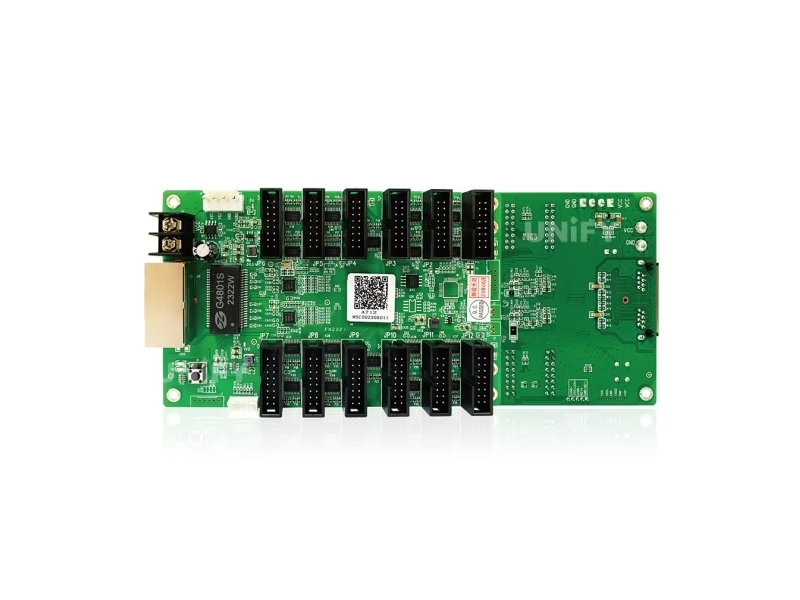
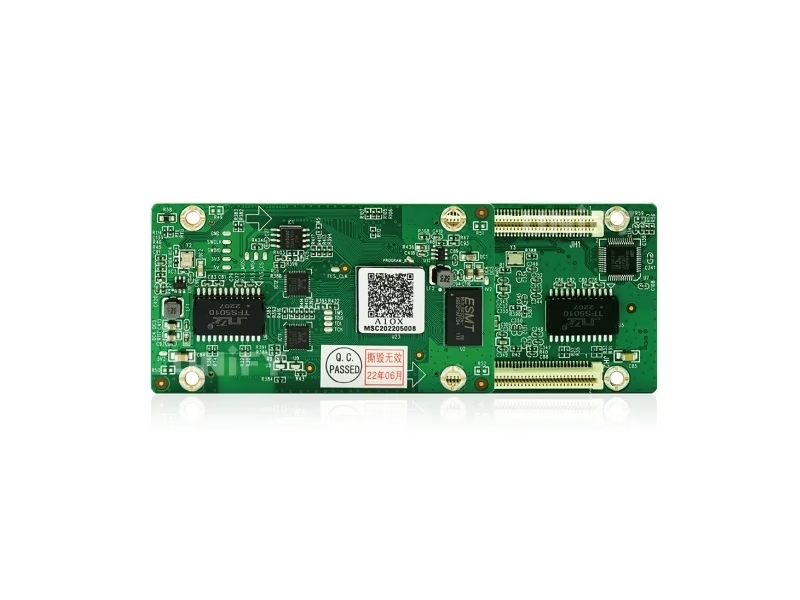
What Is a Mooncell Receiving Card?
The Mooncell receiving card is the component inside every LED cabinet that decodes the Gigabit Ethernet signal from the sending stage and drives the LED module’s row and column drivers. The Mooncell A712 LED Receiving Card is the standard card: 12 HUB75E interfaces with 24 groups of RGB parallel data, loading 512×512 pixels at 60 Hz in PWM mode (512×384 conventional), with 18-bit grayscale, HDR10 and HLG support, the Seam Tool and loop backup — at about $12.70. The Mooncell A10X LED Receiving Card is the compact card: a 120-pin high-density connector with 32 groups of RGB parallel data, loading 512×640 pixels at 60 Hz in PWM mode (512×512 conventional), with 22-bit grayscale, pixel-level calibration and MCU-based backup — at about $27. Both run the same AutoLED configuration software and pair with every Mooncell sending stage, from the MVB4S Pro 2-in-1 to the V Series splicer.
The maintenance view is part of the selection: both cards read their own serial number and position through AutoLED’s network-port debugging, both support configuration readback so a replacement card inherits the wall’s exact settings, and both expose loop-backup and cable-quality status to the host software. The A712’s status LED covers four states — slow flash for idle, uniform flash for live input, off for no network signal, and three interval flashes for the loop-active topology — and the A10X carries the same four-state code on its U9 LED. A field swap on either card is a minutes-long job because the configuration follows the card, not the technician.
A worked cabinet example: a P2.5 indoor cabinet with a 128×64-per-module layout running four modules per box reaches about 32,768 pixels per cabinet — well inside a single A712 or A10X card, which is why one-card-per-cabinet is the family norm. A P1.8 fine-pitch cabinet with 256×128 modules per face crosses 131,072 pixels and still fits one card, while a double-height cabinet with two module rows can push toward the card ceiling and should be counted module by module. The rule that keeps every count honest: per-card load in PWM mode is 262,144 on the A712 and 327,680 on the A10X, chromaticity correction lowers the usable figure, and cascade depth is never the constraint below 1,000 cards per port.
How Do You Calculate How Many Mooncell Receiving Cards You Need?
The card count follows the per-card load in the official sheets: the A712 loads 262,144 pixels per card in PWM mode (512 × 512), the A10X loads 327,680 (512 × 640). Count the wall’s pixels, divide, and round up:
Both cards cascade to 1,000 per network port and support 1–128 scan lines, which is why a single sending stage covers a 4K wall’s 26–32 cards with headroom to spare. The per-dollar loading math — the A712 at about 20,641 pixels per dollar against the A10X at about 12,136 — is on the Mooncell LED controller price guide.
Mixed-module cabinets deserve a sentence of their own: both cards drive multiple modules of varying specifications within their load, which is the normal configuration for cabinets that combine different module sizes — the irregular-layout story of the B1200S pages applies down at the receiving tier too. And both cards run the same synchronous control path as the rest of the family — live video in, corrected rows and columns out — with the configuration and debugging guide covering the commissioning sequence that follows either card choice.
The Mooncell A712 inside a standard HUB75E cabinet.
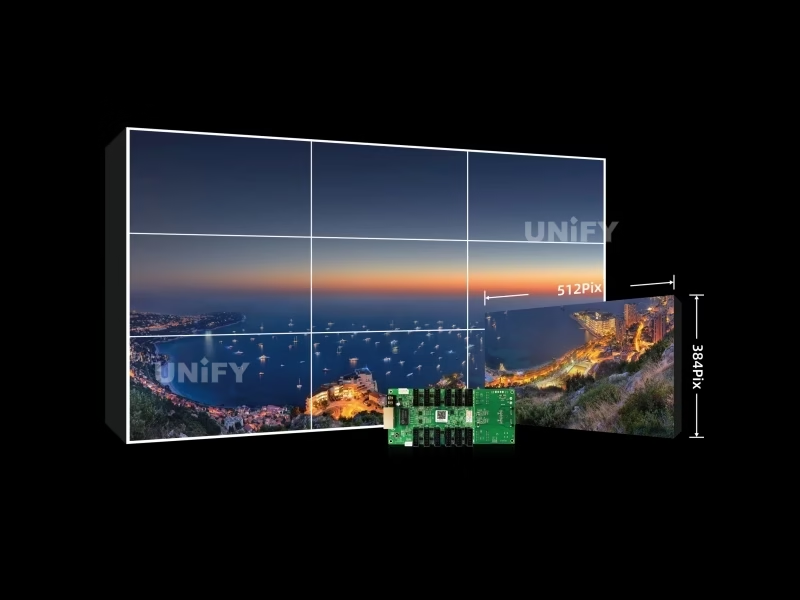
The Mooncell A712 — standard HUB75E card at about $12.70.
Which Mooncell Receiving Card Fits Your Cabinet: A712 or A10X?
The interface decision comes first: the cabinet’s module connector determines which card can physically drive it. From there the grayscale, HDR and price columns split the field:
Three numbered differences decide between them:
- Interface locks the choice. HUB75E-standard modules and cabinets map to the A712’s twelve ports; 120-pin high-density module layouts take the A10X. A cabinet built around the wrong interface is a re-wire, not a swap.
- Color path differs. The A712 carries HDR10 + HLG at 18-bit for HDR content; the A10X answers with 22-bit grayscale — 64× levels against the A712’s 4× — for low-gray-critical fine pitch where dark scenes must stay clean.
- Price tracks density. The A712 at $12.70 delivers about 20,641 pixels per dollar; the A10X at $27 trades density for the compact form factor, 32 groups and the deepest grayscale.
Reliability splits the two cards differently than the specs suggest. The A712 runs loop backup and FPGA dual-program startup as standard — a failed network line keeps the wall alive, and a failed firmware load boots a standby program — while the monitoring five-pack (voltage, temperature, power status, power-on count, running time) is available as customization, which is the rental-fleet story. The A10X carries the same loop backup and FPGA dual-program startup, and its MCU hardware adds the dual-card hot backup and smart-module paths as customizations — the compact card is the one that grows into module-level telemetry. Budget the customization options at order time; neither card’s backup story is a default on the official sheets.
The Mooncell A10X — compact 80×45 mm form factor.
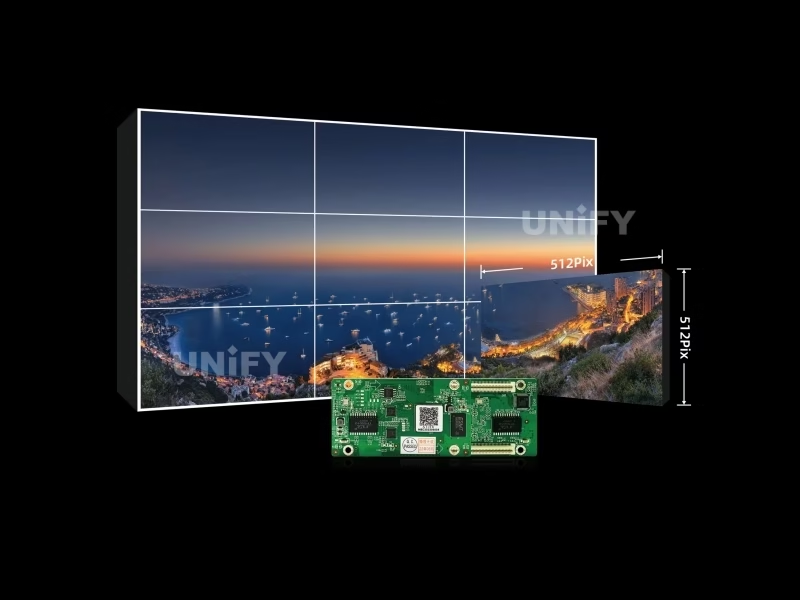
The Mooncell A10X — compact 22-bit card at about $27.
What Do 22-Bit Grayscale and HDR10+HLG Mean When Choosing a Mooncell Receiving Card?
The grayscale and HDR columns are where the two Mooncell receiving cards stop being interchangeable, and the math is worth stating plainly. Enabling the A10X’s 22-bit mode multiplies the screen’s grayscale by 64 — every brightness step lost when the wall dims below peak is recovered, low-gray transitions turn smooth, and the “pitting” artifact of dark scenes disappears. Enabling the A712’s 18-bit mode multiplies grayscale by 4. The A10X is the card for walls that run dark, camera-facing or fine-pitch content for hours; the A712 is the card for content where HDR matters more than grayscale depth.
The HDR side is the A712’s exclusive: both HDR10 and HLG video-source standards pass through its large-bandwidth independent master controller, which is what delivers the wider brightness range and color space of HDR content on a Mooncell wall. A broadcast or cinema-adjacent wall feeding HDR masters points to the A712; a signage or stage wall whose dark scenes must stay smooth points to the A10X. The practical rule: match the card to the content’s hardest requirement — HDR sources take the A712, low-gray depth takes the A10X — and let the interface decision above settle the rest.
Correction is the layer both Mooncell cards share and the sheet documents precisely: pixel-by-pixel brightness and chromaticity correction eliminate the color differences between modules that make an assembled wall look patchwork, and RGB-independent Gamma handles low-gray unevenness and white-balance drift per channel. The A10X adds multi-layer calibration and stores correction data so a card swap does not reset the wall’s uniformity; the A712 adds the Seam Tool, which adjusts the bright and dark lines at module and cabinet splices live during adjustment. Neither correction layer requires a separate instrument — both run through AutoLED and the Mooncell calibration software the integrator already carries.
How Do Mooncell Receiving Cards Compare with Colorlight and Novastar?
The cross-brand receiving-card picture at 2026 street prices, with the official specification data on each side:
The reading: the A712 undercuts the Colorlight volume band at $12.70 while adding HDR10 + HLG, and the A10X answers the compact 22-bit tier that Colorlight’s i-series does not cover at this size. The ecosystem rule applies across the table — Mooncell cards pair only with Mooncell sending stages, so the receiving-card decision is part of the broader brand decision covered on the Mooncell vs Colorlight vs Novastar guide and the Colorlight receiving card selection guide.
Software is the last differentiator in the cross-brand row: the Mooncell A712 and A10X both configure in AutoLED — the same free tool that runs the MVB processors, MTB sending controllers, creative controllers and the V Series splicer — while Colorlight cards run LEDVISION and Novastar cards run NovaLCT. An integrator who already commissions Mooncell sending stages carries the receiving-card workflow at zero learning cost, which is a real factor when a fleet spans processors, sending controllers and splicers under one software surface. The Novastar MRV328 and Novastar receiving card guide pages cover the other side of the comparison.
How to Choose the Right Mooncell Receiving Card: Decision Checklist
Six questions collapse the decision to a model:
The spares rule applies to whichever card wins: one per ten installed, ordered with the system, covers the realistic field failure rate for years at $12.70–$27 a card. The LED display warranty page states what the supplier must hold on RMA and dead-on-arrival replacement.
The power story closes the spec picture: both cards draw 3 W at 0.6 A from DC 3.5–5.5 V, work from −20°C to 70°C, and ship 100 cards per box — the A712 at 90.4 g per card against the A10X’s 20.2 g. Power budgeting on a dense fine-pitch wall is the same arithmetic either way: card count × 3 W is a rounding error on the cabinet power bill, which is one reason the receiving tier is the cheapest insurance a wall carries. The full electrical and environmental tables are on the A712 and A10X product pages linked above; every figure quoted here matches those sheets.
Gigabit cable connection — the field service step behind every swap.
What Do Buyers Ask When Choosing a Mooncell Receiving Card?
Three planning notes close the selection. First, verify the correction load before ordering: the A712’s chromaticity-correction band is 256×320 and the A10X’s is 512×512, so a factory-calibrated wall should be laid out on the corrected figure rather than the raw maximum. Second, order the spares in the same firmware batch as the installed wall where possible — both cards upgrade online through AutoLED, and a fleet at two firmware revisions needs the older revision’s files kept on record. Third, involve the sending-stage plan in the card count: the LED sending card configuration guide and the signal cable troubleshooting guide cover the chain upstream and downstream of the receiving tier, so the selection lands in a working system rather than a parts list.
Conclusion: Which Mooncell Receiving Card Should You Choose?
The Mooncell receiving card selection is a two-card decision with a clean logic. Standard HUB75E cabinets with HDR content and a $12.70 budget take the A712. Compact 120-pin cabinets that need 22-bit grayscale for dark fine-pitch content take the A10X at $27. Count the pixels at 262,144 (A712) or 327,680 (A10X) per card, match the interface, order spares at one per ten, and the receiving tier of the wall is settled — with every specification on this page traceable to the official V4.0 sheets on the A712 and A10X product pages.
Buying receiving cards as part of a complete wall? Talk to us — we are the LED screen manufacturer behind unifyled.com, and every card we quote is configured, tested and warrantied inside the display system we ship.