
CZCL LED Power Supply Price | 200-400W 2026 Guide
Type a CZCL model number into a search bar and you will find the same 200 W unit priced at $12.50 on one store, $22.99 on another, and its bulk-market cousin at $4.55 on Alibaba — with Meanwell’s equivalent sitting at $36. The pricing of LED display power supplies makes sense once you see the three layers behind it, and it stops being confusing the moment you price units the way engineers do: per usable watt, at the 80% loading ceiling. This guide gives you both — the 2026 street prices for the CZCL display family with sources signed, and the arithmetic that tells you which quote is actually cheap. For what each model does, the CZCL selection guide covers the six-question flow; this page is only about money.
Short answer
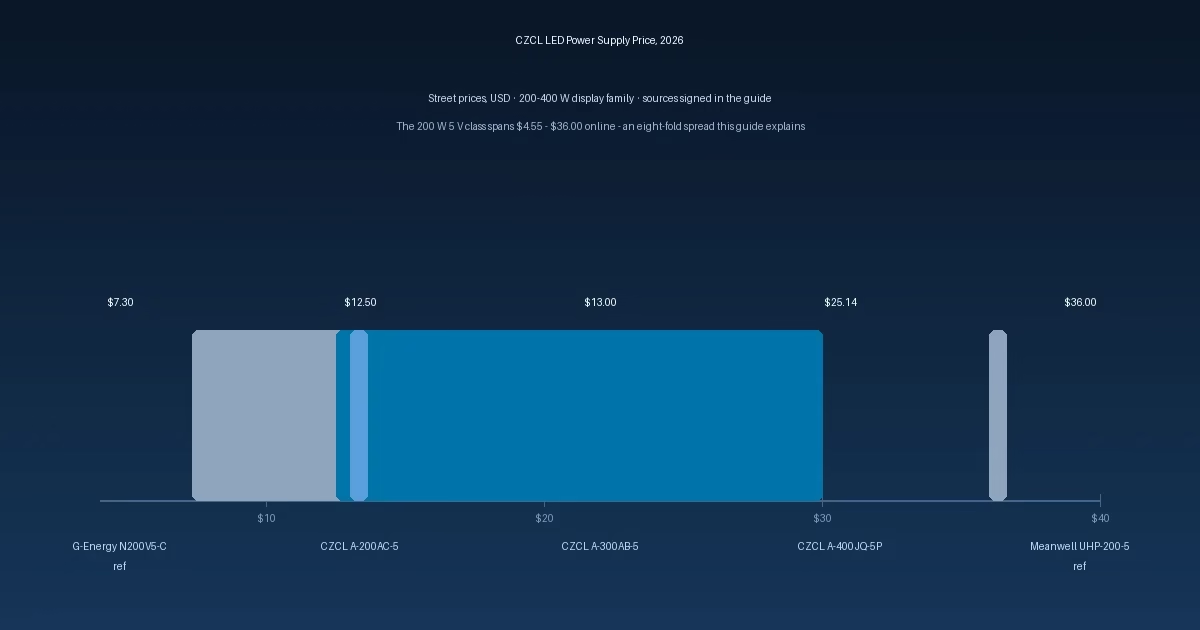
CZCL LED power supply street prices in 2026: A-200AC-5 from $12.50 (leddisplaysupply.com) with the series at $22.99–$29.99 (ledscreenparts.com), A-300AB-5 at $13.00 (ledcontrollercard.com), A-400JQ-5P at $25.14 (AliExpress), and the dual-rail B-200AF as a project part quoted through B2B channels. Per usable watt at the 80% ceiling, the three single-rail classes land within about three cents of each other (5.4–7.9 ¢/W) — you pay for the class the cabinet needs, not a premium per watt. Project and volume pricing steps down sharply from singles, and the 200 W class as a whole spans $4.55–$36.00 online depending on which of the three sales layers you are buying from.
What Does a CZCL LED Power Supply Cost in 2026?
Four models, four price tags, every figure signed to an observable listing from September 2026:
| Model | Street price | Source |
|---|---|---|
| A-200AC-5 · 200 W / 40 A | $12.50; series $22.99–$29.99 | leddisplaysupply.com; ledscreenparts.com |
| A-300AB-5 · 300 W / 60 A | $13.00 (from $15.20) | ledcontrollercard.com |
| A-400JQ-5P · 400 W / 80 A | $25.14 | AliExpress |
| B-200AF · dual rail | Project part — quote-based | B2B channel |
Benchmarks at the same 5 V / 40 A / 200 W point frame those tags: G-Energy’s N200V5-C lists at $7.30–$15.99 across the same two stores, and Meanwell’s UHP-200-5 at $36.00 (both leddisplaysupply.com / ledscreenparts.com). CZCL prices between them — above the LED-native budget brand, well under the industrial generalist — with the only active-PFC 400 W model in this comparison set at $25.14.
Why Do CZCL LED Power Supply Prices Vary Eight-Fold Online?
The 200 W 5 V class spans $4.55 to $36.00 across the open web, and the spread is not random — it is three different businesses selling at three different points of the same chain:
Layer 1 · Factory bulk
Alibaba listings at $4.55–$4.98 for ten-piece lots. This is carton-level pricing straight from production — the number a screen factory’s bill of materials actually sees, before any retail layer touches it.
Layer 2 · Single-unit e-commerce
$12–$19 at parts stores and marketplaces: pick-pack-ship economics, payment fees, and the right to buy one unit for a repair. The $13–$25 CZCL family tags live here.
Layer 3 · Premium retail
$22–$36 at brand-forward stores (and Meanwell’s tier): warranty handling, returns, and shelf convenience priced in. Same silicon, different service wrapper.
Two smaller forces widen the tails: condition (eBay’s “new – open box” listings undercut everything by a third and carry no factory warranty path) and batch economics — freight, exchange rates and date-code freshness all nudge the same listing over its life. None of this changes what is inside the case; it changes who carried it and how many hands it passed through.
What Is the Real Price per Usable Watt?
Rating labels make a 400 W unit look “twice the price” of a 200 W one. The honest comparison divides street price by the usable budget — rated watts × 80% — because that is the power you can actually plan a cabinet around:

| Unit | Street price | Usable at 80% | Price per usable watt |
|---|---|---|---|
| A-200AC-5 | $12.50 | 160 W | 7.8 ¢/W |
| A-300AB-5 | $13.00 | 240 W | 5.4 ¢/W |
| A-400JQ-5P | $25.14 | 320 W | 7.9 ¢/W |
| G-Energy N200V5-C (ref) | $7.30 | 160 W | 4.6 ¢/W |
| Meanwell UHP-200-5 (ref) | $36.00 | 160 W | 22.5 ¢/W |
Read two facts out of that table. First, CZCL’s three single-rail classes price within about three cents of each other per usable watt — stepping up a class buys capacity at nearly flat unit economics, which is why “concentrate cabinets on fewer supplies” usually wins the quote. Second, the premium tier charges roughly triple per usable watt for the same electrical job; whatever that buys in brand assurance, it is not function the cabinet can measure. The count math that turns these budgets into units per screen lives in the power supply count guide.
Which Factors Move Your CZCL Quote?
Between the street tag and your project invoice, five levers do the moving — and seeing them is the difference between a quote and a guess:
| Factor | Effect on price |
|---|---|
| Quantity tier | Sample (1–10) → project (10–500) → volume (500+) steps down per-unit each time; cartons of 30–40 are the natural freight unit |
| Build options | Three-proofing conformal coating, terminal covers and the −40°C low-temperature start are factory options priced at order time — not field retrofits |
| Freight class | 0.3–0.75 kg per unit sounds trivial until a $13 part ships alone: marketplace delivery fees of $75–$78 routinely exceed the hardware |
| Documentation | Certificate copies (62368-1, CCC) and batch test data ride along on project orders; insisting on them at retail costs more or fails |
| Batch and FX | Date-code freshness and exchange-rate windows move the same quote a few percent across a quarter |
How Do You Avoid the Three Classic Price Traps?
The 8× spread breeds three scams-by-negligence that cost buyers real money every season:
Trap 1 · The copy-paste spec sheet
Resellers routinely ship wrong specs with right photos — we documented listings selling this very family at “300 W” that the factory datasheet rates 400 W, input windows off by a whole voltage class. Buy against the factory datasheet; our four model pages each carry the corrections.
Trap 2 · The open-box bargain
Marketplace “new – open box” units at a third off have no factory warranty path and unknown storage history — aged output capacitors are exactly the failure a supply should not start its life with.
Trap 3 · The freight assassin
A $75–$78 fixed delivery fee on a $13 part is a 6× markup wearing a shipping label. It exists because single units ignore carton economics — the fix is batching orders, not hunting a cheaper box.
When Is the Cheapest Power Supply the Most Expensive?
Run the failure math before chasing the bottom of the spread. One dead supply equals one dark cabinet, and the cost of that event is not the $13 part — it is the diagnostic hour, the cabinet access (scaffold or lift on outdoor faces), and the show or advertising hours lost while it blinks. A supply that fails in year two at $4.55 saved has cost more than a unit that runs ten at $12.50; CZCL’s published platform-level annual failure rate sits below 0.2%, with 100% burn-in before shipment, and the family’s published MTBFs (100,000–250,000 hours, MIL-217) are the design intent behind those figures. When one does fail anyway, the diagnostics and replacement workflow keeps the swap to minutes — and a screen that flickers under load is telling you its count or its units are wrong before it goes dark, per the flickering guide.
So the pricing logic in one line: buy the class your cabinet needs at 80% loading, from the layer of the chain that matches your quantity, with the papers your inspector wants — and let the per-usable-watt number, not the sticker, pick the winner. When you would rather see it as a quote, send the cabinet list; the LED screen manufacturer quote comes back with the count, the model mix and the freight plan attached.
Will CZCL LED Power Supply Prices Rise in 2026?
The honest answer is that the cost stack under these units has been moving all year, and the direction is up. The industry spent 2026 absorbing two shocks that land directly on power supply bills of materials: the driver IC shortage tied to AI chip foundry capacity, which competes for the same wafer slots PWM and protection ICs come from, and the broader supply chain price surge that pushed cabinet-level quotes upward through the spring. Copper and steel for transformers and housings ride the same commodity line.
What that means for a buyer is timing, not panic. Street prices observed for this guide (September 2026) still reflect the pre-adjustment layers for most models; factory quotations refresh quarterly, and the August 2026 industry price hike wave has already reached some component contracts. Locking a project quote with batch date-code consistency — rather than stitching together marketplace singles across months — is how screens built this winter avoid paying two batches’ prices for one wall. The structural counterweight: CZCL’s 30,000-unit daily output and vertical scale are exactly what keeps the family’s per-usable-watt band stable while thinner distribution layers reprice first.
CZCL LED Power Supply Price: Frequently Asked Questions
How much does a CZCL 200W LED power supply cost?
The A-200AC-5 lists at $12.50 single-unit (leddisplaysupply.com) with the A-200AC series at $22.99–$29.99 (ledscreenparts.com); factory-bulk 200 W-class lots run $4.55–$4.98 per unit at ten-piece quantities on Alibaba. All observed September 2026.
Why is the same CZCL model priced differently on different sites?
Three sales layers: factory bulk (carton economics, $4–$5 territory), single-unit e-commerce ($12–$19, pick-pack-ship costs priced in), and premium retail ($22–$36 with warranty handling and returns). The hardware is identical; the service wrapper and quantity differ.
Which CZCL model offers the best price per watt?
The A-300AB-5 at street price: $13.00 against a 240 W usable budget works out to 5.4 cents per usable watt, the lowest of the family. The three single-rail classes all land between 5.4 and 7.9 cents, so class choice should follow the cabinet, not the ratio.
Is Meanwell worth three times the price of a CZCL unit?
At 22.5 cents per usable watt versus CZCL’s 5.4–7.9, the premium buys brand assurance rather than electrical function the cabinet can measure. Where Meanwell genuinely earns its tag is projects that mandate it by name — a procurement decision, not a technical one.
How much cheaper is project pricing than the street tag?
Meaningfully: the $4.55–$4.98 Alibaba bulk lots show where carton-quantity pricing lands, and project/volume tiers step down per-unit from singles at each break (10, 500+). Batch date-code consistency and freight planning ride along at those tiers.
Does the B-200AF cost more than the single-rail models?
It is quoted as a project part rather than street-listed, and it replaces two supplies per common-cathode cabinet — compare it against the pair it retires plus one wiring harness, not against a single-rail sticker.
Street tags are for repairs. Screens are bought by the carton.
Get the Project Quote With the Count and Freight Plan
📱 / WhatsApp: +86-191-18802497 · Shenzhen, China · GMT+8
Keep Reading the CZCL Power Supply Series
The companion guides to this article – count math, selection flow, pricing and head-to-head verdicts.