
Why LED Display Prices Are Surging in 2026: An In-Depth Supply Chain Analysis
The global LED display industry entered 2026 confronting a pricing environment unlike any in the past decade. By mid-year, more than 80 Chinese LED display manufacturers — spanning upstream chip fabricators, midstream packaging houses, and downstream display assemblers — have issued formal price adjustment notices. The increases, ranging from 5% to 20% depending on the segment, represent the broadest coordinated cost pass-through the industry has recorded. For international buyers, project contractors, and rental staging companies accustomed to decade-long price deflation in LED hardware, the shift demands a recalibration of procurement strategy and budget forecasting.
LED Display Supply Chain Price Surge 2026: Who Is Raising Prices and by How Much
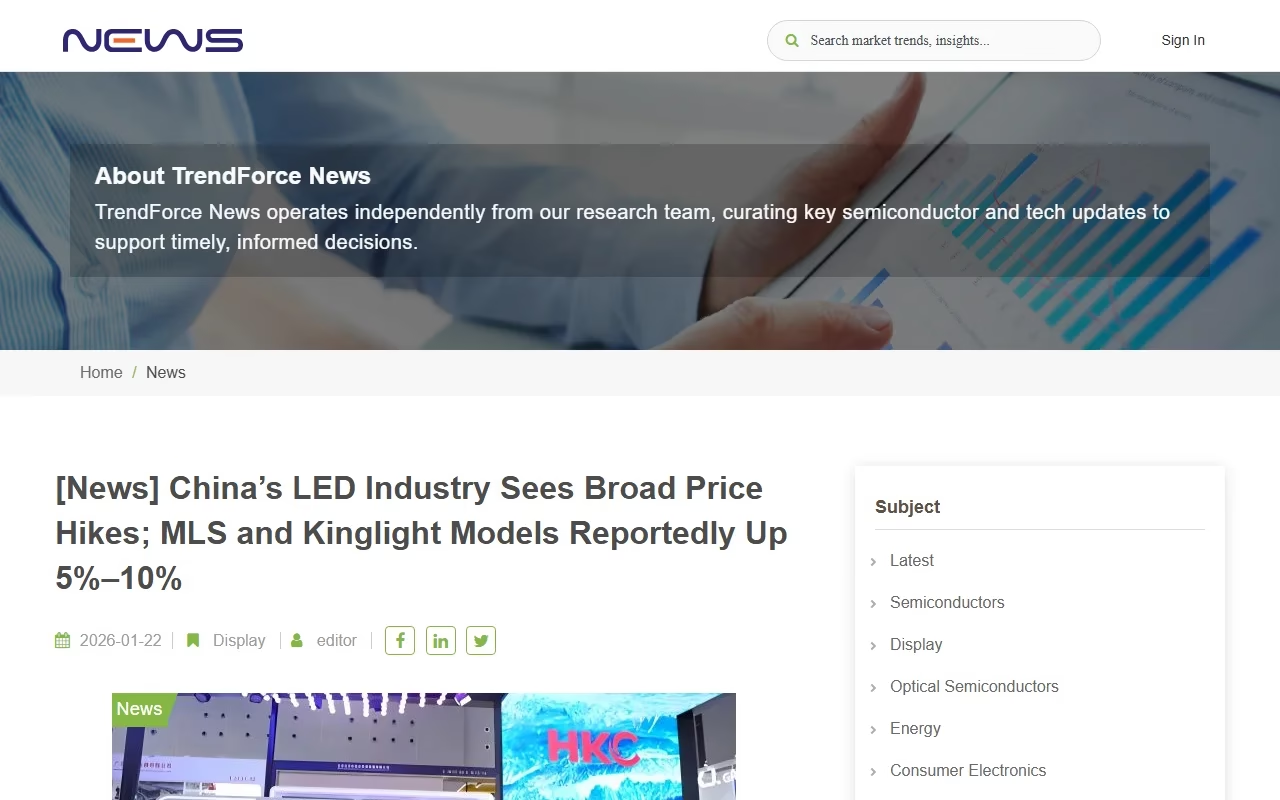
The wave of price adjustments that began with packaging suppliers in August 2025 had, by January 2026, swept through all tiers of the supply chain. MLS (Mullins) and Kinglight, two of China’s largest LED packaging companies, moved first, raising prices on select models by 5% to 10%. By December 2025, industry giants including Sanan Optoelectronics, Nationstar, and Shenzhen MTC had followed, with most new orders executing under revised pricing from January 1, 2026.
Through the first half of 2026, the trend accelerated downstream. Fujian Haijia Group issued two consecutive price notices — a 10%–15% adjustment in April, followed by a further 3%–10% across its full LED module range on July 15. Shanxi Gaoke Hua Ye Electronics applied a 5%–10% increase on COB and standard LED displays from late May. Unilumin (Zhouming Technology), one of China’s largest LED display exporters, adjusted pricing upward by 5%–15% in May, while Skyworth Commercial Display pushed through an 8%–20% increase on its full LED display portfolio. On the control-system side, Colorlight Cloud Technology — the dominant supplier of LED video processors and controllers — raised prices by 7%–20% across its product lines in two separate adjustments during May and June 2026.
The adjustment magnitudes reveal clear structural distinctions across segments. Packaging and module-level products have generally seen increases of 3% to 15%, while PCB boards — under the dual pressure of copper prices and tightening supply — have recorded increases of up to 10% at individual suppliers. Control-system hardware, driven by rising memory prices and constrained wafer capacity, has seen adjustments in the 7% to 20% range. Importantly, most manufacturers are absorbing a portion of the cost increase rather than passing it through entirely: terminal product price increases remain below the cumulative input cost rise, compressing margins that were already thin after a decade of price competition.
The scale is notable. As reported by industry media, over the four years preceding 2026, average LED product prices fell by a cumulative 30%–40%, a decline that far exceeded the increase in raw material costs over the same period. By the third quarter of 2025, gross margins across China’s LED industry had fallen below 20% for many small and mid-sized players, making price adjustments not a strategic choice but an operational necessity.
Three Forces Driving the LED Display Supply Chain Price Surge in 2026
The convergence of three distinct supply-side pressures has transformed what might have been a routine cyclical adjustment into a structural repricing event.
1. Precious and Base Metals Reach Historic Territory
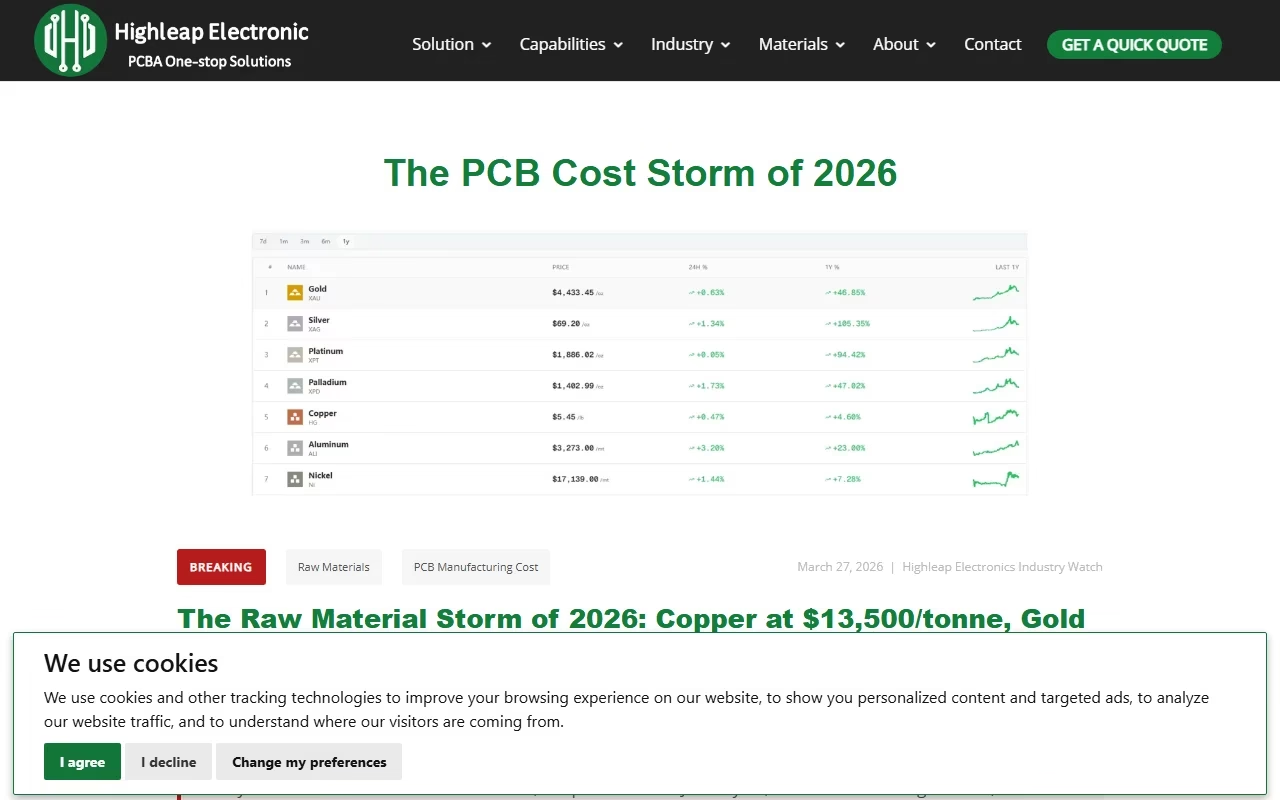
The most direct cost driver is the sustained rally in metals essential to LED manufacturing. Copper, which accounts for 60%–70% of a PCB’s raw material cost through copper-clad laminate (CCL), reached $13,500 per metric tonne on the London Metal Exchange in January 2026 — a 41% year-on-year increase in 2025 alone, and the metal’s strongest annual performance since 2009. J.P. Morgan projects a global refined copper deficit of approximately 330,000 tonnes for 2026, with mine supply growth at only +1.4%, roughly 500,000 tonnes below earlier forecasts. AI data center construction alone is expected to consume approximately 475,000 tonnes of copper this year.
Gold, essential for ENIG (Electroless Nickel Immersion Gold) surface finishing on high-reliability LED driver PCBs, struck an all-time record of $5,595 per troy ounce on January 29, 2026. As of late March, the spot price remained near $4,386/oz — up $1,364 year-on-year. Potassium gold cyanide (PGC), the gold-bearing chemical used in ENIG plating, surged from approximately ₩50,000 per gram in 2023 to ₩99,000 per gram by Q3 2025 — a near-100% increase before the January 2026 spike. For LED display manufacturers sourcing high-layer-count HDI PCBs, ENIG surface finish costs alone have added $40–$50 per square meter at current gold prices.
Tin — critical for solder and component plating — rose more than 60% over the twelve months to mid-2026. Aluminum, used extensively in LED module frames and cabinet housings, gained approximately 25%. Collectively, gold, silver, and copper represent more than 70% of LED packaging material costs, meaning the metal rally has a direct and mathematically inescapable impact on every LED display bill of materials.
2. AI’s Appetite for Wafer Capacity Squeezes LED Driver IC Supply
The semiconductor supply balance has shifted structurally against the LED industry. AI chip production consumed an estimated 800,000 wafers in 2026, with a single leading AI chip manufacturer alone securing that volume for its main processor. With roughly 20 chips per wafer, this translates to approximately 16 million AI accelerator chips — each requiring high-bandwidth memory (HBM) that consumes three times the wafer area per gigabyte compared to standard DRAM. Deloitte revised its 2026 AI chip market estimate upward to approximately $500 billion in early 2026.
This concentration of wafer capacity on high-margin AI silicon has created what SK hynix describes as a structural wafer shortage persisting through 2030, with a 20% supply gap relative to projected demand. The effect on LED driver ICs — which use mature-node capacity at 90nm to 180nm — is twofold: foundries are migrating mature-node lines to specialty processes for automotive and AI-support chips that command higher margins, while the overall wafer supply growth is being directed toward leading-edge AI logic rather than mature-node expansion.
The result: fourteen semiconductor suppliers, including Texas Instruments, Infineon, NXP, and Analog Devices, announced price increases effective April 2026. LED driver ICs and PMICs (Power Management ICs) saw increases starting at 10%, with some specialty analog parts rising significantly further. Industry analyst J2 Sourcing reports that TI price adjustments on certain power ICs reached 85%, forcing board-level redesigns among cost-sensitive OEMs. For the LED display industry, where driver ICs are the single most semiconductor-intensive component category, these increases flow directly into module and finished display pricing.
3. CCL and PCB Costs: A Perfect Storm of Input Inflation
The printed circuit board — the physical backbone of every LED module — has become the single loudest cost alarm in the 2026 supply chain. On March 12, 2026, Mitsui Kinzoku, which controls more than 90% of the global premium-grade copper foil market, notified customers of a 12% price increase on all MicroThin foil products effective April 20. The same week, Mitsubishi Gas Chemical announced a 30% CCL price hike across all thicknesses and grades.
The cascade is clear: copper foil +12% drives CCL +30%, which in turn drives fabricated PCB costs up by an estimated 37.8% year-on-year for high-layer-count designs. Standard PCB lead times have stretched from the traditional 4–6 weeks to 12–16 weeks, as fabricators prioritize high-margin AI server board orders over general-purpose electronics. The European Institute for the PCB Community’s Q1 2026 Supply Chain Update confirmed that premium VLP (Very Low Profile) copper foil grades are being “preferentially allocated to advanced AI server infrastructure” customers.
Beyond copper, glass fiber cloth — the dielectric reinforcement in FR-4 laminates — rose 12% year-on-year in 2025, with some suppliers announcing 20% increases for 2026. Epoxy resin prices, while mixed across regions, saw European producers announce €150–200/tonne increases. These compounding input costs have erased the possibility of PCB cost stability in 2026.
What the 2026 LED Display Supply Chain Price Surge Means for Global Buyers
For international project contractors, system integrators, and rental staging companies that rely on Chinese LED display supply, the 2026 pricing environment introduces several operational challenges.
Shorter quote validity. Multiple manufacturers have reduced price-quote validity windows from the traditional 30 days to as little as 7–15 days. With input costs repricing monthly or even weekly in some subcategories, suppliers can no longer guarantee pricing for extended periods.
Budget overruns on large projects. For tenders bid on 2025 pricing assumptions, actual procurement costs in mid-2026 may exceed budget by 10%–15% before factoring in freight and installation. Project managers executing multi-phase deployments face particular exposure, as Phase 2 pricing may differ materially from Phase 1.
Supply allocation risk. With premium materials preferentially routed to AI and automotive customers, LED display manufacturers without long-term supplier agreements face both higher prices and constrained material availability. The risk is not just higher cost — it is the inability to secure components at any price within required lead times.
Accelerated industry consolidation. The pricing pressure is widening the gap between tier-one manufacturers with scale, supplier relationships, and technical differentiation, and smaller players that lack the bargaining power to secure materials or absorb cost increases. For buyers, supplier stability assessment is now as critical as unit pricing.
Unifyled’s Strategy: Navigating the LED Display Supply Chain Price Surge 2026
As a vertically integrated LED display manufacturer with direct control over SMD assembly, module production, and finished system integration, Unifyled has deployed a multi-layered procurement strategy designed to insulate international buyers from the worst of the ongoing supply chain volatility.
Strategic raw material reserves. Through Q4 2025, Unifyled secured forward contracts on core driver ICs from leading suppliers, including Novastar and Colorlight controller chips, at pre-surge pricing. These reserves provide a buffer that allows Unifyled to maintain price stability on production batches through at least Q3 2026 — a meaningful window for buyers placing orders now.
Dual-source PCB qualification. Unifyled maintains qualified supplier relationships across multiple CCL and PCB fabricator tiers, including Shengyi Technology and ITEQ-qualified laminates. This multi-vendor approach reduces exposure to single-supplier allocation risk and provides pricing flexibility that single-source manufacturers cannot access.
In-house module assembly. By operating our own SMD placement lines, Unifyled captures the margin that would otherwise go to third-party contract manufacturers — margin that can be deployed to absorb a portion of component cost increases rather than passing them fully to buyers. This vertical integration model, combined with direct relationships with LED packaging suppliers, shortens the cost-pass-through chain that drives end-product inflation.
Transparent pricing communication. Rather than surprising buyers with sudden price adjustments, Unifyled provides advance notification of cost-driven changes along with specific, data-backed explanations of the underlying commodity or component movements. For projects quoted today, we commit to a 30-day price validity window — double the current industry norm — backed by our material reserve position.
For international buyers managing the 2026 pricing environment with a manufacturing partner that has prepared for this cycle, Unifyled offers a combination of supply chain discipline and factory-direct pricing that has become meaningfully differentiated in the current market.
Secure your pricing before the next round of component cost adjustments.
Contact the Unifyled procurement team for a same-day project quote with 30-day price validity.
Request a Quote
Or email directly: legidatechled@gmail.com | WhatsApp: +86-191-18802497
Related Reading: LED Display Supply Chain & Pricing Insights
- LED Display Price Increase 2026: What Buyers Need to Know — An earlier analysis of pricing trends across the LED display market
- SMD vs COB vs GOB: LED Packaging Technology Compared — How packaging choices affect display cost and performance
- Common Cathode LED Technology Explained — Energy-efficient design that reduces operating costs
- LED Screen Maintenance: A Complete Guide — Extending display lifespan to protect your investment
- Outdoor LED Screen Price Guide 2026 — Budget planning for outdoor display projects
LED Display Price Surge 2026: References & Data Sources
This article draws on research, data, and reporting from the following authoritative industry sources:
- TrendForce — “China’s LED Industry Sees Broad Price Hikes; MLS and Kinglight Models Reportedly Up 5%–10%” (January 22, 2026). Data on supply chain-wide price adjustments and cost drivers.
- Omdia (Informa Tech) — “What Does China’s LED Price Hike Mean for Global Peers in 2026?” by Chang-Sheng Lim (March 4, 2026). Analysis of global competitive implications.
- Highleap Electronic — “The PCB Cost Storm of 2026: Copper at $13,500/tonne, Gold All-Time High $5,595/oz, CCL Up 30%” (March 27, 2026). Detailed commodity pricing data and PCB cost cascade analysis.
- SupplyChain Strategy — “What Rising Raw Material Prices Mean for Electronics” (February 18, 2026). LME copper and precious metals price analysis.
- Deloitte — “2026 Global Semiconductor Industry Outlook” (Spring 2026). AI chip market sizing and wafer capacity allocation analysis.
- J.P. Morgan Global Research — Copper Outlook (December 2025). Global refined copper deficit projections and mine supply forecasts.
- Goldman Sachs Research — Copper & Gold Research Notes (December 2025 / March 21, 2026). Gold price targets and LME copper range forecasts.
- J2 Sourcing — “Semiconductor Price Hikes and Lead Time Crunches: 14 Suppliers Raise Costs in April 2026.” Supplier-by-supplier semiconductor price adjustment tracking.
- dzping.com — “福建省海佳集团股份有限公司2026.07.15正式发布调价通知” (July 15, 2026). Haijia Group official price adjustment notice and industry context.
- leddxs.com (LED大屏网) — “2026年LED显示屏上半年行业涨价潮” (July 10, 2026). Full summary of H1 2026 price adjustments across Chinese LED display manufacturers.
- eet-china.com (电子工程专辑) — “12家LED显示相关企业宣布调价” (June 2026). Price adjustment notice tracking across 12 LED display companies.
- EIPC Q1 2026 Supply Chain Update — CCL supplier notifications, copper foil allocation trends, and lead time data.
Disclaimer: This article is published for informational purposes and reflects data available as of July 24, 2026. Commodity prices and supplier adjustments are subject to change. Readers should verify current pricing directly with manufacturers before making procurement decisions.