
How to Choose a CZCL LED Power Supply?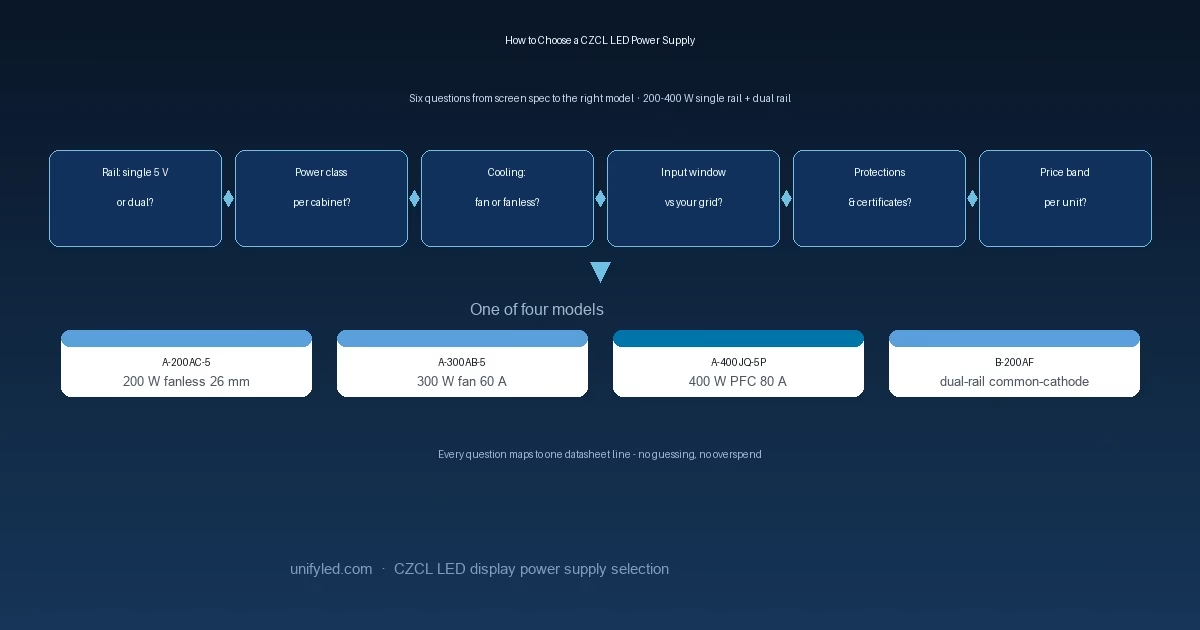
Choosing a power supply for an LED screen used to mean guessing a wattage, buying a generic metal box, and hoping. The CZCL display family makes the guesswork unnecessary — four models divide the work cleanly — but “four models” also means four ways to pick the wrong one. This guide turns the choice into six questions, each answered by one line of a datasheet: rail architecture, power class, cooling, input window, protection level and price. Answer them in order and the model picks itself; the short answer below compresses the whole flow if you are in a hurry.
Short answer
To choose a CZCL LED power supply: run the 5 V single-rail A-series if your modules are standard — A-200AC-5 (200 W, 26 mm fanless) for slim or silent cabinets, A-300AB-5 (300 W, fan-cooled, hiccup auto-recovery) for dense indoor walls, A-400JQ-5P (400 W, active PFC 0.95) for large walls, weak grids or audited installs. Switch to the dual-rail B-200AF (3.8 V + 2.8 V) only when your modules are common-cathode. Then verify the grid: every model here needs a 200–240 V nominal feed, and none accepts 110 V. Count the units with the per-cabinet formula in our power supply count guide before you order.
What Should You Check Before Choosing a CZCL LED Power Supply?
Five facts decide the model, and four of them live in documents you already have. Check them before touching a catalog, because every wrong pick traces back to skipping one of these:
1 · Module rail architecture
Standard modules take one 5 V bus; common-cathode modules take two buses at lower voltages. This single fact splits the family in half before anything else is considered.
2 · Cabinet power draw
Maximum watts per cabinet, from the module datasheet. This sets the power class, not the brand.
3 · Grid voltage on site
200–240 V nominal opens this whole family; 100–120 V closes it. Measure or ask before falling in love with a model.
4 · Cabinet depth and noise rules
A 26 mm bay rejects a 31 mm supply; a church rejects a fan. Physical and acoustic constraints come before spec sheets.
The fifth check is the site’s punishment profile — heat, dust, cold, weak grids, inspectors — and it decides between models that otherwise look similar. The six sections below walk those checks in the order that eliminates the most options fastest.
Which Output Rail Does Your Screen Need: 5 V Single or Dual Rail?
Start here because it is binary. Standard LED display modules drive their LEDs from a single 5 V rail through constant-current driver ICs — every A-series CZCL unit serves them. Common-cathode modules split the wiring: the LED string runs from a lower rail (3.8 V in this family) sized near its forward voltage, and the driver ICs run from an independent 2.8 V rail, so surplus voltage stops burning as heat inside the drivers. Feed those modules 5 V and you erase the efficiency the architecture delivers; feed them the wrong rail and driver ICs die.
So the first question to your module supplier is not about power at all — it is “standard or common cathode?” The common cathode LED technology explainer shows what the wiring looks like and why the two rails cannot merge. Standard screens stay on the A-ladder; common-cathode screens go straight to the CZCL B-200AF, and the rest of this guide still matters for them (cooling, grid and protection all apply to the dual-rail unit too).
How Much Power Class Does Your Cabinet Need?
Inside the A-ladder, the choice is a wattage class: 200 W, 300 W or 400 W. The honest way to pick is the 80% ceiling — each unit’s usable budget is its rating times 0.8, and your cabinet’s maximum draw has to fit inside it with room to spare:
| Class | Usable at 80% | Fits |
|---|---|---|
| A-200AC-5 · 200 W / 40 A | 160 W | One standard indoor cabinet (4 P2.5-class modules + receiving card) |
| A-300AB-5 · 300 W / 60 A | 240 W | Dense indoor cabinets, bright rental faces |
| A-400JQ-5P · 400 W / 80 A | 320 W | Two to three outdoor cabinets concentrated per unit |
The exact count of units for the whole screen — ceiling function, N+1 spares, breaker math — is its own exercise, and it lives in the power supply count guide. For model selection, one more rule does most of the work: when a cabinet’s draw sits within 15% of a class ceiling, move up a class rather than loading to the limit. Heat is the tax the margin pays for.
Fanless or Fan-Cooled: Which CZCL Power Supply Fits Your Cabinet?
Cooling is where the four models separate physically. The A-200AC-5 cools by natural convection in a 165 × 56 × 26 mm shell — silent, dust-sealed, and the only one that fits bays shallower than 30 mm. The A-300AB-5 carries a built-in fan to sustain its 60 A rail, which means it needs airflow clearance and joins the fan-swap service cycle. The A-400JQ-5P and B-200AF return to fanless designs: the JQ-P conducts its heat into an aluminum mounting plate (a datasheet requirement, with thermal grease), and the B-200AF convects through its perforated shell.
Match the constraint you actually have. Churches, studios and meeting rooms hear fans from three meters away — fanless wins there regardless of wattage. Rental fleets care about service access and swap speed; a detachable supply bay beats an integrated one every rebuild cycle:
And measure the bay before ordering: 26 mm shells (A-200AC-5, A-400JQ-5P) and 30–31.2 mm shells (A-300AB-5, B-200AF) are not interchangeable in a cabinet designed for one or the other. The LED screen cabinet guide covers the power-bay layouts these dimensions map onto.
Which Input Voltage Window Survives Your Grid?
All four models are 220–240 V-grid supplies; none accepts 100–120 V. Within that, the windows differ at the brownout edge: the A-300AB-5 rides deepest (176 VAC floor), the A-400JQ-5P spans 180–264 VAC, and the A-200AC-5 starts at 190 VAC. Production nameplates on all of them read 200–240 V nominal — design to the nameplate and every datasheet is satisfied.
Grid quality adds one more fork. On long feeder runs, generator sites or walls where dozens of supplies share one distribution panel, the A-400JQ-5P’s active PFC (power factor 0.95) keeps input current clean and breaker sizing honest — it is the only model in the family with it. A brownout-prone rural feed points at the A-300AB-5’s 176 VAC floor instead. And if the site is 110 V territory, none of these fit: a wide-input series or a step-up source is the honest answer, not an adapter.
Which Protections and Certifications Should the Site Demand?
Protection separates the newer generation from the older one. The A-300AB-5 and A-400JQ-5P protect with hiccup mode on all major fault types — overload, and on the JQ-P also over-temperature and short circuit — folding back and recovering automatically when the fault clears, so a transient blinks the screen instead of darkening it until someone cycles power. The A-200AC-5 carries basic short-circuit and overload protection without the self-recovery behavior, and the B-200AF adds hiccup recovery on short circuit. For rental and hard-to-reach installs, self-recovery is worth more than its price difference.
Certification files differ by model too: the A-400JQ-5P carries the fullest set (UL 62368-1, CAN/CSA C22.2, EN 62368-1, IEC 62368-1 plus CCC), the A-200AC-5 platform references the 62368 family, and the A-300AB-5 datasheet works to UL 1012/GB 4943. Published reliability runs from 100,000 hours MTBF (A-400JQ-5P) through 200,000 (A-300AB-5) to a family-best 250,000 (B-200AF), all MIL-217 at 25°C — and every CZCL unit passes a 100% burn-in test before leaving the factory:
How Much Does Each CZCL LED Power Supply Cost?
Street pricing runs in bands, signed to the sources observed in September 2026: the A-200AC-5 lists at $12.50 (leddisplaysupply.com) up to $22.99–$29.99 for the series (ledscreenparts.com); the A-300AB-5 sits at $13.00 (ledcontrollercard.com); the A-400JQ-5P around $25.14 (AliExpress); and the B-200AF is a project part quoted through B2B channels. Volume tiers step down sharply from singles — these supplies ship 30–40 units to a carton, and that is how screens actually buy them. Full benchmark tables with sources live on the CZCL LED display power supply catalog and each model page.
What Is the Quick-Pick Table for CZCL LED Power Supplies?
Every question above collapses into one table. Find your scenario in the left column; the middle column is the order code:
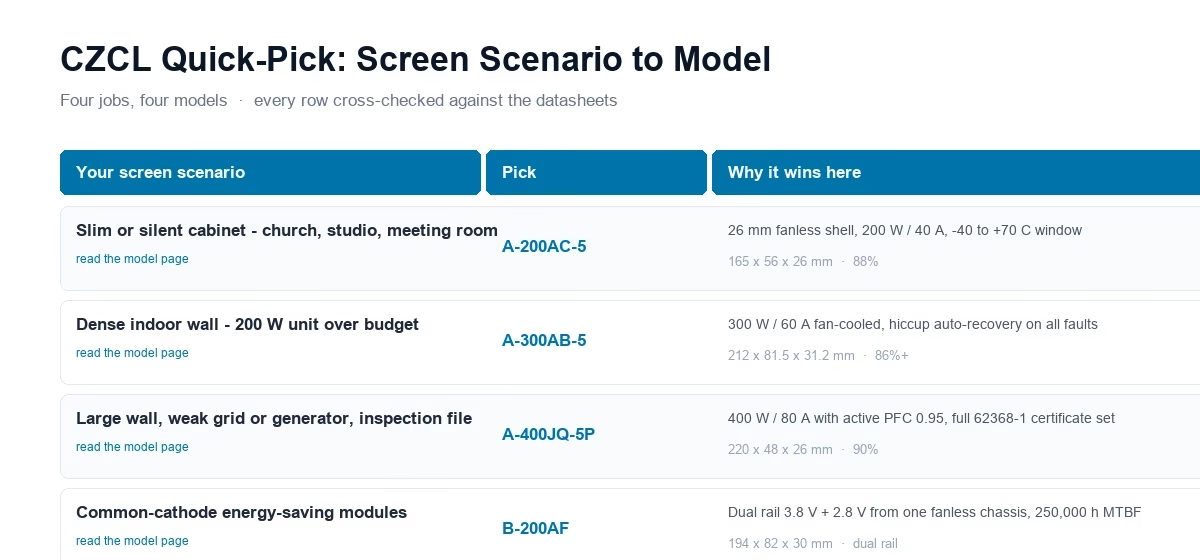
Two boundary cases worth naming. A screen that mixes standard and common-cathode modules takes both architectures — B-200AF units on the common-cathode cabinets, A-series on the rest; the mistake to avoid is one supply type across both. And a slim cabinet that also demands 400 W of concentration gets the A-400JQ-5P’s 26 mm shell with the plate rule honored — the conduction path is not optional on that model.
When the six questions leave a tie — two models both fitting the budget — break it on service life and grid: the higher MTBF wins for always-on sites, the PFC unit wins for weak or long-fed grids. And when the tie is between guessing and asking, send the cabinet list: this guide is the same flow our engineers run, with the load math returned per cabinet from an LED screen manufacturer stocking the full chain.
How to Choose a CZCL LED Power Supply: Frequently Asked Questions
Which CZCL power supply should I use for a standard indoor screen?
Start at the A-200AC-5: one 200 W unit per 500 × 500 mm cabinet covers four P2.5-class modules plus the receiving card within its 160 W usable budget. Move to the A-300AB-5 when the cabinet draws more, and to the A-400JQ-5P when you want fewer supplies on large walls.
How do I know if my screen needs the dual-rail B-200AF?
Ask the module supplier one question: standard or common cathode? Common-cathode modules carry two buses (3.8 V LED, 2.8 V driver) and only the B-200AF feeds both correctly from one chassis. A 5 V supply on a 2.8 V driver bus kills driver ICs.
Can I run CZCL power supplies on 110 V in the US?
No. Every model in the display family needs a 200–240 V nominal grid; datasheet windows run from 176–190 VAC minimum. For 100–120 V markets use a wide-input series or a step-up source.
Is the fan on the A-300AB-5 a maintenance problem?
It is a service item, not a problem: keep the grille clear of dust at scheduled screen service and listen at commissioning. If the cabinet cannot offer service access or must be silent, the fanless A-200AC-5 or A-400JQ-5P is the better fit.
Which CZCL model has the best protection?
The A-400JQ-5P: hiccup-mode auto-recovery across overload, over-temperature and short circuit, plus 3,000 VAC input-to-output isolation and the fullest certificate set. The A-300AB-5 shares the hiccup behavior; the A-200AC-5 offers basic protection without self-recovery.
What if two models both fit my cabinet?
Break the tie on site conditions: higher MTBF (B-200AF’s 250,000 h, A-300AB-5’s 200,000 h) for always-on installations, active PFC (A-400JQ-5P) for weak grids and long feeder runs, slimmest shell (26 mm pair) for tight bays. When it still ties, send the cabinet list for a per-cabinet quote.
Answer the six questions with your spec sheet, or send it over
Get the Right CZCL Model and Count Per Cabinet
📱 / WhatsApp: +86-191-18802497 · Shenzhen, China · GMT+8
Related CZCL Power Reading
How Many Power Supplies Does an LED Screen Need? — the count formula this guide assumes
CZCL LED Display Power Supply — the full four-series catalog with pricing
LED Display Power Consumption — brightness, draw and the electricity bill
Common Cathode LED Technology — the architecture behind the dual-rail fork
Keep Reading the CZCL Power Supply Series
The companion guides to this article – count math, selection flow, pricing and head-to-head verdicts.