
CZCL Power Supply Comparison | 200W vs 300W vs 400W Verdict
Three CZCL supplies share one 5 V rail, one brand and one catalog page — and choosing between them trips up buyers precisely because all three look reasonable on a spec sheet. The A-200AC-5, A-300AB-5 and A-400JQ-5P are not three generations of the same product; they are three different answers to “how much current does a cabinet need, and what will the installation forgive.” This CZCL power supply comparison runs every pair head-to-head, prices them per usable watt instead of per sticker, and hands down one verdict per scenario. The dual-rail B-200AF sits outside this ladder by design, and gets its own section at the end.
Short answer
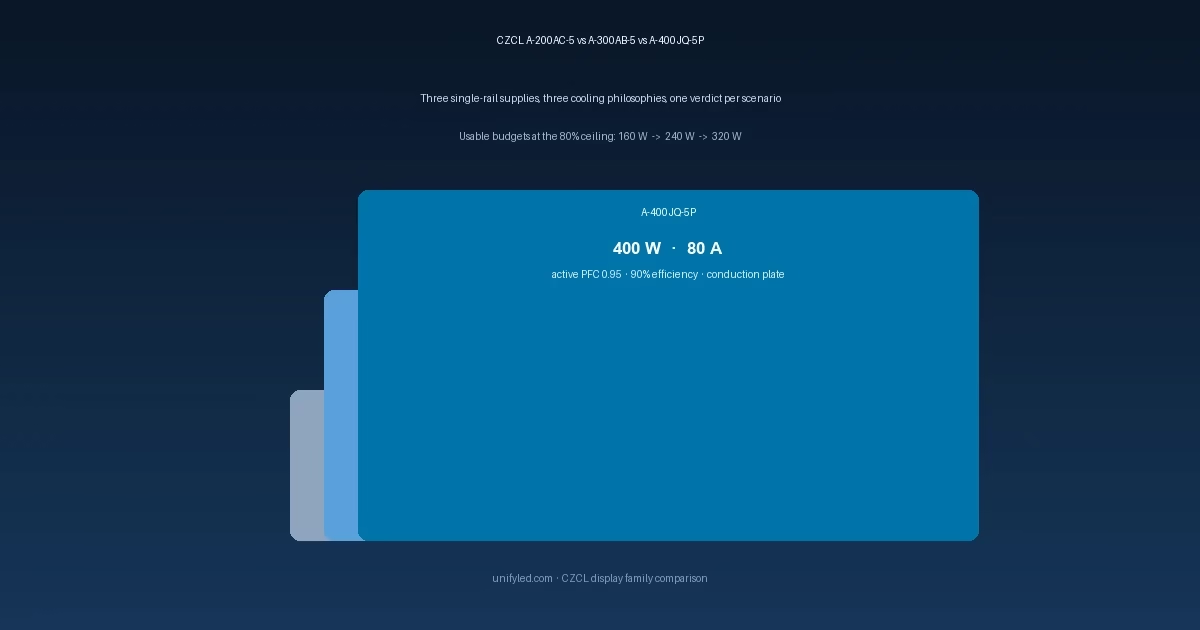
Buy the A-200AC-5 when the cabinet is slim, the room must stay silent, or the site freezes (−40°C rating, 26 mm fanless shell, $12.50 up). Buy the A-300AB-5 for everything else indoor — it delivers 50% more current at the best price per usable watt in the family (5.4 ¢/W) with self-recovering protection. Buy the A-400JQ-5P when the wall is large, the grid is weak or long-fed, or the inspection file demands the full 62368-1 certificate set — 80 A and active PFC 0.95 at $25.14. All three need a 200–240 V grid; the count per cabinet comes from the power supply count formula.
What Does Each Model Bring to the CZCL Power Supply Comparison?
One line per model before the head-to-heads, because the verdicts only make sense against what each unit is built to be:
A-200AC-5 · the specialist
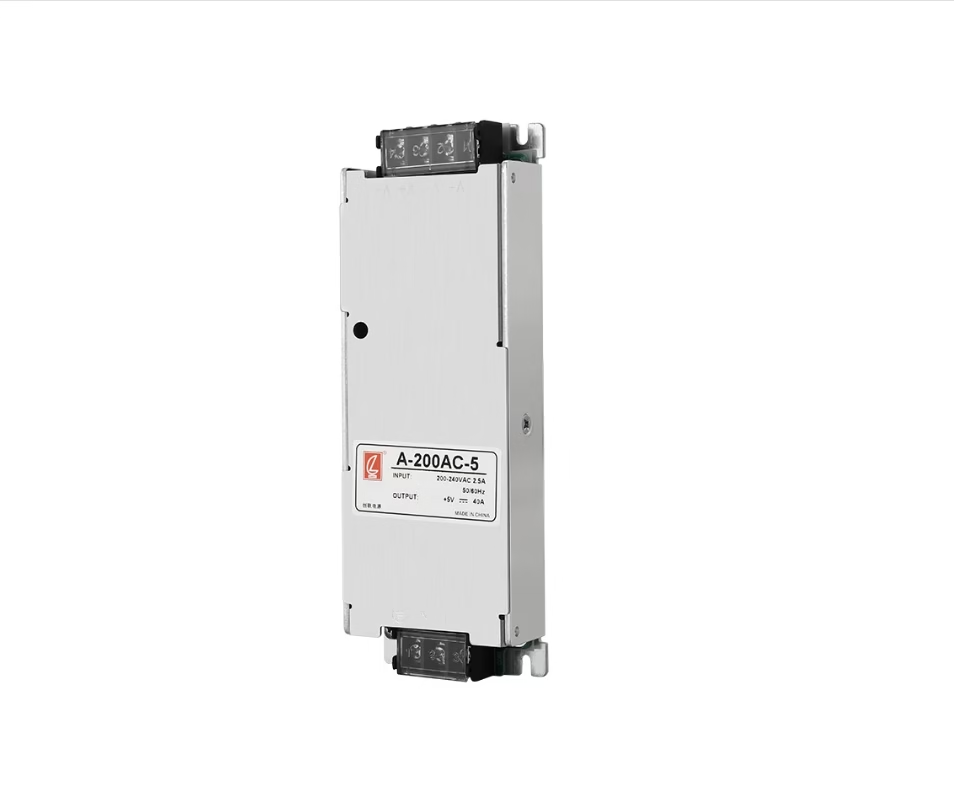
200 W / 40 A in the family’s slimmest fanless shell (165 × 56 × 26 mm, 0.3 kg). Widest temperature window (−40 to +70°C) and the only one that cools by convection alone. The pick where silence, depth or cold is the binding constraint. Full specs →
A-300AB-5 · the workhorse
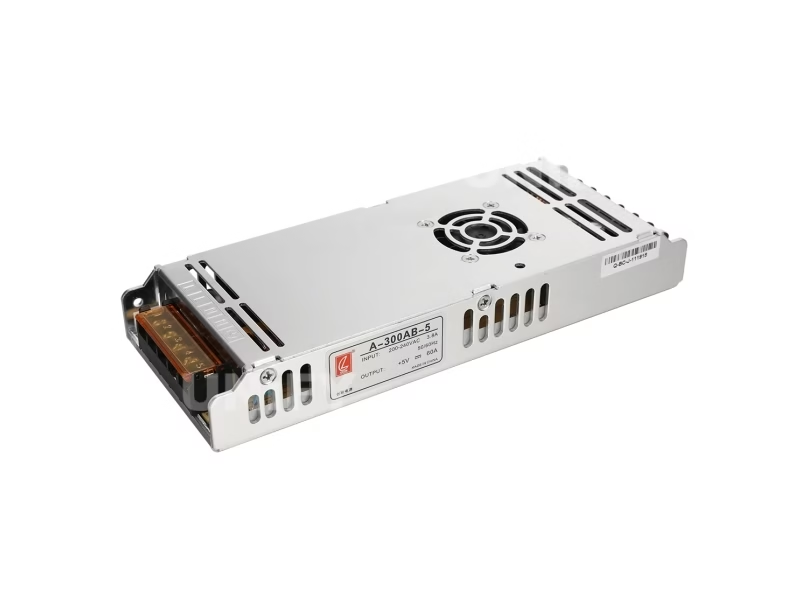
300 W / 60 A with a built-in fan, hiccup auto-recovery on every fault type, the deepest brownout floor (176 VAC) and a 200,000-hour MTBF. The default for dense cabinets and rental fleets. Full specs →
A-400JQ-5P · the flagship
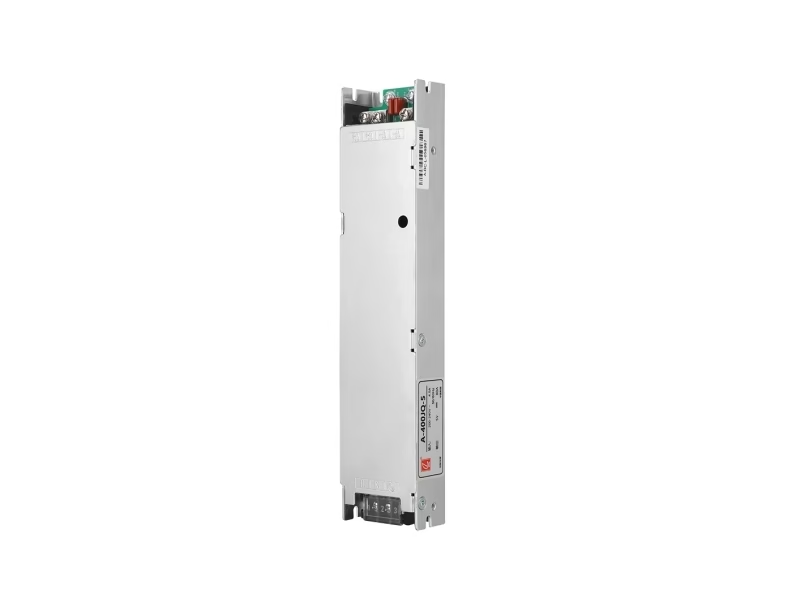
400 W / 80 A with active PFC (0.95) and 90% efficiency in a 26 mm conduction-cooled shell, certified to UL/CSA/EN/IEC 62368-1 plus CCC. The pick for big walls, weak grids and audited installs. Full specs →
A-200AC-5 vs A-300AB-5: Which Wins the CZCL Power Supply Comparison on Value?
This is the pair most buyers actually choose between, and the numbers say the step up costs less than it looks. The A-300AB-5 delivers 50% more current (60 A versus 40 A) and, at typical street prices, a lower cost per usable watt — 5.4 ¢ against the A-200AC-5’s 7.8 ¢. What you pay for the upgrade is not money but three physical things: a fan that joins the service cycle, five millimeters of shell depth (31.2 mm versus 26 mm), and a warmer cold floor (+−25°C minimum against −40°C).
| Parameter | A-200AC-5 | A-300AB-5 |
|---|---|---|
| Output / usable at 80% | 5 V / 40 A / 200 W · 160 W | 5 V / 60 A / 300 W · 240 W |
| Cooling / height | Fanless convection · 26 mm | Built-in fan · 31.2 mm |
| Input floor / temperature | 190 VAC · −40 to +70°C | 176 VAC · −25 to +60°C |
| Protection / MTBF | Short circuit, overload · not published | Hiccup auto-recovery · 200,000 h |
| Street price / usable watt | $12.50 · 7.8 ¢/W | $13.00 · 5.4 ¢/W |
Verdict: silent rooms, sub-30 mm bays and freezing sites keep the A-200AC-5; every other indoor job defaults to the A-300AB-5, whose hiccup recovery alone earns its keep on rental trucks.
A-300AB-5 vs A-400JQ-5P: Does PFC Decide the CZCL Power Supply Comparison?
At the top of the ladder the trade runs from reliability features to grid features. The A-400JQ-5P brings 33% more current (80 A), the family’s only active power factor correction (0.95), the best efficiency (90%), and the fullest certificate set in the display line — the complete UL/CSA/EN/IEC 62368-1 file plus CCC that some inspectors and procurement departments require by name. The A-300AB-5 answers with a longer published life (200,000 hours against 100,000), a deeper brownout floor (176 VAC against 180 VAC), hiccup protection the JQ-P matches, and half the street price ($13.00 against $25.14).
Cooling philosophy differs too: the JQ-P achieves its 400 W fanless by conducting heat into a mandatory aluminum plate with thermal grease, while the AB-5 blows its 300 W across a fan. Neither is better; they impose different cabinet obligations. Verdict: large walls concentrating multiple cabinets per supply, generator-fed or long-feeder sites, and any job with a paperwork mandate go to the A-400JQ-5P — at 7.9 ¢/W it is priced nearly flat against its sibling per usable watt. Standard rental and fixed-install work keeps the A-300AB-5 and pockets the difference.
A-200AC-5 vs A-400JQ-5P: Same 26 mm Shell in the CZCL Power Supply Comparison?
The tempting comparison: both shells measure 26 mm tall, and one carries twice the power. The catch lives in the cooling column. The A-400JQ-5P’s conduction design is a requirement, not a suggestion — the datasheet mandates mounting on an aluminum plate or metal cabinet skin with thermal grease, because the shell dumps its heat into the mounting surface rather than the air. The A-200AC-5 needs no such path; it convects through perforated steel and stays silent doing it.
That difference decides the pair. In a cabinet engineered with a metal power plate, the A-400JQ-5P doubles density at the same height — two of the heaviest cabinets per unit, one supply instead of two. In a sealed plastic-isolated bay, or anywhere the plate cannot be guaranteed, the A-200AC-5 is the only honest choice of the two. Temperature windows reinforce the split: −40 to +70°C on the 200 AC against −20 to +70°C on the JQ-P. Verdict: same height, different contracts — read your cabinet’s power-bay drawing before choosing on wattage alone.

Can You Mix Models in One Screen? The CZCL Power Supply Comparison Rule
Yes — per cabinet, and mixed fleets are how experienced integrators actually bill these walls. A worked pattern on a 40-cabinet indoor face: the sixteen brightest ground-row cabinets take concentrated A-400JQ-5P units (one per two cabinets, plate rule honored), the twenty-four upper slim-row cabinets take one A-200AC-5 each for silence and depth, and the quote closes with two A-300AB-5 spares covering either class in a pinch. Three rules keep the mix honest: every cabinet’s bus carries one rail voltage only; supplies are never paralleled across models; and the spare stock is chosen for terminal compatibility, not just wattage. The cabinet guide shows the bay layouts that make which-slot-gets-which-model a drawing decision instead of a debate.
Which Spec Lines Get Copied Wrong in the CZCL Power Supply Comparison?
Four corrections worth carrying into any purchase order. The input floors differ by design, not by typo — 176 VAC on the A-300AB-5, 180 on the A-400JQ-5P, 190 on the A-200AC-5 — while every production nameplate reads 200–240 V nominal, so treat 200–240 as the design center and all three datasheets agree. The height copy drifts: older listings describe 30 mm-class shells that the factory parameter tables and physical units correct to 26 mm (A-200AC-5, A-400JQ-5P) and 31.2 mm (A-300AB-5). The A-400JQ-5P is routinely mislabeled “300 W” in copied listings; the 2024 R1.0 datasheet says 400 W. And MTBF figures are per-model, not per-brand — quoting the B-200AF’s 250,000 hours for an A-series order is the kind of slip a procurement audit catches.
Where Does the Dual-Rail B-200AF Fit in the CZCL Power Supply Comparison?
It does not — and that is by design. The B-200AF is the family’s common-cathode specialist: two independent rails (3.8 V / 30 A for the LED bus, 2.8 V / 20 A for the driver bus) that no single-rail unit here can substitute, at any price. If your modules are standard 5 V parts, this section is your permission to ignore it; if the spec sheet says common cathode, the three-way comparison above becomes a four-way with one row that wins automatically. The common cathode technology guide explains the architecture, and its 250,000-hour MTBF — the family best — is profiled on the model page.
For the full four-model matrix with pricing benchmarks, the CZCL LED display power supply catalog carries the family table, and the pricing details live in the price guide. Counting units per wall stays in the count formula; and once a screen is built, flicker under load is the symptom that says the model or the count was wrong. When the verdict is still a tie, send the cabinet list — the quote comes back with the per-cabinet decision made, from an LED screen manufacturer that stocks all four.
CZCL Power Supply Comparison: Frequently Asked Questions
Which CZCL power supply is the best all-rounder?
The A-300AB-5: 60 A at the family’s best price per usable watt (5.4 ¢), hiccup auto-recovery, the deepest brownout floor and a 200,000-hour MTBF. The A-200AC-5 only displaces it when silence, sub-30 mm bays or −40°C sites bind first.
Is the A-400JQ-5P worth double the A-300AB-5’s price?
Per usable watt they are nearly flat (7.9 ¢ versus 5.4 ¢) — the JQ-P’s premium buys active PFC for weak or long-fed grids, 90% efficiency, the full 62368-1 certificate set, and 80 A concentration. If none of those bind, the AB-5 keeps the difference.
Can I mix the three models in one LED screen?
Yes, per cabinet — big-wall rows on A-400JQ-5P units with A-200AC-5 in slim or quiet zones is a normal design. Every cabinet’s bus must carry one rail voltage, and none of the three may feed a common-cathode cabinet (that is B-200AF work only).
Which of the three is the most reliable?
By published MTBF, the A-300AB-5 leads at 200,000 hours against the A-400JQ-5P’s 100,000; the A-200AC-5’s datasheet states no figure. All three ship after 100% burn-in from a factory reporting sub-0.2% annual failure rates.
Do all three work on a 110 V US grid?
No — all three need 200–240 V nominal (datasheet floors from 176 to 190 VAC). For 100–120 V markets use a wide-input series or step-up source; this is true of the whole CZCL display family.
What about the B-200AF — should it be in this comparison?
Only as a footnote: it serves common-cathode screens with dual 3.8 V + 2.8 V rails that no A-series unit can feed. For standard 5 V screens the three-way ladder above is the complete decision.
Which model survives outdoor full-brightness duty best?
The A-400JQ-5P for the wall itself — highest usable budget, best efficiency at 90%, and PFC for the long feeder runs outdoor faces usually sit on — provided the conduction plate is engineered in. The A-200AC-5’s −40°C floor makes it the cold-climate pick where winters, not summers, are the enemy.
Do any of the three support N+1 current sharing?
No — all three are single-rail, non-current-sharing designs, so N+1 means a physical spare unit per zone rather than automatic failover. True load-sharing redundancy lives in CZCL’s dedicated current-sharing series, quoted per project.
The verdict per scenario, or the whole family in one carton
Get the CZCL Power Supply Comparison Verdict With the Quote
📱 / WhatsApp: +86-191-18802497 · Shenzhen, China · GMT+8