
VDWALL vs Novastar LED Video Processor: Which Fits Your LED Wall? (2026)
VDWALL vs Novastar led video processor is the cross-brand question behind most processor shortlists in 2026: VDWALL’s four-model ladder (LVP100/100U, LVP605, LVP615S, LVP909) prices from $120 to $843 on the street, while Novastar’s all-in-one VX range (VX4S-N, VX6s, VX1000) runs $700 to $2,500 with the deepest software ecosystem in the industry. Both scale sources onto LED walls and feed sending systems — the differences live in output architecture, control philosophy, calibration tooling and price. This comparison puts sourced numbers on every dimension and ends with a per-budget verdict. Data sources: VDWALL official user manuals and product overviews (2016–2019) and the official LVP100U product page; NovaStar official VX4S-N documentation V1.0.1 as published in our VX4S-N review; September 2026 channel pricing from ledscreenparts.com, controller-led.com and SinaPlug; buyer discussions on r/VIDEOENGINEERING and Small Church Media.
Short answer: At the mainstream 2.3–2.65-million-pixel class both brands deliver, and the decision is philosophical: VDWALL wins on price (the LVP605 at $649 vs the VX4S-N at $1,049 is a 40% gap for comparable loading), on analog input depth, and on panel-first operation; Novastar wins on software ecosystem (NovaLCT, NovaCLB pixel-level calibration), on Gigabit-Ethernet outputs that skip sending cards, and on the road to 4K (the VX1000’s 6.5M pixels versus VDWALL’s 9.2M aggregate across four LVP909 outputs). Budget builds and second-hand wall retrofits point to VDWALL; fine-pitch color-critical walls and software-managed fleets point to Novastar.
What Is the Difference Between VDWALL and Novastar LED Video Processors?
A VDWALL LED video processor is a scaler-switcher from Shenzhen VDWALL Co., Ltd. that converts up to ten video sources into the pixel geometry of an LED screen and delivers the result through internal DVI outputs feeding two to four LED sending cards. A Novastar all-in-one LED display controller — the VX4S-N is the reference here — is a video processor and synchronous control system combined by Xi’an NovaStar Tech Co., Ltd., scaling six inputs and delivering the result over Gigabit Ethernet ports straight to Novastar receiving cards, powered by the Nova G4 processing engine. Same slot in the signal chain, two delivery philosophies: VDWALL hands off on DVI and stays card-agnostic, while Novastar integrates the sending stage and owns the receiver ecosystem.
That architectural split explains most of what follows. A VDWALL box can drive any wall whose receivers accept its sending card — the reason LVP100 and LVP605 units populate so many second-hand and mixed-brand racks. A Novastar controller assumes NovaStar receivers, and in exchange gets one-vendor firmware, calibration and screen management from NovaLCT to NovaCLB.
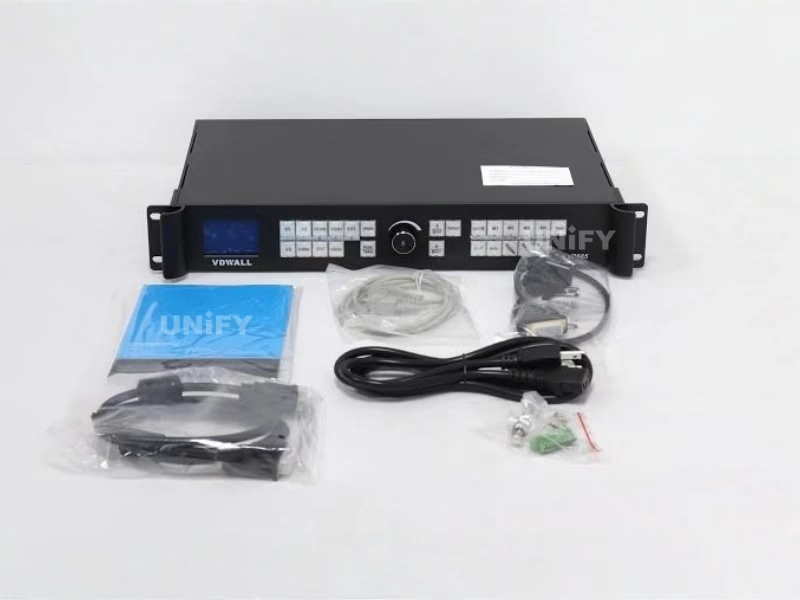
The VDWALL side of the comparison: the ten-input LVP605, the brand’s rental workhorse at $577–759 street.
VDWALL vs Novastar LED Video Processor: How Do the Two Brands Position Differently?
Strip the spec sheets and the two brands are selling different bundles. VDWALL sells hardware autonomy: physical panels with every function on a key, DVI outputs that keep the sending-card market open, hidden factory menus for technicians, and prices that start under $200. Novastar sells managed infrastructure: the Nova G4 engine with 10-bit processing, a four-step no-PC configuration wizard on an OLED panel, a free software suite (NovaLCT for configuration, NovaCLB for per-pixel calibration, SmartLCT for show workflows), and a global support network that publishes its own training videos — two of which are embedded below and in the pricing section.
NovaStar’s official all-in-one lineup overview — the ecosystem side of the comparison (NovaStar official channel).
Neither position is strictly better. The autonomy argument wins whenever the wall’s receivers are not NovaStar — a point Reddit’s r/VIDEOENGINEERING threads return to constantly, because thousands of installed walls carry Linsn or rebranded receivers. The ecosystem argument wins wherever color consistency across cabinets matters at close viewing distance, and wherever a fleet of controllers needs one management workflow.
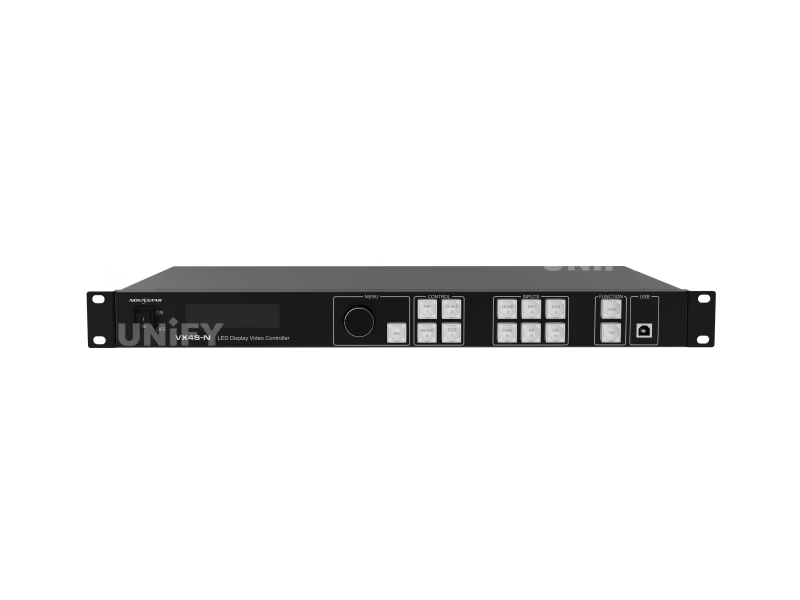
The Novastar side: the VX4S-N all-in-one controller — Nova G4 engine, 2.3M pixels, four Gigabit Ethernet outputs.
Which Brand Drives Your Canvas: VDWALL vs Novastar Loading Capacity?
Capacity decides the shortlist before price enters. The numbers below are the official ceilings; the second VDWALL column shows what happens when units cascade — the brand’s answer to bigger canvases.
Read the table with two caveats. The LVP909’s 9.2 million pixels is the four-port aggregate — each port carries 1920×1200 — so it competes with the VX6s’s 3.9M only when the show’s canvas can be bound across outputs. And the VX1000 is the only native 4K×2K box in this comparison: past roughly 2.65 million pixels on one canvas, Novastar’s ladder continues while VDWALL’s answer is more boxes, not a bigger one.
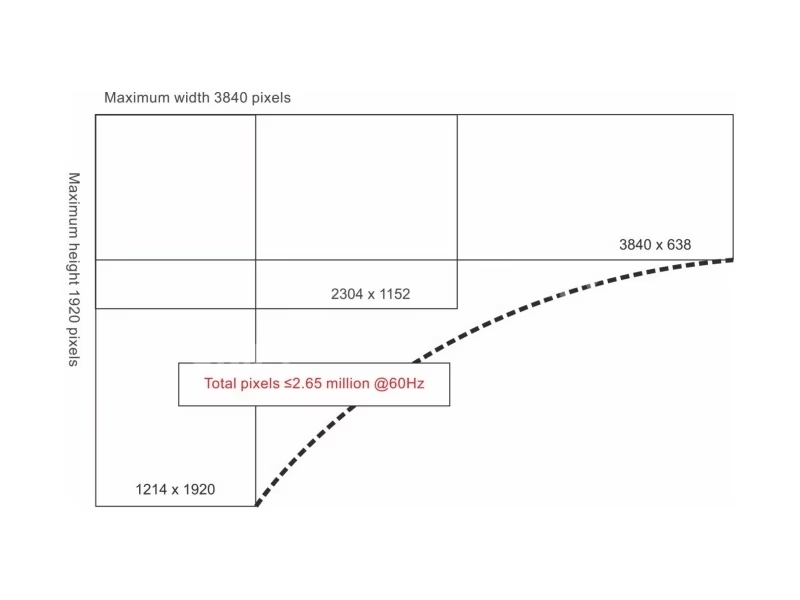
The class both brands fight over: a 2.65-million-pixel wall — LVP615S territory, and one step below the VX4S-N’s own 2.3M ceiling plus its custom-EDID headroom.
Which Brand Has the Inputs and Outputs Your Show Needs: VDWALL or Novastar?
Input depth is VDWALL’s quiet advantage; input modernity is Novastar’s. The LVP605 carries ten inputs — three composite, S-Video, YPbPr, two VGA, DVI, HDMI and an EXT module slot — which is why analog-heavy racks and legacy venues keep it employed. The VX4S-N carries six, but every one of them is the digital-standard set: 3G-SDI with loop-through and deinterlacing, HDMI 1.3, DVI, DisplayPort, VGA and CVBS — broadcast I/O that VDWALL only matches on the LVP615S and LVP909.
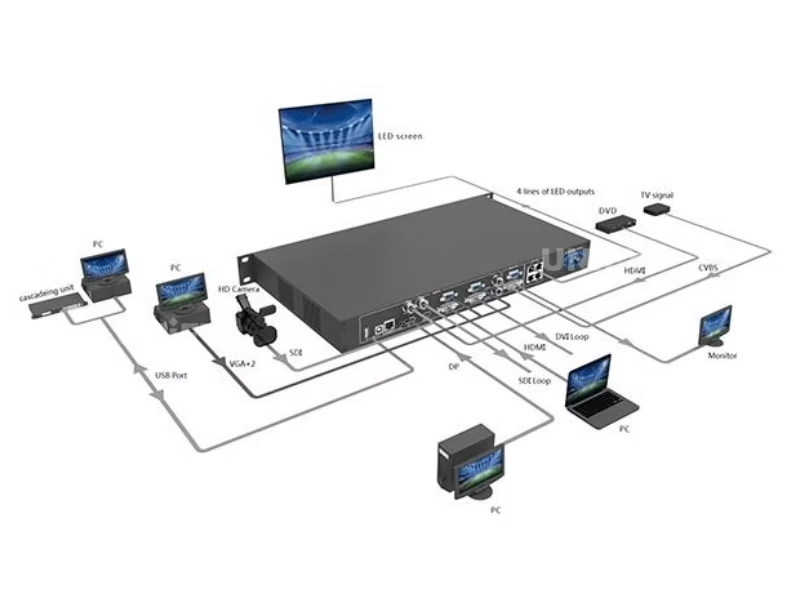
The VX4S-N rear panel: six input families and four Gigabit Ethernet outputs — no sending cards required.
Outputs differ architecturally. VDWALL’s DVI outputs feed whatever sending cards the wall already speaks — two slots in the LVP100/605/615S chassis, one per port on the LVP909. Novastar’s Gigabit Ethernet ports drive its own receivers directly, which removes a purchase and a failure point but binds the wall to the ecosystem. Plan the receiver side with our sending card configuration guide, and the redundancy patterns with our multi-sending-card backup walkthrough.
How Do VDWALL and Novastar Control Workflows Differ?
Both brands run the show from the front panel — the workflows diverge in software and in who they assume is operating.
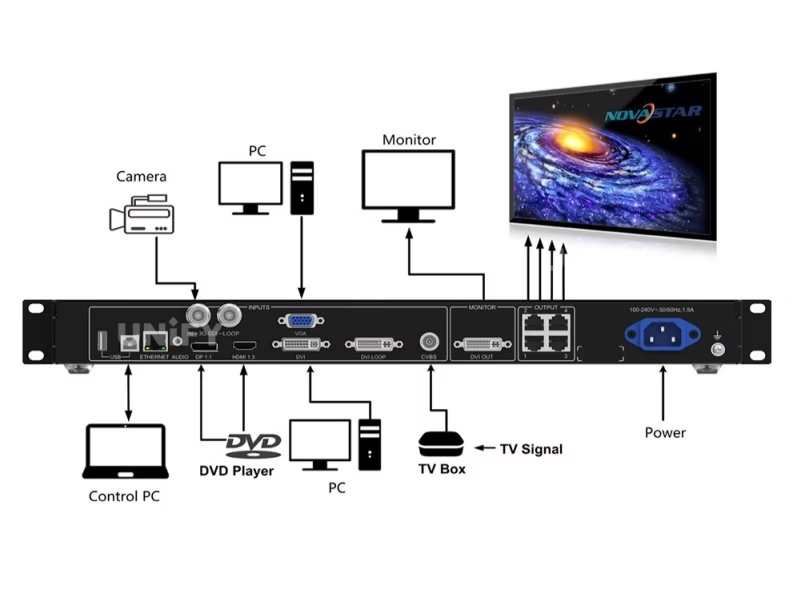
The integrated path: sources in, Nova G4 processing, four Ethernet streams out to NovaStar receivers.
The practical translation: a volunteer can run either brand from the panel, but a fleet manager will feel the difference — NovaLCT manages receiving cards, cabinet topology and firmware for a whole inventory, while VDWALL’s software story stops at per-unit control plus the LVP615S’s phone app. Calibration is the sharpest edge: NovaCLB’s per-pixel correction is aimed exactly at fine-pitch walls viewed from metres away, where VDWALL’s per-input ADC routine is the rougher tool.
How Much Do VDWALL and Novastar LED Video Processors Cost in 2026?
Price is where the comparison stops being philosophical. Every figure carries its source and date:
The head-to-head that matters: the LVP605 and the VX4S-N occupy the same 2.3–2.65M class, and the street gap is roughly 40% in VDWALL’s favor — before counting that the Novastar route needs no sending cards while the VDWALL route prices them separately. The LVP909 at $843 undercuts every Novastar all-in-one while carrying four outputs; the VX1000 answers at a higher tier with native 4K. Novastar’s official product video for the VX4S class shows the all-in-one proposition in one minute:
All-in-one Controller — NovaStar VX4S, official product video (NovaStar official channel).
When Should You Pick VDWALL Over Novastar?
Four situations tilt the comparison to VDWALL, each with a sourced example from the reviews:
- The budget is real. A two-source storefront wall runs on a LVP100U at $140 — Novastar’s current floor is roughly seven times that.
- The rack is analog-deep. Ten inputs with three composite, S-Video and YPbPr make the LVP605 the legacy-source champion; the VX4S-N’s six inputs assume a digital show.
- The wall is second-hand or mixed-brand. VDWALL’s DVI-out-plus-cards architecture adapts to whatever receivers the cabinets carry — the recurring Reddit scenario of rebranded walls with unknown cards resolves on the VDWALL side far more often.
- The show needs outputs, not pixels. Four walls, an ultra-wide ribbon bound across three ports, or a preview-driven desk: the LVP909’s six application modes do jobs no single Novastar all-in-one attempts at $843.
When Should You Pick Novastar Over VDWALL?
And the four that tilt back:
- The wall is fine-pitch and color-critical. NovaCLB’s per-pixel calibration against D65 is aimed at viewing distances VDWALL’s per-input ADC routine does not address.
- The canvas is genuinely 4K. The VX1000’s native 4K×2K@60 and 6.5M pixels have no single-box VDWALL answer; the LVP909 gets there only as a four-port aggregate.
- The fleet is managed. NovaLCT’s receiving-card, topology and firmware management scales across an inventory; VDWALL’s per-unit software does not.
- Support and documentation matter contractually. Novastar’s global channel, official training videos and firmware cadence are the industry’s deepest — an argument procurement teams weigh beyond the spec sheet.
What Do Real Buyers Say About VDWALL vs Novastar?
The forums fill in what spec sheets omit:
- Controller choice threads keep returning to ecosystem fit. r/VIDEOENGINEERING discussions on Novastar controller selection weigh latency, mosaic and budget across the VX and MCTRL lines — Novastar’s breadth is the topic, which is itself the brand’s position.
- The budget question ends at Novastar’s floor. Church-media groups asking for “the cheapest processor” get pointed at Novastar’s entry units — and at VDWALL and Linsn as the undercuts, with the LVP100/100U the cheapest credible name on the list.
- Second-hand walls arrive with VDWALL inside. The recurring post: a used wall with an LVP605/615 and rebranded software, owner asking how to identify receivers and swap processors — VDWALL’s card-agnostic output is the reason its boxes survive these migrations.
FAQ: VDWALL vs Novastar LED Video Processor Questions
Is VDWALL or Novastar better for a small LED wall?
For walls under 2.3 million pixels, VDWALL usually wins on value: the LVP100U ($140) or LVP605 ($577–759) covers what the VX4S-N ($1,049–1,100) does at the same class, with panel-first operation. Pick Novastar only if NovaLCT-managed fleets or NovaCLB calibration are contractual requirements.
Which brand is cheaper, VDWALL or Novastar?
VDWALL, at every comparable class — $120–843 across its four models versus Novastar’s $700–2,500 VX range. The closest head-to-head (LVP605 vs VX4S-N) shows a roughly 40% gap, though the Novastar route bundles the sending stage that VDWALL prices separately.
Can a VDWALL processor drive a wall with Novastar receiving cards?
Yes, if the sending card inserted in the VDWALL chassis speaks the Novastar receiver protocol — VDWALL’s DVI outputs are card-agnostic, and Novastar sells its own sending cards for exactly this hybrid use. The reverse also works: a Novastar controller cannot drive non-Novastar receivers without the matching card family.
Which brand has better software?
Novastar, clearly — NovaLCT, SmartLCT and NovaCLB form a free suite covering configuration, show workflows and per-pixel calibration. VDWALL’s ViewRGB and the LVP615S app handle per-unit control; there is no VDWALL equivalent of fleet-level or pixel-level tooling.
Which brand should I choose for a 4K LED wall?
Novastar — the VX1000 drives 6.5M pixels with native 4K×2K@60. VDWALL’s ceiling is the LVP909’s 9.2M aggregate across four ports, which suits ultra-wide ribbons and multi-wall shows rather than one native 4K canvas.
Does VDWALL support SDI inputs like Novastar?
Yes, on three paths: the LVP605S variant (SDI module), the LVP615S (SDI/HD-SDI/3G-SDI built in with loop-out) and the LVP909 (SDI built in). The VX4S-N carries 3G-SDI with loop-through as standard across its production run.
Which brand is easier for a volunteer to operate?
Both run panel-first. Novastar’s four-step wizard with OLED guidance is the more guided first-time experience; VDWALL’s menus go deeper (hot spares, hidden factory menus) but assume a trained hand for setup. Day-of-show operation is one-key on both.
Do I need sending cards with either brand?
VDWALL yes — two slots (or four ports on the LVP909), cards optional and matched to the wall’s receiver family. Novastar no for its own receivers — the Gigabit Ethernet ports drive them directly — which is part of what the higher unit price buys.
Which brand holds value on the second-hand market?
Both trade actively, differently: VDWALL boxes dominate used-wall listings because they adapt to mixed receivers, while Novastar gear resells on brand trust and firmware support. For disposal value per dollar, the discontinued-but-durable LVP605 is a forum favorite.
Is the LVP909 a competitor to the Novastar VX1000?
Partially. Both are the multi-output flagships of their lines ($843 vs $1,500–2,500), but they differ in kind: the LVP909 binds four DVI ports into switcher/splicer/preview workflows (9.2M aggregate), while the VX1000 is a native 4K×2K canvas driver with ten Gigabit outputs. Choose by whether the show needs outputs or pixels.
What about Colorlight and Huidu — where do they fit?
They bracket this comparison with deeper mid-market ecosystems: our Colorlight and Huidu hubs map their controller lines, and the four-brand architecture question is answered in our sync vs async control guide.
References & Sourced From: VDWALL vs Novastar Comparison Data
- VDWALL official documentation: LVP100 User Manual V1.0 + Overview V1.0; LVP605 Series User Manual with Quick Guide and Applications booklet; LVP615S User Manual V1.2 + Overview V1.1; LVP909 User Manual + Overview V1.2; official LVP100U product page (en.vdwall.cn), including the LVP909 “9.2 million pixels driving capability” statement.
- NovaStar official VX4S-N documentation V1.0.1 as published in our VX4S-N review (2.3M px, 6 inputs, 4× GbE, Nova G4, 25 W, VX6s/VX1000 market table); NovaStar official YouTube channel (UCua9qH2DzgREekzL8sjPdaA) for both embedded videos.
- Channel pricing, September 2026: ledscreenparts.com (LVP605 $649–759; LVP615 family $519–659; LVP909 $843; VX4U $1,190), controller-led.com (LVP100U $140), ledcontrollercard.com ($120), led-card.net ($195), SinaPlug (LVP605 $577.70).
- Buyer discussions: r/VIDEOENGINEERING controller-choice and sending-card threads; Small Church Media group budget-processor discussions.
Verdict: VDWALL or Novastar — Which LED Video Processor Wins?
By budget band, because that is how the purchase actually happens: under $250 the VDWALL LVP100U has no Novastar answer; in the $500–800 workhorse band the LVP605 and LVP615S beat the VX4S-N on price and analog depth while conceding software and calibration; past $1,000 Novastar’s VX6s and VX1000 own the 4K path while the LVP909 owns the multi-output path. Our full selection method across the VDWALL line lives in the choosing guide, the system-level context in our LED video processor overview, and both brands ship from a LED screen manufacturer that quotes the complete chain — processor, cards and cabling — in one package.
Related VDWALL guides:
VDWALL LED video processor hub · How to Choose a VDWALL Processor · Four-Model Family Comparison · 2026 Price Guide