
How to Choose a VDWALL LED Video Processor (2026): LVP100 to LVP909
How to choose a VDWALL LED video processor comes down to four numbers and one person: how many sources feed the show, how many outputs the wall needs, how many pixels the canvas carries, how the box gets controlled — and who stands at the desk. VDWALL’s current line spans four processors, from the discontinued LVP100 and its LVP100U successor at the economy floor to the ten-input LVP605, the SDI-and-app LVP615S and the four-output LVP909. This guide walks the decision in five questions, puts real arithmetic behind the canvas claims, compares the four models with sourced 2026 prices, and ends with a per-venue recommendation. Data sources: VDWALL official user manuals (LVP100 V1.0, LVP605 series, LVP615S V1.2, LVP909, 2016–2019), VDWALL product overviews (V1.0–V1.2, 2017–2018) and the official LVP100U product page, plus September 2026 channel pricing from ledscreenparts.com, controller-led.com, SinaPlug and led-card.net.
Short answer: Choose a VDWALL LED video processor by answering five questions in order. One: is the wall under 2.65 million pixels (2304×1152)? If yes, the economy LVP100/100U or the LVP605 covers it. Two: how many sources — four points to the 100U, eight or ten to the 605 or 615S. Three: who operates — a volunteer wants the panel-first LVP100/605, a phone-wielding director wants the 615S, a preview-driven desk wants the LVP909. Four: does the canvas exceed one port or one unit — 9.2 million pixels of aggregate drive belongs to the 909. Five: what does the budget say — a $120–195 floor, a $519–759 workhorse band, an $843 flagship.
What Is a VDWALL LED Video Processor?
A VDWALL LED video processor is a hardware scaler-switcher made by Shenzhen VDWALL Co., Ltd. that converts standard video sources into the exact pixel geometry of an LED screen and delivers that picture to the wall through LED sending cards. Every model in the line shares the same three-part job — scale, switch, deliver — and the same Faroudja Real Color processing family named in VDWALL’s official overviews. What changes between models is capacity and operation: input count, output count, canvas ceiling, and whether the operator sits at the panel, at a phone, or at a preview monitor. In a LED video processor shortlist, VDWALL occupies the value tiers: same scaling grammar as the premium brands, fewer network features, a lower street price at every rung.
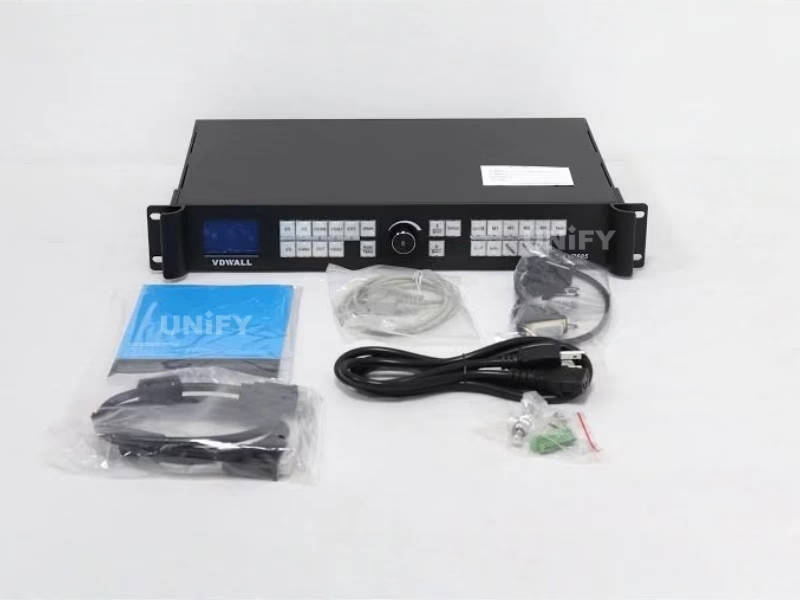
The LVP605: ten input keys, one knob and a three-line LCD — the control grammar every VDWALL processor shares.
How to Choose a VDWALL LED Video Processor in Five Questions
Answer the five questions in order — each one eliminates a model, and the surviving model is the purchase. The table is the whole method; the sections below put numbers behind each row.
Order matters. Canvas eliminates the most models first: a 3840-wide ribbon rules out the 100 and the 605 immediately. Source count breaks the remaining ties: a two-source storefront and a six-source stage both fit the 100’s output spec, but not its input count. Only after the machine fits the show should price pick between survivors.
Which Canvas Size Can Each VDWALL LED Video Processor Cover?
The canvas is the first filter because it is the only spec that cannot be worked around with sources or operators. Turn the wall plan into pixels first — our LED screen calculator converts cabinet counts, and the pixel pitch guide confirms the viewing geometry — then check the arithmetic:
Two reading rules keep the arithmetic honest. First, the 9.2-million figure on the LVP909 is the four-port aggregate, not any single cable — one port still tops out at 1920×1200, and the binding happens across outputs. Second, “under 2.65 million” covers more walls than it sounds like: a 3072×768 wayfinding ribbon (2.36M) fits one economy unit, a question church-media groups ask about the LVP100 by name. A 3840×1080 stage wall, by contrast, needs the 615S’s 3840-wide custom format or two LVP605s in cascade.
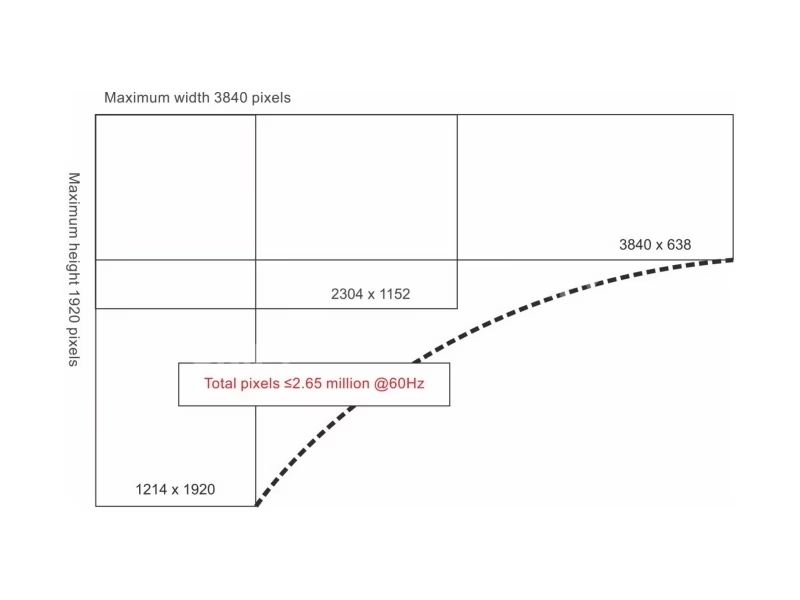
The 2.65-million-pixel mark: one LVP615S carries a 2304×1152 canvas, and the custom format reaches 3840 columns.
How Many Inputs and Outputs Does Your VDWALL LED Video Processor Need?
List every source that will ever plug in — including the backup laptop that appears twice a year — then add one for growth. The four models split cleanly on the result:
Outputs deserve equal weight. Two DVI outputs mean two sending cards and one canvas (or one canvas plus a monitor feed on some models). Four outputs on the LVP909 mean a second wall, an ultra-wide ribbon bound across three ports, or a dedicated preview path — the six application modes re-assign the ports per show. Plan the card count with our sending card configuration guide before ordering either side.
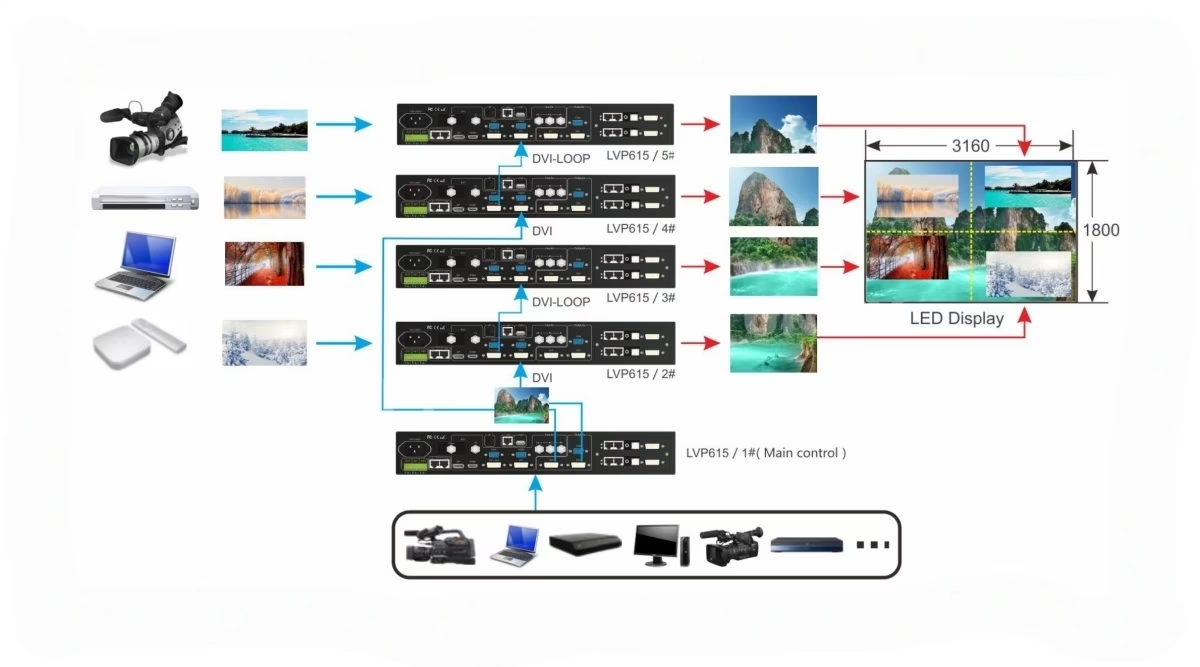
Rear panels decide source plans: count the inputs, the DVI outputs and the sending-card slots before choosing.
Who Operates the VDWALL LED Video Processor: Panel, RS232, WiFi or App?
The operator question eliminates models that spec sheets alone would keep alive. Three operator profiles exist in the field:
The volunteer at the panel. Small venues run on whoever is nearest, and the LVP100/100U plus the LVP605 are built for exactly that — every function has a key, and the 100’s RS232 port stays optional for central-control systems that automate a schedule. No network, no software, nothing to update.
The director on a phone. The LVP615S moves the seat: five control paths (panel, IR remote, RS232, USB, LAN) plus WiFi with an iOS/Android app, and broadcast-style Pre.+Take switching across its four-group seamless matrix so transitions get rehearsed before the audience sees them.
The preview-driven desk. The LVP909 replaces a separate preview monitor — Out4 splits into program-plus-preselect for the operator’s eye, the panel locks with one key for public-facing shows, and WiFi carries a video return so a remote seat sees the wall. That is a director’s workflow at a processor price.
The LVP909 desk: preview on Out4, a Lock key for public shows and four output keys for its bound ports.
How Do the Four VDWALL LED Video Processors Compare: LVP605 vs LVP615S vs LVP909 vs LVP100?
With the three filters applied, the full ladder fits one table. Every figure traces to the official manuals and overviews; prices carry their sources and dates.
3 key differences that survive the table:
- Output count is the family’s real dividing line. Three models carry two DVI outputs; only the LVP909 carries four, and every flagship feature — port binding, the 9.2M aggregate, the preview path — follows from that hardware choice.
- Control depth tracks price exactly. Panel-only at $120–195, panel-plus-software at the 605’s band, five paths plus a phone app at the 615S, and a lockable, preview-feeding desk at the 909.
- Production status is a spec. The discontinued LVP100 is a clearance purchase for frozen installs, not a fleet platform — its successor 100U occupies the same rung with the fifth input and audio out added.
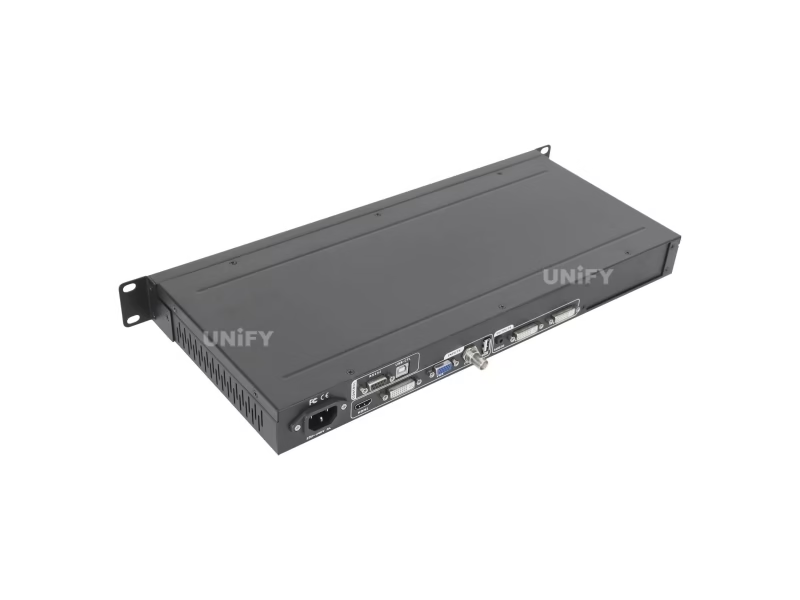
The economy rung: the LVP100 in its 1U, half-depth chassis — discontinued, with the LVP100U carrying the tier forward.
How Much Does a VDWALL LED Video Processor Cost in 2026?
VDWALL sells through distribution, so sourced street listings are the honest reference — every figure below carries its source and date:
Per-pixel, the ladder prices out at roughly $0.32 per thousand pixels for the LVP909’s 9.2M aggregate, $0.24 for the LVP100’s 2.65M ceiling, and $0.22–0.29 for the 605 and 615S — the value tiers earn their name, and the flagship’s premium buys outputs and preview rather than pixels. Sending cards ride in the same budget on every model, and bulk tiers begin around the $2,500 mark on factory listings.
Which VDWALL LED Video Processor Fits Your Venue?
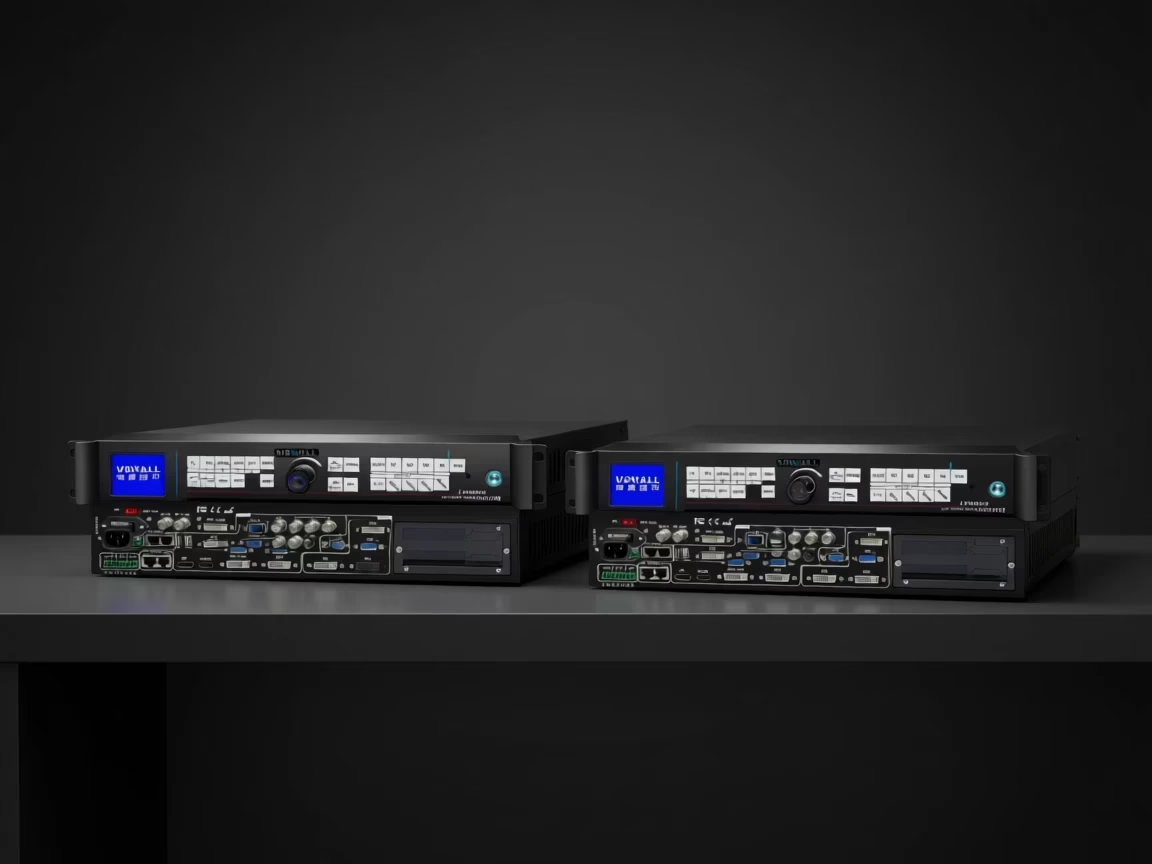
The full ladder in one shot: LVP605, LVP615S, LVP909 and LVP100 — same grammar, four different jobs.
What Mistakes Do Buyers Make When Choosing a VDWALL LED Video Processor?
Five errors account for most returns and regrets we see on this brand:
- Reading the aggregate as a single-cable spec. The LVP909’s 9.2 million pixels bind across four ports; one port carries 1920×1200. Plan tiles and cards per port.
- Building a rental fleet on the discontinued LVP100. Clearance pricing tempts fleet buyers; matched spares end when production does. Fixed installs can buy the bargain — fleets order the 100U.
- Ignoring the switching exceptions. YPbPr never joins the seamless engine on the 605 and 615S, and the LVP100’s manual states seamless switching skips the DVI-to-HDMI pair — route the clean-transition sources accordingly.
- Assuming brightness numbers match across models. The 909 and 100 run 32-step quick scales while the 605 and 615S expose 0–64/0–100 menu scales — mixed canvases match by test pattern, not by value.
- Forgetting the sending cards. Every model takes optional internal cards (two slots on the 100/605/615S, one per active port on the 909); a full 2304×1152 canvas needs two. Budget them with the box.
FAQ: How to Choose a VDWALL LED Video Processor
Which VDWALL LED video processor should I buy for a first LED wall?
For a wall under 2304×1152 with four or five sources and panel operation, the LVP100U — the current economy model with a fifth input, audio out and USB playback. If the source list already runs six or more, start at the LVP605.
Is the discontinued LVP100 still worth buying?
For fixed installs at clearance prices ($120–195), yes — it drives the same 2.65-million-pixel canvas as the 605 with panel control. For rental fleets or rooms that will grow, buy the LVP100U or step up the ladder.
What is the difference between the LVP605 and the LVP615S?
The 615S is the newer generation: SDI and DisplayPort built in (the 605 uses an EXT module), Pre.+Take switching across four input groups, WiFi and app control, and a friendlier custom-output envelope. The 605 keeps ten inputs and a lower price — our LVP605 review details when that is enough.
Does the LVP909 really drive 9.2 million pixels?
Yes — as the four-port aggregate stated by VDWALL’s product center, with each port carrying up to 1920×1200 and the ports bound into one synchronized canvas. Single-cable outputs stay at 1920×1200; the sync-zoom ceiling in the overview is 14400 wide or 6400 tall.
Can a VDWALL processor replace a Novastar controller?
In the same signal-chain slot, yes — both scale sources and feed sending cards. The trade-offs differ: VDWALL wins on price at every rung and adds SDI or preview paths the entry Novastar units skip, while Novastar’s ecosystem runs deeper on software and 4K/8K tiers. Our Novastar controller hub maps that side model by model.
Do I need sending cards with a VDWALL processor?
Yes — cards are optional accessories on every model, and the wall’s receiving-card family decides which to buy. A full-size canvas on the 100/605/615S takes two cards; the 909 takes one per active output port.
Which VDWALL processor has an SDI input?
Three paths: the LVP605S variant (SDI module on the EXT port), the LVP615S (SDI/HD-SDI/3G-SDI built in with loop-out) and the LVP909 (SDI built in). The economy LVP100/100U has none.
Can I control a VDWALL processor from my phone?
On the LVP615S — it ships with an iOS/Android app over WiFi (the hotspot defaults to “LVP615S”, password 88888888, change both on install). The LVP909 offers WiFi control with video return but no app; the LVP100/605 are panel-and-serial machines.
How do I know my wall fits a processor’s canvas?
Multiply the wall’s columns by rows to get pixels, then compare against the ceilings above. A 3072×768 ribbon (2.36M) fits one economy unit; a 3840×1080 wall needs the 615S’s custom format or a 605 cascade; past 9.2M aggregate, leave the VDWALL line.
What does the LVP100U add over the LVP100?
A fifth input, an audio output, USB media playback (MKV, TS, AVI, RMVB, MPEG, MOV and more) and ten preset scene modes — per VDWALL’s official product page — on the same two-output, panel-controlled platform.
Is VDWALL a good brand compared with Colorlight or Huidu?
VDWALL sits in the processor specialist tier — physical-panel operation, Faroudja-claimed processing and aggressive pricing — while Colorlight and Huidu run deeper software ecosystems. Our Colorlight and Huidu hubs cover those lines, and the system-level trade-offs live in our sync vs async control guide.
References & Sourced From: VDWALL LED Video Processor Selection Data
- Shenzhen VDWALL Co., Ltd. official documentation: LVP100 User Manual V1.0 (2018) and Overview V1.0 (2018); LVP605 Series User Manual (50 pp.) with Quick Use Guide and Applications booklet; LVP615S User Manual V1.2 (2019) with Quick Guide V1.0 (2017) and Overview V1.1 (2018); LVP909 User Manual (2016) with Overview V1.2 (2018).
- VDWALL official product center and LVP100U product page (en.vdwall.cn) — including the LVP909 “9.2 million pixels driving capability” statement and LVP100U feature list.
- Channel pricing, September 2026: ledscreenparts.com (LVP605 $649–759, listing updated Dec 2024; LVP615 family $519–659, updated Nov 2025; LVP909 $843; Novastar VX4S $1,499, VX4U $1,190, J6 $3,600), controller-led.com (LVP100U $140), ledcontrollercard.com (LVP100 $120), led-card.net ($195), ledpartsmall.com ($160–180, discontinuation note), SinaPlug (LVP605 $577.70, June 2026).
- Field questions: r/VIDEOENGINEERING threads on LED wall processor choices and VDWALL sending-card swaps; Small Church Media group discussions on VDWALL processor sizing.
Which VDWALL LED Video Processor Should You Buy?
The method compresses to one line: canvas first, sources second, operator third, price last. The LVP100/100U owns small frozen rooms, the LVP605 owns ten-input rental racks, the LVP615S owns broadcast-leaning shows run from a phone, and the LVP909 owns multi-wall and preview-driven productions. Tell us the wall’s pixel grid and the source list, and we will quote the chosen processor with its sending cards and cabling as one package — from a LED screen manufacturer that ships worldwide.
Related VDWALL guides:
VDWALL LED video processor hub · Four-Model Family Comparison · 2026 Price Guide · VDWALL vs Novastar