
VDWALL Video Processor Comparison: LVP605 vs LVP615S vs LVP909 vs LVP100 (2026)
This VDWALL video processor comparison lines up all four models in the current ladder — LVP605, LVP615S, LVP909 and the discontinued LVP100 (with its LVP100U successor) — and reads them the way a purchase actually happens: canvas arithmetic first, then three head-to-head pairs, control workflows, sourced 2026 prices with cost-per-pixel math, and a verdict per venue. Unlike a single-model review, the point here is the spacing between rungs: what each upgrade adds, what each step down saves, and where the ladder’s logic breaks. Data sources: VDWALL official user manuals and product overviews (LVP100 V1.0, LVP605 series, LVP615S V1.2, LVP909 2016 + Overview V1.2, 2016–2019), the official LVP100U product page, and September 2026 channel pricing from ledscreenparts.com, controller-led.com, led-card.net, ledcontrollercard.com and SinaPlug.
Short answer: The ladder reads floor to ceiling. The LVP100/100U is the $120–195 economy floor — four inputs, 2.65M pixels, no mosaic, panel only. The LVP605 ($577–759) is the ten-input baseline with hot spares and multi-unit mosaic. The LVP615S ($519–659) is the same money’s broadcast generation — SDI and DisplayPort in, Pre.+Take switching, WiFi app, 3840-wide custom output. The LVP909 ($843) is the output flagship: four DVI ports binding to a 9.2-million-pixel aggregate with a built-in preview monitor. Cost per million pixels runs from $45 (100) to $218–286 (605), with the 909’s $92 the arithmetic case for buying outputs.
Why Compare the LVP605, LVP615S, LVP909 and LVP100 Side by Side?
Because the four models share one manual grammar, one sending-card architecture and one price ladder, the differences between them are unusually clean — and unusually easy to misread. Each model’s individual review (linked throughout) answers “what is this box”; this comparison answers the three questions a buyer actually asks at the counter: what does the next rung up cost, what does it add, and does my show need it. The method is consistent throughout: every spec cites the official VDWALL documentation, every price carries its source and date, and every pair-wise verdict names the buyer it fits.
One discipline note before the tables: the four models document brightness differently (32-step quick keys on the 100 and 909, 0–64/0–100 menu scales on the 605 and 615S), and the LVP909’s headline pixel figure is a four-port aggregate, not a single-cable output. Both quirks are flagged where they matter rather than smoothed over.
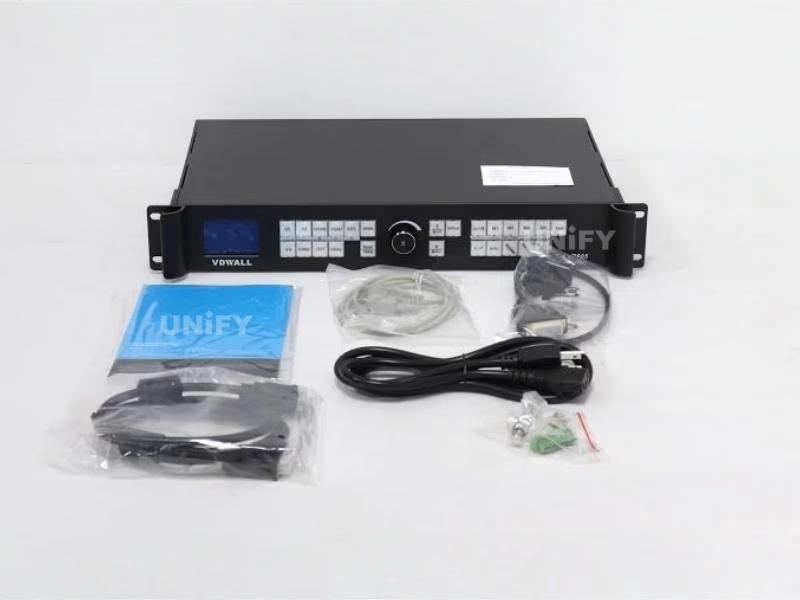
The baseline rung: the ten-input LVP605, the model every other comparison row is measured against.
VDWALL Video Processor Comparison: How Do the Four Models Line Up?
The master table — ten dimensions, four models, every figure sourced:
3 key differences that survive the table:
- Output count is the ladder’s spine. Two DVI ports on three models, four on the LVP909 — and every flagship capability (port binding, the 9.2M aggregate, the preview path, multi-window layouts) follows from that hardware choice.
- Input philosophy splits the middle. The 605 buys analog depth (ten channels); the 615S buys digital modernity (SDI + DP built in) — same money, opposite bets.
- Price steps are not uniform. 100→605 costs ~$450; 605→615S costs roughly nothing to $150; 615S→909 costs $184–324. The 615S is the ladder’s price anomaly — generation upgrade at baseline money.
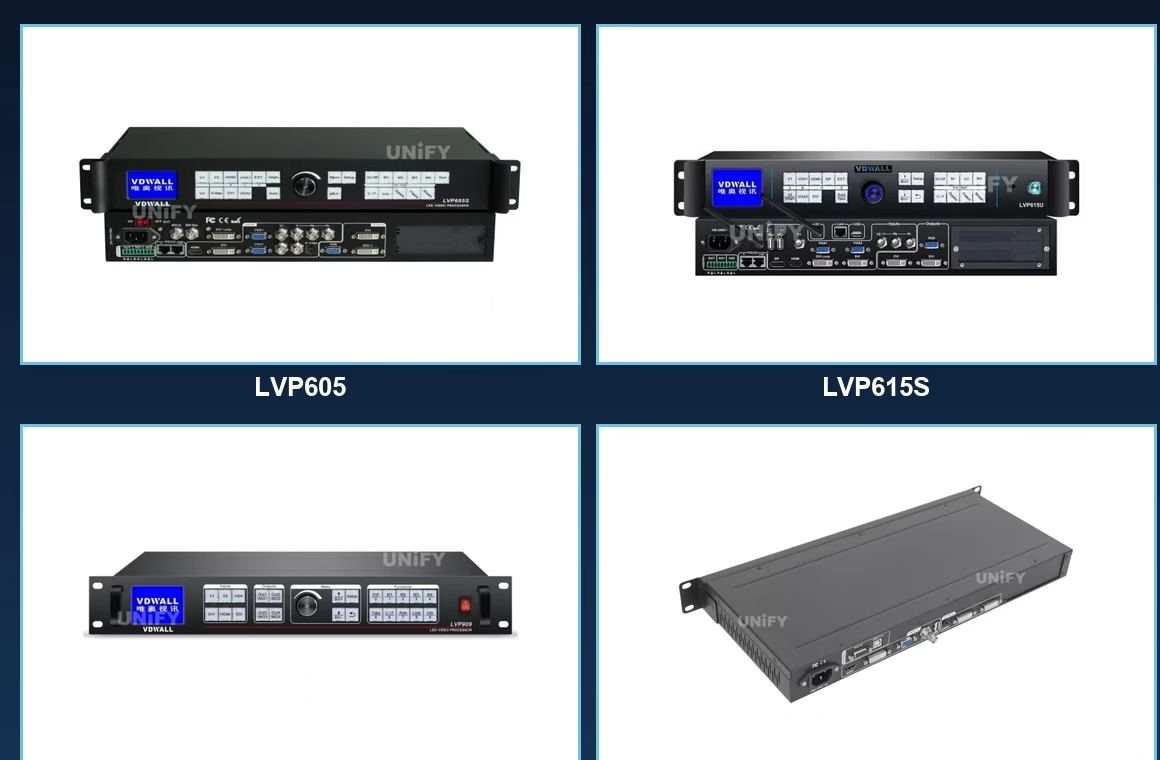
The four rungs in one frame: LVP605, LVP615S, LVP909 and the 1U LVP100.
How Do Canvas and Pixel Arithmetic Compare Across the Four?
Three of the four models quote a 2.65-million-pixel class ceiling — 2304×1152 works out to 2,654,208 — but they reach it differently, and the fourth rewrites the math. The LVP100 and LVP605 get there through presets (16 and 17 respectively, both including the 2560×816 ultra-wide). The LVP615S adds a custom format to 3840 columns or 1920 rows, with VDWALL’s listing noting a higher output can be traded against frame rate below 60 Hz. The LVP909 keeps each port at 1920×1200 and multiplies: four bound ports give VDWALL’s stated 9.2-million-pixel aggregate, with the overview’s sync-zoom ceiling at 14400 wide or 6400 tall.
The practical reading: a 3840×1080 stage wall needs either the 615S’s custom format (one box) or two 605s cascaded (two boxes) — the ladder’s first genuine fork. Past 2.65M on a single canvas, the 909’s binding is the only in-family answer. And when a mosaic spans the 909’s ports, remember the per-port truth from its review: one cable never carries more than 1920×1200, so tiles and sending cards plan per port.
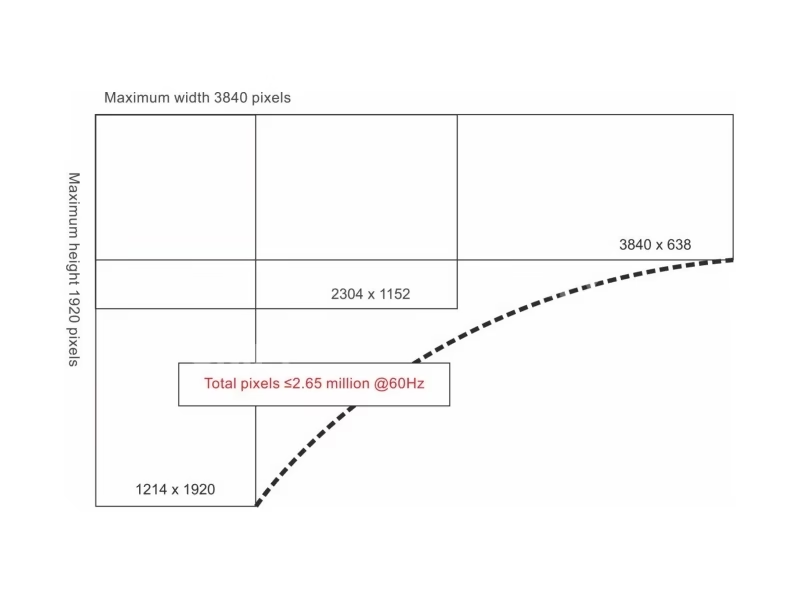
The shared ceiling: 2.65 million pixels — where the 100 tops out, the 605 cascades past it, and the 615S stretches to 3840 columns.
LVP605 vs LVP615S: What Does the Generation Upgrade Add?
This is the ladder’s most interesting pair, because the price barely moves — the 615S’s $519–659 band overlaps the 605’s $577–759 from below. What the newer generation adds: SDI/HD-SDI/3G-SDI and DisplayPort 1.1 as standard (the 605 carries SDI only as an EXT module on the 605S variant), broadcast-style Pre.+Take switching across its four-group seamless matrix (A: V1/V2, B: VGA1/VGA2, C: DVI/HDMI/DP, D: EXT), five control paths with an iOS/Android app over WiFi, a friendlier custom-output envelope, unlimited MacBook-compatible DVI-loop cascade, and a wider 0–45 °C temperature window. What it gives up: two inputs (ten to eight), the S-Video port, one hot-spare pair (four groups to three), and the 605’s formula-gated custom format in exchange for the 615S’s 3840-wide budget.
Pair verdict: for any rack with a broadcast camera, a phone-wielding operator, or a canvas past 2304 columns, the 615S is the buy at effectively the same money. The 605 keeps its crown only where analog depth or the ViewRGB timer workflows are the show.
LVP615S vs LVP909: When Do Outputs Beat Inputs?
Two inputs fewer, two outputs more, and roughly $184–324 between them. The 909’s four DVI ports are spendable currency: bound two/three/four ways into synchronized canvases (the 14400×6400 zoom class), or spent on the six application modes — switcher duty with Out4 as a program-plus-preselect preview monitor, or three/four-window compositions with per-window colored borders. Its Slip wipes (three directional sweeps) and panel Lock round out the director-tier toolkit, with WiFi carrying a video return instead of the 615S’s phone app.
Pair verdict: single-wall shows with a broadcast lean stay on the 615S and bank the difference. The 909 earns its premium the moment the rig owns two walls, a ribbon past one port’s 1920×1200, or an operator who needs to see the preselected source before it goes live.
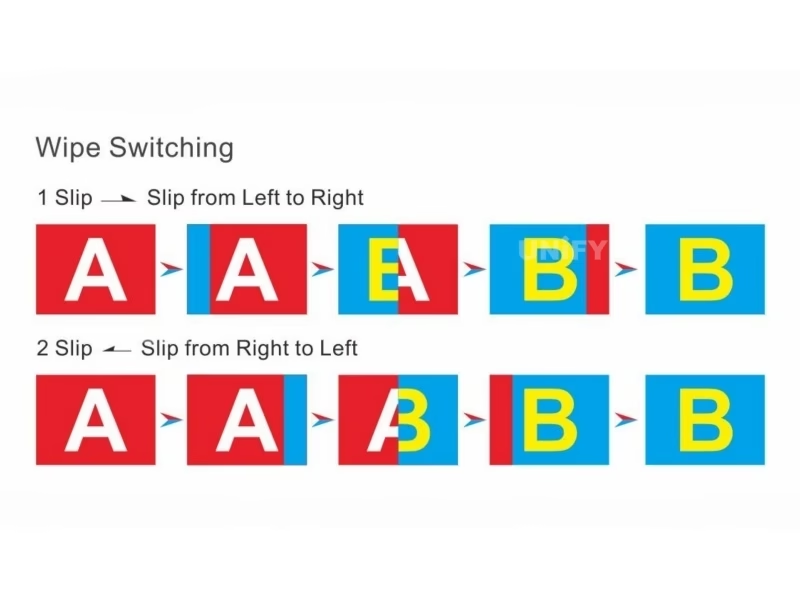
The flagship’s desk: Take, Lock, four output keys — and Out4 doing preview duty in switcher mode.
LVP100 vs LVP605: Is the Discontinued Economy Unit Still Viable?
Roughly $450 separates them on the street — and the 100 is out of production, with resellers pointing buyers to the LVP100U. What the saving costs: six inputs (ten to four), S-Video and YPbPr, all four hot-spare pairs, multi-unit mosaic, PC software, and the 605’s loop output. What survives: the same 2.65-million-pixel canvas through two sending-card slots, the same Faroudja-claimed processing family, EDID-driven pixel-to-pixel setup, a PIP window, and panel operation in a chassis that shrinks to 1U, 200 mm deep and 2.5 kg.
Pair verdict: for a frozen, small-source room, a clearance LVP100 is the cheapest credible entry into the family — our LVP100 review prices it at $120–195. For anything that grows, rents out, or wants remote control, the 605’s $450 buys capabilities the 100 cannot retrofit. The 100U splits the difference as the current economy rung with a fifth input, audio out and USB playback.
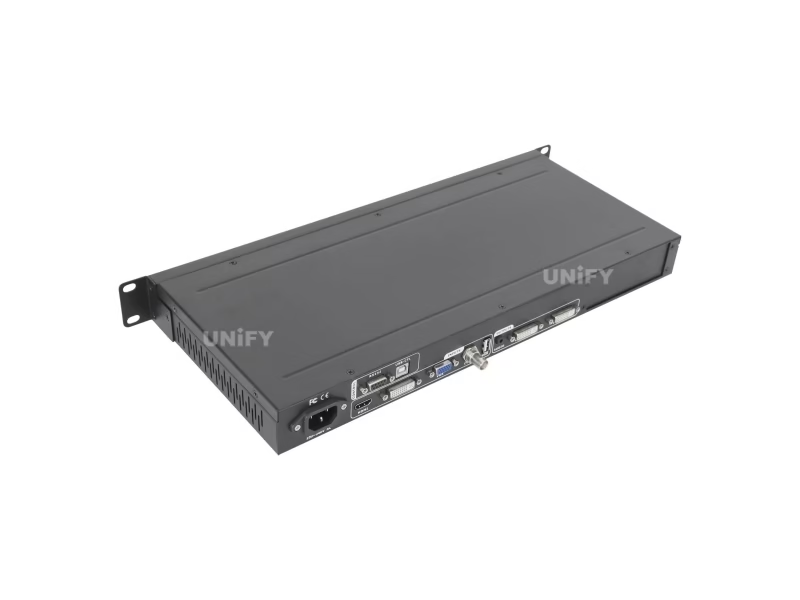
The economy rung: the LVP100’s 1U half-depth chassis — 44 mm tall, 2.5 kg, panel only.
How Do Control and Operation Differ Across the LVP605, LVP615S, LVP909 and LVP100?
All four speak the same menu-and-panel grammar, so a crew trained on one runs any other. The differences sit at the edges:
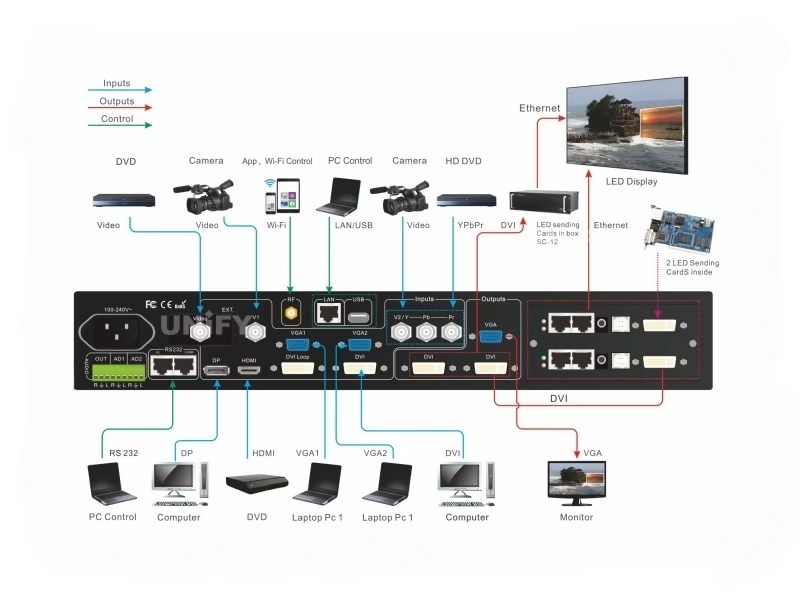
Shared plumbing: every model takes two internal sending-card slots (the 909 one per port) — cards optional, wall decides the family.
3 key differences behind the control ladder:
- Software presence scales with price. None on the 100, ViewRGB on the 605, five paths plus an app on the 615S, WiFi video return on the 909.
- The brightness scales differ mid-family. Quick keys run 0–32 on the 100 and 909 while the 605/615S menus expose 0–64/0–100 — mixed racks match by test pattern, not by number.
- Preview is exclusive to the 909. No other model shows the preselected source before Take commits it.
What Does Each VDWALL Processor Cost — and What Does a Pixel Cost?
Sourced street prices, each with its date, then the arithmetic the ladder implies:
The per-pixel column explains the ladder’s shape: the 100 is the raw pixel bargain, the 605 and 615S price their extra I/O and control at two-to-three times that rate, and the 909’s $92 looks like a bargain only because its currency is outputs — four walls or one bound ribbon, not one big screen. Cross-brand context sits in our VDWALL vs Novastar comparison; the buying method in our choosing guide.
Which VDWALL Processor Wins Each Venue Scenario?
FAQ: VDWALL Video Processor Comparison Questions
LVP605 vs LVP615S — which should I buy?
The 615S at effectively the same money: SDI and DisplayPort built in, Pre.+Take switching, WiFi app, and a 3840-wide custom output, traded against two analog inputs and one hot-spare pair. Only a genuinely analog-heavy rack keeps the 605 ahead.
LVP615S vs LVP909 — is the flagship worth $184–324 more?
Only when outputs are the job: two walls, a ribbon past one port’s 1920×1200, or a preview-driven desk. Single-screen broadcast shows bank the difference and keep the 615S.
LVP100 vs LVP605 — what does the $450 buy?
Six inputs, S-Video and YPbPr, four hot-spare pairs, multi-unit mosaic, PC software and the loop output. Frozen four-source rooms do not need them; growing or rented rooms do.
Which model drives a 3840-pixel-wide wall?
The LVP615S in one box — its custom output reaches 3840 columns (about 2.65M pixels at 60 Hz, tradeable against frame rate). The 605/100 top out at 2304 columns; the 909 gets there by binding ports.
Is the LVP909’s 9.2 million pixels a single-output figure?
No — it is the four-port aggregate stated by VDWALL, with each port capped at 1920×1200 and the ports bound into one synchronized canvas. The overview’s sync-zoom ceiling is 14400 wide or 6400 tall.
Why do brightness numbers differ between models?
The 100 and 909 run 32-step quick keys; the 605 and 615S expose 0–64/0–100 menu scales. Both are documented on their own surfaces — mixed-model canvases should match output by test pattern, not by numeric value.
Which models support mosaic?
Three of four: the 605 (frame-synced multi-unit), the 615S (unlimited DVI-loop cascade, MacBook-compatible) and the 909 (two/three/four-port binding in six application modes). The LVP100/100U has no mosaic — its 2.65M ceiling is final.
Which VDWALL processor has a preview monitor?
Only the LVP909 — Out4 splits into program-plus-preselect in switcher mode and triples as a split-screen monitor in the three-picture mode. The others offer a monitor output for setup, not a preview workflow.
Can the discontinued LVP100 still be serviced?
Practically yes: its sending-card ecosystem is shared across the family, the failure surface is ordinary (power, keys, LCD), and clearance stock at $120–195 can serve as shelf spares. Fleets should standardize on the LVP100U instead.
Which model is best for a first LED wall?
The LVP100U for frozen small rooms ($140, five inputs, USB playback); the LVP615S where a camera, a phone operator or a wide canvas is anywhere in the plan. The full method is in our choosing guide.
Do all four models take the same sending cards?
The slots are architecturally the same — two internal bays on the 100/605/615S, one per port on the 909 — and the card choice follows the wall’s receiver family, not the processor. Our sending card configuration guide covers the pairing.
References & Sourced From: VDWALL Family Comparison Data
- Shenzhen VDWALL official documentation: LVP100 User Manual V1.0 (2018) + Overview V1.0 (2018); LVP605 Series User Manual with Quick Use Guide and Applications booklet; LVP615S User Manual V1.2 (2019) + Quick Guide V1.0 (2017) + Overview V1.1 (2018); LVP909 User Manual (2016) + Overview V1.2 (2018); official LVP100U product page (en.vdwall.cn), including the LVP909 “9.2 million pixels driving capability” statement.
- Channel pricing, September 2026: ledscreenparts.com (LVP605 $649–759, listing updated Dec 2024; LVP615 family $519–659, updated Nov 2025; LVP909 $843), controller-led.com (LVP100U $140), ledcontrollercard.com ($120), led-card.net ($195), ledpartsmall.com ($160–180 with discontinuation note), SinaPlug ($577.70, June 2026).
Verdict: Which VDWALL Video Processor Should Your Rack Carry?
Three sentences carry the whole comparison. The LVP100U is the floor: $140 of correct scaling for frozen rooms, with the discontinued LVP100 a clearance-only alternative. The LVP605 and LVP615S split the middle on philosophy — analog depth versus broadcast modernity at overlapping money — and the 615S is the default for new builds. The LVP909 ends the ladder where outputs begin: four ports, a preview path and 9.2M aggregate for $843. Quote the chosen rung — with its sending cards and cabling — as one package from a LED screen manufacturer that ships worldwide.
Related VDWALL guides:
VDWALL LED video processor hub · How to Choose a VDWALL Processor · VDWALL vs Novastar · 2026 Price Guide