
VDWALL Control Line · Complete Catalog
VDWALL LED Video Processor
Every VDWALL video processor in one catalog — 5 models across 3 tiers, with sourced 2026 prices, six selection guides, the official manuals and factory-direct sourcing. All specifications verified against VDWALL’s official documentation.
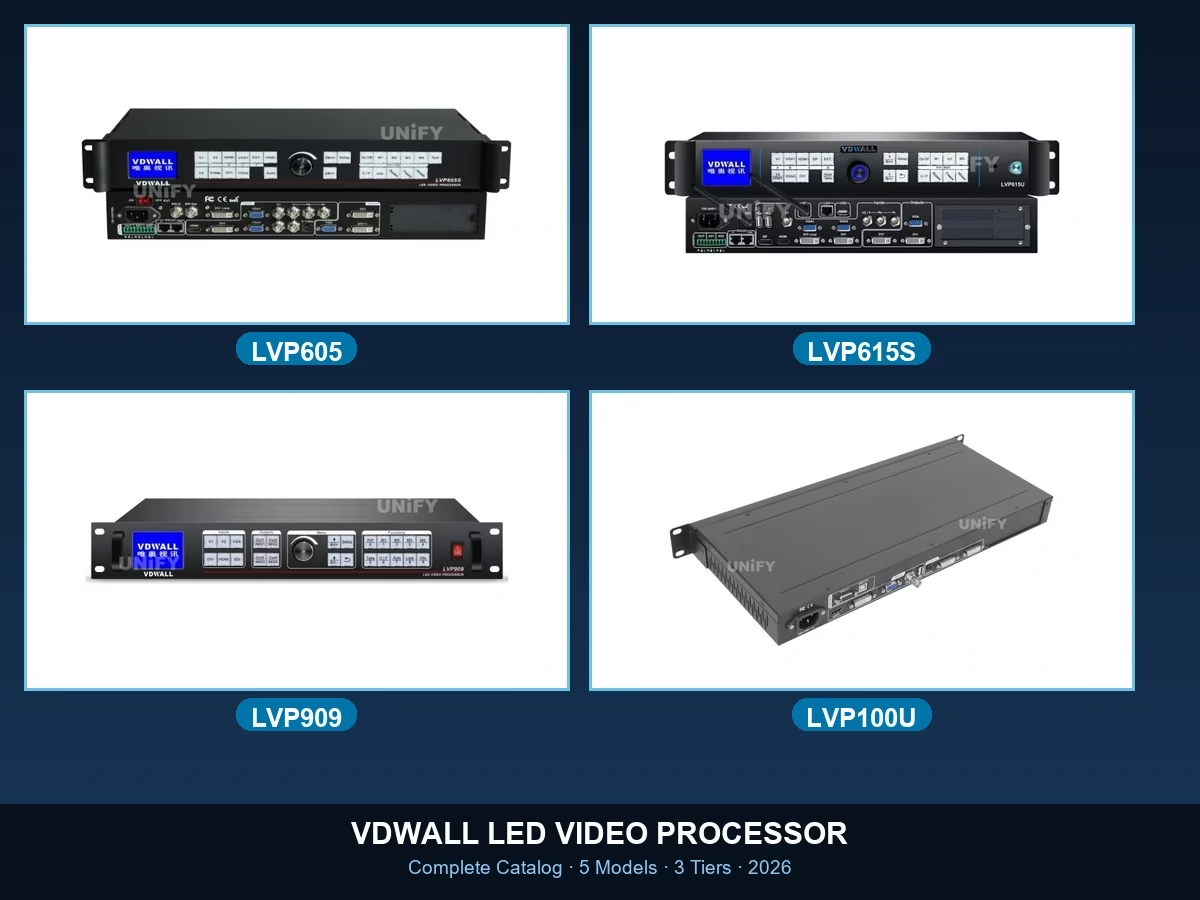
System Overview
What Is the VDWALL LED Video Processor?
The VDWALL LED video processor is the scaler-switcher that turns video sources into a working LED wall: it converts up to ten inputs into the wall’s exact pixel grid, switches between them with cut, fade, blend or wipe transitions, and hands the result to LED sending cards inside its own chassis. Shenzhen VDWALL Co., Ltd. builds the line on a shared Faroudja-processing family and one panel grammar — learn a setting on one model and the others follow. Three tiers cover every point: (1) the economy LVP100/100U — 2.65M pixels, panel-only, the $120–200 floor; (2) the workhorse LVP605 and broadcast LVP615S — ten analog-deep inputs or SDI/DP modernity with WiFi app control, the 2.3–2.65M mainstream class; (3) the four-output LVP909 flagship — 9.2M pixels of aggregate drive, preview monitoring and multi-window composition. For the system background, see synchronous vs asynchronous LED control and the LED video processor overview.
Tier 1 of 3
VDWALL LED Video Processor Series: Economy LVP100 & LVP100U
The floor of the line: four to five inputs, 2304×1152 (2.65M pixels), panel-only operation, a 1U half-depth chassis at 2.5 kg. No mosaic — the ceiling is final. Two generations, one letter apart.
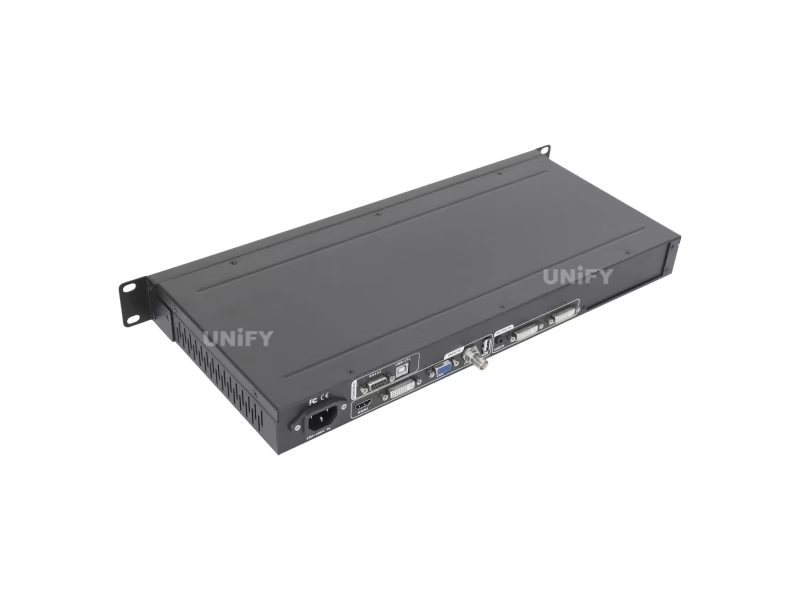
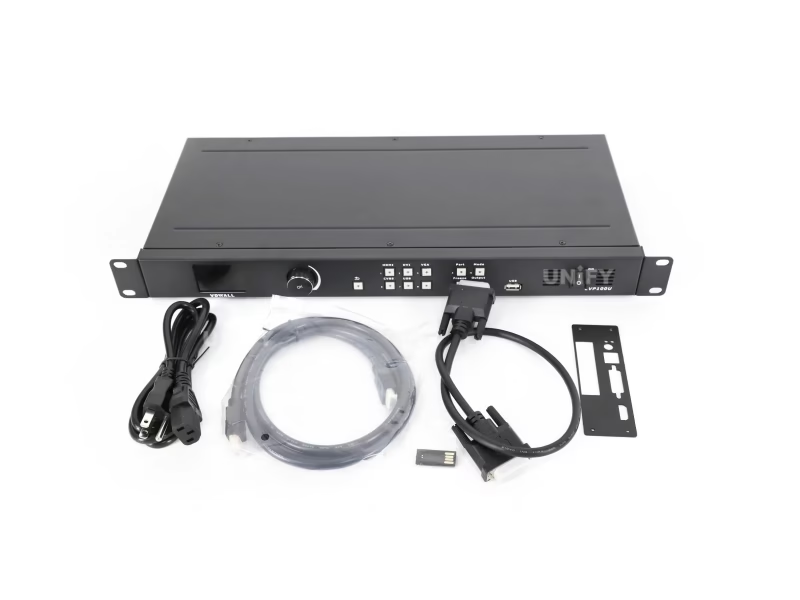
The buying note that matters here: production of the LVP100 has ended — resellers state it in the listings — and the LVP100U succeeds it with a fifth input, audio out and USB playback. A clearance LVP100 suits a frozen four-source room; the full reasoning is in the LVP100 review.
Tier 2 of 3
VDWALL LED Video Processor Series: Workhorse LVP605 & Broadcast LVP615S
The mainstream 2.3–2.65M class, split on philosophy: analog depth versus broadcast modernity at overlapping money. Two sending-card slots, frame-synced mosaic (605) or unlimited DVI-loop cascade (615S), 17 or 18 output formats.
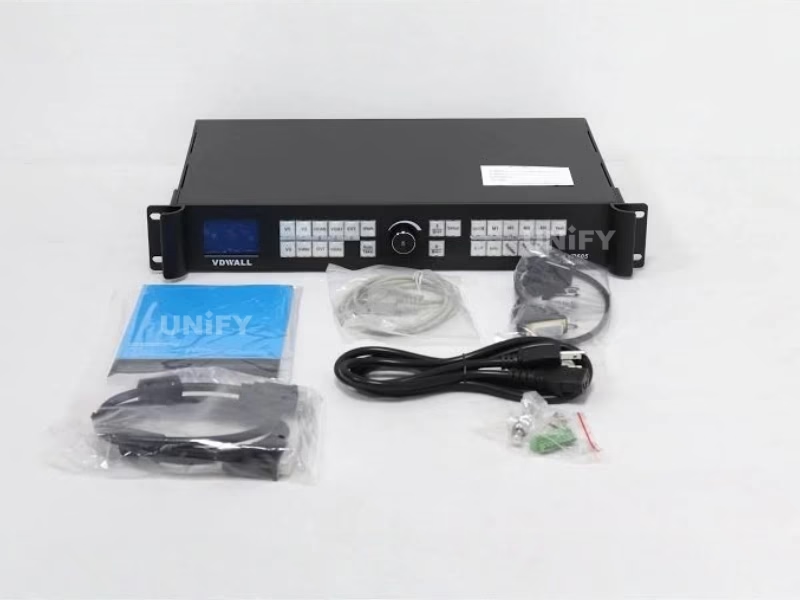
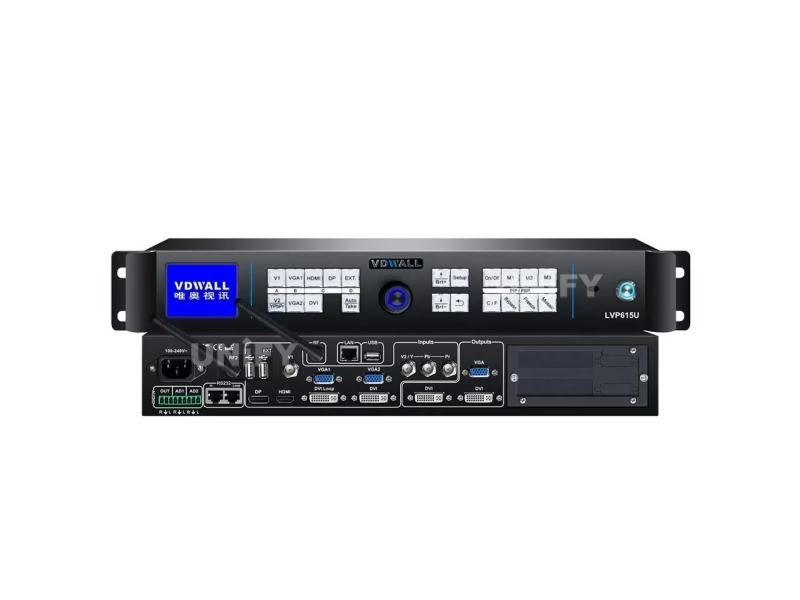
The variant letters sit inside these two: the LVP605S adds an SDI EXT module, the LVP605D a VGA/DVI/HDMI extension, and the LVP615 family spans 615 / 615S / 615S WiFi / 615U (USB media playback). The head-to-head arithmetic — what the generation upgrade adds for roughly $0–150 — is in the family comparison.
Tier 3 of 3
VDWALL LED Video Processor Series: The LVP909 Flagship
Six inputs, four DVI outputs that bind two/three/four ways into one synchronized canvas — VDWALL states 9.2 million pixels of aggregate driving capability with a 14400×6400 sync-zoom ceiling — plus six application modes that re-wire the box per show: switcher with Out4 preview, mosaic splicer, or multi-window composer with colored borders.
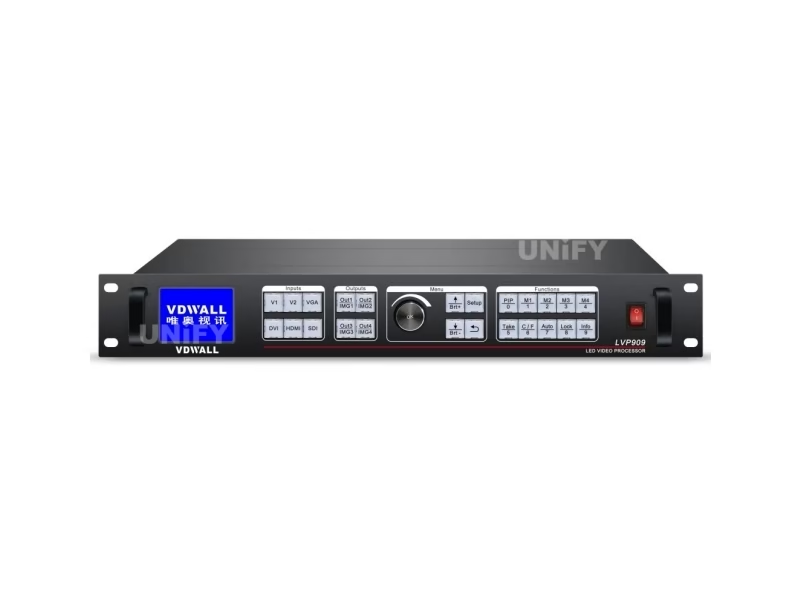
What the four outputs buy that no other model carries: a second wall, an ultra-wide ribbon bound across three ports, or the program-plus-preselect preview path on Out4 — the director-tier toolkit documented in the LVP909 review.
Guides
VDWALL LED Video Processor Selection Guides & Quick Reference
Six in-depth guides cover every decision, plus a quick-reference table for the most common project profiles:
Quick Reference: Match Your Project to a Model
Resources & Support
VDWALL LED Video Processor Resources & Support
Eleven official PDFs, the control guides and the field fixes in one place.
Eleven VDWALL PDFs — user manuals, quick guides and overviews — attached to the LVP100, LVP605, LVP615S and LVP909 pages.
Sending card configuration · multi-card backup · receiver identification
Configuration essentials: every model on this page configures through the same panel grammar — menu, arrows and a save key — with the knob-speed trick on the knobbed models and a Step key on the LVP100. Software coverage grows up the ladder: ViewRGB on the LVP605, five control paths with the phone app on the LVP615S, WiFi video return on the LVP909. When a fault interrupts the show, the eight-fix routine resolves most of what the field reports before a service call is needed.
FAQ
VDWALL LED Video Processor FAQ
Q: How much does a VDWALL LED video processor cost? Sourced September 2026: LVP100 $120–195 (discontinued), LVP100U $140, LVP605 series $440–759, LVP615 family $519–659, LVP909 $843–1,150 — every point dated in the price guide. Sending cards add $120–300 each.
Q: How many pixels can a VDWALL LED video processor drive? 2.65 million (2304×1152) on the LVP100/100U and LVP605; up to 3840 columns custom on the LVP615S; and 9.2 million aggregate on the LVP909’s four bound ports, with a 14400×6400 sync-zoom ceiling.
Q: Is the LVP100 discontinued? Yes — production has ended and the LVP100U succeeds it with a fifth input, audio out and USB playback. Clearance LVP100s at $120–195 remain sensible for frozen fixed installs.
Q: Can a VDWALL processor drive walls with other brands’ receiving cards? Yes — the DVI outputs feed whatever sending card matches the wall’s receiver family, which is why VDWALL units dominate second-hand and mixed-brand racks. Novastar controllers, by contrast, assume the NovaStar receiver ecosystem.
Q: Which models support SDI? Three paths: the LVP605S variant (SDI EXT module), the LVP615S (SDI built in with loop-out) and the LVP909 (SDI built in). The economy LVP100/100U has none.
Q: Which VDWALL model should a church buy? The LVP100U for lyrics-and-slides rooms at $140; the LVP615S when a camera joins the wall and the sound desk takes control — the full walkthrough is in the church setup guide.
VDWALL LED Video Processor Sourcing Guarantees
Every unit ships with VDWALL original packaging and full documentation.
Ready to Source VDWALL LED Video Processors?
Complete chains — processor, sending cards, cabling — factory-direct pricing, one support contact.
unifyledscreen@gmail.com | +86-191-18802497
Technical Deep-Dive
VDWALL LED Video Processor Line Explained: Tiers, Canvas Math & Selection
Published: September 2026 | 10 min read | UnifyLED Engineering Team
Chapter 1 — One Grammar, Three Tiers
The VDWALL LED video processor line looks like five products from the outside and one product from the inside. Every model shares the same menu-and-panel grammar, the same internal sending-card architecture, the same Faroudja-processing family named in VDWALL’s official overviews, and the same three-part job: scale the source to the wall’s exact pixel grid, switch between sources, deliver through DVI outputs. What changes between models is capacity and operation — input count, output count, canvas ceiling, and who holds the operator seat. That is why the ladder reads cleanly: the LVP100/100U at the economy floor, the LVP605 and LVP615S splitting the middle on philosophy, and the LVP909 rewriting the architecture at the top.
Chapter 2 — The Canvas Arithmetic
Three of the five models quote a 2.65-million-pixel ceiling — 2304×1152 works out to 2,654,208 — and they reach it differently. The LVP100/100U and LVP605 get there through preset lists that include the 2560×816 ultra-wide; the LVP615S adds a custom format to 3840 columns or 1920 rows, with VDWALL noting that a higher output can be traded against frame rate below 60 Hz; the LVP909 multiplies — each of its four ports carries 1920×1200, and the ports bind into one synchronized canvas that VDWALL’s product center rates at 9.2 million pixels of aggregate drive, with the overview’s sync-zoom ceiling at 14400 wide or 6400 tall. The fork a buyer actually faces: a 3840-wide stage wall is one LVP615S or two cascaded LVP605s; past 2.65M on a single canvas, the 909’s binding is the only in-family answer, and native 4K sits outside the line entirely — the Novastar comparison maps that boundary.
Chapter 3 — The Dollar Arithmetic
The sourced bands run $140 (LVP100U), $440–759 (LVP605 series), $519–659 (LVP615 family) and $843 (LVP909) — every point dated in the price guide. Two ratios are worth remembering. Cost per million pixels runs from roughly $53 at the economy floor to $218–286 in the middle, then back to $92 on the 909’s aggregate — the middle rungs price their inputs and control, not their pixels. And the generation gap between the LVP605 and LVP615S costs the buyer roughly nothing: SDI, DisplayPort, Pre.+Take switching and the phone app land at overlapping money, which makes the 615S the ladder’s quiet default for new builds. What the tag never includes: sending cards at $120–300 each — two for a full canvas — and the roughly $78 flat shipping the stocking channels charge.
Chapter 4 — Selection in Practice: Three Profiles
Profile one, the frozen small room: a storefront or meeting-room wall inside 2.65M pixels with a presentation PC and a player — the LVP100U at $140 covers it, USB playback removes the second computer, and nothing will ever need re-configuring. Profile two, the growing venue: a wall that will gain a camera and a streaming chain — the LVP615S takes the SDI feed with loop-out, hands control to the sound desk over WiFi, and its four-group matrix keeps every service transition clean. Profile three, the multi-output show: main wall plus side panels, or a ribbon past one port’s 1920×1200 — the LVP909 binds its ports, previews the preselected source on Out4, and locks its panel for public-facing desks. Each profile is the same grammar with different capacity decisions, which is the point of the catalog: the architecture is constant, the choices are finite, and the arithmetic is public.
Chapter 5 — Where the Line Ends, and Where the Help Lives
Two boundaries close the guide. Second-hand and mixed-brand walls: VDWALL’s DVI-out architecture adapts to whatever receivers the cabinets carry once the sending card matches — the reason its boxes dominate those racks and the first thing to check is the receiver silkscreen, per the receiver identification guide. And the 4K boundary: no single VDWALL chassis drives a native 4K canvas, so beyond the 909’s aggregate the honest answer is the multi-unit route or a different brand. When a fault interrupts the show instead of a purchase decision, the eight-fix routine covers most of what the field reports. The five-question selection method lives in the choosing guide, the venue walkthroughs in the church setup guide, and the full family arithmetic in the four-model comparison.