
4 Series · 14 Models · 150–1008 W · 90–264 VAC Universal · Up to 95% Efficiency
Mean Well LED Display Power Supply
The complete Mean Well LED display power supply catalog: fourteen models across four lines — the active-PFC RSP ladder from 150 W to the 1008 W kilowatt platform, the 26–31 mm fanless UHP slim line with R-type redundancy, the economy LRS chain to 500 W, and the 30 mm conformal-coated NEL-400. Official datasheet specs, per-cabinet load math, cooling guidance and pricing, all in one place.
📱 / WhatsApp: +86-191-18802497 · Shenzhen, China · GMT+8
4
Lines on this page
14
Models, full pages each
90–264 VAC
Universal input (PFC lines)
1,791.2K h
Highest MTBF (Telcordia)
95%
Peak efficiency (UHP-500)
Short answer
A Mean Well LED display power supply is a switching-mode AC/DC unit from Mean Well (founded 1982 in Taiwan, one of the world’s largest standard switching-power makers) that converts mains into regulated 5 V or 12 V+ rails for LED screen cabinets. The display family on this page covers fourteen models in four lines: the RSP ladder (5 V from 150 to 450 W plus the RSP-1000 kilowatt platform that parallels four units toward 4000 W, all with active PFC on a 90–264 VAC window), the UHP slim line (26–31 mm fanless, 300 VAC surge tolerance, two-unit redundant builds, up to 95% efficiency), the economy LRS chain (5 V from 200 to 500 W, dual-range input, no PFC), and the NEL-400 (80 A in a 30 mm conformal-coated chassis). Pick by rail, bay depth and grid; every model links to its full page.
What Is a Mean Well LED Display Power Supply?
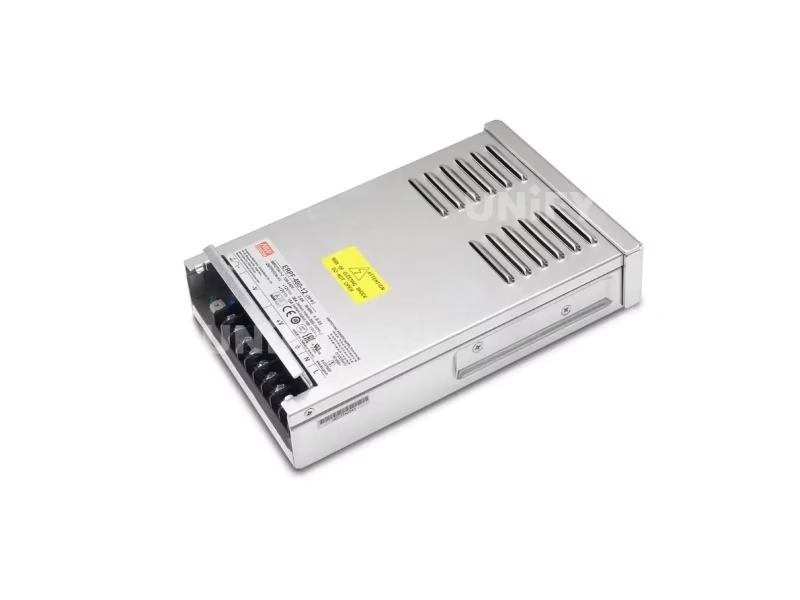
A Mean Well LED display power supply is the component that turns wall power into the low-voltage DC buses an LED screen actually runs on: it rectifies and regulates single-phase AC mains into 5 V (or 12 V and up) DC at tens of amps, feeding LED modules, receiving cards and hub boards inside each cabinet. Mean Well, founded in 1982 in Taiwan and listed on the Taipei Exchange, is one of the world’s largest standard switching power supply manufacturers, and its display-relevant lines ship into screen factories and rental fleets worldwide.
The fourteen models on this page divide by what the cabinet asks for. Standard 5 V screens climb the RSP ladder when the tender wants active PFC and a 90–264 VAC window, or the LRS chain when budget leads. Slim bays take the UHP line’s 26–31 mm fanless profiles with 300 VAC surge tolerance and two-unit redundancy. Corrosive or humid sites take the NEL-400’s conformal-coated 30 mm chassis. Each model has a full page on this site with datasheet-level specs; this hub holds the map, the math and the pricing.
What Are the Four Mean Well LED Display Power Supply Series?
Four lines cover the display lineup. Every spec below is signed to its official Mean Well datasheet — the model cards link to the full pages on this site.
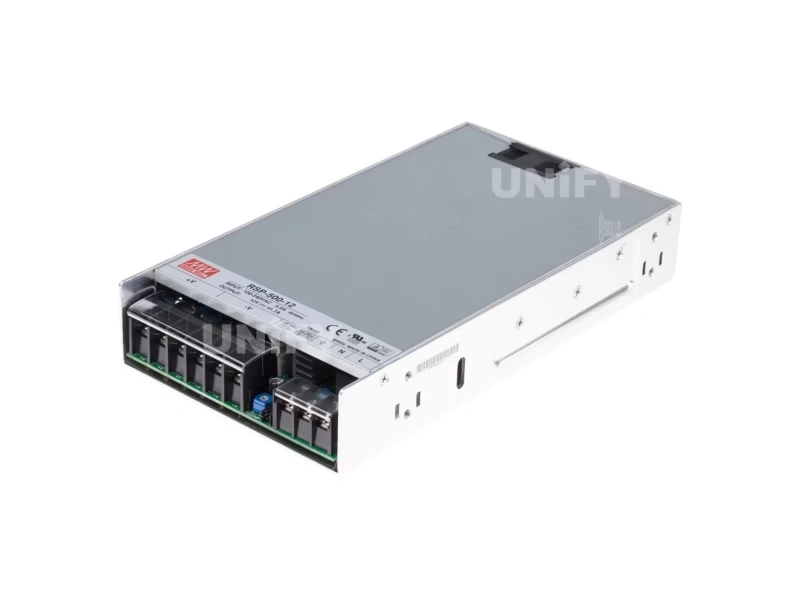
RSP · Universal-PFC Ladder
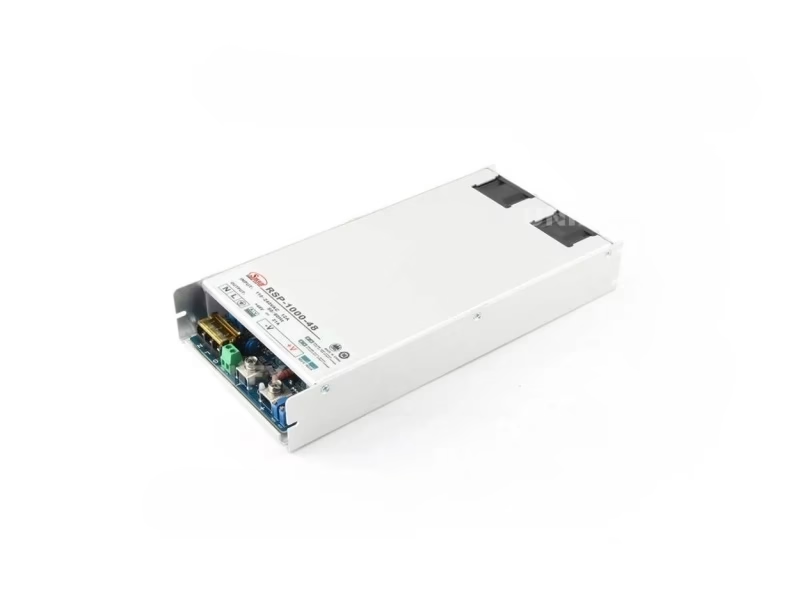
Five models, 90–264 VAC with active PFC: 5 V from 150 to 450 W plus the RSP-1000 kilowatt platform (12 V / 720 W up to 48 V / 1008 W) with four-unit parallel sharing and a 5-year warranty.
Best for: tender files, generator sites, global grids, high-power bays.
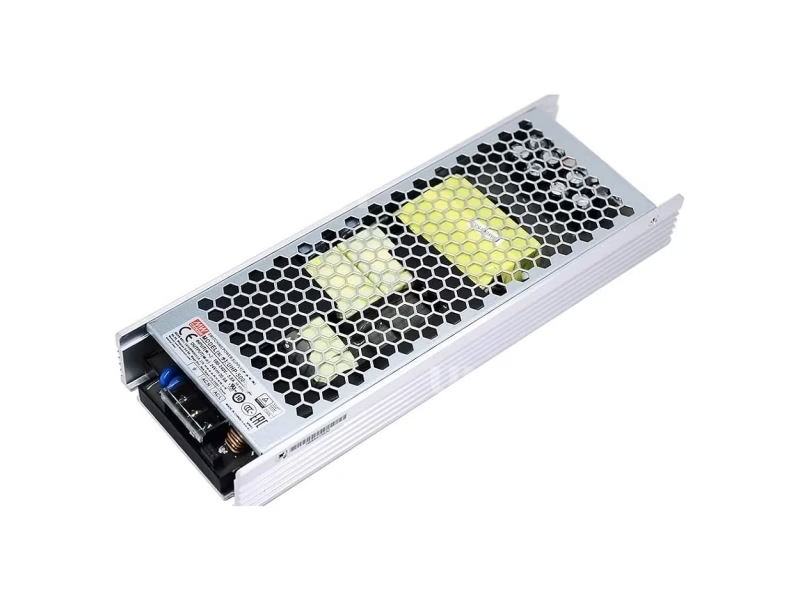
UHP · Ultra-Thin Slim Line
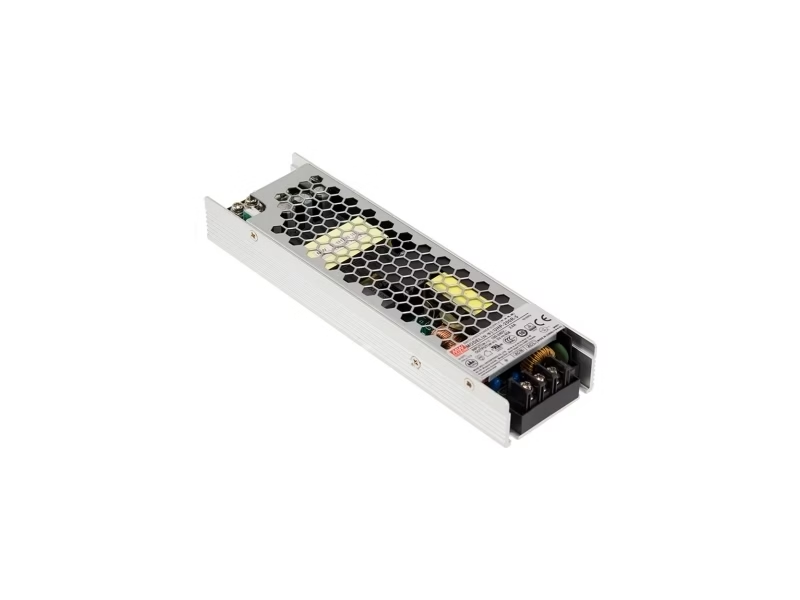
Three models in 26–31 mm fanless profiles: 5 V from 200 to 400 W with efficiency up to 95%, 300 VAC surge input for 5 seconds, and R-type builds that parallel two units for automatic takeover.
Best for: slim poster cabinets, silent installs, vibrating or unstable-grid sites.
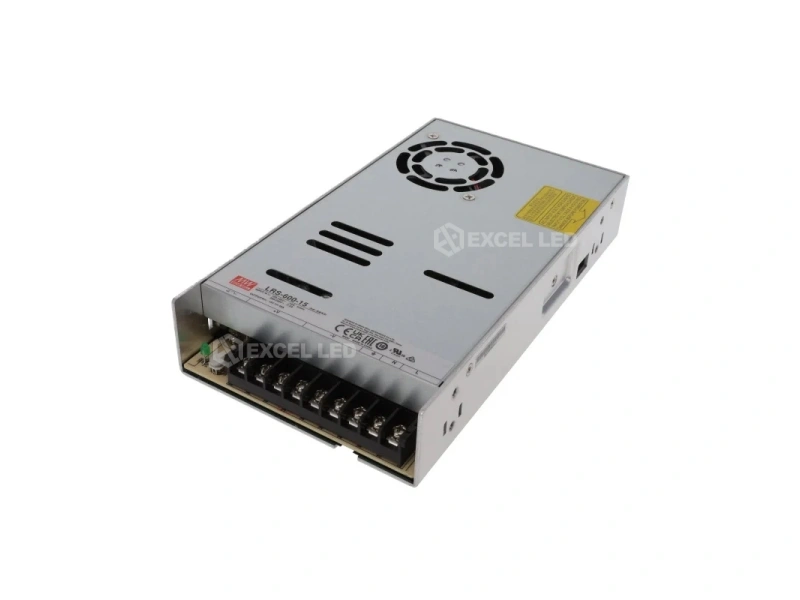
LRS · Economy Chain
Five models on the non-PFC economy line (Mean Well’s own catalogue wording): 5 V from 200 to 500 W on a dual-range 90–132 / 180–264 VAC input; the LRS-150 covers 12 V-and-up small rails at 85–132 / 170–264 VAC.
Best for: budget-led builds, cost-per-watt bidding, standard 110 V or 220 V grids.
NEL · Conformal-Coated Specialty
One model, one job: 5 V / 80 A / 400 W in a 30 mm narrow chassis with conformal coating as standard — the humidity and dust answer at 400 W. 2-year warranty.
Best for: coastal, humid and dusty installs that kill bare-PCB supplies.
| Model | Screen rail | Rails | Cooling / profile | Warranty | Signature |
|---|---|---|---|---|---|
| RSP-150 | 5 V / 30 A / 150 W | 9 (3.3–48 V) | Fanless, 199 × 99 × 30 mm | 3 years | PFC entry, 110 V-native |
| RSP-200 | 5 V / 40 A / 200 W | 12 (2.5–48 V) | Fanless, 215 × 115 × 30 mm | 3 years | Deepest rail menu |
| RSP-320 | 5 V / 60 A / 300 W | 12 (2.5–48 V) | Speed-controlled fan, 30 mm | 3 years | Dense indoor cabinets |
| RSP-500 | 5 V / 90 A / 450 W | 8 (3.3–48 V) | Fan, 230 × 127 × 40.5 mm | 3 years | Remote sense 0.3 V; 1.37M h MTBF |
| RSP-1000 | 12 V / 60 A / 720 W (→ 48 V / 1008 W) | 5 (12–48 V) | Twin fans, 295 × 127 × 41 mm | 5 years | Parallel 4000 W (3+1); DC OK |
| LRS-150 | 12 V / 12.5 A / 150 W (no 5 V rail) | 5 (12–48 V) | Fanless, 159 × 97 × 30 mm | 3 years | 110 V-native small rails |
| LRS-200 | 5 V / 40 A / 200 W | 12 (2.5–48 V) | Fanless, 215 × 115 × 30 mm | 3 years | Economy 200 W |
| LRS-350 | 5 V / 60 A / 300 W | 12 (2.5–48 V) | Fanless, 215 × 115 × 30 mm | 3 years | Economy 300 W |
| LRS-450 | 5 V / 75 A / 375 W | 7 (5–48 V) | 35 mm | 3 years | Economy 375 W |
| LRS-600 | 5 V / 100 A / 500 W | 7 (5–48 V) | Fanless, 225 × 124 × 41 mm | 3 years | Economy line top |
| NEL-400 | 5 V / 80 A / 400 W | Narrow series | 30 mm, conformal coating std. | 2 years | Humidity/dust answer |
| UHP-200 | 5 V / 40 A / 200 W | 9 (3.3–55 V) | Fanless, 26 mm | 3 years | 300 VAC surge 5 s; R-type 2-unit |
| UHP-350 | 5 V / 60 A / 300 W | 9 (3.3–55 V) | Fanless, 31 mm + 450 mm plate | 3 years | 1.79M h Telcordia MTBF |
| UHP-500 | 5 V / 80 A / 400 W | 8 (4.2–55 V) | Fanless, 31 mm + 450 mm plate | 3 years | Up to 95% efficiency; relay DC OK |
Which Mean Well LED Display Power Supply Fits Your Screen?
Match the supply to the cabinet in three questions: what rail does the module architecture demand, how much power does the cabinet actually draw, and what does the site punish you with (slim bays, heat, dust, weak grids). The quick table reads left to right:
| Your screen | Pick | Why |
|---|---|---|
| One small indoor cabinet, budget tender | RSP-150 or LRS-200 | 120–160 W usable budgets; PFC or economy by price. |
| Dense indoor wall | RSP-320 or LRS-350 | 60 A rails, 240 W usable; fan or fanless by noise budget. |
| Big wall, generator power, inspection file | RSP-500 | 90 A rail, PFC-clean grid behavior, 1.37M h dual-method MTBF. |
| 12 V-and-up module architectures, kilowatt bays | RSP-1000 | The only parallel-capable unit: four units toward 4000 W with a 5-year warranty. |
| Slim poster or thin-bezel cabinets | UHP-200 / UHP-350 / UHP-500 | 26–31 mm fanless, 300 VAC surge window, redundancy option. |
| Coastal, humid or dusty installs | NEL-400 | 80 A in 30 mm with conformal coating standard. |
Mixing is normal: one screen can run RSP-500 units on its power-hungry rows and UHP-200 units in the slim bays, as long as every bus carries one rail voltage. The economy and PFC lines can share a cabinet; what cannot mix is rail voltage per bus.
How Much Load Can Each Mean Well LED Display Power Supply Carry?
Every supply obeys the industry-standard 80% loading rule. Plan cabinets against these usable budgets and the fleet lasts:
| Model | Rated | Usable at 80% | Typical coverage |
|---|---|---|---|
| RSP-150 | 150 W / 30 A | 120 W / 24 A | One small indoor cabinet plus receiving card |
| RSP-200 / LRS-200 / UHP-200 | 200 W / 40 A | 160 W / 32 A | One 500 × 500 mm indoor cabinet (4 P2.5-class modules + card) |
| RSP-320 / LRS-350 / UHP-350 | 300 W / 60 A | 240 W / 48 A | A dense 500 × 1000 mm indoor cabinet |
| LRS-450 | 375 W / 75 A | 300 W / 60 A | Bright indoor or small outdoor groups |
| RSP-500 | 450 W / 90 A | 360 W / 72 A | Two indoor cabinets or one bright outdoor group |
| NEL-400 / UHP-500 | 400 W / 80 A | 320 W / 64 A | Fewest-supply designs; slim-bay flagship |
| LRS-600 | 500 W / 100 A | 400 W / 80 A | The biggest single 5 V bus on this page |
| RSP-1000 | 720–1008 W (12–48 V) | 576–806 W | 12 V module rows; four units parallel toward 4000 W |
Turn these budgets into module counts with the per-module draws in our LED display power consumption guide — average program material for indoor P2.5 sits near 10–15 W, outdoor P4.81 nearer 20–30 W, and receiving cards take 3–5 W apiece on the same rail. The per-cabinet count logic lives in how many power supplies an LED screen needs.
Which Input Grids Do Mean Well LED Display Power Supplies Cover?
Every line on this page accepts both major world grids — but they do it two different ways, and the difference matters for generator sites and long feeder runs:
| Line | Input window | Meaning |
|---|---|---|
| RSP (all five) | 90–264 VAC continuous + active PFC | One window for 110 V and 220 V grids alike, brownouts to 90 V (90% load on the RSP-1000), clean harmonics per EN 61000-3-2 |
| UHP (all three) | 90–264 VAC continuous + active PFC | Plus a 300 VAC / 5-second surge survival window — the widest tolerance on this page |
| NEL-400 | 90–264 VAC universal | Full-range input on the coated chassis |
| LRS (all five) | Dual range: 90–132 / 180–264 VAC (LRS-150: 85–132 / 170–264 VAC) | Covers 110 V and 220 V grids without PFC — the economy trade; nameplates read 100–240 V |
Generator and brownout sites: start at the PFC lines
A dual-range LRS needs the wiring variant matched to the grid before the harness is built, and it rides brownouts less gracefully than a continuous 90–264 VAC window. For rental fleets that move between grids and generator-fed sites, the RSP and UHP lines remove the whole question — and the UHP adds the 300 VAC surge window on top.
The 110 V story has a dedicated page: the RSP-150 is the site’s only 110 V-native supply page, and the LRS-150 carries the widest 110 V band (85–132 VAC) in the economy line.
Fanless, Fan-Cooled or Plate-Mounted: Which Cooling Fits Your Bay?
Fourteen models split into three cooling philosophies, and the choice decides what your power bay sounds like, collects, and asks of your cabinet walls:
Fanless convection (9 models)
RSP-150/200, LRS-150/200/350/600, NEL-400 and the whole UHP line: silent, no filter service, no dust path. The UHP units take it furthest — their heat exits through the base, which is why the 350 and 500 require the factory’s 450 × 450 mm aluminum plate.
Thermal fan control (2 models)
RSP-320’s speed-controlled fan and RSP-500’s forced-air cooling buy higher watt density in the same 30–40 mm classes — the dense-cabinet answer, with fan checks added to the service schedule.
Twin-fan kilowatt (1 model)
RSP-1000 moves 720–1008 W with two speed-controlled DC fans in 41 mm — kilowatt bays, 12 V module rows and parallel banks.
Where Do Remote Sense, DC OK and Parallel Functions Fit?
Beyond raw watts, four models add control features the rest of the catalog does not have — this is the map:
| Feature | Model | What it does |
|---|---|---|
| Remote ON/OFF + remote sense | RSP-500 | CN100 control: schedule blanking without touching mains; the +S/−S pair compensates up to 0.3 V of cable drop on long DC runs |
| Optocoupler DC OK + 2-unit redundancy | UHP-200R / UHP-350R | 15 Vdc / 10 mA status contact; two units on one bus, one fails and the other takes over (bus load ≤ one unit’s rating) |
| Relay DC OK + 2-unit redundancy | UHP-500R | 30 Vdc / 1 A relay contact — drives heavier alarm circuits or a contactor coil directly; R build by request |
| Active current sharing (4 units, 3+1) | RSP-1000 | The only true parallel bank: CS bus links four units toward 4000 W at rated × N × 0.9, with a DC OK open-collector for cabinet monitoring — and a 5-year warranty |
Everything else on this page — the economy LRS chain, the NEL-400, the base RSP models — carries no sharing feature and must not be paralleled; split the bus by cabinet instead.
Why Does Mean Well Dominate the LED Display Power Supply Market?
Because the range behaves like one engineering system stepped across four price-and-feature points. The pattern a screen builder actually experiences: one rail map (5 V from 30 A to 100 A, then 12 V-and-up to 1008 W), one mounting grammar (same flange styles, same terminal families, same 30–41 mm classes repeated across lines), and a paper trail that stays consistent — UL 62368-1 / TUV / CCC files, published MTBF figures, and warranty terms written on the datasheets rather than negotiated per batch.
The corporate base behind it: Mean Well was founded in 1982 in Taiwan and is one of the world’s largest standard switching power supply manufacturers, with the RSP/UHP/LRS/NEL display lines drawn from the same catalog as its industrial and LED-driver ranges. And the division of labor inside the family is deliberate: Mean Well’s own catalogue describes the LRS line as the non-PFC economy series — the company prices its own trade-offs, which makes the four-line map on this page honest to quote from.
How Does Mean Well Compare With CZCL and G-Energy at 200–500 W?
At the 5 V display point, three names share most bill-of-materials: Mean Well, CZCL and G-Energy. The honest comparison, model-for-model:
- Price position: street prices run G-Energy lowest, CZCL mid ($12–25 across its family), Mean Well premium — the UHP-200-5 sits near $36 against the CZCL A-200AC-5 at $12.50 (sources in the pricing section below).
- Input window: the RSP/UHP/NEL lines run 90–264 VAC continuous with active PFC (plus the UHP’s 300 VAC surge window); the CZCL display family starts at 176–190 VAC with no 110 V option — for 110 V grids and generator sites the Mean Well window wins outright.
- Reliability paper: published dual-method MTBF goes to 1.79M hours (UHP-350) — figures the CZCL display family does not publish at that level.
- Redundancy: the UHP R-builds parallel two units automatically and the RSP-1000 four units (3+1); the CZCL and G-Energy base display units do not current-share.
- Price-per-feature flip side: CZCL counters with a dual-rail common-cathode unit (B-200AF) and the lowest street prices; G-Energy counters with LED-screen-native models at aggressive pricing — both are real options when budget leads and the grid is a stable 220 V.
Full family detail on the competitors: the CZCL LED display power supply hub carries its four series with datasheet-level specs, and the G-Energy catalog follows the same treatment.
How Much Does a Mean Well LED Display Power Supply Cost?
Observed authorized-distributor pricing, signed to source; project and volume tiers step down from these singles:
| Model | Street price | Source |
|---|---|---|
| RSP-500-5 | $94.60 (single unit) | Mouser, observed September 2026 |
| UHP-200-5 | ~$36 | Observed September 2026 (per our CZCL comparison table) |
| LRS chain / NEL-400 / RSP-1000 | Quote-based — volume pricing dominates these lines | Project channel |
Sample · 1–10 pcs
Repairs, prototypes, trial cabinets — shipped from distributor stock with the nameplate batch visible.
Project · 10–500 pcs
Whole-screen quantities with per-cabinet load math and certificate copies for the inspection file.
Volume · 500+ pcs
Production-line pricing with container freight planning and batch date-code consistency.
Which Applications Use Mean Well LED Display Power Supplies?
Four scenarios cover most of the family’s deployment map — each links to a screen build where the same math applies:
Indoor fixed walls
RSP-320 and LRS-350 density math per cabinet, silent fanless options for lobbies, churches and conference rooms.
Rental and staging fleets
The 90–264 VAC window ends the grid question between venues; hiccup-recovery models blink through transient overloads mid-show.
Outdoor billboards
RSP-500 and LRS-600 concentrate cabinets per supply; the RSP-1000 feeds 12 V module rows and parallel banks at kilowatt scale.
Slim, coated and redundant builds
UHP profiles disappear into 26–31 mm bays; the NEL-400 answers humidity; the R-builds add automatic failover.
How Do You Install and Wire Mean Well LED Display Power Supplies Safely?
The family shares one installation discipline, with two per-line twists. Common to all fourteen: mount on the flanges with the datasheet’s screw specification, bond FG to cabinet earth, meter polarity before the first power-up, and size every unit to the 80% budget.
1 · Match the input style before the harness is built
PFC lines (RSP/UHP/NEL) take 90–264 VAC as one window; the LRS dual-range needs the 110 V or 220 V variant matched to the grid. Catching that at survey stage is free; catching it at commissioning is not.
2 · Build the thermal path the datasheet demands
Fanless units conduct into the mounting surface — the UHP-350 and UHP-500 require the 450 × 450 × 3 mm aluminum plate, smooth or greased, unit centered. Fan-cooled units (RSP-320/500/1000) need airflow across the fans instead.
3 · Wire AC, earth, then DC — and meter before power
Follow each page’s terminal map and torque figures; set the rail with +V ADJ at the load end under full load, then confirm every cabinet matches within a few tenths.
4 · Load-test, then log the fleet
Full white for ten minutes, rail voltage verified at the bus far end, serials and date codes onto the cabinet map — the map wins future warranty conversations.
When a unit does fail, the LED display power supply diagnostics and replacement guide carries the full test-and-swap workflow.
What Problems Do Failing LED Power Supplies Cause?
Power trouble wears disguises — three signatures cover most field calls across this family:
Dim or uneven brightness, one cabinet
Aging capacitors sag the rail under load; the cabinet corner looks tired at full white while neighbors shine.
Flicker on camera or under load spikes
Frame-by-frame rail dips track bright content — suspect the supply before the module.
Cabinet reboots or dead sections
Hiccup cycling reads as “random” dead cabinets; a latched OVP reads as dead-until-repower. Measure the rail during the dropout.
Mean Well LED Display Power Supply: Frequently Asked Questions
Who makes Mean Well LED display power supplies?
Mean Well, founded in 1982 in Taiwan and listed on the Taipei Exchange — one of the world’s largest standard switching power supply manufacturers. The display-relevant lines documented on this page are RSP, UHP, LRS and NEL, fourteen models in total.
Which Mean Well supply should I use for a standard 5 V LED screen?
Match the cabinet’s 80% budget: RSP-150 (120 W usable) for a small cabinet, RSP-200/LRS-200/UHP-200 (160 W) for one typical indoor cabinet, RSP-320/LRS-350/UHP-350 (240 W) for dense builds, RSP-500 (360 W) for the fewest-supply designs, LRS-600 (400 W) for the biggest single bus.
What is the difference between the RSP and LRS lines?
The input stage. The RSP runs 90–264 VAC continuous with active PFC and EN 61000-3-2 harmonic compliance; the LRS is the non-PFC economy line (Mean Well’s own catalogue wording) on a dual-range 90–132 / 180–264 VAC input. Same rail voltages, different grids and price.
Can I run these supplies on 110 V in the US?
Yes. The RSP, UHP and NEL lines carry full rated load across 110–120 V grids on their 90–264 VAC windows, and the LRS dual-range covers 110 V with its 90–132 VAC segment. The RSP-150 is the site’s dedicated 110 V-native page.
Can I parallel two Mean Well supplies for more power?
Only three builds share load: the RSP-1000 links up to four units through its active current-sharing bus (max current = rated × units × 0.9, 3+1 for a hot spare), and the UHP-200R/350R/500R builds parallel two units with automatic takeover. Everything else on this page has no sharing feature and must not be paralleled.
Which model has the best reliability rating?
The UHP-350 publishes the highest MTBF on this page: 1,791,200 hours minimum by Telcordia SR-332 plus 253,400 hours by MIL-HDBK-217F. The RSP-500 follows at 1,372,400 hours Telcordia plus 187,900 hours MIL.
Which model is the slimmest, and what does it ask in return?
The UHP-200 at 26 mm, with the UHP-350 and UHP-500 at 31 mm. The trade: the 350 and 500 require the factory’s 450 × 450 mm, 3 mm aluminum plate under the chassis — without it their derating curves collapse in a hot cabinet.
What warranties does the family carry?
Five years on the RSP-1000, three years across most of the RSP, UHP and LRS lines, and two years on the NEL-400. The terms are written on each datasheet — confirm the exact term for your batch at order time.
Do Mean Well supplies work with Novastar or Colorlight receiving cards?
Yes — receiving cards ride the same 5 V rail as the modules at roughly 3–5 W each, which is why a single 5 V supply covers a cabinet’s modules and card together. The control-side catalog lives in our LED screen display control system guide.
CZCL, G-Energy or Mean Well for my screen?
Budget-led builds on a stable 220 V grid have real options in the CZCL and G-Energy lines. Mean Well wins the 110 V and generator-grid question (90–264 VAC + PFC + the UHP surge window), the reliability paper (1.79M h Telcordia) and the redundancy options — and the premium reflects it. The CZCL hub carries the competitor family in full.
Quote the Mean Well Power Chain With the Load Math Done
Tell us the screen, the modules and the site; we return the model mix, per-cabinet budgets and a matched quote from a LED screen manufacturer that ships worldwide.
📱 / WhatsApp: +86-191-18802497 · Shenzhen, China · GMT+8
Related LED Display Power Resources
LED Display Power Supply (Mother Catalog)
The three-brand mother catalog: 27 model pages, 2026 price bands, architecture map and the 80% load math — start here.
LED Display Power Consumption
Screen-level power math: module draw, brightness settings, breaker sizing and cable gauges.
Power Supply Diagnostics & Replacement
Test a suspect supply, swap it inside a live screen, and root-cause repeat failures.
CZCL LED Display Power Supply
The competitor family in full: four CZCL series with datasheet-level specs and the dual-rail common-cathode unit.
LED Screen Display Control System
The control-side catalog that rides on these 5 V rails: sending cards, receiving cards, processors.