Colorlight vs Novastar LED Control System: Which One Should You Choose?
Published: August 2026 | 15 min read | UnifyLED Engineering Team
The Colorlight vs Novastar LED control system decision is the first one every LED project makes after choosing the panels — and the one most buyers answer on brand loyalty instead of data. The two companies together control roughly three-quarters of the third-party LED controller market, and their catalogs overlap tier by tier: two-port sending controllers, 13-megapixel processors, five different receiving cards. This guide compares them the way an integrator actually buys: tier by tier, with figures traced to official specification documents, and with the popular marketing claims flagged where no document supports them.
Short answer: Novastar and Colorlight both build complete LED control systems — sending controllers, receiving cards and software — and you cannot mix the two in one signal chain. Colorlight costs less across most tiers, with official-document figures you can verify yourself; Novastar leads in broadcast pedigree, global support footprint and multi-sender synchronization tools. Choose Colorlight for retail, mid-size commercial and budget-driven rental; choose Novastar for broadcast OB, large sports venues and XR stages where camera-facing reliability is the product.
- Quick fact — ecosystem rule: Colorlight senders drive Colorlight receiving cards; Novastar senders drive Novastar cards; mixing the two is unsupported by both vendors.
- Quick fact — verified prices: Colorlight receiving cards from $10, entry controllers from $145, flagship processors from $1,500.
- Quick fact — market structure: third-party controllers hold 84.5% of global LED controller market value, and the two brands command roughly three-quarters of that segment (Futuresource Consulting).
- Quick fact — the five questions: downtime tolerance, camera exposure, module density, HDR requirements, multi-sender scale — answer them and the choice makes itself.
What Is the Difference Between Colorlight and Novastar LED Control Systems?
Novastar is the broadcast-grade benchmark: the vendor stadiums, OB vans and XR studios specify when the wall will be on camera and the contract cannot tolerate visible failure. Colorlight is the value-and-usability alternative: official-document features at lower street prices, with software a non-technical operator learns in an afternoon. Neither is “better” in isolation — the question is which one matches the project’s downtime tolerance and camera exposure.
The market structure behind both: third-party controllers hold 84.5% of global LED controller market value, and Novastar and Colorlight together command roughly three-quarters of that third-party segment (Futuresource Consulting, LED video wall controller market data). Colorlight is also the first publicly listed company in the LED control system industry. Both facts matter for procurement: this is a duopoly with deep parts availability and long-term firmware support on both sides — the ecosystem you pick will still exist in five years.
The one rule that overrides everything else: you cannot mix the two ecosystems in one signal chain. Colorlight senders drive Colorlight receiving cards; Novastar senders drive Novastar cards; the protocols are proprietary and mixing is unsupported by both vendors. The receiving card choice follows the sending controller — which makes the comparison below a chain decision, not a component decision. For the fundamentals behind the two architectures, see synchronous vs asynchronous LED control.
Colorlight’s official introduction, with the company’s positioning in its own words:
Colorlight Official — Colorlight Introduction Video, the first listed company in the LED control system industry
How Do Colorlight vs Novastar LED Control Systems Compare Tier by Tier on Sending Controllers?
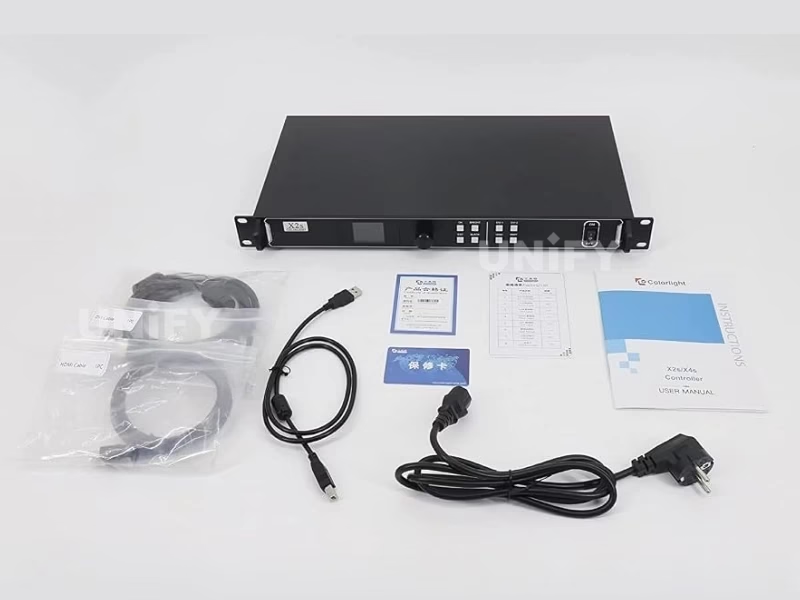
Both catalogs ladder from two-port entry units to multi-megapixel processors. The Colorlight side below uses figures from the official user manuals and specifications we verified for each model; the Novastar side uses each model’s published class. Three tiers matter for most projects:
Three patterns emerge from the official documents. First, Colorlight publishes complete loading figures per model — the X2’s 1.3M, the X4’s 2.3M, the X8m’s 5.24M and the Z6 PRO-G2’s 13.1M are all named in the manuals, which makes tier matching straightforward. Second, the Colorlight flagships carry features the mid-tier does not: the X16’s Genlock loop and HDCP 2.2, the Z6 PRO-G2’s HDR and cinematic color tools. Third, Novastar’s differentiation concentrates at the top — V-Can multi-sender synchronization and fiber infrastructure — which is why the Novastar premium is easiest to justify on multi-controller broadcast projects, not on single-wall installs.
Colorlight’s official processor-series overview:
Colorlight Official — ISLE 2025 Professional Processor Series video
How Do the Receiving Cards of Colorlight vs Novastar LED Control Systems Compare?
The receiving card is the most numerous component in the chain — one per module cluster — so per-card differences compound across a wall. The Colorlight line now spans five cards with five distinct jobs, all with official-document figures:
On the Novastar side, the mirror decision runs through the MRV412 and DH series, documented in the Novastar receiving card selection guide. The honest summary: both lines cover the same jobs — high refresh, monitoring, backup — and the deciding factor is almost never a card-level spec. It is the ecosystem rule again: the cards follow the sender.
Colorlight’s official high-end receiving card showcase:
Colorlight Official — ISLE 2026 High-End Receiving Cards video
Which Colorlight vs Novastar LED Control System Spec Claims Should You Verify?
Comparison articles on this topic repeat the same numbers, and most of them cite nothing. In August 2026, we checked the popular claims against the official specification documents we hold for the Colorlight side:
- “480Hz vs 240Hz.” The 480Hz figure circulates as Novastar’s MX2000 Pro peak and 240Hz as Colorlight’s — neither appears with a scan-mode condition. Colorlight’s own documents state refresh per scan mode (for example, 16,000Hz on static 64×64 modules for the i5A-905). Any refresh claim without the scan mode attached is marketing, not specification.
- “20-bit vs 16-bit grayscale.” Bit-depth claims in LED marketing are usually processing-depth claims, not measured visible output depth. The official receiving card documents name gray levels (65,536) and calibration accuracy (14-bit) — those are the verifiable figures.
- “Colorlight costs 20–35% less.” No dated price survey supports this. Our own verified price bands: receiving cards $10–$18 (i5A-905) and $37–$55 (i5A-F); controllers $145–$350 (X2), $324–$380 (X4), $612–$755 (X8m), $1,500–$1,700 (X16). Compare those against a dated Novastar quote, not against a percentage pulled from an article.
- “Latency degrades above 10 million pixels.” One article states this from field experience with no data. The verifiable figures are the documents’ own: sub-frame latency claims exist on both flagships, and each model’s condition should be read from its specification.
The verification habit that works for both brands: ask the supplier to state the specification revision — every claim we publish on the Colorlight side traces to a named document version (X2 User Manual V1.0, X4 Specification V1.2, X8m Specification V1.0, X16 User Manual, Z6 PRO-G2 Specification V1.4, i5A-905 V1.2, i6 V1.2, i9 V1.4.1, i9+ V4.2.2). A quote that cannot name its revision is quoting a listing, not a product.
How Do Colorlight vs Novastar LED Control System Software Tools Compare for Daily Operation?
The software comparison splits into two questions: commissioning depth and daily operation. On the Colorlight side, LEDVISION handles playback, configuration and mapping; VideoStation adds browser-based management over LAN; ColorAdept covers the calibration and color workflow; iSet serves the older receiving card line. The pattern across all four is the same: graphical interfaces built for non-technical operators, with the trade-off of fewer integrator-level power tools. See control system software and hardware functions for the full layer breakdown.
On the Novastar side, NovaLCT and SmartLCT handle calibration and configuration, V-Can handles multi-sender frame synchronization and centralized firmware pushes for large integrators, and VNNOX adds cloud monitoring. The learning curve is steeper, and the multi-sender tools are where Novastar’s broadcast advantage concentrates — a 20-sender curved wall is a V-Can project, and Colorlight has no direct equivalent at that scale.
The practical framing: if the wall will be operated by staff who are not control-system engineers — a church, a retail chain, a hotel — the LEDVISION side wins on training cost. If the project is a multi-sender broadcast installation managed by a systems integrator, the NovaLCT/V-Can side wins on control depth. The software choice follows the same decision as the hardware.
Colorlight’s official software overview:
Colorlight Official — ISLE 2025 LEDVISION and VideoStation video
Colorlight Official — ISLE 2025 ColorAdept LED Control Software video
When Should You Choose the Colorlight LED Control System Over Novastar?
Choose Colorlight when the project rewards price, setup speed and operator simplicity — and the official figures support the choice in four scenarios:
- Retail chains and DOOH networks. The X2 at $145–$350 per unit covers 1.3M pixels with five inputs — the standard shopfront wall — and the front-panel keys mean a store manager can run it without a laptop.
- Mid-size commercial and conference walls. The X4 drives a complete 1080p wall from one 2.3M-pixel unit — the tier where one controller replaces a cascaded pair.
- Budget-driven rental. The X series price bands, the SODIMM tool-free receiving cards and the i5A-F’s never-goes-black dual mode cover the touring operator’s three concerns: acquisition cost, swap speed and downtime.
- Unattended and advertising walls. The i5A-F‘s 2Gbit fallback keeps content on the wall through signal failures — the uptime feature advertising contracts are written around.
When Should You Choose the Novastar LED Control System Over Colorlight?
Choose Novastar when the wall is on camera or the system spans many senders — the scenarios where its broadcast pedigree and integrator tooling pay for the premium:
- Broadcast OB and live sports. Genlock, sub-frame latency and fiber infrastructure are the table stakes, and the Novastar ecosystem’s documentation depth in this segment is the industry reference. The MCTRL300 and VX16s pages document the class.
- Multi-sender installations. V-Can frame synchronization across dozens of senders has no Colorlight equivalent at the same scale — curved command-center walls and arena scoreboards are Novastar territory.
- XR virtual production stages. The NovaPro UHD Jr tier and its camera-sync tooling are the incumbent choice, though the Z6 PRO-G2‘s Frame Multiplexing and 3D-LUT now compete directly on the Colorlight side.
- Global support requirements. If the project spans regions where the integrator needs local Novastar branch support, the support footprint itself is a selection criterion.
How Much Do Colorlight vs Novastar LED Control Systems Cost in 2026?
Verified price bands from our August 2026 listing research, stated with their source type:
Two honest caveats. First, several Colorlight models — the i6, i9 and i9+ — have no reliable public street price in the listings we reviewed, and we do not quote numbers we cannot verify; those are factory-quote items. Second, the “20–35% cheaper” figure circulating in comparison articles is unverified — the verified bands above are the numbers to budget with. The market context that keeps both brands’ pricing competitive: the LED display control system market reached US$659 million in 2025, projected at 13.6% CAGR to US$1.59 billion by 2032 (QYResearch, Global LED Display Control System Market Report).
How Do You Decide Between Colorlight vs Novastar LED Control Systems: The Five-Question Framework
Run the project through five questions in order, and the ecosystem choice falls out with the model choice:
- Downtime tolerance. Never-black mandates the i5A-F’s dual mode on the Colorlight side — or the equivalent redundancy stack on the Novastar side.
- Camera exposure. Broadcast-camera walls need the high-refresh and sync features; check the scan-mode-conditioned refresh figures on both sides.
- Module density. Data-group counts pick the receiving card tier — 16, 32 or 64+ groups.
- HDR and production features. HDR10/HLG, SHUTTERLOCK or 3D narrow the field to the flagship tiers on either side.
- Multi-sender scale. Dozens of senders with frame sync pushes toward Novastar’s V-Can; single-controller walls keep both options open.
The framework works because the ecosystem rule is binary: once the sender is chosen, the receiving cards follow, and the software follows the cards. Pick the chain, not the components. Colorlight’s cabinet-level integration depth, from the official 2025 launch:
Colorlight Official — 2025 Product Launch High-end Cabinet Control Solutions video
What Questions Do Buyers Ask About Colorlight vs Novastar LED Control Systems?
Conclusion: Colorlight vs Novastar — Which LED Control System Should You Choose?
The Colorlight vs Novastar decision is a chain decision, and the data points to a clean split: Novastar owns the camera-facing, multi-sender, broadcast-grade projects where the premium buys synchronization depth and support footprint; Colorlight owns the retail, commercial and budget-driven tiers where official-document features, verified price bands and operator-friendly software win the bid. Neither brand is the wrong answer — mixing them is. Pick the ecosystem your receiving cards, technicians and spares already speak, verify every spec against a named document revision, and buy the chain from a verified LED screen manufacturer that tests hardware on live modules and commissions the full chain against your actual wall.