
NovaStar VX16s — The Complete B2B Buyer’s Guide
Published July 2026 · UnifyLED Engineering Team · 14 min read
1. Why the VX16s Matters — 10.4M Pixels in a Single 2U Box
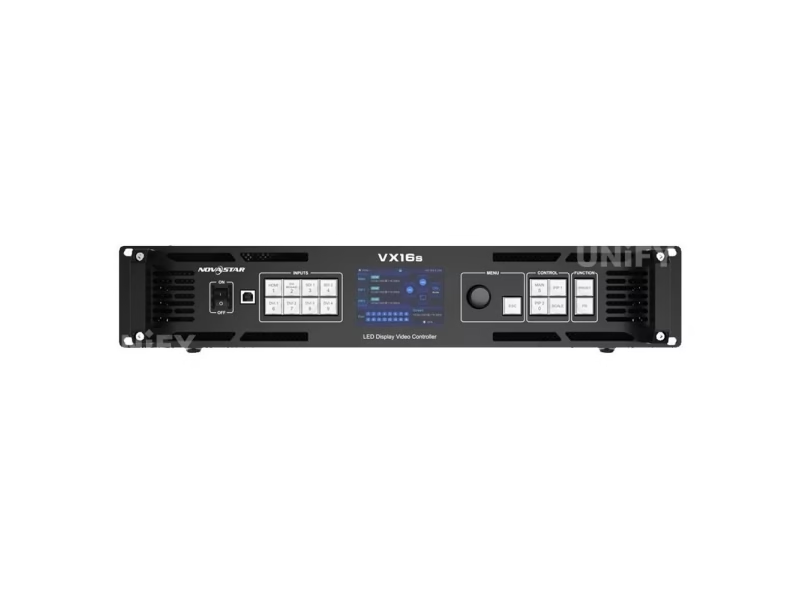
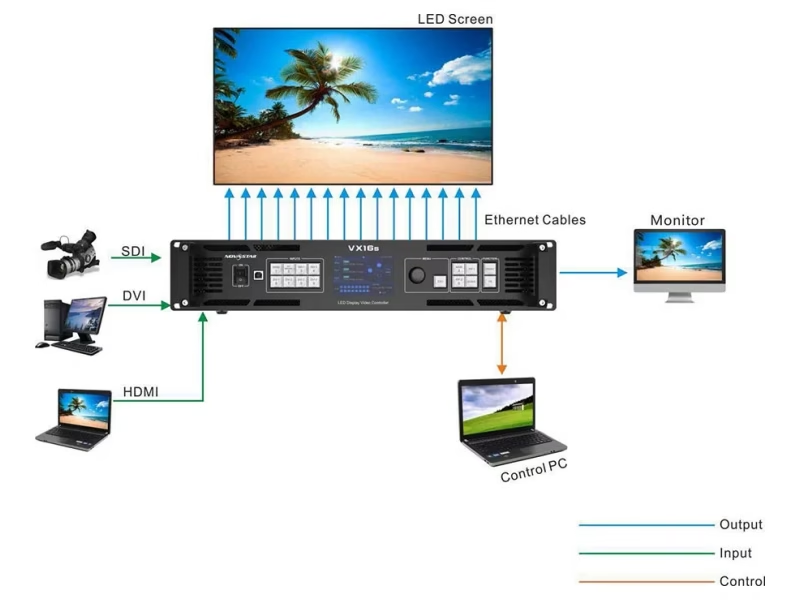
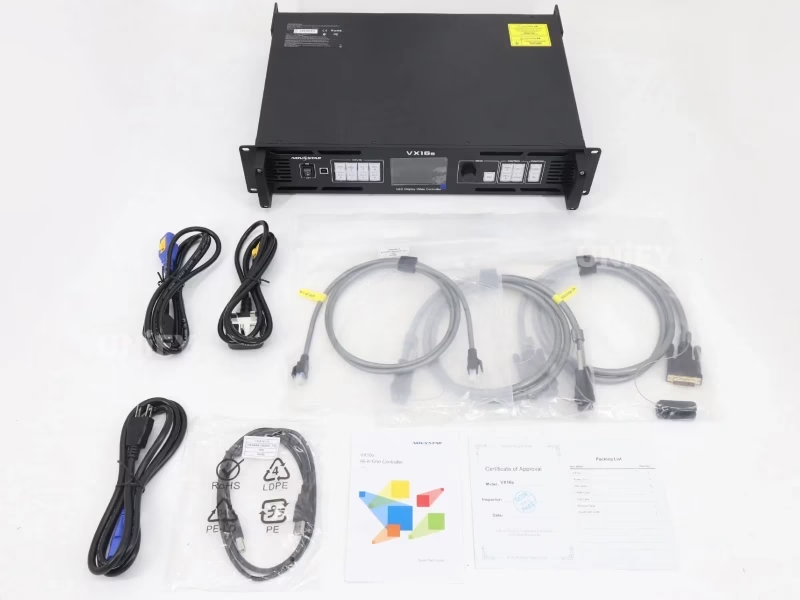
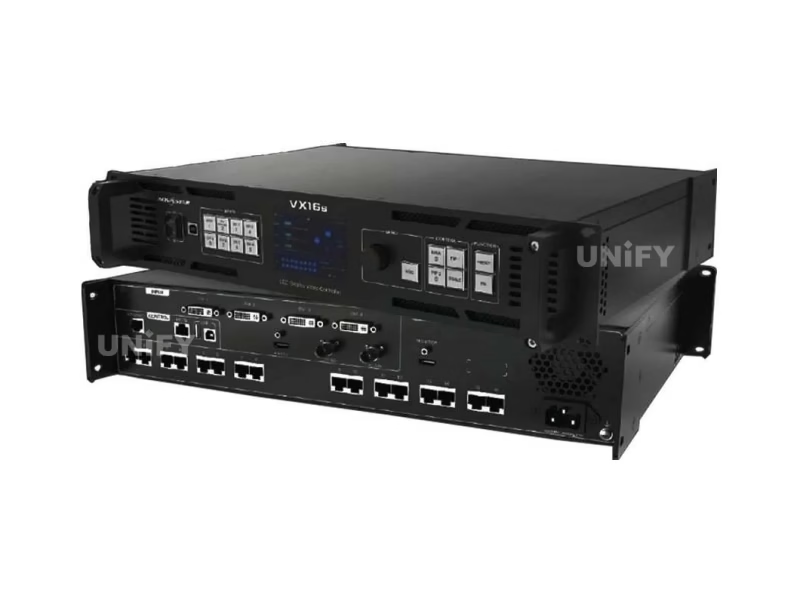
The NovaStar VX16s All-in-One LED Display Controller represents the high end of NovaStar’s VX all-in-one family. With 10,400,000 pixels of capacity — more than any other VX-series controller — it is purpose-built for large-format LED walls where a single-device control architecture simplifies deployment and reduces failure points. Unlike the three-box approach of external scaler + sending card + configuration hardware, one VX16s does all three. For a stage LED display driving an 8K-wide backdrop, that is 16 Ethernet cables from one device instead of coordinating outputs across multiple sending cards.
2. Three-Layer Architecture — What You Can Actually Do With It
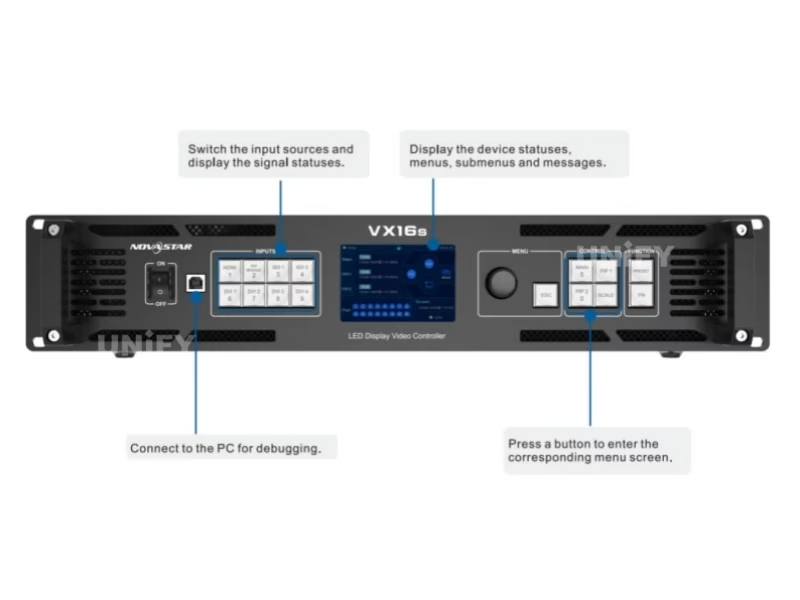
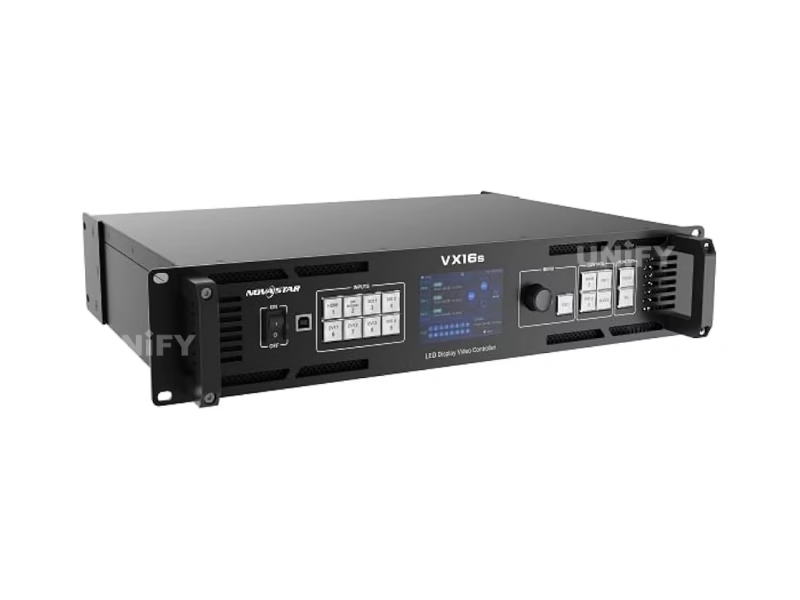
The VX16s layer system is not a simple PIP overlay. The main layer accepts HDMI 2.0 at up to 3840×2160@60Hz or a DVI Mosaic source (4 DVI inputs combined). The two PIP layers each accept up to 2K×1K resolution. Each layer has independent: input source assignment, horizontal/vertical dimensions (up to 32,768 pixels each), X/Y position on screen, input crop (64 px to full input resolution), and priority (1 = back, 3 = front). The TAKE button on the front panel swaps main/PIP assignments during live operation. For conference LED display solutions, this means slides + speaker close-up + countdown timer — all independently controllable.
3. Input Architecture — HDMI 2.0, SDI, and DVI Working Together
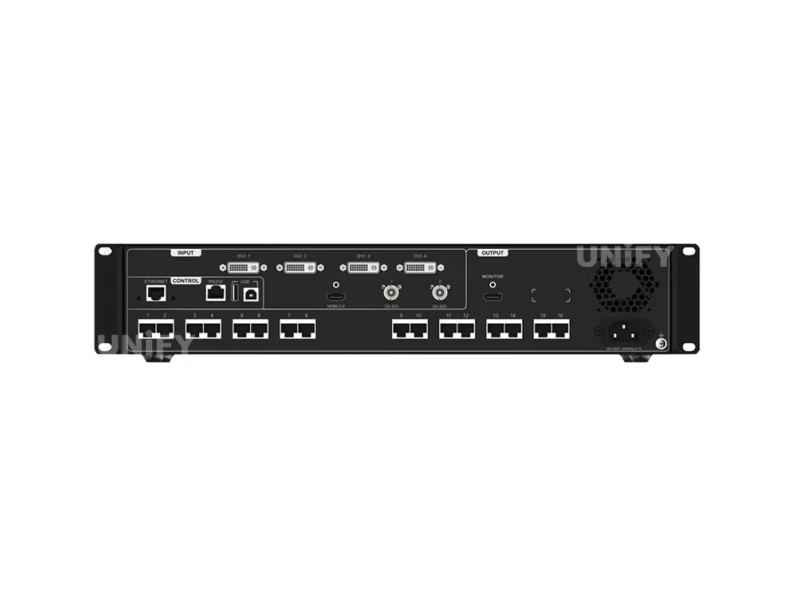
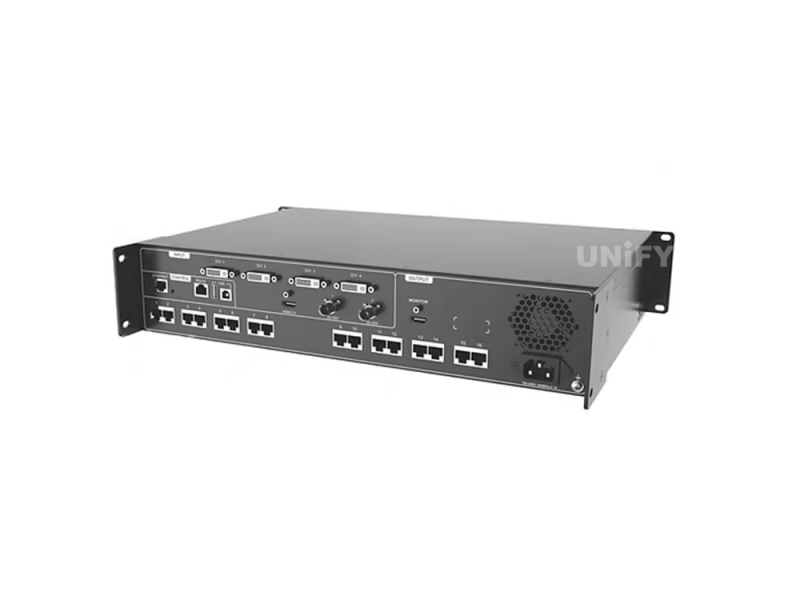
The HDMI 2.0 port is the primary 4K input, accepting 3840×2160@60Hz with HDCP 2.2 and EDID 1.4. The two 3G-SDI ports (BNC) accept up to 1920×1080@60Hz with hardware deinterlacing — plug in broadcast cameras directly without external converters. The four DVI ports serve dual roles: individually as standard 1920×1200@60Hz inputs, or combined via DVI Mosaic into a single ultra-wide source. An important constraint: HDMI and DVI Mosaic sources can only feed the main layer. PIP layers must use SDI or individual DVI sources.
4. Output Capacity — 16 Ports, 650K Pixels Each
Sixteen Neutrik Gigabit Ethernet ports each carry up to 650,000 pixels — identical to the per-port capacity of the NovaPro UHD Jr and MCTRL4K. The total 10.4M-pixel budget is distributed across ports based on your cabinet topology. For a 3840×2160 screen (8.3MP): 13 ports are consumed, leaving 3 ports unused — a 23% headroom that accommodates irregular cabinet layouts. The MONITOR HDMI output (1920×1080@60Hz) provides a real-time confidence feed, switchable between preview and program.
5. Device Backup Mode — How It Actually Works
Device backup mode on the VX16s is a hot-standby architecture, not a cold failover. Both the primary and backup VX16s units receive the same input signals and process identical frame data. The backup unit monitors the primary via the Ethernet control network. If the primary loses signal or any Ethernet port fails, the backup takes over — the screen does not flash, blank, or glitch. This is fundamentally different from Ethernet-level redundancy (which protects against cable failure but not controller failure). For broadcast, live events, and 24/7 control rooms, device-level backup is operational insurance that Ethernet redundancy alone cannot provide.
6. Image Mosaic — When One VX16s Is Not Enough
Up to 4 VX16s units can be cascaded via USB (Type-B output → Type-A input) for screens exceeding 10.4M pixels. Example: a 7680×4320 (33.2MP) LED wall requires 4 VX16s units, each loading 1920×4320 pixels. Configure via the Image Mosaic menu: set total pixel count, rows/columns, and each unit’s load area. Important: each unit requires its own input source. Use an external DA (distribution amplifier) if all units need identical content.
7. Frame Rate Flexibility — 23.98Hz to 120Hz
The VX16s supports an unusually wide range of output frame rates: 23.98, 24, 25, 29.97, 30, 47.95, 48, 50, 56, 59.94, 60, 70, 71.93, 72, 75, 85, 100, 119.88, and 120 Hz. This matters for three use cases: film content (23.98Hz avoids 3:2 pulldown judder), PAL broadcast (50Hz native), and high-refresh installations (100–120Hz for sports venues and esports). The 3D mode (with EMT200 emitter) halves loading capacity while active but supports frame-sequential 3D at up to 60Hz per eye. See LED display refresh rate for refresh-vs-fps distinction.
8. V-Can Software — Beyond the Front Panel
While the VX16s front panel provides complete standalone operation, V-Can software unlocks the full workflow: drag-and-drop layer positioning, visual preset management, test pattern generation, and multi-unit image mosaic configuration from a single PC. V-Can (V3.8.0) is available for Windows and macOS. NovaLCT handles the engineering layer: receiving card configuration, rcfgx management, firmware updates, and calibration. The VX16s communicates via Ethernet (TCP/IP) or USB Type-B.
9. Total Cost of Ownership — 5-Year Analysis
Separate Components: 4K video scaler ($800–$2,000) + 16-port sending card solution ($500–$1,200) + configuration hardware + extra rack space = $1,300–$3,200 hardware cost, plus the operational complexity of 2–3 separate devices.
VX16s: Single device at $2,717 (market reference). 5-year electricity at 70W × 8h/day × $0.12/kWh ≈ $123. The integrated approach eliminates inter-device cabling, reduces rack space (2U vs. 3–5U for separate components), and provides a single point of configuration, firmware management, and vendor support. With LED display lifespan of 100,000 hours, controller reliability over the deployment lifetime is a primary procurement consideration.
10. Sourcing Strategy — Factory Direct vs. Distributor
B2B buyers face a genuine choice: regional distributor (local stock, local warranty, $2,717–$3,799) vs. factory-direct from a LED screen manufacturer that is also a NovaStar partner (15–30% lower, pre-shipment configuration, integrated ecosystem support). Key evaluation questions: Does the supplier test each VX16s with a live LED screen before shipping? Can they provide the complete system — cabinets + controller + receiving cards — pre-configured? Do they offer technical support in your time zone? Our quality control process documentation details our procedures — we encourage direct comparison.
11. Conclusion — Is the VX16s Right for Your Project?
The NovaStar VX16s All-in-One LED Display Controller is the highest-capacity all-in-one controller in NovaStar’s VX series, positioned for large-format LED walls that need 4K processing, three independent layers, and 10.4M-pixel headroom — without the cost and complexity of a flagship NovaPro UHD. For B2B buyers deploying LED screens above 4MP where layer compositing and device-level backup matter, the VX16s offers a compelling single-box solution. When evaluating, move beyond the spec sheet: ask about pre-shipment testing, configuration support, and what happens when something fails at 2 AM during a live show. At UnifyLED, we answer these questions with verifiable data.