
Fine-Pitch Indoor · Flexible & Creative Shapes
P1.25 Indoor Flexible LED Display Collection
A P1.25 indoor flexible LED display wraps 640,000 pixels per square meter around columns, waves and full-circle builds. A 0.2mm flexible PCB bends where rigid cabinets cannot, the silicone base shell keeps curved splicing flat, and strong magnets make every module front-serviceable.
Definition
What Is a P1.25 Indoor Flexible LED Display?
Short answer: A P1.25 indoor flexible LED display is a soft-module video wall built on 0.2mm flexible PCBs with silicone base shells. Each 320×160mm module carries 256×128 pixels — 32,768 dots, 640,000 per square meter — bends concave or convex around columns and waves, and mounts on strong magnets for full front service. It is the pitch to specify when viewers stand closer than about 2m and the surface is not flat.
A P1.25 indoor flexible LED display spaces its LEDs 1.25mm apart — 800 pixels to the metre — on a flexible printed circuit roughly 0.2mm thick instead of a rigid fiberglass board. A high-precision silicone base shell replaces the hard plastic buckling behind every module, SMD1010 lamps sit face-up in the soft mask, and 96 Chipone (ICND series) driver ICs scan the 320×160mm matrix 1/32 to a 3840Hz refresh. Bend, roll or wrap: the module follows the structure, not the other way round.
The pitch buys close-range fidelity that flat walls at coarser spacing cannot hold — pricing runs roughly 20–40% above a rigid module of the same pitch, the premium you pay for the flexible PCB and the silicone masking. If your surface is flat and viewers sit beyond 3m, a P1.953 indoor rental LED display delivers the family’s lowest cost per square meter instead. The pixel pitch guide walks the full trade-off.
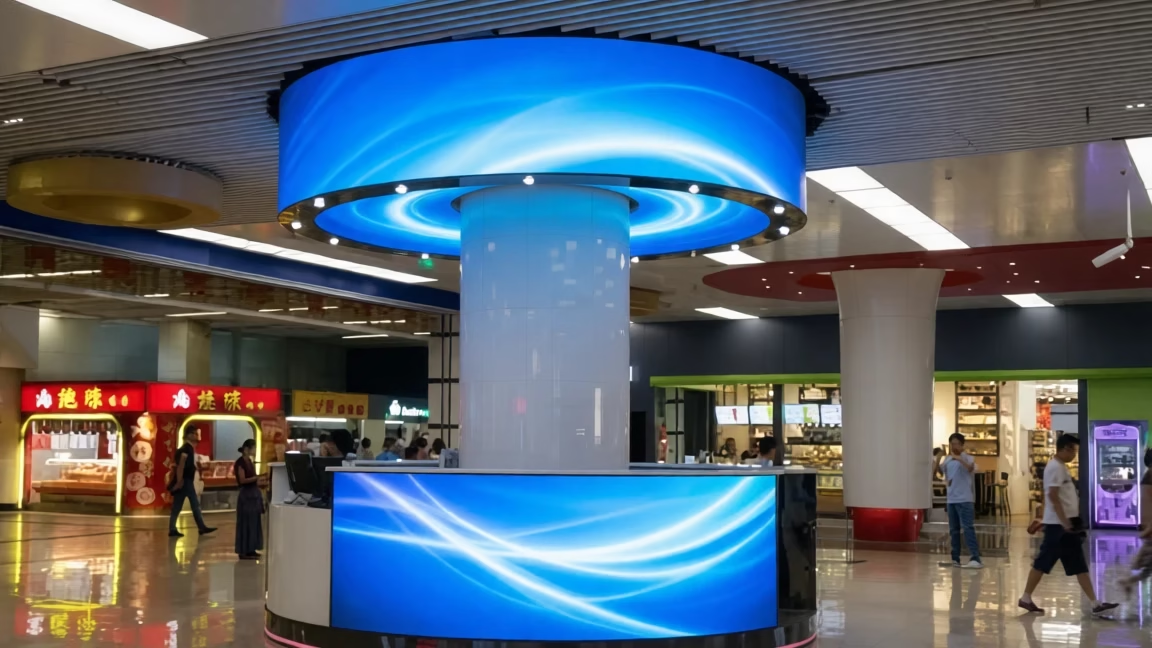
Module Solutions
Which Module Sizes Does a P1.25 Indoor Flexible LED Display Use?
Three module geometries cover the flexible-format market, all at the same 1.25mm pitch and 640,000 pixels per square meter: the industry-standard 320×160mm panel for cylinders and waves, the 250×250mm format that drops straight into 500-series curved rental cabinets, and the 240×120mm panel built for tight-radius columns. Every variant runs SMD1010 lamps on Chipone ICND-series driver ICs with the same silicone base shell.
320×160mm — the Industry-Standard Flexible Module
The size the flexible market standardized on. 256×128 pixels — 32,768 dots — per panel, scanned 1/32 so four of the 128 rows light at any instant. Because nearly every flexible-module factory stocks this format, spares, HUB75 cables and frame hardware stay interchangeable across batches, which matters when a creative build ships in phases. Modules mount onto custom sheet-metal frames in 640×480mm, 640×640mm or 960×960mm, rolled to the exact cylinder or wave radius the site needs.
| Parameter | Spec |
|---|---|
| Module Size | 320×160mm — the industry-standard flexible format |
| Pixel Resolution | 256×128 = 32,768 dots/module |
| Scan Mode | 1/32 scan (4 rows lit) |
| Driver IC Brands | Chipone (ICND series) |
| IC Count | 96 per module |
| Lamp | SMD1010 black-face |
| Brightness | 600–800 nits adjustable |
| Maintenance | Strong-magnet front service — no rear access required |
| Cabinet | Custom sheet-metal 640×480mm (6 modules), 640×640mm (8) or 960×960mm (18), rolled to the cylinder or wave radius |
| Uniformity | Precision silicone base shell keeps curved splicing flat + per-pixel calibration through the control system |
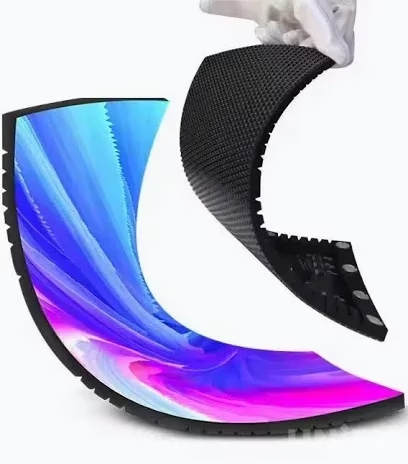
250×250mm — the Rental-Box Module for Curved Walls
The format that turns existing rental stock into curved revenue. Four 200×200-pixel modules fill a 500×500mm curved die-cast aluminum cabinet, eight fill a 500×1000mm — the same boxes a rental fleet already flies in flight cases. The angle-lock system on those cabinets builds arcs, circles and waves from ±15° segments, so one inventory covers flat touring walls one weekend and a wrapped column the next.
| Parameter | Spec |
|---|---|
| Module Size | 250×250mm — matches 500-series curved rental cabinets |
| Pixel Resolution | 200×200 = 40,000 dots/module |
| Scan Mode | 1/20 or 1/25 scan — confirmed to the 200-row matrix at order time |
| Driver IC Brands | Chipone (ICND series) |
| IC Count | 96 per module |
| Lamp | SMD1010 black-face |
| Brightness | 600–800 nits adjustable |
| Maintenance | Strong-magnet front service through the cabinet face |
| Cabinet | 500×500mm curved die-cast aluminum (4 modules/box), 500×1000mm (8) — angle-lock arc, circle and wave builds |
| Uniformity | Silicone base shell + per-pixel & per-color calibration after assembly |

The curved-cabinet system behind this build is documented in full on the 500×500mm rental LED screen collection and the 500×1000mm format.
240×120mm — the Small-Radius Module for Tight Columns
Half the width, half the minimum bend radius. At 192×96 pixels — 18,432 dots on a 1/48 scan — each panel weighs about 0.215kg and wraps columns that the 320×160mm format cannot follow: lobby columns, bar pillars, sculpture cores and anything under roughly a meter of diameter. Fewer factories stock this format and lead times run longer, so we hold it as the dedicated small-radius option rather than the default.
| Parameter | Spec |
|---|---|
| Module Size | 240×120mm — small-radius column specialist |
| Pixel Resolution | 192×96 = 18,432 dots/module |
| Scan Mode | 1/48 scan (4 rows lit) |
| Driver IC Brands | Chipone (ICND series) |
| IC Count | 96 per module |
| Lamp | SMD1010 black-face |
| Brightness | 600–800 nits adjustable |
| Maintenance | Strong-magnet front service, ~0.215kg per module |
| Cabinet | Direct-mounted to curved sub-frames and tight-radius column structures |
| Uniformity | Precision silicone base shell for flat splicing on tight curves + per-pixel calibration |

Shape Family
How Does a P1.25 Indoor Flexible LED Display Build Cylinders, Waves and Custom Shapes?
One module family, four shape grammars. Because the flexible PCB bends in the plane of the panel, the same 320×160mm module that skins a straight wall also skins a drum, a wave and a ribbon — the frame underneath does the shaping, the modules follow it. Every shape below ships with a rolled or machined sub-frame cut to the project radius, silicone-faced modules magnet-mounted from the front.

Convex & Concave Arcs
Gentle bows for showrooms, outward and inward. The silicone base shell carries the bending stress so the lamp face stays in plane from seam to seam.
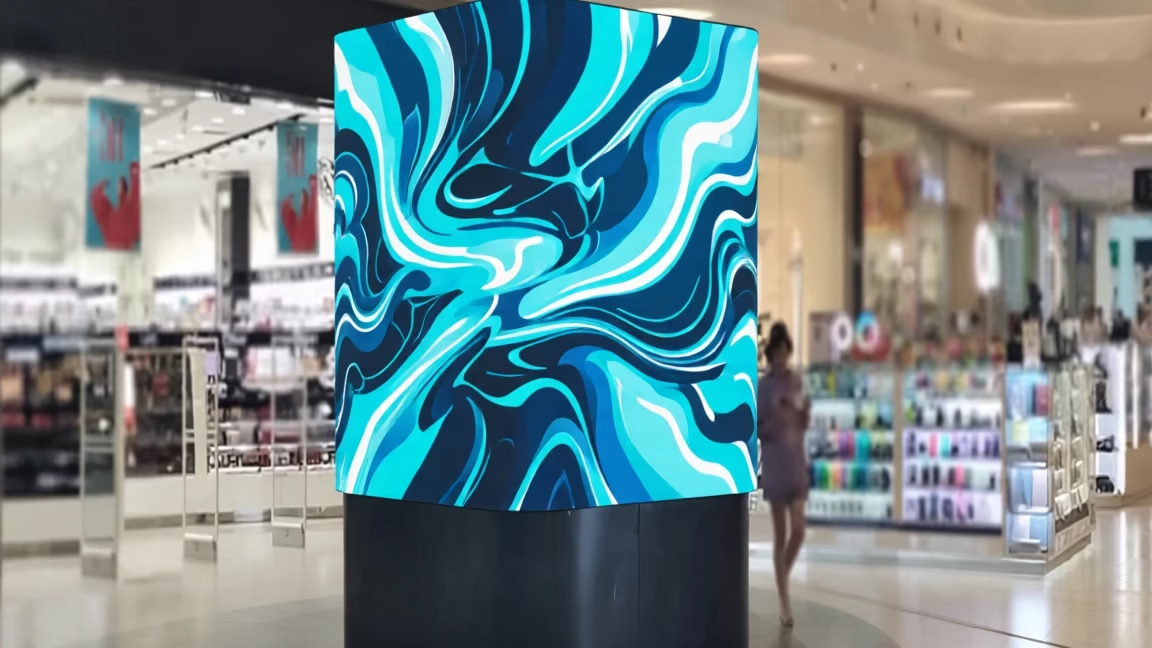
Full 360° Columns
Seamless wraps around structural columns — the classic cylindrical build. Module count locks to the circumference: a Ø1m column takes 10 columns of 320×160mm panels.
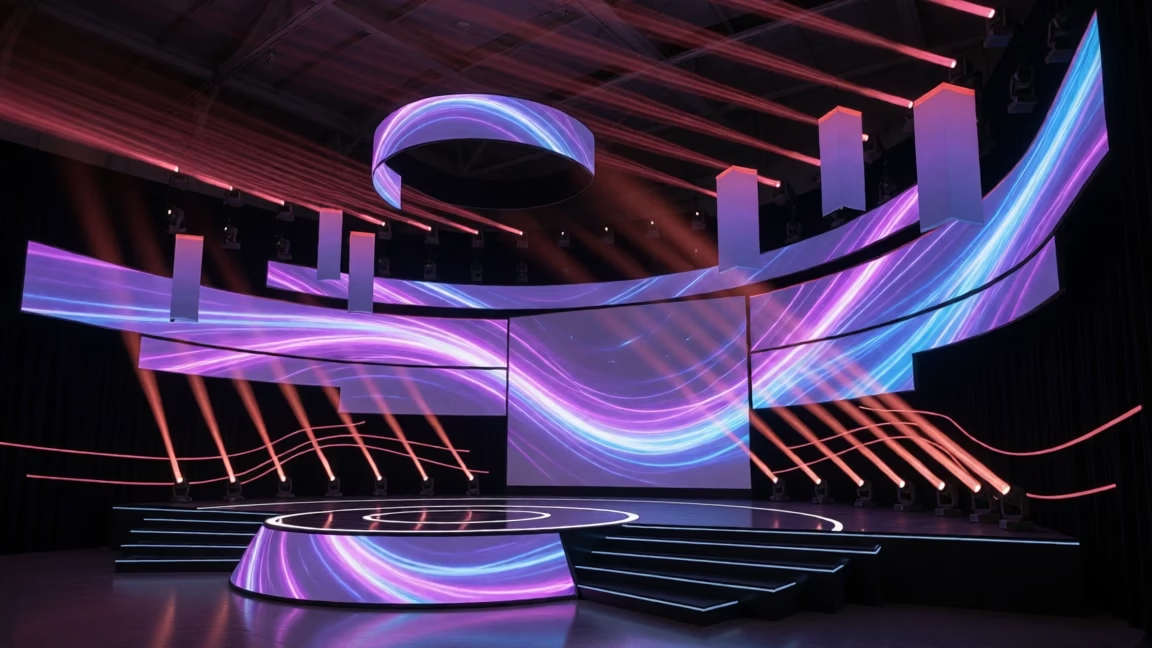
Waves & Ribbons
S-curves and floating ribbons for stages and atriums. Alternate segments tilt on the sub-frame, so the wave depth is a frame dimension, not a module limit.

Sphere Bands & Custom
Latitude bands on spheres, cones and one-off sculptures. A creative controller maps content pixel-by-pixel onto the irregular canvas.
Bending limits, in numbers: industry bending tests put the minimum cylinder diameter for a 320×160mm-class flexible module at roughly 815mm — wrap tighter than that and the lamp foot lifts off the pad. The 240×120mm panel, at half the width, follows radii roughly half as tight (≈400mm class, confirmed against the project drawing before fabrication). Bending runs across the panel width only — never fold along a lamp row.
In Action
What Do Flexible LED Installations Look Like in Action?
Flex Engineering
What Makes a P1.25 Indoor Flexible LED Display Bend Without Breaking?
Four components turn a fine-pitch module into a soft one — and each one is where cheap flexible panels cut corners. At 640,000 pixels per square meter there is no margin for a lifted pad or a stretched trace: every solder joint on a P1.25 panel is a fraction of a millimeter from its neighbor.
0.2mm Flexible PCB
The fiberglass board is replaced by a polyimide FPC around 0.2mm thick. Bending stress spreads across the copper traces instead of concentrating at drilled holes, which is what lets the panel take thousands of curvature cycles without cracking a joint.
Silicone Base Shell
A high-precision silicone bottom case cushions the solder side and locks the optical face flat. On a curve it is the difference between a continuous image and a faceted one — and the reason splices stay flush without shims.
Bend-Tolerant Flat Cables
Standard HUB75 ribbons crack where a curved build flexes every day. The dedicated anti-fatigue flat cables on every panel are spec’d for repeated bending across the arc, power and signal alike.
Strong-Magnet Front Service
Each module seats on locating pins and pulls off with a suction tool — no screws, no rear access, no dismantling the frame. A single technician services a wrapped column from the front in minutes.
Optically the panels hold fine-pitch discipline: SMD1010 black-face lamps on a 5000:1 contrast panel, 12–16 bit grayscale set by the IC grade, and 3840Hz refresh for camera work. After assembly every module passes per-pixel and per-color correction through the control system, so the 32,768-dot canvas reads as one continuous image — on a curve as on a flat wall.
Power
Which Power Supplies Run a P1.25 Indoor Flexible LED Display?
A 640,000-pixel square meter at 600–800 nits draws roughly 700–1,000W at peak and 300–340W in average broadcast content — industry reference figures for this density class — so a typical build carries three to five 5V/40A supply rails per square meter. Two supply tiers are available: standard 5V rails, or an energy-saving 4.2V/4.5V common-cathode configuration that trims running cost on screens that play all day.
| Brand | Role on This Collection | Typical Rails |
|---|---|---|
| Chuanglian Power (CZCL) | Volume rails for standard 5V builds — the default on sheet-metal frame projects | 5V / 40A class |
| MEAN WELL | Spec-grade option when the project calls for a global brand on the power BOM | 5V / 40A class |
| G-Energy | Multi-voltage rails for the 4.2V/4.5V energy-saving common-cathode tier | 4.2V / 4.5V dual-rail |
Compare the full lines in the CZCL, MEAN WELL and G-Energy power collections — all three ship as standard on this collection depending on the tier you specify.
Control Systems
Which Control Systems Drive a P1.25 Indoor Flexible LED Display?
A curved 640,000-pixel canvas needs a controller that can map it. Synchronous systems from six brands drive this collection — all running the same receiving-card layer of NovaStar MRV416 or Colorlight i9 cards, all supporting the per-pixel calibration that keeps a curved wall seamless. Asynchronous players from the same brands run the smaller column builds without a PC.
NovaStar MCTRL4K
4K canvas controller — the headroom pick for multi-column cylindrical walls driven as one image.

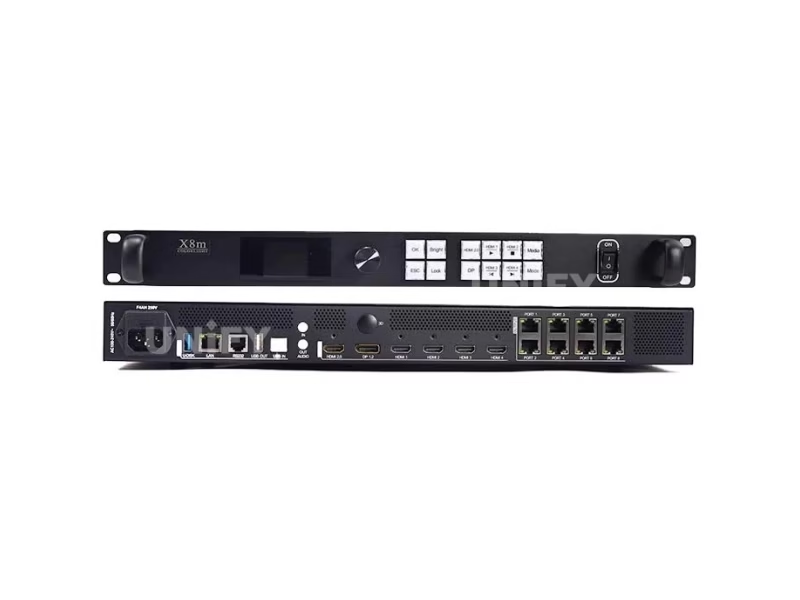
Colorlight X8m
Fine-pitch video processor with the loading for 640,000-pixel canvases and low-latency live input.
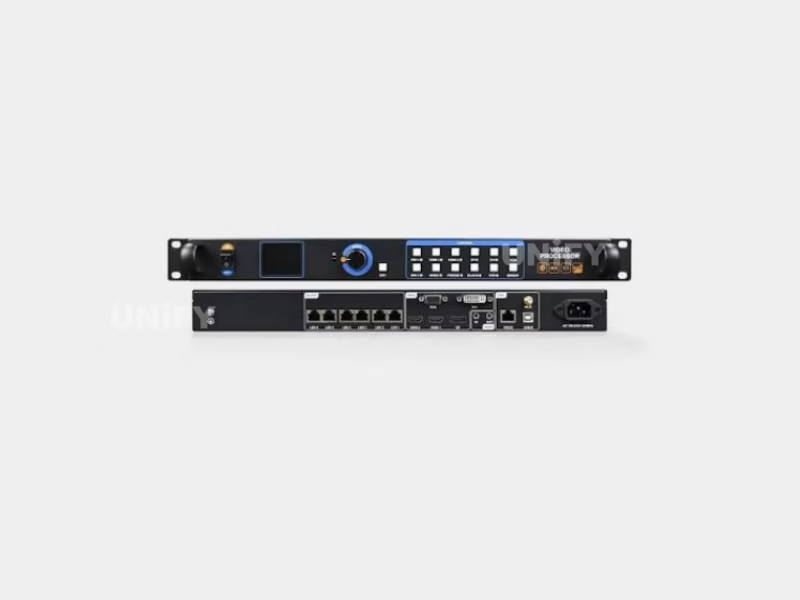
Huidu HD-VP620
Three-in-one processor — switcher, scaler and sender in one box for compact column installs.
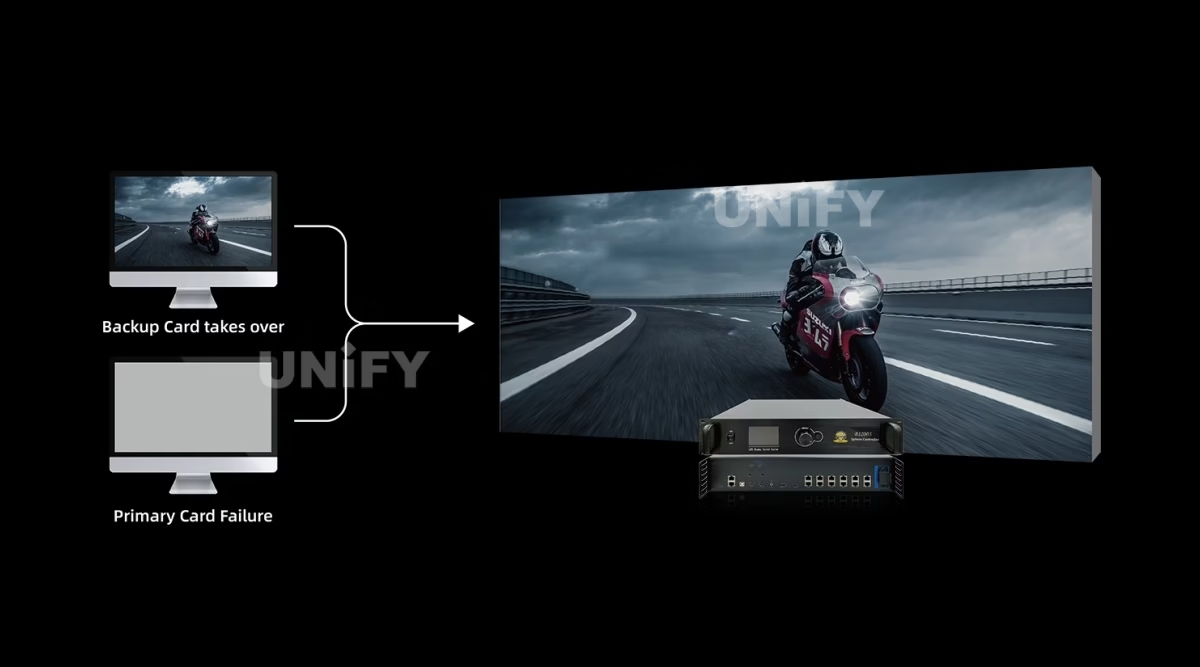
Mooncell B1200S
Creative LED controller — pixel-maps irregular cylinders, spheres and ribbons natively, no manual coordinate math.
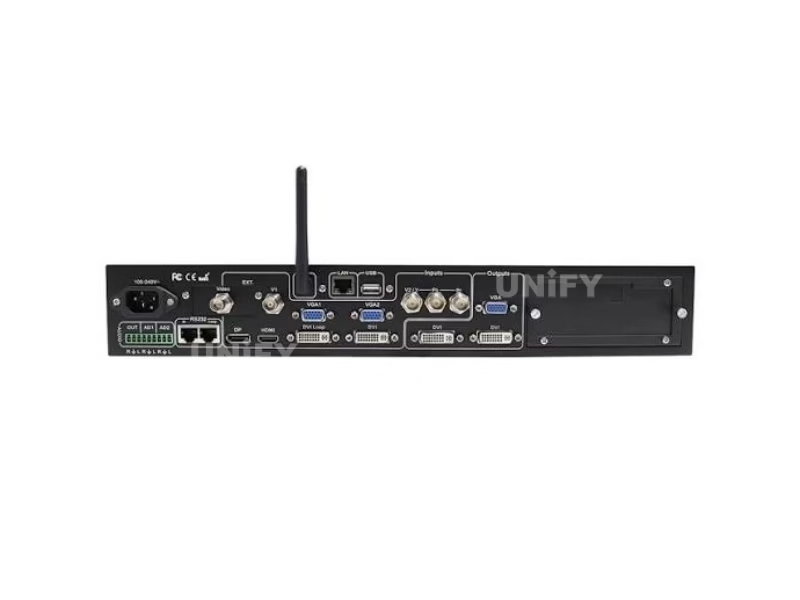
VDWALL LVP615S
2K video processor — the value pick for single-column and small arc walls with broadcast inputs.
RGBlink X2
Multiple-output processor — splits one source across column clusters and flat wings as separate windows.
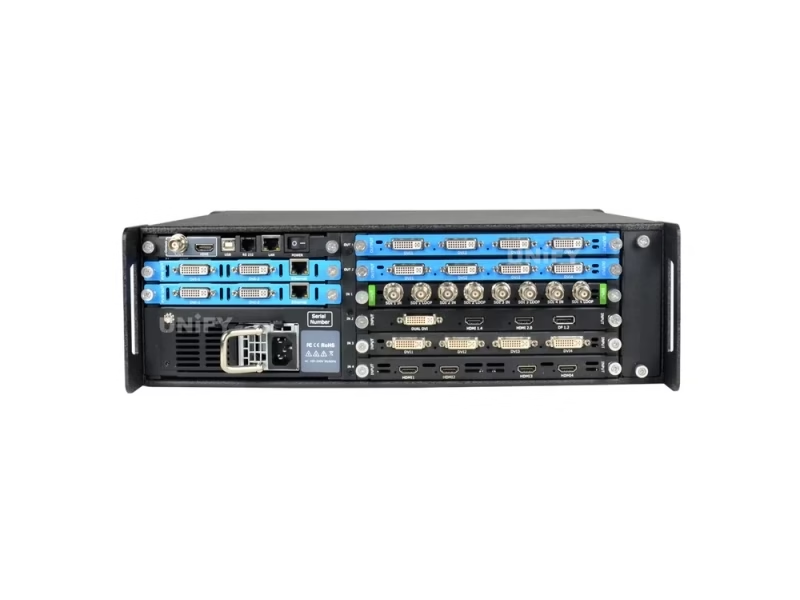
Full lineups, loading tables and selection guides live on the brand hubs: NovaStar, Colorlight, Huidu, Mooncell, VDWALL and RGBlink.
Find Your Build
Which P1.25 Indoor Flexible LED Display Build Fits Your Project?
Route by the geometry you need to cover, not by price alone — the wrong module width costs more in custom frames than the module ever saves.
| Project Geometry | Build | Why |
|---|---|---|
| Standard cylinders and waves, Ø ≥ 1.5m | 320×160mm on rolled sheet-metal frames | Industry-standard format, best supply depth, 815mm minimum cylinder diameter |
| Curved wall on existing 500-series rental stock | 250×250mm in curved die-cast cabinets | Drops into 500×500 / 500×1000 angle-lock cabinets you already own |
| Tight columns, Ø ≈ 0.4–1m | 240×120mm direct on curved sub-frames | Half the panel width, roughly half the minimum bend radius |
| Rental fleet: flat walls one week, wrapped column the next | 250×250mm mixed fleet | One module inventory serves flat and curved cabinets |
| Flat wall, fixed install, viewers beyond 3m | You don’t need flexible — save 20–40% | A rigid indoor fixed build at the same pitch or one step coarser costs far less — start at the LED display collection |
| Pitch | Pixels per ㎡ | Closest comfortable viewing | Curves? | Price tier |
|---|---|---|---|---|
| P1.25 flexible (this page) | 640,000 | from ~1.5m | Cylinders, waves, arcs, spheres | $$$ |
| P1.53 flexible | 422,500 | from ~2m | Cylinders, waves, arcs, spheres | $$ |
| P1.953 indoor rental | 262,144 | from ~2m | Flat + angled lock builds | $$ |
| P2.604 indoor rental | 147,456 | from ~3m | Flat rental builds | $$ |
| P2.976 indoor rental | 112,896 | from ~3m | Flat + curve option on the same cabinet | $ |
| Indoor Fine-Pitch Family | Format | Best for |
|---|---|---|
| P1.25 Indoor Flexible LED Display — this collection | Soft module, 3 sizes | Close-view creative shapes |
| P1.53 Indoor Flexible LED Display Collection | Soft module, 2 sizes | Value curved walls from ~2m |
| P1.86 Indoor Flexible LED Display Collection | 320×160 / 250×250 | Entry curved walls from ~2.5m |
| P2.0 Indoor Flexible LED Display Collection | 320×160 / 250×250 | Scale curved walls from ~3m |
| P2.5 Indoor Flexible LED Display Collection | 320×160 / 250×250 | Volume curved walls from ~3.5m |
| P3.076 Indoor Flexible LED Display Collection | 320×160 / 250×250 | Rental curved walls from ~4m |
| P4 Indoor Flexible LED Display Collection | 320×160 / 250×250 | Giant curved walls from ~5m |
| P5 Indoor Flexible LED Display Collection | 320×160 / 250×250 | Value-frontier curved walls from ~6m |
| P1.953 Indoor Rental LED Display Collection | Die-cast cabinet | Fine pitch on a rental budget |
| P2.604 Indoor Rental LED Display Collection | Die-cast cabinet | Mid-range rental staging |
| P2.976 Indoor Rental LED Display Collection | Die-cast cabinet | Volume rental walls |
Pricing
How Much Does a P1.25 Indoor Flexible LED Display Cost?
Screen-body pricing, FOB — brackets, control and freight quoted per project. Flexible P1.25 commands a premium over rigid panels of the same pitch: the FPC and silicone masking add roughly 20–40% before the frame is counted.
| Build | Screen body, FOB | What moves the number |
|---|---|---|
| 320×160mm on rolled sheet-metal frames | $1,400–2,000 / ㎡ | Frame rolling complexity, quantity, brightness tier |
| 250×250mm in curved die-cast cabinets | $1,700–2,400 / ㎡ | Cabinet count, angle-lock accessory sets, flight cases |
| 240×120mm small-radius custom | $1,900–2,800 / ㎡ | Narrower supply base, sub-frame machining, longer lead time |
| Add-on rows | quoted | Non-standard rolled frames, creative-controller mapping, 4.2V/4.5V energy-saving supply tier |
Module-level cross-check from the same scan: 320×160mm runs about $60–90 per panel (19.53 panels/㎡ ≈ $1,170–1,760 before framing), 250×250mm $95–135 (16 panels/㎡), 240×120mm $45–70 (34.7 panels/㎡). September 2026 market listing scan — Alibaba and Made-in-China listings, factory-direct FOB.
- The 320×160mm build is the supply-depth play — every flexible-module factory stocks it, so price, spares and lead time all sit at their floor.
- The 250×250mm build is the fleet play — the premium buys a wall that reconfigures from flat to curved using cabinets you already own.
- The 240×120mm build is the geometry play — you pay for a radius no other format can follow, and lead times reflect the narrower supply base.
Applications
Where Does a P1.25 Indoor Flexible LED Display Earn Its Premium?
Eight venues put the pitch to work — every one of them closer than 3m to the viewer, every one of them built around a surface a rigid cabinet cannot follow.
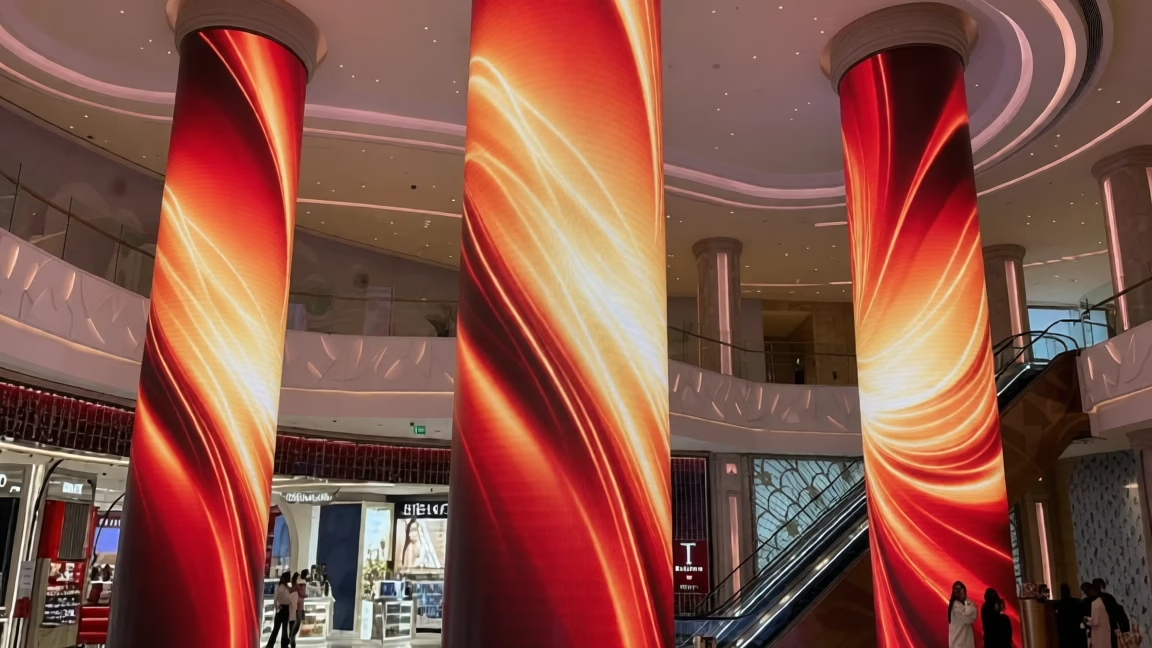
Cylindrical Advertising Columns
Full-wrap brand totems in malls and showrooms — four-sided visibility from one structural column.

Showroom & Lobby Arc Walls
Concave immersion walls that pull visitors in — the format automotive and tech showrooms ask for by name.

Stage Wave Backdrops
S-curve and ribbon sets for corporate stages and concerts, lit close enough that 3840Hz keeps cameras clean.
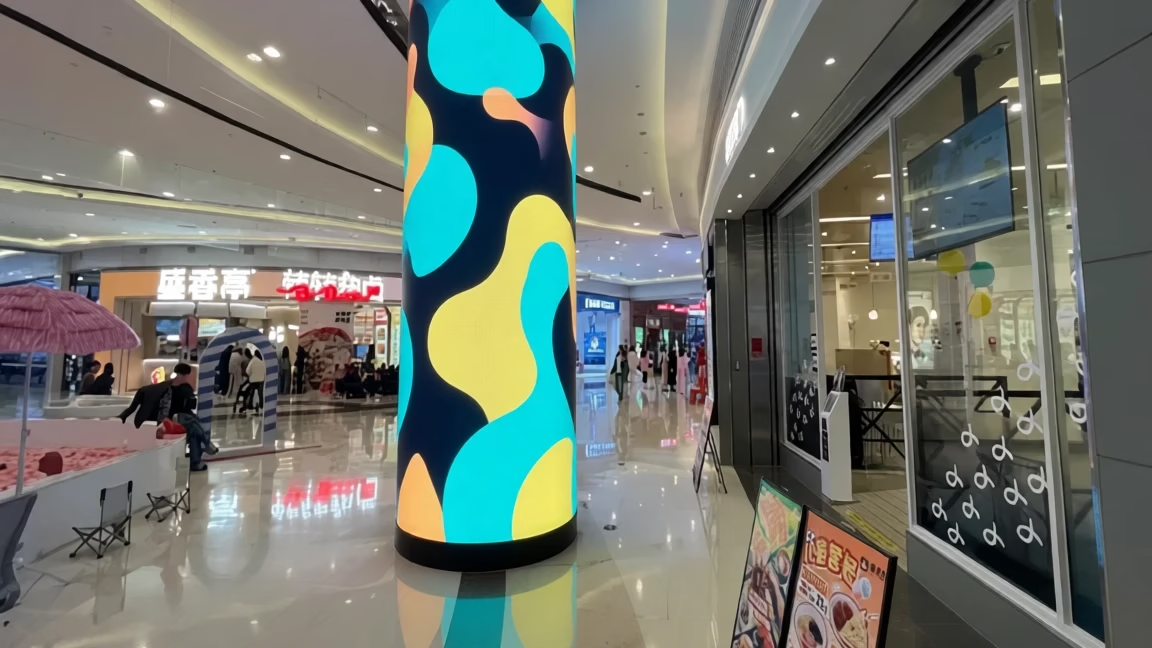
Shopping-Mall Atrium Rings
Helix and ring ribbons around escalator voids — viewed from 2–10m and every angle.
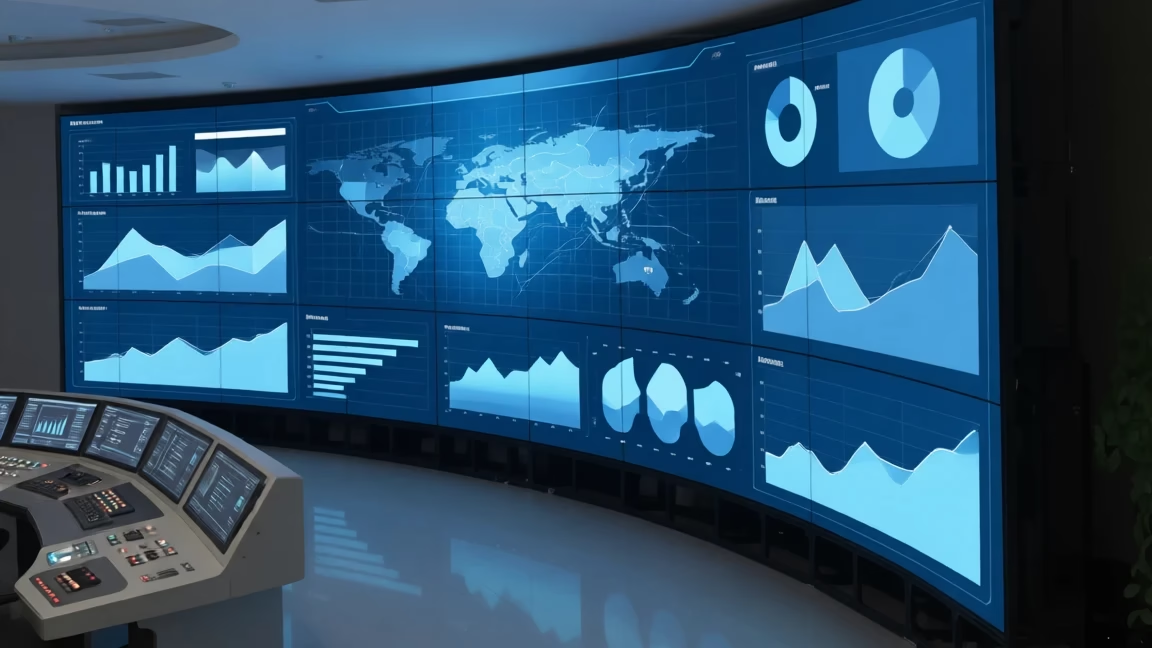
Command-Center Curves
Wrapped console and status walls where operators sit 1.5–2m from the glass — the pitch exists for this distance.
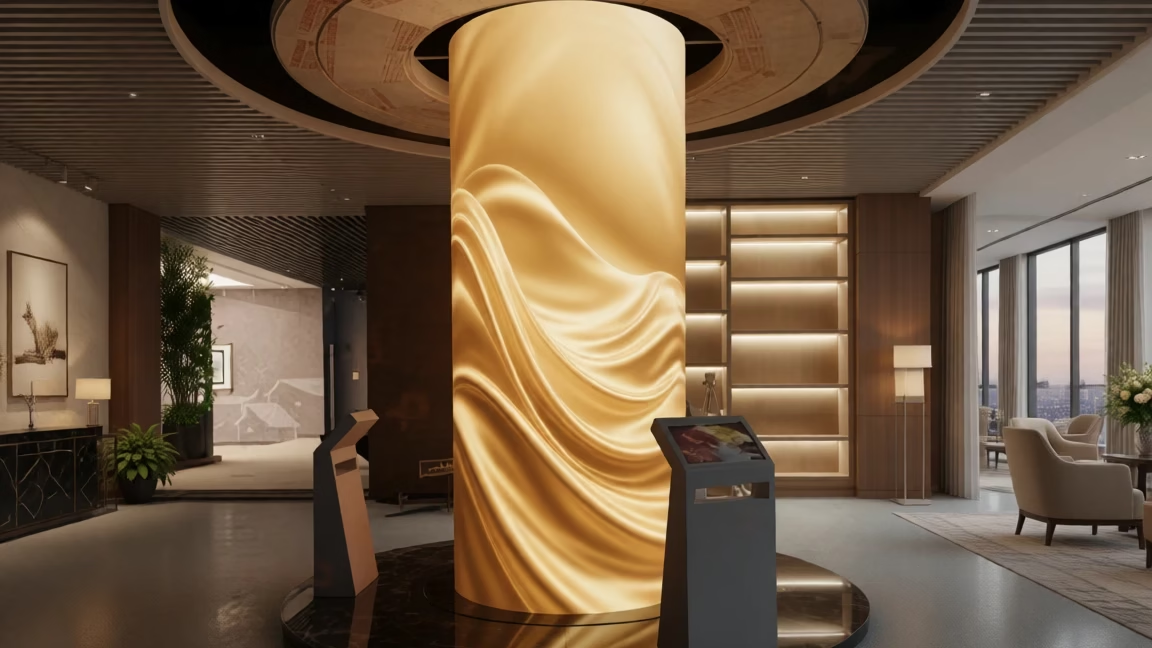
Hotel & Banquet Feature Walls
Columns and curved portals that carry branding without dominating the room at 600–800 nits.
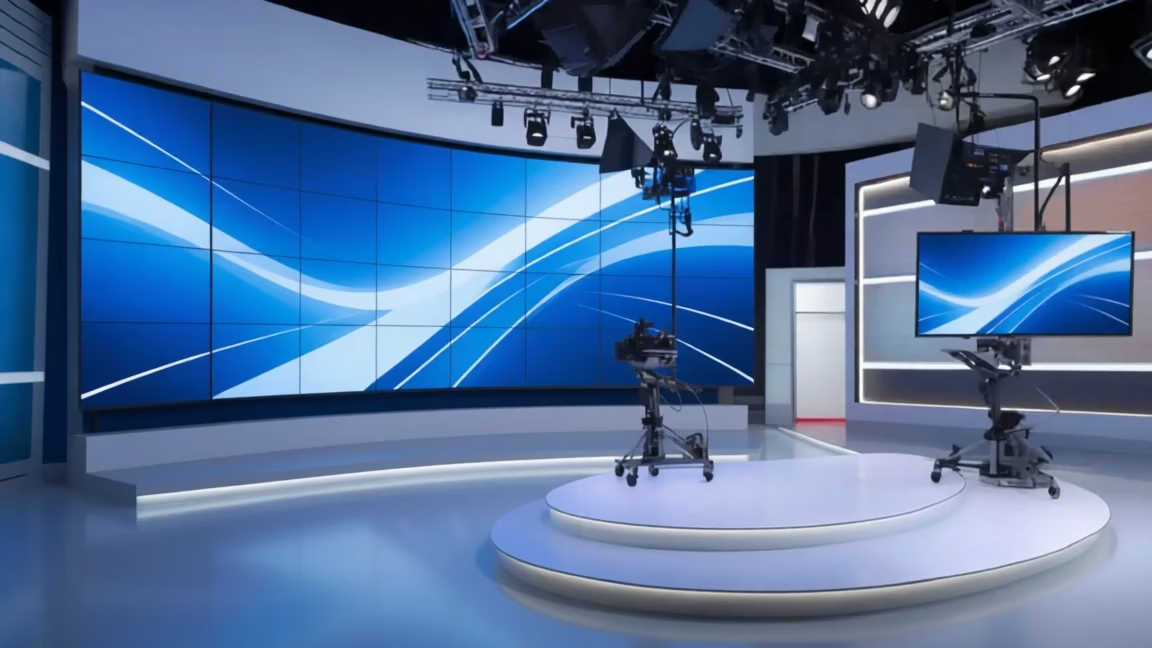
TV Studio Curved Sets
Broadcast sets curve on camera — high refresh and 12–16 bit grayscale keep skin tones honest under studio light.
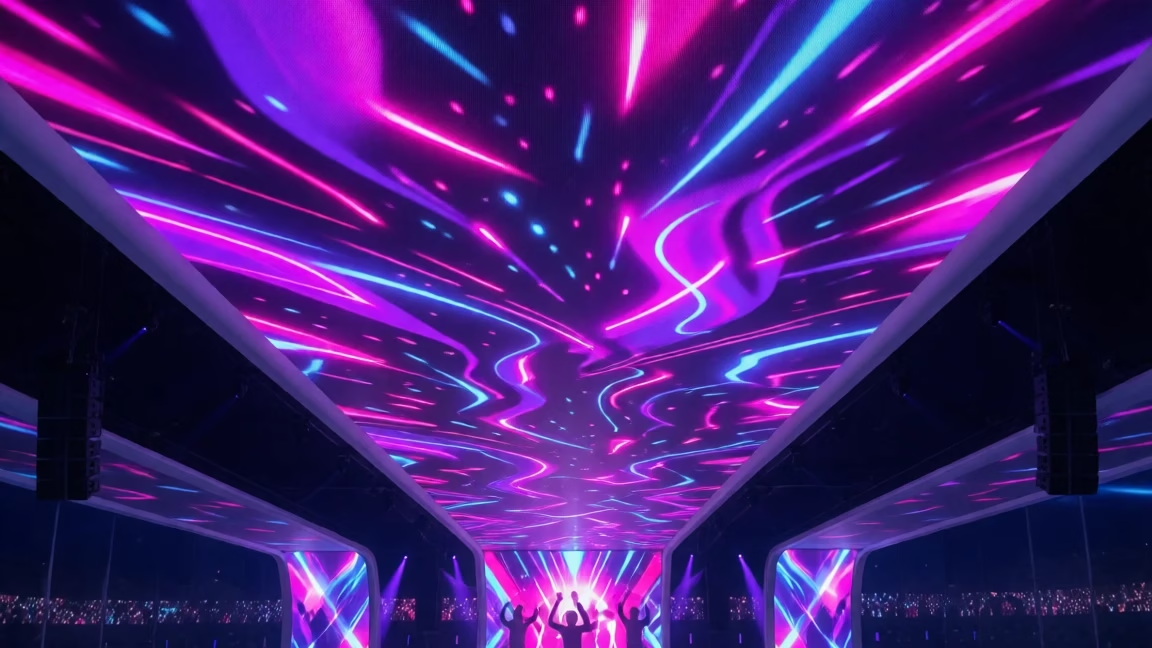
KTV, Clubs & Weddings
Pillars, DJ booths and ceremony arches — small-radius builds where the 240×120mm module does the wrapping.
Reference Builds
What Do Typical P1.25 Indoor Flexible LED Display Projects Look Like?
Four build patterns this collection is engineered around — configurations and module counts as quoted on our production sheets.
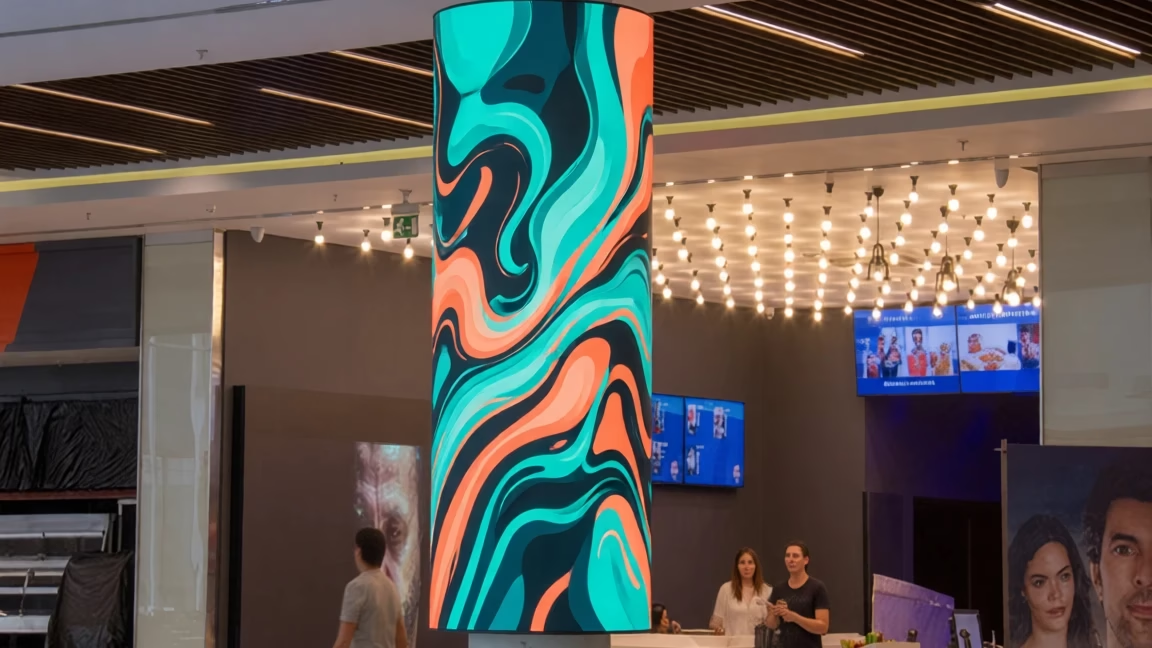
360° Column Wrap — Retail
320×160mm modules on a Ø1.2m rolled frame — 10 panels per ring, front-serviced entirely by magnet.
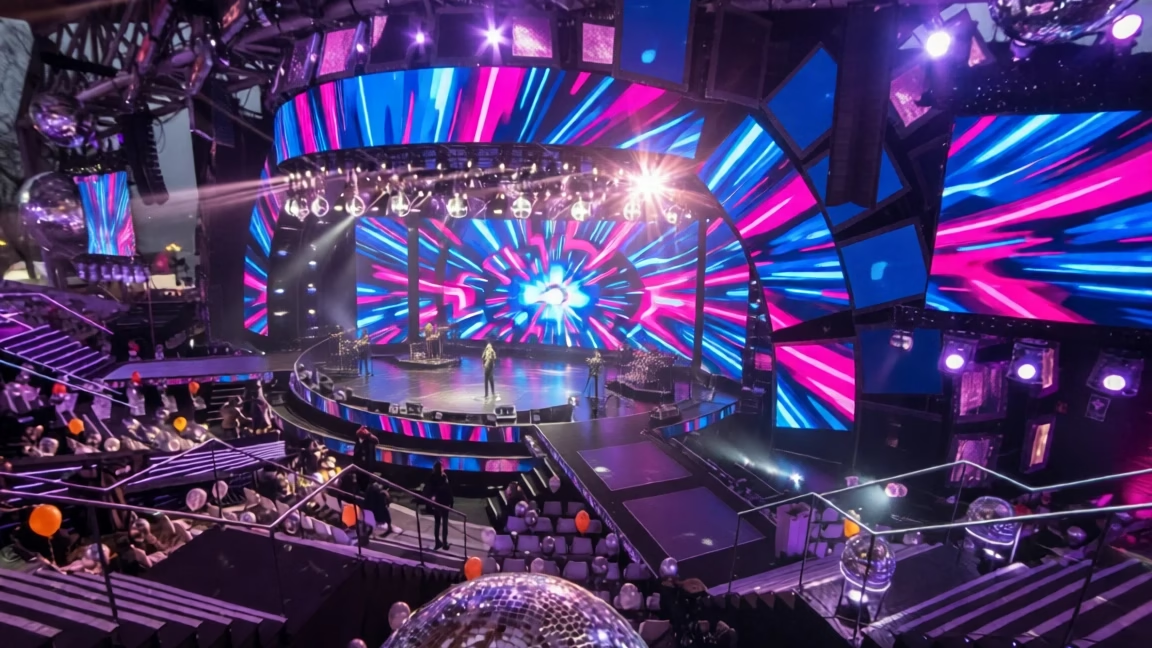
Wave Backdrop — Corporate Stage
320×160mm panels on a three-crest wave frame, creative-controller pixel map, 3840Hz for live cameras.

Small-Radius Column — Lobby
240×120mm modules direct on a Ø0.8m column sub-frame — the geometry only this format follows.
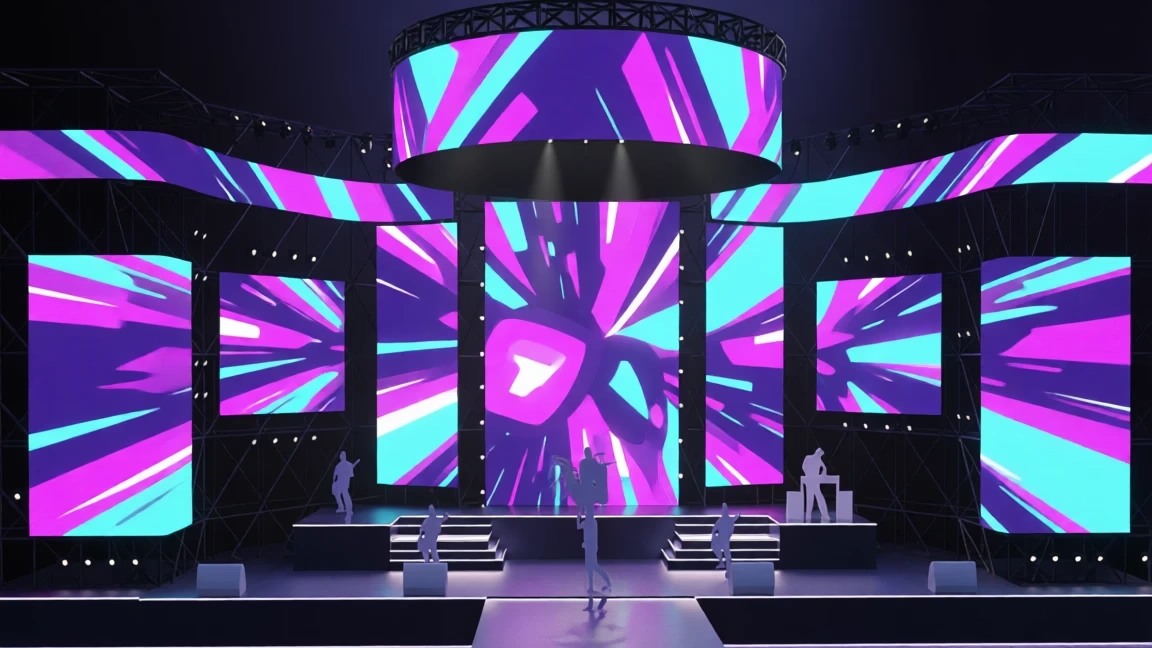
Curved Rental Wall — Event House
250×250mm modules in 500×500mm angle-lock cabinets, arc built from ±15° segments in a day.
FAQ
What Should You Ask Before Buying a P1.25 Indoor Flexible LED Display?
1. What is the smallest cylinder a P1.25 indoor flexible LED display can wrap?
Industry bending tests put the minimum cylinder diameter for a 320×160mm-class flexible module at roughly 815mm. The 240×120mm panel, at half the width, follows radii roughly half as tight — around the 400mm mark — which is why it is the designated small-radius option. Final curvature is confirmed against the project drawing before any frame is rolled.
2. Can the modules bend both concave and convex?
Yes. The FPC and silicone base shell carry bending stress in both directions, so the same inventory skins an outward bow, an inward immersion wall, or alternating wave crests and troughs on one frame.
3. Will bending damage the LEDs or create dead pixels?
Not when the panel is bent the way it is designed to bend: curvature runs across the panel width, never along a lamp row, and never into a sharp crease. The 0.2mm FPC spreads the stress and the anti-fatigue flat cables survive daily flexing. After assembly, per-pixel calibration catches any marginal joint before it ships.
4. How much more does a flexible LED display cost than a rigid one?
Roughly 20–40% more at the same pitch, before custom framing. The premium buys the flexible PCB, the silicone masking and the small-radius geometry. If the wall is flat and viewers stay beyond 3m, a rigid indoor build costs less — that is the honest routing on this page.
5. Flexible LED or flexible OLED — which should I specify?
For anything over a couple of meters wide, flexible LED wins on every axis that matters: it sizes to any radius and any area, runs brighter for lobbies and studios, lasts about 100,000 hours without the burn-in OLED panels are prone to, and costs far less per square meter at scale. Flexible OLED makes sense only at display sizes, not wall sizes.
6. Can a flexible LED display be used outdoors?
This collection is an indoor format: the silicone masking gives the module splash-and-dust resilience for covered semi-outdoor spots, but sustained rain, UV and temperature swings call for an outdoor flexible line. Specify this collection for interior and covered applications.
7. How are the modules installed — do magnets really hold?
Yes — each module seats onto steel locating pins and is held by high-pull magnets rated well beyond its ~0.2–0.3kg weight. The frame carries the structure; the magnets carry alignment and service access. Frame fabrication tolerance is held within ±1.5mm so the silicone faces splice flush.
8. Are seams visible on a curved P1.25 wall?
The precision silicone base shell keeps panel faces in plane without shims, and per-pixel, per-color calibration matches brightness and color across the canvas. At a 1.25mm pitch viewed from its intended distance, the wall reads as one continuous image — the seam question disappears into the picture.
Buyer’s Guide
Why Choose a 1.25mm Pitch for a Flexible Indoor LED Display?
Because the shape buys nothing if the picture fails up close. A curved wall invites people to walk up to it — and at 1m, the spacing you can hide at P2.5 turns into visible structure between the dots. The 1.25mm pitch puts 640,000 pixels into every square meter, which holds the image together from about 1.5m outward: fine text on a command-center console, skin tones on a studio set, product close-ups on a showroom arc. Step back to 3m and any of the coarser indoor rental pitches looks equally clean — that is exactly why the flexible premium should only be paid when the surface or the distance demands it.
The pitch also decides the module economics. At 1.25mm, a 320×160mm panel carries 32,768 dots — four times the pixel count of a P2.5 panel of the same size — driven by 96 ICs on a 1/32 scan at 3840Hz. Every lamp is an SMD1010, the smallest mainstream package in volume production, chosen because a black-face 1010 keeps contrast at 5000:1 while leaving enough pad area for the flexible solder joints. Grayscale runs 12–16 bit depending on the IC grade specified, and the refresh tier matters as much as the pitch on any set that appears on camera.
How Is a Flexible LED Module Manufactured?
It starts as a polyimide FPC — the same film family used in phone cameras — around 0.2mm thick, with the circuit pattern imaged onto copper laid thin enough to fold. SMD1010 lamps are placed by the same pick-and-place lines that build rigid fine-pitch panels, then reflowed at temperatures tuned for the film. The finished board is bonded into a high-precision silicone base shell: the soft case is what makes the panel a soft module, cushioning the solder side and holding the optical face in plane. Rubber masks front and back finish the assembly, and every panel ages in before packing.
The yield-critical step is the bend test. Panels from this collection are flexed across their working radius repeatedly before calibration, because a joint that survives reflow can still lift when the copper work-hardens. The panels that pass go through per-pixel and per-color correction in the control system, so a 640,000-dot canvas arrives matched panel to panel. That discipline is why the silicone shell matters beyond protection: it is the datum that keeps a curved splice as flat as a flat one.
Flexible LED Display vs Flexible OLED: Which Should You Specify?
The two technologies answer different questions. A flexible OLED panel is a fixed-size display with a factory-set curve — superb for a 55-inch console screen, impractical as a wall. A flexible LED display sizes continuously: the same 320×160mm module that builds a Ø1.2m column builds a 20m wave, because the panel is one cell in a canvas, not the canvas itself. Brightness goes the same way — 600–800 nits here against the few hundred an OLED holds — and LED life runs about 100,000 hours without OLED’s static-image burn-in.
Cost scales the other way at small sizes, which is the honest limit: under roughly a meter of screen, a consumer OLED is cheaper than a controller, rails and modules. Past that line the LED system wins on every axis that matters to an install — any radius, any area, front service, and a supply chain that stocks the industry-standard 320×160mm format worldwide.
What Does Installing a P1.25 Indoor Flexible LED Display Involve?
The screen is light; the frame is the work. Site survey fixes the true radius, the sub-frame is rolled or machined to match, and tolerance is held within ±1.5mm so the silicone faces meet flush. Modules then go on from the front — locating pins align each one, magnets seat it, and a suction tool pulls it back off for service without touching the panel behind it. Power and data route on the anti-fatigue flat cables along the arc, and the creative controller pixel-maps the irregular canvas so content lands where the geometry says it should.
Commissioning closes the loop: the control system runs per-pixel and per-color correction against the installed canvas, the brightness schedule is set for the venue’s ambient light, and the front-service routine is walked through with the venue team. A column wrap of a few square meters is a one-day job for two technicians once the frame is in — the modules themselves mount in minutes, which is the quiet argument for magnet mounting over every screwed alternative.
What Maintenance Does a P1.25 Indoor Flexible LED Display Need?
Front service is the design promise, and it holds up in practice. A module that misbehaves comes off with a suction tool in under a minute — no rear crawl space, no frame dismantling, no specialist crew — and because the 320×160mm format is stocked industry-wide, a replacement panel is a commodity rather than a custom order. We ship 3% free spare modules with every build, which covers the occasional strike during furniture moves or deep cleans for the life of a typical install.
Routine care is what any fine-pitch wall needs, with two flexible-format additions. Clean the silicone faces with the same soft, dry-or-damp discipline as a rigid panel — no solvents, nothing abrasive — and during any scheduled service window, visually check the anti-fatigue flat cables where they exit the arc, since that is the only part of the signal path that flexes in daily operation. The control system carries the rest: a per-pixel calibration re-run once a year keeps brightness matched across the canvas as lamps age, and takes minutes on a collection this size.
How Does the 4.2V/4.5V Energy-Saving Supply Cut Running Cost?
The standard build feeds the modules from 5V rails at about 300–340W per square meter in average content. The energy-saving tier moves the driving voltage down to 4.2V or 4.5V on a common-cathode layout: the LEDs sit on the low side of the supply, so the driver burns the difference as controlled voltage instead of heat. Less heat in the module means the silicone shell and the solder joints run cooler — which on a curved panel that cannot convect like an open cabinet is worth as much as the electricity it saves.
The saving scales with how hard the screen works. An always-on lobby column or a mall atrium ring running long hours every day sees the meaningful reduction; an event screen that plays a few weekends a quarter will never amortize the tier’s modest premium. Specify the 4.2V/4.5V configuration on the G-Energy multi-voltage rails when the display is metered as an operating cost; specify standard 5V when duty cycle is light. The honest answer, as with the pitch itself, comes from the duty cycle — and we will size the supply tier against your content schedule before the quote is issued.
The Bottom Line on the P1.25 Indoor Flexible LED Display
A P1.25 indoor flexible LED display is the specification to reach for when two things are true at once: viewers stand close, and the surface is not flat. The industry-standard 320×160mm module covers cylinders and waves at the best supply depth; the 250×250mm format turns 500-series rental stock into curved revenue; the 240×120mm panel follows radii nothing else in the fine-pitch range can. Price the geometry first — the premium over a rigid wall is 20–40%, and it is worth every cent exactly as long as the curve is real.
Related Collections
P1.953 Indoor Rental LED Display Collection
Fine pitch on a rental budget — 262,144 px/㎡ in die-cast cabinets, the flat-wall alternative one step coarser.
500×500mm Rental LED Screen Collection
The angle-lock cabinet system that takes 250×250mm flexible modules into arcs, circles and waves.
LED Display Collection
Indoor, outdoor, rental and poster lines from the factory — start here when the wall is flat and the budget is fixed.
Ready to Curve Your Wall?
Send the column diameter, wave profile or arc drawing — we return a module layout, frame drawing and screen-body quote from the P1.25 indoor flexible LED display collection within 24 hours.