
Fine-Pitch Indoor · Rental & Staging
P2.976 Indoor Rental LED Display Collection
The volume line of the indoor rental family: one 250×250mm module — 84×84 pixels, 112,896 dots per square meter — in die-cast cabinets that also curve. Flat walls, inside corners, outside corners; 800–1,200 nits on national-standard pure-copper wiring, 3,840Hz high refresh and a 1/21 scan built for the way this module is wired.
Definition
What Is a P2.976 Indoor Rental LED Display?
Short answer: A P2.976 indoor rental LED display is the mainstream volume pitch of the indoor rental family — 250×250mm modules carrying 84×84 pixels (7,056 dots) inside die-cast aluminum 500×500mm or 500×1000mm cabinets that support inside-curve and outside-curve custom builds. At 112,896 pixels per square meter it reads cleanly from about 3m, and its per-square-meter price is the reason big rental walls stay profitable.
A P2.976 indoor rental LED display spaces its LEDs 2.976mm apart — 336 pixels to the metre. Each 250×250mm module carries 7,056 dots driven by 63 driver ICs on a 1.6mm or 2.0mm fiberglass board, scanned 1/21 so exactly four of the 84 rows light at any instant — a scan that divides this module evenly, which is one reason the pitch runs so efficiently. Cabinets are die-cast aluminum in the two 500-series sizes, and the same lock system that builds a flat wall also builds curves: inside corners and outside corners come from the same fleet, no special cabinets required.
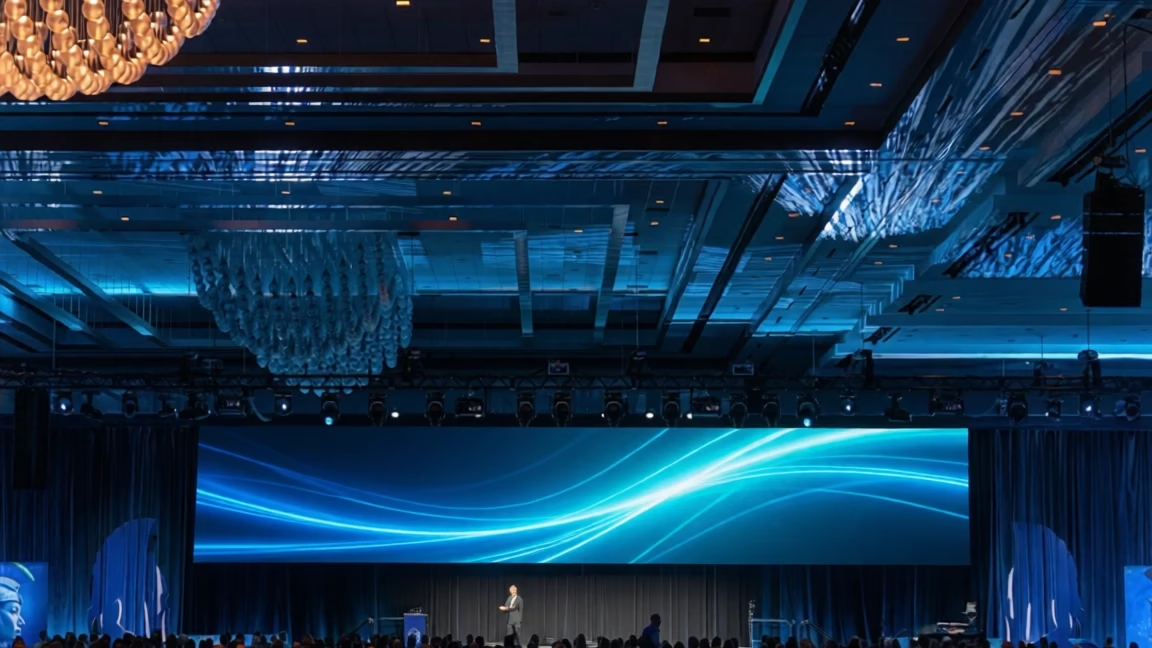
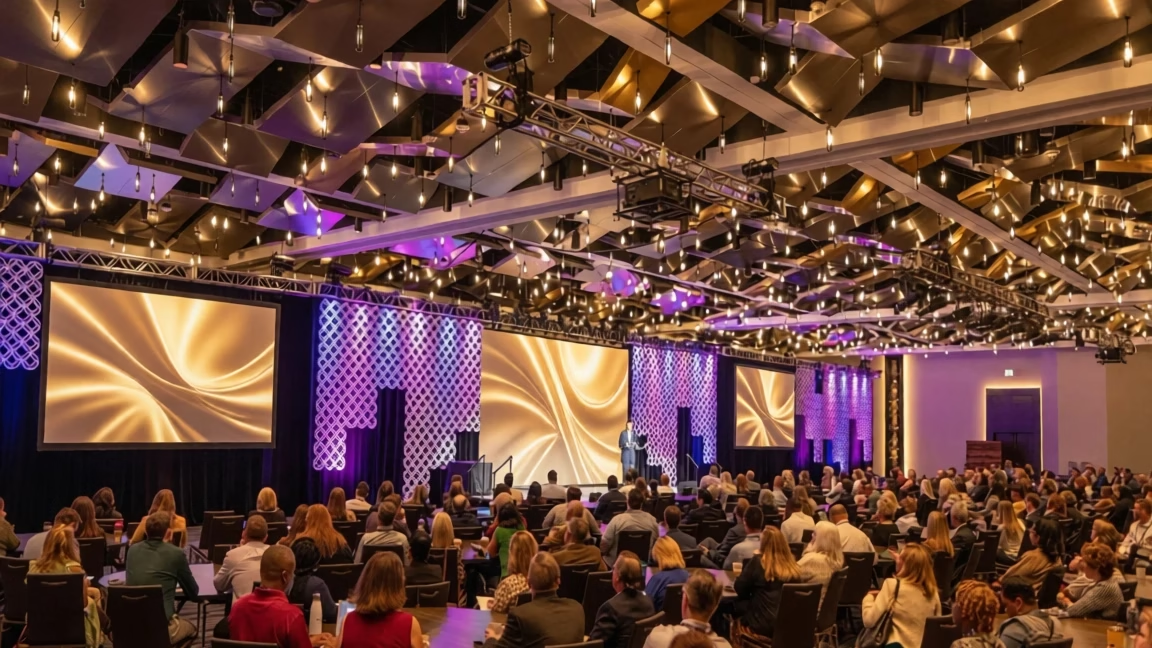
The buying line sits near 3m. Inside that radius the finer pitches earn their premium — P2.604 for mid-hall detail, P1.953 for camera-close work. From 3m to about 12m, P2.976 delivers the picture the room can actually perceive at the lowest cost per square meter in the family — which is why it anchors convention halls, concert side stages, hotel ballrooms and the big-box exhibition floor. As our pixel pitch guide puts it: the room chooses the pitch, and this is the pitch the volume rooms choose.
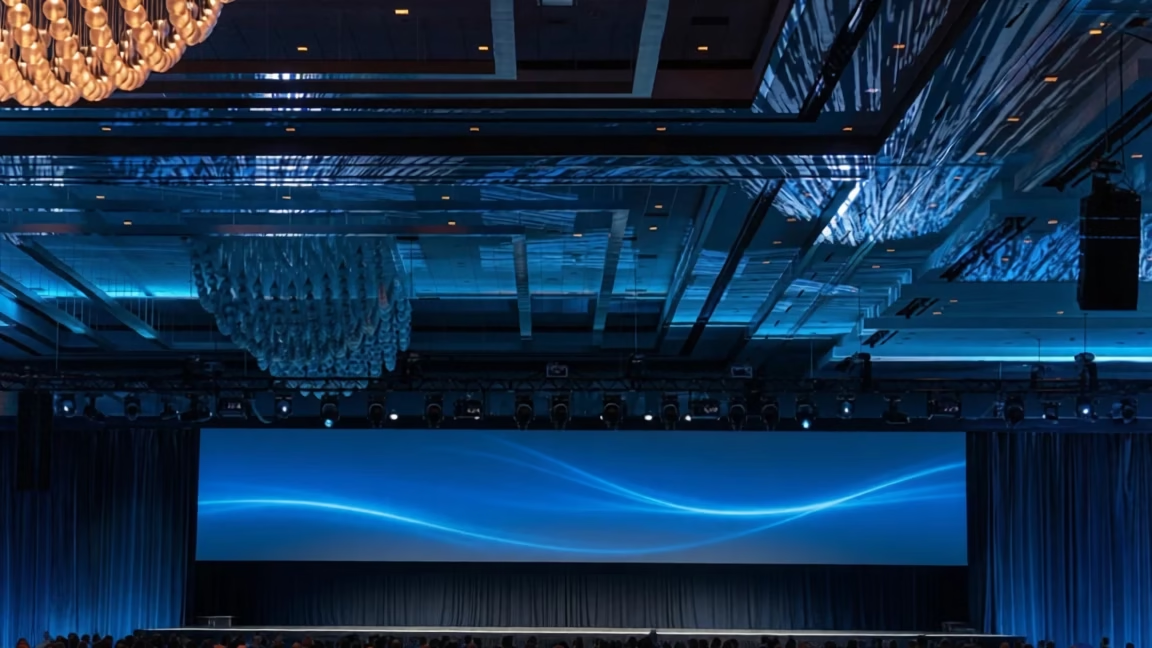
Module & Cabinet Builds
Which Module and Cabinet Sizes Does a P2.976 Indoor Rental LED Display Use?
One production module — 250×250mm, the best-rented size in the indoor family — in two die-cast aluminum cabinet formats. Both cabinets carry the curved-build lock geometry: the same boxes that stack a flat wall form inside and outside corners when a design calls for it.

The 250×250mm Module
One module geometry across the collection: 84×84 pixels, 7,056 dots, SMD2121 pure-black face. Sixteen modules build one square meter — four fill a 500×500mm cabinet, eight fill a 500×1000mm — and every module releases magnetically from the front or unscrews from behind.
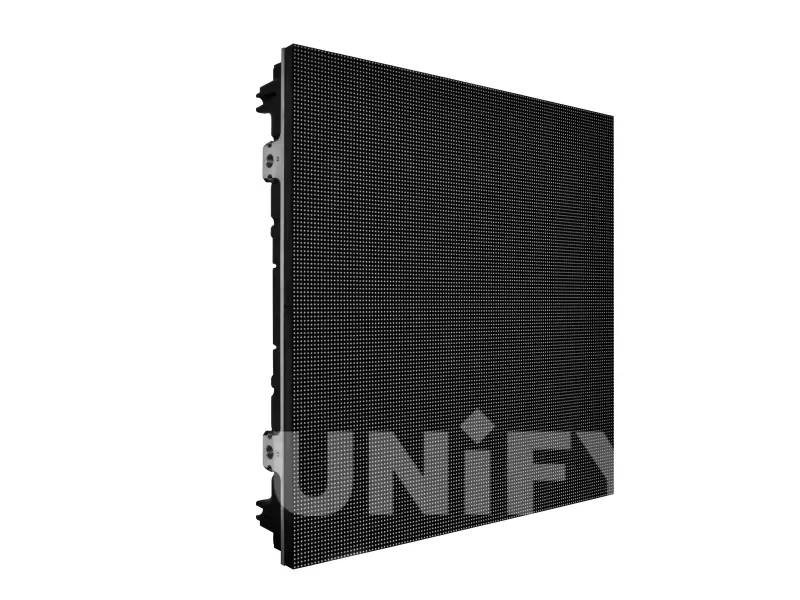
500×500mm Die-Cast Cabinet — Flat, Curved, Anywhere
Four modules per box with the curved-build lock geometry built in: mount the boxes straight for a flat wall, or step them at an angle for inside and outside corners — creative wraps without a special cabinet order. The most common unit in rental fleets, and the size most flight cases are cut for.
| Parameter | Spec |
|---|---|
| Module Size | 250×250mm |
| Pixel Resolution | 84×84 = 7,056 dots/module |
| Scan Mode | 1/21 scan (4 rows lit — native match for 84 rows) |
| Driver IC Brands | Chipone (ICND series) |
| IC Count | 63 per module (112 dots per IC) |
| Lamp | SMD2121 pure-black — Grade 1 / Grade 2 domestic brands, tiered at order time |
| Brightness | 800–1,200 nits (copper/alloy wire) / 1,200+ nits (gold-wire boost) |
| Maintenance | Magnetic front service standard; screw rear service both supported |
| Cabinet | 500×500mm die-cast aluminum, 4 modules/box, inside/outside curve locks, stack + rig |
| Uniformity | Wavelength & brightness sorting before assembly + hardware per-pixel correction through the control system |
500×1000mm Die-Cast Cabinet — Speed at Scale
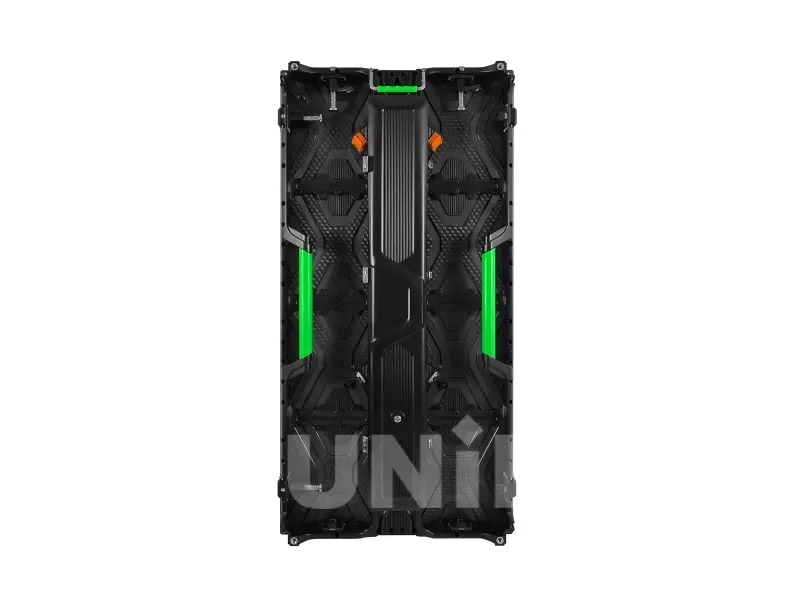
Eight modules per box with the same curve-capable lock geometry. Halving the box count per square meter is what keeps a 40㎡ convention wall a one-morning build — and on this pitch it prices lower per square meter than any finer option in the family.
| Parameter | Spec |
|---|---|
| Module Size | 250×250mm |
| Pixel Resolution | 168×168 per cabinet (28,224 dots) |
| Scan Mode | 1/21 scan (ICN2053-class) |
| Driver IC Brands | Chipone (ICND series) |
| IC Count | 252 per cabinet |
| Lamp | SMD2121 pure-black — Grade 1 / Grade 2 domestic brands, tiered at order time |
| Brightness | 800–1,200 nits (copper/alloy wire) / 1,200+ nits (gold-wire boost) |
| Maintenance | Magnetic front service standard; screw rear service both supported |
| Cabinet | 500×1000mm die-cast aluminum, 8 modules/box, inside/outside curve locks, ground stack or flown |
| Uniformity | Wavelength & brightness sorting before assembly + hardware per-pixel correction through the control system |
Build Quality
How Is Display Quality Built Into a P2.976 Indoor Rental LED Display?
The lamp is the headline: SMD2121 pure-black, the larger of the two rental standard packages. At this pitch the bigger body carries more current and sheds heat better than the micro packages, which is why a P2.976 wall holds its brightness through a twelve-hour show day — and the black body keeps contrast high in lit rooms. Lamps are graded at order time: Grade 1 stock for flagship fleets, Grade 2 domestic stock where the quote leads.
The wiring is the part most quotes never mention: national-standard pure-copper power and signal lines inside every cabinet. Pure copper holds its cross-section and its contact under years of connect-disconnect cycles, so voltage drop stays low and connectors stay tight — the difference between a fleet wall that needs constant attention and one that tours quietly. Uniformity is handled in two passes: every lamp is sorted for wavelength and brightness before assembly, then the finished wall receives hardware-based per-pixel correction through the control system — correction stored in the equipment, not dependent on a laptop being present. The 3,840Hz high-refresh configuration is standard, so the wall is camera-safe out of the case.
Power & Thermal
How Much Power Does a P2.976 Indoor Rental LED Display Use?
Lamp count is the power story: 112,896 lamps per square meter is 23% fewer than the P2.604 wall and 57% fewer than P1.953 — big-room walls on this pitch draw measurably less for the same coverage. Pure-copper wiring keeps that power moving without resistive loss at the connectors, and heat leaves through the die-cast shell; the line runs fanless end to end. The full brightness-to-wattage arithmetic lives in our power consumption guide.
| Supply Brand | Typical Rail | Role in the Cabinet |
|---|---|---|
| Chuanglian Power | 5V | Rental-fleet standard; compact footprint for 500-series cabinets |
| MEAN WELL | 5V | Specifier-preferred option where brand approval is written into the tender |
| G-Energy | 5V | High-efficiency line for gold-wire boost builds |
All three brands mount in the same tray, so a fleet can standardize on one or mix by project tender without touching the cabinet design — the power supply selection guide walks the choice.
Control Stack
Which Control Systems Drive a P2.976 Indoor Rental LED Display?
This pitch is built for synchronous control: a sending unit and video processor push live video frame-by-frame to the receiving card in every cabinet, with the stable, heavy-load behavior broadcast trucks expect on a long program day — the synchronous control guide explains why rental walls run this way. Phone and cloud-platform central control sits on top for multi-screen venues. Four control brands and two video-processing houses cover every scenario; senders and receiving cards stay on one platform per wall.
NovaStar

The broadcast-reference stack. An NovaStar controller such as the VX4S-N all-in-one drives mid-size walls with the hardware calibration this collection assumes.
Colorlight
Staging value with cloud management: the Colorlight controller line, X4-class wall processors included, pairs with phone and cloud dashboards for multi-screen venues.
Huidu

Three-in-one processors that fly in a single flight case — the Huidu HD-VP830 class runs sending, processing and playback for corporate AV teams.
Mooncell

Two-in-one processors such as the Mooncell MVB20E-G merge sending and processing with automatic recovery — built for a fleet that moves weekly.
VDWALL

The signal path in front of the wall: scaling and switching on the VDWALL LVP100-class processors rental stock already knows.
RGBlink
Ten-channel switching in one box — the RGBlink mini edge puts cameras, playback and speaker content on the wall without a separate switcher.
Comparison
P2.976 or P2.604 — Which Indoor Rental Pitch Fits Your Room?
Same module size, same cabinet family, same curve-capable locks — the logistics are identical, so the choice is pure viewing distance and budget. The three tables below make the call.
1) Route by viewing distance first
| Closest Viewer | Right Product |
|---|---|
| Under 3m — head tables, camera close-ups | P2.604 indoor rental or P1.953 for camera work |
| 3–12m — convention halls, ballrooms, concert sides ✓ | This P2.976 indoor rental collection |
| Outdoors in daylight — even briefly | Sunlight-rated walls — P3 / P4 outdoor |
| Beyond 12m, budget first | Coarser outdoor pitches — P5 / P6 outdoor |
2) P2.976 vs P2.604 on the same cabinet family
| Dimension | P2.976 (this page) | P2.604 |
|---|---|---|
| Pixel density | 112,896 px/㎡ | 147,456 px/㎡ |
| Native 1080p wall | 5.71 × 3.21m | 5.0 × 2.81m |
| Minimum viewing distance | ≈3m | ≈2.6m |
| Lamp package | SMD2121 pure-black | SMD1515 / SMD2121 |
| Curve builds | Inside + outside corners, standard locks | Flat builds |
| Relative cost per ㎡ | Lowest in the family — the volume line | Higher |
3) Where P2.976 sits in the pitch family
| Pixel Pitch | Pixel Density | Smallest 1080p Wall | Min Viewing Distance |
|---|---|---|---|
| P1.5 | 444,444 px/㎡ | 2.88 × 1.62m | 1.5m |
| P1.8 | 308,642 px/㎡ | 3.46 × 1.94m | 1.8m |
| P1.953 indoor rental | 262,144 px/㎡ | 3.75 × 2.11m | 2m |
| P2.604 indoor rental | 147,456 px/㎡ | 5.00 × 2.81m | 2.6m |
| P2.976 — this page | 112,896 px/㎡ | 5.71 × 3.21m | 3m |
| P2.976 outdoor rental | 112,896 px/㎡ | — (outdoor) | 2.9m+ |
| P2.5 outdoor | 160,000 px/㎡ | 4.80 × 2.70m | 2.5m |
| P3 outdoor | 111,111 px/㎡ | 5.76 × 3.24m | 3m |
| P4 outdoor | 62,500 px/㎡ | 7.68 × 4.32m | 4m |
| P5 outdoor | 40,000 px/㎡ | 9.60 × 5.40m | 5m |
| P6 outdoor | 27,778 px/㎡ | 11.52 × 6.48m | 6m |
| P8 outdoor | 15,625 px/㎡ | 15.36 × 8.64m | 8m |
| P10 outdoor | 10,000 px/㎡ | 19.20 × 10.80m | 10m |
Pricing
How Much Does a P2.976 Indoor Rental LED Display Cost?
Short answer: market listings for P2.976 rental walls price at roughly $700–1,200 per square meter FOB (2026-09 market listing scan). At 16 modules per square meter that is about $44–75 per 250×250mm module — the lowest entry point in the indoor rental family.
What moves a quote inside that band:
- Lamp grade. Grade 1 stock sits at the top of the band; Grade 2 domestic lamps move the module price down without changing geometry.
- Wire tier. The gold-wire 1,200+ nits build costs more than the copper/alloy 800–1,200 nits base.
- Curve hardware. Inside/outside corner builds use the same locks but consume more planning time — curved packages quote per design.
- Refresh. 3,840Hz high refresh is standard here; market builds at 1,920Hz run roughly 8–12% cheaper, so the band already includes it.
- Order size. Volume pricing typically opens above 50㎡.
Buying vs renting — the market arithmetic: the crossover that held for P2.604 holds here at a lower entry price: rental rates run $55–110/㎡ per day for the screen alone, $125–195/㎡ full-service, and about 15 event-days a year is where buying wins (2026-09 market breakdown).
Worked example: a 10×4m convention wall (40㎡) at band midpoint lands near $38,000 FOB — 160 modules in 80 of the 500×1000mm cabinets, or 160 of the 500×500mm ones. The screen size guide and our engineers will sanity-check the count before you commit.
Applications
Where Does a P2.976 Indoor Rental LED Display Deliver the Most Value?
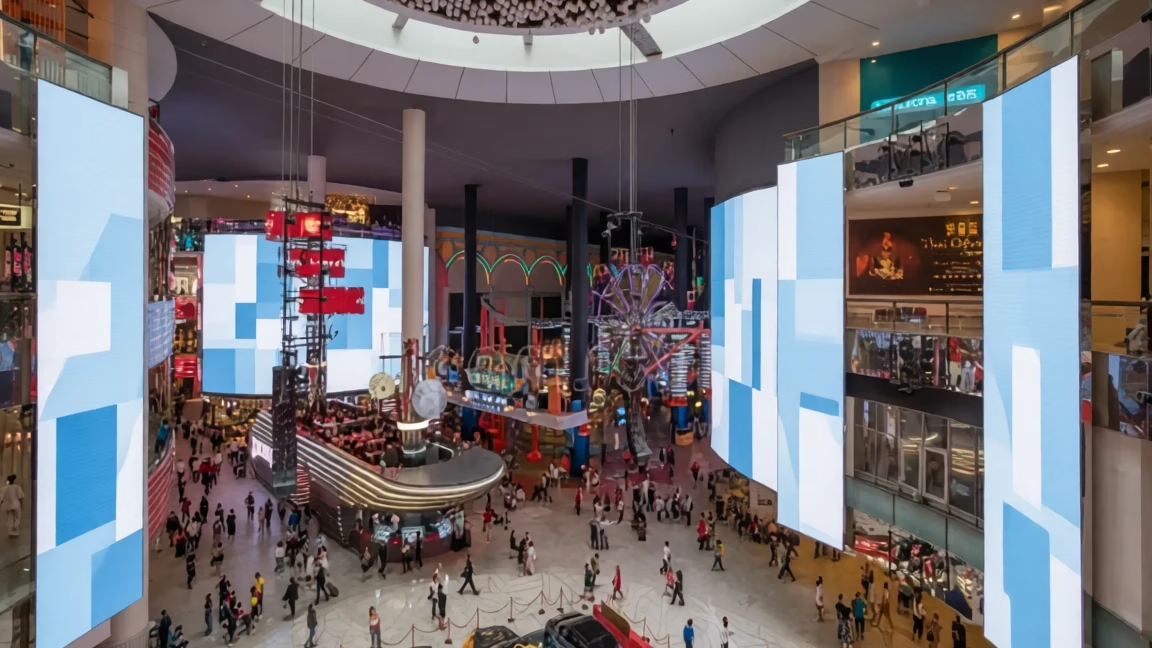
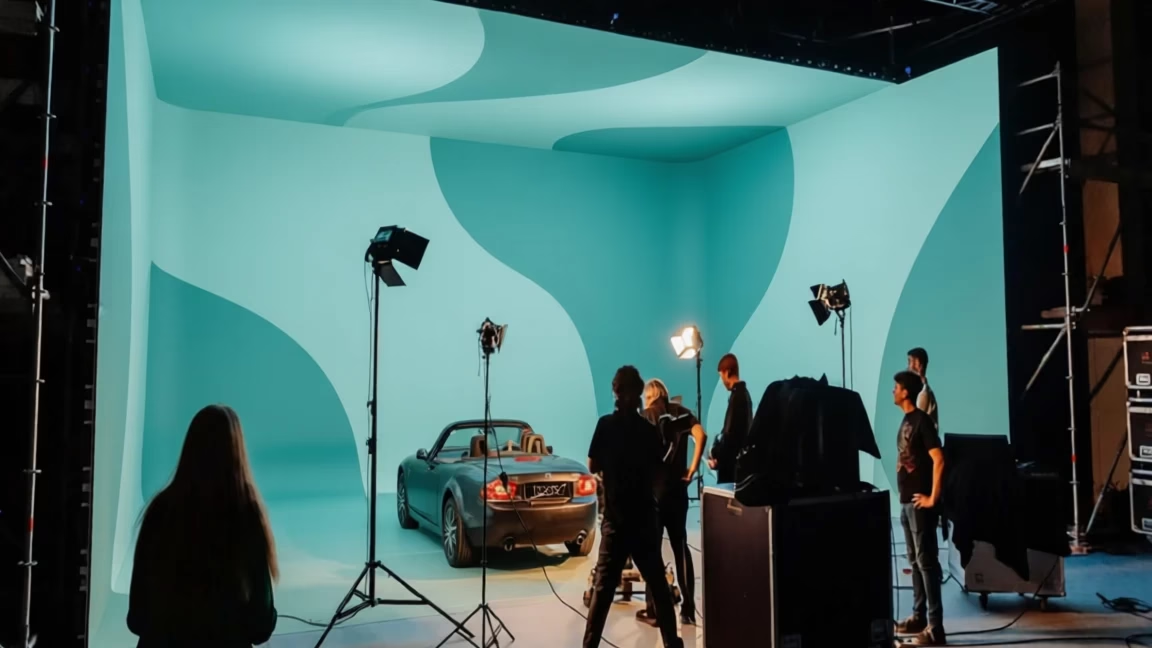
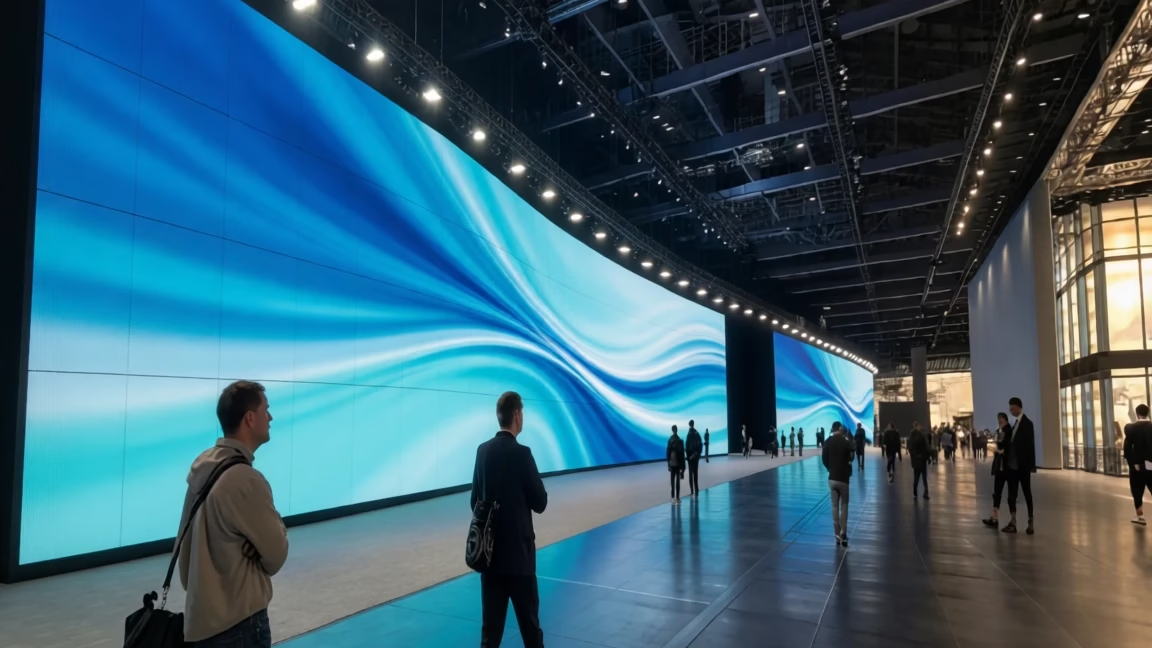
These are the big rooms — the ones where the closest viewer is 3–12m out and the wall is large enough that per-square-meter cost decides who wins the bid. That is exactly the P2.976 contract.



Reference Projects
What Have P2.976 Indoor Rental LED Display Builds Looked Like?
Reference configurations our production floor has shipped in this spec — the package sizes our crews load most often:
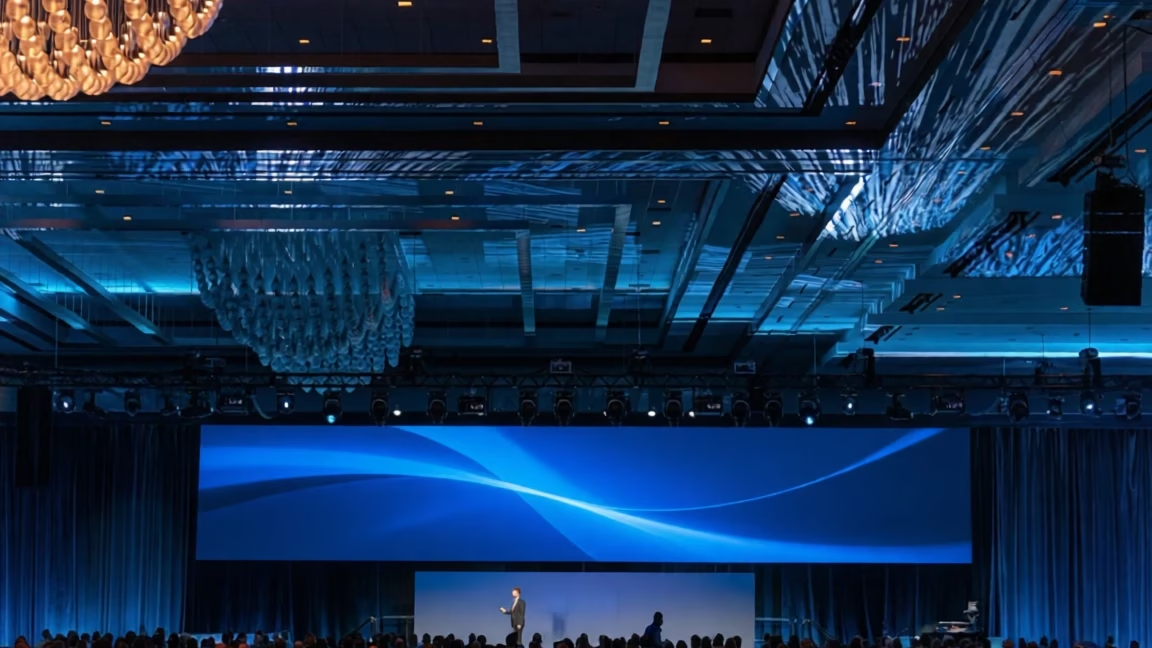
Convention Package
10 × 4m · 40㎡
640 modules in 80 of the 500×1000mm cabinets — the headline wall priced to win. 800–1,200 nits copper-wire build, 3,840Hz standard, one-morning build at 80 boxes.

Concert Package
2 × (4 × 3m) Side Screens · 24㎡
384 modules in 48 of the 500×1000mm cabinets, flown as IMAG pairs. Gold-wire 1,200+ nits tier for stages with heavy wash light.
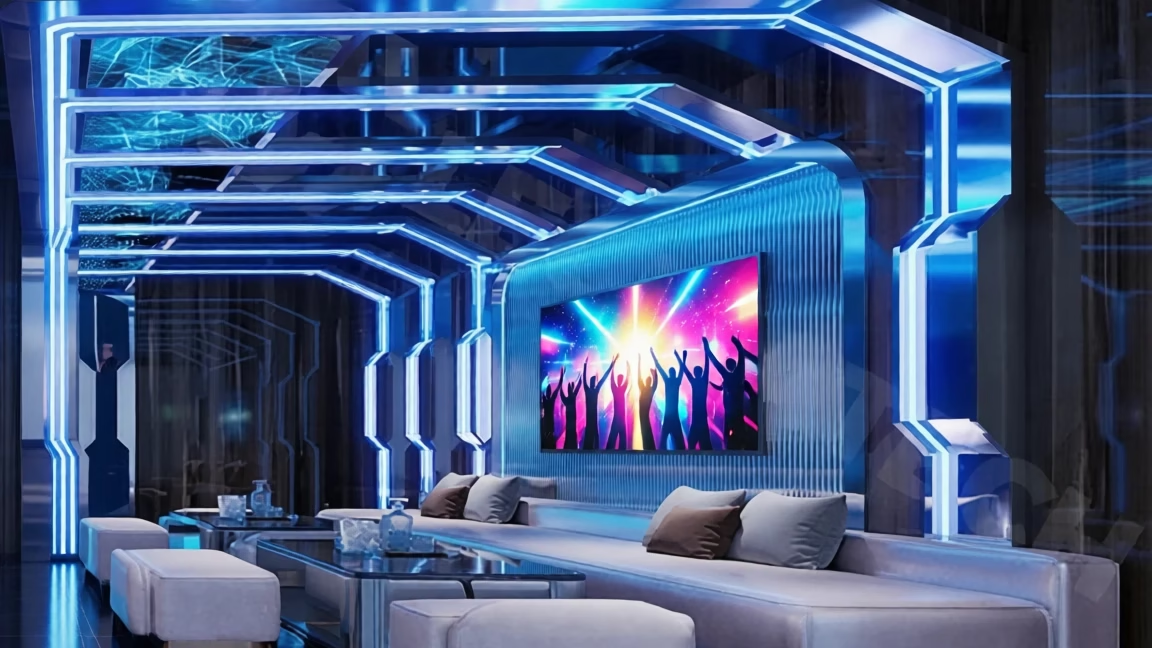
KTV Curve Package
≈30㎡ · Curved & Corner Builds
Around 480 modules across inside-corner, outside-corner and flat runs from one cabinet fleet — the curve-lock geometry quoting per design, no special boxes.
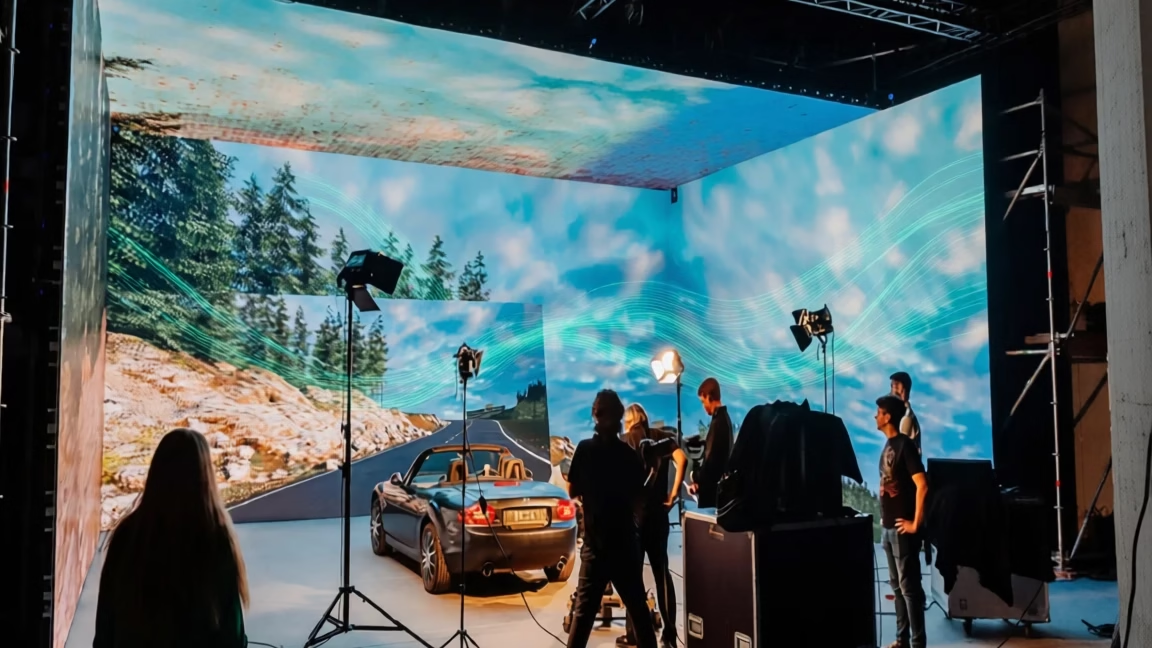
Streaming Package
8 × 3m · 24㎡
384 modules in 48 of the 500×1000mm cabinets, ground-stacked behind the desk. 800–1,200 nits base for controlled studio light, 3,840Hz for the camera chain.
Named project case studies with site photography follow once client sign-offs clear — ask us for references in your region meanwhile.
FAQ
P2.976 Indoor Rental LED Display: Frequently Asked Questions
What viewing distance does a P2.976 indoor rental LED display need?
Plan for a minimum of about 3m and a working band of 3–12m. At 2.976mm pitch and 112,896 pixels per square meter, the wall reads as clean video from roughly three metres out — convention halls, ballrooms, concert side stages and exhibition aisles all sit comfortably inside that band.
How does P2.976 compare with P2.604 for rental fleets?
P2.976 carries 112,896 px/㎡ against P2.604’s 147,456 — about 23% fewer lamps — and prices roughly one tier lower per square meter. Its native 1080p canvas is larger (5.71 × 3.21m vs 5.0 × 2.81m), and it adds curve-capable locks the P2.604 build does not include. Fleets buy P2.976 by the truckload for volume rooms and keep finer pitches for the camera-close jobs.
How do inside and outside corner builds work?
The cabinet locks are cut for it: the same die-cast boxes that stack a flat wall can be stepped at an angle to form inside corners and outside corners, so an L-shaped set, a wrap-around DJ booth or a column-hugging wall comes from the standard fleet. No special curved cabinets are ordered — the curve is a layout decision, quoted per design.
Why is 1/21 scan the right match for this module?
Because the numbers divide. The module is 84 rows tall and 1/21 scan lights exactly 4 rows at any instant — 84 ÷ 21 = 4, with no uneven multiplexing. Each of the 63 driver ICs carries exactly 112 dots. That native match is part of why this pitch runs efficiently and evenly where a forced scan ratio would flicker or run hot.
What does national-standard pure-copper wiring actually change?
Longevity and consistency. Pure-copper power and signal lines hold their cross-section and contact pressure through years of connect-disconnect cycles, so voltage drop stays low and joints stay tight — fleet walls stop developing the intermittent faults that copper-clad or thin conductors grow after a season of flight cases.
Is 3,840Hz enough for broadcast trucks and livestreams?
Yes — 3,840Hz high refresh is standard on this collection and is the camera-safe tier the market charges extra for. Paired with synchronous control it holds a long broadcast program day stable: steady load across hundreds of cabinets, no scan lines on camera, no roll bars when the truck genlocks the chain.
How many cabinets make a 1080p P2.976 wall?
A native 1920×1080 image on this pitch is 5.71 × 3.21m — about 18.4㎡. On the 500mm cabinet grid that usually rounds to a 6 × 3.5m wall (2016×1176 pixels) built from 42 of the 500×1000mm cabinets, with the processor scaling the small difference. The screen size guide works out any target dimension.
How much does a P2.976 indoor rental LED display cost?
Roughly $700–1,200 per square meter FOB (2026-09 market listing scan) — about $44–75 per 250×250mm module at 16 modules per square meter. Lamp grade, the gold-wire brightness tier and curved-build planning move a specific quote inside that band; the same 15-events-a-year buy-vs-rent crossover applies.
Engineering Guide
Why Is P2.976 the Volume Pitch of the Indoor Rental Family?
Every product family has a volume line — the specification that wins most of the bids, fills most of the trucks and pays for the warehouse. In indoor rental LED that line is P2.976: 250×250mm modules carrying 84×84 pixels, at a per-square-meter price the finer pitches cannot touch. This guide walks through why the numbers landed where they did, and how to spec the collection so a fleet earns on every job.
The economics of 84×84
Everything about this pitch follows from one ratio: 112,896 lamps per square meter is about 57% fewer than P1.953 and 23% fewer than P2.604, while the 3-metre viewing floor still covers the majority of large indoor rooms. Fewer lamps mean less material in every module, less current in every cabinet and fewer failure points in every fleet — savings that compound into the lowest per-square-meter price in the family. On a 40㎡ convention wall, choosing P2.976 over a finer pitch saves enough to fund the truss, the flight cases and the crew, and still lands under the finer-pitch hardware bill. That is what “volume pitch” means in practice: not a compromise the client notices, but a margin the rental company keeps.
The content canvas scales just as cleanly. At 336 dots per metre, a native 1080p frame is 5.71 × 3.21m — and because real walls round to the cabinet grid, the practical 1080p-class canvas is a 6 × 3.5m wall at 2016×1176 pixels. Bigger rooms simply grow the canvas outward: the 10×4m convention wall shows 3360×1344, more resolution than most broadcast pipelines deliver, at a price per square meter that lets the wall be that big in the first place.
The 1/21 scan is not arbitrary — it is the native match
Scan ratios look like trivia until they are wrong. This module is 84 rows tall; a 1/21 scan lights exactly 4 rows at any instant, and 84 divides by 21 with nothing left over. Each of the 63 driver ICs then carries exactly 112 dots. The even split is why the wall runs cool, refreshes to 3,840Hz without strain, and shows no multiplexing artifacts when the camera pans — the scan was designed around the geometry, not forced onto it. When a supplier quotes a different scan ratio on this pitch, it is worth asking what the rows divide into.
Pure copper, sorted lamps and hardware correction: the fleet trifecta
Volume fleets live and die between shows, and three build choices on this collection are aimed squarely at that life. National-standard pure-copper power and signal lines hold their contact through thousands of connect-disconnect cycles — the single biggest source of intermittent faults in aging fleets is wiring, and this build removes it. Wavelength-and-brightness sorting before assembly means every module starts within a tight bin, and hardware-based per-pixel correction through the control system — compensation stored in the equipment, not in a laptop — holds the wall uniform after any module swap. Add magnetic front service and screw rear service both supported, and the service question on show day is never “how do we open this” but only “which side is closer.”
Curves from the same fleet
The lock geometry on these cabinets does something the finer pitches in the family do not: inside corners and outside corners build from the standard fleet. Step the boxes and a flat wall becomes an L-shaped set, a wrap-around booth, a column-hugging corridor wall — the creative shapes that used to require special curved cabinets now come from the same truck. For a rental company that means one inventory covers the flat-wall majority and the creative premium jobs alike; for the client it means the curve does not carry a cabinet surcharge, only the design time. Our stage backdrop guide shows where curved builds earn their keep.
Design content for the 336-dot canvas
At 336 dots per metre, a character 40 pixels tall stands about 119mm on the wall — readable from the back of a hall this pitch serves, which changes how decks and loops should be built. Compose at the wall’s real size rather than inside a presentation template: a 10×4m convention wall is 3360×1344, and artwork made at that size fills the canvas edge to edge instead of floating in scaled black bars. Venue content on this pitch also moves faster — highlight reels, live IMAG, scoreboards — because the audience distance forgives motion that would expose a finer wall’s scan behavior, and the 1/21 scan’s even multiplexing keeps those pans clean on camera.
One design habit pays for itself across a whole season: plan the grid before the graphics. Curved builds shift module seams to deliberate angles, and artwork that respects the seam map — logos centered inside a cabinet field, motion flowing across rather than against the curve — reads as a custom installation rather than a wall bent to fit. The resolution guide covers the pixel math for any target canvas.
Broadcast-day behavior and the fifteen-event line
On the day, this pitch behaves like broadcast equipment: synchronous control with stable heavy-load behavior across hundreds of cabinets, 3,840Hz refresh that holds camera chains clean, and phone or cloud dashboards when a venue runs several walls at once — the control architecture our sync vs async guide covers in full. Then the ownership arithmetic: at $700–1,200 per square meter FOB against $55–110/㎡ daily rental rates, the fifteen-event crossover lands even earlier than on finer pitches — a fleet that works even twenty days a year is cheaper owned than rented. Send us the room, the wall size and the event calendar, and the quote comes back module-level with the lamp grade, wire tier and cabinet mix itemized.
The short version: a P2.976 indoor rental LED display is the volume workhorse — 112,896 pixels per square meter, clean from 3m out, a 5.71 × 3.21m native 1080p canvas, curve-capable locks on every cabinet, national-standard pure-copper wiring and a 1/21 scan that divides the module evenly. It is the pitch that lets rental businesses say yes to the biggest walls at the best margin.
Related P2.976 Indoor Rental LED Display Resources
P1.953 Indoor Rental LED Display Collection →
500×500mm Rental LED Display Collection →
500×1000mm Rental LED Display Collection →
Rental LED Display Solutions →
LED Screen Maintenance Guide →
Spec Your P2.976 Indoor Rental LED Display With Our Engineers
Send us the room, the wall size and the event calendar. The quote comes back itemized line by line — lamp grade, wire tier, cabinet mix, curve plan, control stack — factory-direct, with 3% spare modules in every order.
UnifyLED — LED screen manufacturer · unifyledscreen@gmail.com · Changsha / Shenzhen, China
Browse our guides: P2.6 vs P3.91 Rental LED Screen
Browse our guides: Panel Weight for Truss Limits