
The Value Pitch · Fixed Installation
P4 Outdoor LED Display Collection
Four module formats on the 4mm value pitch — the 320×160mm production standard, long 256×128mm boards, square 256×256mm panels and a 250×250mm die-cast rental format. Over 5,500 nits against the sun, IP65-sealed fronts, and the widest cabinet choice in the outdoor range.
Definition
What Is a P4 Outdoor LED Display?
Short answer: A P4 outdoor LED display is a weatherproof video wall whose LEDs sit 4mm apart — 62,500 pixels per square meter — and it is the value champion of the outdoor range: sharp enough to read from 4 meters, priced well below the 3mm class. It comes in four module formats (320×160mm, 256×128mm, 256×256mm, 250×250mm), runs ≥5,500 nits behind an IP65 front, and works with every mainstream receiving card. For most fixed outdoor signage viewed from 4–10 meters, P4 is where budget and clarity meet.
A P4 outdoor LED display is a fixed-installation video wall assembled from SMD modules with a 4mm center-to-center pixel distance — 62,500 pixels in every square meter, on SMD1921 lamps chosen for exactly this pitch class. It occupies the middle band of outdoor viewing: from 4 meters the pixel grid dissolves, and out to roughly 10 meters it delivers the same perceived sharpness as finer pitches at a fraction of the LED count.
That arithmetic is the whole appeal. A P4 wall drives about 40% fewer LEDs per square meter than the P3 outdoor class — and LEDs dominate the bill of materials — so the same meterage costs meaningfully less while the audience, standing beyond 4 meters, sees no difference. For the category background, see outdoor LED display types and the outdoor LED module guide; run your wall through the LED screen calculator.
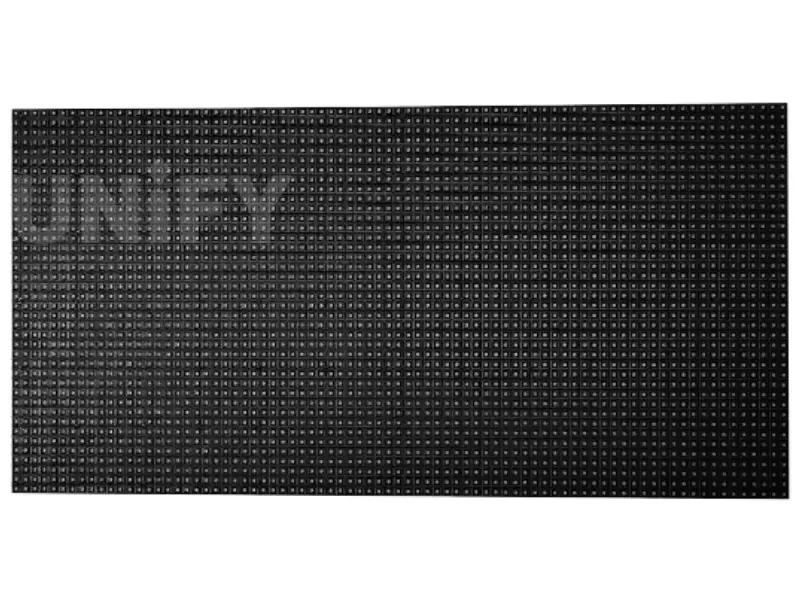
One number anchors every decision on this page: 62,500 pixels per square meter. A 4×3m wall resolves 1,024×768 — enough for full-motion video read comfortably at 4–10m — at a per-square-meter cost that lets buyers say yes to bigger walls. If your closest viewer stands under 4 meters, step up to the P3 outdoor collection; beyond 10 meters, the P5 class and coarser pitches buy the same perceived quality for less.
Module Options
Which Module Sizes Does a P4 Outdoor LED Display Use?
Four formats cover the P4 outdoor range — the widest cabinet spread of any pitch class. All produce the same 62,500 px/㎡ wall; they differ in board shape, cabinet pairing and IC count. IC counts are total devices fitted per module (driver + decode + row transistors) and scale with scan mode.
① 320×160mm — The Absolute Mainstream

The board most of the industry ships for outdoor 4mm walls: 80×40 pixels, 15.the 960×960mm waterproof iron or aluminum cabinet family as its native home — eighteen boards fill a 960×960, twenty-four fill a 1280×960, eight fill a 640×640, and a magnesium-aluminum option (960×960 / 1280×960, internal soft-connection wiring) covers premium builds. Rear maintenance is standard, and the 320×160 format is the one most often built with front-service options: face-screw modules for economy or lock-catch modules for tool-free access on walls without a rear corridor. The same board suite accepts P2.5 through P10 modules, so the cabinet you buy today survives every future pitch change.
| Pixels per module | 80×40 = 3,200 dots |
| ICs fitted (total) | 30–60 · driver ICs from Chipone, Macroblock, SM Micro or Fuman |
| LED type | SMD1921 · Grade 1 (premium) / Grade 2 (value) |
| PCB | 1.6mm FR-4 fiberglass board |
| Maintenance | Rear standard · front face-screw or lock-catch builds common |
| Cabinets | 1280×960mm (×24) · 960×960mm (×18) · 640×640mm (×8) waterproof iron/aluminum — A960 series · OK series; magnesium-aluminum option (960×960 / 1280×960, internal soft-connection) |
| Brightness | 5,500–6,500 nits (copper/alloy wire) · 7,000–10,000 nits (gold-wire high-brightness build) |
| Scan & refresh | 1/10 or 1/8 scan · standard / high-refresh optional |
| Uniformity | Strict binning standard + factory and on-site per-pixel calibration |
| Density / viewing | 62,500 px/㎡ · view from ~4m |
② 256×128mm — The Traditional Long Board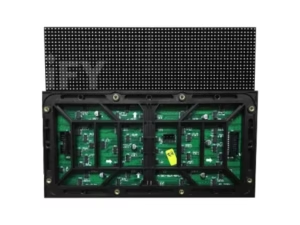
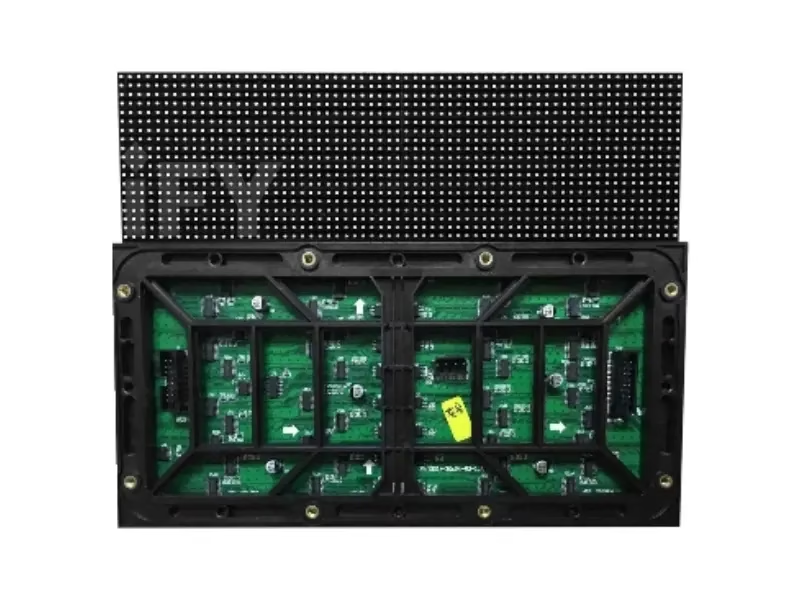
The long-strip format that 256-series cabinets were built around: 64×32 pixels per board, 23.4 boards per square meter, pairing with 768×768mm cabinets (eighteen boards) and long 1024×768mm cabinets (twenty-four). The long board means fewer mounting events per wall and long horizontal LED runs — a format many signage factories still standardize on. Rear maintenance standard.
| Pixels per module | 64×32 = 2,048 dots |
| ICs fitted (total) | 16–32 · driver ICs from Chipone, Macroblock, SM Micro or Fuman |
| LED type | SMD1921 · Grade 1 (premium) / Grade 2 (value) |
| PCB | 1.6mm FR-4 fiberglass board |
| Maintenance | Rear standard |
| Cabinets | 768×768mm iron (×18) · 1024×768mm iron (×24) |
| Brightness | 5,500–6,500 nits (copper/alloy wire) · 7,000–10,000 nits (gold-wire high-brightness build) |
| Scan & refresh | 1/8 scan · standard / high-refresh optional |
| Uniformity | Strict binning standard + factory and on-site per-pixel calibration |
| Density / viewing | 62,500 px/㎡ · view from ~4m |
③ 256×256mm — The Traditional Square
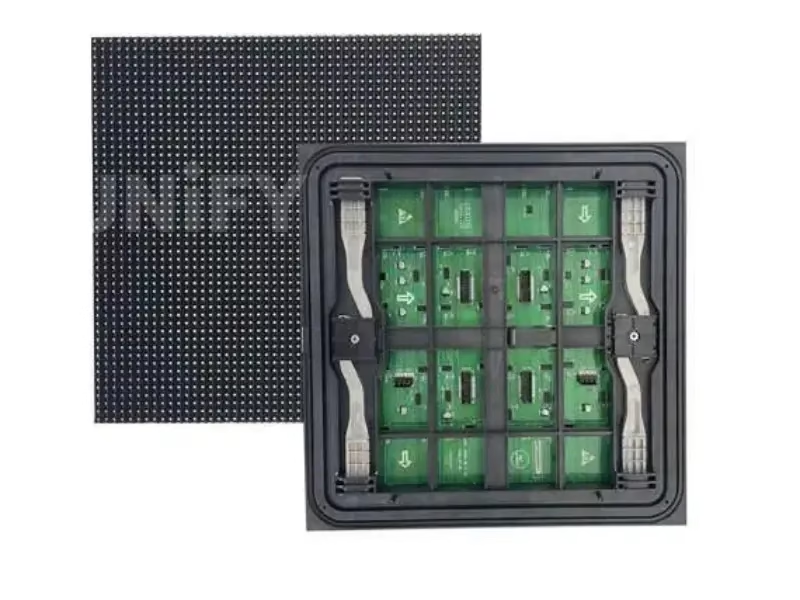
The square board for 256-series and 512-series architecture: 64×64 pixels per board, 15.3 boards per square meter, filling a 512×512mm cabinet four at a time or a 768×768mm cabinet nine at a time. Square boards suit symmetric wall proportions and keep spares uniform; rear maintenance is standard.
| Pixels per module | 64×64 = 4,096 dots |
| ICs fitted (total) | 32–64 · driver ICs from Chipone, Macroblock, SM Micro or Fuman |
| LED type | SMD1921 · Grade 1 (premium) / Grade 2 (value) |
| PCB | 1.6mm FR-4 fiberglass board |
| Maintenance | Rear standard |
| Cabinets | 512×512mm iron (×4) · 768×768mm iron (×9) |
| Brightness | 5,500–6,500 nits (copper/alloy wire) · 7,000–10,000 nits (gold-wire high-brightness build) |
| Scan & refresh | 1/8 or 1/16 scan · standard / high-refresh tiers |
| Uniformity | Strict binning standard + factory and on-site per-pixel calibration |
| Density / viewing | 62,500 px/㎡ · view from ~4m |
Watch It Built
What Does a P4 Outdoor LED Display Look Like in Production?
Board Build
How Thick Is the PCB in a P4 Outdoor LED Display Module?
The PCB in a P4 outdoor LED display module is a 1.6mm fiberglass (FR-4) board. At 4mm pitch the board carries 3,200 lamps on the mainstream format — a third of the solder density of the P2.5 class — so a standard 2-layer 1.6mm board handles the current with margin to spare, and its job is flatness: keeping 3,200 joints seated against the mask through −30°C nights and 60°C+ sun-facing surface temperatures.
FR-4 Fiberglass
Glass-epoxy class that self-extinguishes and resists warpage — thickness below 1.6mm is where boards start to bow and lamps lift at the edges.
Conformal Coating
The solder side carries a three-proof varnish against moisture, salt and dust; roadside and coastal walls step up to a full GOB pour over the lamp face.
SMD1921 Lamp
The industry-standard lamp for P3–P4 outdoor duty — large enough for 5,500+ nits and heat dissipation, smaller and newer than the legacy 3535 outdoor package.
What Contrast and Grayscale Does a P4 Outdoor LED Display Reach?
Two numbers decide how “real” the picture looks before brightness ever enters the conversation: the contrast ratio and the grayscale depth. Both are component choices — mask and lamp on one side, driver IC on the other — and both are specified in writing on our P4 Outdoor LED Display production sheets.
Black mask — 5,000:1
Spraying the module mask with black ink lifts the contrast ratio to about 5,000:1. Blacks stop washing out under ambient light, and colors read closer to true — the difference between a wall that looks like a mirror in daylight and one that disappears into the picture.
SMD vs DIP — and the black-face option
SMD packaging out-contrasts legacy DIP by geometry — less exposed reflective surface per lamp. Step up to black-face 1921 lamps and contrast climbs further. The trade-off: at the same current a black-face lamp is dimmer than a white one, so the power run needs heavier-gauge wire and the build costs more. The payoff outdoors is no-glare, mirror-free daylight performance and truer color.
Grayscale — 8 / 12 / 16-bit
Grayscale depth ships in 8-bit, 12-bit and 16-bit per color, and the number is decided by the driver IC — not the lamp. Higher bit depth shows first in dark gradients: a wall that dims after midnight needs 16-bit, or night content bands where the shading should be smooth.
Contrast and brightness pull against each other — a black-face, black-masked wall reads deeper but needs the brightness tier to match. The brightness guide covers how we balance the two on export builds.
Power
Which Power Supply Brands Does a P4 Outdoor LED Display Use?
A P4 outdoor LED display runs on 5V switching supplies from three brands we fit in production: Chuanglian Power (创联), MEAN WELL (明纬) and G-Energy (巨能伟业). Each 960×960mm cabinet carries its own 5V 40A (200W) supply, so a failed unit takes down about one square meter of wall — not the whole face.
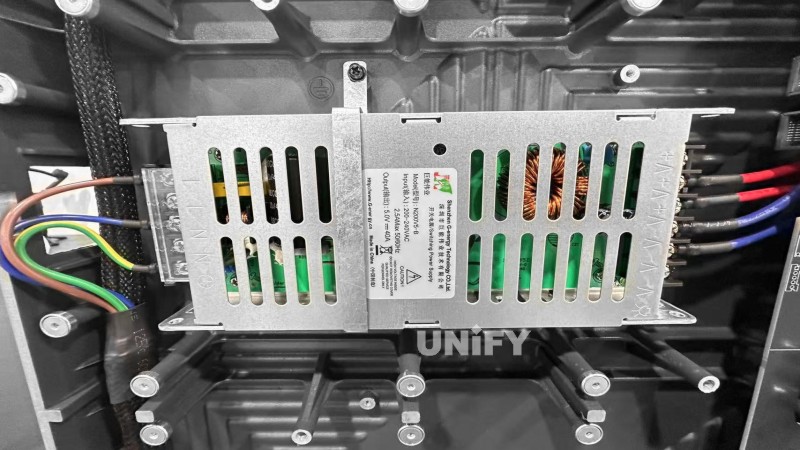
Budget check: at 62,500 pixels per square meter, a P4 outdoor wall averages 350–450W/㎡ on mixed content and peaks near 500–650W on full white — the lightest power bill of the fine outdoor pitches. Watch the field-test video above for measured numbers, and size the feed with headroom for inrush.
Control Stack
Which Control Systems Work With a P4 Outdoor LED Display?
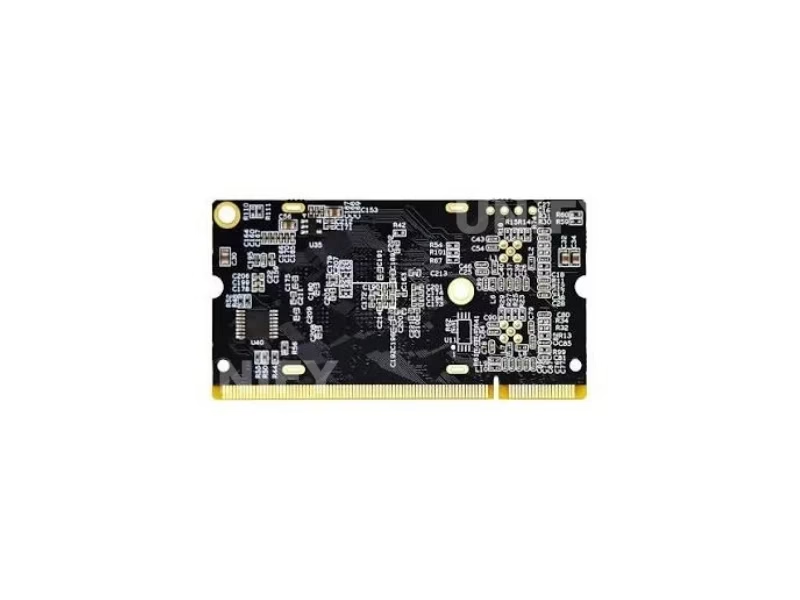
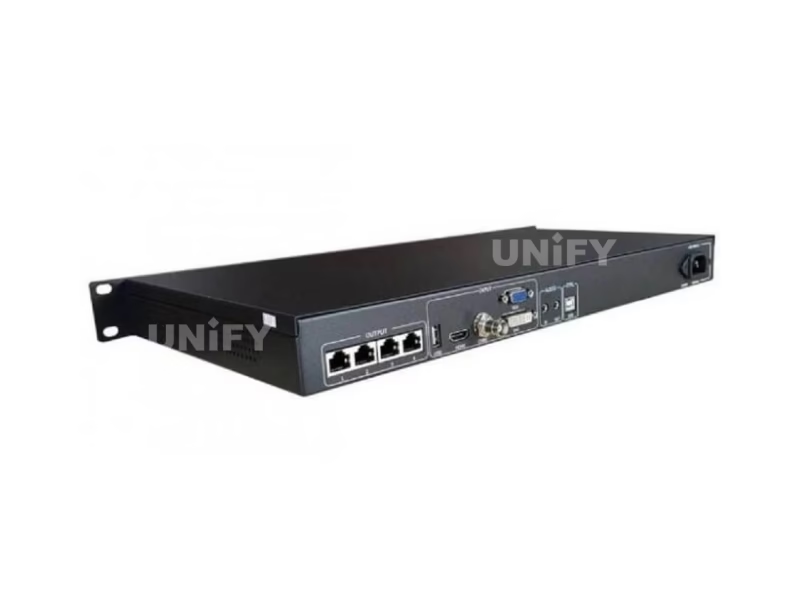
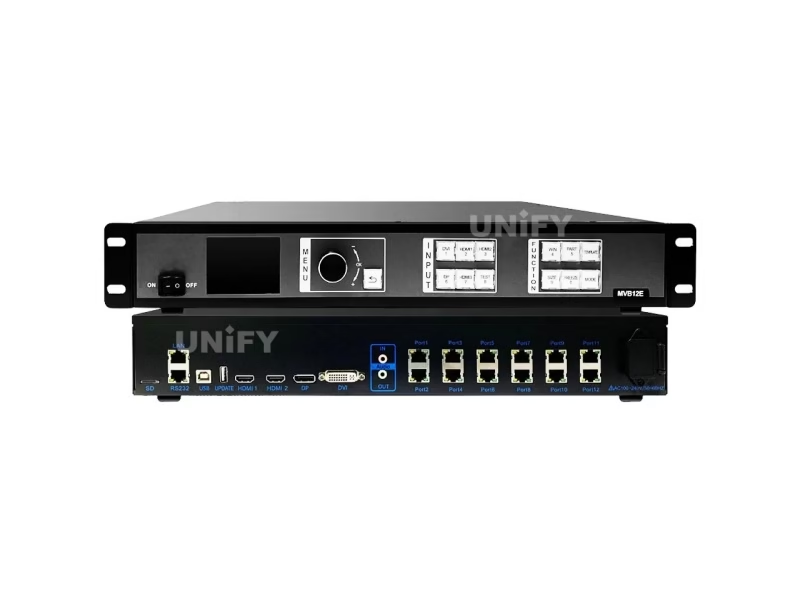
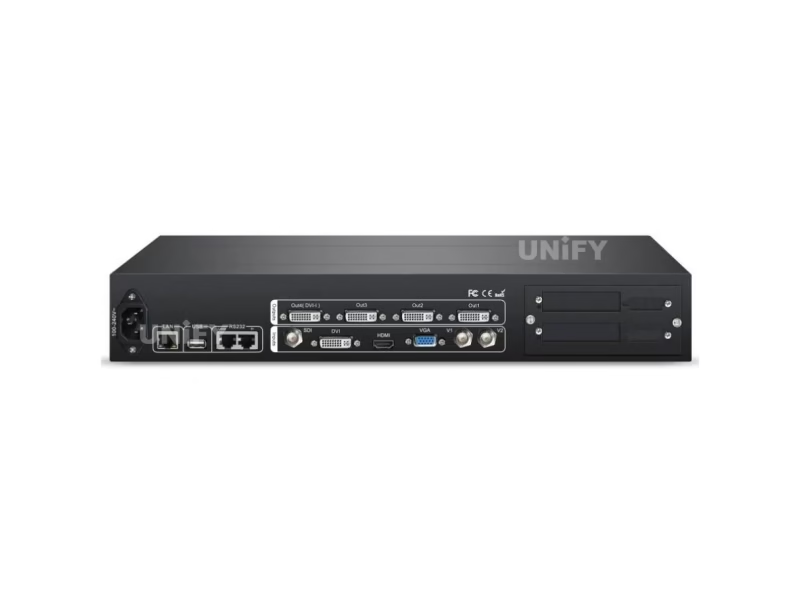
Six hardware ecosystems fit these HUB75 modules — four control platforms plus two video-processing lines. Pick one ecosystem and stay in it, because sending cards and receiving cards must come from the same family: Two control modes fit every ecosystem: synchronous cards drive large-area walls and TV-broadcast scenarios in real time, while asynchronous cards serve smaller walls with app-based scheduling and cloud publishing.
NovaStar

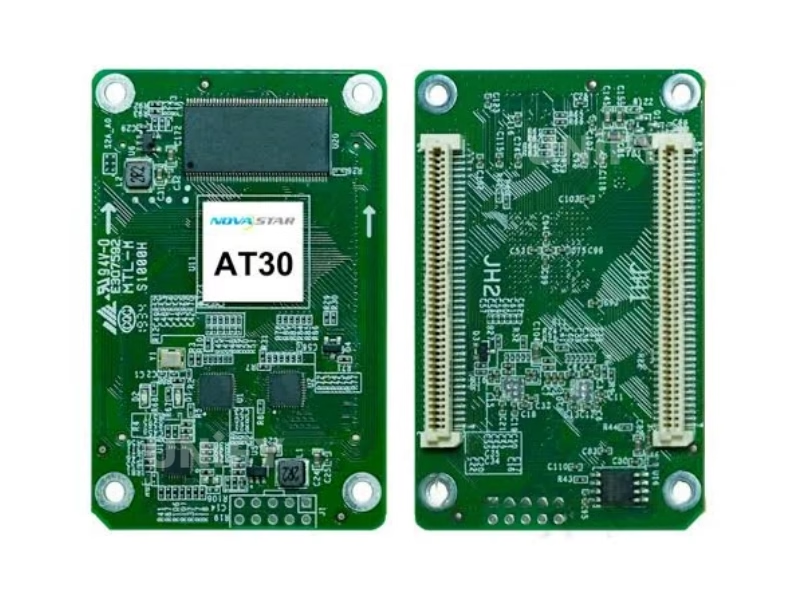
The broadcast-grade default. AT30-class receiving cards pair with MCTRL/VX senders; calibration and brightness-ramping tools are the industry benchmark.
Best for: premium fixed installs, camera-facing walls
Colorlight
The value-performance leader. The i9-class and i5A family cover fixed walls; X-series processors handle the front end.
Best for: billboard and signage budgets
Huidu

The asynchronous specialist — VP-series all-in-one processors and C-class cards play scheduled content without a PC.
Best for: unattended signage, storefront screens
Mooncell

The rising third force — MVB 2-in-1 processors and A-series receivers at aggressive price points.
Best for: cost-controlled fixed installs
VDWALL

The touring-grade processor line — the LVP family drives rental stages and fixed walls with proven field reliability.
Best for: rental & touring LED walls
RGBlink
Switcher-processor hybrids with broadcast I/O — the mini and X families bridge live production and the wall.
Best for: live production & streaming
Synchronous Control (Sync)
Real-time playback driven by a sending card or video processor — what plays on the source plays on the wall instantly. The stable choice for large-area walls and television-broadcast scenarios, with cloud monitoring on top.
Best for: large walls, live video, TV broadcast
Asynchronous Control (Async)
An onboard card stores and schedules content from a phone app — no PC attached, runs unattended, supports cloud publishing over 4G/WiFi. The economical brain for smaller P4 walls and monitoring-style displays.
Best for: storefront & roadside signs, monitoring screens, scheduled playback
Watch: NovaStar Smart LCT platform introduction (NovaStar official)
Smart LCT is NovaStar’s configuration and calibration suite — the software layer that sets up every receiving card in a P4 wall. One rule above all: keep sender and receivers on the same platform — a NovaStar sender will not drive Colorlight receivers.
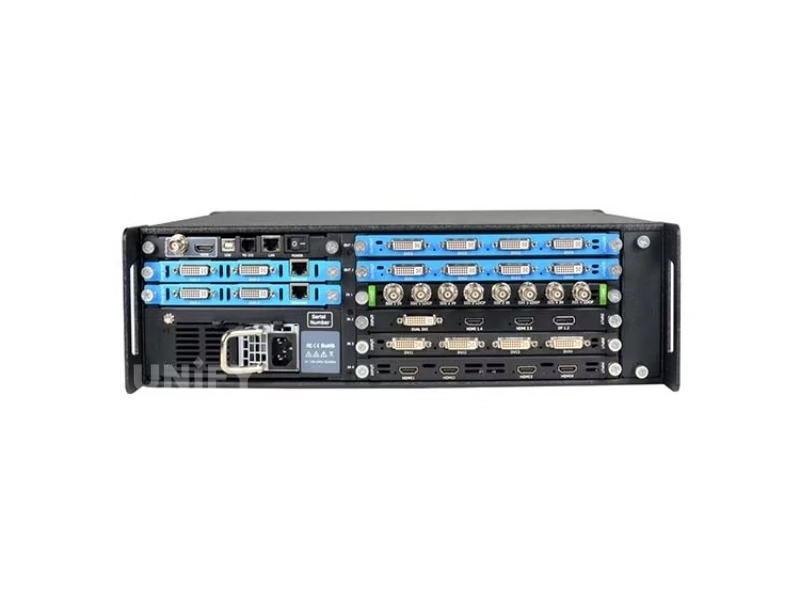
Adapted hardware across the six control and processing ecosystems we carry — each card links to its own spec page:
How Far Can You View a P4 Outdoor LED Screen?
Pitch sets the floor of the viewing range. Route yourself before you budget:
P4 or P5 — Which Outdoor Pitch Should You Buy?
This is the comparison buyers actually wrestle with, and it reduces to one measurement — your closest viewer:
The routing rule: viewer inside 4–8m — P4 pays for itself in sharper promotions; viewer never closer than 8–10m — P5 banks the difference. And if the wall is a touring asset rather than a fixed one, the die-cast rental path runs through P3.91 outdoor.
How Does P4 Compare With Other LED Display Pixel Pitches?
Density grows with the square of the pitch; the 1080p column lists the smallest 16:9 wall that reaches 1920×1080 on each pitch:
Pitch family detail pages: P1.5 · P1.8 · P2 · P2.5 · P2.6 · P2.9 · P3 · P4.81 · pixel pitch explained
Price Transparency
How Much Does a P4 Outdoor LED Display Cost?
Market reference ranges for 2026 (module prices scanned from retail listings, converted at 15.6 boards per square meter and checked against complete-wall quotes):
Reference: our own outdoor LED display price guide puts HD commercial fixed walls (P3/P4) at $800–1,200/㎡ across the market — factory-direct P4 sits at the accessible end of that band. Control hardware adds $500–2,000 per project; freight near $200–400 per cubic meter; local steel and installation running 20–30% of screen value. All figures are a market scan, not a quote.
Applications
Where Does a P4 Outdoor LED Display Deliver the Most Value?
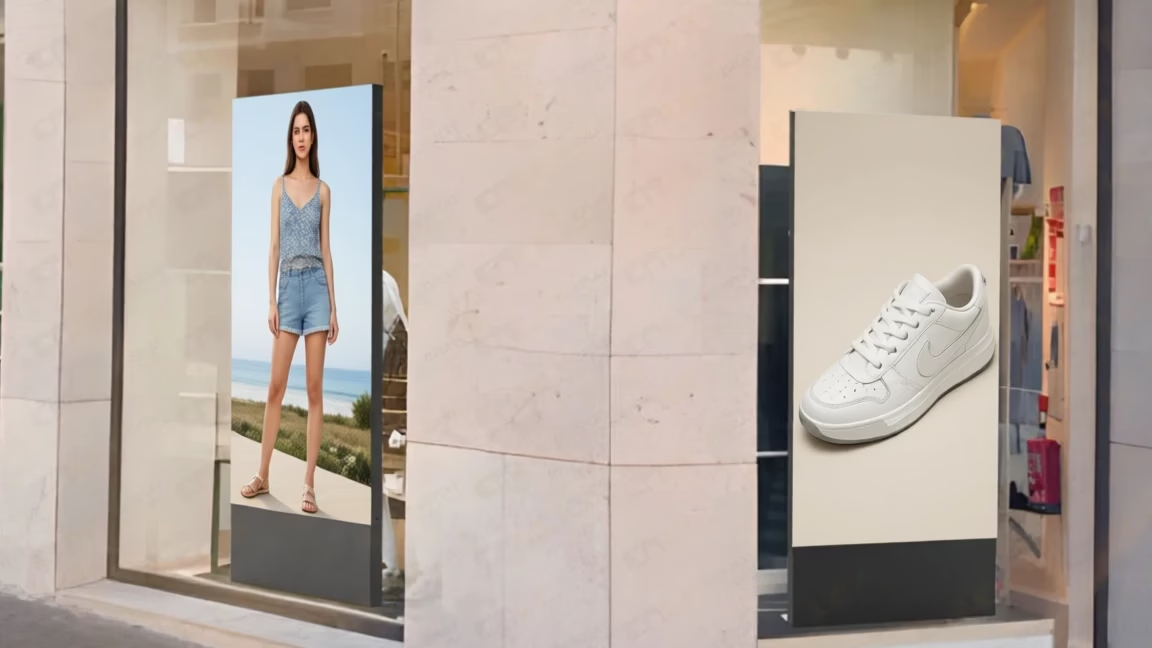
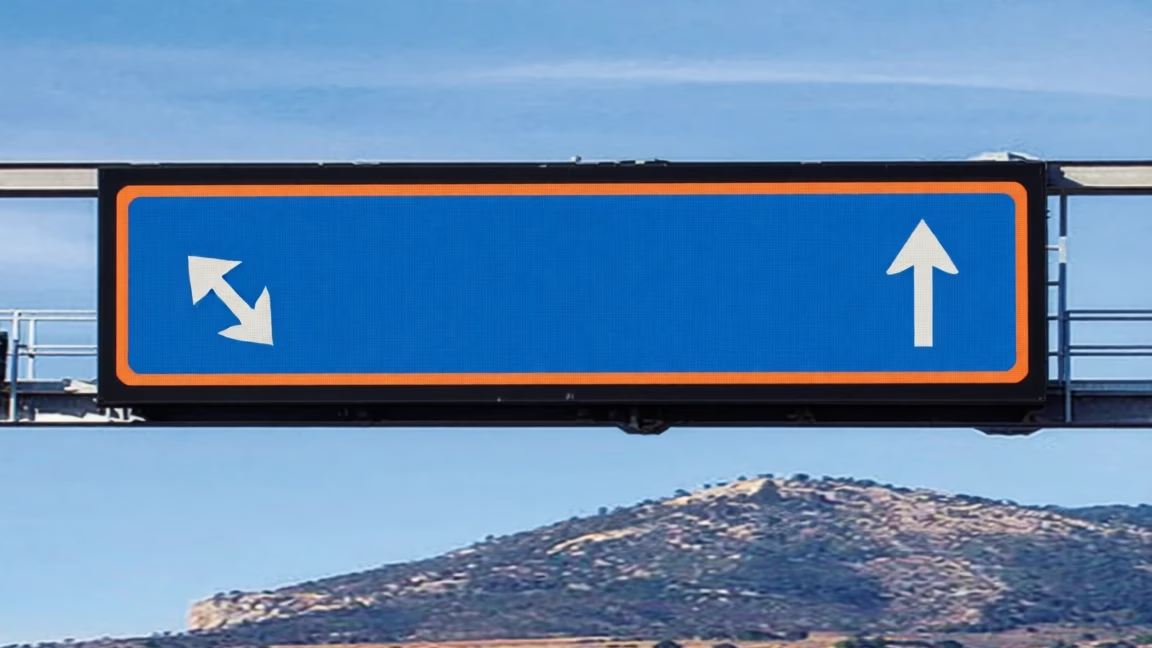
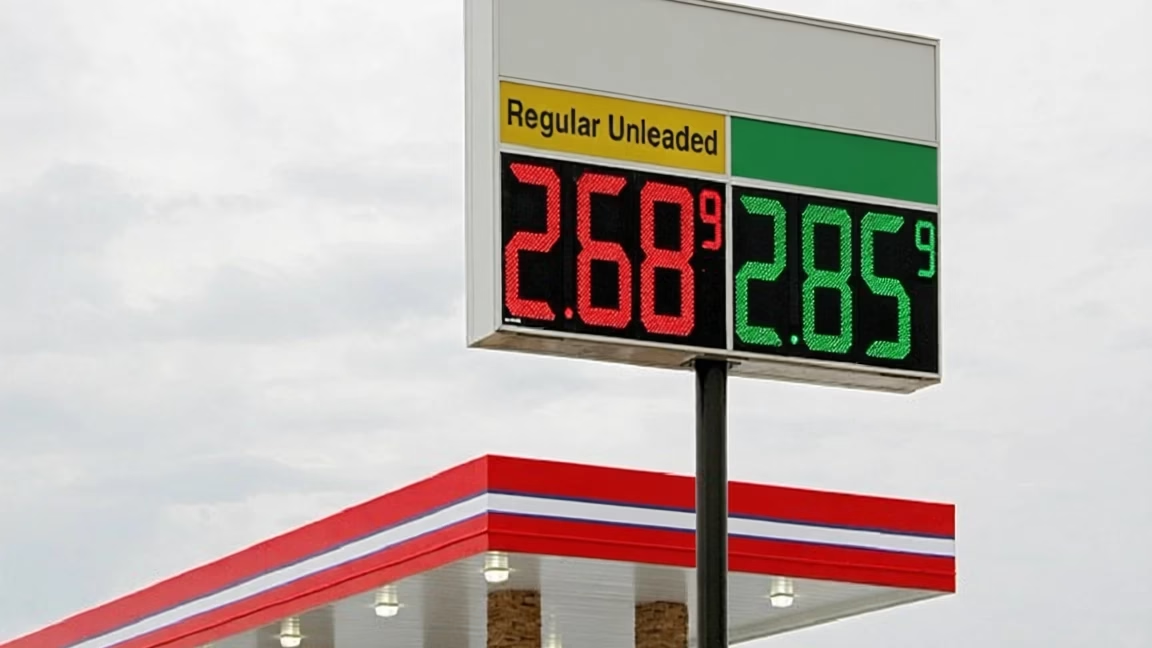
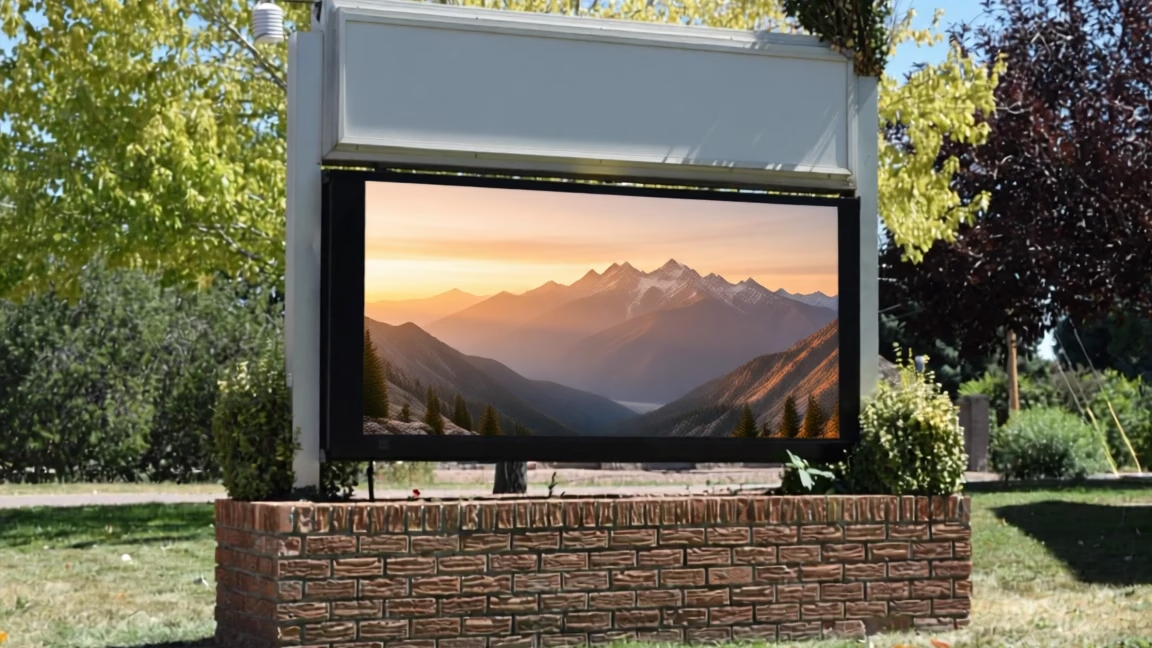
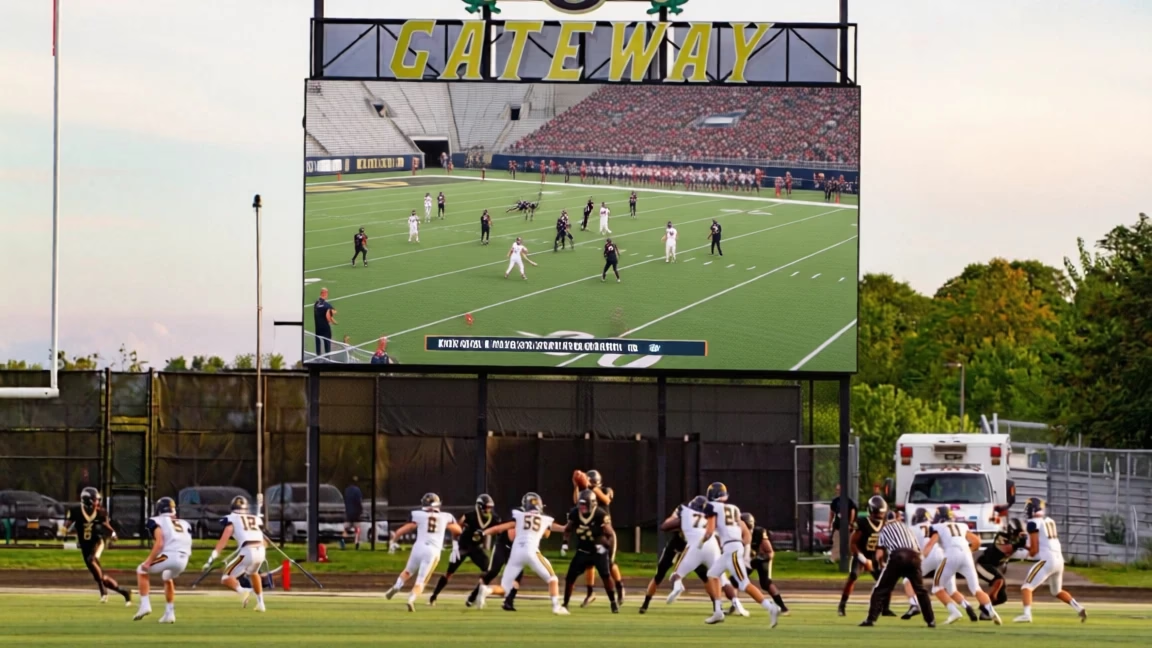
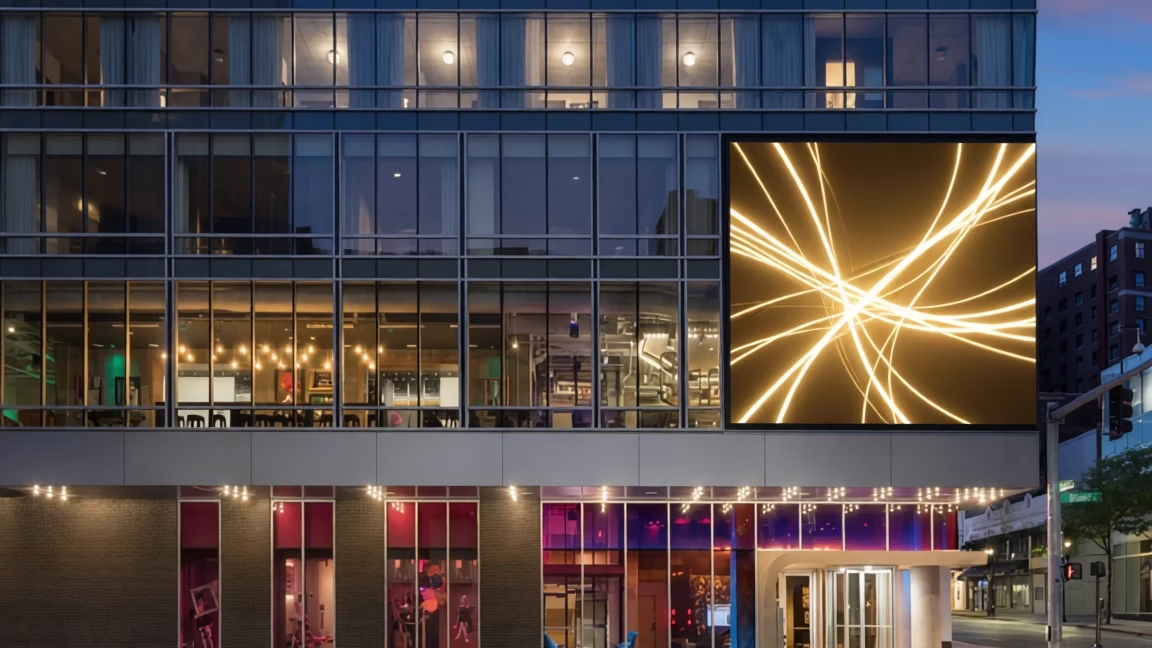
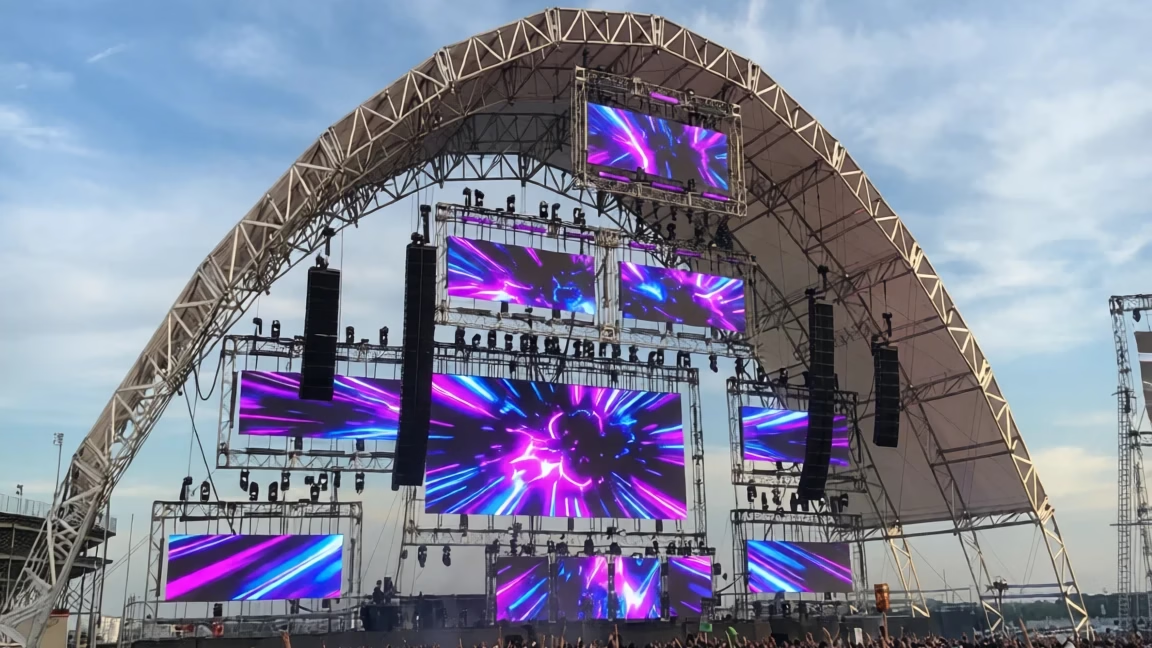
Eight placements where the 4–10m viewing band makes P4 the smart buy:

Projects
What Have Real P4 Outdoor LED Display Projects Looked Like?
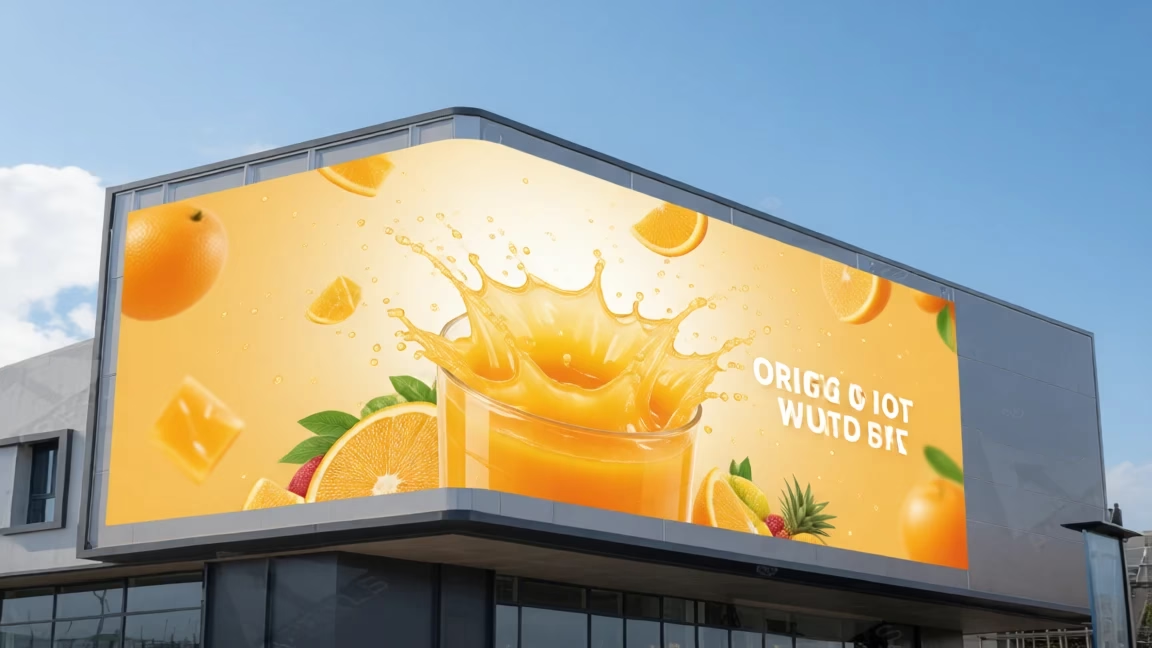
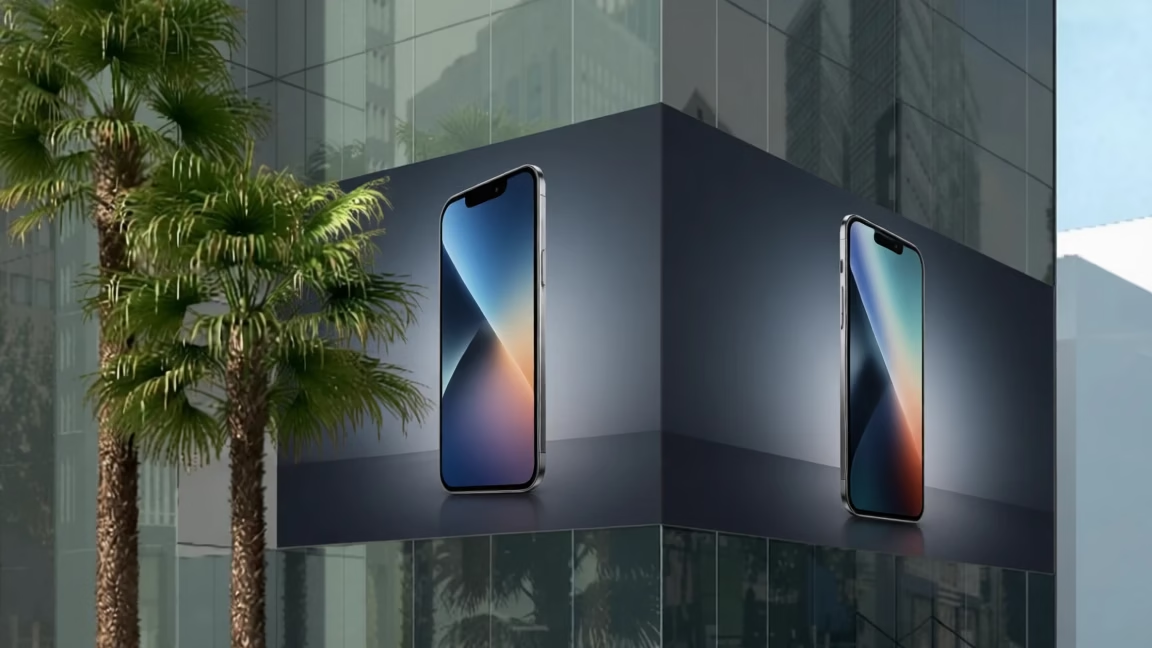
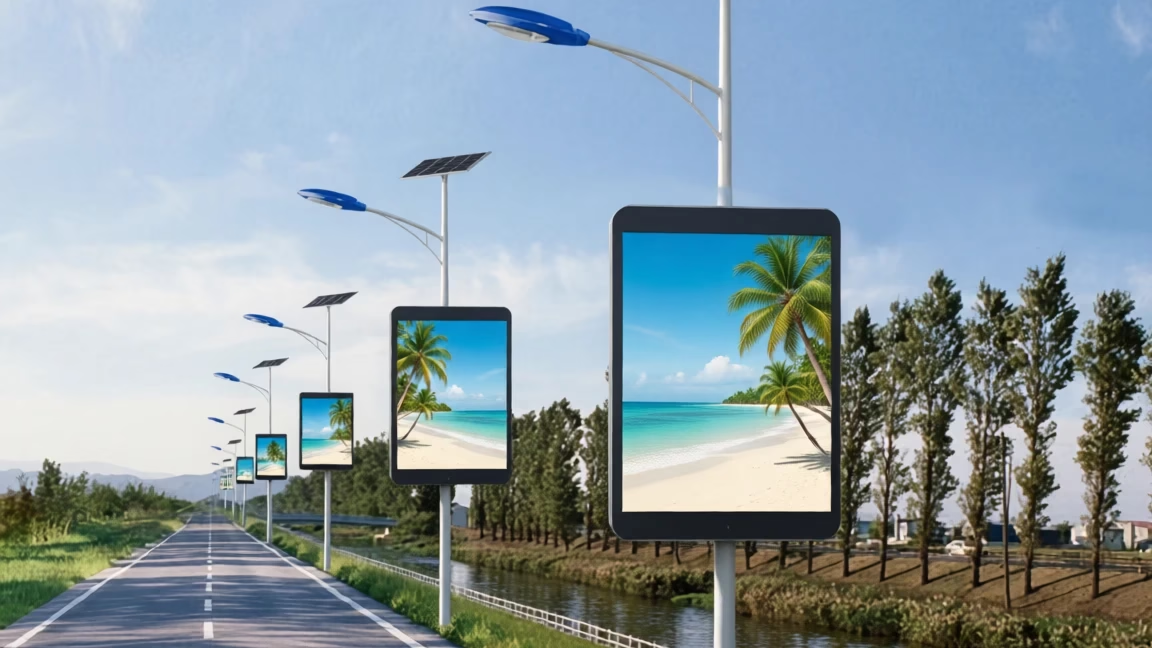
P4 outdoor projects share a familiar look — set back just far enough, readable in daylight, mounted where the audience passes. The three typical placements below show what a finished build looks like; ask us for named references in your market:
FAQ
P4 Outdoor LED Display: Frequently Asked Questions
Is P4 the best value outdoor pitch?
For walls viewed from 4–10 meters, yes — it is the balance point of the outdoor range. P4 drives about 40% fewer LEDs per square meter than P3, which is where the savings come from, yet at 4 meters and beyond the two walls read identically. Below 4 meters of viewing distance the advantage moves to P3; above 10 meters it moves to P5.
How many modules and cabinets make one square meter of P4 outdoor LED display?
The 320×160mm board: 15.6 per square meter. The 256×128mm board: 23.4. The 256×256mm board: 15.3. The 250×250mm board: 16. In cabinets: a 960×960mm iron cabinet takes 18 of the 320×160 boards (about 1.08 cabinets per square meter), a 512×512mm takes four square boards, and a 500×500mm die-cast cabinet takes four rental boards.
P4 or P5 — which should I buy for an outdoor sign?
Measure your closest viewer. Inside 4–8 meters, P4 pays for itself: small promotion text stays crisp where P5 softens. If nobody ever stands closer than 8–10 meters, P5 delivers the same perceived quality for less money and a lighter power bill. The decision is a tape measure, not a datasheet.
Why SMD1921 lamps — and how do they differ from SMD3535?
SMD1921 is the industry-standard lamp for P3–P4 outdoor duty: a 1.9×2.1mm package sized to deliver 5,500+ nits with proper heat dissipation at this density. SMD3535 is the older, larger outdoor package that coarser pitches (P5+) still use. At P4, the 1921 gives you the same brightness in a tighter grid, which is what the pitch requires.
How much power does a P4 outdoor LED display use?
Plan for roughly 350–450W per square meter on mixed content and 500–650W peak on full white — the lightest bill among the fine outdoor pitches because the LED count is 40% below P3. Each 960×960mm cabinet carries its own 5V 40A supply (Chuanglian Power, MEAN WELL or G-Energy), keeping failure domains cabinet-sized. Brightness scheduling moves the bill more than any hardware choice.
What control system does a P4 outdoor LED display need?
Any of the four mainstream platforms — NovaStar, Colorlight, Huidu or Mooncell — drives these HUB75 modules, with VDWALL and RGBlink processors covering the front end. The rule that matters: sending card and receiving cards must come from the same family, chosen once for the whole fleet. For unattended signs, Huidu async hardware runs scheduled content from an app; for camera-facing walls, NovaStar remains the reference.
How much does a P4 outdoor LED display cost per square meter in 2026?
Market scans put a standard fixed-install P4 outdoor wall (cabinets, modules, power, basic control) at $600–1,000 per square meter factory-direct, with GOB protection adding $100–200 and front-service builds adding 10–15%. Module-only purchases run $20–45 per 320×160mm board. Our price guide breaks down the full cost stack.
Can I upgrade the pitch later without replacing the cabinets?
On the 320×160mm format, yes — that board suite shares mounting geometry across P2.5, P3, P4, P5, P6.67, P8 and P10, so a wall can change pitch by swapping modules while cabinets, structure and power stay in service. It is the cheapest upgrade path in LED hardware, and the main reason we recommend the 320×160 format for walls that may need a different resolution later.
Full Guide
P4 Outdoor LED Display: The Value-Pitch Buying Guide
A P4 outdoor LED display is where outdoor budgets and outdoor clarity meet: 4mm between pixels, 62,500 pixels per square meter, readable from 4 meters and priced for walls measured in tens of square meters. This guide covers the decisions that determine whether one performs for a decade — module format, scan electronics, board build, power architecture, control ecosystem and total cost.
Why is P4 called the value pitch?
Every outdoor pitch owns a viewing band, and the money follows the band. P2.5 owns the shop window; P3 owns the plaza; P10 owns the highway. The 4–10 meter band — where most fixed signage audiences actually stand — belongs to P4, and it wins there on arithmetic rather than spectacle.
The LED count is the lever. A P4 wall drives 62,500 lamps per square meter against P3’s 111,111 — a 44% reduction in the component that dominates the bill of materials. Perceived quality is unchanged for any viewer past 4 meters, because the eye cannot resolve a 4mm grid from that distance no matter how much finer the neighbor pitch is. The result is the best price-to-clarity ratio outdoors: the coarsest pitch that still reads as high definition at commercial distances, which is why manufacturers and buyers alike treat P4 as the default answer for fixed outdoor signage.
The band logic also explains the module spread on this page. A wall viewed from 4 meters needs its pixels packed tightly enough to survive scrutiny at the rail, but the same wall read from 9 meters is wasting lamps nobody can resolve. Buyers who fix the viewing geometry first — closest viewer, not average viewer — find that the four module formats on this page sort themselves quickly: die-cast 250×250 for anything that might tour, 320×160 for walls that will outlive their first pitch, and the 256-series boards for architecture that dictates cabinet dimensions. The pitch decides the money; the format decides the logistics.
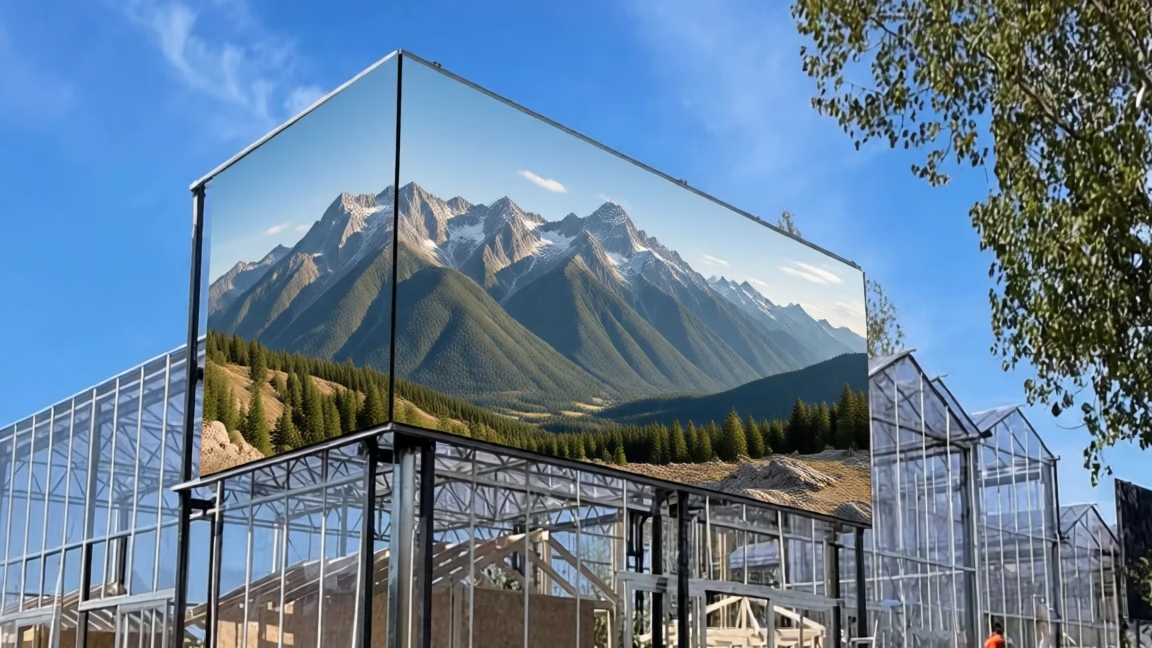
Four module formats — which one fits your wall?
P4 ships in more cabinet formats than any other pitch, and the choice is architectural rather than optical — every format produces the same 62,500-pixel wall. The 320×160mm board is the mainstream: 80×40 pixels, 15.6 boards per square meter, native to the 960×960mm iron and aluminum cabinet families, and the format with the deepest spare-parts bench. It is also the format most often built for front access — face-screw modules for budget walls, lock-catch modules for tool-free service.
The 256×128mm long board and 256×256mm square board belong to the 256-series cabinet world (768×768mm, 1024×768mm, 512×512mm), where wall dimensions follow the building rather than the catalog. The 250×250mm die-cast board is the rental-industry format: four boards per 500×500mm aluminum cabinet, quick locks and flight cases, at a working pitch of roughly 4.03mm — close enough to market as P4, but worth confirming in writing when you order. One cabinet takes one board format only; mixing formats breaks the pixel grid, and no control system will fix a misaligned wall.
What do scan rate, ICs and refresh do at 4mm?
A P4 board is a scanned matrix: the mainstream 320×160mm format runs 30–60 total ICs depending on configuration — sixteen-channel drivers plus row decode and transistors, counted across the whole board. The IC figure on a datasheet is the board’s total device population, not a quality score; what matters is that the numbers reconcile with the scan mode. At 62,500 pixels per square meter the duty per lamp is lighter than the P3 class, which is part of why P4 walls historically show excellent longevity figures.
Refresh is still the spec to police: 1,920Hz looks fine to pedestrians but bands on every phone camera, while 3,840Hz clears phone footage and most professional work. Storefronts and plazas are precisely where people raise a phone, so 3,840Hz is our default on this class. Calibration, as always, is finished at the factory against a reference camera before shipment — a 62,500-pixel surface forgives less than you would expect, and mixing module batches from different factories onto one wall is the false economy that shows as visible seams for the life of the screen.
What does a P4 outdoor wall cost to run?
Power is where P4 quietly beats its finer siblings. At 62,500 lamps per square meter the wall draws roughly 350–450W on mixed content and 500–650W peak on full white — the lightest bill of the fine outdoor pitches. A 20㎡ wall at 400W average consumes about 8kW per operating hour; on a 12-hour daily schedule that is roughly $29–58 of electricity a month at commercial tariffs, and brightness scheduling after midnight cuts it further.
The hardware side is settled by three names: Chuanglian Power, MEAN WELL and G-Energy each build the 5V 40A units we fit, one per cabinet, keeping failure domains cabinet-sized. Failed supplies cause more outdoor service calls than failed LEDs — corroded terminals and cheap units are what actually end walls early — so brand supplies with conformal-coated terminals are the cheapest insurance in the build. Watch the field-test video above for measured consumption on a real 960×960mm install.

Maintenance access belongs in the same conversation as power, because it decides where the money goes in year three. A wall with a rear corridor runs rear-service boards and spends nothing on access hardware; a wall hung against a facade needs face-screw or lock-catch front modules, and on the 320×160 format that option is standard engineering rather than a custom order. Decide access before you buy, not after the first dead module — retrofitting front service onto a rear-service wall means new cabinets, not new modules.
Which control ecosystem should you standardize on?
These modules work with every mainstream receiving card — NovaStar, Colorlight, Huidu and Mooncell on the control side, with VDWALL and RGBlink covering the video-processing front end — and the platforms are not interchangeable with each other. Sending and receiving hardware must come from one family, so the platform you pick is the platform your whole fleet inherits. NovaStar is the reference for premium and camera-facing walls; Colorlight delivers most of that performance for signage budgets; Huidu owns the unattended-async niche; Mooncell closes the price gap; VDWALL and RGBlink carry the live-production front end.
Standardize once, and buy spare receiving cards with the wall. The support call you want to avoid is the one where a three-year-old card fails, the platform has moved a generation, and the wall is dark on a Friday. Fleets that keep two spare receivers per screen size recover in minutes; the ones that do not, learn.
What does the total cost of a P4 outdoor LED display look like?
Budget a standard fixed wall at $600–1,000 per square meter factory-direct (September 2026 market scan), then add what dealers quote separately: control hardware at $500–2,000 per project, freight near $200–400 per cubic meter, and local steel plus installation running 20–30% of screen value. GOB protection adds $100–200 per square meter and repays itself wherever traffic or coastal salt threatens the lamp face. Inside the module, remember where the money goes: LED chips take 35–45% of module cost, which is why pitch — the decision that sets how many chips you buy — is the primary price lever outdoors.
Two lines hide in plain sight. Spare modules: 3% of quantity sounds like a rounding error until the first scaffolding bump ends a board. And the mask: a UV-stabilized matte mask is the difference between a wall that still reads black in year five and one that reads warm gray. Specify both in writing, along with the warranty terms and where the spares ship from — those answers tell you more about a supplier than any datasheet.
The 6-point buying checklist for a P4 outdoor LED display
- Band check first — closest viewer 4–10m is the P4 band; under 4m step to P3, past 10m take P5 and bank the difference.
- Pick the format by cabinet, not by optics — all four boards produce the same wall; the 960×960 vs 512/768 vs die-cast decision is architecture and spares.
- Brightness in writing — 5,500+ nits on the datasheet and a full-white outdoor demo.
- Refresh 3,840Hz — for anything people will photograph or film.
- Named components — brand power supplies, stated scan mode, SMD1921 lamps, UV-stabilized mask, conformal-coated boards.
- One control family — choose the platform, buy spares with the wall, keep sender and receivers matched for life.
Work the list in order and the buying decision reduces to arithmetic. A P4 outdoor LED display is not the sharpest wall you can buy — it is the one that turns your budget into the most square meters of readable, daylight-proof signage, which is exactly what most outdoor projects actually need.
Related P4 Outdoor LED Display Resources
P3 Outdoor LED Display Collection →
P5 Outdoor LED Display Collection →
P6 Outdoor LED Display Collection →
P10 Outdoor LED Display Collection →
960×960mm Outdoor Cabinet — A960 Series →
OK Series Outdoor Billboard →
P4.81 Outdoor LED Module →
P5 Outdoor LED Module →
Outdoor LED Display Price Guide →
LED Screen Calculator →
Outdoor LED Module Buying Guide →
Outdoor LED Screen Rental →
P4 Outdoor LED Display Screen Quick Guide →
Spec Your P4 Outdoor LED Display With Our Engineers
Send us the wall size, the closest viewing distance and the install surface. You get a module-level quote with brightness, scan mode, cabinet material and control stack itemized — factory-direct, with 3% spare modules included.
UnifyLED — LED screen manufacturer · unifyledscreen@gmail.com · Changsha / Shenzhen, China