
Huidu A-Series Flagship · Dual-Mode Player · 1.3M Pixels · HDMI Auto-Scale
Huidu HD-A5 Dual Mode LED screen Player
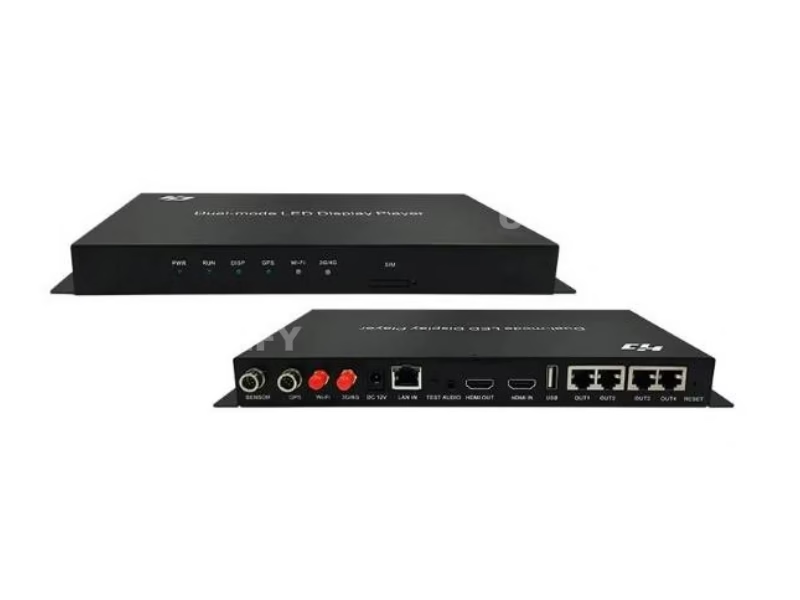
The Huidu HD-A5 Dual Mode LED screen Player plays stored programs and live HDMI input from one box: 1.3 million pixels across two Gigabit outputs, asynchronous playback from 8 GB of storage, and a synchronous HDMI path that auto-scales the input — no video processor needed — with internet and LAN management and no IP configuration.
Product Overview
What Is the Huidu HD-A5 Dual Mode LED screen Player?
The HD-A5 is a full-color dual-mode LED display player that combines an asynchronous playback box with a synchronous HDMI input path, per Huidu Specification V1.1 (20190515). It drives up to 1.3 million pixels across two Gigabit outputs, plays stored programs from 8 GB of flash, and takes live HDMI input that auto-scales to the wall — no external video processor — with the same HDPlayer workflow and cloud management as the HD-A3 Async Control Player below it in the A-series ladder.
Short answer: The Huidu HD-A5 is a dual-mode LED player: an asynchronous box (8 GB storage, 17-format hardware decoding at 60 Hz) plus a synchronous HDMI input that auto-scales to the screen — 1.3 million pixels across two Gigabit outputs, widest 16384, 18 W, working temperature -40°C to +80°C, certificates CCC/CE/FCC/RoHS/BIS, managed through the free HDPlayer software or the cloud with no IP configuration.
The dual-mode architecture is the point: a storefront runs scheduled promos all week as an async player, then a live HDMI feed (a product launch, a sports broadcast, a camera) on event days — one box, no extra video processor, no second control system. That makes the A5 the bridge between the async world of the asynchronous media player guide and the sync world of the HD-VP210 processor family; the sync vs async guide draws the underlying line. Unify LED is an LED screen manufacturer supplying Huidu control systems at factory level — this page uses the official HD-A5 Specification V1.1 as its data source, with marketplace confusion corrected below.
Huidu Official — introduction of dual-mode LED display player box HD-A5
Specifications
What Are the HD-A5 Dual Mode Player Specifications?
Specifications from the official Huidu HD-A5 Specification — the document inside the file is V1.1 (20190515), which is the version quoted here.
Core Specifications (Official V1.1)
Software: HDPlayer (Windows), free — mirrored on our Huidu system software downloads page.
Spec Correction — Exclusive
Where Do HD-A5 Listings Get the Specs Wrong?
We compared the top-ranking HD-A5 listings against the official V1.1 document. Four recurring differences:
Comparison
Which LED Player Fits: HD-A5, HD-A3, Novastar TB or a VP Processor?
Three comparison angles settle the HD-A5 purchase:
Table A — The A-Series Ladder: HD-A3 vs HD-A5 (Official Specs)
Table B — Three-Way Positioning
Three-line selection guide: pure scheduled content under 655,360 pixels — the HD-A3; scheduled content plus live HDMI events, or screens over 655,360 pixels — the HD-A5; live-only multi-input walls — the VP210 and up. The async player comparison covers the wider class.
Core Features
What Does the HD-A5 Dual Mode Player Do?
Six capabilities from the official V1.1 define how the A5 behaves in the field:
🔄 Dual-mode, one box
Async playback from 8 GB storage plus live HDMI input in the same unit — scheduled promos all week, live events on demand.
🖥️ HDMI auto-scale, no video processor
Plug a computer or set-top box into the HDMI input and the sync picture auto-scales to the wall — the video processor stays in the drawer.
🔗 Two Gigabit outputs
2 × 655,360 = 1.31M — the 1.3M budget is exactly two port-loads, the same per-port figure across Huidu’s documents.
📏 16384-pixel wide limit
The widest canvas in the A-series: 16384 × 80 = 1,310,720 exactly — ultra-wide fascias on one box.
☁️ Cloud + LAN management
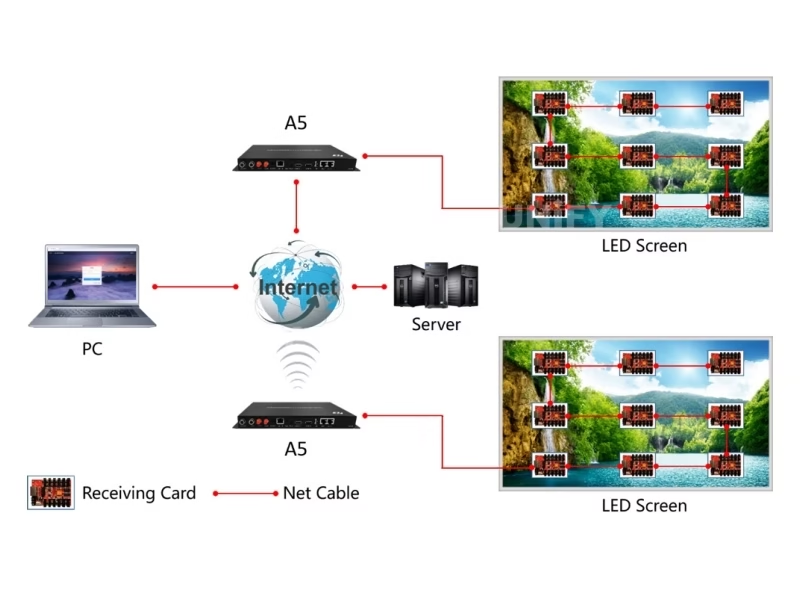
Internet unified management (3G/4G optional with SIM), LAN cluster, Wi-Fi + app — no IP configuration, auto-detected by ID.
🌡️ Sensors + GPS
S108/S208 sensors feed temperature, humidity, brightness and PM data; optional GPS adds satellite time and fixed-point broadcast.
Interface
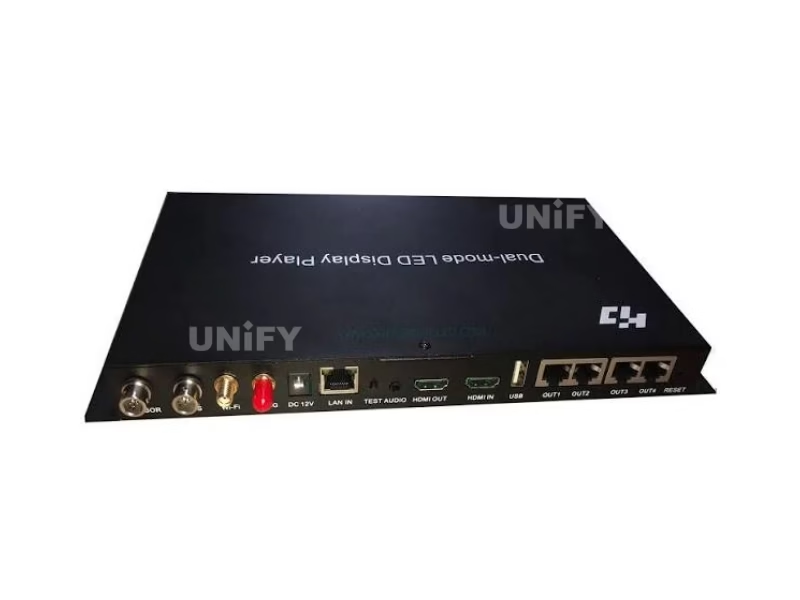
Which Ports Are on the HD-A5 Dual Mode Player?
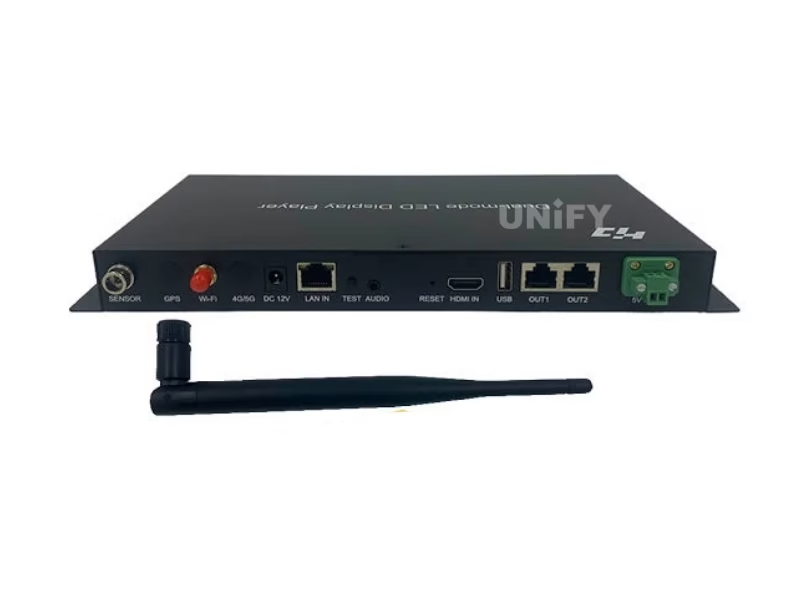
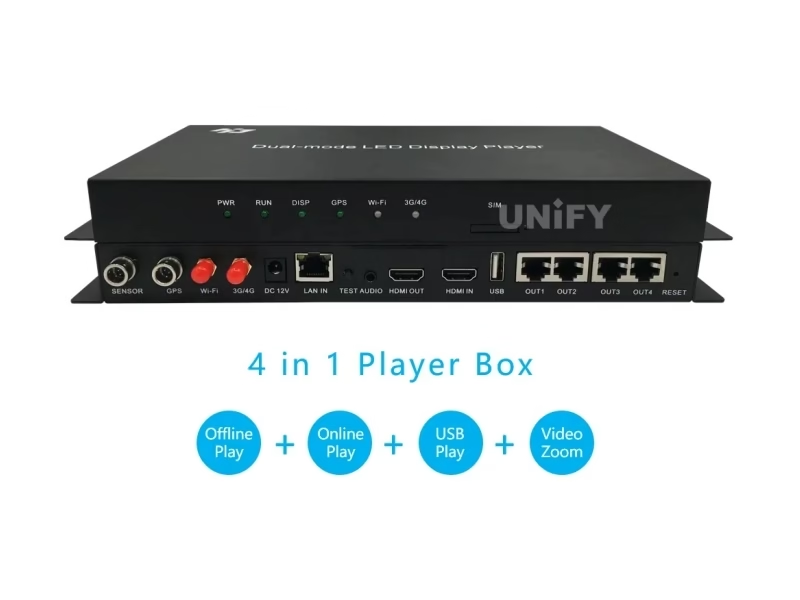
Ports and indicators from the official V1.1:
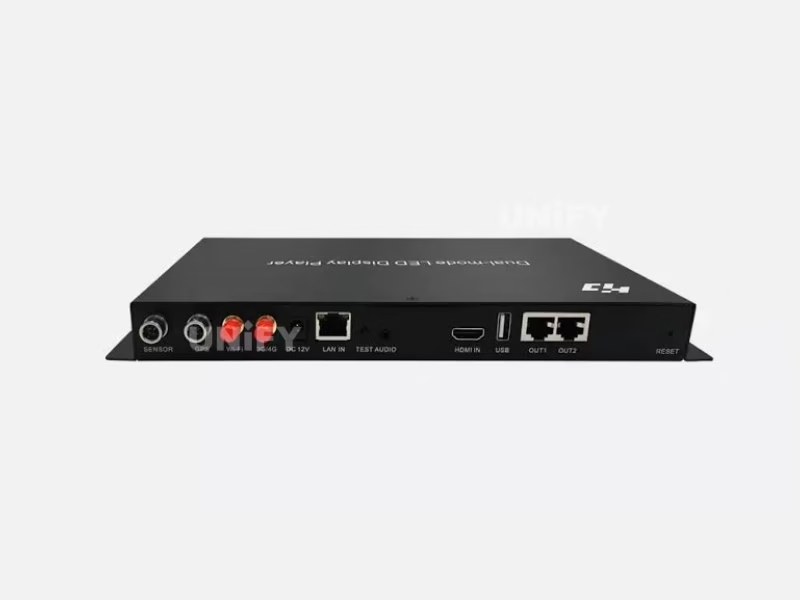
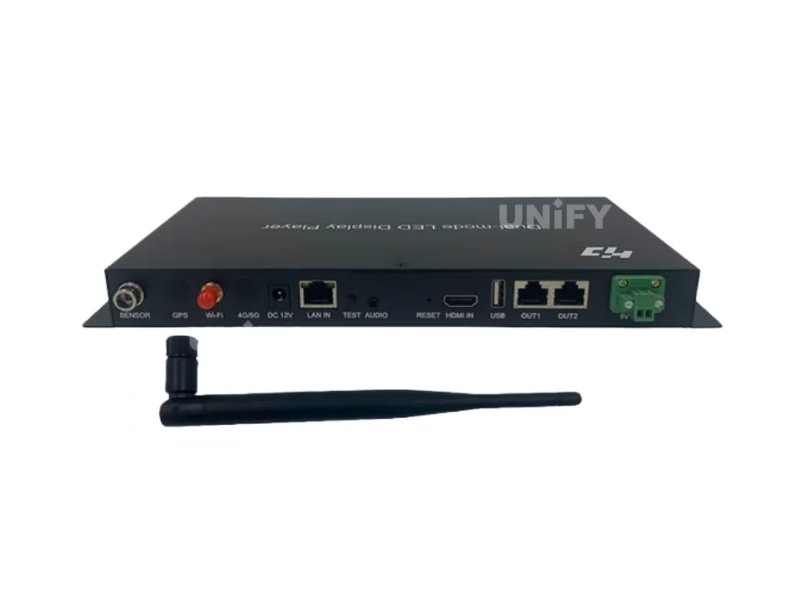
- Sensor port — S108/S208 temperature, humidity, brightness, PM sensors.
- GPS port — satellite time, fixed-point broadcast (optional).
- Wi-Fi antenna port and 4G antenna port (optional).
- Power ports — 12 V DC and 5 V DC (use one or the other).
- Input RJ45 — computer or LAN connection.
- HDMI input — computer, set-top box, camera source; auto-scales to the wall.
- USB 2.0 — U-disk or mobile hard disk (storage expansion, direct playback).
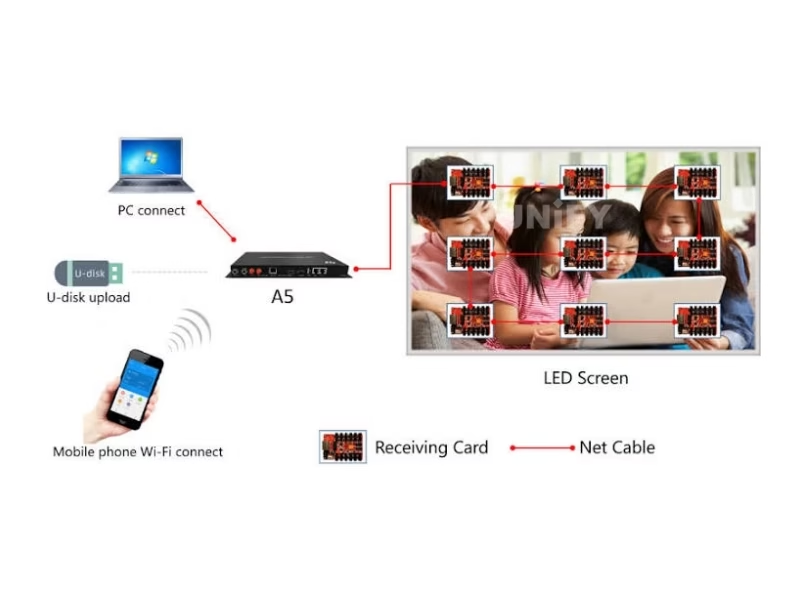
- Output RJ45 × 2 — two Gigabit chains to receiving cards.
- Audio output — standard stereo.
- Test button — module test; reset button — factory defaults.
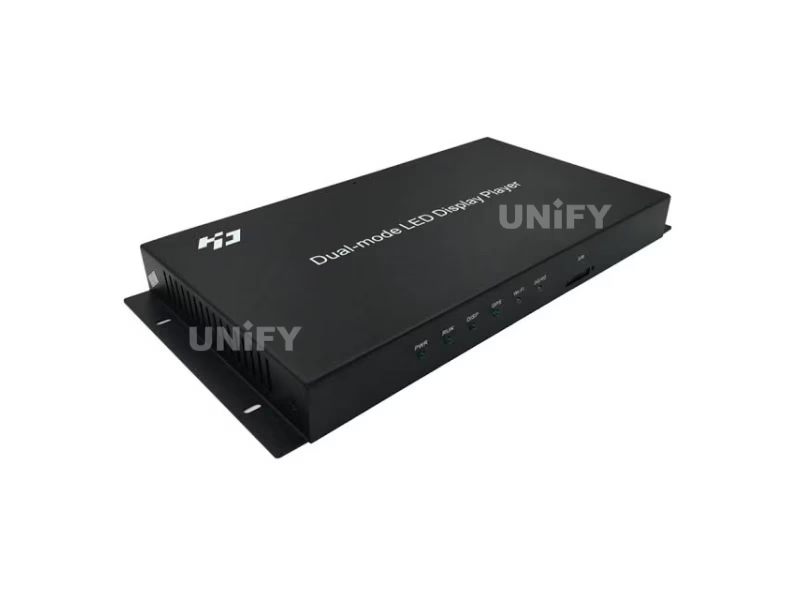
- SIM slot — 3G/4G (optional); indicator LEDs — power, RUN, screen display, Wi-Fi, GPS, 4G.
Loading Capacity
How Big a Screen Can the HD-A5 Dual Mode Player Drive?
1.3 million pixels is exactly two port-loads: 2 × 655,360 = 1,310,720, the same per-port figure across every Huidu document on this site. The official width limit divides cleanly too: 16384 × 80 = 1,310,720. Translated into real screens (UnifyLED conversion):
The extreme shape uses the width limit: an 16384-pixel fascia at P4 is 65.54 m wide × 0.32 m tall — a roadside banner no other Huidu player in this class drives from one box.
The per-port arithmetic, again. We derived 655,360 pixels per Gigabit port on the HD-VP210 page; the HD-VP620, HD-VP830 and HD-A3 documents all print it; the A5’s 1.3M is simply two of those port-loads. Every Huidu document on this site tells the same story.
Screen power planning belongs to our LED display power consumption guide.
Setup Tutorial
How Do You Set Up the Huidu HD-A5 Dual Mode Player?
Channel A — the async path. Install HDPlayer on a Windows PC, run the smart-setting wizard (the A5 is auto-detected by ID, no IP configuration), edit programs and send them by U-disk, LAN, Wi-Fi or the cloud — the same workflow as the HD-A3.
Channel B — the sync path. Plug a computer, set-top box or camera into the HDMI input and the live picture auto-scales to the wall — the official 2:14 video below explains how the synchronous mode works in the A4/A5/A6 family. No video processor, no external scaler, no configuration.
Huidu Official — how synchronous mode works in Huidu LED player box HD A4 A5 A6
Channel C — dual modes at the same time. The A5 can run the stored program and the HDMI live input together on one canvas — the official 1:39 video shows the setup for A6/A5/A4.
Huidu Official — how to set up dual-mode player A6/A5/A4 to play dual modes at the same time
Channel D — window control. The portion-area setting places the HDMI input into a defined region of the canvas (a live corner over the promo wall), and the rotation setting handles screens mounted at an angle — both covered in the official videos below.
Huidu Official — how to set up portion area of A6 A5 A4 HDMI input
Huidu Official — A5 tutorial of LED display rotation setup in HDPlayer
Full mounting and network context: our LED screen installation guide, plus the playlists and schedules guide for the program side.
Applications
Where Is the HD-A5 Dual Mode Player Used?
The dual-mode A5 serves the sites that switch between scheduled content and live input:
- Storefronts and retail — weekly promos as an async player, live product launches and broadcasts over HDMI on event days.
- Bars, clubs and sports venues — scheduled menu and promo rotation, live match or broadcast feed on the big screen via HDMI.
- Parks and community screens — scheduled information with live event inserts; the official park project shows the A5 in the field.
- Advertising vehicles — 18 W draw, GPS optional and 3G/4G for fleet updates, with a live HDMI camera feed available on demand.
- Churches and auditoriums — service content on schedule, live camera or presentation input on HDMI during events.
Huidu Official — A5 dual-mode LED display player application case
Factory & Quality Control
How Is the HD-A5 Dual Mode Player Supplied and Guaranteed?
Unify LED buys Huidu control systems at factory level, tests each unit before dispatch and backs them with a 2-year warranty:
- Factory-direct pricing — no distributor markup; bulk discounts from 10 pcs.
- 100% functional test before dispatch — every unit powered and run against a test panel in both modes before packing.
- 2-year warranty — free replacement for manufacturing defects; field care in our LED screen maintenance guide.
- Certificates included — CCC, CE, FCC, RoHS and BIS are listed in the official V1.1; copies ship with the order.
Pricing
How Much Does the Huidu HD-A5 Dual Mode Player Cost?
Published prices verified 2026-08-26:
The dual-mode economics: the A5 (USD 218–278) sits above the HD-A3 (USD 135) — the premium buys double the pixels, the second port and the HDMI sync path. And because the HDMI input auto-scales, a site that would otherwise add a separate video processor (USD 200–500 market range) does not need one: the A5 is the processor for the occasional-live site. Our 2026 LED display price report tracks the wider market.
Factory-direct pricing from Unify LED applies from single units; request a quote for your quantity and destination.
FAQ
HD-A5 Dual Mode Player: Frequently Asked Questions
Q1. What is a dual-mode LED player? A player that runs two architectures in one box: asynchronous playback of stored programs (8 GB, 17-format decoding) and a synchronous HDMI input that auto-scales to the wall — scheduled content all week, live input on demand, no video processor required.
Q2. How many pixels can the HD-A5 drive? 1.3 million (1280×1024), widest 16384, highest 2048. The arithmetic is exact: two Gigabit outputs × 655,360 pixels per port = 1,310,720, and 16384 × 80 = 1,310,720.
Q3. Does the HD-A5 replace a video processor? For single-live-source sites, yes: the HDMI input auto-scales to the wall, so a separate video processor (USD 200–500 market range) stays in the drawer. Multi-input switching walls still belong to the VP processor family.
Q4. Can the HD-A5 play async and sync at the same time? Yes — dual modes run together on one canvas, and the portion-area setting places the HDMI input into a defined region (a live corner over the promo wall). The official videos above show both setups.
Q5. What is the difference between HD-A5 and HD-A3? Double the pixels (1.3M vs 655,360), two Gigabit outputs instead of one, an HDMI sync input with auto-scaling, and a 16384-pixel width limit instead of 4096. The A3 is the pure-async entry; the A5 is the dual-mode flagship of the A-series.
Q6. How wide a screen can the HD-A5 drive? 16384 pixels of width per the official V1.1 — at P4 that is a 65.54 m × 0.32 m roadside banner. The width limit is exact math: 16384 × 80 = 1,310,720, the full 1.3M budget.
More player questions: our async playback troubleshooting guide and LED display FAQ.
Certifications
Which Certificates Does the HD-A5 Dual Mode Player Carry?
The official V1.1 document lists five certificates directly: CCC, CE, FCC, RoHS and BIS. Copies ship with every order; warranty terms in our warranty guide.
Get HD-A5 Bulk Pricing from the Factory
Genuine Huidu dual-mode players, 100% pre-tested, 2-year warranty, shipped worldwide. Tell us your pixel budget, screen count and destination — quote within 24 hours.
Deep Blog
Huidu HD-A5 Dual Mode LED screen Player: The Complete Buying Guide (2026)
The Huidu HD-A5 Dual Mode LED screen Player is the A-series flagship and the box that settles a real-world argument: which sites need both a player and a video processor? The answer, for most occasional-live sites, is neither separately — the A5 runs scheduled programs from storage and auto-scales a live HDMI input in the same unit. This guide rebuilds the A5 from Huidu Specification V1.1, explains the dual-mode architecture and its exact arithmetic, walks the setup, and positions the A5 against the A3, the Novastar TB range and the VP processor family on this site.
Chapter 1 — The Dual-Mode Architecture: Two Paths, One Box
The A5 contains two independent signal paths. The asynchronous path plays stored programs from 8 GB of flash through a hardware decoder at 60 Hz — the classic async workflow of the HD-A3. The synchronous path takes the HDMI input and auto-scales it to the wall — the classic sync function of a VP210, minus the processor. The two paths share the output FPGA and the receiving-card chain, which is why the box is one unit and one control surface instead of two. The official 2:14 video on the synchronous mode explains the auto-scaling in the A4/A5/A6 family; the 1:39 video shows both modes running at once.
The architecture also explains the reliability story: because playback never depends on a live network, an A5 keeps running its stored programs through internet outages, router swaps and cloud platform maintenance. The HDMI path is additive — plug in a source when you need it, unplug when you do not — and the box falls back to the async program the moment the cable is removed. For a storefront that cannot afford a dark screen during a network fault, that is the quiet difference between a player and a server-dependent system.
Chapter 2 — The Spec Sheet, Rebuilt from V1.1
Official V1.1 (20190515) defines the A5 in one paragraph: a full-color dual-mode box with 1.3 million pixels (1280×1024), two Gigabit outputs, HDMI input with auto-scaling, 8 GB storage, 17-format decoding, and internet/LAN management with no IP configuration. Three listing errors recur across marketplaces: “3840 max width” (official V1.1: 16384 — the 3840 figure is the VP-series width pasted onto the A5), “2 kg” (official 0.948 kg), and “one Gigabit output” ported from the A3 page (official: two). The file name on some downloads says V2.0 while the document inside is V1.1 — we quote the content version. When a listing disagrees with V1.1, V1.1 wins.
The version note matters more than it looks. A spec sheet that cannot keep its own version number straight — file name V2.0, content V1.1 — is a reminder to read the document, not the label. The same discipline applies to the sensor line: official V1.1 names the S108/S208 sensors for temperature, humidity, brightness and PM; listings that promise broader sensor families are describing other A-series revisions. Ask for the sensor model list in writing with the order, and the environment layer ships correctly the first time.
Chapter 3 — The Arithmetic: 1.3M, Two Ports, 16384 Wide
The A5’s numbers are the same per-port arithmetic that anchors every Huidu document on this site. Two Gigabit outputs × 655,360 pixels per port = 1,310,720, the official 1.3M. The width limit divides cleanly: 16384 × 80 = 1,310,720. The 1280×1024 standard configuration is 1,310,720 exactly. We derived the 655,360 per-port figure on the HD-VP210 page; the HD-VP620, HD-VP830, HD-A3 and now the A5 all confirm it in print. The practical reading: 1.3M is a 5.12 m × 4.10 m P4 wall, a 12.80 m × 10.24 m P10 fascia, or a 65.54 m × 0.32 m ultra-wide banner at the 16384-pixel limit — the widest canvas in the A-series.
The 16384 figure also changes how you quote fascias. A roadside banner that reads 60 m wide at P4 is 15,000 pixels — inside the A5’s width limit with pixels to spare, so a single box drives it. The same banner on an A3 (4096 wide) needs a multi-box setup or a different player class entirely. Width-hungry projects are where the A5 pays for itself even when the pixel count would fit a smaller box: the width limit, not the area, is often the binding constraint on long-format signage.
Chapter 4 — The HDMI Path: The Processor That Stays in the Drawer
The A5’s most valuable function is the one that subtracts hardware. Plug a computer, set-top box or camera into the HDMI input and the live picture auto-scales to the wall — the function a separate video processor performs, at USD 200–500 in the market ranges quoted on our VP pages. The honest boundaries: the A5 handles one live source at a time and 1080p-class input; sites that switch multiple live sources with seamless transitions still belong to the VP410 or VP620. But for the storefront, the bar or the church that needs scheduled content plus one live feed, the A5 is the processor — and the procurement email can cross the video processor line off the budget.
One honest boundary to state plainly: the A5’s HDMI path is a single live source, and the input class is 1080p. Multi-input switching with seamless transitions, 4K sources, or live-mixed shows belong to the VP processor family — the VP210 for 1.3M, the VP410 for 2.3M, and the VP620 for 4K input. The decision rule we give integrators: count the live sources. One occasional source — A5. Multiple continuous sources — VP. Sites that run both patterns (a storefront that occasionally goes live, and a stage that is always live) end up with one of each, which is exactly what the two product families are for.
Chapter 5 — A3 vs A5: When to Step Up
The HD-A3 at USD 135 covers pure-async sites up to 655,360 pixels. Step to the A5 (USD 218–278) when any of three conditions hold: the screen crosses 655,360 pixels (the A5’s 1.3M doubles the canvas); the site needs a live HDMI input even occasionally (the sync path and its auto-scaling); or the project wants the 16384-pixel width limit for ultra-wide fascias. The A-series ladder above the A5 runs the dual-mode A6/A7 with larger loading and the 4K-class A7/A8 — ask us for the full ladder when the budget crosses 1.3M.
Chapter 6 — Dual-Mode Operations in the Field
The field patterns that make the A5 worth its premium: a storefront runs promos and hours as async content, then a product launch or broadcast plugs into HDMI for the day — the 1:39 dual-mode video shows the setup in two steps. A bar runs menu rotation all week and the match feed on Saturday. A park screen runs information on schedule with a live event insert in a portion area — the 1:41 portion-area video places the HDMI input into a corner region while the async program keeps playing. The rotation setting handles screens mounted at an angle. Every pattern is one box, one control surface, one software package.
The fleet operator’s view adds the management layer: like every A-series box, the A5 auto-registers by controller ID, so a network of storefronts, bars and park screens appears in HDPlayer or the cloud without per-site IP records. The 3G/4G option with the SIM slot covers sites with no fixed internet, and the GPS option adds satellite time and fixed-point broadcast — a vehicle fleet can schedule content by location and play a targeted announcement when the truck reaches a zone. For multi-site operators, the A5 turns “go to the screen” into “send from the office” on every box in the fleet.
Chapter 7 — The A5 Against the Alternatives
The class map on this site: pure-async players — the HD-A3 and the Novastar TB range (TB30 through TB60) — serve scheduled content only; sync processors — the VP series — serve live multi-input walls; the A5 sits in the gap that pure-async and pure-sync both miss. The async player selection guide and the comparison cover the wider class; the A5 is the recommendation when the question is “both”.
Chapter 8 — Price, Warranty and the Buying Checklist
Verified August 2026 pricing: USD 218–278 at reiled.com, factory-direct on request. The A5 prices between the A3 (USD 135) and the VP processors (USD 115–560), and the dual-mode premium buys two capabilities at once: double the async pixels and the HDMI sync path. Unify LED is an LED screen manufacturer in Changsha, China, supplying control systems alongside modules, cabinets and power supplies as one assembly — the A5 ships tested in both modes against the receiving cards it is specified for, with a 2-year warranty and certificate copies (CCC/CE/FCC/RoHS/BIS) with every order.
Final checklist for the procurement email: (1) state the pixel budget and shape — 1.3M at 1280×1024 with the 16384-wide limit decides the A5 vs the A6/A7 ladder; (2) confirm the HDMI source — computer, set-top box or camera — and whether dual-mode-at-once is required; (3) list the receiving-card model so compatibility is confirmed before dispatch; (4) state the update paths — U-disk, LAN, Wi-Fi or 3G/4G cloud — and whether the SIM option is required; (5) list any sensors (S108/S208) and the GPS option; (6) ask for the certificate copies explicitly; (7) order one spare per ten installed — the player is the cheapest component in the signal chain and the spare beats the site visit.
The spare logic is the same as the A3 but the stakes are higher: a dual-mode site that loses its player loses both the scheduled program and the live input in one fault. At USD 218–278 the spare is the cheapest insurance in the chain, and because every A5 in a fleet runs the same configuration surface, a spare unit can stand in for any screen in the network until the replacement arrives — ten minutes of swap, zero missed programming.
The troubleshooting reality, in the official 4:28 video below: most A4/A5/A6 field faults are HDPlayer configuration issues, not hardware — the software-side check list (smart setting, test button, program-send path) resolves the majority before a spare box is ever needed. The two-mode test is the field shortcut: if the async program plays but the HDMI input stays black, the fault is in the source or the cable, not the box; if both paths fail, check power and the receiving-card chain first — the same order the async playback troubleshooting guide recommends.
Huidu Official — how to solve common problems of HDPlayer software controller A4 A5 A6
Conclusion. The Huidu HD-A5 Dual Mode LED screen Player is the A-series flagship: 1.3 million pixels across two Gigabit outputs — two port-loads of the 655,360 arithmetic that anchors every Huidu document on this site — asynchronous playback from 8 GB, an HDMI sync path that auto-scales and retires the video processor, a 16384-pixel width limit, and cloud management with no IP configuration. Trust V1.1 over the 3840 listings, plan for the occasional-live site, and the A5 carries the dual-mode wall on one box.
LED Control System Range
Which LED Controllers Should You Explore Next?
Huidu, Colorlight and Novastar control products, media player guides and free software resources on UnifyLED.
Colorlight Controllers
Guides & Resources
Where Can You Download HD-A5 Resources?
The official Huidu HD-A5 Specification (V1.1, 20190515 — the version inside the file) — the data source for every figure on this page.
Related: browse the full Huidu LED controller catalog — 12 models across four product lines, free HDSet / HDPlayer / HD Show software, cloud remote control without a subscription, and factory-direct pricing.