
NovaStar MCTRL PRO Series
Novastar MCTRL660 PRO LED Display Controller
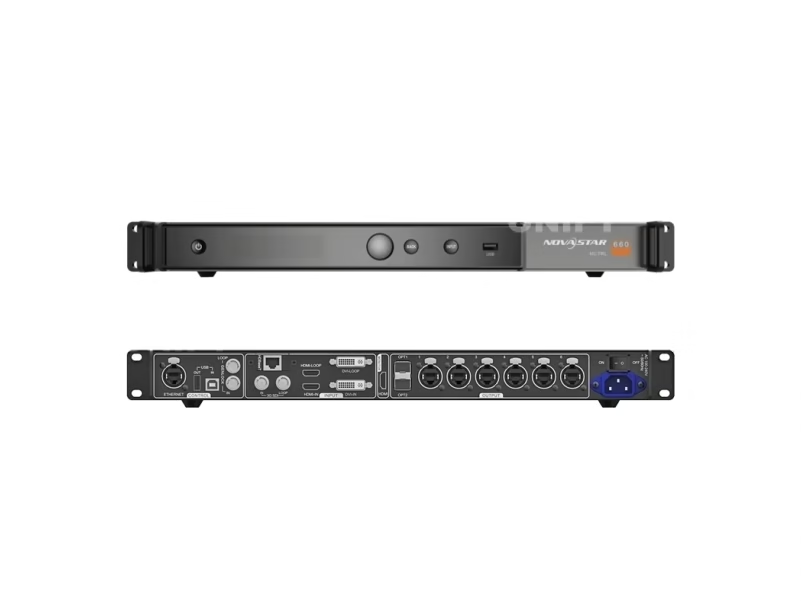
Professional broadcast-grade LED controller with native 3G-SDI input, dual 10G fiber outputs, 6 Gigabit Ethernet ports, GENLOCK synchronization, and sub-1ms latency — engineered for live broadcast, XR virtual production, and large-scale rental deployments requiring fiber-based long-distance transmission.
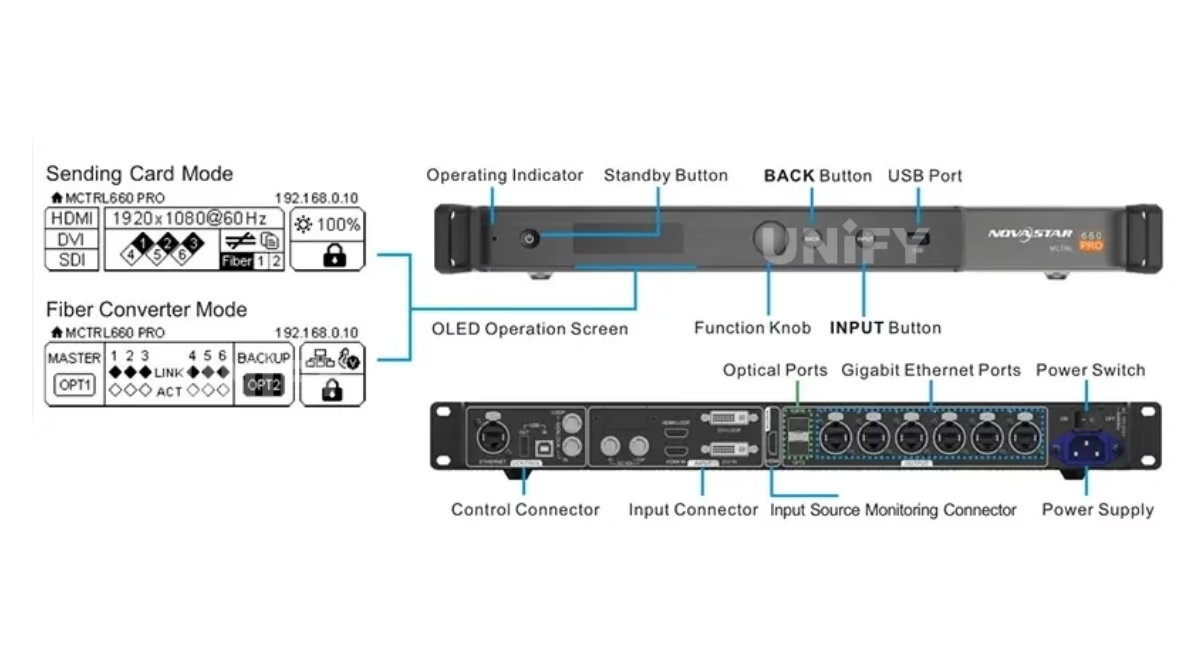
Product Overview
What Is the Novastar MCTRL660 PRO?
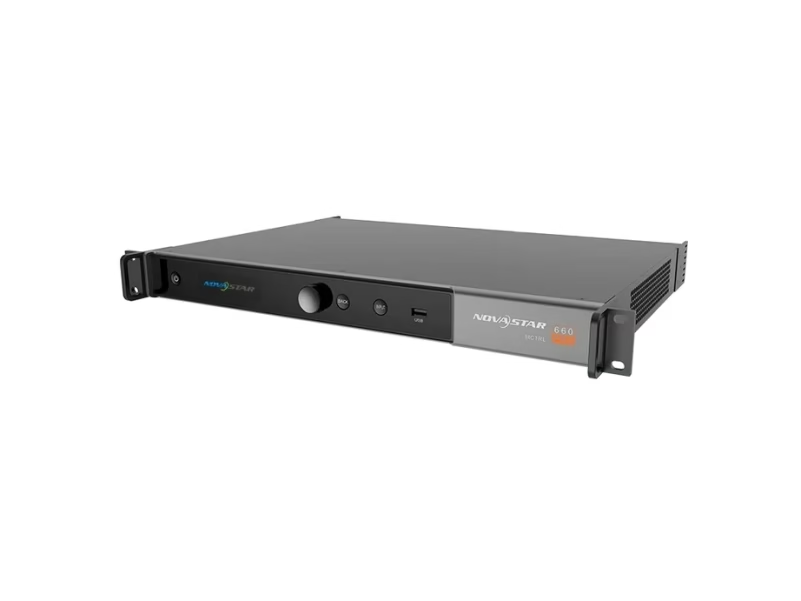
The Novastar MCTRL660 PRO LED display controller is the broadcast-grade flagship of NovaStar’s MCTRL series — the only model below the MCTRL4K that combines native 3G-SDI input, dual 10G optical fiber outputs, GENLOCK frame synchronization, and sub-1ms processing latency in a single 1U chassis. It is purpose-built for live broadcast environments (OB vans, television studios, sports production), XR virtual production stages requiring camera-to-wall synchronization, and large-scale rental deployments where fiber-based signal transmission over hundreds of meters is a non-negotiable requirement. With 6 Gigabit Ethernet ports delivering 2.3 million total pixels, three user-selectable working modes (sending card, fiber converter, dual output), and 8/10/12-bit color processing, the MCTRL660 PRO bridges the gap between the standard MCTRL660 and the flagship MCTRL4K. For architecture comparison, see synchronous vs asynchronous LED control.
Key differentiator: The 3G-SDI input enables direct connection to broadcast cameras, production switchers, and OB van equipment without external converters. The dual 10G fiber outputs support cable runs up to 10 km with single-mode fiber. The GENLOCK port accepts tri-level or black-burst sync signals for frame-accurate camera-to-wall synchronization. The standard MCTRL660 has none of these capabilities.
Specifications
Technical Specifications
Video Input & Output
Physical & Environmental
The larger chassis (356mm depth vs 268.5mm on standard MCTRL660) accommodates the fiber SFP+ cages, GENLOCK circuitry, and SDI processing board. At 20W, active cooling is required — the internal fan is thermostatically controlled and rated for 50,000 hours MTBF. See LED display power consumption.
Engineering Advantages
Key Features
Native 3G-SDI Broadcast Input
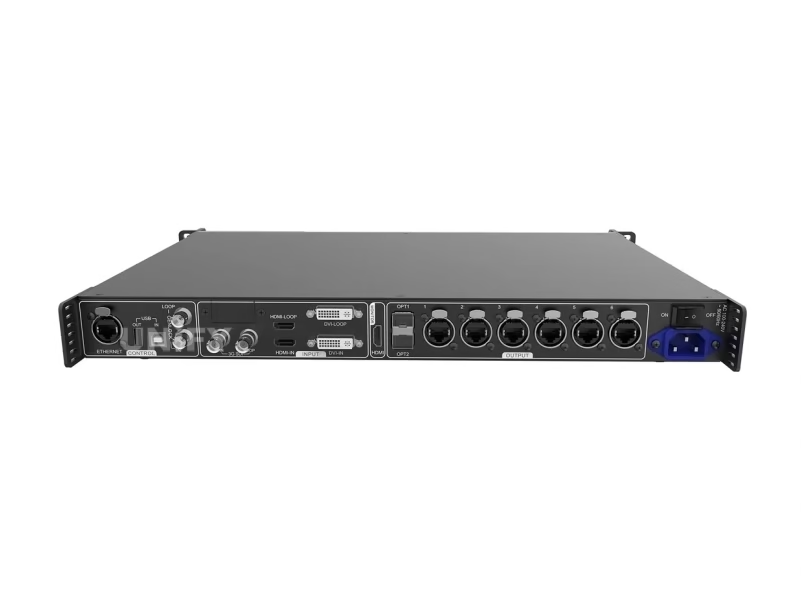
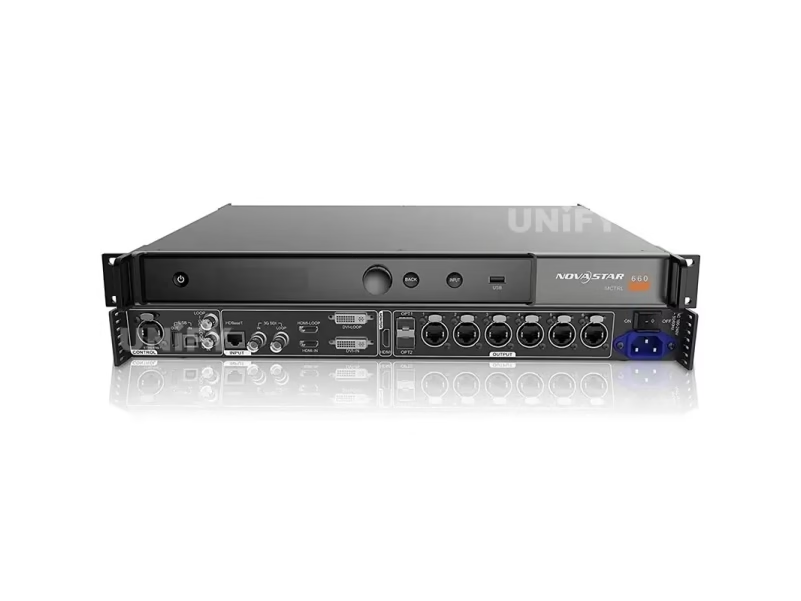
SMPTE 424M/292M/259M compliant. Direct connection to broadcast cameras, production switchers, and OB van equipment. Includes 3G-SDI loop-through for daisy-chaining to additional controllers or monitors without external DAs.
Dual 10G Fiber + 6 Ethernet Ports
2× 10G SFP+ fiber outputs support single-mode transmission up to 10 km — immune to EMI and ground loops. 6 Gigabit Ethernet ports handle 3.9M total pixel bandwidth for complex multi-cabinet topologies.
GENLOCK <1ms Low Latency
GENLOCK IN/LOOP accepts tri-level or black-burst sync for frame-accurate camera-to-wall synchronization. Sub-1ms processing latency eliminates visible delay between live camera feed and LED wall output — critical for broadcast and XR.
Image Mirroring + Free Rotation
Hardware-level image mirroring and free rotation across single or multiple ports. RGB independent gamma adjustment eliminates low-gray unevenness and white balance drift — 68.7 billion colors at 12-bit 4:4:4.
Operational Flexibility
Three Working Modes
The MCTRL660 PRO is the only MCTRL controller offering three user-selectable operating modes — selected from the OLED menu — that adapt the hardware to different deployment topologies without external conversion equipment.
Sending Card Mode (Standard)
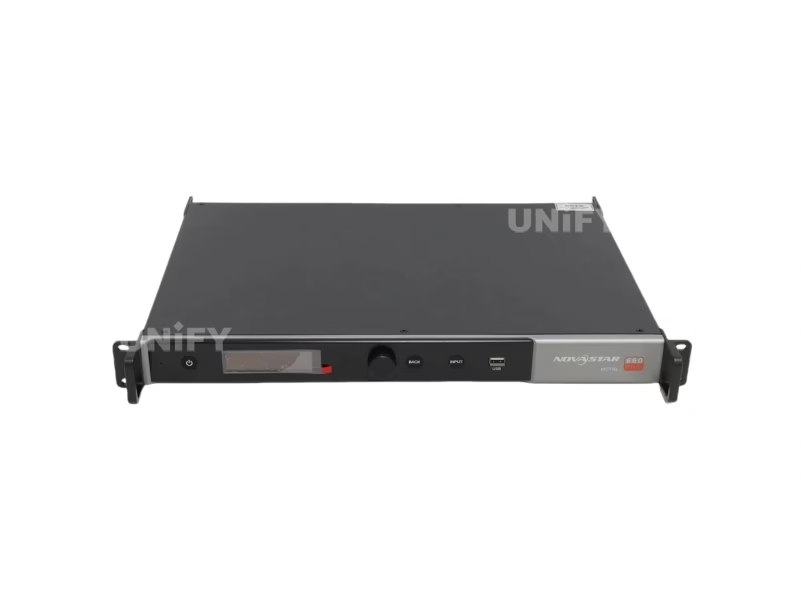
OLED menu: Working Mode → Sending Card. Uses optical ports or Ethernet ports to output video signals directly to receiving cards in LED cabinets. This is the standard operating mode for all LED display deployments. Supports all input types (HDMI, DVI, 3G-SDI) and full calibration, mirroring, and GENLOCK functionality.
Fiber Converter Mode
OLED menu: Working Mode → Fiber Converter. Uses optical ports for input and Gigabit Ethernet ports for output (or vice versa) to realize optical-to-electrical signal conversion. This eliminates the need for standalone fiber media converters — simplifying the signal chain, reducing equipment count, and saving approximately $200–$400 in external converter costs per fiber link.
Dual Output Mode
OLED menu: Working Mode → Dual Output. One controller outputs the same image simultaneously through both optical ports and Ethernet ports — driving two separate display systems from a single video source. Ideal for main screen + confidence monitor setups, or primary + backup display redundancy configurations in mission-critical broadcast environments.
Configuration
OLED Quick Configuration & NovaLCT
The MCTRL660 PRO features an OLED menu screen with rotary knob for standalone configuration — plus full NovaLCT support for advanced functions. The NovaStar NCE training below covers the complete software workflow.
NovaStar Official — NovaStar Official — Basic Configuration of NovaLCT NCE 2022 Training
OLED Quick Config (No PC Required)
Select Working Mode & Input Source
OLED menu → Working Mode (Sending Card / Fiber Converter / Dual Output) → Input Settings → select HDMI, DVI, or 3G-SDI source → set EDID resolution and color depth.
Quick Screen Configuration
OLED → Screen Settings → Quick Config → set Cabinet Row/Column Qty, Port 1 Cabinet Qty, Data Flow direction (previewed in real-time as you rotate the knob). Press to save — the screen lights up immediately.
GENLOCK & Advanced Settings
Configure GENLOCK sync source (tri-level/black-burst), image mirroring mode, RGB gamma adjustment, and network settings. For irregular screen shapes, pixel-level calibration, and firmware updates, use NovaLCT via USB or Ethernet. See LED display configuration.
Controller Comparison
NovaStar Sending Box Family
Official NovaStar overview of all MCTRL models, followed by specification comparison with the MCTRL660 PRO column highlighted.
NovaStar Official — NovaStar Official — ENHANCE YOUR ARSENAL Complete Sending Box Lineup
The MCTRL660 PRO is the only MCTRL controller combining 3G-SDI, GENLOCK, fiber output, and sub-1ms latency — making it the definitive choice for broadcast and XR applications below the MCTRL4K. See our LED video processor guide.
Applications
Where the MCTRL660 PRO Is Essential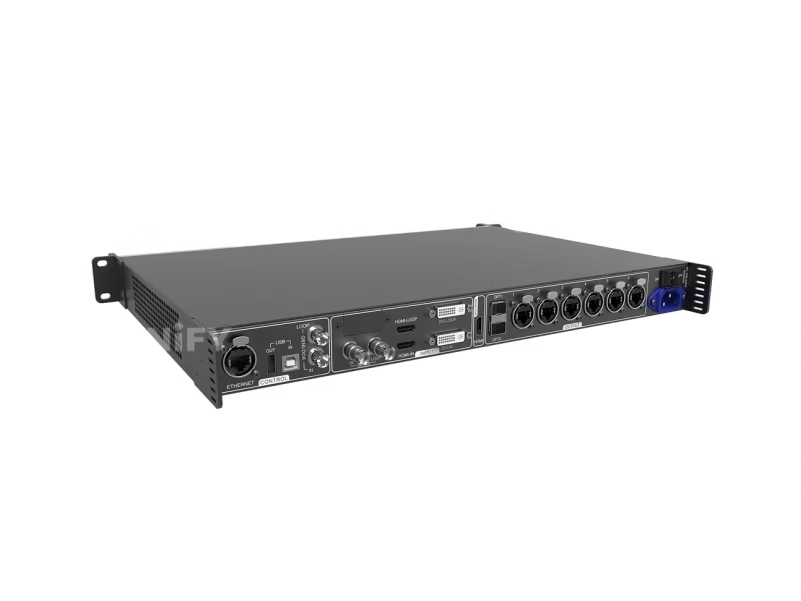
Live Broadcast & OB Vans
Native 3G-SDI connects directly to broadcast cameras and switchers. GENLOCK sync eliminates frame tearing in multi-camera setups. Sub-1ms latency keeps the LED wall in perfect sync with live action. See LED screen for events.
XR Virtual Production
GENLOCK frame-accurate synchronization with Unreal Engine-powered LED volumes. Fiber outputs eliminate ground loops between video server and LED wall. 12-bit 4:4:4 color depth for camera-facing displays.
Large-Scale Rental
6 Ethernet ports + 2 fiber outputs handle the most complex stage topologies. Fiber converter mode eliminates external media converters. Dual output mode drives main screen + confidence monitor simultaneously.
Sports Venues & Stadiums
Fiber transmission over hundreds of meters from control room to distributed displays. GENLOCK ensures all perimeter boards and scoreboards stay synchronized. SDI input from broadcast feed.
B2B Procurement
MCTRL660 PRO Price & Sourcing
CE, FCC, IC, CB, RoHS certified. Always verify when sourcing — buy from LED screen manufacturer authorized channels. Includes: power cord, Ethernet cable, USB cable, HDMI cable, DVI cable.
FAQ
Frequently Asked Questions
Ready to Source the MCTRL660 PRO?
Factory-direct pricing, global logistics, broadcast system design consultation.
unifyledscreen@gmail.com | +86-191-18802497
Technical Deep-Dive
Novastar MCTRL660 PRO LED Display Controller: Broadcast-Grade Engineering Analysis
Published: July 2026 | 15 min read | UnifyLED Engineering Team
The Novastar MCTRL660 PRO LED display controller is not simply an MCTRL660 with additional ports — it is a fundamentally different class of controller engineered for a fundamentally different operational environment. The standard MCTRL660 is optimized for rental staging and fixed installations where the primary workflow is standalone LCD configuration and the video source is nearly always HDMI or DVI. The MCTRL660 PRO is optimized for broadcast studios, OB vans, XR virtual production volumes, and large-scale rental deployments where the video source is 3G-SDI from a production switcher, the cable run to the first cabinet exceeds 100 meters, and frame-accurate synchronization between camera shutters and LED refresh cycles is non-negotiable. This article provides the engineering analysis that differentiates the PRO from the standard model — the SDI signal chain, the GENLOCK timing architecture, the fiber transmission topology, and the procurement decision framework for broadcast system integrators.
The 3G-SDI Signal Chain: Why Broadcast Demands SDI
The 3G-SDI (Serial Digital Interface) input is the MCTRL660 PRO’s defining broadcast feature. SDI is the universal professional video transport standard — every broadcast camera with a professional BNC output, every production switcher in an OB van, every broadcast-grade video router, and every SMPTE-compliant playback server outputs SDI. HDMI and DVI, by contrast, are consumer and prosumer interfaces that lack the mechanical reliability, cable length capability, and embedded metadata support that broadcast workflows require.
The engineering advantages of SDI over HDMI for LED wall applications are threefold. First, cable reliability: SDI uses BNC connectors with a positive locking bayonet mechanism rated for 1,000+ mate/demate cycles versus HDMI’s friction-fit connector rated for approximately 100–200 cycles. In OB van and rental environments where cables are connected and disconnected daily, BNC connectors fail far less frequently. Second, cable length: SDI over RG6 coaxial cable supports reliable 1080p60 transmission up to 100 meters without repeaters — HDMI over copper is limited to approximately 5–10 meters before signal degradation requires active extension. Third, embedded audio and metadata: SDI carries up to 16 channels of embedded 48kHz/24-bit audio, timecode, closed captioning, and ancillary data alongside the video signal in a single cable — eliminating the separate audio cabling and synchronization that HDMI+DVI setups require. See LED display refresh rate for camera sync specifications.
GENLOCK Architecture: Frame-Accurate Camera-to-Wall Sync
GENLOCK (Generator Lock) is the technology that synchronizes the LED wall’s frame refresh to an external reference signal — typically a tri-level sync (for HD/3G workflows) or black-burst (for legacy SD workflows) generated by a master sync generator in the broadcast facility or OB van. Without GENLOCK, the LED controller refreshes frames at its own internal clock rate. The camera captures frames at its own internal clock rate. These two clocks are never perfectly synchronized, and the drift between them produces a visible horizontal tear line that scrolls up or down the recorded image — invisible to the live audience, but clearly visible on the broadcast feed and recorded footage.
GENLOCK eliminates this by slaving the LED controller’s frame timing to the camera’s sync signal. The MCTRL660 PRO’s GENLOCK IN port accepts a tri-level sync (typical for 1080p/1080i workflows) or black-burst (NTSC/PAL reference) via a standard BNC connector. The GENLOCK LOOP port passes the sync signal to additional MCTRL660 PRO units or other GENLOCK-capable equipment in the rack — eliminating the need for a sync distribution amplifier. When GENLOCK is active, the controller’s OLED displays “Genlock Locked” with the detected sync format. The GENLOCK status is also reported via NovaLCT and VNNOX Care for remote monitoring. This is essential for multi-camera broadcast productions where the LED wall appears in multiple camera angles that must all be tear-free.
Fiber Transmission Topology: Why 10G SFP+ Changes Deployment Architecture
The MCTRL660 PRO’s dual 10G SFP+ optical ports fundamentally change how large LED deployments are cabled. In a traditional copper-based topology (MCTRL300/600/660 standard), the controller sits within 100 meters of the first LED cabinet — limited by Cat6 Ethernet cable length. For outdoor stages, stadiums, and distributed campus displays, this often means the controller rack must be placed in a weather-exposed, insecure, or space-constrained location near the display — rather than in the climate-controlled, secure control room where it belongs.
With the MCTRL660 PRO’s fiber outputs, the controller rack stays in the control room. A single pair of single-mode fiber strands (one for each SFP+ port) runs from the rack to the LED wall location — distances of up to 10 km are supported with standard LR optics. At the wall end, the fiber connects to the first cabinet’s receiving card (if it has an SFP input) or to an active fiber-to-Ethernet converter built into the cabinet. This topology provides three operational advantages: the expensive controller equipment stays in a protected environment, the fiber cable is immune to the ground potential differences that cause hum bars on copper-based LED walls in large venues, and the fiber’s immunity to electromagnetic interference eliminates the pixel glitches that occasionally appear on copper-based links near dimmer racks, motor controllers, or RF transmission equipment. For electrical planning, see LED display power consumption.
Sub-1ms Latency: Why It Matters and How It’s Achieved
The MCTRL660 PRO’s sub-1ms processing latency — measured from the last pixel of the input frame arriving at the SDI/HDMI/DVI port to the first pixel of that frame appearing on the LED wall — is achieved through a dedicated FPGA video pipeline that bypasses the frame-buffer memory used in standard MCTRL controllers. This “line-locked” processing architecture begins outputting pixels before the full input frame has been received, reducing latency from the 2–3 frames typical of buffered controllers to less than one frame at 60Hz (16.67ms per frame → <1ms processing).
For most applications — corporate presentations, retail signage, worship displays — 2–3 frames of latency (33–50ms) is imperceptible. For broadcast and XR applications, it is unacceptable. In a live broadcast studio, the LED wall behind the presenter must show camera feeds or graphics that are in lip-sync with the presenter’s audio. At 33ms latency, the wall is visibly behind the audio. At sub-1ms, the wall appears instantaneous — the presenter, the camera, and the wall are in perfect temporal alignment. In XR virtual production, where the LED wall displays a real-time rendered Unreal Engine environment that the camera moves through, sub-1ms latency eliminates the motion-to-photon delay that causes VR sickness and breaks immersion. For application-specific guidance, see LED screen for events and LED display configuration.
Procurement Decision: MCTRL660 vs MCTRL660 PRO
The MCTRL660 PRO costs approximately $700–$900 — roughly double the MCTRL660’s $350–$550. The decision to invest in the PRO should be based on three non-negotiable technical requirements, not a general preference for “better” equipment: (1) Does the signal chain include broadcast cameras or production switchers with SDI output? If yes — the PRO’s native SDI eliminates external converters. (2) Is the cable run from controller to first cabinet longer than 100 meters? If yes — the PRO’s fiber outputs are required; copper Ethernet cannot span the distance. (3) Is the LED wall filmed by cameras synchronized to an external reference? If yes — the PRO’s GENLOCK is non-negotiable; without it, horizontal tear lines will appear in the recorded footage.
If the answer to all three questions is no — the standard MCTRL660 is the correct controller. It delivers identical core video quality, the same 2.3M pixel capacity, the same 12-bit color depth, and the same OLED standalone configuration at half the cost. For procurement guidance from a verified source, contact a LED screen manufacturer with NovaStar authorization. For maintenance planning, see LED screen maintenance.
Conclusion
The Novastar MCTRL660 PRO LED display controller is not a general-purpose tool — it is a specialized instrument for broadcast, XR, and large-scale fiber-connected LED deployments. Its value proposition is defined by three capabilities absent from every other MCTRL controller below the MCTRL4K: native 3G-SDI input that integrates directly into broadcast signal chains without conversion, GENLOCK synchronization that eliminates camera-to-wall timing artifacts, and dual 10G fiber outputs that decouple controller placement from display location. For the 15–20% of professional LED deployments that require one or more of these capabilities, the MCTRL660 PRO is the only rational choice below the $2,000+ MCTRL4K. For the remaining 80–85% — rental staging, corporate events, fixed installations, retail, worship — the standard MCTRL660 or MCTRL600 delivers equivalent core performance at substantially lower cost. The art of controller selection is matching the tool to the deployment, and the MCTRL660 PRO’s deployment profile is broadcast, not universal.
MCTRL Series
Explore the Complete NovaStar Controller Range
From Taurus multimedia players to VX all-in-one controllers and MCTRL sending boxes.
VX All-in-One
Resources
Download MCTRL660 PRO Resources
Official NovaStar MCTRL660 PRO specifications, user manual, and quick start guide.