
Fine-Pitch Indoor · Flexible & Creative Shapes
P1.53 Indoor Flexible LED Display Collection
A P1.53 indoor flexible LED display is the value sweet spot of the soft-module family: 422,500 pixels per square meter on 0.2mm flexible PCB, wrapped around columns and waves at roughly 20–30% less than the 1.25mm tier — with the same strong-magnet front service and the same 3840Hz refresh.
What Is a P1.53 Indoor Flexible LED Display?
Short answer: A P1.53 indoor flexible LED display is a soft-module video wall that bends around columns, waves and full-circle builds at the 1.5mm-class pitch. Each 320×160mm module carries 208×104 pixels — 21,632 dots, 422,500 per square meter — on a 0.2mm flexible PCB with a silicone base shell, scanned 1/26 to 3840Hz and mounted on strong magnets for full front service. It is where curved walls stop paying the ultra-fine-pitch premium.
A P1.53 indoor flexible LED display runs its LEDs at a 1.5385mm spacing — the industry’s “1.5 series” — so each 320×160mm panel holds 208×104 pixels driven by 78 Chipone (ICND series) driver ICs. The rigid fiberglass board is gone: a 0.2mm flexible PCB carries the circuit, a high-precision silicone base shell keeps the optical face flat through every curve, and SMD1212 black-face lamps sit in a soft rubber mask. Flexible modules of this class take U-shaped bends up to 120°, which covers most column and wave geometry an interior will ask for.
The 1.5 series is where flexible pricing gets practical: expect roughly 20–30% below the 1.25mm tier for a wall that still reads cleanly from about 2m. Below 2m — or for camera-close studio work — step up to the P1.25 indoor flexible LED display; above 3m on a flat wall, a P1.953 indoor rental LED display costs less. The pixel pitch guide maps the whole ladder.

Which Module Sizes Does a P1.53 Indoor Flexible LED Display Use?
Two formats cover the 1.5 series in flexible form. The 320×160mm panel is the industry-standard soft module — 208×104 pixels, in stock across the supply chain. The 250×250mm panel drops into 500-series curved rental cabinets, the standard matrix there being 160×160. Both run SMD1212 black-face lamps, Chipone ICND-series driver ICs and the same silicone base shell.
320×160mm — the Industry-Standard 1.5-Series Soft Module
The format the flexible market standardized on, now at the value pitch. 208×104 pixels — 21,632 dots — per panel, scanned 1/26 so four of the 104 rows light at any instant. Modules seat on custom sheet-metal frames in 640×480mm, 640×640mm or 960×960mm, rolled to the cylinder or wave radius the site needs; at this pitch the frame still does the shaping, the modules follow it.
| Parameter | Spec |
|---|---|
| Module Size | 320×160mm — industry-standard flexible format (actual pitch 1.5385mm, the “1.5 series”) |
| Pixel Resolution | 208×104 = 21,632 dots/module |
| Scan Mode | 1/26 scan (4 rows lit) |
| Driver IC Brands | Chipone (ICND series) |
| IC Count | 78 per module |
| Lamp | SMD1212 black-face |
| Brightness | 600–800 nits adjustable |
| Maintenance | Strong-magnet front service — no rear access required |
| Cabinet | Custom sheet-metal 640×480mm (6 modules), 640×640mm (8) or 960×960mm (18), rolled to the cylinder or wave radius |
| Uniformity | Precision silicone base shell keeps curved splicing flat + per-pixel calibration through the control system |

250×250mm — the Rental-Box Module for Curved Walls
The panel that turns 500-series rental stock into curved revenue. The standard 250×250mm matrix in the 1.5 family is 160×160 pixels — an actual 1.5625mm pitch, one step inside the series — four modules to a 500×500mm curved die-cast cabinet, eight to a 500×1000mm. Angle-lock segments build the arc, so a fleet that flies flat walls one weekend wraps a column the next.
| Parameter | Spec |
|---|---|
| Module Size | 250×250mm — matches 500-series curved rental cabinets (actual pitch 1.5625mm, 1.5-series standard matrix) |
| Pixel Resolution | 160×160 = 25,600 dots/module |
| Scan Mode | 1/32 or 1/40 scan — confirmed to the 160-row matrix at order time |
| Driver IC Brands | Chipone (ICND series) |
| IC Count | 78 per module |
| Lamp | SMD1212 black-face |
| Brightness | 600–800 nits adjustable |
| Maintenance | Strong-magnet front service through the cabinet face |
| Cabinet | 500×500mm curved die-cast aluminum (4 modules/box), 500×1000mm (8) — angle-lock arc, circle and wave builds |
| Uniformity | Silicone base shell + per-pixel & per-color calibration after assembly |
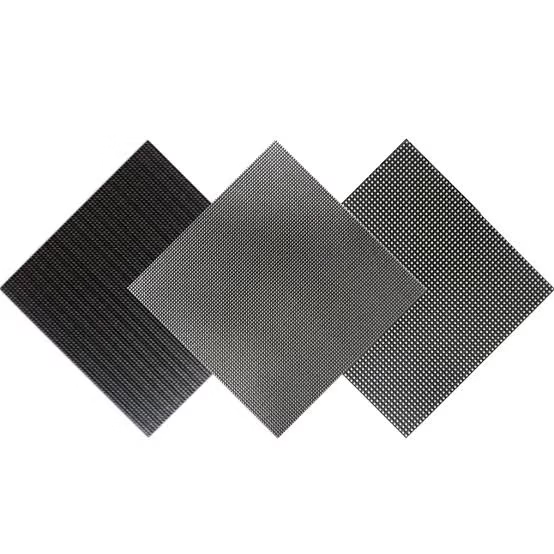
The curved-cabinet system behind this build is documented in full on the 500×500mm rental LED screen collection and the 500×1000mm format.
How Does a P1.53 Indoor Flexible LED Display Build Cylinders, Waves and Custom Shapes?
One panel family, four shape grammars — and at the 1.5 series the math is friendlier than most buyers expect. Modules of this class take U-shaped bends up to 120°, so a single panel spans a deeper arc than you would guess from its width; the sub-frame carries the long sweep, the silicone-faced panels carry the surface.

Convex & Concave Arcs
Bowed feature walls for lobbies and experience centers, bending inward or outward. The silicone shell spreads the stress so the face stays in plane from seam to seam.
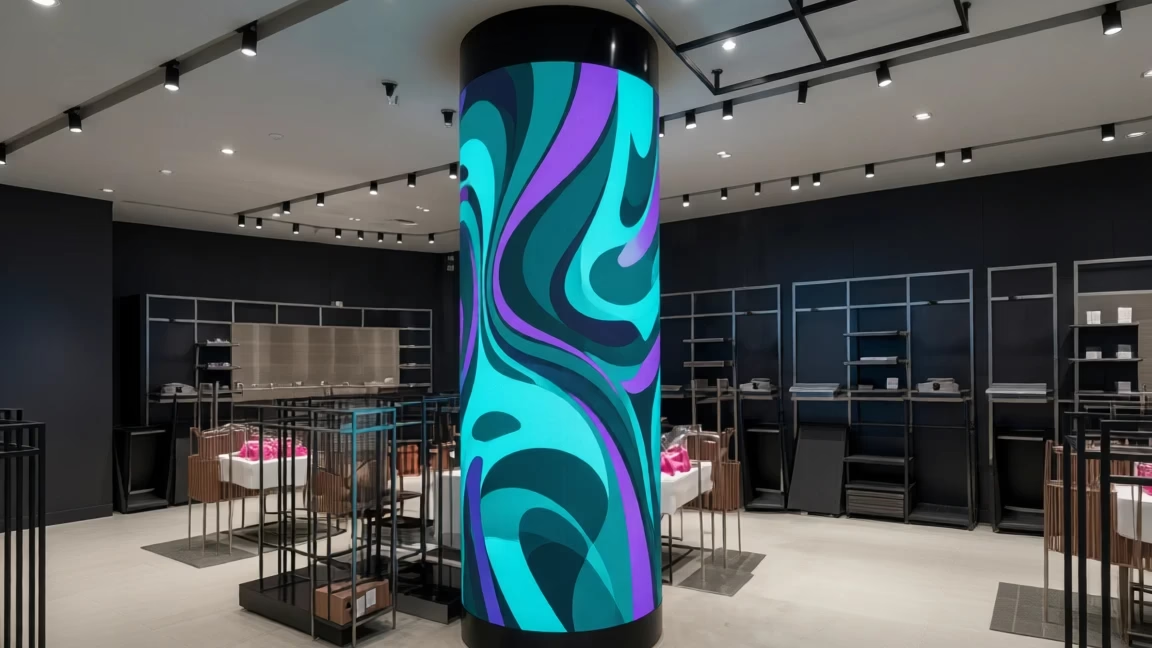
Full 360° Columns
Seamless wraps around structural columns. Panel count locks to the circumference: a Ø1.2m column takes 12 rings of 320×160mm panels end to end.
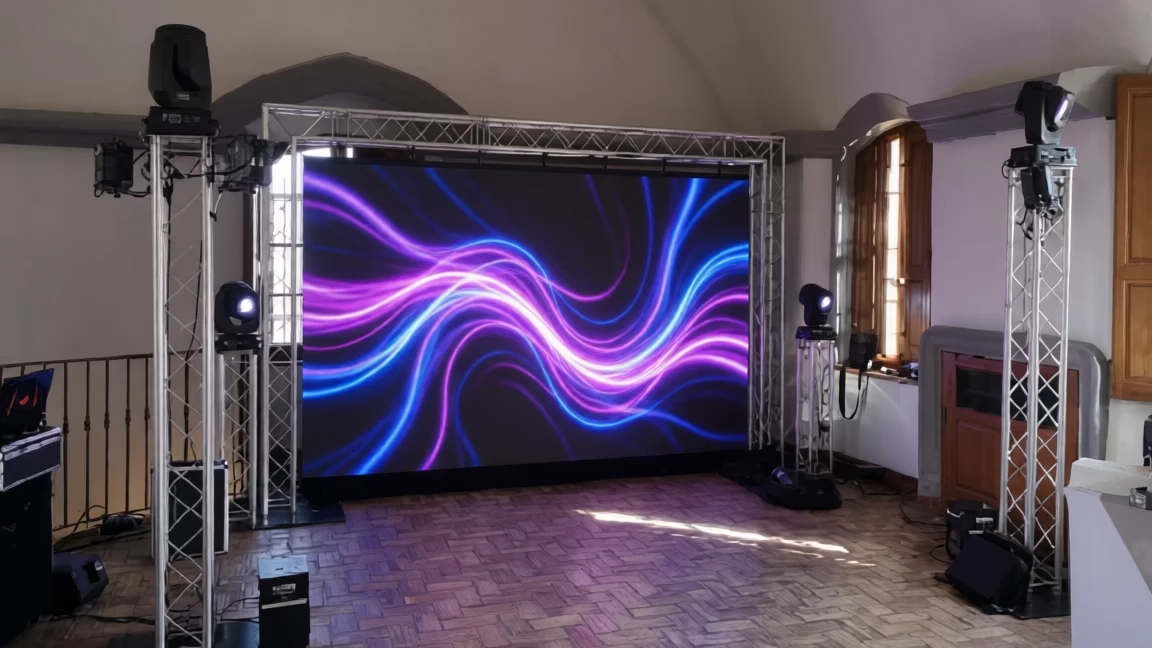
Waves & Ribbons
S-curves and floating ribbons for stages and atriums. Alternate segments tilt on the frame, so wave depth is a frame dimension — not a module limit.

Sphere Bands & Custom
Latitude bands on spheres, cones and one-off sculptures — a creative controller maps content pixel-by-pixel onto the irregular canvas.
Bending limits, in numbers: the 320×160mm-class panel follows a minimum cylinder diameter of roughly 815mm in industry bending tests, and this class takes U-shaped bends up to 120° per panel. Wrap tighter than the limit and the lamp foot lifts off the pad — final curvature is confirmed against the project drawing before any frame is rolled. Bending runs across the panel width only, never along a lamp row.
What Do Flexible LED Installations Look Like in Action?
What Makes a P1.53 Indoor Flexible LED Display Bend Without Breaking?
Four components turn a fine-pitch module into a soft one — and at 422,500 pixels per square meter, every one of them is a joint density problem before it is a bending problem.
0.2mm Flexible PCB
A polyimide FPC replaces the fiberglass board. Bending stress spreads across thin-film copper instead of concentrating at drilled holes, which is what lets the panel take U-shaped bends up to 120° without cracking a joint.
Silicone Base Shell
The precision silicone bottom case cushions the solder side and locks the optical face flat. On a curve it is the line between a continuous image and a faceted one — splices stay flush without shims.
Bend-Tolerant Flat Cables
Where a curved build flexes daily, standard HUB75 ribbons crack. The dedicated anti-fatigue flat cables on every panel are spec’d for repeated bending across the arc — power and signal alike.
Strong-Magnet Front Service
Each module seats on locating pins and lifts off with a suction tool — no screws, no rear crawl space. A single technician services a wrapped column from the front in minutes.
Optically the panels hold the 1.5-series line: SMD1212 black-face lamps on a 5000:1 contrast panel, 12–16 bit grayscale set by the IC grade, and 3840Hz refresh that keeps camera pans clean. After assembly every module passes per-pixel and per-color correction through the control system, so the 21,632-dot canvas reads as one continuous image — on a wave exactly as on a flat wall.
Which Power Supplies Run a P1.53 Indoor Flexible LED Display?
At 422,500 pixels per square meter and 600–800 nits, a square meter draws roughly 550–800W at peak and 250–320W on average broadcast content — industry reference figures for this class. A typical build carries two to four 5V/40A rails per square meter; the energy-saving 4.2V/4.5V common-cathode tier trims running cost on screens that play all day.
| Brand | Role on This Collection | Typical Rails |
|---|---|---|
| Chuanglian Power (CZCL) | Volume rails for standard 5V builds — the default on sheet-metal frame projects | 5V / 40A class |
| MEAN WELL | Spec-grade option when the project calls for a global brand on the power BOM | 5V / 40A class |
| G-Energy | Multi-voltage rails for the 4.2V/4.5V energy-saving common-cathode tier | 4.2V / 4.5V dual-rail |
Compare the full lines in the CZCL, MEAN WELL and G-Energy power collections — all three ship as standard on this collection depending on the tier you specify.
Which Control Systems Drive a P1.53 Indoor Flexible LED Display?
A curved 422,500-pixel canvas needs a controller that can map it. Synchronous systems from six brands drive this collection — all running the same receiving-card layer of NovaStar MRV336 or Colorlight i9+ cards, all supporting the per-pixel calibration that keeps a curved wall seamless. Asynchronous players from the same brands run the smaller column builds without a PC.
NovaStar MCTRL600
The workhorse sender for single-column and small arc walls at the 1.5 series density.

Huidu HD-VP410
Three-in-one processor — switcher, scaler and sender in one box for compact installs.



RGBlink VSP 628Pro
Web-controlled scaler that splits one source across column clusters as separate windows.

Full lineups, loading tables and selection guides live on the brand hubs: NovaStar, Colorlight, Huidu, Mooncell, VDWALL and RGBlink.
Which P1.53 Indoor Flexible LED Display Build Fits Your Project?
Route by geometry and inventory, not by price alone — the two formats answer different questions.
| Project Geometry | Build | Why |
|---|---|---|
| Fixed cylinders, waves and arcs — one-off creative shapes | 320×160mm on rolled sheet-metal frames | Industry-standard panel, best supply depth, 815mm minimum cylinder diameter |
| Curved wall on existing 500-series rental stock | 250×250mm in curved die-cast cabinets | Drops into 500×500 / 500×1000 angle-lock cabinets you already own |
| Rental fleet: flat touring walls one week, wrapped column the next | 250×250mm mixed fleet | One module inventory serves flat and curved cabinets |
| Viewers closer than 2m, or camera-close studio work | Step up to P1.25 flexible | At under 2m the 1.5-series dot structure starts to show — the P1.25 indoor flexible LED display holds the image where this one won’t |
| Pitch | Pixels per ㎡ | Closest comfortable viewing | Curves? | Price tier |
|---|---|---|---|---|
| P1.25 flexible | 640,000 | from ~1.5m | Cylinders, waves, arcs, spheres | $$$$ |
| P1.53 flexible (this page) | 422,500 | from ~2m | Cylinders, waves, arcs, spheres | $$$ |
| P1.953 indoor rental | 262,144 | from ~2.5m | Flat + angled lock builds | $$ |
| P2.604 indoor rental | 147,456 | from ~3m | Flat rental builds | $$ |
| Indoor Flexible Family | Formats | Best for |
|---|---|---|
| P1.25 Indoor Flexible LED Display Collection | 320×160 / 250×250 / 240×120 | Closest-view precision shapes |
| P1.53 Indoor Flexible LED Display — this collection | 320×160 / 250×250 | Value curved walls from ~2m |
| P1.86 Indoor Flexible LED Display Collection | 320×160 / 250×250 | Entry curved walls from ~2.5m |
| P2.0 Indoor Flexible LED Display Collection | 320×160 / 250×250 | Scale curved walls from ~3m |
| P2.5 Indoor Flexible LED Display Collection | 320×160 / 250×250 | Volume curved walls from ~3.5m |
| P3.076 Indoor Flexible LED Display Collection | 320×160 / 250×250 | Rental curved walls from ~4m |
| P4 Indoor Flexible LED Display Collection | 320×160 / 250×250 | Giant curved walls from ~5m |
| P5 Indoor Flexible LED Display Collection | 320×160 / 250×250 | Value-frontier curved walls from ~6m |
How Much Does a P1.53 Indoor Flexible LED Display Cost?
Screen-body pricing, FOB — frames, control and freight quoted per project. The 1.5 series sits roughly 20–30% under the 1.25mm tier, which is exactly why most curved walls start here.
| Build | Screen body, FOB | What moves the number |
|---|---|---|
| 320×160mm on rolled sheet-metal frames | $1,100–1,700 / ㎡ | Frame rolling complexity, quantity, brightness tier |
| 250×250mm in curved die-cast cabinets | $1,400–2,200 / ㎡ | Cabinet count, angle-lock accessory sets, flight cases |
| Add-on rows | quoted | Non-standard rolled frames, creative-controller mapping, 4.2V/4.5V energy-saving supply tier |
Module-level cross-check from the same scan: 320×160mm runs about $60–110 per panel in volume (19.53 panels/㎡ ≈ $1,170–2,150 before framing); 250×250mm $75–115 (16 panels/㎡). September 2026 market listing scan — Made-in-China, Alibaba and eBay trade listings, factory-direct FOB.
- The 320×160mm build is the supply-depth play — every flexible-module factory stocks it, so price, spares and lead time all sit at their floor.
- The 250×250mm build is the fleet play — the premium buys a wall that reconfigures from flat to curved using cabinets you already own.
Where Does a P1.53 Indoor Flexible LED Display Earn Its Keep?
Eight venues put the 1.5 series to work — curved surfaces, viewers from 2m back, budgets that want resolution without the ultra-fine premium.
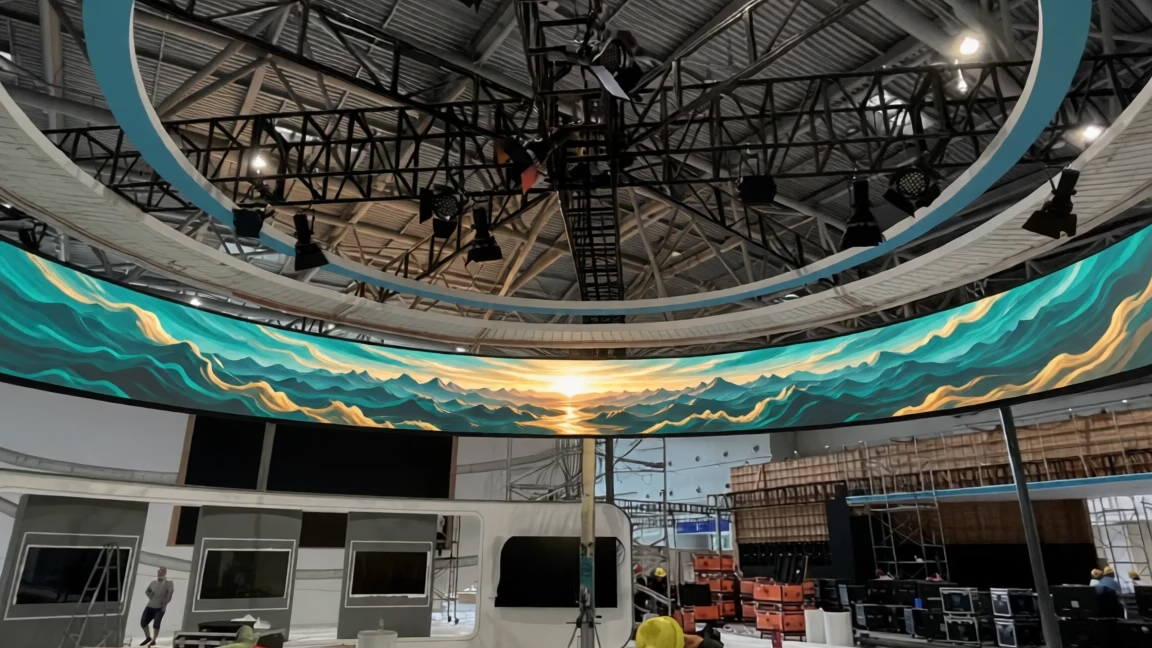
Immersive Exhibition Surrounds
Wrapping visitors in content — arcs that bend overhead and underfoot in brand pavilions and museums.
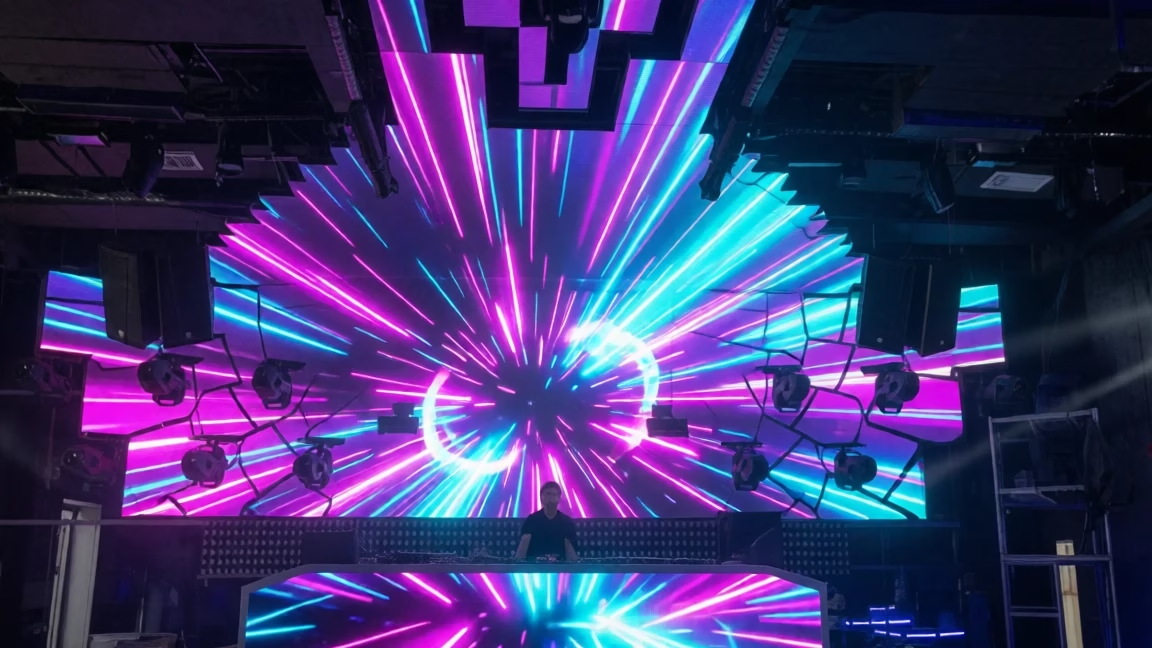
Club & DJ Booth Curves
Booths and bars wrapped in pixel — the 1.5 series survives the hours and the bending in one piece.

Wedding Arches & Pillars
Ceremony arches and wrapped pillars that change content between events — rental-friendly formats.

Science-Museum Sphere Bands
Latitude bands on suspended globes — the creative-controller canvas younger visitors remember.
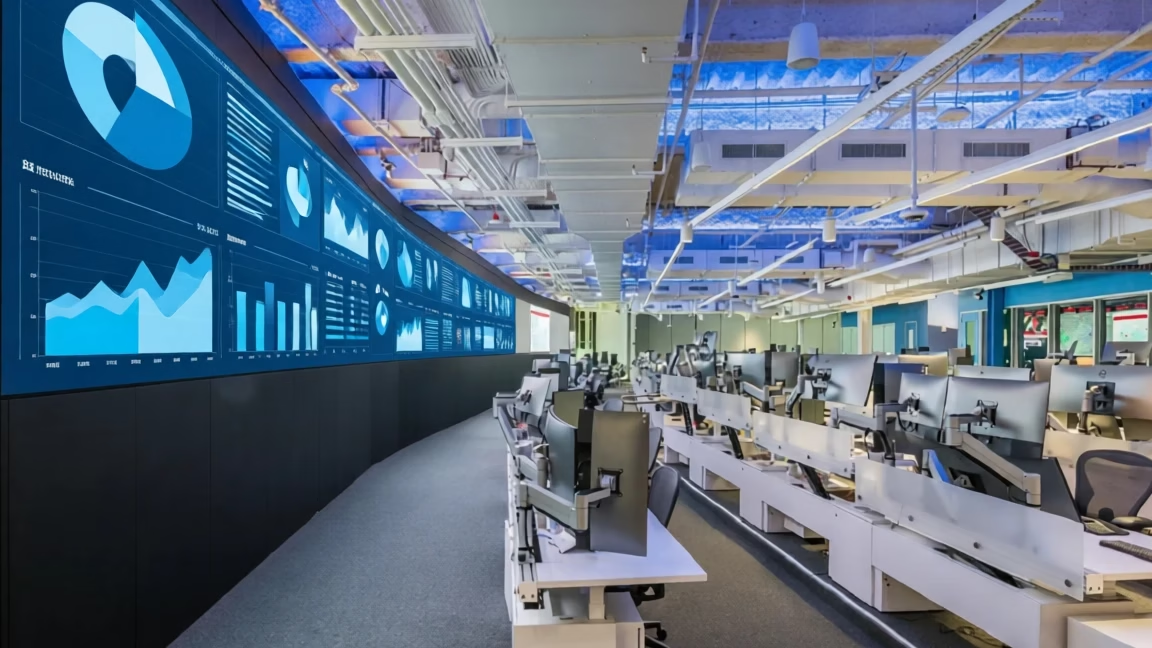
Boardroom Arc Walls
Concave meeting-room walls that hold fine text from the far seat — 422,500 px/㎡ carries the detail.

Flagship Window Curves
Retail windows that wrap the glass line — brightness dialed to 600–800 nits for storefront light.
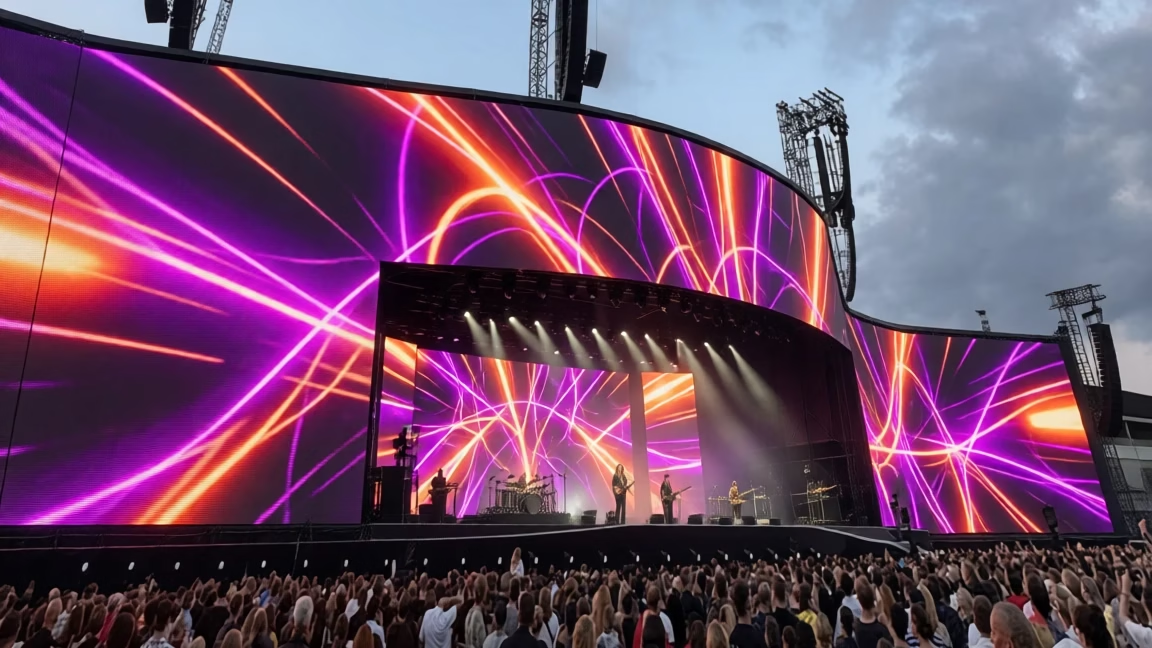
Stage Side Pods
Wings that curve off the main wall and follow the sightlines — 3840Hz keeps broadcast clean.

Trade-Fair Towers
Four-sided towers assembled in hours on one rolled frame — the booth centerpiece that ships flat.
What Do Typical P1.53 Indoor Flexible LED Display Projects Look Like?
Four build patterns this collection is engineered around — configurations and module counts as quoted on our production sheets.

360° Column Wrap — Retail
320×160mm modules on a Ø1.2m rolled frame — 12 panels per ring, front-serviced entirely by magnet.

Immersive Arc — Brand Pavilion
320×160mm panels on a two-plane arc frame, creative-controller pixel map, 3840Hz for live demo cameras.

Trade-Fair Tower — Expo
Four 640×640mm rolled faces on one spine — 32 modules, assembled and calibrated in a day.

Curved Rental Wall — Event House
250×250mm modules in 500×500mm angle-lock cabinets, arc built from ±15° segments in a day.
What Should You Ask Before Buying a P1.53 Indoor Flexible LED Display?
1. How far can a P1.53 indoor flexible LED display bend?
Panels of this class take U-shaped bends up to 120°, and the 320×160mm format follows a minimum cylinder diameter of roughly 815mm in industry bending tests. Curvature runs across the panel width, never along a lamp row — final radii are confirmed against the project drawing before the frame is rolled.
2. Should I buy P1.53 or P1.25 for a curved wall?
Let the closest viewer decide. From about 2m outward the 1.5 series reads as a continuous image and costs 20–30% less; inside 2m — or under studio cameras — the 1.25mm tier holds the dot structure hidden. Most lobby, retail and exhibition work sits comfortably in P1.53 territory.
3. Will bending damage the LEDs or create dead pixels?
Not within the rated curve. The 0.2mm FPC spreads bending stress, the silicone base shell cushions the solder side, and the anti-fatigue flat cables survive daily flexing. After assembly, per-pixel calibration catches any marginal joint before it ships.
4. How much does a P1.53 indoor flexible LED display cost per square meter?
Screen-body pricing runs about $1,100–1,700 per square meter on rolled sheet-metal frames and $1,400–2,200 in curved die-cast rental cabinets, FOB. Frames, control and freight quote per project — the full breakdown sits in the pricing section above.
5. Can the modules be reused across rental jobs?
Yes — that is the 250×250mm format’s whole point. The same soft modules seat in flat or curved 500-series cabinets through the angle-lock system, so one inventory serves a touring wall on Saturday and a wrapped column the next weekend. Strong-magnet front service keeps turnaround fast between jobs.
6. Can a flexible LED display be used outdoors?
This is an indoor collection: the silicone masking handles splash and dust for covered semi-outdoor spots, but sustained rain, UV and temperature swings call for an outdoor flexible line. Specify this collection for interior and covered applications.
7. Do the magnets really hold a module on a vertical curve?
Yes — each module weighs a few hundred grams and seats on steel locating pins held by high-pull magnets rated well beyond that load. The frame carries the structure and the magnets carry alignment; frame tolerance is held within ±1.5mm so the silicone faces splice flush.
8. Are seams visible on a curved P1.53 wall?
The precision silicone shell keeps panel faces in plane without shims, and per-pixel, per-color calibration matches brightness across the canvas. From the format’s intended viewing distance of 2m and beyond, the wall reads as one continuous image.
Where Does P1.53 Sit in the Flexible LED Family?
The 1.5 series is the volume heart of the soft-module market, and P1.53 is its most common face. Below it, the 1.25mm tier buys close-view precision at a premium; above it, P1.86 and P2 trade resolution for budget. Between those poles, P1.53 holds 422,500 pixels per square meter — enough dot structure to carry fine text, skin tones and product detail from about 2 meters — while its module economy stays anchored to the industry-standard 320×160mm format that every flexible-module factory stocks.
That stock depth is the quiet advantage. A creative build at the value pitch can ship in phases, mix batches, and find spares years later, because 208×104 on a 320×160mm soft body is the configuration the supply chain standardized on. For a buyer, the practical translation is simple: shorter lead times, softer price negotiations, and a wall that stays serviceable for its whole life.
What Does the SMD1212 Package Change at 1.53mm?
Package choice is a density decision. At the 1.5 series the lamp moves up from the SMD1010 used at 1.25mm to an SMD1212 black-face: a slightly larger foot that carries a bigger pad, which matters more on a flexible PCB than on a rigid one. The larger pad spreads the mechanical stress of bending across more solder area, and the black face keeps contrast at 5000:1 — the same discipline fine-pitch buyers expect, tuned for a panel that moves.
The driver layer matches that logic. 78 Chipone ICND-series ICs scan the 21,632-dot matrix at 1/26 with a 3840Hz refresh, and grayscale runs 12–16 bit by IC grade. The combination is what lets a curved wall appear on camera without scan lines and hold uniform color across a wave — the electronics are doing the same work the silicone does mechanically: keeping the surface honest.
How Is Content Mapped onto a Curved P1.53 Canvas?
A curved wall is an irregular canvas, and the controller is what makes it behave like a flat one. After the frame is set and the modules are mounted, the control system reads the physical layout — ring counts on a column, crest spacing on a wave — and builds a pixel map that places every one of the canvas’s dots where the geometry says it sits. Content is then authored to that map, so a logo wraps a cylinder exactly where the designer drew it.
Creative controllers take this further with native shape libraries: cylinders, spheres and ribbons as first-class canvas types rather than manual coordinate math. For standard arcs and waves the mainstream synchronous systems handle the mapping themselves, and the calibration pass — per-pixel, per-color, run after the build is up — closes the last gap between panels. The result is a wall that plays like one screen, because electrically and optically it is one.
What Does a P1.53 Flexible Build Cost Over Its Life?
The purchase is the visible number: roughly $1,100–2,200 per square meter of screen body depending on format. The operating number is smaller than most expect — 250–320W per square meter on average content, trimmed further by the 4.2V/4.5V common-cathode tier on screens that run all day. Lamp life runs about 100,000 hours, and the 3% spare-modules allowance that ships with every build covers the knocks of daily front service.
The number buyers forget is reuse. A 250×250mm flexible inventory that moves between flat and curved cabinets earns across formats — the same modules, flight cases and crew knowledge serving a touring wall, a booth tower and a wrapped column. Against a custom-built curved screen that serves one campaign, the fleet math is why rental houses standardize on this pitch.
What Does Installing a P1.53 Indoor Flexible LED Display Involve?
The frame is the work; the modules are the reward. A survey fixes the true radius, the sheet-metal sub-frame is rolled to match, and tolerance is held within ±1.5mm so the silicone faces meet flush. Modules then go on from the front — locating pins align each one, magnets seat it, and a suction tool pulls it back off for service without touching the panel behind it. Power and data route on the anti-fatigue flat cables along the arc, and the controller pixel-maps the canvas so content lands where the geometry says it should.
Commissioning closes the loop: per-pixel and per-color correction runs against the installed canvas, the brightness schedule is set for the venue’s ambient light, and the front-service routine is walked through with the venue team. Because the 320×160mm format is the industry standard, crews who have built any soft-module wall before will find nothing new here — the mounting grid, the cable discipline and the calibration flow all match the formats they already know.
What Maintenance Does a P1.53 Indoor Flexible LED Display Need?
Front service is the design promise. A misbehaving module comes off with a suction tool in under a minute and a replacement goes back in the same way — no rear crawl space, no frame teardown. Replacement stock is a commodity at this pitch: the 320×160mm soft module is the most widely stocked flexible format in the market, which is a quiet form of insurance on any build. Every collection ships with 3% free spare modules to cover the knocks of daily service.
Routine care mirrors any fine-pitch wall, with one flexible-format habit: clean the silicone faces with soft, dry-or-damp discipline — no solvents, nothing abrasive — and during scheduled service windows, glance over the anti-fatigue cables where they exit the arc, since that is the only part of the signal path that flexes in daily operation. The control system carries the rest: a per-pixel calibration re-run once a year keeps brightness matched across the canvas as lamps age, and takes minutes on a collection this size.
The Bottom Line on the P1.53 Indoor Flexible LED Display
A P1.53 indoor flexible LED display is the specification to reach for when a wall must bend and the budget must not. The 320×160mm module covers fixed creative shapes on the industry’s deepest supply base; the 250×250mm format turns 500-series rental stock into curved revenue. From about 2 meters back, 422,500 pixels per square meter read as one continuous image — and everything inside that envelope, the 1.5 series delivers at 20–30% under the ultra-fine tier.
Related Collections
P1.25 Indoor Flexible LED Display Collection
The ultra-fine tier of the soft-module family — 640,000 px/㎡ for the closest viewers and camera work.
500×500mm Rental LED Screen Collection
The angle-lock cabinet system that takes 250×250mm flexible modules into arcs, circles and waves.
LED Display Collection
Indoor, outdoor, rental and poster lines from the factory — start here when the wall is flat and the budget is fixed.
Ready to Curve Your Wall?
Send the column diameter, wave profile or arc drawing — we return a module layout, frame drawing and screen-body quote from the P1.53 indoor flexible LED display collection within 24 hours.