
P3 vs P4 Outdoor LED Display: Which Pitch Saves Money? (2026)
The P3 vs P4 outdoor LED display comparison is the ladder’s steepest value step: 1mm of pitch separates them, and inside that millimeter live a 44% lamp-count gap, a $50–100 per-square-meter price gap, and two viewing bands that overlap across most of their length. A P3 outdoor LED display is a 3mm-class wall carrying 105,625–111,111 pixels per square meter; a P4 outdoor LED display is the 4mm wall carrying 62,500 — the value pitch that buys the most clarity per dollar once the closest viewer sits past 4 meters. This guide runs the five differences that actually move a purchase: lamp count, viewing band, price, board ecosystem, and the fixed-canvas reversal — then compresses them into one decision rule. The full spec sheets live on the P3 outdoor collection and the P4 outdoor collection.
Short answer — the five differences: (1) Lamp count: 111,111/105,625 vs 62,500 px/㎡ — a 44% cut. (2) Viewing bands: P3 owns 3–8 m; P4 owns 4–10 m; the 4–8 m overlap is where the real decision lives. (3) Price: $700–1,100 vs $600–1,000/㎡ — about $50–100 less per square meter for P4. (4) Board ecosystem: both live on the 320×160mm suite — pitch becomes a module swap. (5) Fixed-canvas reversal: for the same 1080P-class canvas the P3 wall totals less money despite its dearer square meter. The rule: under 3 m go finer; 3–4 m P3 only; 4–8 m decide by text demand and budget; 8–10 m P4; past 10 m P5.
What Is the Actual Difference in a P3 vs P4 Outdoor LED Display?
A P3 outdoor LED display is a 3mm-class wall — built either as exact-pitch P3.0 on 192×192mm squares (64×64 = 4,096 dots, 111,111 px/㎡) or as P3.076 on the industry-standard 320×160mm board (104×52 = 5,408 dots, 105,625 px/㎡) — in SMD1415 lamps behind an IP65 front. A P4 outdoor LED display is the 4mm wall one rung down: 40×20 = 800 dots on the same 320×160mm board outline, in SMD1921, 62,500 px/㎡. Both run 5,500+ nit brightness tiers, both seal to IP65 in waterproof iron cabinets, and both share the same control stack — the environment does not separate them; resolution and money do.
The comparison matters because the two bands overlap. P3 owns 3–8 meters; P4 owns 4–10 meters; between 4 and 8 meters both pitches deliver their full promise, and the choice becomes commercial rather than visual. Seeing the P3 side in the field:
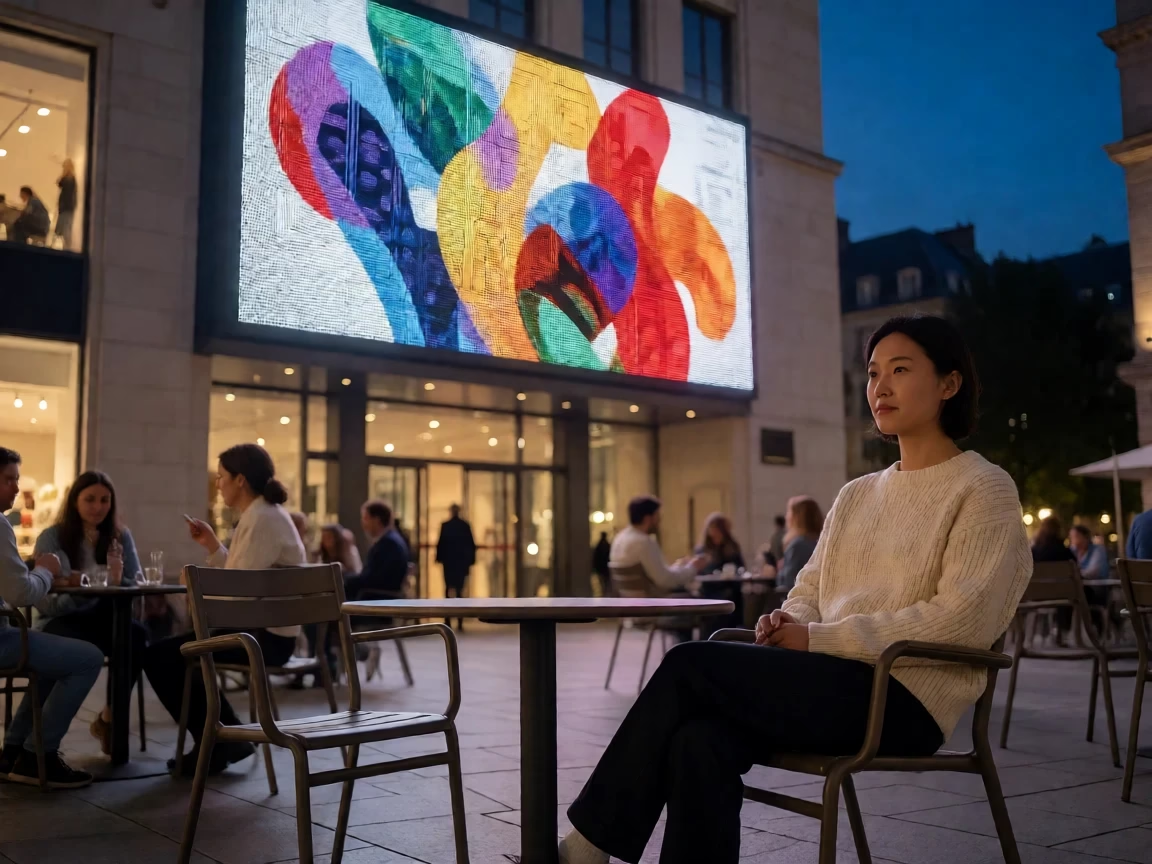
The P3 side in the field: a plaza facade at dusk, where fine text earns the premium.
How Do Lamp Count and Pixel Density Compare in a P3 vs P4 Outdoor LED Display?
Per square meter, P3 carries 111,111 lamps (exact P3.0) or 105,625 (P3.076) against P4’s 62,500 — a 44% cut in the component that takes 35–45% of module cost. That single line drives most of the price gap, most of the power gap, and the entire “value pitch” story. The boards behind the grids:
The module is the service unit on both pitches — lamps, mask and driver ICs in one swap — and the swap discipline is identical:
Module-level service: the same swap discipline whether the grid is 5,408 dots or 800.
How Does Viewing Distance Decide a P3 vs P4 Outdoor LED Display Choice?
The two bands, from each pitch’s own math: P3 reads as HD from 3 m with small text holding at 7–10 m; P4 reads as HD from 4 m with text crisp at 5–8 m and softening as the viewer approaches 4. The bands overlap across 4–8 meters — the steepest part of the value ladder — and that overlap is exactly why this comparison exists. Three zones fall out of it:
Under 3 m: both pitches show their grids; the ladder continues up to P2.5 and finer. 3–4 m: P3’s exclusive territory — storefronts and entrance walls where the viewer stands close enough to resolve a 4mm grid. 4–8 m (the overlap): both deliver HD, and the decision is commercial — detail-heavy text and close scrutiny favor P3, budget and larger faces favor P4. 8–10 m: P4’s edge, the last rung where 4mm still renders its full promise. Past 10 m: the ladder steps down to P5. The full derivations sit in the P3 outdoor quick guide, the P4 outdoor quick guide and the site-wide viewing distance reference.
What Does the Price Gap in a P3 vs P4 Outdoor LED Display Add Up To?
The 2026 factory-direct bands, same signature on both collections: $700–1,100/㎡ for standard fixed P3, $600–1,000/㎡ for standard fixed P4 — about $50–100 less per square meter for P4 across the band, and $100 lower at the floor. Module prices track the same curve: $25–50 per P3.076 board against $20–45 per P4 board.
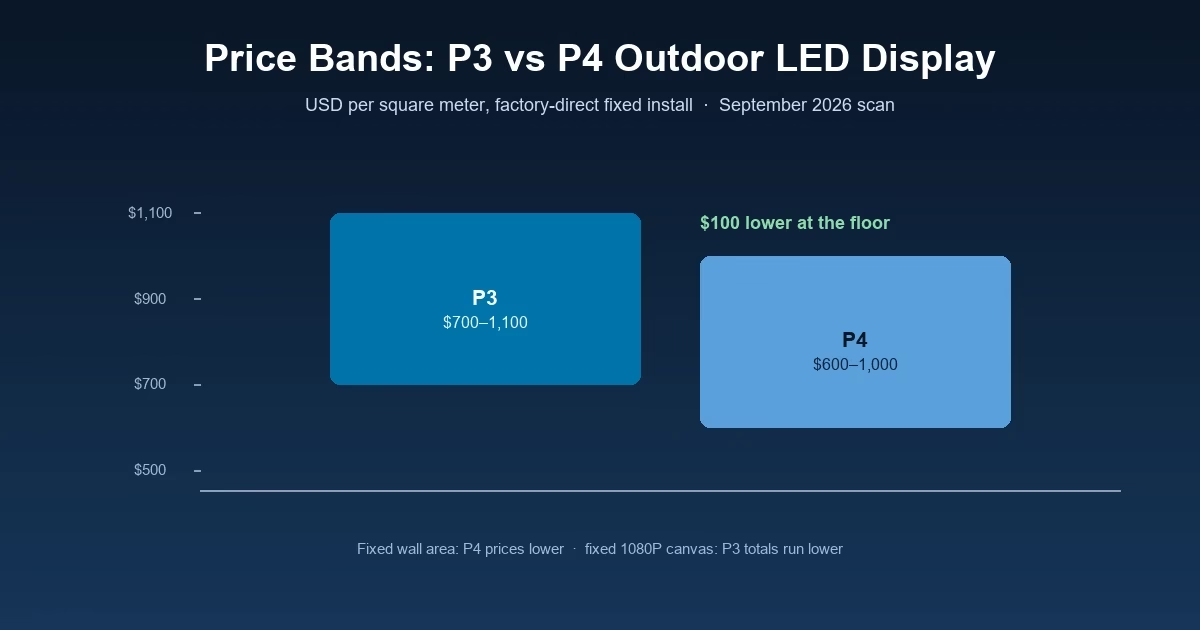
The per-square-meter bands. The twist: which pitch totals less depends on what is fixed — the area or the canvas.
For a fixed wall area — a 13㎡ storefront band — P4 prices at $7,800–13,000 where P3 prices at $9,100–14,300: the saving lands whole. But combine the price gap with section five’s canvas arithmetic and it reverses: for a fixed 1080P-class canvas, the P3 wall totals $13,200–20,700 while the P4 wall needs 33.18㎡ and totals $19,900–33,200 — the finer pitch costs less in total despite its dearer square meter. Everything else is a text-demand argument. The pitch-specific stacks are in the P3 outdoor price guide and the P4 outdoor price guide.
Can the Same Boards Run Both Sides of a P3 vs P4 Outdoor LED Display Choice?
On the 320×160mm suite, yes — and it is the quiet argument for the format. The P3.076 grid (104×52) and the P4 grid (40×20) are two different dot layouts on the same board outline, sharing mounting holes from P2.5 through P10. A wall built on that kit can change pitch later by swapping modules — P4 today, P3.076 tomorrow — without touching cabinets, structure or power. The exact-P3.0 square is the exception: it lives on its own 576/768mm cabinet line, bought when a tender says 6.0mm or an extension must match an older wall board-for-board. Where the swap story shows up in practice:
Module swap in seconds: the same board outline makes pitch a service event, not a rebuild.
For buyers this collapses into two practical rules. Spare parts: both pitches’ quotes should state lamp grade, scan and bundle — but only the 320×160mm kit lets one spare-part bench serve a fleet that mixes pitches. Future-proofing: a P4 wall specified on the shared kit can step up to P3.076 resolution later for the cost of modules alone — roughly half the wall’s value in the 2026 bands — rather than a full rebuild. Where that option matters, say so in the RFQ.
And the reversal itself, drawn on one canvas. The same 1,920×1,080-pixel target at three pitches:
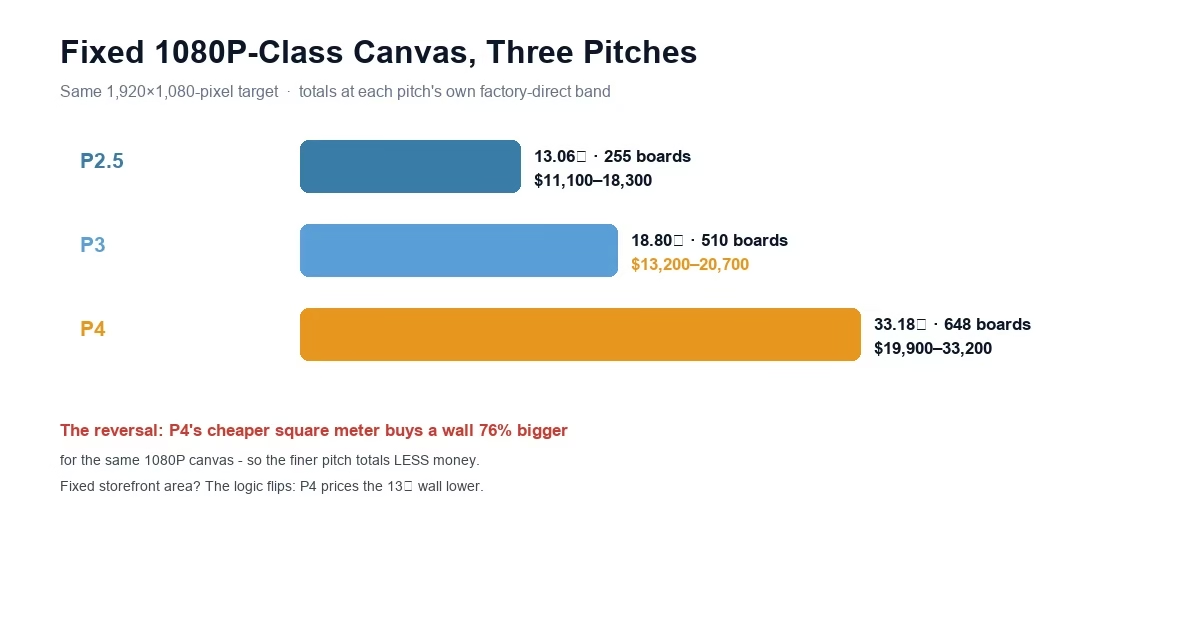
Fixed canvas, three tags: the finer pitch’s dearer square meter buys a smaller wall — and totals less.
Which One Should You Buy? The P3 vs P4 Outdoor LED Display Decision Rule
Measure the closest spot a paying customer stands, then apply the rule in order:
- Under 3 m: both pitches show their grids; step to P2.5 or finer.
- 3–4 m: P3 only — it is the coarsest outdoor pitch that still reads as HD here.
- 4–8 m (the overlap): decide by text demand and budget. Storefronts and entrance walls where fine text pays the rent → P3. Facades, plazas and car parks where video carries the message → P4 at roughly $50–100 less per square meter.
- 8–10 m: P4’s edge — the last rung where 4mm still renders its full promise.
- Past 10 m: step down — P5 and coarser; the background math is in the pixel pitch guide.
The P4 side of that rule, shipping:
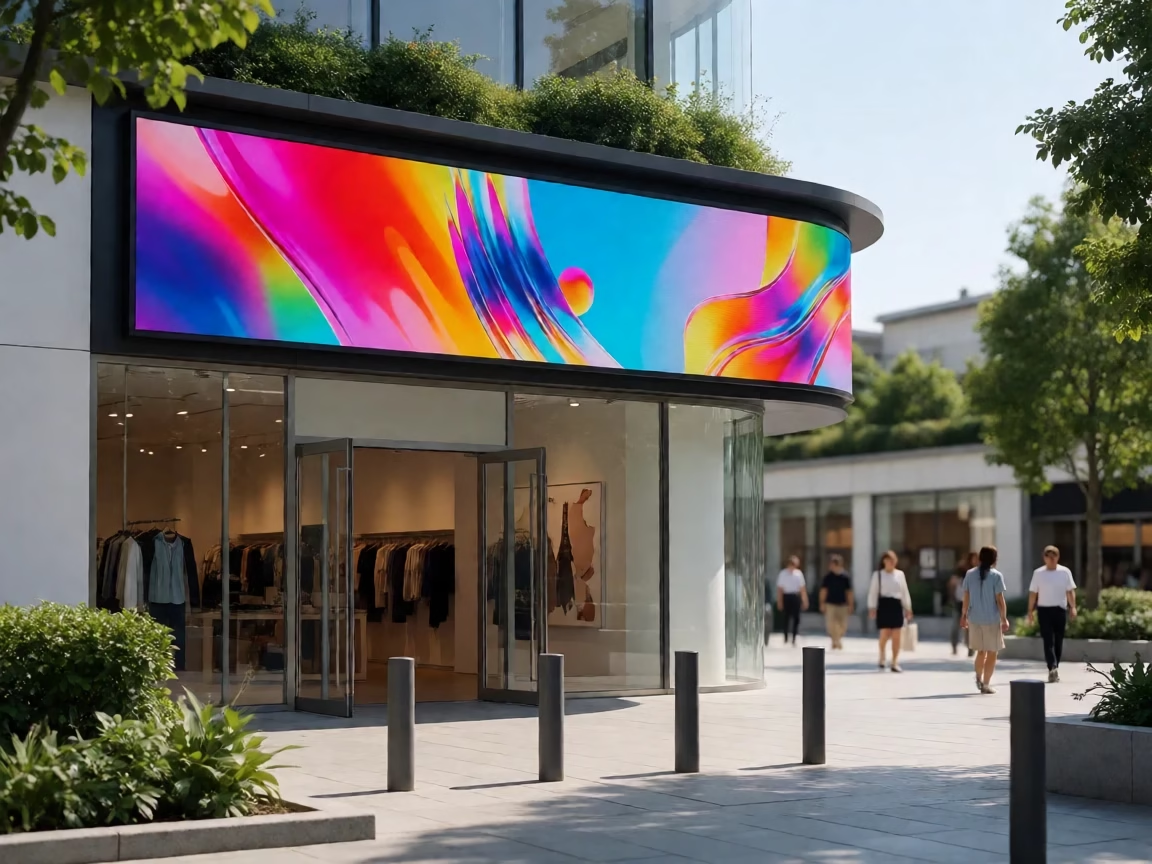
The P4 side in the field: a storefront forecourt wall — the value pitch’s home placement.
What Do Buyers Also Ask About a P3 vs P4 Outdoor LED Display?
Is P4 sharper than P3 at 5 meters?
Barely. At 5 m both pitches sit inside their readability band and side-by-side differences are subtle — visible mainly in fine text, dense dashboards and direct A-B comparison. The difference becomes decisive under about 4 m, where only P3 keeps rendering small text as text.
How much cheaper is P4 than P3 per square meter?
The 2026 factory-direct bands are $600–1,000 per square meter for P4 against $700–1,100 for P3 — roughly $50–100 less per square meter across the band, and $100 lower at the floor. For a fixed wall area that saving lands whole; for a fixed 1080P-class canvas it reverses, because the P4 wall is 76% larger.
Can a P3 wall be upgraded to P4 later — or the other way?
On the 320×160mm board suite, yes — the P3.076 grid (104×52) and the P4 grid (40×20) share the same board outline and mounting holes from P2.5 through P10, so a wall can change pitch by swapping modules while cabinets, structure and power stay in service. Exact-P3.0 legacy squares are the exception: they live on their own 576/768mm cabinet line.
Which one for a storefront — and which for a plaza facade?
Storefronts and entrance walls where viewers close inside 4–5 meters and fine text pays the rent: P3. Plaza facades, car parks and building identity walls watched from 5–10 meters where video carries the message: P4, at roughly $50–100 less per square meter.
Do P3 and P4 share modules?
They share the board outline, not the grid: both live on 320×160mm boards, but the P3.076 grid packs 104×52 = 5,408 dots while the P4 grid lays 40×20 = 800 dots on the same outline. Cabinets, power and the swap ecosystem are shared; the modules themselves are pitch-specific.
Is P4 still the value pitch when P3 costs only $100 more?
Past 4 meters, yes — P4’s 44% lighter lamp load is invisible to the viewer, so the saving is free quality-wise. Inside 4 meters the P3 premium buys resolution the viewer can actually see, which is why storefront walls pay it and highway-side facades do not.
References & Sourced From: P3 vs P4 Outdoor LED Display Data
- P3 figures (105,625–111,111 px/㎡; 320×160mm = 104×52 = 5,408 dots at 1/13 scan, 42–84 ICs; 192×192mm = 4,096 dots at 1/16; SMD1415 Grade 1 Nationstar class / Grade 2 Xinda class; $700–1,100/㎡ fixed, $25–50/module; 3–8 m band): our P3 outdoor collection, September 2026.
- P4 figures (62,500 px/㎡; 320×160mm = 40×20 = 800 dots at 1/10 or 1/8 scan, 30–60 ICs; SMD1921 Grade 1 / Grade 2; $600–1,000/㎡ fixed, $20–45/module; 4–10 m band; four board formats): our P4 outdoor collection, September 2026.
- Fixed-canvas arithmetic (1080P-class: P2.5 13.06㎡/255 boards, P3 18.80㎡/510 boards, P4 33.18㎡/648 boards) and the 44% lamp-count gap: computed from module grids, cross-checked against the pixel pitch reference.
- Price bands and the shared 320×160mm board suite (mounting geometry from P2.5 through P10): our P3 outdoor price guide, P4 outdoor price guide and outdoor LED display price guide.
Verdict: Who Wins the P3 vs P4 Outdoor LED Display Matchup?
There is no universal winner — there is a zone map. P3 wins under 4 m and wherever the closest viewer is close enough that 78% more density shows up in the rent-paying detail: storefronts, entrance walls, content with fine text. P4 wins on budget inside the overlap: the same perceived HD at roughly $50–100 less per square meter, plus the shared 320×160mm kit’s exit option of a later pitch swap. Neither wins past 10 m — the ladder does. Run your sidewalk measurement first, then price both as one-package builds with cabinets, power and control included, the way a LED screen manufacturer quotes them — and let the zone, not the spec sheet, pick the pitch.
Related P3 vs P4 outdoor guides:
P3 Outdoor LED Display Collection · P4 Outdoor LED Display Collection · P2.5 vs P3 Outdoor LED Display · Outdoor LED Display Price Guide