
How Much Does a Video Wall Cost in 2026? Real Prices and Budgets
A video wall is a display system built from multiple panels or LED cabinets driven as one logical canvas. Its cost is not a single sticker price: it is the sum of panels, processing, structure, installation, and service. In 2026, a packaged entry-level wall starts near $9,500, a typical installed lobby wall lands between $30,000 and $100,000, and a premium MicroLED wall can pass $200,000 (SVSolutions 2026). Factory-direct LED cabinets start at $400–$1,400 per square meter.
Short answer: How much does a video wall cost? It depends on how you buy it. A hardware kit for a 10 ft × 5 ft P2.9 wall runs $11,000–$15,000, but it excludes structure, power, installation, and calibration. An installed P2.5 wall from an integrator runs $900–$1,600 per square foot, which puts a 12 ft × 7 ft lobby wall at $60,000–$100,000. Factory-direct LED cabinets from a manufacturer run $400–$1,400 per square meter, and a complete 24 m² P2.5 project typically lands at $17,000–$24,000 before local labor. The gap between these numbers is scope, not magic.
1. How Much Does a Video Wall Cost? The 2026 Answer in One Screen
A video wall is a set of displays plus the processing and mounting that make them behave as one screen. Four price frames are quoted in the market. A video wall kit is a hardware-only package of cabinets, a basic sending card, and a frame for buyers who install it themselves. A factory-direct LED wall is a cabinet set bought from the manufacturer with power and basic control included, before local steel and labor. An installed video wall is a turnkey project that adds engineering, structure, electrical work, calibration, and service. A brand all-in-one wall is a single-SKU product such as Samsung The Wall.
| Buying route | What the price includes | 2026 range | Best for |
| Online kit | Cabinets, basic sending card, simple frame | $9,500–$39,000 | Rental houses, churches, event crews |
| Factory-direct cabinets | Modules, cabinets, power, basic control | $400–$1,400/㎡ | Buyers with a local installer |
| Installed project | Everything above plus structure, power, labor, calibration | $400–$4,000+/sq ft | Lobbies, retail, control rooms |
| Brand all-in-one | One SKU, processing and mount included | $79,999–$219,999 | Preset sizes, low integration risk |
Before pricing panels, settle what the wall has to do. A video wall for a bright lobby and one for a dark control room carry different brightness, pitch, and processing requirements. Start with the room, viewing distance, and content, then ask an LED screen manufacturer for a per-square-meter number and a line-item scope. Comparing a kit price with a turnkey price without adjusting scope is the most common budgeting error.
2. What Makes Up a Video Wall Price? The Six Line Items
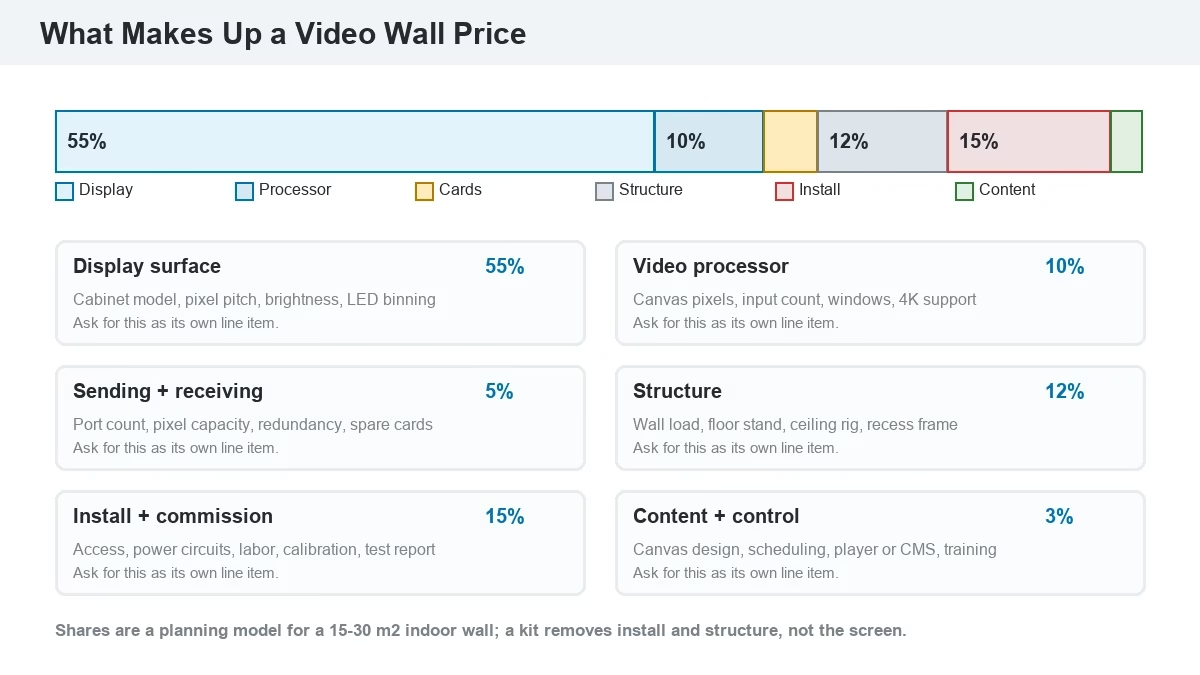
A video wall budget is the sum of six line items: display surface, processor, sending and receiving hardware, mounting structure, installation and commissioning, and content or control software. Each line scales with a different variable, which is why two quotes for the same wall size can differ by a factor of three. An LED video processor runs from about $500 for a single-chain unit to $10,000 for a configurable 4K model. Budget the controller separately: the RGBlink LED video processor price guide, Colorlight controller price guide, and Mooncell LED controller price guide show the tiers.
| Line item | What drives the number | 2026 budget guide |
| Display surface | Area, pixel pitch, brightness, cabinet build | $400–$1,400/㎡ LED; $600–$6,000 per LCD panel |
| Video wall processor | Input count, output canvas, layers, 4K support | $500–$10,000 |
| Sending and receiving hardware | Cabinet count, port count, redundancy | $500–$2,000 per project |
| Mounting structure | Wall load, floor stand, hanging frame, recess | Often 10–20% of screen value |
| Installation and commissioning | Access, height, site hours, calibration | +20–30% of screen value |
| Content and control | Canvas design, scheduling, live sources | $0–$5,000+ depending on scope |
Four key differences separate these line items:
- The display surface scales with area and pitch. Halving the pitch roughly quadruples the LED count for the same square meter.
- The processor scales with canvas pixels, not screen size. A 4K canvas needs a processor rated above 8.29 million pixels.
- Structure and installation scale with the building. A wall at 4 m height costs more to mount than the same wall at 1 m.
- Content is the only line that can be deferred, and deferring it leaves a finished wall with nothing to show.
3. How Much Does an LED Video Wall Cost per Square Meter?
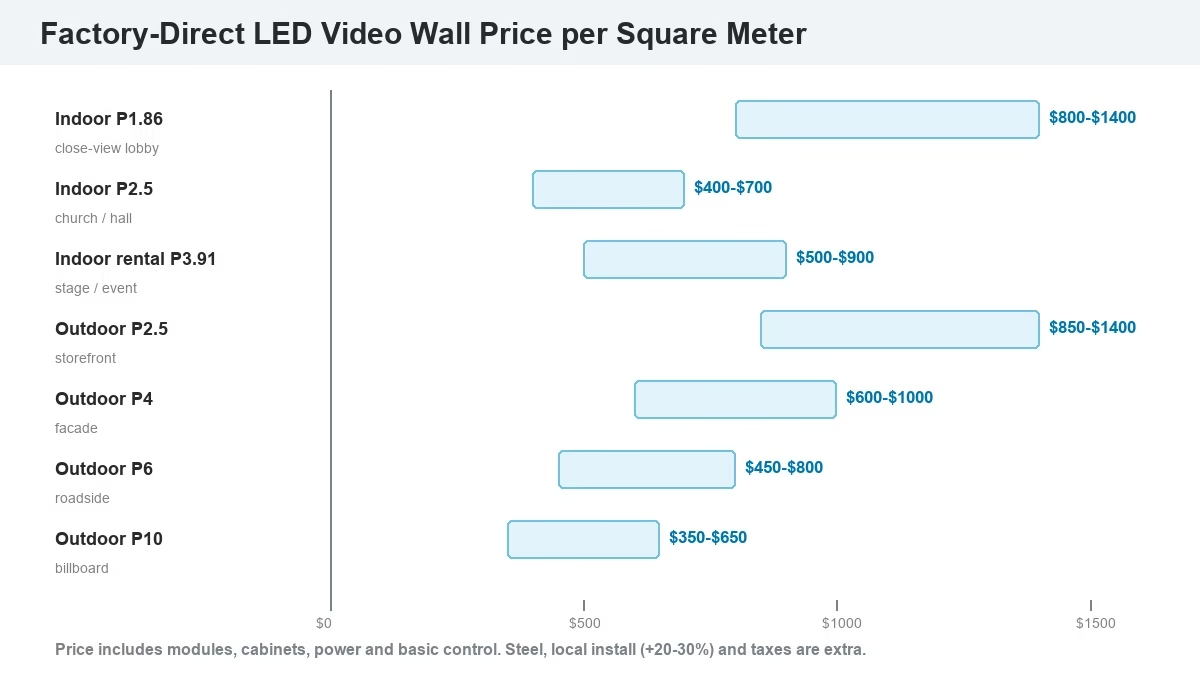
A direct-view LED video wall is a wall in which each pixel emits its own light from an LED, tiled from cabinets and driven by a sending and receiving card chain. Its price is quoted per square meter because cabinets tile into any size. The 2026 factory-direct bands below cover modules, cabinets, power, and basic control, before local steel and installation.
| Type and pitch | Pixels per ㎡ | Factory-direct price/㎡ | Typical use |
| Indoor fixed P1.86 | 289,000 | $800–$1,400 | Lobbies, boardrooms, close viewing |
| Indoor fixed P2.5 | 160,000 | $400–$700 | Churches, halls, retail, mid-distance |
| Indoor rental P3.91 | 65,536 | $500–$900 FOB | Stages, events, mobile fleets |
| Outdoor P2.5 | 160,000 | $850–$1,400 | Storefronts, close-view outdoor |
| Outdoor P4 | 62,500 | $600–$1,000 | Building facades, street level |
| Outdoor P6 | 27,778 | $450–$800 | Roadside, mid-distance signage |
| Outdoor P10 | 10,000 | $350–$650 | Billboards, long-distance viewing |
The same ladder appears on the individual price pages for P2.5 outdoor LED display price and P10 outdoor LED display price. Indoor fixed walls follow a lower curve because brightness and weather sealing are lower. The P1.86 indoor fine pitch LED display, P2.5 indoor LED display, and P3.91 indoor rental LED display pages show cabinet formats and the adders for high refresh, GOB, and COB.
3.1 How Does Pixel Pitch Change the LED Video Wall Price?
Pixel pitch is the distance in millimeters between adjacent LED clusters. Pixels per square meter are 1,000 divided by the pitch, squared. P2.5 gives 160,000; P1.86 gives about 289,000; P10 gives 10,000. More pixels mean more LED chips, driver channels, and scan boards, which is why the P1.86 band sits at roughly twice the P2.5 band.
The choice is not “finer is better.” At 5 m, a P2.5 wall and a P1.86 wall are hard to tell apart with moving video. The rule is minimum viewing distance in meters ≈ pitch × 2, or in feet ≈ pitch × 3. A 10 ft viewing distance needs about P3.3; buying P1.5 spends money on pixels the audience cannot resolve. Screen size is covered in the LED screen size guide.
The clip shows what the fine-pitch premium buys at close range: cabinet handling, module seating, and uniformity where pixels are still visible.
4. How Much Does an LCD Video Wall Cost per Panel and per Project?
An LCD video wall is a matrix of commercial LCD panels joined by a mounting frame and fed by a splicing processor or a video wall controller. The panels are mass-produced, so the entry price is lower than LED at small sizes. Commercial 55-inch panels run $600–$3,000 each, and $2,000–$6,000 for high-brightness or narrow-bezel models. A 3×3 wall starts around $5,400 in panels and can reach $54,000 before processing.
| Cost factor | LCD video wall | Direct-view LED video wall |
| Entry size | 2×2 of 55″ panels ≈ 2.4 m wide | Any size from one cabinet upward |
| Panel cost | $600–$6,000 per panel | $400–$1,400/㎡ |
| Seams | Visible bezel, 0.9–3.5 mm per joint | No bezel; cabinet joints under 0.1 mm |
| Brightness | 500–800 nits typical | 800–1,200 nits indoor; 5,000+ outdoor |
| Cost crossover | Wins below about 110–130 inches diagonal | Wins above that, and wherever seams matter |
Three key differences set the LCD price apart:
- LCD panels are a finished commodity, priced per panel and fixed by the grid.
- LCD walls need a splicing processor, which scales with canvas pixels rather than panel count.
- Bezels are a design cost. Narrow-bezel panels carry a premium, and seams stay visible at close range.
5. What Does a Video Wall Cost for a Lobby, Church, Retail Store, or Control Room?
A project budget is the total installed cost for a specific room, not a per-square-meter rate. The four applications below use 2026 integrator ranges for installed walls and factory-direct bands for the screen itself.
| Application | Typical size and pitch | Installed budget | Factory-direct screen |
| Corporate lobby | 3.7×2.1 m, P1.5–P1.9 | $60,000–$100,000 | $11,000–$19,000 |
| Church sanctuary | 6×3.4 m, P2.5 | $15,000–$40,000 | $8,000–$14,000 |
| Retail feature wall | 4.9×2.7 m, P1.9–P2.5 | $90,000–$180,000 | $10,000–$19,000 |
| Control room | 5×2.8 m, P1.2–P1.5 or LCD | $80,000–$250,000 | $20,000–$40,000 |
The gap between the two right-hand columns is the integration layer: structure, power, cabling, installation, calibration, and service. Two P2.5 walls can also differ by 20–30% in screen price because of cabinet tolerance, IC choice, refresh rate, and binning. A 36 m² P2.5 church wall, for example, runs $14,400–$25,200 factory-direct and $21,000–$38,000 installed; the LED display for church collection covers cabinet formats and stage viewing. The factory walkthrough below shows the inspection points.
6. How Much Do Video Wall Installation and Structure Add to the Price?
Installation and structure is the local work that turns cabinets into a finished wall: a load-rated frame, floor or wall anchors, power circuits, data cabling, cabinet alignment, calibration, and commissioning. In 2026, local steel and installation add 20–30% to the screen value on a standard indoor wall. The share rises for ceilings, curves, outdoor wind loads, and sites that only allow night work.
Four variables move the number:
- Mounting type. A wall frame is cheapest; a floor stand or ceiling rig adds engineering and steel.
- Height and access. Work above 4 m needs scaffolding or a lift, and both carry daily costs.
- Power and structure. A dedicated circuit and a load-rated frame are line items, not footnotes.
- Commissioning. Calibration, test patterns, source testing, and handover take technician time.
Ask for structure and installation as separate lines. A single installed rate hides which items are included, and the lowest total often excludes the most expensive one.
7. How Much Does a Video Wall Cost to Run Every Year?
Running cost is the annual electricity, spares, calibration, and service that keep a video wall working. Power is the largest recurring line. The formula is average watts per square meter × wall area × hours per day × 365 ÷ 1,000 × tariff. At a commercial tariff of $0.15/kWh, the numbers are easy to compare.
| Wall | Average draw | 12 h/day, 24 m² | 24/7, 24 m² |
| Indoor P1.86 | 140 W/㎡ | ~14,700 kWh ≈ $2,200 | ~29,400 kWh ≈ $4,400 |
| Indoor P2.5 | 70 W/㎡ | ~7,350 kWh ≈ $1,100 | ~14,700 kWh ≈ $2,200 |
| Outdoor P6, 50 m² | 250 W/㎡ | ~54,750 kWh ≈ $8,200 | ~109,500 kWh ≈ $16,400 |
The watt bands and tariff arithmetic match the outdoor LED display power consumption guide. Auto-brightness at night can cut an outdoor wall’s average draw by 30–50%. Add 5–10% batch-matched spares at purchase, one calibration visit per year, and a service reserve. Those items usually add 3–8% of hardware cost per year.
8. How Much Does Video Wall Rental Cost, and When Does Buying Cost Less?
Video wall rental is the hire of a screen, rigging, processing, and crew for an event. In 2026, screen-only rental runs $55–$110 per square meter per day; full service runs $125–$195. Event packages give a simpler view: an 8×5 ft wall starts around $3,000, and a 20×12 ft wall runs $14,000–$25,000, with labor at 25–40% of the total (Trivision 2026). A smaller corporate wall averages around $1,200 per event (Unilumin 2024).
Buying becomes cheaper at a predictable event count. A 60 m² P3.91 rental wall at $500–$900/㎡ costs $30,000–$54,000 FOB. At $3,300–$6,600 per day for screen-only hire, the crossover arrives at roughly 10–15 event-days. A rental house that runs 30 event-days a year is buying; a company that runs two events a year is renting. Storage, crew, transport, and maintenance belong in the buy-side math.
9. Why Do Online Video Wall Kits Cost Less Than Installed Video Walls?
A video wall kit is a hardware-only package: cabinets, a basic sending card, a simple frame, and cables. An installed wall adds structural engineering, dedicated power circuits, installation labor, calibration, commissioning, spares, and a service agreement. That difference explains why a 10×5 ft P2.9 kit at $11,000–$15,000 works out to $220–$300 per square foot, while an installed P2.5 wall runs $900–$1,600 (CrownTV 2026).
The kit is not a scam and the installed price is not automatically fair. They are different products. A kit suits a church, rental house, or event crew that sets up and strikes the wall. A lobby wall that runs 12 hours a day needs the structure, power, calibration, and service the installed price covers. Compare at the same scope or the number means nothing.
10. How Much Should You Budget for a Video Wall? Three Tiers and a Worked Example
A video wall budget is a range tied to a scope, not a target price. The three tiers below separate a small installed wall, a mid-size commercial wall, and a large or fine-pitch project. Ranges use factory-direct screen bands plus installation and processing.
| Tier | Scope | Installed budget |
| Entry | 6–10 m² P2.5 indoor or 2×2 LCD, basic control | $8,000–$20,000 |
| Commercial | 15–30 m² P1.86–P2.5, processor, structure, calibration | $20,000–$60,000 |
| Fine pitch or large | 30 m²+ P1.2–P1.5, redundant processing, engineered structure | $60,000–$200,000+ |
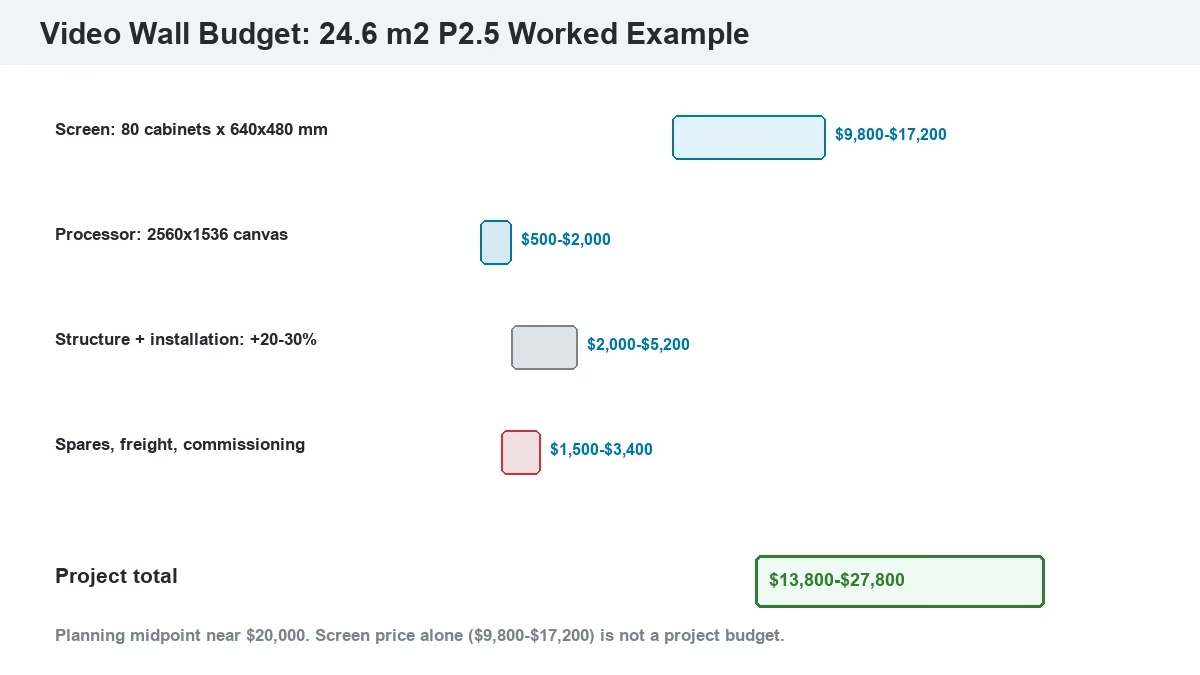
Worked example: a 24.6 m² P2.5 indoor wall. At 6.4×3.84 m, it uses 80 cabinets of 640×480 mm in 10 columns by 8 rows. At $400–$700/㎡, the screen costs $9,800–$17,200. A processor for the 2,560×1,536 canvas costs $500–$2,000. Structure and installation add 20–30%; spares, commissioning, and freight add $1,500–$3,400. The project lands at $13,800–$27,800, with a planning midpoint near $20,000.
How Much Does a 3×3 Video Wall Cost?
A 3×3 video wall is nine panels in three rows and three columns. In LCD, nine 55-inch commercial panels at $600–$3,000 each cost $5,400–$27,000, plus a mounting kit around $500–$1,500, a splicing processor at $500–$2,000, and installation. The installed range is roughly $9,000–$35,000. In LED, a 3×3 grid of 640×480 cabinets is 2.76 m², which is too small for most LED projects; LED becomes sensible when the wall is larger than about 4 m².
11. Which Video Wall Cost Mistakes Should You Avoid?
Most budget overruns are decided before the purchase order. Four mistakes account for the largest gaps.
- Buying pitch the audience cannot see. A P1.2 wall at 10 ft spends money on resolution the eye cannot resolve.
- Choosing direct-view LED below 110 inches. A large LCD panel or 2×2 LCD wall covers that size at a fraction of the cost.
- Accepting a lump-sum quote. Without per-square-meter pricing and line items, bids cannot be compared.
- Ordering no spares. Modules bought two years later will not color-match the original batch.
12. How Do You Compare Video Wall Prices Line by Line?
A video wall quote is a document that lists scope, quantities, and unit prices. Ask every vendor for the same eight lines: cabinet or panel model and batch; spare modules at 5–10%; processor capacity in pixels and inputs; sending and receiving hardware; structure and mounting; power circuits; installation, calibration, and commissioning; and warranty, response time, and spares availability.
Then ask three questions: What is the installed price per square meter? What is excluded? What happens when a module fails in year three? A quote that answers all three is comparable.
13. What Are the Most Common Video Wall Cost Questions?
How much does a video wall cost per square foot?
Installed walls run $400–$4,000+ per square foot depending on pitch and market. Factory-direct LED cabinets run roughly $37–$130 per square foot, before structure and local labor.
Why are LED video walls so expensive?
An LED wall is priced by pixel count, not glass area. Finer pitch means more LED chips, driver channels, and scan boards per square meter. Structure, processing, calibration, and low volume compared with consumer televisions add the rest.
How much does a church video wall cost?
A 36 m² P2.5 church wall typically lands at $21,000–$38,000 installed, with the screen at $14,400–$25,200 factory-direct.
How much does installation add to a video wall?
Installation and structure usually add 20–30% to the screen value, and more for ceilings, curves, outdoor structures, and restricted site hours.
Is an LCD or LED video wall cheaper?
LCD is cheaper below about 110–130 inches diagonal because panels are mass-produced. Above that size, LED is the only way to get a bezel-free canvas at scale.
14. References & Sourced From: Video Wall Cost and Market Data
- CrownTV, “How Much Does an LED Video Wall Cost in 2026? Real Prices by Pixel Pitch,” updated October 2, 2026.
- SVSolutions, “How Much Does an LED Video Wall Cost? Complete 2026 Guide.”
- Trivision Event Production, “How Much Does LED Wall Rental Cost? 2026 Pricing Guide.”
- Samsung Insights, “What is the cost of an LED video wall?”, December 21, 2023.
- RefreshLED, “How Much Does an LED Video Wall Cost?” 2026.
- Unilumin, LED video wall cost and rental data, 2024.
- UnifyLED product and price data: P1.86 indoor, P2.5 indoor, P3.91 rental, P10 outdoor, 2026.
- Grand View Research, video wall market estimate, 2024.
15. Conclusion: How Much Does a Video Wall Cost for Your Project?
How much a video wall costs is a function of five choices: the buying route, pixel pitch, size, integration scope, and service plan. A kit, a factory-direct cabinet set, and an installed project are three different products at three different prices. Start with viewing distance and the room, get a per-square-meter number, list the six line items, and add running costs before comparing bids. For the engineering behind the numbers, read how does a video wall work.