
P4 vs P5 Outdoor LED Display: Text or Power Bill? (2026)
The P4 vs P5 outdoor LED display comparison is decided by a single line on the site plan: 6 meters. P4 keeps small text crisp at 5–8 meters; P5 softens before 6. Inside that line, the P4 premium buys resolution the viewer can actually see; past it, the P5 saving — $50 lower at the floor ($550–900 vs $600–1,000 per square meter) plus 36% fewer lamps and the lightest power bill tiers in the family — becomes free quality-wise. This guide runs the five differences that actually move a purchase: lamp count, the text line, price, the common cathode option, and power economics — then compresses them into one tape-measure decision. The full spec sheets live on the P4 outdoor collection and the P5 outdoor collection.
Short answer — the five differences: (1) Lamp count: 62,500 vs 40,000 px/㎡ — a 36% cut. (2) The text line: P4 crisp at 5–8 m; P5 softens before 6. (3) Price: $600–1,000 vs $550–900/㎡ — $50 lower at the floor for P5. (4) The energy option: common cathode lives on P5’s 320×320mm board. (5) Board ecosystem: both live on the 320×160mm suite — pitch becomes a module swap. The rule: under 4 m go P3; 4–6 m P4 only; 6–10 m decide by text demand and power bill; 10–15 m P5; past 15 m P6.
What Is the Actual Difference in a P4 vs P5 Outdoor LED Display?
A P4 outdoor LED display is a 4mm wall carrying 62,500 lamps per square meter on the 320×160mm board (40×20 = 800 dots, 1/10 or 1/8 scan, 30–60 ICs) in SMD1921 behind an IP65 front — the value pitch of the family. A P5 outdoor LED display is the 5mm wall one rung down: 32×16 = 512 dots on a 1/8 scan (24–48 ICs) in SMD1921/2727, 40,000 px/㎡ — the billboard-value pitch, with the 320×320mm big board adding common cathode and front service. Both run 5,500+ nit brightness tiers, both seal to IP65 in waterproof iron cabinets, and both share the same control stack — the environment does not separate them; resolution and money do.
The comparison matters because the two bands overlap. P4 owns 4–10 meters; P5 owns 5–15 meters; between 5 and 10 meters both pitches deliver their full promise, and the choice becomes commercial rather than visual. The lamp-count gap also drives the running-cost story: P5’s lighter load is why its power tiers sit 100W per square meter below P4’s, which over the life of a 24/7 wall compounds into the largest single saving in the comparison. Seeing the P4 side in the field:
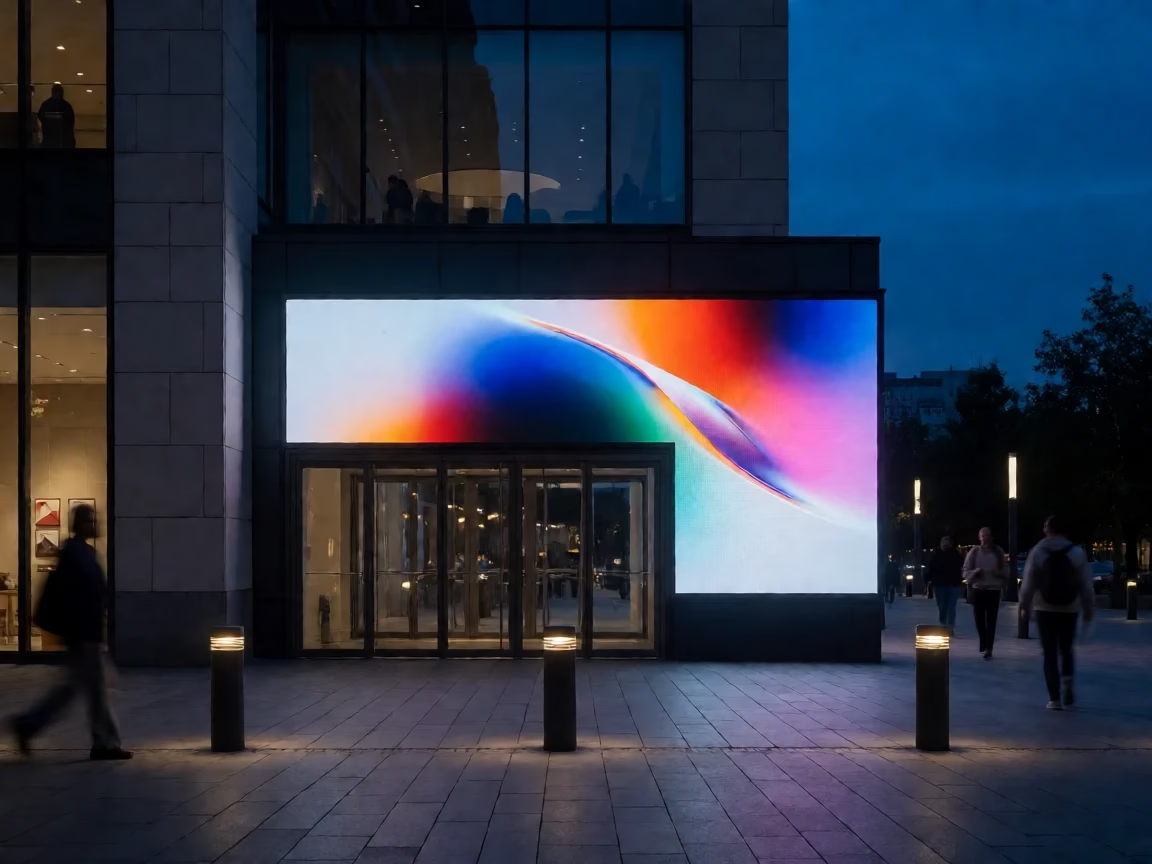
The P4 side in the field: a plaza edge at blue hour, where promotion text stays crisp.
How Do Lamp Count and Power Compare in a P4 vs P5 Outdoor LED Display?
Per square meter, P4 carries 62,500 lamps against P5’s 40,000 — a 36% cut in the component that takes 35–45% of module cost. The power line follows: 350–450W per square meter mixed on P4 against 250–350W on P5, with peaks at 500–650W and 450–600W respectively. The boards behind the grids:
The module is the service unit on both pitches, and the swap story is the same:
Module-level install: the same swap discipline whether the grid is 800 dots or 512.
How Does Viewing Distance Decide a P4 vs P5 Outdoor LED Display Choice?
The two bands, from each pitch’s own math: P4 reads as HD from 4 m with text crisp at 5–8 m; P5 reads as HD from 5 m with small text softening before 6. The bands overlap across 5–10 meters, and the overlap splits at the 6-meter text line. Three zones fall out of it: 4–6 m — P4’s exclusive territory, where promotion text still reads as text and P5 has started to soften. 6–10 m (the overlap) — both deliver HD, and the decision is commercial: text-heavy content favors P4, video and power economics favor P5. Past 10 m — P5’s edge, with the ladder stepping to P6 past 15 m. The full derivations sit in the P4 outdoor quick guide, the P5 outdoor quick guide and the site-wide viewing distance reference.
What Does the Price Gap in a P4 vs P5 Outdoor LED Display Add Up To?
The 2026 factory-direct bands, same signature on both collections: $600–1,000/㎡ for standard fixed P4, $550–900/㎡ for standard fixed P5 — $50 lower at the floor, roughly 8–10% on a like-for-like wall. Module prices track the same curve: $20–45 per P4 board against $18–40 per P5 board.
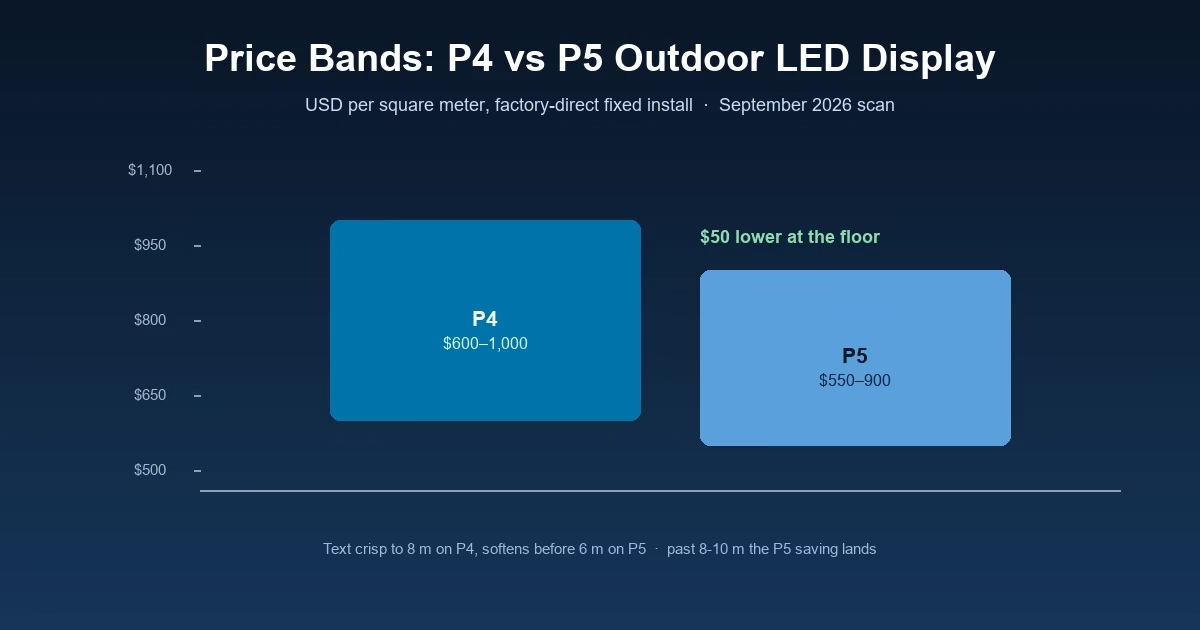
The per-square-meter bands: $50 at the floor — and the text line decides whether that saving is free.
For a fixed 46㎡ roadside billboard — 900 boards on either pitch — P4 prices at $27,600–46,100 and P5 at $25,300–41,500: the P5 saving lands at roughly $2,300–4,600 (8–10%). On a like-for-like 100㎡ face running 20 hours a day, the power line compounds it: P4 at 400W average draws about 292,000 kWh a year against P5’s 219,000 — a gap of roughly 73,000 kWh, or $11,000–22,000 a year at commercial tariffs. That is why past 8–10 meters the P5 switch pays twice.
There is a third line that behaves differently on each pitch: the module count itself. A 46㎡ billboard consumes 900 boards on either pitch, but the service granularity differs — P4’s 800-dot boards cover 0.0512㎡ each, while P5’s 512-dot boards cover the same area with a quarter of the lamps, which shows up in module-level swaps: a dead P5 module removes fewer pixels from the wall while it waits for replacement. On networks running dozens of faces, that granularity difference is one more reason fleets standardize on the coarser pitch once the viewing distance allows it. Where the P5 saving lives in the field:
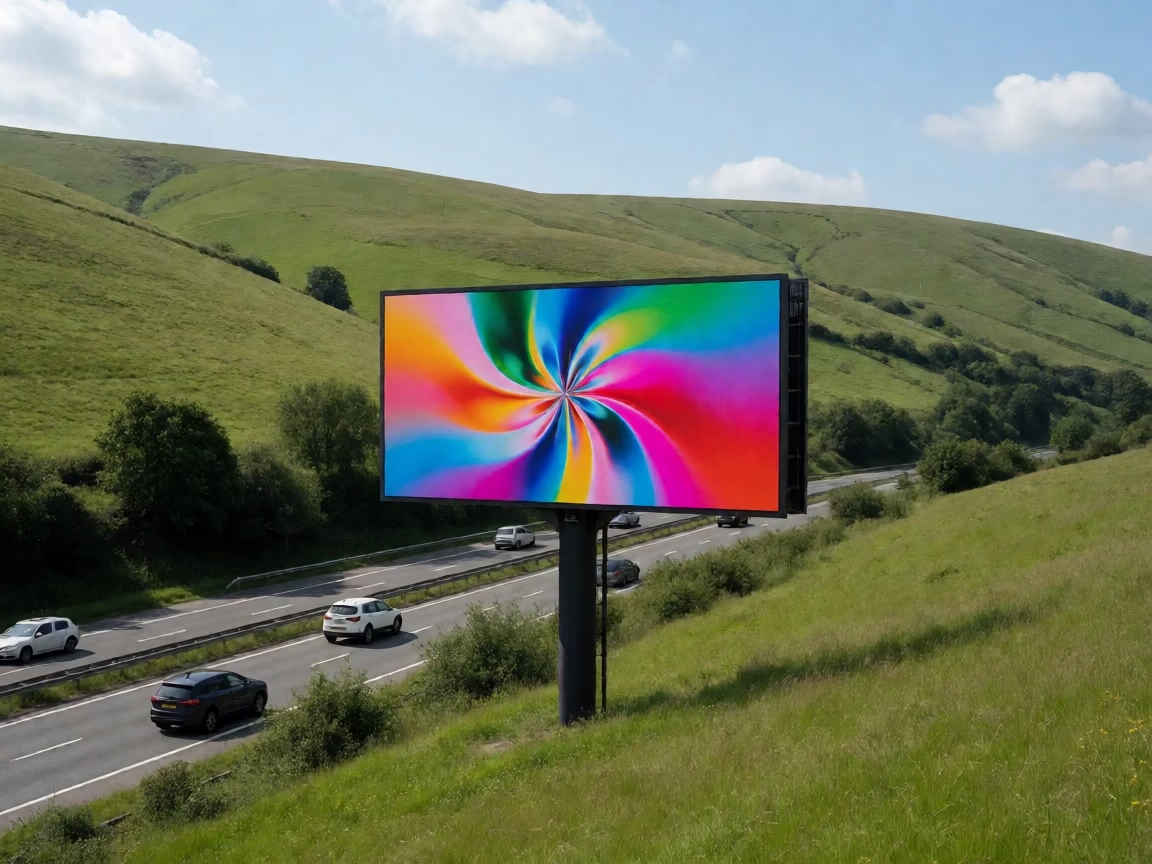
The P5 side in the field: a roadside billboard among the hills — same impact, lighter running bill.
The pitch-specific stacks are in the P4 outdoor price guide and the P5 outdoor price guide.
Which Options Move the P4 vs P5 Outdoor LED Display Choice — and Pay Back?
Both pitches carry GOB (+$100–200/㎡) and front-service builds (+10–15%), but each has one option the other cannot match. P4’s warning: retrofitting front service onto a rear-service wall means new cabinets, not just new modules — decide access before the cabinets are ordered. P5’s signature: the common cathode build lives on its 320×320mm big board — +8–12% upfront, ~30% lower power, front service available — and on 24/7 billboard duty it pays back within the first year in high-tariff markets, with the cool-screen drive eliminating the evening color drift. Cabinet flexibility follows the same split: P5’s die-cast hard-link format and 1280×960mm one-lift assembly suit large facades and curved set-backs, while P4’s four-format spread covers the legacy 256-series walls. Where P5’s cabinet flexibility shows up on site:
Curved setup on die-cast aluminum: the flexibility the P5 big-board format brings to facades.
What Cost Lines Hide Outside the P4 vs P5 Outdoor LED Display Choice?
Four lines sit outside a factory quote, identical in structure across both pitches. Control hardware adds $500–2,000 per project; steel structure and installation add 20–30% of screen value locally; sea freight runs roughly $200–400 per cubic meter; and spare modules — 3% of quantity — are the cheapest insurance until the first storm ends a board. The running-cost line is where the pitches separate: the P4-vs-P5 power gap on a 100㎡ 20-hour face is roughly 11,000 kWh a year — $6,600–13,100 at commercial tariffs — before either pitch’s scheduling kicks in. Specify spares, the UV-stabilized matte mask and warranty terms in writing — and note that the two pitches quote different module counts for the same wall (15.6 boards per square meter on P4 against 19.5 on P5’s grid for a 46㎡ face is 720 versus 900), which moves the spare-module line too.
What Do Buyers Also Ask About a P4 vs P5 Outdoor LED Display?
Is P5 sharper than P4 at 6 meters?
No — the line runs the other way. P4 keeps small text crisp at 5–8 m, while P5 softens before 6 m. Past 8–10 m both pitches read the same to the viewer, which is exactly where the P5 saving becomes free.
How much cheaper is P5 than P4 per square meter?
The 2026 factory-direct bands are $550–900 per square meter for P5 against $600–1,000 for P4 — $50 lower at the floor, about 8–10% on a like-for-like wall. For a fixed 46㎡ billboard that is roughly $2,300–4,600 back, before the power-bill saving starts compounding.
Can a P4 wall be upgraded to P5 later?
On the 320×160mm board suite, yes — the P4 grid (40×20) and the P5 grid (32×16) share the same board outline and mounting holes from P2.5 through P10, so a wall can change pitch by swapping modules while cabinets, structure and power stay in service.
Which one for a storefront — and which for a roadside billboard?
Storefronts, forecourts and plaza edges where viewers close inside 6 meters and promotion text pays the rent: P4. Roadside billboards, rooftops and set-back facades watched from 8–15 meters where video carries the message: P5, with a lighter power bill on top of the lower tag.
Is the common cathode option a P4 or a P5 feature?
P5 — it lives on the 320×320mm big board, adding 8–12% upfront and cutting power roughly 30%, with front service available. On 24/7 billboard duty it pays back within the first year in high-tariff markets. P4’s efficiency story is simply its lighter 62,500-lamp load.
Is P5 still the value pick when P4 costs only $50 more?
Past 8–10 meters, yes — P5’s 36% lighter lamp load is invisible to the viewer, so both the $50 per square meter and the roughly 11,000 kWh-a-year power saving are free quality-wise. Inside 6 meters, P4’s sharper text is visible and worth the premium.
References & Sourced From: P4 vs P5 Outdoor LED Display Data
- P4 figures (62,500 px/㎡; 320×160mm = 40×20 = 800 dots at 1/10 or 1/8 scan, 30–60 ICs; SMD1921 Grade 1 / Grade 2; $600–1,000/㎡ fixed, $20–45/module; 4–10 m band; text crisp 5–8 m): our P4 outdoor collection, September 2026.
- P5 figures (40,000 px/㎡; 320×160mm = 512 dots at 1/8 scan, 24–48 ICs; SMD1921/2727; $550–900/㎡ fixed, $18–40/module; 5–15 m band; text softens before 6 m; 320×320mm common cathode): our P5 outdoor collection, September 2026.
- Price bands ($600–1,000 vs $550–900) and the shared 320×160mm board suite (mounting geometry from P2.5 through P10): our P4 outdoor price guide, P5 outdoor price guide and outdoor LED display price guide.
- Power arithmetic (350–450 vs 250–350W/㎡ mixed; 100㎡ 20-hour example ≈ 73,000 kWh/year gap): computed from the two collections’ signed load figures.
Verdict: Who Wins the P4 vs P5 Outdoor LED Display Matchup?
There is no universal winner — there is a line on the site plan. P4 wins inside 6 meters and wherever promotion text is the product: storefronts, forecourts, plaza edges. P5 wins past 8–10 meters: the same perceived video at roughly 8–10% less hardware, a lighter power bill for the life of the wall, and the common-cathode option for 24/7 duty. Neither wins past 15 m — the ladder does. Run your tape measure first, then price both as one-package builds with cabinets, power and control included, the way a LED screen manufacturer quotes them — and let the 6-meter text line, not the spec sheet, pick the pitch.
Related P4 vs P5 outdoor guides:
P4 Outdoor LED Display Collection · P5 Outdoor LED Display Collection · P3 Outdoor LED Display Price · Outdoor LED Display Price Guide