
P2.5 vs P3 Outdoor LED Display: 5 Differences and the Decision Rule (2026)
The P2.5 vs P3 outdoor LED display comparison is the finest pitch-versus-pitch call in outdoor LED — 0.5mm separates them, and inside that 0.5mm live a 44% pixel-density gap, an 18–21% price gap, and two different viewing-distance bands that overlap for most of their length. A P2.5 outdoor LED display is a 2.5mm-pitch wall carrying 160,000 pixels per square meter; a P3 outdoor LED display is the 3mm-class wall — built as exact-pitch P3.0 at 111,111 px/㎡ or as P3.076 on the 320×160mm module grid at 105,625 px/㎡ — that delivers nearly the same perceived image a step back, for less money per square meter. This guide runs the five differences that actually move a purchase: density, resolution footprint, viewing distance, price, and cabinet compatibility — then compresses them into one decision rule. The full spec sheets live on the P2.5 outdoor collection and the P3 outdoor collection.
Short answer — the five differences: (1) Density: 160,000 vs 111,111/105,625 px/㎡ — a 44%/51% gap. (2) Resolution footprint: the same 1080P-class canvas measures 13.06㎡ in P2.5 but 18.80㎡ in P3.0. (3) Viewing distance: P2.5 owns 2.5–7.5 m; P3 owns 3–8 m; the 3–7.5 m overlap is where the real decision lives. (4) Price: $850–1,400 vs $700–1,100/㎡ — 18–21% less for P3. (5) Cabinets: P3.076 shares the 320×160mm kit with P2.5 — pitch becomes a module swap, not a rebuild. The rule: under 3 m buy P2.5; 3–7.5 m decide by detail demand and budget; past 8 m step down the ladder.
What Is the Actual Difference in a P2.5 vs P3 Outdoor LED Display?
A P2.5 outdoor LED display is a fixed-install or rental wall whose pixels sit 2.5mm apart — 160,000 of them per square meter, delivered on the 320×160mm module (128×64 dots, SMD1415 lamps above 5,500 nits) that dominates outdoor fine pitch. A P3 outdoor LED display is the 3mm-class wall one rung down: pixels 3mm apart in the exact-pitch format (192×192mm square modules, 111,111 px/㎡) or 3.076mm apart on the production format that reuses the same 320×160mm board (104×52 = 5,408 dots, 105,625 px/㎡). Both run IP65-sealed fronts in waterproof iron cabinets with the same Novastar, Colorlight, Huidu or Mooncell control stack — the environment does not separate them; only resolution and money do.
That family detail matters more than it looks. Because P3.076 lives on the same 320×160mm module kit as P2.5, many factories treat them as one production line with two pitch options — which is why the P3 outdoor collection reads as one family with two module formats, and why section five’s cabinet argument exists at all. Seeing the P3 class in the field:
The contender in the field: an outdoor P3 video wall doing full-time advertising duty.
How Do Pixel Density and Resolution Compare in a P2.5 vs P3 Outdoor LED Display?
Per square meter, P2.5 carries 160,000 pixels against 111,111 (P3.0) and 105,625 (P3.076) — 44% and 51% more. But density only pays when the canvas is the target, and that reframes the comparison. Take the 1080P-class canvas (1,920×1,088 pixels, the closest whole-module grid to HD). Counting boards on each format:
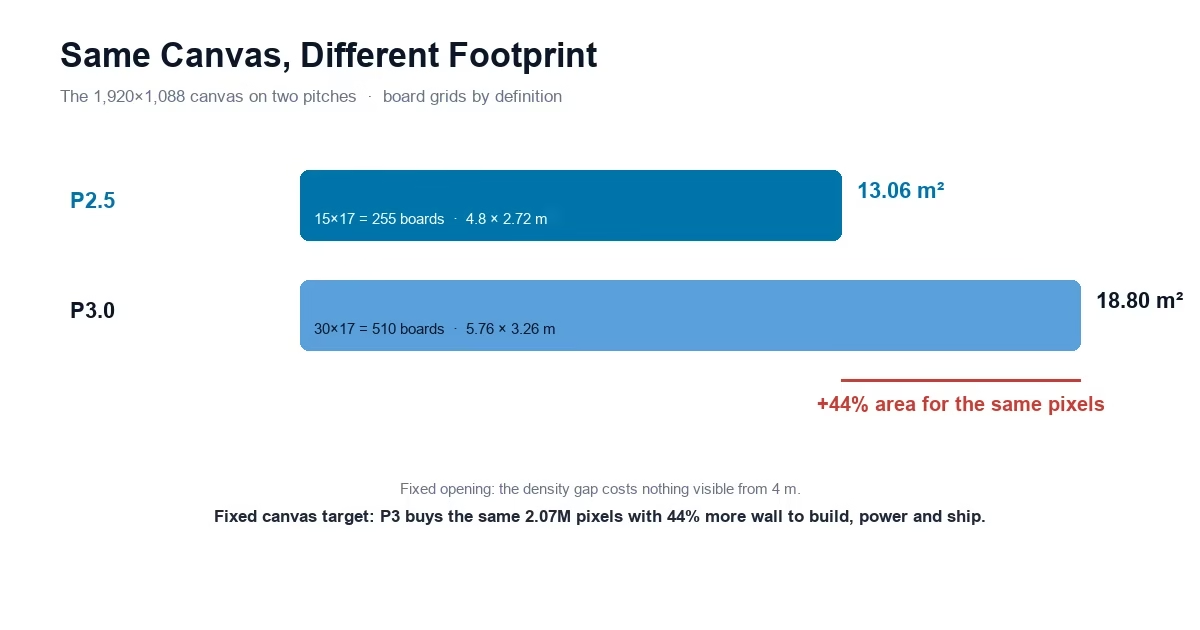
Same canvas, different footprint: the P3.0 1080P-class wall is 44% larger — twice the boards, half the pixels each.
Read that table as the first real fork in the P2.5 vs P3 outdoor LED display decision. If the wall must fit a fixed opening — a facade niche, a storefront band, an existing structure — the per-square-meter comparison applies and P3’s lower density costs you nothing you can see from 4 m out. If instead the canvas is the target and the footprint is negotiable, the P3 route buys the same 2.07 million pixels with 44% more area: more wall to hang, more structure, more power, more square meters to ship. That footprint difference is a line item most buyers meet only after the quote arrives; the arithmetic here puts it before the quote.
How Does Viewing Distance Decide a P2.5 vs P3 Outdoor LED Display Choice?
The two bands, from each pitch’s own math: P2.5 reads as HD from 2.5 m (pixels blend) with its optimal zone at 5–7.5 m; P3 reads as HD from 3 m with its optimal zone reaching to about 8 m. The bands overlap almost entirely — 3 to 7.5 m is P2.5-and-P3 territory at once — and that overlap is exactly why this comparison exists. The full derivation sits in our P2.5 outdoor viewing distance guide and the site-wide viewing distance reference.
Three zones fall out of the overlap. Under 3 m: P3’s pixel grid starts to show; P2.5 is the coarsest pitch that still reads as HD, so the comparison ends. 3–7.5 m: both pitches deliver HD, and side-by-side differences stay subtle — visible mainly in fine text, dense dashboards and direct A-B viewing. Here the decision is commercial, not visual: detail-heavy content or the finest possible storefront image favors P2.5; the same perceived quality for 18–21% less favors P3. Above 8 m: both pitches are spending pixels no viewer resolves, and the ladder continues down — the P3.91 outdoor class from about 8–10 m, then P4.81 and P5. The honest summary: the P2.5 vs P3 outdoor LED display choice is decided inside a 5-meter-deep band, and most outdoor sites already know which zone their sidewalk belongs to.
What Does the Price Gap in a P2.5 vs P3 Outdoor LED Display Add Up To?
The 2026 factory-direct bands, same signature on both collections: $850–1,400/㎡ for standard fixed P2.5, $700–1,100/㎡ for standard fixed P3 — P3 runs 18–21% less at every rung, about $150–300/㎡, and roughly 20% less at the band midpoints. Rental die-cast formats carry the same relationship (P2.5 rental at $950–1,400/㎡). The full cost stacks are in the P2.5 outdoor price guide; the P3 side prices the same way on its collection page.
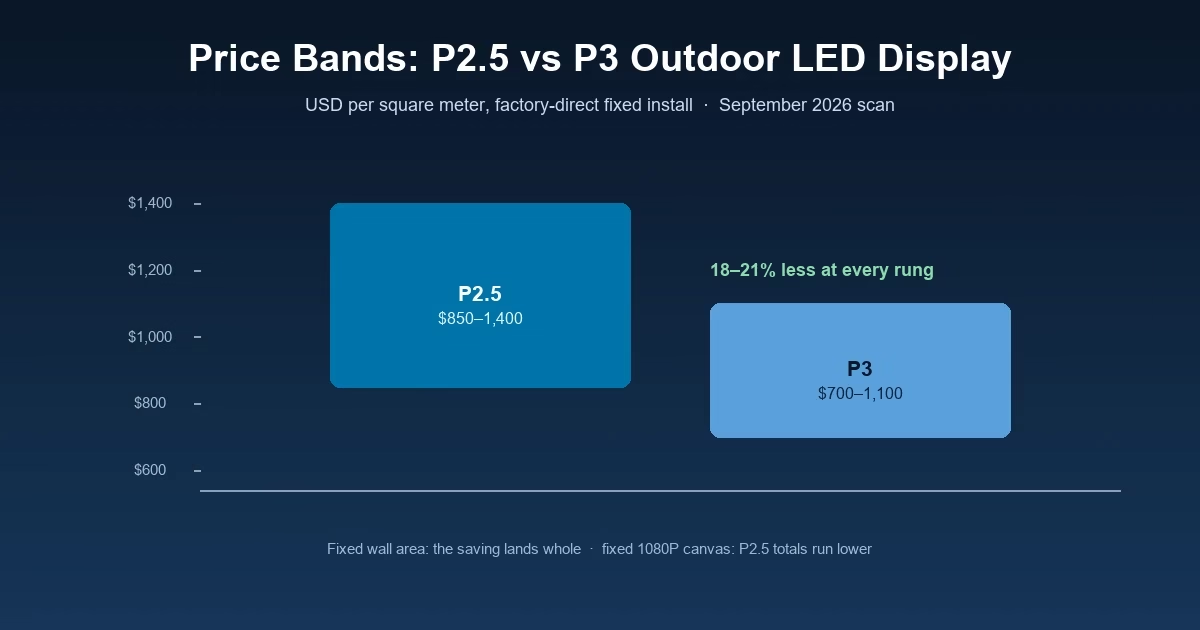
The per-square-meter bands. The twist: which pitch is cheaper depends on what is fixed — the area or the canvas.
Now combine the price gap with section two’s footprint gap, because they point in opposite directions. Fixed wall area (a 13㎡ storefront band): P3 prices at $9,100–14,400 where P2.5 prices at $11,100–18,300 — the per-square-meter saving lands whole. Fixed canvas (1080P-class): P2.5 needs 13.06㎡ ($11,100–18,300) but P3.0 needs 18.80㎡ ($13,200–20,700) — and the P3 wall now costs more in total despite its cheaper square meter. That reversal is the single most useful number in this comparison: when resolution is the target, P2.5 is the cheaper way to buy 2 million pixels; when area is the target, P3 is the cheaper way to fill it. Everything else is a detail demand argument.
Can the Same Cabinets Run Both Sides of a P2.5 vs P3 Outdoor LED Display Choice?
On the production format, yes — and it is the quiet argument for the 320×160mm ecosystem. The P3.076 variant uses the same module kit as P2.5: same 320×160mm board outline, same 960×960mm waterproof iron cabinet (eighteen per cabinet stack in the A960-format fixed build), same power and control architecture. A wall built on that kit can change pitch later by swapping modules — P2.5 today, P3.076 tomorrow, coarser pitches after that — without touching cabinets, structure or cabling. The exact-pitch P3.0 square runs its own cabinet formats (576, 768 or 960mm iron), so the swap argument applies to it only at the cabinet level.
For buyers this collapses into two practical rules. Spare parts: stocking one 320×160mm module format covers both pitches — a rental fleet or multi-site operator carries half the spare inventory. Future-proofing: a wall specified as P3.076 for budget reasons can step up to P2.5 resolution later for the cost of modules alone — roughly half the wall’s value in the 2026 bands — rather than a full rebuild. Where that option matters, say so in the RFQ: it is a one-line requirement that some factories meet by default and others only on request (front-service lock-catch versions likewise — the P3 collection specifies rear-standard with front-service available on request).
Which One Should You Buy? The P2.5 vs P3 Outdoor LED Display Decision Rule
Measure the closest spot a paying customer stands, then apply the rule in order:
- Under 2.5 m: both pitches show their grids; step to indoor-class fine pitch (P2 and finer) or redesign the placement.
- 2.5–3 m: P2.5 only — it is the coarsest outdoor pitch that still reads as HD here. The P2.5 outdoor collection is the shortlist.
- 3–7.5 m (the overlap zone): decide by detail demand and budget. Storefront and entrance walls where text readability up close pays the rent → P2.5. Facades, plazas and car parks where video carries the message → P3 at 18–21% less, or P3.076 on the shared kit if a future pitch swap matters.
- 7.5–8 m: P3’s edge — the last rung where 3mm-class still renders full HD before coarser pitches take over.
- Past 8 m: step down — P3.91, then P4.81 and P5; the background math is in the pixel pitch guide.
The P2.5 side of that rule, shipping:
The P2.5 side of the pair, outbound — fine pitch leaves the factory packed like the precision product it is.
What Do Buyers Also Ask in a P2.5 vs P3 Outdoor LED Display Comparison?
Which is better for outdoor use, P2.5 or P3?
Neither is better in absolute terms — viewing distance decides. Under about 3 meters only P2.5 stays HD; from 3 to about 7.5–8 m both read as HD, and the call comes down to detail demand versus budget; past 8 m a coarser pitch beats both on value.
How much cheaper is P3 than P2.5 outdoors?
The 2026 factory-direct bands are $700–1,100/㎡ for P3 against $850–1,400/㎡ for P2.5 — 18–21% less at every rung, about $150–300/㎡. For a fixed wall area that saving is real; for a fixed resolution target it can reverse (see the same-canvas arithmetic above).
Can you see the difference between P2.5 and P3 at 5 meters?
Barely. At 5 m both pitches sit inside their HD band and side-by-side detail differences are subtle. The difference becomes visible under about 4 m, on fine text and dense graphics, and in direct A-B comparison at the same distance.
Do P2.5 and P3 outdoor displays use the same cabinets?
The P3.076 variant does — it uses the same 320×160mm module kit as P2.5, so walls can change pitch by swapping modules without changing cabinets or structure. The exact-pitch P3.0 square (192×192mm) pairs with its own iron cabinet formats (576, 768 or 960mm).
Which survives outdoor conditions better, P2.5 or P3?
The class is the same: both run SMD1415 lamps above 5,500 nits behind IP65-sealed fronts in waterproof iron cabinets. Environment does not separate the two pitches — viewing distance does.
Should I compare P2.5 with P3.91 instead?
If your audience sits beyond 8–10 m, yes — P3.91 is the mainstream outdoor step with roughly 65,000 px/㎡ and a much lower tag. The P2.5 vs P3 comparison only matters inside about 8 m, where both are still delivering HD.
References & Sourced From: P2.5 vs P3 Outdoor LED Display Data
- P2.5 figures (160,000 px/㎡; 320×160mm = 128×64 dots; $850–1,400/㎡ fixed, $950–1,400 rental; 2.5–7.5 m band): our P2.5 outdoor collection and its price guide, September 2026 market scan.
- P3 figures (111,111 px/㎡ exact P3.0; 105,625 px/㎡ P3.076; 104×52 = 5,408 dots, 1/13-scan class, SMD1415; $700–1,100/㎡ fixed; 3–8 m band; 576/768/960mm iron cabinets): our P3 outdoor collection, September 2026.
- Viewing-distance formulas (1000-and-3000 rule; 1-arcminute acuity): the site viewing distance guide; canvas arithmetic computed from module grids (255 boards vs 510 boards for the same 1,920×1,088 canvas).
- Environment class (SMD1415 above 5,500 nits, IP65 fronts, iron cabinets, Novastar/Colorlight/Huidu/Mooncell control): stated identically on both collections.
Verdict: Who Wins the P2.5 vs P3 Outdoor LED Display Matchup?
There is no universal winner — there is a zone map. P2.5 wins under 3 m and wherever the closest viewer is close enough that 44% more density shows up in the rent-paying detail: storefronts, entrance walls, content with fine text. P3 wins on budget inside the overlap: the same perceived HD at 18–21% less per square meter, plus the P3.076 exit option of sharing P2.5’s module kit for later swaps and shared spares. Neither wins past 8 m — the ladder does. Run your sidewalk measurement first, then price both as one-package builds with cabinets, power and control included, the way a LED screen manufacturer quotes them — and let the zone, not the spec sheet, pick the pitch.
Related P2.5 vs P3 outdoor guides:
P2.5 Outdoor LED Display Collection · P3 Outdoor LED Display Collection · P2.5 Outdoor Price Guide · P2.5 Outdoor Viewing Distance · P2.5 Outdoor LED Display Quick Guide · P3 Outdoor LED Display Screen Quick Guide