
P2.5 Outdoor LED Display Quick Guide: Specs, Checks and Costs (2026)
This P2.5 outdoor LED display quick guide compresses a factory spec sheet into the nine decisions that actually move a purchase. A P2.5 outdoor LED display is a 2.5mm-pitch wall carrying 160,000 pixels per square meter behind an IP65-sealed front — indoor-grade resolution built to outdoor-grade survival standards, readable from 2.5 m out. The format spans three module sizes, two brightness tiers, a 1/32-scan electronics standard and six control ecosystems, at $850–1,400 per square meter factory-direct in the September 2026 market scan. Each section states the check, the numbers behind it, and the trap for buyers who skip it. The full engineering detail lives on the P2.5 outdoor collection; this page is the pass you run before money moves.
Short answer — the guide in one paragraph: (1) Build on the 320×160mm module (128×64 dots, 19.5 boards per square meter) unless the wall demands otherwise. (2) Order brightness by sun exposure: 5,500–6,500 nits copper/alloy-wire, or 7,000–10,000 nits gold-wire for full-sun faces. (3) Add GOB protection (+$100–200/㎡) wherever traffic, vandalism or salt threatens the lamp face. (4) Verify 1/32 scan, 3,840Hz refresh and named driver ICs before the deposit. (5) Fit 5V 40A/60A brand supplies — or the 4.2V energy-saving rail for 24/7 duty. (6) Standardize on one control family and buy spares with the wall. (7) Budget $850–1,400/㎡ fixed, $950–1,400/㎡ rental die-cast. (8) Walk away under 2.5 m (indoor fine pitch) or past 6 m (P3.91, roughly 40% cheaper).
What Is a P2.5 Outdoor LED Display?
A quick guide is the compressed form of a buying decision: the checks in the order a factory engineer would run them, with the arithmetic exposed, not hidden behind adjectives. A P2.5 outdoor LED display is the near-viewing member of the outdoor family — the pitch you buy when the audience stands close enough to read small text and judge skin tones. It exists because a large share of outdoor placements are watched from 2–6 m: storefronts face sidewalks, fuel-station boards face their own pumps, mall facades face the door queue.
Every number here is signed the same way as the P2.5 outdoor collection: spec figures from current production builds, prices from a September 2026 scan of factory listings and module e-commerce. Where the market disagrees with itself — by 30–60% between suppliers — the range is shown instead of a flattering single number.
How Does a P2.5 Outdoor LED Screen the Three Module Sizes?
Module format is the first check because it cascades into cabinets, spares and labor. The 320×160mm module is the production standard of outdoor fine pitch: 8,192 dots on 48 Chipone-class ICs, seated eighteen-up in a 960×960mm waterproof iron cabinet or twenty-four-up in the 1280×960mm magnesium-aluminum format. The 160×160mm module is the traditional square — 4,096 dots, granular for odd wall proportions and small spare stock. The 250×250mm module is the die-cast rental format — 10,000 dots, four-up in a 500×500mm aluminum cabinet with quick locks and flight-case transport.
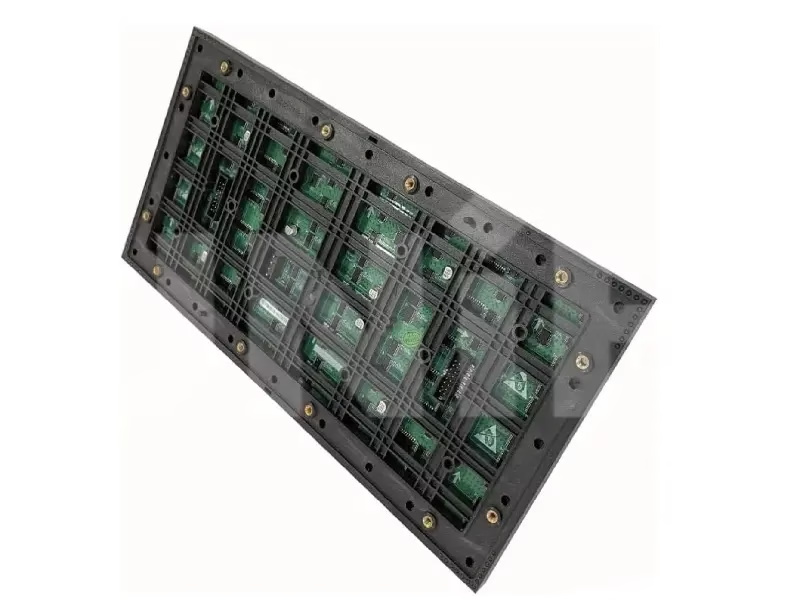
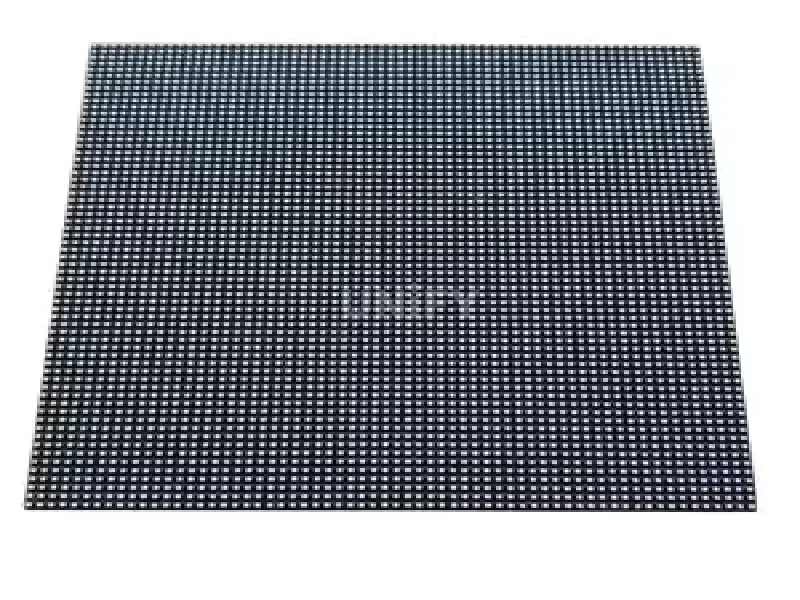
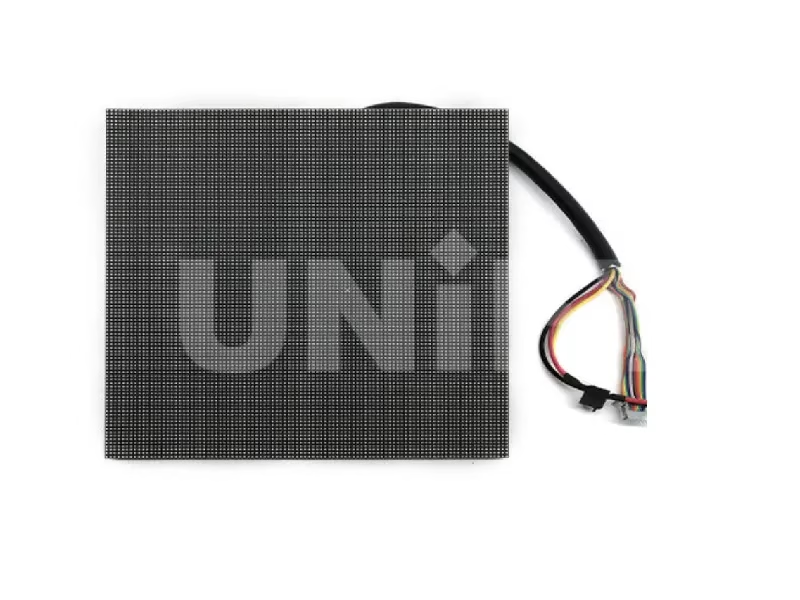

Three boards, one pixel density: every format lands 160,000 px/㎡ — the choice is about labor and cabinets, not resolution.
For most walls the 320×160mm board wins on arithmetic: a 3×2m wall takes 117 boards instead of 234 — half the mounting events, half the pigtails, half the spares. Choose 160×160mm for odd wall proportions or service-heavy fleets; 250×250mm for touring rental work, stock confirmed first. One rule has no exceptions: one cabinet takes one module size only — mixing formats breaks the pixel grid, and no control system fixes a misaligned wall.
What Brightness Tiers Does a P2.5 Outdoor LED Display Check?
Brightness is the check that decides whether the wall reads at noon or washes into a gray rectangle. Outdoor production ships in two tiers: 5,500–6,500 nits on copper/alloy-wire lamps for shaded and near-shaded faces, and 7,000–10,000 nits on gold-wire high-brightness builds for south-facing facades, full-sun roadside and high-altitude sites. SMD1415 is the outdoor-grade lamp both tiers share — the heat-tolerant package that trades a little efficiency for outdoor survival — and it comes in two procurement grades: Grade 1 (Nationstar class, high stability, long-life) and Grade 2 (Xinda class, value engineering). Either grade works; the tier is what you order against the sun.
Two disciplines keep this check honest. First, get the nits in writing and demo a unit at full white outdoors — anything under 5,000 nits disappoints at noon. Second, insist on the UV-stabilized matte mask: a gloss mask washes out in sunlight, and a non-UV mask drifts warm-gray by year three.
Contrast is the other half of the noon-readable equation. The black mask spray on our outdoor modules takes the panel to 5,000:1 — SMD construction out-contrasts legacy DIP lamps, and black-lamp builds go higher still. Black lamps trade money for that contrast: they cost more than white-body lamps, run dimmer at equal current, and force thicker power cabling, which is why the brightness tier and the lamp body are quoted together. The outdoor payoff is direct: a high-contrast face does not mirror the sky, and colors read true against noon sun.

Order by sun exposure, not by price: the gold-wire tier exists for the faces that cook at noon.
Which Protection Build Does a P2.5 Outdoor LED Video Wall Recommend: SMD or GOB?
SMD (surface-mounted device) is the standard construction: SMD1415 lamps soldered onto the PCB behind a mask, sealed to IP65 at the cabinet front. GOB (glue-on-board) is the protective upgrade: a transparent polymer pour over the whole module face that encapsulates lamps, mask and solder joints. Standard SMD is the right build for most fixed walls at no extra cost; GOB adds $100–200 per square meter and earns it back wherever the lamp face takes abuse — street-level storefronts, sports halls, coastal salt air, anywhere a taxi kiss or thrown bottle is a when, not an if.
The sealing logic matters as much as the lamp protection. A P2.5 outdoor wall seals its front and breathes at the back: IP65 face, IP54+ rear with drain holes and a fan path. Sealing both sides is the classic beginner error — trapped condensation kills more modules than rain ever does. See the pour itself:
GOB in the factory: the full-face pour that turns three fragile SMD lines into one sealed surface.
Which Electronics Does a P2.5 Outdoor LED Screen Display Verify Before Deposit?
Scan mode is the fraction of the pixel grid lit at any instant, and it is the most misread number on a P2.5 datasheet. The 2026 production standard for outdoor P2.5 is 1/32 scan: the driver ICs cycle through all sixteen channel states fast enough that the eye integrates a steady image. The failure mode to police is a reduced scan mode — 1/16 and lower — sold as the full 1/32. The check is arithmetic: the 320×160mm board carries 48 total ICs — sixteen-channel drivers plus row decode — and the counts reconcile on the datasheet. If a quote’s IC count and scan mode do not reconcile, the spec is fiction.
Refresh rate is the number buyers feel: at 1,920Hz the wall looks flawless to pedestrians but bands on every smartphone camera, while 3,840Hz clears phone footage and most professional work. Outdoor P2.5 is bought for placements people photograph, so 3,840Hz is the default, not an upgrade. The PCB runs 1.6–2.0mm FR-4 fiberglass multilayer — the 2.0mm four-layer option keeps the scan stable when a high-brightness cabinet interior passes 50°C. Uniformity is finished at the factory: lamp binning plus per-pixel brightness and chromaticity calibration loaded into the receiving cards at commissioning, which is why mixing module batches from different factories is a false economy the seams display for life.
Grayscale is decided by the driver IC, not the lamp: production ICs run 8, 12 or 16 bit, and the IC named on the datasheet sets how smoothly the wall renders shadows and low-brightness gradients — 16-bit processing is the tier that matters wherever the wall meets a camera.
Run these six electronics checks against any quote before money moves:
- Scan mode stated as 1/32 — IC counts reconciling to the board layout.
- Refresh 3,840Hz — if people will photograph or film the wall.
- Driver IC named — Chipone class or equivalent with a datasheet, not “high-refresh IC”.
- Grayscale stated — 8/12/16-bit processing set by the named driver IC; 16-bit for camera-facing walls.
- PCB spec’d — 1.6–2.0mm FR-4, four-layer option declared for high-brightness builds.
- Calibration declared — per-pixel brightness and chromaticity, batch-matched modules.
How Does a P2.5 Outdoor LED Display Screen Match Power, Cabinets and Control?
Power architecture is unglamorous, and it is where outdoor walls most often die. Each cabinet carries its own switching supply — Chuanglian Power as the volume standard, MEAN WELL where export specs demand it, G-Energy for energy-saving duty — at 5V 40A (200W) or 60A (300W), so failure domains stay cabinet-sized: a dead unit takes down 2.4 square meters, not the wall. Design for roughly 650–800W per square meter of peak draw on full white and 250–350W on mixed content, with inrush headroom. A 4.2V energy-saving supply is the low-rail alternative: it drops the LED forward path closer to its physical requirement, adds 8–12% upfront and returns about 30% of the power bill — in high-tariff 24/7 markets, payback is measured in months. Full supply grades: the LED display power supply guide.
Cabinets are the check buyers order last and should order first. The fixed-install families are 640×640mm waterproof iron (eight 320×160mm boards), 960×960mm iron or aluminum (eighteen boards — the A960-format outdoor build), and 1280×960mm magnesium-aluminum with internal soft connections; rental work runs 500×500mm die-cast aluminum in the 500×500mm rental format. Maintenance access decides: rear service is cheaper wherever a corridor or scaffold exists; front-service lock-catch cabinets are the answer when the wall’s back touches a structure. Measure the wall, not the brochure.
Control is a one-time fleet decision. Six ecosystems drive these modules — NovaStar, Colorlight, Huidu, Mooncell, VDWALL and RGBlink — compared in detail on our LED screen control system guide. The rule that matters: sending card and receiving cards must come from the same family, so the platform you pick is the platform your whole fleet inherits. Sync platforms suit camera-facing walls; asynchronous cards suit unattended signage, playing scheduled content from a phone app over 4G. Standardize once, and buy spare receiving cards with the wall. Installation itself has exactly two honest methods:
Fixed wall or hanging beam: the two installation routes, and the steel each one implies.
What Does a P2.5 Outdoor LED Display Wall Budget Per Square Meter in 2026?
The September 2026 market scan — module e-commerce prices divided by 19.5 boards per square meter, cross-checked against finished-wall quotes — puts the five builds here:
Three cost lines sit outside it. Control hardware adds $500–2,000 per project; steel structure and installation add 20–30% of screen value locally; and spare modules — 3% of quantity — sound like a rounding error until the first impact ends a board. Specify the UV-stabilized matte mask in the same line item: it costs little more than gloss and decides whether the wall still reads black in year five. The full cost stack, including the 30–60% supplier-to-supplier spread, is in the P2.5 outdoor price guide; the class-wide context is in the outdoor LED display price guide.
Where Does a P2.5 Outdoor LED Screen Display Send You Instead?
A quick guide that only sells one pitch is a brochure. P2.5 outdoor wins one band of viewing distances and loses outside it: measure the closest spot a paying customer stands and route yourself:
Inside the 2.5–6 m band, the placements that pay for the density are consistent: storefront and retail facades, mall entrances and plazas, roadside walls where traffic stops, fuel-station price boards, church and school entrances, and hotel identity walls. The shopping mall LED display solution and the church LED display solution show two built out. Where the band edges sit, the math is in the P2.5 outdoor viewing distance guide, the site-wide viewing distance reference and the pixel pitch guide — and if the comparison in your head is one pitch finer or coarser, the P2.5 vs P3 decision rule runs the same arithmetic one rung down.
What Do Buyers Also Ask in a P2.5 Outdoor LED Display?
What contrast ratio and grayscale should a P2.5 outdoor LED display have?
A black-spray mask takes the panel to about 5,000:1 — SMD lamps out-contrast DIP, and black-lamp builds go higher still, at higher cost, lower brightness than white lamps and thicker power cabling. Outdoors that buys a non-reflecting face and truer color at noon. Grayscale runs 8, 12 or 16 bit and is set by the driver IC — specify 16-bit where the wall meets cameras.
Is a P2.5 outdoor LED display worth it, or should I buy P4 and save money?
It depends on your closest viewer. If people stop within 2.5–6 m — storefronts, plazas, forecourts — P2.5 is the pitch that makes text and faces read as clean video, and P4 will look soft. If nobody stands closer than 8 m, a P3.91 or P4.81 wall delivers the same perceived quality for roughly 40% less per square meter.
How many modules and cabinets make one square meter of P2.5 outdoor LED display?
The 320×160mm module: 19.5 per square meter, so a 3×2m wall takes 117 boards. The 160×160mm module: 39 per square meter. The 250×250mm module: 16 per square meter. In cabinets, 640×640mm runs about 2.44 per square meter and 500×500mm die-cast to exactly 4.
Can a P2.5 outdoor LED display really be read in direct sunlight?
Yes, provided brightness is spec’d in the right tier and the mask is matte. Production ships two tiers — 5,500–6,500 nits on copper/alloy-wire lamps or 7,000–10,000 nits on gold-wire builds. Pick by sun exposure, ask for the nits in writing, and demo a unit at full white outdoors; anything under 5,000 nits disappoints at noon.
Which brightness tier should I order for a P2.5 outdoor LED display?
Shaded or north-facing placements: the 5,500–6,500 nit copper/alloy-wire tier is enough and costs less. South-facing facades, full-sun roadside and high-altitude sites: the 7,000–10,000 nit gold-wire build holds contrast at noon. Order by sun exposure, not by price — and never by a datasheet alone.
Front maintenance or rear maintenance — which do I need?
Measure the wall, not the brochure. If the back of the screen touches a wall, sits in a shaft or hangs over a facade with no walkway, you need front-service cabinets with lock-catch modules. If there is a corridor, catwalk or scaffold behind the wall, rear maintenance is cheaper and simpler.
What does 1/32 scan mean on a P2.5 outdoor module datasheet?
One thirty-second of the pixel grid is lit at any instant and the driver ICs switch through all states fast enough that the eye sees a steady image. It is the 2026 production standard for outdoor P2.5. If a quote offers 1/16 scan, that is reduced inventory, not a better spec — count the driver ICs against the datasheet before the deposit.
How much does a P2.5 outdoor LED display cost per square meter in 2026?
A standard fixed-install wall (cabinets, modules, power, basic control) runs $850–1,400 per square meter factory-direct in the September 2026 market scan. GOB protection adds $100–200; the 4.2V energy-saving build adds 8–12% upfront and cuts the power bill about 30%. Module-only purchases run $25–60 per 320×160mm board.
How long does a P2.5 outdoor LED display last — and what fails first?
Rated working life is about 100,000 hours to half-brightness — a decade of typical outdoor duty. What ends outdoor walls early is heat and water ingress, which is why cabinet drainage, fan paths, conformal-coated boards and brand-name power supplies matter more than the lamp datasheet. Keep 3% spare modules on site.
References & Sourced From: 2026 P2.5 Outdoor LED Display Screen Data
- Module builds (320×160mm = 128×64 dots, 48 ICs; 160×160mm = 4,096 dots, 24 ICs; 250×250mm = 10,000 dots, 60 ICs; 19.5/39/16 boards per square meter; cabinets 640×640, 960×960, 1280×960 magnesium-aluminum, 500×500 die-cast): our P2.5 outdoor collection, production data.
- Brightness tiers (5,500–6,500 nits copper/alloy wire; 7,000–10,000 nits gold wire), lamp grades (SMD1415/1515, Grade 1 Nationstar class / Grade 2 Xinda class), 1/32 scan at 1,920/3,840Hz, PCB 1.6–2.0mm FR-4, binning and per-pixel calibration, black-mask contrast to 5,000:1 (SMD above DIP; black-lamp builds higher), 8/12/16-bit grayscale set by the driver IC: same collection, September 2026.
- Price bands ($25–60 per module; $850–1,400/㎡ standard fixed; GOB +$100–200/㎡; 4.2V option +8–12% upfront with ~30% power saving; $950–1,400/㎡ rental): September 2026 market scan, module prices ÷ 19.5 cross-checked against finished-wall quotes.
- Power architecture (Chuanglian Power / MEAN WELL / G-Energy at 5V 40A/60A; 4.2V rail; 650–800W/㎡ peak, 250–350W mixed) and control ecosystems (NovaStar, Colorlight, Huidu, Mooncell, VDWALL, RGBlink): the power supply guide and the control system guide.
Verdict: How Do You Run This P2.5 Outdoor LED Display in Order?
Run the checks in the order they fail on real projects:
- Pitch honesty first — measure the closest viewer; under 2.5 m go indoor fine pitch, past 6 m take P3.91.
- Module format — 320×160mm as default, one module size per cabinet family, spares matched.
- Brightness in writing — tier ordered against sun exposure, nits stated, full-white demo witnessed.
- Electronics verified — 1/32 scan with reconciling IC counts, 3,840Hz refresh, named driver ICs.
- Protection and power specified — GOB where abuse is likely, brand supplies, 4.2V rail for 24/7 duty.
- One control family — platform chosen once, spare receiving cards bought with the wall.
Work the list in order and the purchase reduces to arithmetic. A P2.5 outdoor LED display is not the cheapest wall per square meter — it is the one specified for placements where the audience is close enough to read it, and close enough to judge it. Send us the wall size, the closest viewing distance and the install surface, and a LED screen manufacturer will return a module-level quote with brightness tier, scan mode, cabinet material and control stack itemized — 3% spare modules included.
Related P2.5 outdoor LED display guides:
P2.5 Outdoor LED Display Collection · P2.5 Outdoor Price Guide · P2.5 Outdoor Viewing Distance · P2.5 vs P3 Outdoor LED Display · P3 Outdoor LED Display Screen Quick Guide · P4 Outdoor LED Display Screen Quick Guide · P5 Outdoor LED Display Screen Quick Guide · P6 Outdoor LED Display Screen Quick Guide · P8 Outdoor LED Display Screen Quick Guide · P10 Outdoor LED Display Screen Quick Guide