
P10 Outdoor LED Display Screen Quick Guide: Formats, Checks and Costs (2026)
This P10 outdoor LED display screen quick guide compresses a factory spec sheet into the nine decisions that actually move a purchase — and it covers what makes this class unlike every finer pitch: DIP-versus-SMD lamp technology, three levels of energy-saving power architecture, and the economics of distance. A P10 outdoor LED display screen is where outdoor LED began and where the money math still works hardest — 10mm between lamps, 10,000 pixels per square meter, readable across a highway, priced at $350–650 per square meter factory-direct in the September 2026 market scan: the floor of the outdoor family. Each section states the check, the numbers, and the trap for buyers who skip it. The full engineering detail lives on the P10 outdoor collection; this page is the pass you run before money moves.
Short answer — the guide in one paragraph: (1) Settle DIP vs SMD by site: SMD3535 for modern mixed content, DIP for extreme sun, coastal and high-vibration faces, legacy extensions. (2) Pick the board format by cabinet math — all three produce the same 10,000-pixel wall. (3) Brightness by orientation: 5,500–6,500 nits copper/alloy wire, 7,000–10,000 nits ultra-bright gold wire. (4) Take the energy-saving power options — 4.2V/3.8V supplies and common-cathode cool screen; the family’s lowest running cost is standard here. (5) Verify scan mode with reconciling IC counts and the binning report. (6) One cloud-ready control family. (7) Budget $350–650/㎡ fixed. (8) Walk away under 10 m (go P8) — past that, P10 wins the arithmetic every time.
What Is a P10 Outdoor LED Display Screen?
A quick guide is the compressed form of a buying decision: the checks in the order a factory engineer would run them, with the arithmetic exposed, not hidden behind adjectives. A P10 outdoor LED display screen is where outdoor LED economics work hardest: lamp count per square meter falls with the square of the pitch, and at 10mm it lands at 10,000 — a quarter of P8’s load and a sixteenth of P4’s — while any viewer past 10 meters cannot resolve the difference. It is the last standard pitch on the ladder: under 10 m belongs to finer classes, and past 10 m the distance is so dominant that pixel count stops being the buying question.
Every number here is signed like the P10 outdoor collection: spec figures from current production builds, prices from a September 2026 scan of factory listings and module e-commerce — ranges shown, not flattering single numbers.
Which Module Format Does a P10 Outdoor LED Display Screen Use?
The 320×160mm board is the nationwide standard: 32×16 = 512 dots on a 1/2 scan (24 ICs standard refresh, 48 high refresh), 19.5 boards per square meter, front-service available on request. The 160×160mm engineering square (256 dots on a 1/4 scan, 16 ICs) is where DIP remains the native format — 36 squares fill a 960×960mm cabinet “in the same rhythm the industry learned fifty years ago” — with a front-flip cover available for building ads. The 320×320mm big board (1,024 dots, 48 ChipOne common-cathode dedicated ICs) ships common cathode standard with a dedicated front-service design and die-cast hidden-wiring hard-link cabinets. One cabinet takes one board format only: mixing formats breaks the pixel grid.
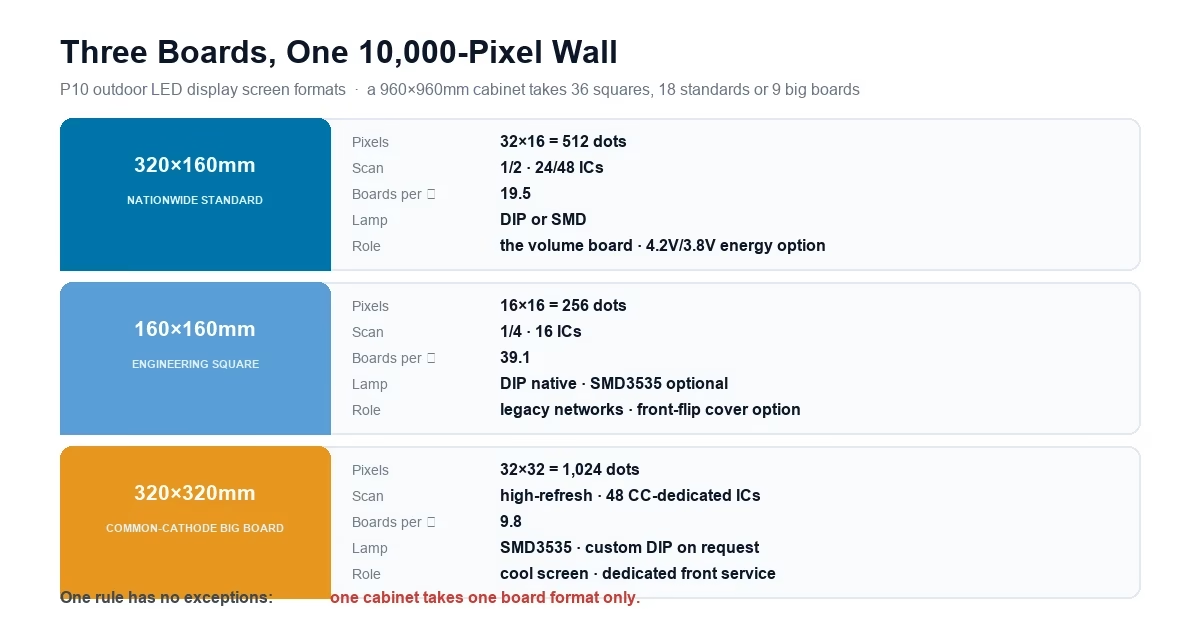
Three boards, one 10,000-pixel wall: a 960×960mm cabinet takes 36 squares, 18 standards or 9 big boards.
Why Does DIP Still Live on a P10 Outdoor LED Display Screen?
Every pitch finer than P10 settled this debate in SMD’s favor years ago. P10 is the exception, and the reasons are physical. DIP — direct-insert — mounts three separate lamp legs through the board, each in its own sealed package: the waterproofing is built into the lamp, the brightness per lamp remains the industry’s highest, and the mechanical construction tolerates vibration and abuse that would crack a surface-mounted lens. SMD3535 answers with a single black lens holding three chips: wider viewing angles, smoother color mixing, and a contrast-friendly face modern content rewards. The market has split accordingly — new mixed-content billboards default to SMD3535; extreme-sun faces, coastal and high-vibration sites and every legacy network extension still specify DIP. Our production line carries both on every board format, priced as options rather than upgrade penalties, because the right answer is the site’s, not the catalog’s.
The armor standard at this pitch: an anti-knock face test — the toughness DIP builds into the lamp itself.
What Brightness Tiers Does a P10 Outdoor LED Display Screen Reach?
Two tiers cover the class: 5,500–6,500 nits on copper/alloy-wire lamps for shaded and north-facing faces, and 7,000–10,000 nits on ultra-bright gold wire for full-sun highways — on a 10mm grid the lamps are large enough that either choice reads boldly, so the decision is climate and angle, not brightness anxiety. Get the tier in writing and verify at full white outdoors, under a UV-stabilized matte mask.
What Contrast and Grayscale Does a P10 Outdoor LED Display Screen Reach?
Contrast splits by lamp technology, and the split is the reason both still exist: DIP throws the rawest brightness and holds a punchy high-contrast look at distance in its reflective package; SMD3535 black-face lamps absorb stray light for a cleaner 5,000:1-class contrast and hold image quality to wider angles. Grayscale follows the driver — ChipOne-class ICs run 8-bit baseline, 12-bit value and 16-bit processing tiers, and on a 10,000-pixel face it shows most in dusk operation, the hours when billboards earn their premium rates. This is where the common-cathode cool-screen design pulls away: no localized heat drift means no color patches sweeping the face as the evening session heats up. Verify with a low-gray gradient demo at 5% brightness alongside the binning report — on the sparsest grid in the family, a mixed batch without honest spectral and luminance sorting shows as visible patches.
Which Electronics Should a P10 Outdoor LED Display Screen Verify Before Deposit?
Scan mode is the fraction of the pixel grid lit at any instant, and this class runs three: 1/2 scan on the nationwide standard board, 1/4 on the engineering square, and a high-refresh configuration on the common-cathode big board. The reconciliation check is arithmetic: the standard board’s 512 dots at 1/2 scan work out to roughly 256 driven channels — 16 sixteen-channel drivers plus row decode, about 24 devices (48 on the high-refresh build); the big board’s 1,024 dots run 48 common-cathode dedicated ICs. If a quote’s IC count and scan mode do not reconcile to the dot count, the spec is fiction.
Refresh is the spec to police: 1,920Hz bands on every smartphone camera, 3,840Hz clears phone footage and most professional work — and highway giants get photographed precisely because they are landmarks. Strict spectral and luminance binning plus full-wall per-pixel correction (NovaStar/Colorlight) ships standard. Run these five checks against any quote:
- Scan mode stated — 1/2, 1/4 or high-refresh, IC counts reconciling to the dot count.
- Refresh 3,840Hz — landmark faces get photographed at night.
- Driver IC named — ChipOne class or equivalent, common-cathode drivers declared on the big board.
- Lamp and mask spec’d — DIP or SMD3535 declared per board, UV-stabilized matte mask, conformal-coated boards.
- Binning report on file — spectral and luminance sorting, per-pixel per-color correction, batch-matched modules.
The factory work behind those numbers:
Inside the line: the dispensing and QC steps behind every module’s sealing claim.
How Do You Match Power, Cabinets and Control on a P10 Outdoor LED Display Screen?
Power is the quiet reason billboard networks keep choosing 10mm: the standard wall draws roughly 120–200W per square meter on mixed content, peaking near 250–350W on full white — and because the lamps are large and lightly loaded, they convert more of that power into light instead of heat. On a 100㎡ face running 20 hours a day, the difference between P6 and P10 is measured in thousands of dollars of electricity per year before a single lamp fails. Then the class goes further than any finer pitch can: the 320×160mm board accepts 4.2V and 3.8V energy-saving supplies, cutting consumption about 30% more; the 320×320mm big board ships common cathode standard — red, green and blue powered individually and precisely, with the cool-screen design eliminating the localized heat drift that shows as color patches on cheaper walls. Three formats, three levels of energy advantage. The supplies come from Chuanglian Power (volume standard, 4.2V/3.8V options), MEAN WELL (export spec) and G-Energy (ultra-thin 24/7 specialist, 4.2V) — the only pitch whose power table lists the energy rails as standard rows. Full supply grades: the LED display power supply guide.
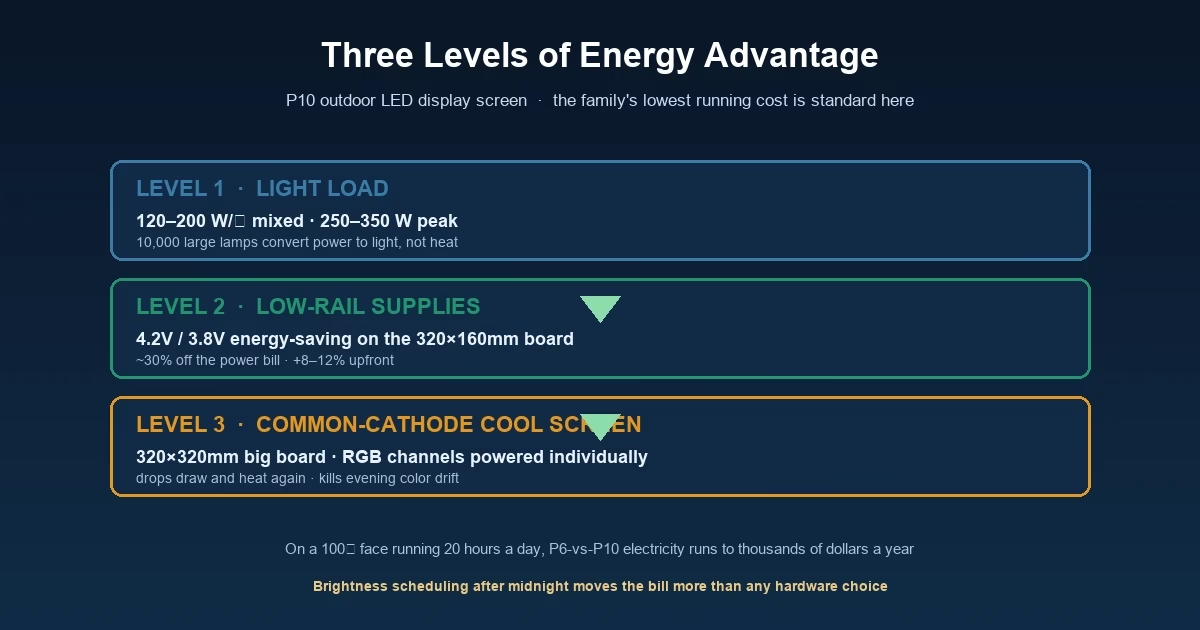
The family’s lowest running cost is standard at P10: three formats, three levels of energy advantage.
Control splits by duty, and both modes reach the cloud. Synchronous systems — NovaStar and Colorlight front ends — carry the stable heavy load for live-signal walls: broadcast feeds, sports venues, control-room networks. Asynchronous systems — Huidu and Mooncell players — publish schedules from a cloud server or a phone app and play for months unattended, which is how most nationwide billboard fleets actually operate; VDWALL and RGBlink cover the live-production front end, all compared on our LED screen control system guide. One rule holds everywhere: sending and receiving hardware must come from one family, chosen once for the whole fleet. Then the steel:
Highway-class steel: at this scale the structure line is quoted before the screen line.
What Does a P10 Outdoor LED Display Screen Cost Per Square Meter in 2026?
The September 2026 market scan — module e-commerce prices cross-checked against finished-wall quotes — puts the four builds here:
Three lines sit outside the table. Control hardware adds $500–2,000 per project; spare modules — 3% of quantity — are the cheapest insurance until the first storm ends a board; and local steel plus installation runs 20–30% of screen value. Inside the module, LED chips take 35–45% of module cost — pitch remains the primary price lever, and at 10mm it works entirely in your favor. The class-wide context is in the outdoor LED display price guide.
When Is a P10 Outdoor LED Display Screen the Wrong Choice?
The routing here has only two rows, because P10 is the end of the standard ladder:
The closest call is P8-or-P10 — the tape-measure rule is in the FAQ above; on pure distance plays, P10 wins the arithmetic every time. Where the bands come from: the viewing distance reference and the pixel pitch guide; the LED screen calculator sizes any wall on this page’s module grids.
What Do Buyers Also Ask About a P10 Outdoor LED Display Screen?
Why do P10 walls still use DIP lamps when everything else moved to SMD?
Because at 10mm pitch the DIP advantages still outweigh the costs. The three separate sealed lamps throw the highest per-lamp brightness in the industry and shrug off water, heat and vibration without relying on the mask — which is why DIP walls from fifteen years ago are still running. SMD3535 answers with wider viewing angles and smoother mixing, so the modern default is SMD for mixed content and DIP for extreme-sun, harsh-climate and legacy-spec walls.
How many modules and cabinets make one square meter of a P10 outdoor LED display screen?
The 160×160mm engineering square: 39.1 per square meter. The 320×160mm standard board: 19.5. The 320×320mm big board: 9.8. In cabinets, a 960×960mm iron cabinet takes 36 squares, 18 standard boards or 9 big boards (about 1.08 cabinets per square meter); a 640×640mm cabinet takes 16 squares.
How energy-efficient is a P10 outdoor LED display screen?
It is the most efficient outdoor class we ship, three ways. The standard wall draws roughly 120–200W per square meter on mixed content simply because 10,000 lamps is a light load. The 320×160mm board accepts 4.2V or 3.8V energy-saving supplies that cut the bill about 30% further. And the 320×320mm big board ships common cathode standard — red, green and blue powered individually — which drops draw and heat again while eliminating localized color drift. On a 100㎡ 24/7 wall, the savings compound into thousands of dollars a year.
How much does a P10 outdoor LED display screen cost per square meter in 2026?
A standard fixed-install P10 wall (cabinets, modules, power, basic control) runs $350–650 per square meter factory-direct — the floor of the outdoor family. The 4.2V/3.8V energy-saving build adds 8–12% upfront and returns about 30% of the power bill; the common-cathode big board adds 10–15%. Module-only purchases run $8–20 per board.
P8 or P10 — which should I buy for a highway billboard?
Measure the closest lane. Traffic that passes within 8–12 meters reads P8’s finer text; if the nearest viewer never closes inside 12 meters, P10 delivers the same perceived impact at the family’s lowest cost — and adds the energy-saving power options P8 does not carry. On pure distance plays, P10 wins the arithmetic every time.
What control system does a P10 outdoor LED display screen need?
NovaStar, Colorlight, Huidu, Mooncell and the wider ecosystem all drive these HUB75 modules, with VDWALL and RGBlink covering the front end. Both modes support cloud publishing and phone-based centralized control: synchronous systems carry the stable heavy load for live-signal walls, and asynchronous players handle scheduled playback from the cloud. The one rule: sending card and receiving cards must come from the same family.
How much power does a P10 outdoor LED display screen use?
Plan for roughly 120–200W per square meter on mixed content and 250–350W peak on full white; the common-cathode big board runs about 30% below that. Each cabinet carries its own supply (Chuanglian Power, MEAN WELL or G-Energy), and DIP builds draw more per lamp than SMD. Brightness scheduling after midnight moves the bill more than any hardware choice.
How long does a P10 outdoor LED display screen last?
Rated to 100,000 hours at half brightness — and P10 holds the family longevity record because its large lamps run far below their thermal limits. Walls from the early DIP era are still in daily service. What ends outdoor walls early is water at the connections and heat in the supplies, so cabinet drainage, brand-name supplies and conformal-coated boards matter more than any lamp datasheet. We back production walls with a 2–3 year warranty and 3% free spare modules.
References & Sourced From: 2026 P10 Outdoor LED Display Screen Data
- Module builds (320×160mm = 32×16 dots, 1/2 scan, 24/48 ICs; 160×160mm = 256 dots, 1/4 scan, 16 ICs, DIP native; 320×320mm = 1,024 dots, 48 common-cathode dedicated ICs, dedicated front service; 39.1/19.5/9.8 boards per ㎡; density 10,000 px/㎡): our P10 outdoor collection, current production data.
- Brightness tiers (5,500–6,500 nits copper/alloy wire; 7,000–10,000 nits ultra-bright gold wire), DIP and SMD3535 lamp options per board, SMD black-face contrast to 5,000:1-class, grayscale 8/12/16-bit by driver IC generation, common-cathode cool-screen technology, strict spectral and luminance binning plus full-wall per-pixel correction: same collection, September 2026.
- Price bands ($8–20 per module; $350–650/㎡ standard fixed — the floor of the outdoor family; 4.2V/3.8V energy-saving +8–12% with ~30% power saving; common-cathode big board +10–15%): September 2026 market scan, module prices cross-checked against finished-wall quotes.
- Power (Chuanglian Power / MEAN WELL / G-Energy at 5V 40A with 4.2V/3.8V energy rails; 120–200W/㎡ mixed, 250–350W peak; 100㎡ 20-hour running example) and control ecosystems (NovaStar, Colorlight, Huidu, Mooncell, VDWALL, RGBlink): the power supply guide and the control system guide.
Verdict: How Do You Run the P10 Outdoor LED Display Screen Checks in Order?
Run the checks in the order they fail on real projects:
- Band check first — closest viewer 10 m and beyond is the P10 band; under 10 m step to P8 and bank nothing but regret.
- DIP vs SMD by site — SMD3535 for modern mixed content; DIP for extreme sun, punishing climates and legacy network extensions.
- Format by cabinet math — 320×160mm as the national default; 160×160mm for DIP-native legacy work; 320×320mm for front service and the cool screen.
- Take the energy options — 4.2V/3.8V supplies and common cathode; the family’s lowest running cost is standard here.
- Electronics verified — scan mode with reconciling IC counts, 3,840Hz refresh, low-gray demo witnessed, binning report on file.
- One cloud-ready control family — platform chosen once, spares bought with the wall, fallback tested before handover.
Work the list in order and the purchase reduces to arithmetic. A P10 outdoor LED display screen is not the finest wall you can buy — it is the one that turns a distance-dominated site into the most square meters of readable advertising per dollar, with lamps tough enough that your successor will still be maintaining the wall you bought. Send us the wall size, the closest viewing distance and the install surface, and a LED screen manufacturer will return a module-level quote with lamp technology, brightness tier, energy rail and control stack itemized — 3% spare modules included.
Related P10 outdoor LED display screen guides:
P10 Outdoor LED Display Collection · P6 Outdoor LED Display Screen Quick Guide · P5 Outdoor LED Display Screen Quick Guide · Common Cathode Technology · P2.5 Outdoor LED Display Screen Quick Guide · P3 Outdoor LED Display Screen Quick Guide · P4 Outdoor LED Display Screen Quick Guide · P8 Outdoor LED Display Screen Quick Guide