
CZCL AB Series · 5V 60A · 300W · Fan-Cooled · 31.2 mm Shell
CZCL A-300AB-5 LED Switching Power
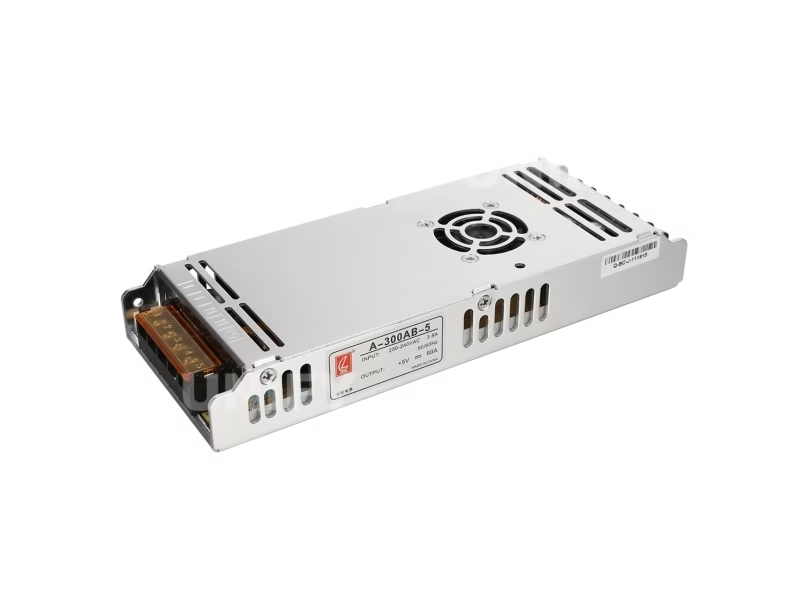
The CZCL A-300AB-5 LED switching power supply delivers 5 V DC at a full 60 A — 300 W — from a 176–264 VAC input, with hiccup-mode protection that recovers itself after a fault and an MTBF of 200,000 hours. It is the high-current, power-dense member of CZCL’s LED display power family.
📱 / WhatsApp: +86-191-18802497 · Shenzhen, China · GMT+8
300 W
Rated output power
5 V / 60 A
DC output rail
176–264 VAC
Input range
31.2 mm
Shell height
200,000 h
MTBF at 25°C (MIL-217)
Short answer
The CZCL A-300AB-5 is a 300 W fan-cooled switching power supply for LED screens: 176–264 VAC in, 5 V DC at 60 A out, ±1% output accuracy, in a 212 × 81.5 × 31.2 mm aluminum case weighing 0.75 kg. Overvoltage, overload, over-temperature and short-circuit faults put it into hiccup mode — it recovers automatically once the fault clears — and the factory rates it at 200,000 hours MTBF (MIL-217, 25°C). Keep loading at or below 80% — about 240 W or 48 A — and one unit carries a high-density indoor cabinet or a bright outdoor module group.
What Is the CZCL A-300AB-5 LED Switching Power Supply?
The CZCL A-300AB-5 is a 300 W switching-mode power supply (SMPS) for LED display cabinets: it converts a 176–264 VAC mains feed into a regulated 5 V DC bus at up to 60 A, feeding LED modules, receiving cards and hub boards in screens that draw more current than a 200 W-class supply can hand. It is the 5 V variant of the A-300AB series, which spans six rails — 2.8, 3.3, 3.8, 4.2, 4.5 and 5 V — all rated at 60 A, covering both standard and common-cathode energy-saving module architectures.
The manufacturer is Changzhou Chuanglian Power Supply Technology Corporation (CZCL), founded in 2000, operating a 22,000 m² factory with six SMT lines and a daily output of 30,000 pieces, with ISO 9001, ISO 14001 and QC 080000 certification and UL, CB, CE, CCC, KC and BIS product approvals. The A-300AB datasheet adds platform-level detail worth knowing before you buy: every unit passes a 100% full-load burn-in test, the design is rated for 10–500 Hz vibration and 20 G shock, and optional build variants include three-proofing conformal coating, a terminal cover and a −40°C low-temperature start.
Where it beats a 200 W unit
High-brightness outdoor faces, dense fine-pitch indoor walls, and any cabinet whose module count pushed a 200 W supply past the 80% line — 60 A on the rail means fewer supplies per cabinet and simpler DC bussing.
Self-recovering protection
Hiccup mode on overvoltage, overload, over-temperature and short circuit: the unit folds back, retries, and resumes on its own when the fault clears — no truck roll to press a reset.
Rated for the long run
MTBF of 200,000 hours at 25°C per the MIL-217 method, a 2-year factory warranty, and 100% full-load burn-in before shipment.
Sizing the electrical side of a whole screen? Pair this page with the LED display power consumption guide, and for the control end of the same cabinet see the LED screen display control system catalog.
What Are the CZCL A-300AB-5 Specifications?
Every figure below comes from the official CZCL A-300AB specification sheet (5 pages, file rev. 11/05/2019) — not from reseller listings. One field note where the datasheet and the physical nameplate disagree gets its own warning box.
| Parameter | CZCL A-300AB-5 |
|---|---|
| Rated output power | 300 W |
| Output voltage | +5 V DC |
| Output current | 60 A rated |
| Output accuracy / line / load regulation | ±1.0% / ±0.5% / ±1.0% |
| Ripple and noise | 200 mVp-p |
| Input voltage range | 176–264 VAC (nameplate: 200–240 VAC, 3.8 A) |
| Input frequency | 47–63 Hz |
| Efficiency | ≥86% (5 V rail) |
| Inrush / leakage current | 60 A cold start at 230 VAC / <1 mA at 240 VAC |
| Setup / rise / hold-up time | 3000 ms / 50 ms / 20 ms at 230 VAC full load |
| Protections | OVP and OLP at 110–150% rated: hiccup mode, auto-recovery; OTP and SCP: hiccup mode, auto-recovery |
| Cooling | Built-in cooling fan (fan-cooled) |
| Working temperature | −25°C to +60°C, 20–95% RH non-condensing (derating curve applies) |
| Storage temperature | −40°C to +85°C |
| Vibration / shock | 10–500 Hz at 2G / 20 G, 11 ms, three axes |
| MTBF | 200,000 hours at 25°C (MIL-217 method) |
| Dimensions | 212 × 81.5 × 31.2 mm (L × W × H) |
| Weight / packing | 0.75 kg per piece; 30 pieces per carton |
| Safety / EMC design standards | GB 4943, UL 1012; EN 55022, EN 55024, EN 61000-4 series, GB 17625.1, EN 61000-3-2/-3 |
| Withstand voltage / isolation | I/P-O/P 1.8 kVAC; 100 MΩ isolation resistance |
| Series rails | A-300AB-2.8 / -3.3 / -3.8 / -4.2 / -4.5 / -5 (all 60 A) |
| Warranty | 2 years (factory datasheet) |
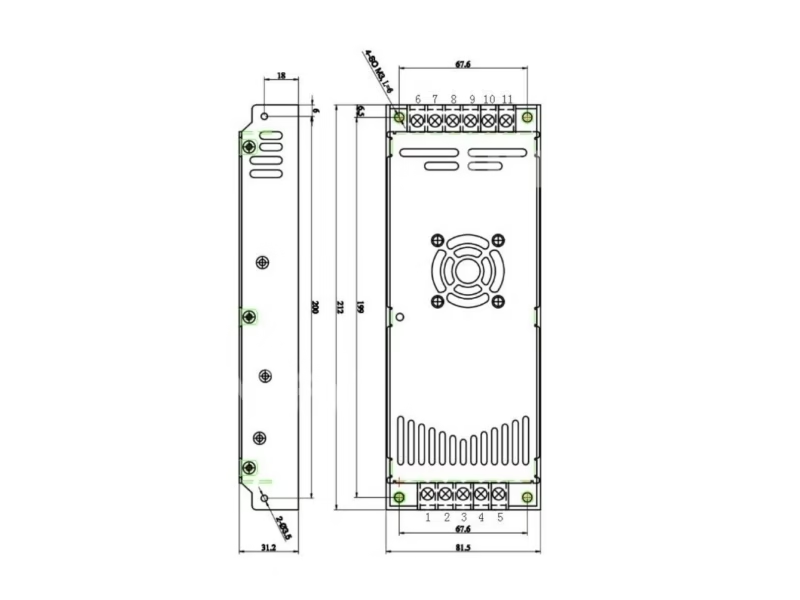
Factory mechanical drawing: 212 × 81.5 × 31.2 mm, M3 mounting tabs, fan position marked
Datasheet vs nameplate: which input range do you buy against?
The datasheet specifies 176–264 VAC; the nameplate on current production units reads 200–240 VAC, 3.8 A (the batch photo below shows it). Both readings exclude 100–120 V grids — US, Canada and Japan need a wide-input model. For design work, treat 200–240 V nominal as the design center and you stay inside both documents.
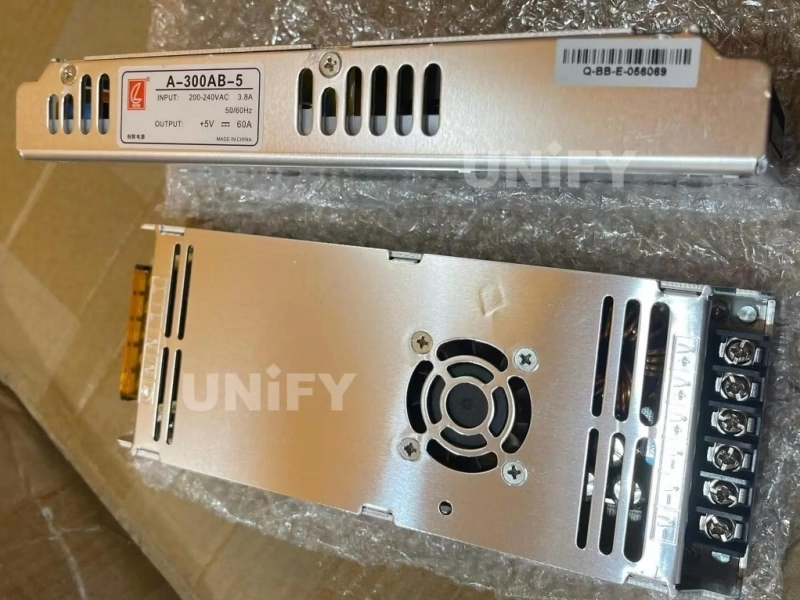
Current production batch: nameplate INPUT 200–240 VAC 3.8A · OUTPUT +5V, 60A
How Much Load Can a 5V 60A 300W LED Switching Power Supply Carry?
Two rules converge on the same answer. The industry-standard practice is to load a switching supply to no more than 80% of its rating, and the factory’s own datasheet says the same thing in different words: “to extend the lifetime, it is recommended to configure the load more than 30% of the remaining allowance” — a device that needs 100 W should get a supply of no less than 130 W, which caps loading near 77%. Apply the stricter of the two and you get this budget:
Power budget
300 W × 80% = 240 W usable per unit
Current budget
60 A × 80% = 48 A usable per unit
Mapped onto typical modules (average program-material draws — full-white test patterns run higher, so verify against your module datasheet):
| Typical load | Average draw | Max per A-300AB-5 at 240 W |
|---|---|---|
| Indoor P2.5 module (320 × 160 mm) | ~10–15 W | ~16–24 modules |
| Rental P3.91 module (250 × 250 mm) | ~15–20 W | ~12–16 modules |
| Outdoor P4.81 module (250 × 250 mm) | ~20–30 W | ~8–12 modules |
| Receiving card (Novastar / Colorlight class) | ~3–5 W | Shares the same 5 V rail |
In practice one A-300AB-5 covers a dense 500 × 1000 mm indoor cabinet or a bright outdoor module group that would force a 200 W supply over its budget. Two field cautions from the factory datasheet: at continuous full load the unit needs a 400 × 400 × 3 mm aluminum plate added behind it as auxiliary heat dissipation, and outdoor screens running at full brightness deserve the derating math in our power consumption guide — the same planning that goes into a P3 outdoor LED display build.
Why Does the A-300AB-5 Use a Cooling Fan?
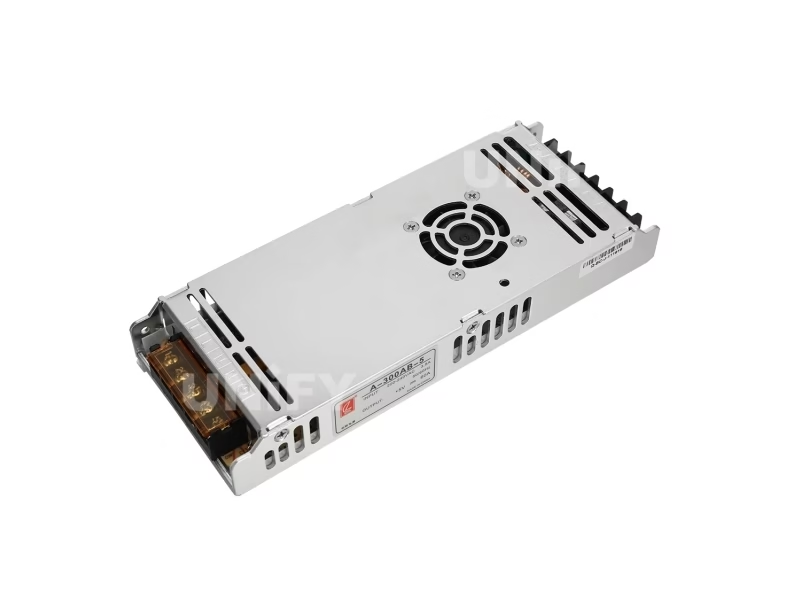
At 300 W in a 212 × 81.5 × 31.2 mm shell, heat density crosses what natural convection can carry, so CZCL fits a built-in fan — the datasheet’s cooling checkbox is marked “Fan,” and the grille sits mid-shell. The fan buys the high current rating and keeps internal components inside their lifetime curves; the trade is that it becomes the one component in the supply with a maintenance habit attached.
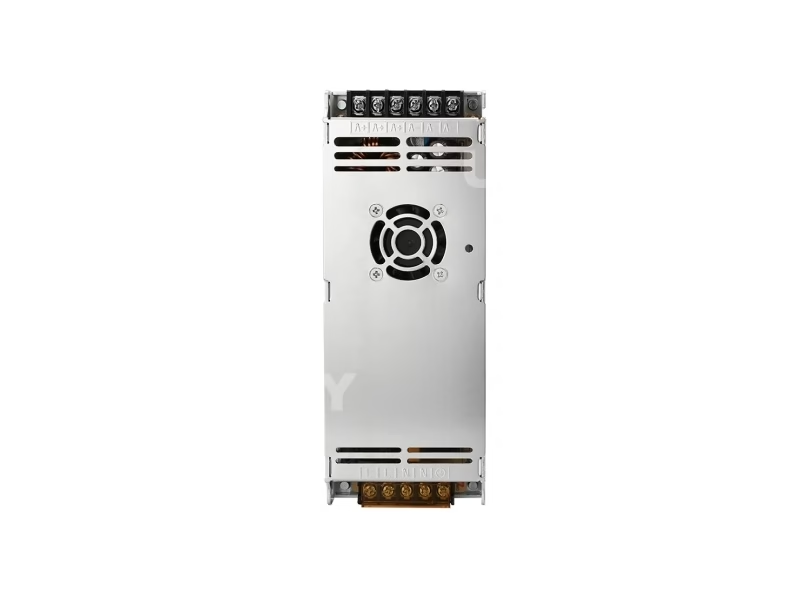
What the fan gives you
A 60 A rail in this footprint, stable output at ≥86% efficiency, and a −25 to +60°C working window with the factory derating curve — headroom that a fanless 200 W design spends on silence instead.
What it asks of you
Keep the grille clear of tape dust and stage haze during scheduled screen service, and listen at commissioning — a grinding fan at month three is a warranty conversation, not a normal sound.
Harsh-environment option
Dusty or coastal sites should order the factory’s three-proofing (conformal coating) build variant — the datasheet lists it as a standard extension option, along with a terminal cover and −40°C low-temperature start.
Reliability at the platform level is signed, not implied: the datasheet carries an MTBF of 200,000 hours at 25°C under the MIL-217 method, every unit passes a 100% full-load burn-in test, and the factory reports an annual average failure rate below 0.2% across its catalogue. If your cabinet has no room for fan service access or demands zero acoustic noise, that is the case for the fanless sibling — the CZCL A-200AC-5 LED switching power — covered in the comparison below.
What Is Hiccup-Mode Protection and Why Does It Matter for an LED Screen?
The A-300AB-5 protects itself with hiccup mode: when overvoltage (at 110–150% of rated output), overload, over-temperature or a short circuit trips the unit, it folds its output down, waits, then retries — repeating the cycle until the fault condition clears, at which point it resumes normal operation on its own. The factory datasheet states this for all four fault types, with automatic recovery.
The practical difference shows up on a live screen. A latching protection design shuts off and stays off until a human cycles power — a transient overload from a brightness ramp or a marginal connector becomes a dead cabinet until someone climbs a lift. A hiccup-mode supply rides through the same transient: the cabinet may blink, but it comes back by itself. For rental fleets and hard-to-reach installs, that behavior difference is worth more than a few dollars of bill-of-materials.
Which Output Rail Fits Your LED Screen: 2.8V to 5V?
The A-300AB series ships six rails, and the datasheet rates every one of them at 60 A — power scales with voltage. That structure maps directly onto module architecture:
| Model | Rail | Rated current | Rated power | Typical use |
|---|---|---|---|---|
| A-300AB-2.8 | 2.8 V | 60 A | 168 W | Common-cathode energy-saving modules |
| A-300AB-3.3 | 3.3 V | 60 A | 198 W | Low-voltage LED strings |
| A-300AB-3.8 | 3.8 V | 60 A | 228 W | Energy-saving fixed installs |
| A-300AB-4.2 | 4.2 V | 60 A | 252 W | Power-saving walls |
| A-300AB-4.5 | 4.5 V | 60 A | 270 W | Reduced-heat indoor walls |
| A-300AB-5 | 5.0 V | 60 A | 300 W | Standard modules + receiving cards |
If your screen spec calls a common-cathode power architecture, match the rail to the module and read our common cathode LED technology explainer before ordering — mixing a 5 V supply onto a 2.8 V rail is a one-way ticket for the modules.
How Does the A-300AB-5 Compare With the CZCL A-200AC-5?
Both are CZCL LED display supplies on the same 5 V standard rail, and screens regularly mix them in one cabinet row. They divide the work by heat and current:
- Current: 60 A versus 40 A — the AB carries 50% more load per unit.
- Cooling: the AB-5 is fan-cooled; the A-200AC-5 is fully fanless and silent.
- Profile: 31.2 mm versus 26 mm — the A-200AC-5 wins the slimmest cabinets.
- Input window: 176–264 VAC versus 190–264 VAC — the AB rides deeper brownouts.
- Protection: full hiccup auto-recovery on the AB-5; basic short-circuit/overload on the A-200AC-5.
| Parameter | A-300AB-5 | A-200AC-5 |
|---|---|---|
| Output | 5 V / 60 A / 300 W | 5 V / 40 A / 200 W |
| Cooling | Built-in fan | Fanless convection |
| Input range | 176–264 VAC | 190–264 VAC |
| Dimensions | 212 × 81.5 × 31.2 mm | 165 × 56 × 26 mm |
| Weight | 0.75 kg | 0.3 kg |
| Working temperature | −25 to +60°C | −40 to +70°C |
| Protection | Hiccup mode, auto-recovery (OVP/OLP/OTP/SCP) | Short circuit / overload |
| MTBF | 200,000 h (MIL-217) | Not published |
| Rail options | 2.8 / 3.3 / 3.8 / 4.2 / 4.5 / 5 V | 3.8 / 4.2 / 4.5 / 5 V |
Full detail on the fanless unit lives on the CZCL A-200AC-5 LED switching power page; order one of each for a trial cabinet and the choice makes itself.
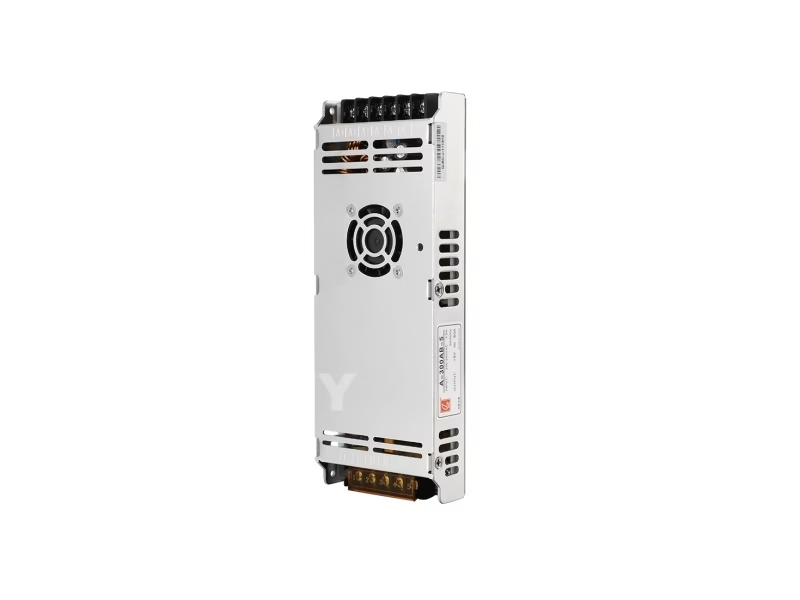
Side profile: the 31.2 mm body and the high-current output block that separate the AB from the 200 W class
How Do You Install and Wire the CZCL A-300AB-5 Safely?
The datasheet’s installation warnings set the rules; the sequence below folds them into a commissioning workflow.
1 · Mount within the screw limits
Use M3 × 6 mm screws; the housing takes a maximum 4 mm screw depth. Deeper screws contact the internals — the datasheet flags this explicitly.
2 · Plan for heat
Continuous full-load operation requires a 400 × 400 × 3 mm aluminum plate behind the unit as auxiliary heat dissipation, per the datasheet. Design the bay for airflow across the fan grille.
3 · Wire and verify before power
Check AC versus DC terminals and positive versus negative polarity with a meter — the factory instructs proofreading every connection and testing for short circuits on both the mains side and the output side before switch-on.
4 · Ground it properly
Ground wire heavier than AWG 18, terminated reliably — the factory calls this out for both safety and interference reduction.
5 · Respect the nominal ratings
Stay inside the nameplate values; the factory requires consulting its technical department before any output-parameter change, and after-sales service goes through the factory line at 86-519-85215050 rather than self-repair.
6 · Load-test the cabinet
Run a full-white pattern for ten minutes, verify rail voltage at the far end of the DC bus, and confirm the fan spins clean and quiet before closing the cabinet.
Do not parallel the outputs
The A-300AB base series is not a current-sharing design. Two paralleled units will not split load evenly — one runs hot while the other idles. For N+1 redundant bays, use CZCL’s dedicated current-sharing series instead.
When a unit does fail in the field, our LED display power supply diagnostics and replacement guide covers the test-and-swap workflow end to end.
What Problems Does a Failing LED Power Supply Cause?
Power trouble wears disguises — check these three signatures before blaming a module or a control card:
Dim or uneven brightness, one cabinet
Aging output capacitors sag the rail under load; the cabinet’s corner looks tired while its neighbors shine. Full-white patterns make it obvious.
Flicker on camera or under load spikes
An overloaded or failing rail dips for a frame at a time. Flicker that tracks bright content points at the supply first.
Cabinet reboots or dead sections
Protection cycling reads as “random” dead cabinets. Measure the rail during the dropout before replacing modules — hiccup mode means the cause is usually upstream.
How Much Does the CZCL A-300AB-5 Cost?
Single units retail in the $13–$16 band on component marketplaces — ledcontrollercard.com lists it at $13.00 (marked down from $15.20), and IndiaMART quotes around ₹1,200 per piece in the Indian channel (both observed September 2026). Volume pricing steps down sharply from there, and the 30-pieces-per-carton packing tells you how this part is actually bought.
Sample · 1–10 pcs
For repairs, prototypes and trial cabinets — shipped from stock with the nameplate you see above.
Project · 10–500 pcs
Whole-screen and fleet quantities with per-cabinet load math, rail matching to your module datasheets, and three-proofing options where the site needs them.
Volume · 500+ pcs
Production-line pricing on CZCL stock with container freight planning and batch date-code consistency.
Send the module types, modules-per-cabinet and total cabinet count, and the quote comes back with the load math attached — from an LED screen manufacturer that stocks the full chain from power to control.
CZCL A-300AB-5 LED Switching Power: Frequently Asked Questions
Can I run the CZCL A-300AB-5 on a 110 V outlet in the US?
No. The datasheet input window is 176–264 VAC and the production nameplate reads 200–240 VAC, 3.8 A — both exclude 100–120 V grids. For US, Canadian or Japanese sites you need a wide-input supply or a step-up transformer.
How many LED modules can one A-300AB-5 drive?
At the 80% loading rule: 240 W or 48 A usable. A typical indoor P2.5 module draws about 10–15 W of average program material, so one unit covers roughly 16–24 such modules plus the receiving card — verify against your module’s datasheet and brightness profile.
Does the A-300AB-5 have a fan or is it fanless?
It is fan-cooled — the datasheet marks the built-in fan, and the grille sits mid-shell. The fan is what buys the 60 A rail in a 31.2 mm shell; keep it clear of dust during scheduled screen service. For a silent cabinet, the fanless CZCL A-200AC-5 covers 200 W / 40 A.
What is hiccup-mode protection?
A protection style where the supply folds back and retries after a fault instead of latching off. On the A-300AB-5, overvoltage, overload, over-temperature and short-circuit events all recover automatically once the fault clears — a transient overload blinks the cabinet but does not kill it until a manual restart.
What is the difference between the A-300AB-5 and the A-200AC-5?
Current class and cooling philosophy: 300 W / 60 A with a fan versus 200 W / 40 A fanless. The AB-5 also rides deeper brownouts (176 VAC floor), recovers from faults automatically, and spans six rails down to 2.8 V; the A-200AC-5 is slimmer (26 mm), lighter and silent.
Can I parallel two A-300AB-5 units for more current?
No. The base series is not a current-sharing design, so two paralleled units will not divide load evenly. Use a higher-rated single unit or CZCL’s dedicated current-sharing series for N+1 bays.
Why does the datasheet mention a 400 mm aluminum plate?
The factory requires a 400 × 400 × 3 mm aluminum plate as auxiliary heat dissipation whenever the unit runs at continuous full load — the fan handles normal duty, and the plate carries the worst-case thermal. Build it into the bay if your cabinets will sit at or near 300 W.
What warranty and service life does CZCL publish?
The datasheet carries a 2-year warranty and an MTBF of 200,000 hours at 25°C (MIL-217 method), with 100% full-load burn-in testing before shipment. Factory after-sales runs through the service line at 86-519-85215050 rather than field repair.
Quote the CZCL A-300AB-5 With the Load Math Done
Send your module types and cabinet count; we return per-cabinet power sizing and a matched quote from a LED screen manufacturer that ships worldwide.
📱 / WhatsApp: +86-191-18802497 · Shenzhen, China · GMT+8
Related LED Display Power Resources
CZCL A-200AC-5 (Fanless 200 W)
The silent sibling: 5 V / 40 A / 200 W in a 26 mm fanless shell for slim cabinets.
LED Display Power Consumption
Screen-level power math: module draw, brightness settings, breaker sizing and cable gauges.
Power Supply Diagnostics & Replacement
Test a suspect supply, swap it inside a live screen, and root-cause repeat failures.
LED Screen Display Control System
The control-side catalog: sending cards, receiving cards and processors that ride on the 5 V rail.
Beyond 300 W — and off the single rail
The flagship A-400JQ-5P doubles this unit’s rail with active PFC; the dual-rail B-200AF serves common-cathode screens with independent 3.8 V and 2.8 V buses and a family-best 250,000 h MTBF.
CZCL LED Power Supply Guides
Four deep-dives from the CZCL power series – the count math, the selection flow, the pricing and the head-to-head verdicts.