
Mooncell · V Series · Video Splicer
Mooncell V Series Video Splicer
The Mooncell V Series Video Splicer is the modular video-wall platform of the Mooncell family: four chassis from 3U to 14U, 40 to 200 Gigabit outputs, 26 to 130 million pixels, 4:4:4 color processing and HDR10 for command centers, conference halls and broadcast studios.
Product Overview
What Is the Mooncell V Series Video Splicer?
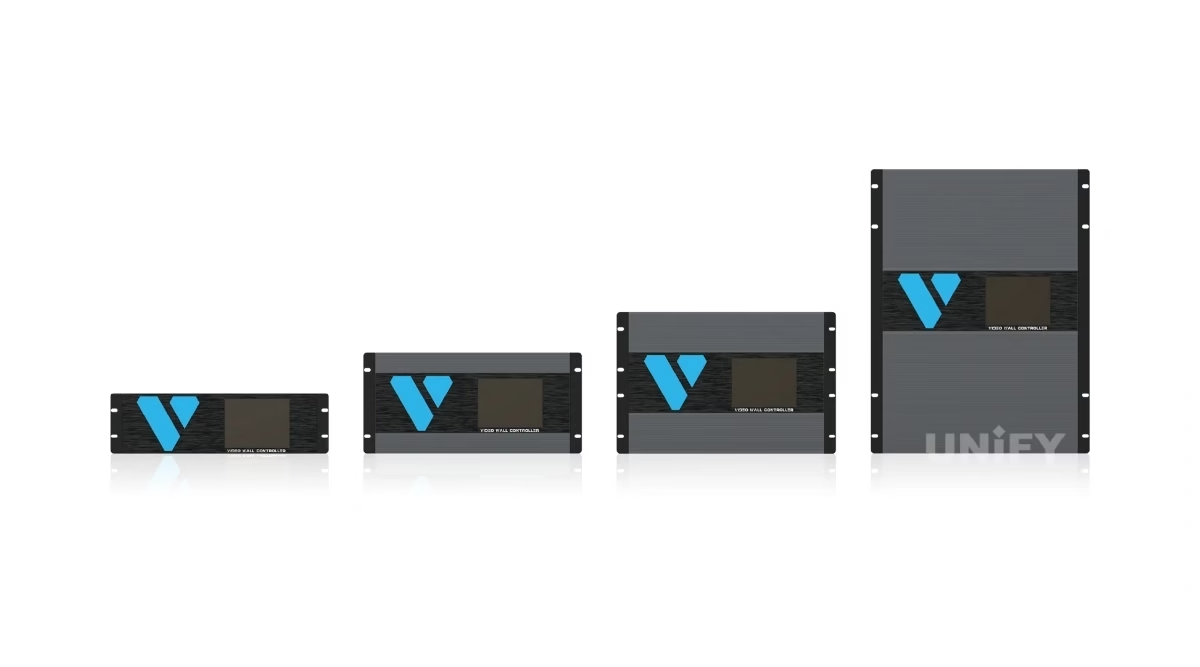
The Mooncell V Series Video Splicer is Mooncell’s modular video-wall processing platform: four standard chassis — the V300 (3U), V500 (5U), V700 (7U) and V1400 (14U) — accept modular input boards, process digital and analog signals with 4:4:4 color at up to 4K@60Hz, and drive LED receiving cards through 40 to 200 Gigabit Ethernet ports with loads from 26 to 130 million pixels. It supports frame synchronization, Genlock cascading, irregular splicing, WEB control with saved scenes, input hot backup and redundant power. Mooncell positions it for command and dispatch centers, conference halls, exhibition centers, data operation centers and broadcast studios, and this page uses the official V Series Video Splicer Specification V4.1 as its data source.
Short answer: The Mooncell V Series Video Splicer is a modular video-wall processor in four chassis sizes — V300 (3U, 40 ports, 26M pixels, 32 layers), V500 (5U, 60 ports, 39M, 48 layers, redundant power), V700 (7U, 100 ports, 65M, 80 layers) and V1400 (14U, 200 ports, 130M, 160 layers). Each port loads 655,360 pixels (480,000 with 10-bit HDR10, first 8 ports only); input boards cover DVI, HDMI 1.3/1.4/2.0, DP 1.2, VGA and 3G-SDI; and the platform processes 4:4:4 color, frame-synchronized output, Genlock cascading and irregular splicing. It is quoted per project, with channel reference processors running $1,799 to $4,369.
The V Series completes the Mooncell family picture: the MB401 plays content, the MVB12E and M40 process mid-size walls, the MTB2000E sends 10.4M-class canvases, and the V Series splices the largest walls — 26M to 130M pixels — through modular chassis that scale with the project. Receiving cards sit inside the cabinets, driven directly by the splicer’s Gigabit outputs: the A712 (HUB75E) or A10X (120-pin).
Specifications
What Are the Mooncell V Series Video Splicer Specifications?
Data from the official Mooncell V Series Video Splicer Specification V4.1 (first release July 18, 2025; V4.1 December 8, 2025 updating the front-panel image; hardware V1.0.0).
Processing across the platform: 4:4:4 color; HDR10; frame synchronization; Genlock cascading; arbitrary layering among all signals; multi-screen free roaming and scaling; irregular splicing and intelligent irregular splicing; HDMI audio input; WEB control with PC scenes, scheduled scenes and scene rotation; EDID modification; signal cropping and local zoom; smart resolution settings with different resolutions between network ports. Input boards: 4×DVI, 4×HDMI1.3, 4×HDMI1.4, 2×HDMI2.0, 2×DP1.2, 8×HDMI1.3 (4:2:2 only), 8×VGA and 4×3G-SDI (broadcast, with deinterlacing).
Data Verification
How Do the Mooncell V Series Loading Numbers Check Out — 26M to 130M?
The V Series is the cleanest arithmetic in the Mooncell family — every rung divides exactly, and one HDR10 rule is worth pinning down:
40 × 655,360 = 26,214,400 ≈ 26M · 60 × 655,360 = 39,321,600 ≈ 39M · 100 × 655,360 = 65,536,000 ≈ 65M · 200 × 655,360 = 131,072,000 ≈ 130M — every rung divides exactly, unlike some series where the rated load falls short of the port sum.
With 10-bit HDR10 enabled, each port carries 480,000 pixels at bandwidth 1440 — and only the first 8 ports of the unit are used. A wall designed at 10-bit depth is an 8-port-per-unit design, not a full-chassis one.
Different resolutions can be used between network ports — the same flexible-loading idea as the MTB2000E’s flexible wiring, applied across a 40-to-200-port canvas.
The practical read: size the chassis on the pixel budget, and budget the HDR10 path separately — a 26M wall at 8-bit is a V300; the same wall at 10-bit HDR10 is an 8-port discipline that may need a larger chassis or a different allocation.
Model Selection
Which Mooncell V Series Video Splicer Do You Need: V300, V500, V700 or V1400?
The V Series is a four-rung modular ladder — the chassis scales, the boards mix, and the rung is set by the pixel budget and layer count:
The deciding variables: pixel budget, input channel count and layer count — and whether the project needs the redundant-power rung, which arrives at the V500. All four accept the same modular input boards and drive the same receiving cards.
Input Boards
What Input Signals Can the Mooncell V Series Accept?
The modular input boards are where the V Series earns its “splicer” name — eight board types cover every source a command center or broadcast studio owns:
The ultra-wide and tall inputs are the board-level headline: a 7680×1080 strip or a 1920×4800 tower feeds the splicer natively instead of being split before arrival — the same canvas shapes the family’s flexible-loading story supports downstream.
Display Functions
What Can the Mooncell V Series Do with a Video Wall?
The display stack is what makes the V Series a splicer rather than a processor — five capabilities define it:
Arbitrary layering among all signals with multi-screen free roaming and scaling — up to 160 layers on the V1400, each positioned and sized without constraint.
Frame synchronization across the spliced canvas — no frame loss, complete picture detail, and Genlock cascading ties multiple units to the same clock for multi-wall venues.
Irregular display splicing and intelligent irregular splicing — the creative-geometry story of the B1200S pages, now available at splicer scale.
WEB control with PC scenes, scheduled scenes and scene rotation — operators switch layouts from a browser, and the wall follows a program instead of a technician.
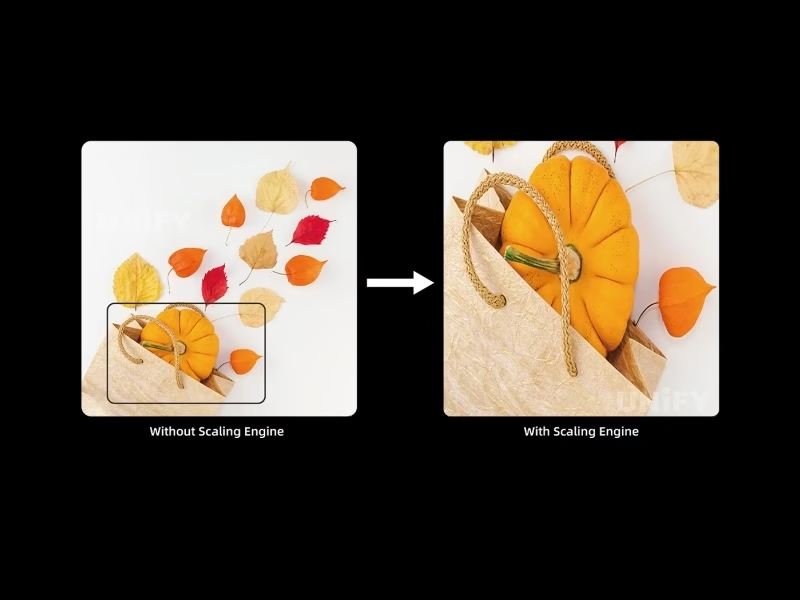
Around those: HDMI audio input, EDID modification per input, signal-source cropping with local zoom, a content-adaptive scaling engine, and smart resolution settings that let different network ports carry different resolutions — the flexible-loading idea applied across a 200-port canvas.
Reliability
How Does the Mooncell V Series Keep a Command Wall Alive?
Command and dispatch walls are the least tolerant installs in the LED business — the V Series answers with a four-layer reliability story:
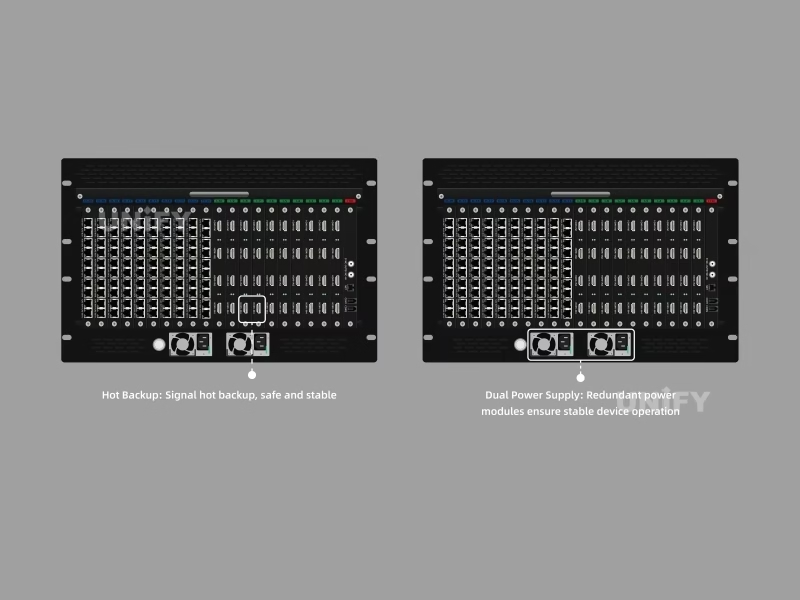
Input signal hot backup with seamless switching between sources — a failed feed swaps to its backup without the wall noticing, the same family story as the receiving-card backup tiers.
The V500, V700 and V1400 carry redundant power modules — 550 W ×2 on the V500/V700 and 550 W ×4 on the V1400 — a power-supply failure no longer takes the wall down.
Frame synchronization and Genlock cascading keep multi-unit canvases phase-locked — the sync layer that makes a spliced wall read as one display.
The system-level redundancy picture — backup sending hardware, cascade failover, spare discipline — is in the LED display system redundancy & backup guide.
Core Features
What Does the Mooncell V Series Video Splicer Bring to a Project?
Six capabilities define the V Series for flagship installations — the color path first, then the scale, then the control and reliability layers.
4:4:4 color processing across the platform and HDR10 at 10-bit depth — rich color and sharp detail on large screens, the flagship color path of the family.
Four chassis from 3U to 14U with 40 to 200 Gigabit outputs — every rung divides exactly at 655,360 pixels per port, from 26M to 130M.
Frame synchronization across the spliced canvas with Genlock cascading for multi-unit venues — the wall reads as one display.
WEB control with PC scenes, scheduled scenes and scene rotation — operators switch layouts from a browser, and the wall follows a program.
Input hot backup with seamless switching, and 550 W ×2/×4 redundant power from the V500 up — command-grade reliability.
3G-SDI broadcast boards with deinterlacing and 8× VGA analog boards — the input matrix that covers studios and legacy rooms.
System Configuration
How Do You Configure a Mooncell V Series Wall?
The V Series sits directly in front of the receiving cards — no intermediate sending stage — and the configuration follows the family workflow:
Each output card carries 10 Gigabit ports connecting directly to Mooncell receiving cards — the A712 (HUB75E) or A10X (120-pin) — compatible with all Mooncell receiving cards per the sheet.
WEB control sets layers, scenes and schedules; EDID modification per input tells each source what the wall expects — the commissioning path that replaces per-source guesswork.
Genlock cascading ties multiple V Series units to the same clock — the multi-chassis venue story, and the same sync architecture documented on the MVB20E-G page.
The full commissioning sequence — wiring, network mapping, module configuration, correction — is covered step by step in the LED display configuration and system debugging guide.
Family Architecture
Where Does the Mooncell V Series Fit in the Mooncell Family?
The V Series completes the family’s six-role picture — and the honest architecture comparison is the buyer’s map:
The buying logic is scale and role: content and playback point to the MB401; mid-size walls to the 2-in-1 or sending rungs; creative geometry to the B/MB controllers; and the largest fixed walls — command centers, venues, studios — to the V Series. The LED video processor category page maps the wider class.
Applications
Where Does the Mooncell V Series Video Splicer Fit Best?
Mooncell’s official application set — command and dispatch centers, conference and reporting halls, exhibition centers, data operation centers and broadcasting studios — defines the V Series’s home turf. Four project classes carry most of the demand:
Multi-source walls with hot backup, redundant power and frame sync — the reliability tier the V Series was named for
Large presentation walls with saved scenes and WEB control — layout changes between sessions from a browser
24/7 monitoring walls with EDID-managed sources, cropping and local zoom on dense data feeds
3G-SDI inputs with deinterlacing and Genlock sync for camera-facing studio walls
Official Mooncell case sharing.
Official Mooncell video — the control system in the field.
For event and staging contexts around these walls, the LED screen for events guide covers the deployment planning around the display itself.
Pricing
How Much Does a Mooncell V Series Video Splicer Cost?
Price transparency, stated plainly: the V Series is quoted per project — Mooncell lists no public retail price (official hotline 400-881-3531), and the chassis, input boards and quantity set the quote. Same-channel reference for the video-wall processor class: the Magnimage LED-780H at $1,799, the VDWALL LVP404-412 at $2,888–$4,369 and the Novastar J6 at $3,600 — the V Series sits in and above that class by scale. Factory-direct tiers for B2B buyers:
A per-wall budget is the honest math: the splicer is one line item among receiving cards, structure and content — see the LED display warranty page for what to hold the supplier to on spares. Ask for a factory-direct quote at your chassis count and board mix — we are the LED screen manufacturer behind unifyled.com.
FAQ
What Do Buyers Ask About the Mooncell V Series Video Splicer?
What Assurance Comes With the Mooncell V Series Video Splicer?
Every V Series chassis ships with Mooncell original packaging and compliance documentation.
Ready to Specify the Mooncell V Series Video Splicer?
Project-based pricing, genuine Mooncell stock, modular pre-configuration and 2-year warranty.
unifyledscreen@gmail.com | +86-191-18802497
Technical Deep-Dive
What Should Engineers Know Before Buying the Mooncell V Series Video Splicer?
Published: September 2026 | 12 min read | UnifyLED Engineering Team
The Mooncell V Series Video Splicer is the top of the Mooncell family — the modular platform that splices 26 to 130 million pixels across command-center walls, venue canvases and broadcast studios. This guide is written for engineers and project managers specifying the largest fixed walls in 2026, using the official Mooncell V Series Video Splicer Specification V4.1 as the data source, with the loading math, the input-board matrix and the HDR10 rule that project documentation gets wrong.
Short answer: The Mooncell V Series Video Splicer is a modular video-wall processor in four chassis — V300 (3U, 40 ports, 26M, 32 layers), V500 (5U, 60 ports, 39M, 48 layers, redundant power), V700 (7U, 100 ports, 65M, 80 layers) and V1400 (14U, 200 ports, 130M, 160 layers). Each port loads 655,360 pixels (480,000 with 10-bit HDR10, first 8 ports only); input boards cover DVI, HDMI 1.3/1.4/2.0, DP 1.2, VGA and 3G-SDI; and the platform processes 4:4:4 color, frame-synchronized output, Genlock cascading, irregular splicing and hot backup with redundant power. It is quoted per project, with channel reference processors running $1,799 to $4,369.
Chapter 1 — Definition: The Modular Splicer
The Mooncell V Series Video Splicer is a modular video-wall processing platform: standard 3U, 5U, 7U and 14U chassis accept input and output boards, process digital and analog signals with 4:4:4 color at up to 4K@60Hz, and drive LED receiving cards directly through 40 to 200 Gigabit Ethernet ports. It is the synchronous spine of the largest fixed installations — the wall that cannot blink, the canvas that must stay phase-locked. The specification history is short: V4.0 first released July 18, 2025, V4.1 on December 8, 2025 updating the front-panel image, on hardware V1.0.0.
The family map is worth restating as the V Series closes it: the MB401 plays content, the MVB12E and M40 process mid-size walls, the MTB2000E sends 10.4M-class canvases, the B1200S and MB400S handle creative geometry, the A712 and A10X sit in every cabinet — and the V Series splices the largest walls of all.
Chapter 2 — Loading: 26M to 130M, Verified
The V Series is the cleanest arithmetic in the Mooncell family: 40 × 655,360 = 26,214,400 (V300), 60 × 655,360 = 39,321,600 (V500), 100 × 655,360 = 65,536,000 (V700) and 200 × 655,360 = 131,072,000 (V1400) — every rung divides exactly, unlike some series where the rated load falls short of the port sum. Per-port ceilings: 1920×1920 at 655,360 pixels, 8-bit. The HDR10 rule is the one that trips planners: with 10-bit enabled, each port carries 480,000 pixels at bandwidth 1440, and only the first 8 ports of the unit are used — a 10-bit wall is an 8-port-per-unit discipline, not a full-chassis one. Size the chassis on the 8-bit budget, and budget the 10-bit path separately.
Practical formats: a 26M canvas (V300) at P2.5 runs about 12.8 × 7.2 m; a 65M canvas (V700) about 20 × 11 m; a 130M canvas (V1400) about 28 × 16 m. The smart-resolution setting — different resolutions between network ports — is the flexible-loading idea of the MTB2000E applied across a 200-port canvas, so mixed-pitch walls keep every port honest.
Port allocation deserves a procurement reading, because the V Series bills by chassis and the chassis is sized by the wall. A 26M canvas at P2.5 runs about 12.8 × 7.2 m and fits the V300’s 40 ports with headroom; a 65M canvas about 20 × 11 m and fits the V700’s 100 ports; a 130M canvas about 28 × 16 m needs the V1400’s 200 ports. The layer budget tracks the chassis too — 32 layers on the V300 against 160 on the V1400 — so a command wall that runs dozens of simultaneous windows sizes the chassis by layers as much as by pixels. Mixed-pitch walls, where sections run different module resolutions, are where the smart-resolution setting earns its keep: different network ports carry different resolutions, so a P2.5 zone and a P4 zone share one chassis without wasting port capacity.
Chapter 3 — The Input-Board Matrix
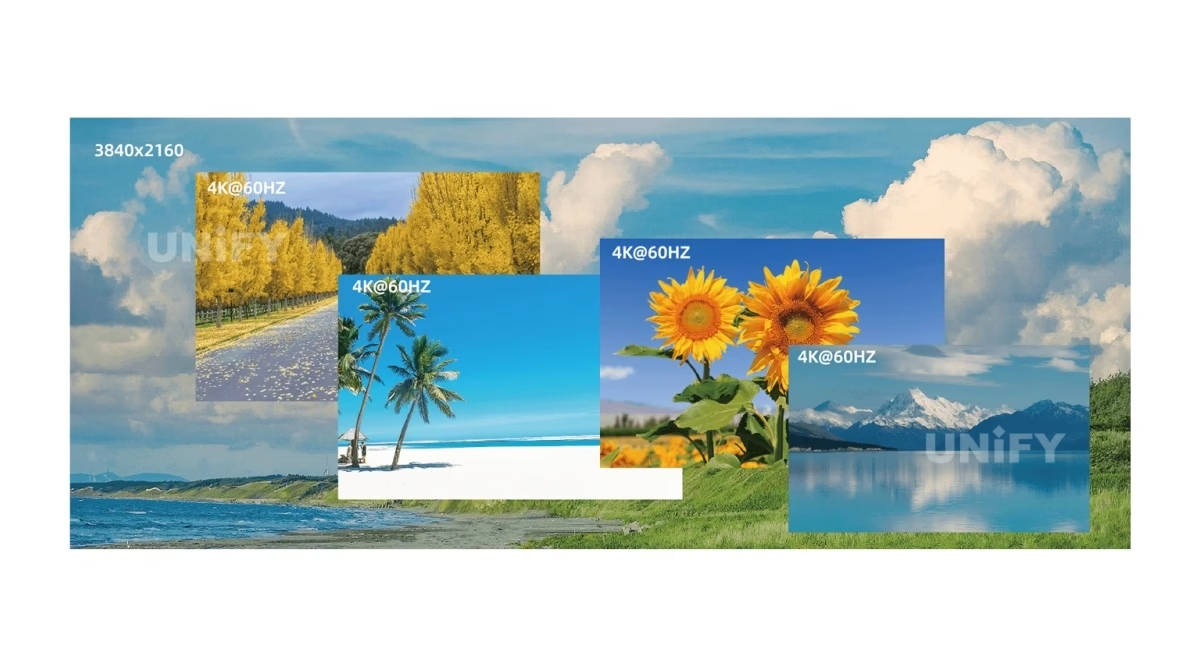
Eight modular input boards cover every source a command center or broadcast studio owns. DVI and HDMI 1.3 boards take 2048×1152@60 with EDID customization; HDMI 1.4 takes 4K30; HDMI 2.0 and DP 1.2 boards take 4K60, 4096×2160, ultra-wide 7680×1080 and tall 1920×4800 (max width 7680, height 4800) with backward compatibility; the 8-port HDMI 1.3 board processes YCbCr 4:2:2 only; the 8× VGA board covers analog legacy sources; and the 4× 3G-SDI board handles broadcast ST-424/ST-292/ST-259 sources with 1080i/576i/480i deinterlacing. The ultra-wide and tall inputs are the board-level headline: a 7680×1080 strip or a 1920×4800 tower feeds the splicer natively instead of being split before arrival.
Chapter 4 — Display, Sync and Control
The display stack is what makes the V Series a splicer rather than a processor. Arbitrary layering among all signals with multi-screen free roaming and scaling — up to 160 layers on the V1400 — gives operators complete canvas freedom. Frame synchronization holds the spliced canvas together with no frame loss, and Genlock cascading ties multiple chassis to the same clock for multi-unit venues — the same sync architecture documented on the MVB20E-G page. Irregular splicing and intelligent irregular splicing extend the creative story of the B1200S to splicer scale. WEB control with PC scenes, scheduled scenes and scene rotation lets operators switch layouts from a browser; EDID modification per input tells each source what the wall expects; signal cropping with local zoom and a content-adaptive scaling engine handle dense data feeds; and HDMI audio input rides the video path.
The control layer deserves its own paragraph, because command rooms live on repeatable layouts. PC scenes capture the full wall state — layers, windows, sources, resolutions — and recall it with one click; scheduled scenes and scene rotation change the wall on a program, so a control room that shows operations by day and analytics by night does it without an operator at the console. WEB control puts the same surface in a browser, which is the practical answer for rooms that want the splicer managed from the network rather than a serial console. EDID modification per input completes the picture: each source is told exactly what the wall expects, which is what makes a dense multi-source wall map cleanly instead of negotiating with each source’s default.
Chapter 5 — Reliability: Command-Grade by Design
Command and dispatch walls are the least tolerant installs in the LED business, and the V Series answers with a four-layer reliability story. Input signal hot backup with seamless switching between sources keeps a failed feed from reaching the wall. Redundant power modules arrive at the V500 rung — 550 W ×2 on the V500 and V700, 550 W ×4 on the V1400 — so a power-supply failure no longer takes the wall down. Frame synchronization and Genlock cascading keep multi-unit canvases phase-locked. And the direct connection to receiving cards — each output card carries 10 Gigabit ports — removes an entire intermediate stage from the chain. The system-level redundancy picture is in the LED display system redundancy & backup guide.
The commissioning sequence in practice: rack the chassis — 3U at 7.8 kg through 14U at 30 kg, so rack planning happens before the crate arrives — fit the input and output boards in the slot plan, wire the output cards’ 10-port Gigabit groups to the receiving-card chains, and power up to verify the board indicators: each input port’s LED lit means the source is connected, dark means no signal or a bad source. Then the software pass: set EDID per input, build the wall canvas, allocate layers and windows, configure smart resolutions per network port, save the scenes, and schedule rotation. The WEB control surface handles the whole pass from a browser, and the configuration discipline carries over from the sending pages: save, verify, and keep the scene file with the system documentation.
Chapter 6 — Commissioning the V Series
The V Series sits directly in front of the receiving cards — no intermediate sending stage — and commissioning follows the family workflow with splicer-specific steps. Wire the output cards’ 10-port Gigabit groups to the receiving-card chains; set the input boards’ EDID per source; build layers and scenes in WEB control; configure smart resolutions per network port; save the scenes and schedule rotation. Genlock cascading ties multi-chassis venues to one clock, and the configuration readback discipline carries over from the sending pages. The complete sequence is covered in the LED display configuration and system debugging guide.
Official Mooncell video — immersive experience.
Official Mooncell brand video.
Board selection is the other spec decision, and it is where the V Series quote gets its shape. A broadcast studio adds 3G-SDI boards with deinterlacing; a conference center adds HDMI 2.0 and DP 1.2 boards for 4K60 sources plus VGA for legacy laptops; a control room mixes DVI and HDMI 1.4 boards with EDID customization for its workstation fleet. The 8-port HDMI 1.3 board is the density play at 4:2:2 — eight sources on one card for signage-style feeds that do not need the 4:4:4 path. And the HDR10 discipline from Chapter 2 applies per port: boards feed the first-8-ports 10-bit budget only where HDR content actually runs. Spec the board mix to the source inventory, not to the catalog.
Chapter 7 — What the V Series Costs, Honestly
The V Series is quoted per project — Mooncell lists no public retail price (hotline 400-881-3531) — and the chassis, input-board mix and quantity set the quote. The honest frame is the video-wall processor class on the same channel: the Magnimage LED-780H at $1,799, the VDWALL LVP404-412 at $2,888–$4,369 and the Novastar J6 at $3,600. The V Series enters that class at the low end and scales above it by chassis — a V1400 with 200 ports and 160 layers is a different budget than a 3U control-room box, and the quote should say so. The splicer is one line item among receiving cards, structure and content; the LED display warranty page covers what to hold the supplier to on spares. Factory-direct tiers shift the price with chassis count, board mix and redundancy bundles; ask for a quote at your configuration.
Two closing notes on the V Series that apply to the whole family. First, the naming and versioning discipline: the sheet header carries V4.0 while the update record carries V4.1 — the same file-header-versus-record pattern seen across the MTB2000E and MB401 pages — and the V4.1 record is the reference. Second, the loading discipline: the V Series divides exactly at 8-bit, but the HDR10 10-bit rule (480,000 pixels, first 8 ports only) is the number a 10-bit wall must be planned on. Pin the sheet to the tender, and the wall will match the drawing.
Conclusion
The Mooncell V Series Video Splicer is the modular spine of the Mooncell family: 26M to 130M pixels across four chassis, 4:4:4 color and HDR10, frame sync and Genlock, an eight-board input matrix from DVI to 3G-SDI, and command-grade hot backup with redundant power. It is the platform to specify when the wall is measured in tens of millions of pixels and cannot blink, and the V4.1 sheet is the reference to pin to it.
Planning a large fixed wall? Talk to us — we are the LED screen manufacturer behind unifyled.com, and V Series projects ship modular pre-configured with 2-year warranty and splicer engineering support.
Related Pages
Explore the Mooncell Control Ecosystem
Mooncell MB400S Creative LED Controller
Mooncell MTB400E Master Controller
Mooncell MTB2000E Master Controller
Mooncell B1200S Creative LED Controller
Mooncell A10X LED Receiving Card
Mooncell A712 LED Receiving Card
Mooncell C2 LED display control system
Mooncell MVB4S Pro 2-in-1 LED Video Processor
Mooncell MVB12E 2-in-1 LED Video Processor
Mooncell MVB20E-G 2-in-1 LED Video Processor
Mooncell M40 2-in-1 LED Video Processor
18 pages · English · V4.0 July 18, 2025 · V4.1 December 8, 2025 · hardware V1.0.0 · covers V300/V500/V700/V1400