
NovaStar AT Series · Mid-Range Receiving Card
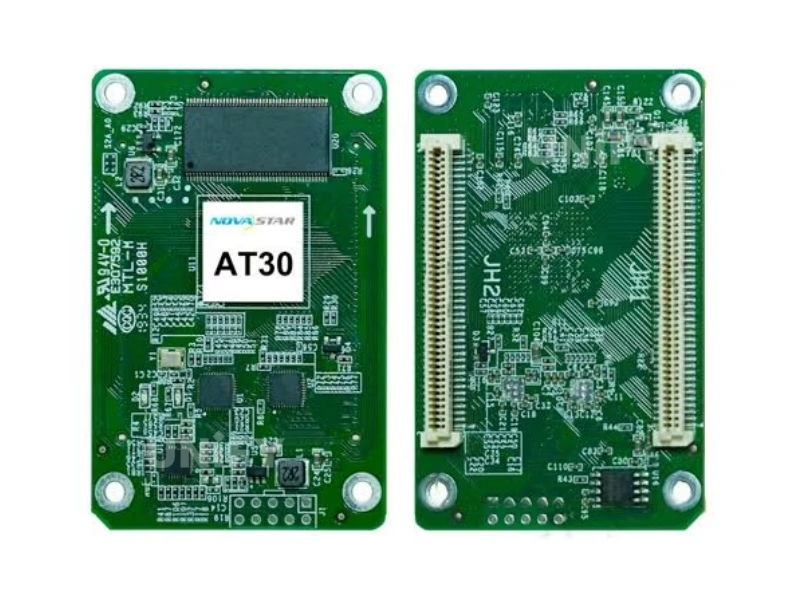
Novastar AT30 LED Wall Receiving Card
512×256@60Hz mid-range receiving card — double the AT20’s pixel capacity with 24 parallel RGB data groups, pixel-level calibration, 3D support, individual RGB gamma, 90° rotation, and EMC Class B compliance. The optimal price-to-performance choice for LED displays between 5–15m².
What Is the Novastar AT30 LED Wall Receiving Card?
The Novastar AT30 LED Wall Receiving Card is a mid-range general-purpose receiving card that doubles the AT20’s pixel capacity — supporting up to 512×256@60Hz with 24 groups of parallel RGB data (expandable to 64 serial, up to 128 via multiplexing). It occupies the sweet spot in NovaStar’s AT series: sufficient capacity for mid-size fixed installations where the AT20’s 256×256 limit would require too many cards, but without the premium pricing of the A5s Plus’s advanced Color Management engine.
The AT30 shares the AT20’s full feature set — pixel-level brightness and chroma calibration via NovaCLB, 3D output with compatible controllers, individual red/green/blue gamma adjustment, 90° image rotation, quick dark/bright line correction at module seams, and dual configuration parameter backup — all on an EMC Class B certified hardware platform. The only difference from the AT20 is the vertical resolution: 512 pixels tall vs 256.
For a 10m² P2.5 indoor LED wall, the AT30 needs approximately 13 cards vs the AT20’s 25 — cutting card count, hub board count, and cabling complexity nearly in half for roughly 25–35% more per-card cost. As a LED screen manufacturer, we recommend the AT30 as the default choice for projects in the 5–15m² range where the AT20 becomes impractical but the A5s Plus is overkill. For architecture reference, see our guide on synchronous vs asynchronous LED control.
Novastar AT30 Technical Specifications
Verified against official NovaStar AT30 Receiving Card Specifications V1.0.3 (September 2020)
| Parameter | Specification |
|---|---|
| Max Resolution | 512×256@60Hz |
| Parallel RGB Data Groups | 24 (64 serial, expandable to 128) |
| Calibration | Pixel-level brightness & chroma calibration (NovaCLB) |
| 3D Support | Yes (with compatible sending card) |
| Image Rotation | 90° increments (0°/90°/180°/270°) |
| Individual RGB Gamma | Yes (NovaLCT V5.2.0+) |
| Quick Dark/Bright Line Fix | Yes — instant correction at module seams |
| Dual Config Backup | Yes — application + factory area storage |
| EMC Certification | Class B |
| Connector | High-density connector (dust & vibration resistant) |
| Input Voltage | DC 3.8 V to 5.5 V |
| Rated Current / Power | 0.5 A / 2.5 W |
| Operating Temperature | –20°C to +70°C |
| Certifications | RoHS, EMC Class B |
Novastar AT30 Key Features: Double the AT20’s Capacity, Same Professional Calibration
The AT30 inherits every feature from the AT20 and adds the one that matters most for mid-size displays: 512-pixel vertical resolution.
512×256 — 2× AT20 Capacity
Double the vertical pixels of the AT20. For a 10m² P2.5 wall: 13 cards vs 25 — nearly half the card count, half the hub boards, half the cabling. The 25–35% per-card premium typically pays for itself in reduced hardware and labor for displays over 5m².
Pixel-Level Calibration
Brightness and chroma calibration per pixel via NovaCLB. Eliminates module-to-module variance on indoor LED display screens viewed at close distance. Coefficients persist through power cycles.
3D + RGB Gamma + 90° Rotation
3D output with compatible sending card. Individual red/green/blue gamma for white balance control at low grayscale. Display rotation in 90° increments. Quick dark/bright line fix at seams — instant, no video source change needed.
EMC Class B + Dual Config Backup
Meets residential/commercial EMC standards — safe near audio equipment in churches and conference rooms. Configuration stored in both application and factory areas for instant restoration. High-density connectors resist dust and vibration.
Novastar AT30 vs AT20 vs AT32 vs AT60: Which AT Series Card Fits Your Project?
The AT30 delivers the best price-to-capacity ratio in the series — double the AT20’s resolution for roughly 25–35% more cost.
| Feature | AT20 | AT30 ⭐ | AT32 | AT60 |
|---|---|---|---|---|
| Max Resolution | 256×256 | 512×256 | 512×256 | 512×384 |
| Parallel RGB Groups | 24 | 24 | 32 | 32 |
| Calibration | Pixel-level | Pixel-level | 12-bit precision | 12-bit precision |
| 3D / Gamma / Rotation | ✅ | ✅ | ✅ | ✅ |
| Dual Card Backup | No | No | No | No |
| Best For | Under 5m², budget | 5–15m², mid-range | 5–15m², 32 groups | 10–20m², high-end |
Verdict: The AT30 is the best value in the AT series. It doubles the AT20’s resolution for a modest price increase, making it the default recommendation for any project over 5m². Step up to AT32 if you need 32 data groups; go to A5s Plus if you need Color Management or dual card backup.
Novastar AT30 — How Much Screen Can 512×256 Pixels Actually Drive?
The 512×256 resolution makes the AT30 ideal for mid-size displays. Here is the practical area calculation — and the AT20 comparison that shows exactly when the AT30 upgrade pays for itself.
| Pixel Pitch | Area per AT30 | AT30 Cards for 10m² | AT20 Cards for 10m² | Card Savings |
|---|---|---|---|---|
| P2.5 (Indoor) | 1.28 × 0.64m = 0.82 m² | 13 | 25 | −48% |
| P3.91 (Outdoor) | 2.00 × 1.00m = 2.00 m² | 5 | 10 | −50% |
| P4.81 (Outdoor) | 2.46 × 1.23m = 3.03 m² | 4 | 7 | −43% |
| P10 (Billboard) | 5.12 × 2.56m = 13.1 m² | 1 | 2 | −50% |
Across all pixel pitches, the AT30 reduces card count by 43–50% vs the AT20 — fewer hub boards, fewer power supplies, fewer Ethernet cables, fewer failure points. For outdoor LED screens at P10, a single AT30 drives over 13m².
Novastar AT30 Software & Calibration: NovaLCT + NovaCLB
Configure, calibrate, and manage all AT30 settings through NovaStar’s free Windows software suite.
NovaLCT V5.2.0+ (Windows)
Configure card parameters, individual RGB gamma, dark/bright line correction, and firmware updates. Free from NovaStar software downloads.
NovaCLB (Calibration)
Pixel-level brightness and chroma calibration via X-Rite i1 Pro series colorimeters. Coefficients stored on-card — persists through power cycles, independent of video source.
Config Readback & Dual Backup
Read back firmware and configuration to local PC. Dual config storage (application + factory area) for instant restoration.
Novastar AT30 Application Scenarios: Where the Mid-Range AT Series Card Excels
Mid-Size Church & Auditorium Displays
For a 6–10m² P2.5 church stage screen, 8–13 AT30 cards provide full coverage with roughly half the BOM complexity of AT20 equivalents. EMC Class B protects wireless microphones. Pixel-level calibration ensures uniform worship lyrics.
Corporate Lobby & Conference Room Walls
Fine-pitch indoor LED display screens in the 5–12m² range are the AT30’s sweet spot. 512-pixel height handles 16:9 aspect ratios naturally. Pixel-level calibration is essential at P1.8–P2.5 viewing distances.
Retail Digital Signage Networks
For chain stores deploying standardized 3–6m² P3.91 window displays, the AT30’s 512×256 resolution maps cleanly to landscape formats. Consistent card choice across sites simplifies spares inventory and technician training.
P10 Outdoor Billboards
A single AT30 drives 13.1m² of P10 display. For a 40m² highway billboard, only 4 cards needed. The cost savings vs AT20 compound at scale — fewer cards, fewer hub boards, simplified LED screen maintenance.
Why Source Your Novastar AT30 from UnifyLED?
Genuine AT30 — Factory-Verified
As a LED screen manufacturer and NovaStar distributor, every AT30 is sourced directly from NovaStar. V1.0.3 hardware with EMC Class B verified before shipping. Never grey-market.
Batch QC + Rcfgx Support
10% per-batch testing: power-on, Ethernet communication, calibration coefficient upload. Rcfgx file preparation for your specific LED modules included.
Bulk Order Logistics
Blister-packaged individually. Volume pricing for 5+ boxes. Worldwide shipping from Shenzhen — express 5–10 days, economy 15–25 days. Full customs documentation.
Full AT/A5s/A8s Range
We stock AT20 through A8s. If your project scales up and needs higher-spec cards, we provide consistent rcfgx continuity and volume pricing across models.
Novastar AT30 Pricing & Bulk Order Information
What’s Included
- Original NovaStar AT30 (V1.0.3, EMC Class B)
- Blister-packaged individually
- Batch QC test report (upon request)
- Rcfgx file preparation for your LED modules
- Lifetime technical support
Get Your AT30 Quote
Response within 2 hours (GMT+8)
unifyledscreen@gmail.com
WhatsApp / Phone
+86-191-18802497
Frequently Asked Questions About the Novastar AT30 LED Wall Receiving Card
What is the maximum resolution of the Novastar AT30?
512×256@60Hz — double the AT20’s 256×256. Per the official V1.0.3 specification.
AT30 vs AT20 — is the upgrade worth it?
Yes for displays over 5m². AT30 costs 25–35% more per card but reduces card count by 43–50%. The savings in hub boards, power supplies, and cabling typically exceed the per-card premium for any project over 8m².
AT30 vs A5s Plus — which should I choose?
AT30: 512×256, 24 groups, no Color Management. A5s Plus: 512×384, 32 groups, 18bit+ Color Management, dual card backup. Choose AT30 if you don’t need Color Management or backup. Choose A5s Plus for color-critical or mission-critical applications.
Does the AT30 support pixel-level calibration?
Yes — via NovaCLB. Coefficients persist through power cycles. This feature matches the A5s Plus despite the AT30’s lower price.
Can the AT30 work with non-NovaStar controllers?
No — NovaStar proprietary protocol only. Requires a NovaStar sending controller.
What software configures the AT30?
NovaLCT V5.2.0+ (Windows). Free from novastar.tech. Required for RGB gamma and dark/bright line correction.
Ready to Source the Novastar AT30 LED Wall Receiving Card?
512×256 capacity — double the AT20. 24 parallel data groups. EMC Class B. Pixel-level calibration. The mid-range AT series sweet spot — factory-direct pricing, rcfgx support, global logistics.
unifyledscreen@gmail.com | +86-191-18802497
Technical Deep-Dive
AT30 vs AT20: When Double the Resolution Pays Off — A Novastar AT Series Cost-Benefit Analysis
Published: August 2026 | 7 min read | UnifyLED Engineering Team
The AT20 and AT30 are identical in every specification except one: vertical pixel resolution. AT20 = 256×256. AT30 = 512×256. That single difference triggers a cascade of cost effects — card count, hub board count, power supply count, cabling complexity — that determines whether the AT30’s 25–35% price premium is a bargain or a waste. This article calculates the crossover point: the display area at which the AT30’s reduced card count pays for the premium, and when stepping up further to the A5s Plus makes engineering sense.
The Crossover Point: When AT30 Becomes Cheaper Than AT20
At P2.5 pixel pitch: AT20 covers 0.41m² per card; AT30 covers 0.82m² per card. For a 5m² display: AT20 needs 13 cards; AT30 needs 7 cards. Assuming AT20 = $40/card, AT30 = $52/card (30% premium): AT20 total = $520; AT30 total = $364 — AT30 is 30% cheaper in total card cost at just 5m². Adding hub boards (~$15 each, one per 4 cards): AT20 needs 4 hub boards ($60); AT30 needs 2 ($30). Total: AT20 = $580, AT30 = $394 — AT30 saves $186 (32%). The crossover happens at approximately 3m² at P2.5 — meaning for the vast majority of real-world LED displays, the AT30 is the more economical choice despite its higher per-unit price. For detailed pixel calculations, see our LED pixel pitch guide.
When the AT20 Still Makes Sense
The AT20 remains the better choice for: (1) very small displays under 3m² where the card count difference is 1–2 cards, (2) P10 or larger pixel pitch where a single AT20 already covers 6.5m², and (3) projects where card-level redundancy is not a concern and the absolute lowest per-unit cost is the priority. For everything else — which describes the majority of fixed LED installations in churches, retail, and corporate settings — the AT30 is the mathematically superior choice.
Download the Novastar AT30 LED Wall Receiving Card Specifications
unifyledscreen@gmail.com | +86-191-18802497 | Worldwide Shipping