
MEAN WELL LRS Series · 600 W Single Output · 7 Voltages 5–48 V · 5 V / 100 A · 3-Year Warranty
Mean Well LRS-600 Switching Power Supply
The Mean Well LRS-600 is the 600 W summit of the family: seven outputs from 5 V to 48 V — including a 27 V rail no smaller LRS offers — with the 5 V model delivering 100 A and 500 W from one chassis. Half a kilowatt from a 41 mm case, at a per-watt price below the LRS-450’s.
📱 / WhatsApp: +86-191-18802497 · Shenzhen, China · GMT+8
5–48 V
7 output voltages, 27 V included
5 V / 100 A
500 W module-bus model
Up to 92%
Efficiency, published per model
4-Min Cooldown
After any protection event
3 Years
Manufacturer warranty
Short answer
The Mean Well LRS-600 is a 600 W-class single-output enclosed switching power supply offered in seven DC voltages — 5 V/100 A (500 W), 12 V/50 A, 15 V/40 A, 24 V/25 A, 27 V/22.2 A, 36 V/16.6 A and 48 V/12.5 A — in a 225 × 124 — 41 mm fan-cooled chassis. Per the official datasheet (2025-09-12 revision) efficiency reaches 92%, full load runs from −20 to +65°C on the thermostatic fan, and the family’s constant-current protection carries a longer cooldown: 4 minutes after any protection event before restart (Note 9). One detail most listings omit: on the 5 V model the label itself derates with input — 100 A above 110 VAC, 90 A below it. The 500 W rail exceeds anything in the CZCL display family and powers a dense LED cabinet from a single supply.
What Is the Mean Well LRS-600 Switching Power Supply?
The Mean Well LRS-600 is a single-output enclosed-type AC-DC switching power supply rated for 600 W continuous output, the largest model in the low-profile LRS family. The chassis grows to 41 mm (case 292) and the mounting pattern doubles to eight M4 screws per side, but the family formula holds: 115/230 VAC input by physical switch, thermostatic fan, LED power indicator, 3-year warranty, serial-traceable stock.
Two things define the model. First, the 5 V rail at 100 A: half a kilowatt on the module bus from one unit, past the point where any CZCL display supply follows — the A-400JQ-5P tops the CZCL family at 400 W. Second, the 27 V model, an output no smaller LRS offers, serving telecom-style buses and 27 V industrial loads; on an LED build it covers the growing 27 V lighting-hardware segment without a converter stage.
Half a kilowatt, one chassis
400 W usable at 5 V per the 80% rule — a whole dense cabinet per supply, with fewer breakers, fewer wire runs and fewer failure points than any two-supply layout.
Per-watt price turns the corner
At published distributor pricing the LRS-600 lands near 10–11 cents per rated watt — below the LRS-450’s 14.6–15.6 cents. The big chassis is also the family’s value point.
Serial-traceable, 3-year warranty
Same family safeguards: serial number verifiable on the MEAN WELL website, 100% full-load burn-in, 3-year manufacturer warranty.
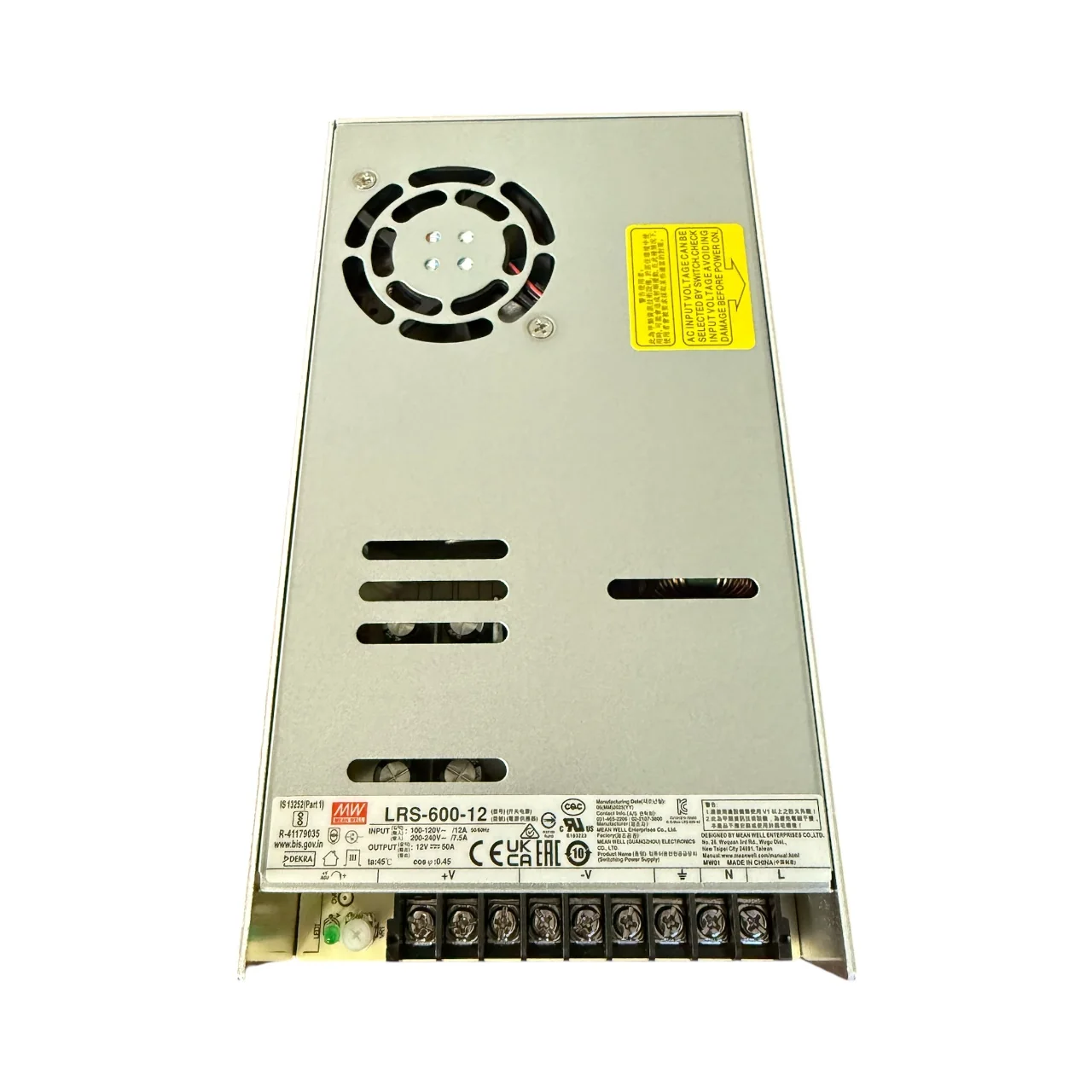
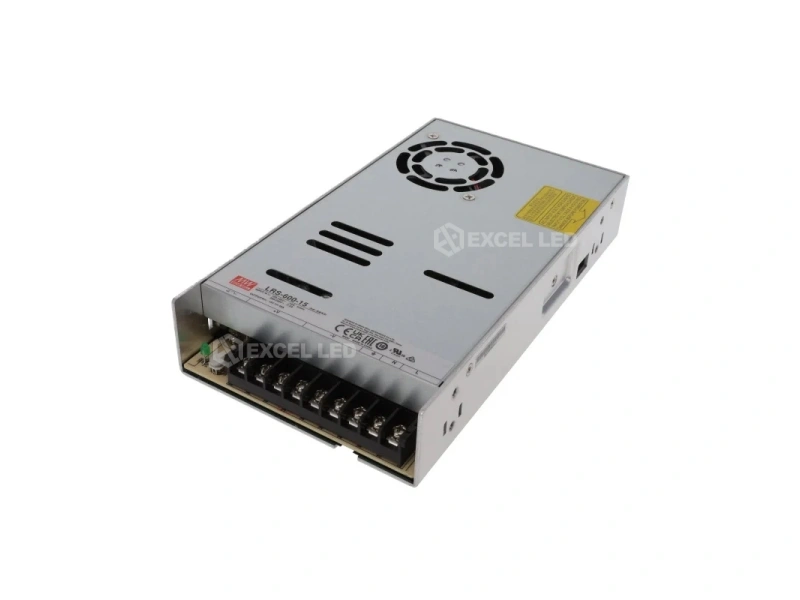
The 600 W chassis: fan at the short end, 9-pin terminals along the front, 8-M4 anchors per side
MEAN WELL’s own product video for this exact series:
The ladder it tops: LRS-150 (12–48 V auxiliary), LRS-200 (5 V/40 A), LRS-350 (5 V/60 A, first fan), LRS-450 (5 V/75 A, constant-current), and the LRS-600 at 5 V/100 A. The five-step table is below.
What Are the Mean Well LRS-600 Specifications?
All figures come from the official MEAN WELL LRS-600 specification sheet (2025-09-12 revision), with one datasheet note that changes how the headline 5 V rating reads — the label-current rule covered in its own section below.
| Model | Output | Rated power | Adj. range | Ripple max | Efficiency |
|---|---|---|---|---|---|
| LRS-600-5 | 5 V / 100 A | 500 W | 4.75–5.5 V | 200 mVp-p | 86% |
| LRS-600-12 | 12 V / 50 A | 600 W | 11.4–13.2 V | 200 mVp-p | 90% |
| LRS-600-15 | 15 V / 40 A | 600 W | 14.25–16.5 V | 200 mVp-p | 90% |
| LRS-600-24 | 24 V / 25 A | 600 W | 22.8–26.4 V | 240 mVp-p | 91% |
| LRS-600-27 | 27 V / 22.2 A | 599.4 W | 25.65–29.7 V | 270 mVp-p | 91% |
| LRS-600-36 | 36 V / 16.6 A | 597.6 W | 34.2–39.6 V | 360 mVp-p | 92% |
| LRS-600-48 | 48 V / 12.5 A | 600 W | 45.6–52.8 V | 360 mVp-p | 92% |
| Parameter | LRS-600 series |
|---|---|
| Input voltage range | 90–132 VAC / 180–264 VAC selected by switch; 255–370 VDC with switch on 230 VAC; low-input derating may apply (Note 8) |
| Input frequency / current | 47–63 Hz; 12 A at 115 VAC, 7.5 A at 230 VAC (typ.) |
| Inrush / surge endurance / leakage | 35 A cold start at 115 VAC, 60 A at 230 VAC; 300 VAC surge for 5 s; <2 mA at 240 VAC |
| Setup / rise / hold-up time | 1300 ms / 50 ms full load; hold-up 20 ms at 230 VAC, 16 ms at 115 VAC (typ.) |
| Overload protection | 105–150%: constant-current limiting, shutdown after 3 s, re-power to recover |
| Overvoltage / overtemperature | Shutdown, re-power to recover (all models); 4-min cooldown before restart per Note 9 |
| Short circuit | Constant-current limiting within the overload behavior above |
| Cooling | Built-in DC fan, thermostatic: ON ≥50°C, OFF ≤40°C; forced-air full load −20 to +65°C |
| Withstand / insulation | I/P-O/P 3.75 kVAC; I/P-FG 2 kVAC; O/P-FG 0.5 kVAC; 100 MΩ at 500 VDC |
| Environment | −20 to +65°C, 20–90% RH non-condensing; storage −40 to +85°C; 5 G vibration; 2,000 m full load, 5,000 m derated |
| MTBF | 1,533.4K hrs min. (Telcordia SR-332); 301.7K hrs min. (MIL-HDBK-217F, 25°C) |
| Dimensions / weight | 225 × 124 × 41 mm (case 292); 0.95 kg; 12 pcs per 12.4 kg carton |
| Safety standards | BS IEC/UL 62368-1; EAC TP TC 004; KC 62368-1 (except 5 V); BIS IS 13252; BSMI CNS15598-1; GB 4943.1; BS EN/EN 61558-1/-2-16 |
| EMC | Emission: BSMI CNS15936, EAC TP TC 020, KC; Immunity: EAC, KC. Harmonics: does not meet EN 61000-3-2 (datasheet Note 12) |
| Build and warranty | 50–130 kHz switching; LED power indicator; 8-M4 mounting per side; Chinese utility patent ZL202220241473.0; 3-year warranty |
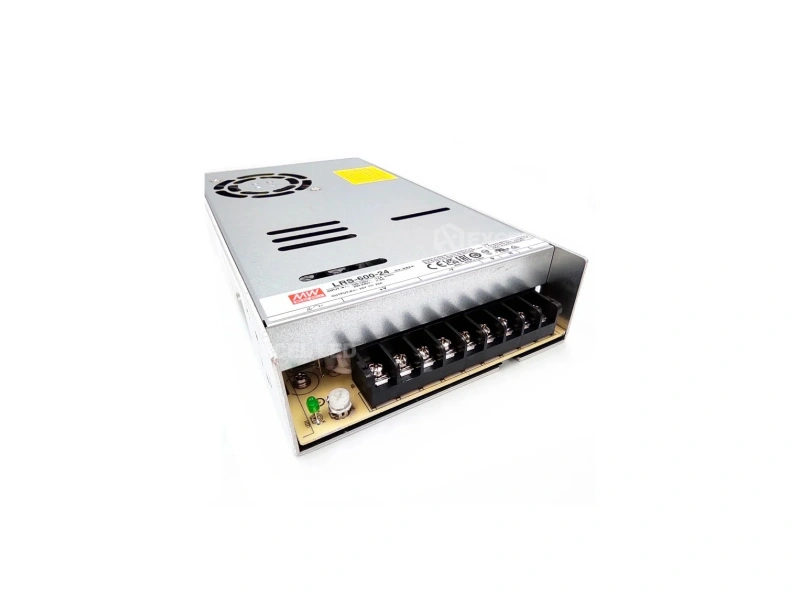
One chassis, seven labels: 12 V, 24 V and 36 V variants of the LRS-600 side by side
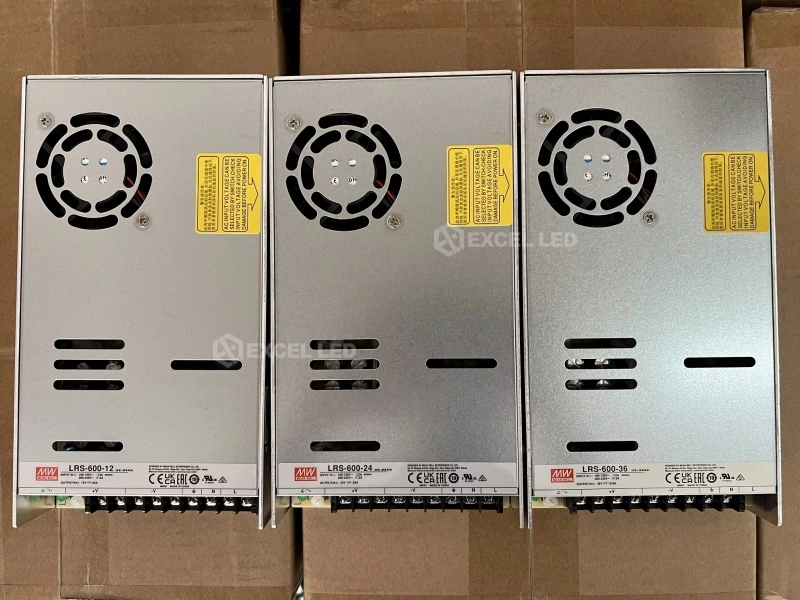
LRS-600-24 closeup: status LED, +ADJ pot and the 9-pin terminal row
Three field notes most listings skip
First, the 5 V label rule: the same LRS-600-5 unit states 100 A on its label above 110 VAC input and 90 A below it — a 115 V-grid build carries 10% less module-bus current than the headline number (details below). Second, the cooldown grew with the power: Note 9 specifies 4 minutes after any protection event, up from the LRS-450’s 3 — commissioning schedules should plan for it. Third, full load ends at +65°C, five degrees cooler than the LRS-450 — the bigger chassis runs more watts, but its ceiling is lower; check the derating curve before promising 600 W in a July rooftop cabinet.
Which Mean Well LRS-600 Voltage Should You Order?
Seven models, three jobs:
5 V at 100 A — the whole wall
500 W rated, 400 W usable at the 80% rule (360 W on a sub-110 V grid per the label rule). One LRS-600-5 replaces an LRS-450-5 plus change — the consolidation model for dense fixed-install walls.
12 / 15 / 24 V — the ecosystem core
480 W usable each — control cabinets, strip-light and lightbox walls, industrial loads — with the family’s best per-watt pricing doing the quiet work.
27 / 36 / 48 V — the specialty rails
27 V is new to the LRS line (telecom-style buses, 27 V LED hardware); 36 and 48 V serve high-voltage arrays and industrial mains at 92% efficiency — with the family’s highest ripple figures, noted below.
Trim discipline carries over with the Note 3 constraint: adjustment only inside the 100–120/200–240 VAC input windows. On a 100 A bus the trim decision matters more than anywhere else in the family — a 200 mV lift across a dense wall is real heat at the module, so meter first and let the selection guide‘s per-bus method make the call.
How Does the 100 A Label Rule Work on the LRS-600-5?
This is the detail the datasheet prints on the curve page and reseller listings never copy. Because of a test-method difference, the rating on the unit’s label differs from the derating curve: on a 5 V model the label states 100 A when the input voltage is above 110 VAC, and 90 A when the input is below 110 VAC.
230 V grids (Europe, China, most of Asia)
Input sits far above 110 VAC: the full 100 A / 500 W rating applies, and the 80% budget is 400 W usable on the module bus.
115 V grids (North America, Japan)
Nominal 115 V sits above 110 VAC, so the label still reads 100 A — but a brownout or generator sag below 110 VAC moves the unit to the 90 A / 450 W state. Size North American cabinets against 360 W usable, not 400 W, and say so in the handover doc.
The same input-dependence thinking appears in Note 8 (“derating may be needed under low input voltages”) across the series. Neither clause appears in distributor bullet points — which is exactly why it belongs in a spec-level page like this one. For the ecosystem voltages the practical impact is smaller, but the habit holds: read the label on the unit you received, not the catalog row you ordered from.
How Does the Mean Well LRS-600-5 Compare With Two LRS-450-5 Units?
With the CZCL family maxing out at 400 W, the honest comparison for the LRS-600-5 is inside Mean Well’s own line: one 600 W unit versus the two-supply layout it replaces:
| Dimension | 1 × LRS-600-5 | 2 × LRS-450-5 |
|---|---|---|
| Combined rated power | 500 W | 750 W (2 × 375 W) |
| 80% usable at 5 V | 400 W (360 W below 110 VAC) | 600 W across two groups |
| Chassis count / footprint | 1 unit, 225 × 124 × 41 mm | 2 units, 2 × 225 × 124 × 35 mm |
| Wiring and protection | One bus, one breaker, one fan to service | Two buses, two breakers, two fans; load balance is manual |
| Failure blast radius | Whole wall dark until swap | Half the wall dark; the other half rides through |
| Street price (qty 1) | ~$56 (~11.2¢/rated W) | ~$110 for the pair (~14.7¢/W) |
| Protection cooldown | 4 min (Note 9) | 3 min (Note 9) |
The decision is a risk shape, not a spec sheet: the single LRS-600-5 wins on cost per watt, cabinet space, wiring labor and service surface — and concentrates the failure domain in one chassis. The two-supply layout costs more per watt and takes more room, but halves the blast radius and lets one group keep playing while the other is down. Dense permanent installs with stocked spares tend to consolidate; rental and event builds that cannot afford a single point of failure tend to split. If the split wins, the LRS-450 page carries its own numbers; and if 400 W-class CZCL hardware with active PFC fits the compliance brief instead, the CZCL A-400JQ-5P remains the reference point the LRS-600 passes on the way up.
How Much LED Load Can a Mean Well LRS-600 Carry?
Apply the 80% rule to each model’s rated power:
| Model | Rated | 80% usable power | Usable current |
|---|---|---|---|
| LRS-600-5 | 500 W | 400 W (360 W below 110 VAC) | 80 A at 5 V (72 A derated) |
| LRS-600-12 | 600 W | 480 W | 40.0 A at 12 V |
| LRS-600-15 | 600 W | 480 W | 32.0 A at 15 V |
| LRS-600-24 | 600 W | 480 W | 20.0 A at 24 V |
| LRS-600-27 | 599.4 W | 479.5 W | 17.76 A at 27 V |
| LRS-600-36 | 597.6 W | 478.1 W | 13.28 A at 36 V |
| LRS-600-48 | 600 W | 480 W | 10.0 A at 48 V |
The ecosystem rails converge on 478–480 W usable — one number to remember, 100 W more than the LRS-450’s 360–361 W. On the module bus, 400 W usable covers a dense cabinet from one chassis; a 600 W wall wants two LRS-600-5 units on separate groups, not one at 120%. The screen-level arithmetic is worked through in the LED display power consumption guide and the per-cabinet counting method.
And the standing honesty notes: constant-current limiting spans 105–150% with the 3-second shutdown (no peak-load pulse story on any rail), and the +65°C full-load ceiling means the hottest cabinets should size against the derating curve, not the nameplate.
What Protections and Certifications Does the Mean Well LRS-600 Carry?
Protection follows the LRS-450’s architecture with a longer fuse: overload 105–150% rides as constant-current limiting for up to 3 seconds before shutdown; overvoltage and overtemperature shut down directly; every protection event requires a re-power cycle, and Note 9 specifies a 4-minute cooldown before restart. Isolation is 3.75 kVAC input-to-output at 100 MΩ, and the published measurement methods apply:
Compliance note the datasheet puts in writing — and most listings leave out
Per datasheet Note 12, the LRS-600 does not meet EN 61000-3-2 harmonic-current limits under the same conditions as the whole high-LRS family: EU public-grid use at 220 V or greater where the supply draws more than 75 W continuously or forms part of a lighting system. Industrial cabinets, professional equipment and display systems outside the lighting classification are the intended applications; EU lighting work belongs on the LRS-150 or a PFC-equipped series such as the CZCL A-400JQ-5P LED switching power.
Certifications mirror the LRS-450: BS IEC/UL 62368-1, BS EN/EN 61558-1/-2-16, GB 4943.1, BIS IS 13252, BSMI CNS15598-1, EAC and KC marks — an industrial/AV list without the household-appliance approval. Ripple spans 200 mVp-p at 5–15 V, 240 mV at 24 V, 270 mV at 27 V and 360 mVp-p on the 36/48 V rails — the family’s highest, fine for industrial and LED loads, worth a check before precision instrumentation.
How Do You Install and Wire a Mean Well LRS-600 Safely?
The 9-pin block matches the family: pins 1–2 are AC L/N, pin 3 is FG, pins 4–6 are −V and pins 7–9 are +V. Case 292 doubles the mounting pattern to 8-M4 screws per side (L=6 mm) — at 0.95 kg and 600 W the extra anchors are not decorative; use them all.
1Set the input switch first. Confirm the 115/230 selector against the grid before first energization — and in North America, note the label-current rule for your sizing sheet.
2Use all eight M4 anchors. Metal-to-metal on a clean plate, airflow direction clear at both ends, fan accessible for annual service.
3Earth FG first. Ground, then L/N, then DC — the FG terminal carries the EMI filter return and the chassis bond.
4Spread the DC bus across all three terminals per pole. At 100 A on the 5 V model this is the difference between a bus bar and a heat treat; parallel conductors per terminal if the run demands it.
5Budget the 4-minute cooldown. If the unit trips during commissioning, keep it off, meter the output side, fix the fault — the restart is deliberate by design.
6Respect Note 3 and Note 8. Trim only inside the 100–120/200–240 VAC windows, and expect derating at the bottom of the input range — enclosure planning sits in the LED screen cabinet guide.
The detachable power-box layout our own stage-screen builds use — supplies serviceable without rigging work — is the kind of mounting thinking a 600 W cabinet deserves:
How Does the LRS-600 Compare With the LRS-150, LRS-200, LRS-350 and LRS-450?
The full five-step family ladder, one table:
| Dimension | LRS-600 | LRS-450 | LRS-350 | LRS-200 | LRS-150 |
|---|---|---|---|---|---|
| Voltages | 7: 5–48 V (+27 V) | 6: 5–48 V | 8: 3.3–48 V | 8: 3.3–48 V | 5: 12–48 V |
| Rated power | 500–600 W | 375–451.2 W | 198–350.4 W | 132–212.4 W | 150–158.4 W |
| 5 V rail | 100 A / 500 W | 75 A / 375 W | 60 A / 300 W | 40 A / 200 W | none |
| Efficiency range | 86–92% | 87–92% | 79.5–89% | 83–90% | 87.5–90% |
| Full-load temp | −20 to +65°C | −20 to +70°C | −25 to +70°C | −25 to +70°C | −30 to +70°C |
| Hold-up (230 VAC) | 20 ms | 16 ms | 16 ms | 16 ms | 40 ms |
| Protection cooldown | 4 min (Note 9) | 3 min (Note 9) | — | — | — |
| Case / cooling | 41 mm / fan | 35 mm / fan | 30 mm / fan | 30 mm / convection | 30 mm / convection |
| MTBF (MIL-HDBK-217F) | 301.7K hours | 252.2K hours | 328.6K hours | 279.4K hours | 558.2K hours |
The ladder ends with a twist: the LRS-600 is the most powerful and near the best value per watt, yet its full-load ceiling (+65°C) is the lowest and its cooldown the longest. The fanless LRS-150 still owns the reliability figure and the compliance map. Choose by bus and by environment — the 80% rule sizes every rail the same way.
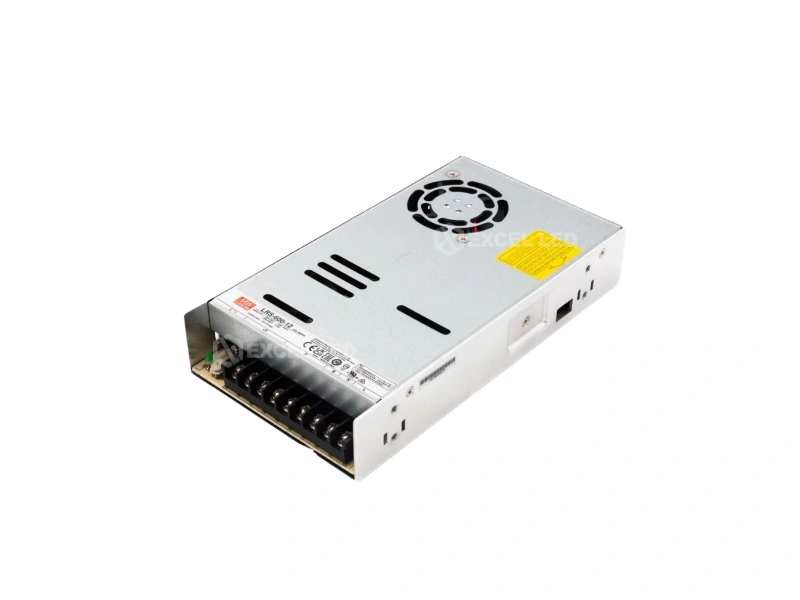
The 41 mm profile: six millimeters deeper than the LRS-450, the family’s thickest
What Problems Does a Failing Power Supply Cause?
At 600 W the failure modes concentrate — one supply, one bus, one blast radius:
💡 A whole wall that browns out during show conditions
The constant-current limit holding against a growing load: voltage sags wall-wide as content brightens. Meter under full white — a rail pinned near its limit needs a second supply, not a swap.
⏳ A 4-minute wait that feels like a dead unit
Note 9’s cooldown after any protection event. Crews that do not know the spec swap a good supply; crews that do use the wait to meter the bus. Brief the habit at handover.
🌻 A fan that never stops, then trips
Internal heat pinned above 50°C — dust load or a failing electrolytic bank. Service before the overtemperature protection makes the call at show time.
The replacement workflow on a real cabinet — isolation, metering, swap, verification — is in the power supply diagnostics and replacement guide.
How Much Does the Mean Well LRS-600 Cost?
Public street pricing, stable against the 2026 component-cost story in the LED display supply chain price surge analysis:
| Model | Unit price (qty 1) | Volume price | Source |
|---|---|---|---|
| LRS-600-5 | ~$56.00 | ~$54.26 at 9+ | Your Pixel Store (US) |
| LRS-600-24 | $59.19 | $52.83 at 100+ pcs | StepperOnline (US) |
The per-watt arithmetic from the CZCL power supply price guide: at ~$56 for 500 W rated, an LRS-600-5 costs about 11.2 cents per rated watt, and the 24 V model at $59.19 for 600 W lands near 9.9 cents — below the LRS-450’s 14.6–15.6 cents and in line with the LRS-350. The family’s price curve finally bends: past 450 W, Mean Well’s big chassis is also its better value, which is why the consolidation math in the comparison above lands where it does.
Buying caution unchanged: verify the serial number on the MEAN WELL website before deployment. At 100 A on a mains-connected device, a counterfeit is not a discount — it is the fire inspector’s opening statement.
Mean Well LRS-600: Frequently Asked Questions
Does the Mean Well LRS-600 have a 5 V output for LED display modules?
Yes – the LRS-600-5 delivers 5 V at 100 A (500 W rated, 400 W usable at the 80% rule), the largest module-bus rail in the LRS family and beyond anything in the CZCL display lineup. The series also adds a 27 V model no smaller LRS offers.
Why does the label say 100 A but the spec sometimes says 90 A?
A datasheet note on the derating curve page explains it: due to the test-method difference, the LRS-600-5’s label states 100 A when input voltage is above 110 VAC and 90 A when input is below 110 VAC. A 230 V build keeps the full rating; a North American build should size against 360 W usable to survive grid sag, not just the 400 W headline.
Why won’t my LRS-600 restart right after a trip?
Datasheet Note 9: any protection event triggers about 4 minutes of cooldown before restart – up from the LRS-450’s 3 minutes. The delay is deliberate. Keep the unit off, meter the output side, fix the fault, then re-power.
Is one LRS-600-5 better than two LRS-450-5 units?
On cost per watt, cabinet space, wiring labor and service surface – yes: ~11.2 cents per rated watt against ~14.7, one bus, one breaker, one fan. On failure risk – no: one chassis means the whole wall dark on a fault, where two supplies lose only half. Permanent installs with spares consolidate; event builds that fear a single point of failure split.
Why does the LRS-600 only reach 65 degrees C at full load when the LRS-450 reaches 70?
The datasheet’s own numbers: the LRS-600 holds full load from -20 to +65 degrees C on its fan, five degrees short of the LRS-450 despite the bigger chassis. More watts in a similar footprint means less thermal headroom at the top – hottest cabinets should size against the derating curve, not the nameplate.
What is the 27 V model for?
The LRS-600-27 (27 V / 22.2 A / 599.4 W) serves telecom-style 27 V buses and the growing 27 V LED hardware segment – an output no smaller LRS offers. It lets a mixed cabinet run 5 V modules and 27 V accessories from one brand and one wiring standard.
How should the 100 A output be wired?
Across all three terminals per pole – pins 4-6 are -V and pins 7-9 are +V – and at 100 A, use parallel conductors per terminal where the run demands it, landing on all three screws. Use all eight M4 chassis anchors; at 0.95 kg and 600 W they are load-bearing, not decorative.
Which LRS should I buy – 150, 200, 350, 450 or 600?
Follow the bus and the environment. EU-visible auxiliary work – LRS-150. Silent cabinets or 5 V at 40 A – LRS-200. 5 V at 60 A or 3.3/4.2 V rails – LRS-350. 5 V at 75 A or 450 W ecosystem rails – LRS-450. Whole-wall 5 V at 100 A, 27 V buses, or the best per-watt price in the family – LRS-600. All five carry the 3-year warranty.
Related Power Pages and Guides
Mean Well LRS-450 (5 V / 75 A)
The step below: constant-current protection, 35 mm chassis, +70°C full-load ceiling.
Mean Well LRS-350, 200 & 150
The rest of the ladder: 5 V/60 A, 5 V/40 A, and the compliance-safe 12–48 V auxiliary pick.
CZCL A-400JQ-5P (5 V / 80 A)
The CZCL family’s ceiling at 400 W with active PFC – the reference the LRS-600 passes on the way up.
CZCL Display Power Supply Hub
The 5 V screen-side family from the other culture: four CZCL supplies spec’d, priced and linked.
How Many Power Supplies Does an LED Screen Need?
Per-cabinet counting, breaker math and the 80% rule applied to a full wall.
LED Display Power Supply (Mother Catalog)
The three-brand mother catalog: 27 model pages, 2026 price bands, architecture map and the 80% load math — start here.
UnifyLED LED Display Solutions
The full build picture: indoor and outdoor screens, control systems, cabinets and power architecture.
Need Mean Well LRS-600 Units for Your Project?
Tell us the load list, grid voltage and target market – we will confirm the voltage class, the 100A/90A input rule for your grid, and quote genuine serial-traceable stock with the 3-year warranty intact.