
MEAN WELL LRS Series · 450 W Single Output · 6 Voltages 5–48 V · Up to 92% Efficient · 3-Year Warranty
Mean Well LRS-450 Switching Power Supply
The Mean Well LRS-450 is the top of the LRS line: six outputs from 5 V to 48 V with 75 A on the 5 V rail — 375 W for a whole LED cabinet from one unit — the family’s highest efficiency at up to 92%, and a new protection character: constant-current limiting instead of hiccup, with a deliberate 3-minute cooldown before restart.
📱 / WhatsApp: +86-191-18802497 · Shenzhen, China · GMT+8
5–48 V
6 output voltages, one chassis
5 V / 75 A
375 W module-bus model
Up to 92%
Highest efficiency in the LRS line
105–150%
Constant-current limiting, new character
3 Years
Manufacturer warranty
Short answer
The Mean Well LRS-450 is a 450 W-class single-output enclosed switching power supply offered in six DC voltages — 5 V/75 A (375 W), 12 V/37.5 A, 15 V/30 A, 24 V/18.8 A (451.2 W), 36 V/12.5 A and 48 V/9.4 A — in a 225 × 124 × 35 mm fan-cooled chassis. Per the official datasheet (2025-09-12 revision) it is the most efficient LRS at up to 92%, holds full load from −20 to +70°C on its thermostatic fan, and changes the family’s protection character: overload up to 150% is handled by constant-current limiting for 3 seconds before shutdown, all protection events require a re-power cycle, and the datasheet specifies a 3-minute cooldown before restart (Note 9). The 5 V model feeds LED display modules at whole-cabinet scale — against the CZCL A-400JQ-5P’s 5 V / 80 A / 400 W it trades 5 A and active PFC for a published MTBF, public pricing and a 3-year warranty.
What Is the Mean Well LRS-450 Switching Power Supply?
The Mean Well LRS-450 is a single-output enclosed-type AC-DC switching power supply rated for 450 W continuous output, the largest model in the low-profile LRS family. It keeps the family formula — 115/230 VAC input selected by a physical switch, 1U-class low profile, LED power indicator, 3-year warranty — and scales everything up: a 35 mm case (against the 30 mm of the 150/200/350), a 50–130 kHz variable switching frequency, and efficiency up to 92%, the highest in the line.
The series also marks a control-architecture change that matters to how you commission and troubleshoot it. Where the LRS-150/200/350 answer overload with hiccup pulsing, the LRS-450 limits current constantly — holding the output at its current limit for up to 3 seconds before shutting down, then waiting for a re-power cycle. Datasheet Note 9 adds a deliberate 3-minute cooldown after any protection event before restart. For a screen builder that means a tripped LRS-450 does not blink back on its own: the fault is held visibly, and the restart is an operator decision — a different rhythm from every smaller LRS, covered in the protection section below.
One unit, one cabinet
375 W rated and 300 W usable at 5 V per the 80% rule — a dense fine-pitch cabinet that wanted two LRS-350-5 units runs on one LRS-450-5, halving supply count, wiring runs and breaker positions.
Family-best efficiency
90–92% on the 12–48 V models, published per model in the datasheet — at 450 W per unit, the two-point efficiency gap against the LRS-350 is real heat and real money across a 20-supply install.
Serial-traceable, 3-year warranty
Same family safeguards: serial number verifiable on the MEAN WELL website, 100% full-load burn-in, 3-year manufacturer warranty.
MEAN WELL’s official LRS platform introduction covers the family concept the 450 tops out:
The LRS-450 sits at the top of a four-step ladder on this site: the LRS-150 for 12–48 V auxiliary work, the LRS-200 adding 5 V/40 A, the LRS-350 at 5 V/60 A with the first fan, and the LRS-450 at 5 V/75 A with the protection redesign. The full family table is below.
What Are the Mean Well LRS-450 Specifications?
All figures come from the official MEAN WELL LRS-450 specification sheet (2025-09-12 revision). The series starts at 5 V — there is no 3.3 V or 4.2 V model here, a deliberate narrowing toward the screen bus and industrial mains voltages the 450 W class serves.
| Model | Output | Rated power | Adj. range | Ripple max | Efficiency |
|---|---|---|---|---|---|
| LRS-450-5 | 5 V / 75 A | 375 W | 4.75–5.5 V | 200 mVp-p | 87% |
| LRS-450-12 | 12 V / 37.5 A | 450 W | 11.4–13.2 V | 200 mVp-p | 90% |
| LRS-450-15 | 15 V / 30 A | 450 W | 14.25–16.5 V | 200 mVp-p | 90% |
| LRS-450-24 | 24 V / 18.8 A | 451.2 W | 22.8–26.4 V | 240 mVp-p | 91% |
| LRS-450-36 | 36 V / 12.5 A | 450 W | 34.2–39.6 V | 360 mVp-p | 92% |
| LRS-450-48 | 48 V / 9.4 A | 451.2 W | 45.6–52.8 V | 360 mVp-p | 92% |
| Parameter | LRS-450 series |
|---|---|
| Input voltage range | 90–132 VAC / 180–264 VAC selected by switch; 255–370 VDC with switch on 230 VAC |
| Input frequency / current | 47–63 Hz; 10 A at 115 VAC, 6 A at 230 VAC (typ.) |
| Inrush / surge endurance / leakage | 35 A cold start at 115 VAC, 60 A at 230 VAC; 300 VAC surge for 5 s; <2 mA at 240 VAC |
| Setup / rise / hold-up time | 1500 ms / 50 ms full load; hold-up 16 ms at 230 VAC, 12 ms at 115 VAC (typ.) |
| Overload protection | 105–150%: constant-current limiting, shutdown after 3 s, re-power to recover |
| Overvoltage / overtemperature | Shutdown, re-power to recover (all models); 3-min cooldown before restart per Note 9 |
| Short circuit | Constant-current limiting within the overload behavior above |
| Cooling | Built-in DC fan, thermostatic: ON ≥50°C, OFF ≤40°C; forced-air full load −20 to +70°C |
| Withstand / insulation | I/P-O/P 3.75 kVAC; I/P-FG 2 kVAC; O/P-FG 0.5 kVAC; 100 MΩ at 500 VDC |
| Environment | −20 to +70°C, 20–90% RH non-condensing; storage −40 to +85°C; 5 G vibration; 2,000 m full load, 5,000 m derated |
| MTBF | 1,508.9K hrs min. (Telcordia SR-332); 252.2K hrs min. (MIL-HDBK-217F, 25°C) |
| Dimensions / weight | 225 × 124 × 35 mm (case 291); 0.85 kg; 15 pcs per 14.11 kg carton |
| Safety standards | BS IEC/UL 62368-1; EAC TP TC 004; KC 62368-1 (except 5 V); BIS IS 13252; BSMI CNS15598-1; GB 4943.1; BS EN/EN 61558-1/-2-16 |
| EMC | Emission: BSMI CNS15936, EAC TP TC 020, KC; Immunity: EAC, KC. Harmonics: does not meet EN 61000-3-2 (datasheet Note 12) |
| Build and warranty | 50–130 kHz switching; LED power indicator; Chinese utility patent ZL202220241473.0; 3-year warranty |
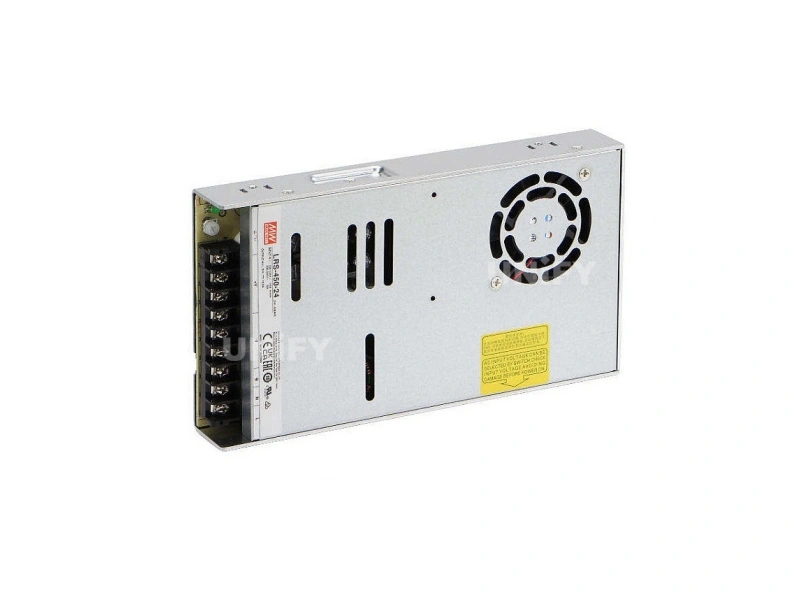
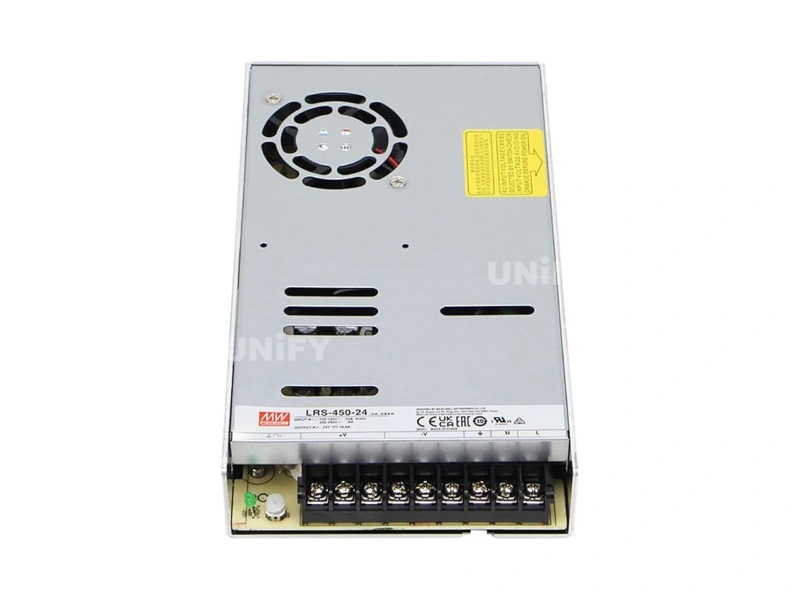
225 × 124 × 35 mm, 0.85 kg: five millimeters deeper than every smaller LRS
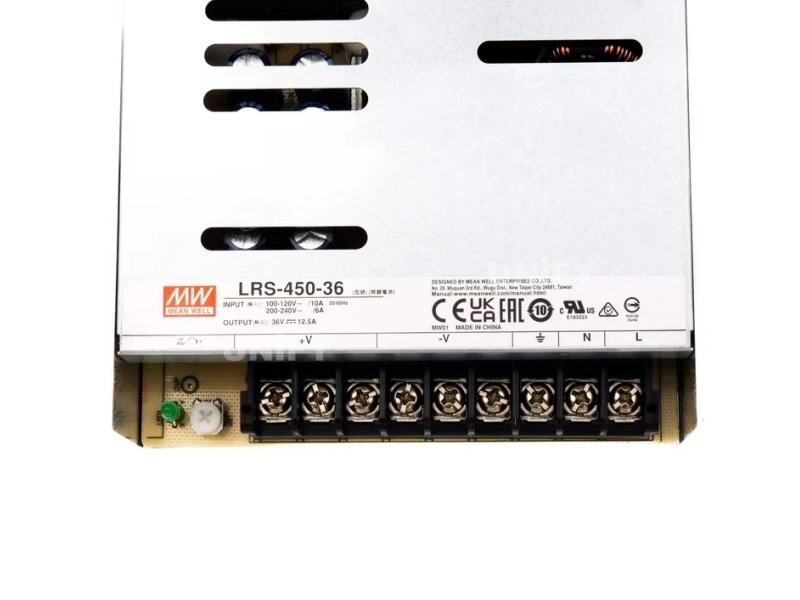
Label block with UKCA, CE, EAC and IS 13252 registration; +ADJ and status LED at the board edge
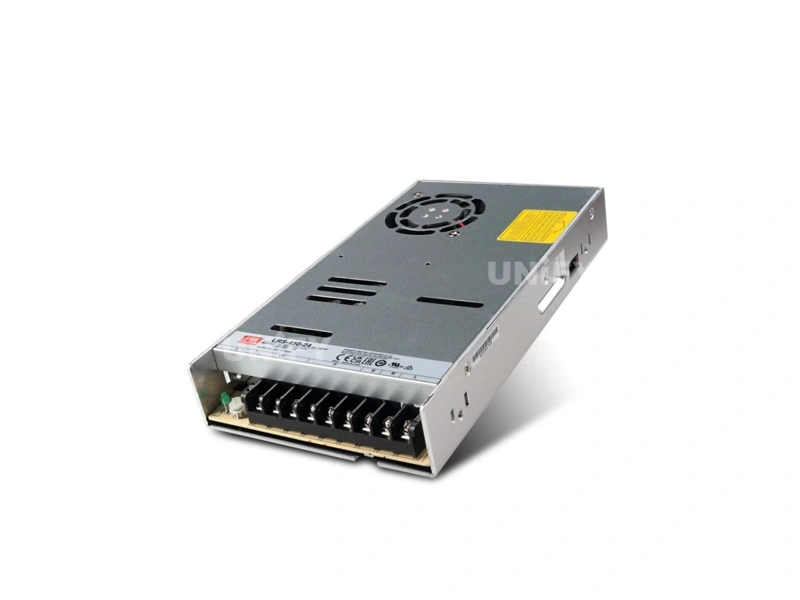
Top face: fan at the short end, convection slots along the sink, terminals at the front edge
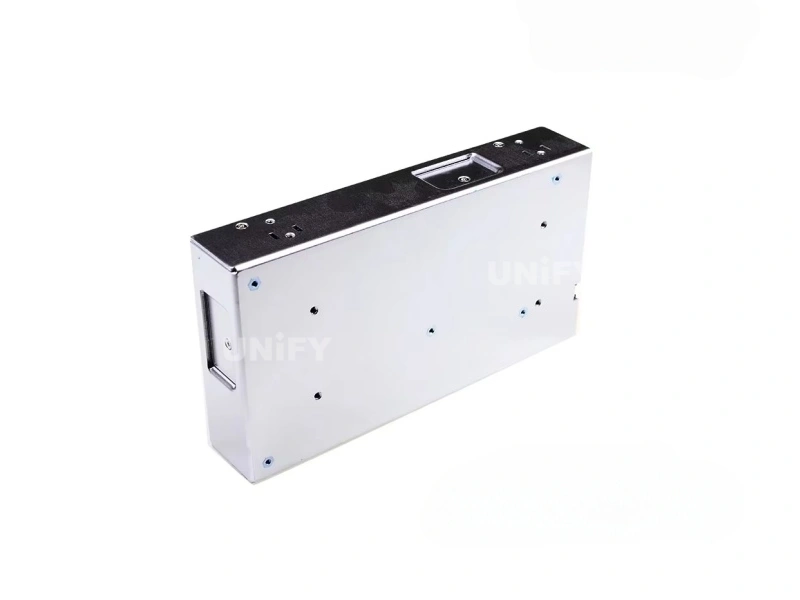
Base plate: M4 mounting points and the handle cutouts on both flanges
Three field notes most listings skip
First, the cooldown: Note 9 makes every protection event a 3-minute standdown — a cabinet that trips during commissioning is out of service for minutes, not seconds, so find the fault before re-energizing. Second, the trim window: Note 3 restricts output-voltage adjustment to input windows of 100–120 VAC or 200–240 VAC — trimming at the edges of the 90–132/180–264 range can produce abnormal output, a restriction no smaller LRS carries. Third, ripple scales with voltage here: 360 mVp-p on the 36/48 V models against 200 mV at 5–15 V — fine for industrial loads, worth checking before pairing the high-voltage rails with sensitive equipment.
Which Mean Well LRS-450 Voltage Should You Order?
Six models, two jobs:
5 V — the module bus at cabinet scale
75 A rated, 375 W, 300 W usable at the 80% rule. There is no 3.3 V or 4.2 V model in this series — common-cathode LED rails and low-voltage designs stay on the LRS-200 and LRS-350, and this page does not pretend otherwise.
12 / 15 / 24 / 36 / 48 V — the ecosystem, upsized
360–361 W usable across all five — control cabinets, large strip and lightbox walls, industrial loads — with the family’s best efficiency (90–92%) doing the quiet work on the power bill.
The trim discipline carries over with a new constraint: the +ADJ pot covers a narrower window than the LRS-200/350 (11.4–13.2 V on the 12 V model, for instance) and Note 3 ties adjustment to the 100–120/200–240 VAC input windows. On a 75 A bus the adjustment decision is worth a meter reading before the screwdriver comes out — the sizing method in the LED power supply selection guide applies unchanged.
How Does the Mean Well LRS-450-5 Compare With the CZCL A-400JQ-5P?
The third head-to-head in this series of pages, and the closest to parity: the CZCL A-400JQ-5P runs 5 V / 80 A / 400 W where the LRS-450-5 runs 5 V / 75 A / 375 W — different specs, same battlefield of the 400 W-class module-bus supply:
| Dimension | Mean Well LRS-450-5 | CZCL A-400JQ-5P |
|---|---|---|
| Output | 5 V / 75 A / 375 W | 5 V / 80 A / 400 W |
| Efficiency (published) | 87% (typ., datasheet) | 90%, with active PFC (0.95) |
| Harmonics (EN 61000-3-2) | Not met (Note 12 restrictions) | Compliant (PFC stage) |
| Cooling | Built-in fan, thermostatic 50°C on / 40°C off | Fanless, forced heat-sink plate |
| MTBF (published, 25°C) | 252.2K h (MIL-HDBK-217F) | 100K h (MIL-217) |
| Overload character | Constant-current 3 s, then shutdown; 3-min cooldown | Per CZCL datasheet |
| Dimensions | 225 × 124 × 35 mm, 0.85 kg | 220 × 48 × 26 mm |
| Input | 90–132 / 180–264 VAC by switch | 230 V-market window |
| Warranty | 3 years, serial-traceable | Project-dependent (ask with the quote) |
The two units embody opposite answers to the same brief. The A-400JQ-5P is the electrical machine: 5 A more current, a PFC stage that cleans harmonics at the source (the CZCL family’s only one), fanless silence in a 26 mm body that fits shallow cabinets. The LRS-450-5 is the documented machine: a published MTBF two and a half times higher, a published efficiency curve, the 115 V input switch, public street pricing, and a 3-year warranty behind serial-traceable stock. If the cabinet is EU-grid public-mains and harmonics are contractual, the CZCL A-400JQ-5P LED switching power is the compliant tool; if the buy is distributed, documented and warranty-driven, the LRS-450-5. The wider CZCL lineup sits in the CZCL power supply collection.
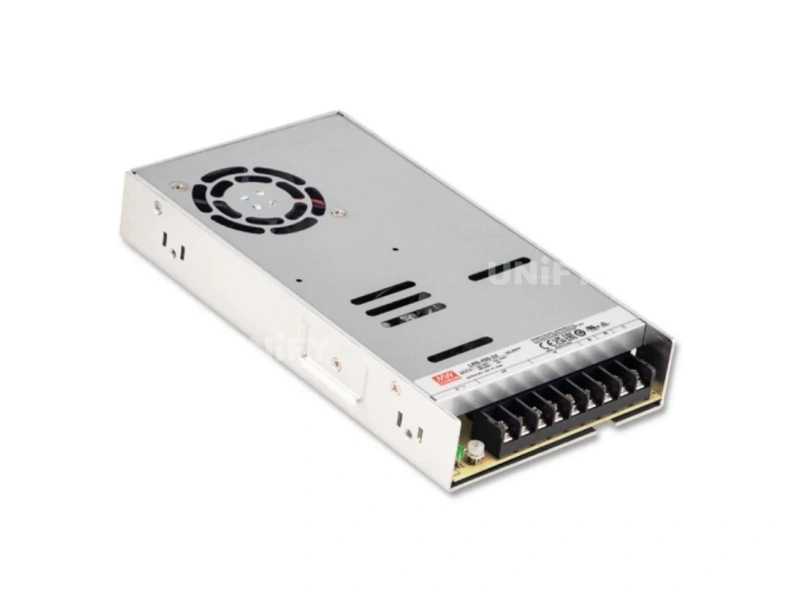
LRS-450-5: the 375 W module-bus flagship of the LRS line
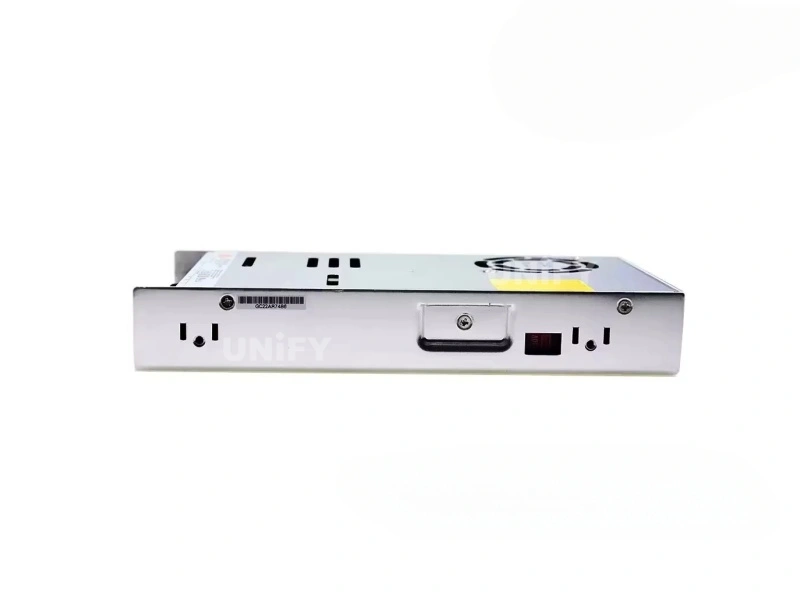
LRS-450-36 label: 36 V • 12.5 A at 92% efficiency
How Does the Mean Well LRS-450 Protection Work?
This is where the LRS-450 departs from its siblings, and the difference changes how a cabinet behaves on a bad day. Overload between 105% and 150% triggers constant-current limiting: instead of hiccup-pulsing the output, the unit holds current at the limit — voltage sags, loads dim or brown out, but nothing shuts off. Only if the overload persists past 3 seconds does the unit shut down. Overvoltage and overtemperature shut down directly, on all models — the 48 V model no longer gets its own latch-off treatment because every model now latches the same way.
What constant-current buys
Capacitive inrush, motor starts and momentary stalls ride through on limited current instead of tripping a hiccup — screens power up cleanly into big capacitor banks, and brief faults become a visible voltage sag instead of a blackout.
What it costs
A sustained fault cooks at the current limit for 3 seconds before shutdown — harder on the fault than a hiccup’s instant pulsing. And Note 9’s 3-minute cooldown means recovery is slow and deliberate: diagnose before re-powering, because the unit will not hurry for you.
Commissioning procedure changes accordingly: an LRS-450 that shuts down during first power-up should stay off while you meter the output side — the 3-minute wait is a feature, forcing the fault-finding the smaller hiccup units let crews skip. The verification habit is the same one shown in our replacement video below.
How Much LED Load Can a Mean Well LRS-450 Carry?
Apply the 80% rule to each model’s rated power:
| Model | Rated | 80% usable power | Usable current |
|---|---|---|---|
| LRS-450-5 | 375 W | 300 W | 60.0 A at 5 V |
| LRS-450-12 | 450 W | 360 W | 30.0 A at 12 V |
| LRS-450-15 | 450 W | 360 W | 24.0 A at 15 V |
| LRS-450-24 | 451.2 W | 361 W | 15.04 A at 24 V |
| LRS-450-36 | 450 W | 360 W | 10.0 A at 36 V |
| LRS-450-48 | 451.2 W | 361 W | 7.52 A at 48 V |
The pattern repeats the family logic at a higher level: the five ecosystem voltages converge on 360–361 W usable, and the 5 V module bus gets 300 W — the budget of one and a quarter LRS-350-5 units in a single chassis. A module string drawing 450 W wants two LRS-450-5 units on separate groups; a 300 W cabinet runs on one with the breaker to itself. The screen-level arithmetic is worked through in the LED display power consumption guide and the per-cabinet counting method.
One sizing note the constant-current design changes: the old 150%-for-1-second peak story is gone from the small rails. On the LRS-450 the overload band is 105–150% with constant-current behavior — peaks ride through as current-limited sag rather than a rated pulse, which is why the sizing discipline stays at the 80% line regardless.
What Protections and Certifications Does the Mean Well LRS-450 Carry?
Protection behavior is covered in the section above — constant-current limiting, 3-second shutdown, universal latch-off and the Note 9 cooldown. On the certification side, the LRS-450 carries BS IEC/UL 62368-1, BS EN/EN 61558-1 and -2-16, GB 4943.1, BIS IS 13252 (registration visible on the label), BSMI CNS15598-1, EAC and KC marks — an industrial/AV list like the rest of the high-LRS family, without the household-appliance approval the LRS-150 holds. Isolation is 3.75 kVAC input-to-output at 100 MΩ.
Compliance note the datasheet puts in writing — and most listings leave out
Per datasheet Note 12, the LRS-450 does not meet EN 61000-3-2 harmonic-current limits, with the same conditions as the LRS-200 and LRS-350: EU public-grid use at 220 V or greater where the supply draws more than 75 W continuously or forms part of a lighting system. The CZCL A-400JQ-5P’s active PFC is precisely the compliance tool this series lacks — for EU lighting-adjacent work, the LRS-150 or a PFC series is the pick; industrial cabinets and display systems outside the lighting classification are the LRS-450’s home ground.
Ripple and noise deserves one honest line here: 200 mVp-p on the 5–15 V models is family-normal, but the 24 V model is rated 240 mVp-p and the 36/48 V models 360 mVp-p — the highest figures in the LRS line. Industrial loads shrug; precision instruments and long analog runs may not.
How Do You Install and Wire a Mean Well LRS-450 Safely?
The 9-pin block matches the family: pins 1–2 are AC L/N, pin 3 is FG, pins 4–6 are −V and pins 7–9 are +V. Case 291 fixes with 4-M4 screws per side (L=6 mm both sides, L=3 mm alternate), and the mechanical drawing marks the airflow direction — keep both ends clear.
1Set the input switch first. Confirm the 115/230 selector against the grid before first energization — same rule as every LRS.
2Respect the Note 3 trim window. Output-voltage adjustment is only specified with input at 100–120 VAC or 200–240 VAC — trim inside those windows or not at all.
3Earth FG first. Ground, then L/N, then DC — the FG terminal carries the EMI filter return and the chassis bond.
4Spread the DC bus across all three terminals per pole. At 75 A on the 5 V model this is non-negotiable; twist and shorten the pairs.
5Plan for the 3-minute cooldown. If the unit trips during commissioning, keep it off, meter the output side, fix the fault — the restart is deliberate by design.
6Leave the airflow and fan service clear. Metal-to-metal mounting, both airflow ends open, fan accessible for annual service — enclosure planning sits in the LED screen cabinet guide.
The complete installation workflow on a real screen — from mounting to metering to first light — in our own step-by-step video:
How Does the Mean Well LRS-450 Compare With the LRS-150, LRS-200 and LRS-350?
The four-step family ladder, one table:
| Dimension | LRS-450 | LRS-350 | LRS-200 | LRS-150 |
|---|---|---|---|---|
| Voltages | 6: 5–48 V | 8: 3.3–48 V | 8: 3.3–48 V | 5: 12–48 V |
| Rated power | 375–451.2 W | 198–350.4 W | 132–212.4 W | 150–158.4 W |
| 5 V rail | 75 A / 375 W | 60 A / 300 W | 40 A / 200 W | none |
| Efficiency range | 87–92% | 79.5–89% | 83–90% | 87.5–90% |
| Overload character | Constant-current 3 s, then off | Hiccup; 150% peak 1 s (12–48 V) | Hiccup; 150% peak 1 s (12–48 V) | Hiccup |
| Restart after protection | Re-power, 3-min cooldown | Auto (hiccup) / re-power (48 V) | Auto (hiccup) / re-power (48 V) | Auto (hiccup) / re-power |
| Cooling / case | Fan / 35 mm | Fan / 30 mm | Convection / 30 mm | Convection / 30 mm |
| MTBF (MIL-HDBK-217F) | 252.2K hours | 328.6K hours | 279.4K hours | 558.2K hours |
| EN 61000-3-2 / EN 60335-1 | Not met / not covered | Not met / not covered | Not met / not covered | Class A ≤75% / covered |
The ladder reads cleanly: each step up buys power, current on the 5 V rail, and efficiency, and pays in case depth, MTBF (the fanless 150 still leads) and compliance scope. Only the LRS-150 crosses the EU harmonic and household lines; only the 200/350 carry the 3.3/4.2 V rails; only the 450 brings constant-current limiting and whole-cabinet 5 V power. Choose by bus, size by the 80% rule, and let the compliance table settle the EU questions.
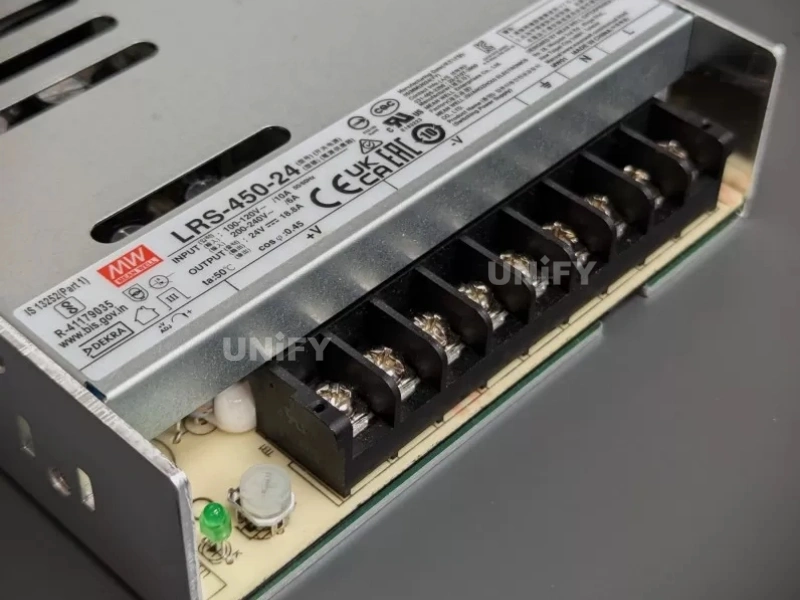
The 35 mm profile: five millimeters deeper than the 150/200/350, still 1U-friendly
What Problems Does a Failing Power Supply Cause?
The LRS-450’s protection character adds one symptom pattern the hiccup units do not show:
💡 A whole cabinet that browns out instead of tripping
Constant-current limiting at work: an overdrawn 5 V bus sags the whole rail dimly rather than blinking. Meter under load — if the rail sits below 4.75 V with the cabinet lit, the supply is at its current limit, not broken.
⏳ A unit that will not restart after a trip
The Note 9 cooldown at work: 3 minutes minimum after any protection event. If restarts still fail after a cool-down, the fault is real — meter the output side before the next attempt.
🔌 Local dark patches on a 5 V wall
Rail sag localized to one supply’s group, or a section gone dark. Symptom mapping continues in the flickering and uneven brightness guides.
The full swap workflow on an indoor screen — isolation, metering, replacement, verification — in our own video:
The written procedure is in the power supply diagnostics and replacement guide.
How Much Does the Mean Well LRS-450 Cost?
Public street pricing, stable against the 2026 component-cost story in the LED display supply chain price surge analysis:
| Model | Unit price (qty 1) | Source |
|---|---|---|
| LRS-450-5 | $54.79 | Jameco (US) |
| LRS-450-24 | $70.35 | RS Components (US) |
The per-watt arithmetic from the CZCL power supply price guide: at $54.79 for 375 W rated, an LRS-450-5 costs about 14.6 cents per rated watt, and the 24 V model at $70.35 for 451.2 W lands near 15.6 cents — the family’s highest per-watt figures, against the LRS-350’s 9–10 cents. The premium buys the new case, the efficiency step and the 75 A rail; on pure cost per watt the LRS-350 still wins, which is exactly why the ladder exists. Buy the 450 for cabinet consolidation and documented specs, not for the cheapest watt.
The buying caution holds: verify the serial number on the MEAN WELL website before deployment — and at 75 A on a mains-connected device, a counterfeit is not a discount, it is a hazard.
Mean Well LRS-450: Frequently Asked Questions
Does the Mean Well LRS-450 have a 5 V output for LED display modules?
Yes – the LRS-450-5 delivers 5 V at 75 A (375 W rated, 300 W usable at the 80% rule), the whole-cabinet module-bus rating. There is no 3.3 V or 4.2 V model in this series – common-cathode rails stay on the LRS-200/350.
Why does the LRS-450 shut down instead of hiccupping on overload?
The overload protection is constant-current limiting: between 105% and 150% the unit holds current at the limit for up to 3 seconds, then shuts down. Overvoltage and overtemperature shut down directly. All events require a re-power cycle, and Note 9 specifies a 3-minute cooldown before restart.
Why won’t my LRS-450 restart immediately after a trip?
Datasheet Note 9: once any protection triggers, about 3 minutes of cooldown is required before restart. The delay is deliberate – find the fault with the unit off instead of cycling into it. If restarts keep failing after full cooldown, meter the output side for a real fault.
How does the LRS-450-5 compare with the CZCL A-400JQ-5P?
Different specs on the same battlefield: 5 V/75 A/375 W versus 5 V/80 A/400 W. The CZCL brings the active PFC (EN 61000-3-2 compliance the LRS-450 lacks), 5 A more current, and a fanless 26 mm body; the Mean Well brings a published MTBF of 252.2K hours against 100K, the 115 V input switch, public pricing and the 3-year warranty. Choose by compliance requirement and buying channel.
Can I adjust the output voltage of the LRS-450 at any input voltage?
No. Datasheet Note 3 restricts voltage adjustment to input windows of 100-120 VAC or 200-240 VAC – adjusting outside those ranges can cause abnormal output. Trim inside the windows, meter the result, and never use the pot to convert between voltage classes.
How many LED modules can one LRS-450-5 run?
Apply the 80% rule: 375 W x 80% = 300 W usable, or 60 A at 5 V. A module string drawing 450 W wants two units on separate groups; a 300 W cabinet runs on one. The same per-bus discipline from the sizing guides applies.
Is the LRS-450’s ripple higher than the smaller LRS models?
On the high-voltage rails, yes: the datasheet rates 240 mVp-p on the 24 V model and 360 mVp-p on the 36 V and 48 V models, against 200 mVp-p at 5-15 V and 150-200 mV across the LRS-200/350. Fine for industrial and LED loads; worth checking before precision instruments or long analog runs.
Which LRS should I buy – 150, 200, 350 or 450?
Follow the bus and the compliance map. Pure 12-48 V auxiliary work in EU-visible installs – LRS-150. Silent sealed cabinets or the 5 V bus at 40 A – LRS-200. The 5 V bus at 60 A or full power without a thermal cliff – LRS-350. Whole-cabinet 5 V power at 75 A, or 450 W ecosystem rails with the family’s best efficiency – LRS-450. All four carry the 3-year warranty.
Related Power Pages and Guides
Mean Well LRS-350 (5 V / 60 A)
The step below: 8 voltages, first LRS fan, hiccup protection – the 9–10¢/W value pick.
Mean Well LRS-200 & LRS-150
The convection half of the family: 5 V/40 A screen rails and the compliance-safe auxiliary pick.
CZCL A-400JQ-5P (5 V / 80 A)
The same-battlefield CZCL flagship: active PFC, fanless 26 mm body, EN 61000-3-2 compliant.
Power Supply Diagnostics & Replacement
From symptom to swapped unit: isolation, metering and verification workflow.
LED Display Power Supply (Mother Catalog)
The three-brand mother catalog: 27 model pages, 2026 price bands, architecture map and the 80% load math — start here.
UnifyLED LED Display Solutions
The full build picture: indoor and outdoor screens, control systems, cabinets and power architecture.
Need Mean Well LRS-450 Units for Your Project?
Tell us the load list, grid voltage and target market – we will confirm the voltage class, the EU compliance fit, and quote genuine serial-traceable stock with the 3-year warranty intact.