
P3 Outdoor LED Display Screen Quick Guide: Formats, Checks and Costs (2026)
This P3 outdoor LED display screen quick guide compresses a factory spec sheet into the nine decisions that actually move a purchase. A P3 outdoor LED display screen is the mid-band workhorse of outdoor video — a 3mm-pitch wall carrying about 111,000 pixels per square meter, readable from 3 m out and priced like outdoor hardware rather than indoor fine pitch. The class ships in two module formats (exact-pitch P3.0 on 192×192mm boards, P3.076 on the industry-standard 320×160mm board), two brightness tiers, a 1/13 or 1/16 scan electronics standard and six control ecosystems, at $700–1,100 per square meter factory-direct in the September 2026 market scan. Each section states the check, the numbers behind it, and the trap for buyers who skip it. The full engineering detail lives on the P3 outdoor collection; this page is the pass you run before money moves.
Short answer — the guide in one paragraph: (1) Choose the format by cabinet, not by pitch: P3.0 for 576/768mm architectural iron, P3.076 for the 960×960mm ecosystem and future pitch swaps. (2) Order brightness by sun exposure: 5,500–6,500 nits copper/alloy-wire, or 7,000–10,000 nits gold-wire for full-sun faces. (3) Add GOB protection (+$100–200/㎡) wherever traffic or salt threatens the lamp face. (4) Verify 1/13 (P3.076) or 1/16 (P3.0) scan with reconciling IC counts, 3,840Hz refresh, named driver ICs. (5) Fit 5V 40A/60A brand supplies and plan 400–500W/㎡ mixed, 650–800W peak. (6) Standardize on one control family and buy spares with the wall. (7) Budget $700–1,100/㎡ fixed. (8) Walk away under 3 m (go P2.5) or past 8 m (go P3.91, roughly 30% cheaper).
What Is a P3 Outdoor LED Display Screen?
A quick guide is the compressed form of a buying decision: the checks in the order a factory engineer would run them, with the arithmetic exposed, not hidden behind adjectives. A P3 outdoor LED display screen is the pitch that owns the 3-to-8-meter band — the distance where most commercial life happens: a customer walking a storefront, a queue outside a mall, cars stopped at a signal. At 3 m the pixel grid disappears; at 8 m the wall still renders text promotions sharply, which is exactly where coarser outdoor pitches start to fail.
Every number here is signed the same way as the P3 outdoor collection: spec figures from current production builds, prices from a September 2026 scan of factory listings and module e-commerce. Where the market disagrees with itself — supplier quotes spread 30–60% — the range is shown instead of a flattering single number.
How Do You Choose Between P3.0 and P3.076 on a P3 Outdoor LED Display Screen?
This is the check unique to the 3mm class, and the answer surprises buyers: the 0.076mm pitch difference is invisible. P3.0 packs 111,111 pixels per square meter against P3.076’s 105,625 — a 5% difference no viewer detects at any distance the pitch is rated for. The real choice is industrial. The P3.076 board exists because the 320×160mm module is the industry’s standard outdoor format: 104×52 pixels is what the grid gives on a 320mm-wide board, and the format brings the whole ecosystem with it — the 960×960mm iron cabinet family and mounting holes shared across every pitch from P2.5 to P10. P3.0 exists because 192mm-square cabinets (576×576, 768×768mm) follow architectural dimensions cleanly, and the smaller board is a cheaper spare.
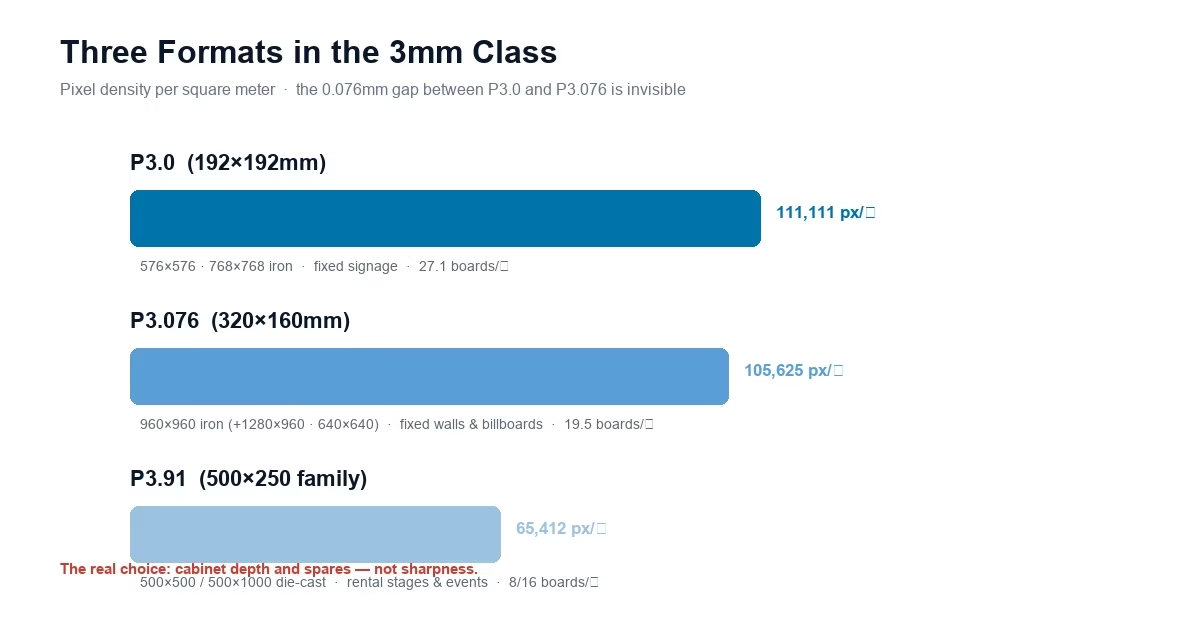
Same 3mm-class picture on the left two columns; the format choice is cabinet depth and spares, not sharpness.
The rule: buy P3.076 for ecosystem depth and future pitch swaps; buy P3.0 when cabinet dimensions follow the building, not the catalog. Walls that may step finer or coarser later — or fleets that want one spare-part bench — go 320×160mm; facades with fixed structural openings go 192×192mm.
What Brightness Tiers Does a P3 Outdoor LED Display Screen Need?
Brightness decides whether the wall reads at noon or washes out. Outdoor production ships in two tiers: 5,500–6,500 nits on copper/alloy-wire lamps for shaded and near-shaded faces, and 7,000–10,000 nits on gold-wire high-brightness builds for south-facing facades and full-sun roadside. SMD1415 is the outdoor-grade lamp both P3 formats share (the P3.0 board also runs SMD1921 on request), and it comes in two procurement grades: Grade 1 (Nationstar class, high stability) and Grade 2 (Xinda class, value). Either grade works; the tier is what you order against the sun.
Two disciplines keep the check honest: get the nits in writing and demo a unit at full white outdoors — under 4,500 nits disappoints at noon — and insist on the UV-stabilized matte mask, the part that decides whether the wall still reads black in year five.
Contrast is the other half of the noon-readable equation. The black mask spray on our outdoor modules takes the panel to 5,000:1 — SMD construction out-contrasts legacy DIP lamps, and black-lamp builds go higher still. Black lamps trade money for that contrast: they cost more than white-body lamps, run dimmer at equal current, and force thicker power cabling, which is why the brightness tier and the lamp body are quoted together. The outdoor payoff is direct: a high-contrast face does not mirror the sky, and colors read true against noon sun.
Which Protection Build Should a P3 Outdoor LED Display Screen Use: SMD or GOB?
SMD (surface-mounted device) is the standard construction: SMD1415 lamps on the PCB behind the mask, sealed to IP65 at the cabinet front. GOB (glue-on-board) is the protective upgrade: a transparent polymer pour over the whole module face that encapsulates lamps, mask and solder joints. Standard SMD is right for most fixed walls at no extra cost; GOB adds $100–200 per square meter and earns it back where the lamp face takes abuse — street-level walls, coastal salt air, sports halls, anywhere an impact is a when rather than an if.
Sealing logic matters as much as lamp protection. A P3 outdoor wall seals its front and breathes at the back: IP65 face, drained and filtered rear with a fan path — sealing both sides is the classic error that traps condensation and kills modules. The connectors are where water actually gets in, so check how they are sealed:
IP65 in practice: sealed connectors, not just a sealed mask.
Which Electronics Should a P3 Outdoor LED Display Screen Verify Before Deposit?
Scan mode is the fraction of the pixel grid lit at any instant, and the 3mm class runs two standards: 1/13 scan on the P3.076 board (104×52 = 5,408 dots) and 1/16 scan on the P3.0 board (64×64 = 4,096 dots). The reconciliation check is arithmetic: the P3.076 board’s 5,408 dots at 1/13 work out to roughly 416 driven channels — 26 sixteen-channel drivers plus row decode, about 42 devices, doubling to 84 on reinforced configurations — with driver ICs from Chipone, Macroblock, SM Micro or Fuman. The P3.0 board carries 48. If a quote’s IC count and scan mode do not reconcile to the dot count, the spec is fiction.
Grayscale is decided by the driver IC, not the lamp: production ICs run 8, 12 or 16 bit, and the IC named on the datasheet sets how smoothly the wall renders shadows and low-brightness gradients — 16-bit processing is the tier that matters wherever the wall meets a camera.
Refresh rate is the spec to police: 1,920Hz looks fine to pedestrians but bands on every smartphone camera; 3,840Hz clears phone footage and most professional work — the default here, because storefronts and plazas are exactly where people raise a phone (the P3.0 board supports multi-tier refresh; higher tiers increase scan load). The PCB runs 1.6mm FR-4 fiberglass. And calibration is finished at the factory: wavelength screening plus system-level per-pixel correction, mapped against a reference camera before shipping — a 105,000-pixel-per-square-meter surface shows batch mismatch ruthlessly. Run these six checks against any quote:
- Scan mode stated — 1/13 (P3.076) or 1/16 (P3.0), IC counts reconciling to the dot count.
- Refresh 3,840Hz — if people will photograph or film the wall.
- Driver IC named — Chipone, Macroblock, SM Micro or Fuman, not “high-refresh IC”.
- Grayscale stated — 8/12/16-bit processing set by the named driver IC; 16-bit for camera-facing walls.
- PCB spec’d — 1.6mm FR-4 fiberglass, conformal-coated boards.
- Calibration declared — wavelength screening plus per-pixel correction, batch-matched modules.
How Do You Match Power, Cabinets and Control on a P3 Outdoor LED Display Screen?
Power is the running cost that surprises buyers. Plan for 400–500W per square meter on mixed content and 650–800W peak on full white: a 20㎡ wall at 450W average burns about 9kW per operating hour — roughly $1–2 per hour at commercial tariffs, or $30–60 per month on a 12-hour daily schedule. Brightness scheduling moves that bill more than any hardware choice. Each cabinet carries its own 5V 40A or 60A supply — Chuanglian Power as the volume standard, MEAN WELL where export specs demand it, G-Energy as the ultra-thin specialist for billboard-class cabinets — so failure domains stay cabinet-sized, and conformal-coated terminals resist the corrosion that ends most outdoor walls long before their LEDs do. Full supply grades: the LED display power supply guide.
Cabinets follow the format choice from section two: 576×576mm iron (nine P3.0 boards) and 768×768mm iron (sixteen boards) on the P3.0 side; 960×960mm iron (eighteen P3.076 boards — the A960-format outdoor build), 640×640mm (eight boards) and 1280×960mm magnesium-aluminum with internal soft connections on the P3.076 side. Maintenance access decides rear versus front: rear service is standard, and front-service lock-catch cabinets are available on request where the wall’s back touches a structure. And on the 320×160mm format, the cabinet you buy is the cabinet you keep for life — the board suite shares mounting holes across eight pitches:

The cheapest upgrade path in LED hardware: swap modules, keep cabinets, structure and power.
Control is a one-time fleet decision. Six ecosystems drive these HUB75 modules — NovaStar, Colorlight, Huidu, Mooncell, VDWALL and RGBlink — compared on our LED screen control system guide. Sending card and receiving cards must come from one family, so the platform you pick is the platform your fleet inherits; sync suits camera-facing walls, async cards run unattended signage from a phone app. Standardize once and buy spare receiving cards with the wall. Installation itself starts with steel:
The steel comes first: structure is the 20–30% local line in the budget below.
What Does a P3 Outdoor LED Display Screen Cost Per Square Meter in 2026?
The September 2026 market scan — module e-commerce prices cross-checked against finished-wall quotes — puts the four builds here:
Three lines sit outside the table. Control hardware adds $500–2,000 per project and local steel plus installation 20–30% of screen value; spare modules — 3% of quantity — are the cheapest insurance until the first scaffolding bump ends a board. Inside the module, remember where the money goes: LED chips take 35–45% of module cost, which is why pitch — the decision that sets how many chips you buy — is the primary price lever in outdoor LED. And weigh warranty terms like a cost line: a 2–3 year warranty from a factory that stocks the boards it shipped beats a paper 5-year promise from a trading company. The class-wide context is in the outdoor LED display price guide; the finer-pitch comparison runs in the P2.5 outdoor price guide.
When Is a P3 Outdoor LED Display Screen the Wrong Choice?
A quick guide that only sells one pitch is a brochure. P3 owns one band and loses outside it: measure the closest spot a paying customer stands and route yourself:
Inside the 3–8 m band the placements are consistent: storefront and retail facades, mall entrances, signal-side roadside where traffic stops, school and church entrances, building identity walls. The shopping mall LED display solution shows one built out. Where the band edges come from, the math is in the site-wide viewing distance reference and the pixel pitch guide — and for the pitch one step finer, the P2.5 vs P3 decision rule runs the same arithmetic.
What Do Buyers Also Ask About a P3 Outdoor LED Display Screen?
What contrast ratio and grayscale should a P3 outdoor LED display screen have?
A black-spray mask takes the panel to about 5,000:1 — SMD lamps out-contrast DIP, and black-lamp builds go higher still, at higher cost, lower brightness than white lamps and thicker power cabling. Outdoors that buys a non-reflecting face and truer color at noon. Grayscale runs 8, 12 or 16 bit and is set by the driver IC — specify 16-bit where the wall meets cameras.
What is the difference between P3.0 and P3.076?
P3.0 is the exact 3.0mm pitch on 192×192mm square boards (64×64 pixels); P3.076 is what you get fitting 104×52 pixels on the industry-standard 320×160mm board. On a finished wall the two are visually identical — a 0.076mm difference is below what any viewer can resolve. Choose by cabinet format: P3.0 pairs with 576×576 and 768×768mm iron cabinets, P3.076 with the 960×960mm family.
How many modules and cabinets make one square meter of a P3 outdoor LED display screen?
The 320×160mm P3.076 board: 19.5 per square meter. The 192×192mm P3.0 board: 27.1 per square meter. In cabinets, a 960×960mm iron cabinet holds 18 P3.076 boards (about 1.08 cabinets per square meter), a 576×576mm takes 9 boards (3.0 per square meter) and a 768×768mm takes 16 (1.7 per square meter).
Is P3.076 different enough from P3.91 to matter?
Yes — P3.076 packs 105,625 pixels per square meter against P3.91’s 65,412, about 60% more picture information. The practical question is duty: P3.076 on iron cabinets is a fixed-installation build, while P3.91 lives on lightweight die-cast rental cabinets. Buy P3.076 for a wall that stays put; buy P3.91 if the wall tours.
Can a P3 outdoor LED display screen be read in direct sunlight?
Yes, provided brightness is spec’d in the right tier with a matte mask. Production ships in two tiers — 5,500–6,500 nits on copper/alloy-wire lamps or 7,000–10,000 nits on gold-wire builds. Ask for the nits in writing and demo a unit at full white outdoors; under 4,500 nits will disappoint at noon.
How much power does a P3 outdoor LED display screen use?
Plan for roughly 400–500W per square meter on mixed content and 650–800W peak on full white. A 20㎡ wall at 450W average burns about 9kW per operating hour — roughly $1–2 per hour at commercial tariffs, or $30–60 per month on a 12-hour daily schedule. Brightness scheduling moves the bill more than any hardware choice.
What control system does a P3 outdoor LED display screen need?
Any of the mainstream platforms — NovaStar, Colorlight, Huidu, Mooncell and the wider ecosystem — drives these HUB75 modules. The rule that matters: sending card and receiving cards must come from the same family, chosen once for the whole fleet. For unattended signs, async cards run scheduled content from an app; for camera-facing walls, NovaStar remains the reference.
How much does a P3 outdoor LED display screen cost per square meter in 2026?
A standard fixed-install wall (cabinets, modules, power, basic control) runs $700–1,100 per square meter factory-direct in the September 2026 market scan. GOB protection adds $100–200 and front-service lock-catch builds add 10–15%. Module-only purchases run $25–50 per 320×160mm board.
Can I upgrade the pitch later without replacing the cabinets?
On the 320×160mm format, yes — the board suite shares the same mounting holes across P2.5, P3.076, P3.33, P4, P5, P6.67, P8 and P10, so a wall can change pitch by swapping modules while cabinets, structure and power stay in service. It is the cheapest upgrade path in LED display hardware.
References & Sourced From: 2026 P3 Outdoor LED Display Screen Data
- Module builds (P3.076: 104×52 = 5,408 dots, 42–84 ICs, 1/13 scan; P3.0: 64×64 = 4,096 dots, 48 ICs, 1/16 scan; 27.1/19.5 boards per square meter; cabinets 576×576, 768×768, 960×960, 640×640, 1280×960 magnesium-aluminum): our P3 outdoor collection, current production data.
- Brightness tiers (5,500–6,500 nits copper/alloy wire; 7,000–10,000 nits gold wire), lamp grades (SMD1415/1921, Grade 1 Nationstar class / Grade 2 Xinda class), 1,920/3,840Hz refresh, PCB 1.6mm FR-4, wavelength screening plus per-pixel correction, black-mask contrast to 5,000:1 (SMD above DIP; black-lamp builds higher), 8/12/16-bit grayscale set by the driver IC: same collection, September 2026.
- Price bands ($25–50 per module; $700–1,100/㎡ standard fixed; GOB +$100–200/㎡; front-service +10–15%): September 2026 market scan, module prices cross-checked against finished-wall quotes.
- Power (Chuanglian Power / MEAN WELL / G-Energy at 5V 40A/60A; 400–500W/㎡ mixed, 650–800W peak; 20㎡ running example) and control ecosystems (NovaStar, Colorlight, Huidu, Mooncell, VDWALL, RGBlink): the power supply guide and the control system guide.
Verdict: How Do You Run the P3 Outdoor LED Display Screen Checks in Order?
Run the checks in the order they fail on real projects:
- Band check first — closest viewer 3–8 m is the P3 band; under 3 m step to P2.5, past 8 m take P3.91.
- Format by cabinet, not by pitch — 0.076mm is invisible; 576/768 versus 960×960 cabinet families is the real choice.
- Brightness in writing — tier ordered against sun exposure, nits stated, full-white demo witnessed.
- Electronics verified — 1/13 or 1/16 scan with reconciling IC counts, 3,840Hz refresh, named driver ICs.
- Protection and power specified — GOB where abuse is likely, brand supplies, conformal-coated terminals, drained rear confirmed.
- One control family — platform chosen once, spare receiving cards bought with the wall.
Work the list in order and the purchase reduces to arithmetic. A P3 outdoor LED display screen is not the finest wall you can buy — it is the one built for the 3-to-8-meter band where most outdoor audiences stand, at a price that lets you say yes to the square meters the site needs. Send us the wall size, the closest viewing distance and the install surface, and a LED screen manufacturer will return a module-level quote with brightness tier, scan mode, cabinet format and control stack itemized — 3% spare modules included.
Related P3 outdoor LED display screen guides:
P3 Outdoor LED Display Collection · P2.5 Outdoor LED Display Quick Guide · P2.5 vs P3 Outdoor LED Display · LED Display Viewing Distance · P4 Outdoor LED Display Screen Quick Guide · P5 Outdoor LED Display Screen Quick Guide · P6 Outdoor LED Display Screen Quick Guide · P8 Outdoor LED Display Screen Quick Guide · P10 Outdoor LED Display Screen Quick Guide