
P2.5 Outdoor LED Display Viewing Distance: The Formulas and the Module Math (2026)
The P2.5 outdoor LED display viewing distance starts at 2.5 meters — closer than that, the pixel grid shows — and lands at its best between 5 and 7.5 meters, where the 160,000 pixels per square meter blend into a TV-like image. Those two numbers decide everything else: how big the wall must be for 720P, 1080P or 4K content, which placements earn the P2.5 premium, and at what distance you should step down the pitch ladder instead. This guide runs the three standard formulas against P2.5, works the module arithmetic on the 320×160mm board that dominates outdoor P2.5 builds, and settles the argument the industry keeps having about whether a 2.5mm pitch belongs outdoors at all. The spec side lives on our P2.5 outdoor LED display collection; the money side is in the P2.5 outdoor LED display price guide.
Short answer: A P2.5 outdoor LED display viewing distance runs 2.5 m minimum (pixels blend), 5–7.5 m optimal (the 2×–3× rule; 7.5 m is the classic 3000-rule answer), and about 8.6 m by the strict visual-acuity method. A 2.72 m-tall wall stays legible out to roughly 80 m (height × 30), with text readable far beyond the HD zone. For a 1080P-class canvas you need 15×17 modules = 4.8×2.72 m (13.06㎡, 255 boards); for 4K-class, 30×34 = 9.6×5.44 m (52.22㎡, 1,020 boards).
What Is the P2.5 Outdoor LED Display Viewing Distance?
A viewing distance is a range, not a point, and for P2.5 outdoors it has four marks. Minimum — 2.5 m: inside this line the eye resolves the 2.5 mm gap between pixel centers, and the image breaks into the screen-door effect. Optimal — 5 to 7.5 m: the band where the grid merges into a continuous image; 7.5 m is the textbook answer for P2.5 (the same figure our LED display viewing distance guide derives from the 1000-and-3000 rule). Acuity-HD — about 8.6 m: the strict 1-arcminute threshold where a viewer with 20/20 vision can no longer distinguish two adjacent 2.5 mm pixels. Legibility tail — tens of meters: HD ends long before usefulness ends; large text and video stay readable on a 2.72 m-tall wall out to roughly 80 m, and industry listings for outdoor P2.5 modules quote usable viewing out to 25 m and beyond.
Why the outdoor context matters: the same 2.5mm pitch indoors competes against 1.2–2mm fine-pitch walls at conference-room distances. Outdoors, P2.5 is already the fine end of the ladder — sunlight brightness (5,500+ nits) and sealed cabinets dominate the engineering, and the audience is almost always farther away. That is exactly why the distance math decides the purchase: at 3 m, P2.5 outdoor is the right tool; at 30 m, it is 160,000 pixels per square meter that no driver will ever see.
A second axis matters outdoors and it is often confused with distance: daylight legibility. Brightness and resolution solve different problems. A 5,500-nit wall fights the sun; the pitch decides how fine the image reads at a given range. Raising brightness does not push the HD line farther away — only pitch does that — but low brightness shortens the useful range at any pitch, because contrast dies before resolution does. When a quote trades one against the other, both halves of the range shrink at once: that is the build to refuse.
How Do You Calculate a P2.5 Outdoor LED Display Viewing Distance?
Three rules cover every project brief. All three are on the viewing distance guide; here they are with the P2.5 numbers filled in:
Two practical readings of that table. First, the gap between 7.5 m and 8.6 m is the difference between the industry’s rule of thumb and the optics of 20/20 vision — both are honest; the rule is a design convention, the arcminute figure is the physics. Second, the legibility tail explains a pattern buyers see in the field: a P2.5 storefront wall still “works” as signage at 20 m, because at that range the viewer reads headlines, not pixels. The HD budget and the communication budget are different budgets.
If you would rather compute than read, the site’s LED screen calculator turns any pitch and wall size into resolution and distance numbers; the background definitions sit in the LED pixel pitch guide.
Worked on a real placement: a 3.2 × 1.92 m storefront window wall — the 720P-class grid from the next section. Minimum 2.5 m: the sidewalk zone where pedestrians actually stop. Optimal 5–7.5 m: across the street and along the opposing storefront line. Legibility tail: 1.92 × 30 ≈ 58 m — the message still reads at the far end of the block even though HD ends at 7.5 m. One field habit worth more than any formula: measure the site before choosing the pitch. Pace or laser the distance from the wall face to the closest spot a paying customer stands, and let that number — not a catalog default — pick the pitch.
How Does the P2.5 Outdoor LED Display Viewing Distance Set the Screen Size for 720P, 1080P and 4K?
The outdoor P2.5 workhorse board is 320×160 mm carrying 128×64 dots — 8,192 pixels per module, 160,000 per square meter. Resolution targets then become pure counting, because every canvas row must land on a 64-pixel module boundary:
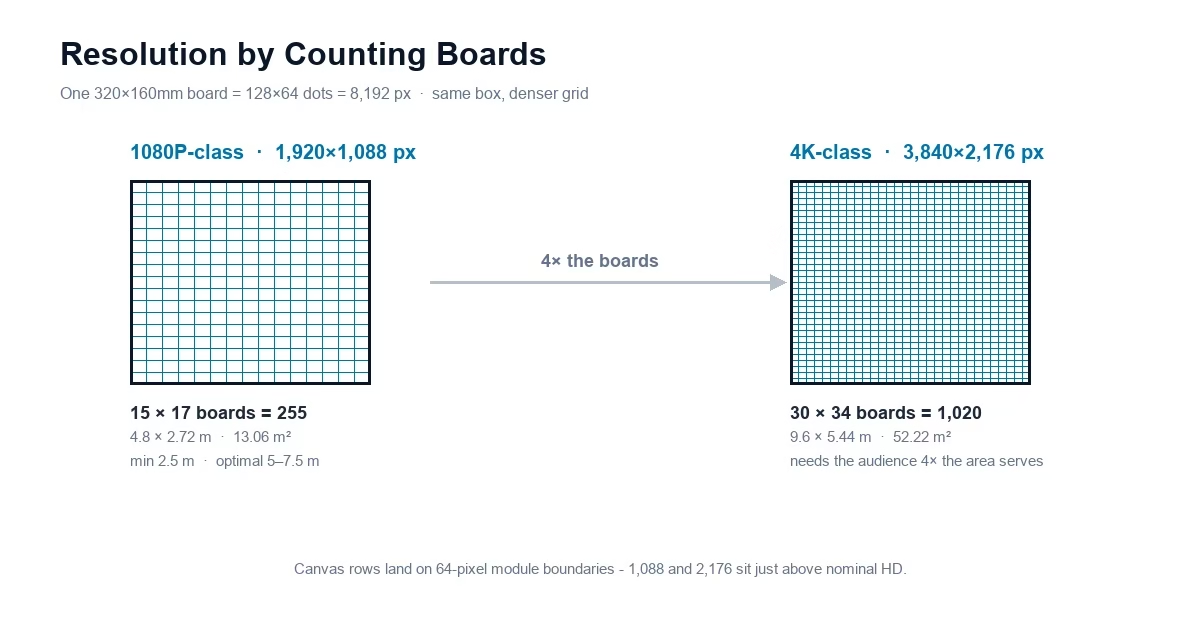
Counting boards, not pixels: the 1080P-class wall (15×17) is the volume sweet spot for storefront and entrance placements.
The rows land just above the nominal targets — 1,088 rather than 1,080, 2,176 rather than 2,160 — because 64-pixel module rows rarely divide HD heights exactly; that is normal for the industry and invisible on content. Note what the distance math adds to the size math: the 4K wall only makes sense where its 5.44 m height and its audience both exist — at 7.5 m viewing it renders a canvas most placements never need. The 13.06㎡ 1080P-class build inside the optimal 5–7.5 m band is where outdoor P2.5 earns its keep, and where the price guide puts the $11,100–18,300 FOB range. Cabinet formats for that wall class are covered on the collection page — the A960 960×960mm outdoor cabinet is the common fixed-install chassis.
Is the P2.5 Outdoor LED Display Viewing Distance Argument Against Outdoor Use Valid?
Search the topic and you will meet a confident claim: outdoor LED starts at P4 or P6, because “outdoor means 10 m or more”, so P2.5 outdoors is over-engineered. The claim is half right, and the half that is wrong is where the opportunity sits.
The valid half: for roadside and highway placements, audiences at 15–50 m cannot resolve 2.5 mm pitch, so paying for 160,000 px/㎡ there is wasted money — the indoor vs outdoor breakdown and every honest pitch ladder agree on this. The invalid half: a large and growing class of outdoor placements — storefronts, entrances, mall facades, lamp-post screens, drive-throughs, transit shelters, stage sides — put viewers at 2.5–10 m, inside the P2.5 HD zone. For those placements the “outdoor starts at P4” rule produces the opposite error: a visibly coarser image exactly where the audience is closest.
Indoor vs outdoor engineering, compared — the environment decides the cabinet, the distance decides the pitch.
The hardware objection has also aged out. Outdoor P2.5 is no longer an indoor module with a raincoat: current builds run SMD1415 lamps rated above 5,500 nits — the brightness the physics of daylight requires (see the brightness guide) — inside IP65-rated sealed cabinets with conformal-coated PCBs. The question was never whether 2.5 mm survives rain; current cabinets do. The question is only whether your audience stands inside 7.5 m. Distance first, environment second — that ordering is the whole method.
Which Placements Match a P2.5 Outdoor LED Display Viewing Distance?
The ladder, by band — with the honest exit rows:
The lower rows of that ladder in one minute — what a coarser pitch means and when it is the smarter buy:
The coarser end of the ladder, explained — what P5 means and where it beats P2.5 on value.
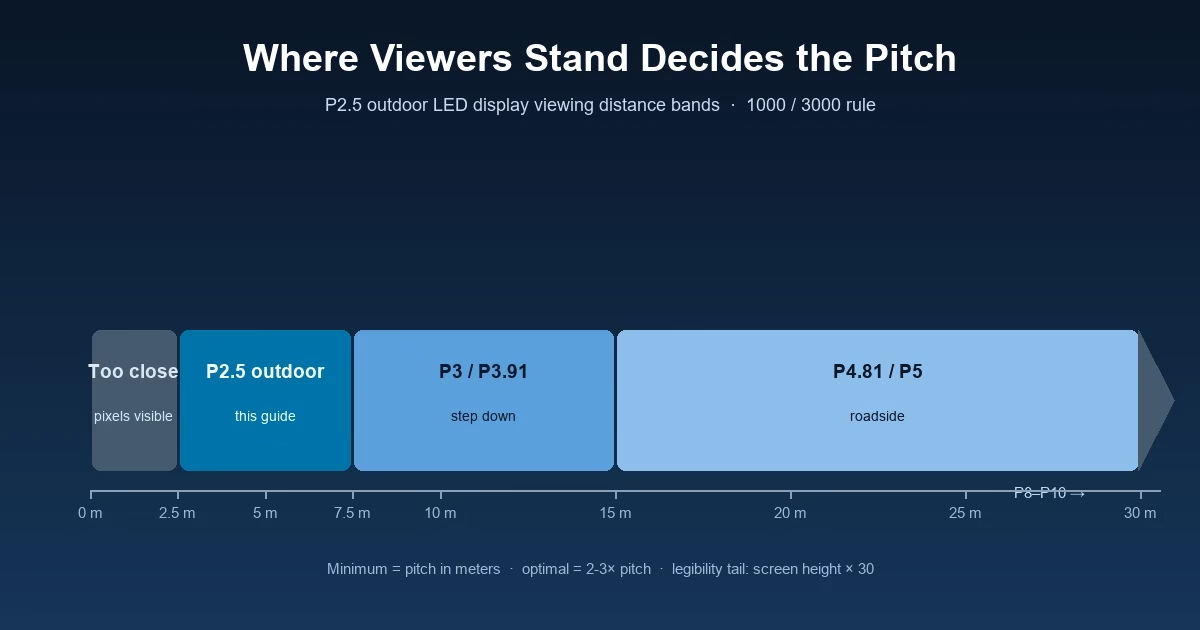
Distance bands across the outdoor ladder — P2.5 owns the 2.5–7.5 m band and hands off from there.
One placement note from the field: mixed audiences are the norm, not the exception. A storefront wall serves pedestrians at 3 m and drivers at 12 m; the design distance should be the closest audience that matters commercially, because HD for the near viewer is what stops the walk-by — the far viewer is reading headlines either way. Where the near band runs 2.5–4 m but the budget resists P2.5, the P3 outdoor collection is the first step down the ladder — the visible difference at those distances is real but modest, and the per-square-meter saving is not (the price bands show both).
Content design stretches a distance budget, too. Inside the optimal band, standard 16:9 video works as-is. Near the minimum line, larger type, shorter messages and high-contrast graphics keep the wall comfortable for viewers who stand closer than the pitch strictly allows — and the alternative, pulling every viewer back to the ideal range, is not usually an option on a sidewalk. Budget the content adjustments into the plan before paying for a finer pitch to earn the same effect.
What Do Buyers Also Ask About the P2.5 Outdoor LED Display Viewing Distance?
What is the minimum viewing distance for a P2.5 outdoor LED display?
About 2.5 meters — the standard rule takes the pixel pitch in millimeters as the minimum distance in meters. Closer than that, viewers start to see the pixel grid (the screen-door effect) instead of the image.
What is the best viewing distance for a P2.5 outdoor LED wall?
Roughly 5–7.5 meters, where 2×–3× the pitch lands. The classic 3000-rule answer for P2.5 is 7.5 m — at that distance the pixels blend into a continuous, TV-like image.
How big does a P2.5 outdoor screen need to be for 1080P?
Fifteen by seventeen 320×160mm modules: 4.8 × 2.72 m, 13.06 square meters, 255 boards. That grid produces a 1,920 × 1,088-pixel canvas — just over the 1,080 mark because each module carries 64 pixel rows.
Can viewers see individual pixels on a P2.5 screen at 2 meters?
Yes. At 2 m the 2.5 mm pixel grid is still resolvable, so content should lean on larger type and bold graphics, or the placement should move to a finer pitch. Under about 2.5 m, P2.5 stops reading as HD.
Is a P2.5 outdoor LED display overkill for a billboard?
Past roughly 15 m, yes — the resolution advantage is no longer visible and a coarser pitch delivers the same perceived image for less money. P2.5 earns its price only where the audience stands inside about 7.5 m.
How does viewing distance change the price of an outdoor LED wall?
Distance decides pitch, and pitch decides cost per square meter. Matching the pitch to the real viewing band is the single largest saving available: a coarser pitch at 10 m can cut the tag substantially — our P2.5 outdoor price guide carries the full bands.
How is viewing angle different from viewing distance?
Viewing angle is the off-axis range — about 160° horizontal on outdoor P2.5 modules — within which the image stays readable as you move sideways; viewing distance is the near-to-far axis. A wall mounted high on a facade needs both: enough angle for pedestrians across the street, enough distance range for the ones directly below.
Does higher brightness push the viewing distance farther?
No. Brightness fights sunlight; pitch fights distance. A brighter P2.5 wall stays readable in glare, but its HD line stays at 2.5–7.5 m — only a finer pitch moves that line closer, and only a coarser pitch moves it away.
References & Sourced From: P2.5 Outdoor LED Display Viewing Distance Data
- Formulas (1000-and-3000 rule; 1-arcminute acuity method; height × 30 legibility): our LED display viewing distance guide, consistent with the industry charts published by hscled (P2.5: 2.5 m minimum, 5–7.5 m comfortable) and ledscreenparts, checked September 2026.
- Module arithmetic: 320×160mm outdoor board, 128×64 dots (8,192 px, 160,000 px/㎡) per the spec tables on our P2.5 outdoor collection; canvas sizes computed from 64-pixel module rows.
- Outdoor usability band (2.5–25 m for outdoor P2.5 modules, 5,500+ nits): current manufacturer module listings checked September 2026, consistent with our brightness guide.
- Pitch ladder densities (P3.91 ≈65,000 px/㎡; P4.81 ≈43,000; P5 = 40,000): computed from pitch definitions.
Verdict: How Far Is Too Far for a P2.5 Outdoor LED Display Viewing Distance?
The method in four lines. Measure where the audience actually stands — the closest commercially important viewers, not the farthest possible ones. Under 2.5 m, step down to a finer pitch; between 2.5 and 7.5 m, P2.5 outdoor is exactly right, and the 13.06㎡ 1080P-class wall (15×17 modules) is the build to price; past 7.5–10 m, step down the ladder to P3/P3.91, then P4.81/P5, and past 30 m to P8–P10, because resolution no viewer can resolve is money spent for nothing. Run the numbers once with the screen calculator, then get the wall priced as one package — modules, cabinets, power and control together — from a LED screen manufacturer that builds P2.5 outdoor walls to the placement, not to a catalog.
Related P2.5 outdoor guides:
P2.5 Outdoor LED Display Collection · P2.5 Outdoor Price Guide · P2.5 vs P3 Outdoor · LED Display Viewing Distance · LED Pixel Pitch Guide · P2.5 Outdoor LED Display Quick Guide