
Mooncell Video Processor vs Video Splicer: Which Architecture in 2026?
The Mooncell video processor vs video splicer question is an architecture decision, not a spec race: the two families overlap at 26 million pixels and split apart everywhere else. This guide compares the Mooncell 2-in-1 processors (MVB4S Pro through M40) and the Mooncell V Series video splicers (V300 through V1400) on loading, inputs, layers, sync and price — and ends with a decision table that lands on one architecture per project. Every figure traces to the official Mooncell specification sheets (V4.x series) and the product pages linked throughout.
Short answer: A Mooncell video processor is a 2-in-1 chassis that processes and sends a 2.6M-to-26M wall in one box, with windowing, scaling and preset resolutions — the MVB4S Pro at $198 through the M40 at 26M with fiber. A Mooncell video splicer is a modular 3U-to-14U matrix that accepts up to 160 input channels across DVI-to-3G-SDI boards and drives 26M-to-130M walls with frame sync, Genlock cascading and redundant power — the V Series, quoted per project. Processors win for mid-size, portable and rental walls under about 10M; splicers win for command centers, broadcast studios and venues above 26M; between 10M and 26M the decision is inputs, layers and redundancy, not pixel count.
What Is the Difference Between a Mooncell Video Processor and a Video Splicer?
The Mooncell video processor is a 2-in-1 chassis that combines video processing — scaling, windowing, color — with the sending stage that distributes pixels to the receiving cards. The Mooncell video splicer is a modular processing matrix that accepts many input boards and drives the wall through 10-port output cards, built for installations where inputs, layers and redundancy outgrow a single-box processor.
Both families drive the same receiving cards — the A712 and A10X — and both configure in AutoLED, so the architecture decision changes the chassis and the budget, not the receiving tier or the software the team already knows.
The processor’s windowing is simpler than the splicer’s layering, and that is a feature for most mid-size jobs: the 2-in-1 line mixes up to six windows with PIP insertion and preset resolutions from 1024×768 to 2560×960, which is the conference, retail and rental story. The MVB20E-G adds the production features the splicer does not carry at 13M — ambient-light sensing for auto brightness, active 3D and Genlock on one input — which makes it the bridge for stage walls that want processor economics with a slice of splicer capability. The MVB12E and MVB4S Pro pages document the window math rung by rung for the buyer comparing against the splicer floor.
When Do You Need a Mooncell Video Processor Instead of a Video Splicer?
The processor family answers the walls that fit in one box and one budget line. The MVB4S Pro (2.6M, 4 ports, about $198) is the value pick for Full HD and 2.6M-class walls; the MVB12E (7.8M, 12 ports, 4K60, about $865) drives a full 4K wall without cascading; the MVB20E-G (13M, 20 ports, stage features, about $1,243) adds ambient-light sensing, 3D and Genlock for production walls; and the M40 (26M, 40 ports plus fiber) tops the line at the processor/splicer boundary. Rental fleets and portable production walls point to the processors: one chassis per truck, preset resolutions, and a street price that makes spares trivial.
The sending-only tier deserves a place in the comparison, because it fills the gap between the 2-in-1 processors and the splicer: the MTB400E (2.6M, 4 ports, $195) and the MTB2000E (10.4M scaled, 20 ports, HDR10, $1,010–$1,080) send PC-driven canvases without processing. A wall that runs from a PC with processing upstream takes the sending controller at a fraction of the 2-in-1 price; a wall that needs windowing and scaling in the same chassis takes the 2-in-1; a wall that outgrows both takes the splicer. The three tiers are the full Mooncell answer to “what drives my wall?” — documented together on the how to choose a Mooncell LED control system guide.
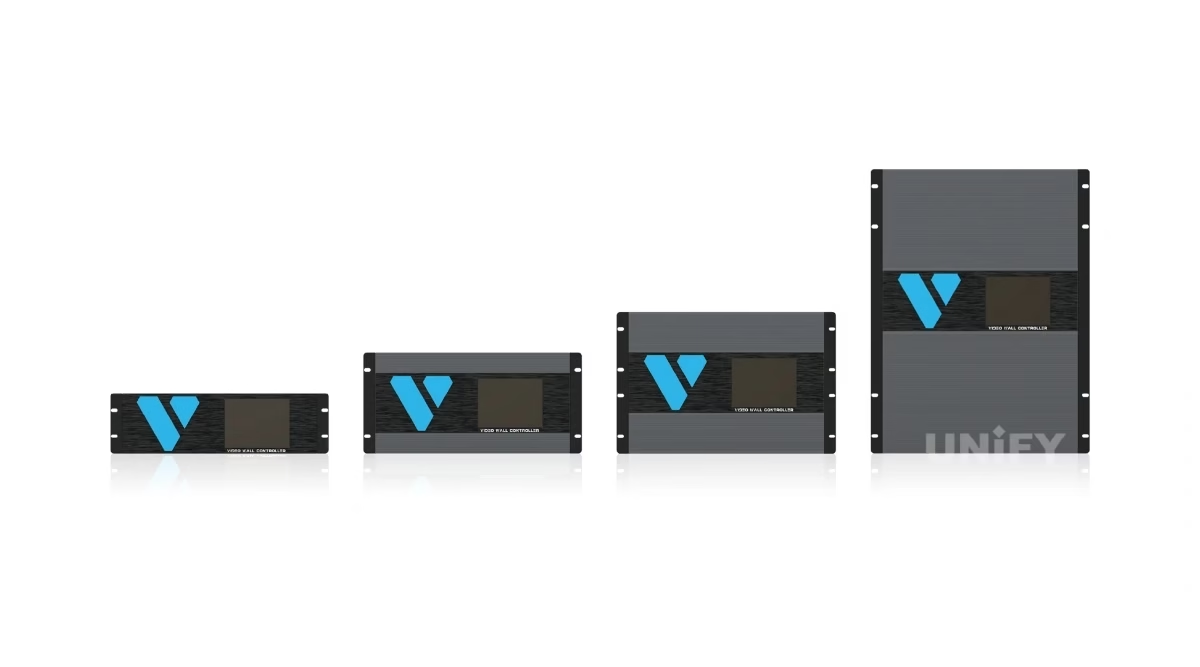
V Series splicer — the modular matrix from 26M to 130M.
When Does a Mooncell Video Splicer Beat a Processor?
The Mooncell V Series Video Splicer wins on the three axes a processor cannot stretch: inputs, layers and redundancy. A command center feeding 80 sources into one wall is a splicer conversation, not a processor one; a broadcast studio mixing 3G-SDI camera feeds with HDMI graphics needs the splicer’s modular input boards and Genlock; a wall whose operation cannot tolerate a single PSU failure needs the V500-and-up redundant 550 W modules. The V Series’s four chassis — V300 (26M, 40 ports), V500 (39M, 60 ports), V700 (65M, 100 ports) and V1400 (130M, 200 ports) — scale with the project, and every rung divides exactly at 655,360 pixels per port.
A worked example shows why the layer count matters before the pixel count does. A 65M command wall could, in principle, be driven by six 10.4M-class processors ganged by one PC — but the operators need 40 simultaneous data feeds on one canvas, which means 40 layers. The V700 splicer carries 80 layers natively and accepts the feeds on its own input boards; the processor stack would need external converters and a windowing scheme the 2-in-1 line does not offer at that count. Conversely, the same 65M as a stadium ribbon playing one video stream takes a processor-class or sending tier with fiber, because layers are irrelevant and the M40’s long-run capability is the feature that matters. Architecture follows the operation, not the megapixel headline.
MVB12E — the 4K 2-in-1 processor tier.
How Do Mooncell Processors and Splicers Compare on Loading and Inputs?
The two families meet at 26 million pixels — the M40 processor’s ceiling is the V300 splicer’s floor — and diverge on everything that scales with inputs and layers:
The input story is where the splicer separates hardest: its modular boards accept DVI, HDMI 1.3/1.4/2.0, DP 1.2, VGA and broadcast 3G-SDI with deinterlacing — a processor’s fixed input set cannot host a camera wall or a legacy VGA fleet without external converters. The LED video processor category page maps the wider cross-brand class for both architectures.
The input-board matrix deserves the same treatment as the sync layer, because it is the splicer’s structural advantage over every processor. The V Series boards run from 4× DVI and 4× HDMI 1.3 (2048×1152@60) through HDMI 2.0 and DP 1.2 boards that accept 4K60, ultra-wide 7680×1080 and tall 1920×4800, to the 8× VGA board for analog legacy sources and the 4× 3G-SDI board for broadcast feeds. A command center mixing workstation DVI, camera SDI and graphics HDMI is one splicer project; the same wall on processors needs external converters per source type. The V Series page carries the full board table with EDID customization on every input.
What Do Frame Sync, Genlock and Layer Count Mean on a Mooncell Splicer?
Three splicer capabilities explain most of the price difference between the two architectures, and they are worth understanding before the budget meeting:
- Frame synchronization holds the spliced canvas together with no frame loss — the wall reads as one display even when it spans a 200-port chassis driving cabinets across a command floor. On a single-box processor, the canvas is small enough that sync is a background property; on a splicer it is the feature the operation depends on.
- Genlock cascading ties multiple splicer chassis to the same clock — the multi-unit venue story that pairs with the 4:4:4 color processing and HDR10 the V Series carries. A broadcast studio running camera-facing walls from two chassis needs the cascade; a rental processor never will.
- Layer count scales with the chassis: 32 layers on the V300 through 160 on the V1400, each layer free to roam and scale across the canvas. A control room running dozens of simultaneous data feeds sizes the chassis by layers as much as by pixels — the same logic the V Series page documents rung by rung.
How Do the Price Stories of Mooncell Processors and Splicers Compare?
The price stories are as different as the architectures. Processors are catalog products with street prices: the MVB4S Pro at about $198, the MVB12E at about $865, the MVB20E-G at about $1,243, and the M40 quoted per project at the 26M boundary. Splicers are project hardware with no public retail price — the chassis, the input-board mix and the redundancy configuration set each quote, with the video-wall processor class on the same channels running from $1,799 (Magnimage LED-780H) to $4,369 (VDWALL LVP404-412) as the frame. The honest comparison is total control-chain cost: a 7.8M wall’s processor chain (MVB12E plus A712 cards) lands near $1,300, while a 65M command wall’s splicer chain is a project line item — the Mooncell LED controller price guide carries the full math.
The maintenance story completes the price comparison. A processor fleet is spare-friendly by design: one spare unit per venue covers the sending tier, the receiving cards carry one-per-ten spares, and the configuration readback makes a processor swap a minutes-long job — the rental discipline documented on the Mooncell LED controller troubleshooting guide. A splicer installation is different: the chassis is a fixed asset with hot-backup input paths and redundant 550 W modules, so the maintenance model is service contracts and spare boards rather than spare chassis. Factor that operating cost into the architecture decision — a wall that must never darken justifies the splicer’s redundancy; a fleet that re-rigs weekly justifies the processor’s portability.
How to Choose Between a Mooncell Video Processor and a Video Splicer
Six questions collapse the architecture decision:
The mid band between 10M and 26M is the honest gray zone: the MTB2000E sending controller covers a 10.4M PC-driven canvas, the MVB20E-G covers 13M with stage features, the M40 covers 26M with fiber, and the V300 splicer covers the same 26M with 32 layers and modular inputs. When inputs and layers are modest, the processors win on price and portability; when the wall is a control surface, the splicer wins on everything that matters.
One practical note on the 26M boundary that most comparisons miss: the M40 and the V300 both reach 26 million pixels over 40 ports, and the M40 adds 4× 10G fiber for long runs while the V300 adds layers and modular inputs — so a stadium ribbon with long fiber runs may pair the M40 with the receiving tier, while a control room with dozens of sources takes the V300 even at the same pixel count. The receiving cards are identical either way: the A712 for HUB75E modules and the A10X for compact frames, selected by the cabinet rather than the chassis — which is why the receiving-card guide applies to both architectures unchanged.
What Do Buyers Ask About Mooncell Processors vs Splicers?
The installation profile settles the edge cases. Fixed installations that never move — command centers, broadcast studios, venue walls — point to the splicer when inputs and layers demand it, and the splicer’s redundancy justifies itself over a decade of operation. Installations that tour, rent or re-rig weekly point to the processors, whose street prices and preset-resolution workflow make fleet management a spreadsheet exercise. And the LED screen for events guide covers the staging side of the same choice, where portability and speed of rig beat raw layer count every time. The synchronous vs asynchronous mode decision precedes both, since every architecture on this page is the synchronous side of that split.
Conclusion: Which Mooncell Architecture Should You Choose?
The Mooncell video processor vs video splicer decision is a scale-and-surface call. Walls under about 10M that move, tour or live behind a single budget line take the processors — the MVB4S Pro at $198 through the MVB20E-G’s stage features at $1,243, with the M40 bridging to 26M. Walls above 26M, or any wall whose inputs, layers and redundancy outgrow a single box, take the V Series splicer — modular input boards to 3G-SDI, 32 to 160 layers, frame sync, Genlock cascading and redundant power, quoted per project. The two families meet at the 26M boundary, share the receiving tier and the AutoLED workflow, and part company on price structure and operational scale. Size the load, count the inputs, and the architecture names itself.
Planning a wall and unsure which architecture fits? Talk to us — we are the LED screen manufacturer behind unifyled.com, and every Mooncell system we ship is configured, tested and warrantied inside the display.