
LED All-in-One Display Market 2026: From Pilot Product to Standard Meeting-Room Configuration
In 2024, an LED all-in-one display was a showcase item. By mid-2026, it is the default answer to the 100–150-inch meeting-room question. Research firm Hangjianet reports that about 80% of 20 surveyed supply-chain companies grew all-in-one LED shipments year-on-year in H1 2026, half of them by more than 30%; TrendForce counted actual 2025 shipments above 14,000 units, beating its own 12,000–13,000 forecast; and Omdia puts all-in-one LED sales growth at sixfold since 2020. Prices tell the same story — mainstream 135-inch P1.5 units now sell below RMB 100,000, down from a 200,000-plus RMB ceiling a few years ago. This report compiles the growth data, the price mechanics, the export wave, and a buyer’s checklist for the LED all-in-one display market in 2026.
Short answer: The LED all-in-one display market in 2026 is defined by standardization and price collapse. About 80% of surveyed manufacturers grew shipments in H1 2026, 2025 shipments exceeded 14,000 units against a 12,000–13,000 forecast, and sales have grown sixfold since 2020 (Omdia). Specifications converged on 135-inch P1.5 2K and 165-inch P1.8 2K as mainstream, with 165-inch P0.9 4K as the high-end tier; mainstream 135-inch prices fell below RMB 100,000 as COB yields rose and panel makers entered production. The replacement window is now opening overseas — about one year behind China — and global brands are responding with lower-priced entries.
What Is Driving the LED All-in-One Display Market Boom in 2026?
An LED all-in-one display is a self-contained LED video wall — panel, controller, and audio in one unit — that installs against a wall and behaves like a very large television. Four forces, mapped by Hangjianet’s survey of 20 supply-chain companies, explain the 2026 boom.
Supply-side cost reduction. COB packaging yields matured through 2025–2026, and panel giants — BOE, TCL CSOT, and HKC — entered the display module business at factory scale. Both effects pushed BOM costs down through the curve analyzed in our COB LED display price 2026 report, moving all-in-one units from custom-engineering territory into government and enterprise batch procurement.
Demand-side replacement. In the 100–150-inch commercial display segment, LED all-in-one units are systematically replacing projectors and LCD video walls: zero seams, high brightness, eye-protective panels, no dark-room requirement, and stable image quality. H1 2026 marked the point where the shift stopped being pilot adoption and became standardized meeting-room configuration.
Scenario expansion. The same product now serves smart classrooms, corporate training rooms, brand showrooms, retail stores, and remote-collaboration spaces — breaking the single-scenario ceiling that limited earlier generations.
Overseas catch-up. Overseas markets trail China by roughly one year in technology iteration, and 2026 is their replacement window — demand is concentrating in Southeast Asia, the Middle East, Europe, and the United States. The earnings reports of the last week of August confirm the trend from three directions: Ledman reported LEDHUB smart conference all-in-one sales and revenue growing sharply in overseas small-office segments; Absen listed smart all-in-one as a priority investment area; and Hisense launched a COB G-series all-in-one line.
How Fast Is the LED All-in-One Display Market Growing in 2026?
The growth numbers stack across three independent trackers. Hangjianet’s survey of 20 core supply-chain companies found about 80% reported year-on-year shipment growth in H1 2026 — half estimating growth above 30%, half in the 10–30% band — with the remaining 20% flat or transitional, citing overlap between mainstream sizes and engineering displays and longer government procurement cycles. TrendForce reports actual 2025 shipments exceeded 14,000 units against a 12,000–13,000 forecast. Omdia measures all-in-one LED display sales at six times the 2020 level, and invidis’s market coverage of the segment noted demand “rocketing” for all-in-one LED displays within a global LED video display market up 20% year-on-year.
Context matters: the global LED display industry is not uniformly strong in 2026. Omdia counted Q1 2026 worldwide LED display shipments up only 0.6% year-on-year with revenue down 2.3% — a “volume up, value down” adjustment documented in our August price hike analysis. All-in-one is the exception: growth inside a flat market is category shift, not tide.
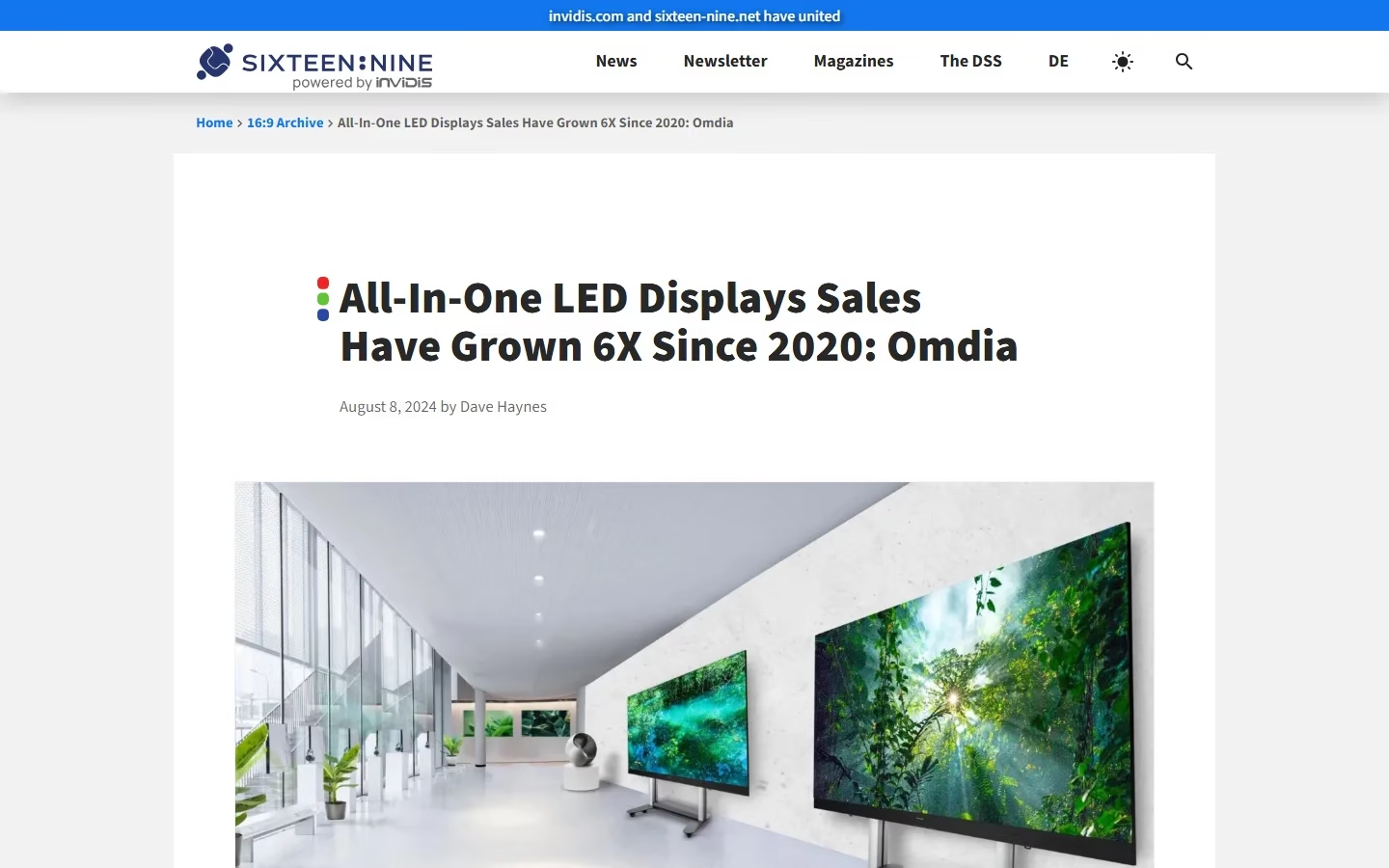
The “de-projectorization” inflection is the operational marker: by H1 2026, LED all-in-one units became a standard business configuration for meeting rooms rather than a niche pilot, with installed-base replacement — not new demand — the core growth engine.
Why Did LED All-in-One Display Prices Fall Below 100,000 RMB?
The price curve is the story buyers feel first. Mainstream 135–138-inch 16:9 all-in-one units carried a 200,000-plus RMB price tag in earlier years; the mainstream band in 2026 is 130,000–150,000 RMB, with some 135-inch P1.5 models below 100,000 RMB. Two mechanics drove the collapse, and one headwind is pulling the other way.
COB economics. Chip-on-board packaging — bare chips bonded directly to the board — lifted yields as process maturity climbed, cutting the single largest cost block of fine-pitch modules. The same curve that reset SMD vs COB vs GOB economics across the industry applies directly to all-in-one panels.
Panel-maker entry. BOE, TCL CSOT, and HKC entered LED display module production with display-factory scale economics — the same “capacity for share” play that reset LED packaging technology pricing. Volume from three panel giants collapses the module premium that used to justify custom pricing.
The specification convergence followed. Products have consolidated into three clear tiers — 135-inch P1.5 2K and 165-inch P1.8 2K as mainstream; 165-inch P0.9 4K as high-end — replacing the fragmented size and pitch menu of 2023–2024. Standardization allows batch production, and batch production is what made sub-100,000 RMB pricing possible.
The headwind. This price decline is a technology-route dividend, not a raw-material gift. Driver ICs, PCBs, and packaging inputs rose 10–80% through 2026, as documented in our driver IC shortage and supply chain price surge reports. All-in-one prices fell despite those inputs — which is why the next price step depends on yield and volume, not on input markets stabilizing.
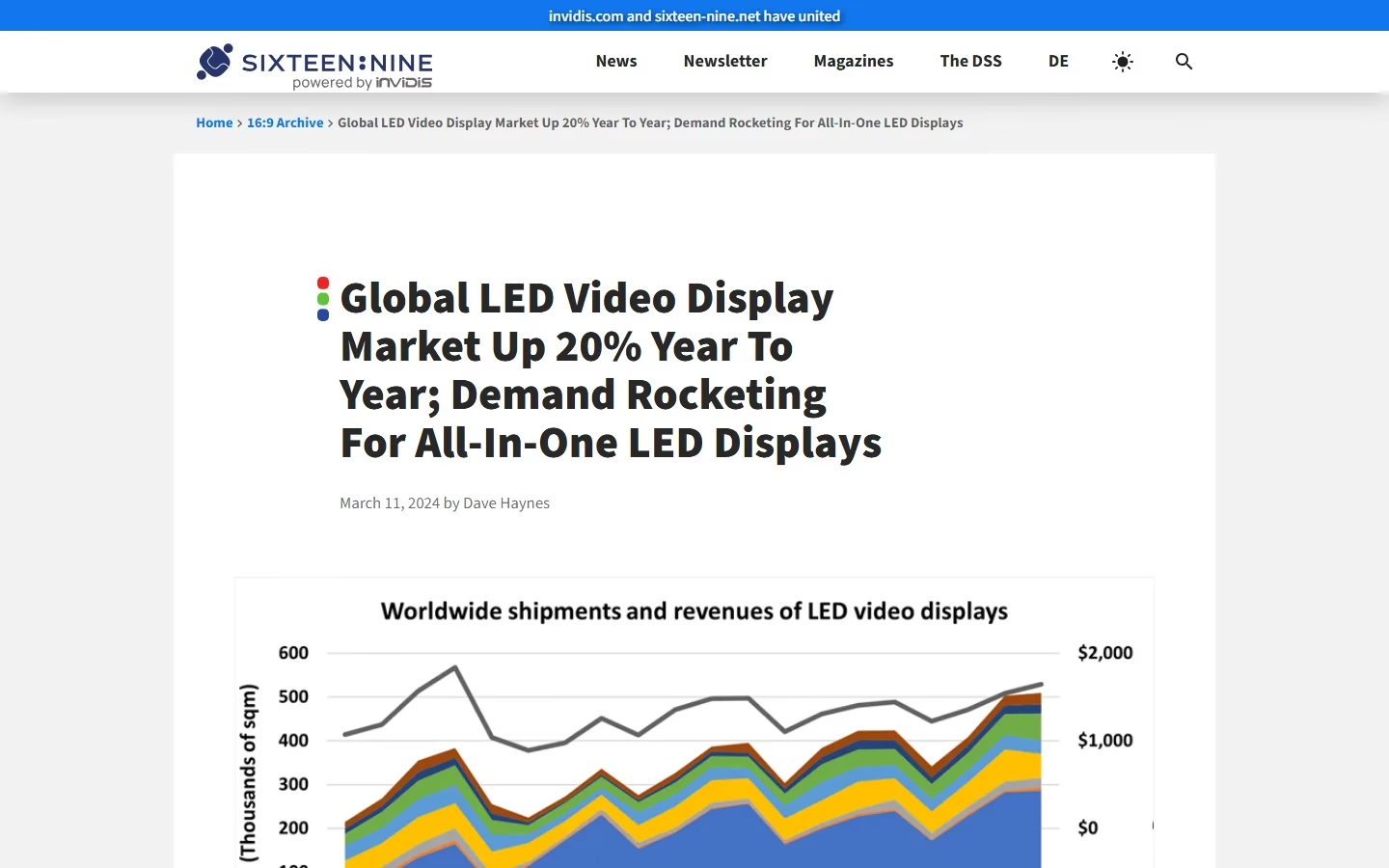
What Does the LED All-in-One Display Market Shift Mean for Global Buyers in 2026?
The shift reaches international buyers as a replacement window with three signatures.
Chinese export is one year ahead. Overseas markets lag China by about one year in iteration, so the 2026 overseas replacement window matches the 2025 Chinese one — and Chinese products enter it with standardized specs and proven cost structure. The export lane is now visible: Skyworth’s commercial display arm signed an exclusive Korean distribution agreement with VECT in May 2026, and VECT announced in August that Skyworth all-in-one samples had arrived for KC certification — Korean-language localization complete. Ledman’s LEDHUB is growing in overseas small-office segments, and Absen’s overseas revenue reached 78.7% of total in H1 2026 with all-in-one named a priority.
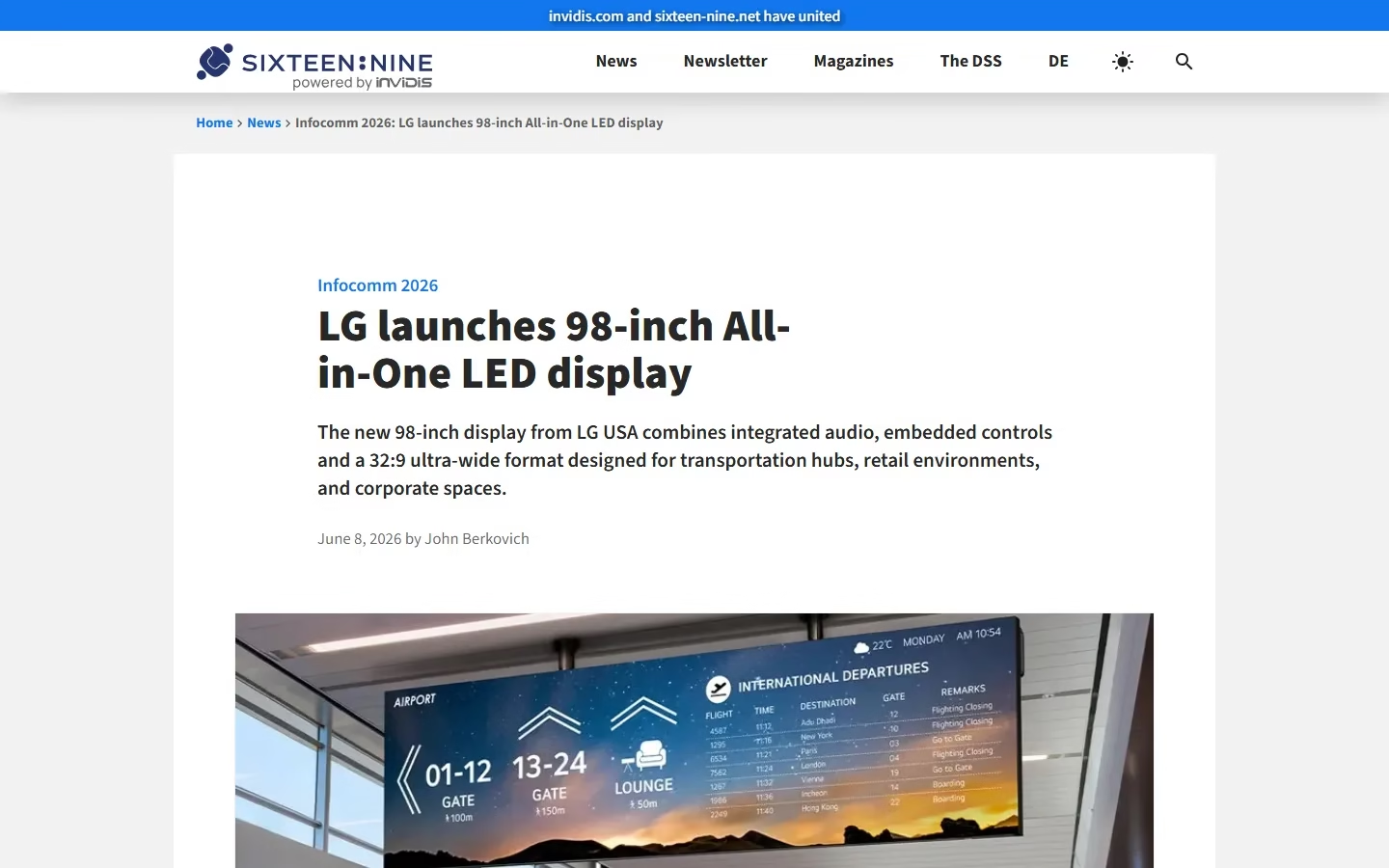
Global brands are answering with price. PPDS (Philips professional displays) launched its Unite LED 3000 series in late August 2026 as its “most accessible 16:9 direct-view LED range to date,” explicitly targeting buyers who previously had to compromise on performance or support at lower price points. LG pushed the category in the other direction at InfoComm 2026 with a 98-inch all-in-one unit — the category’s small-format frontier, competing head-on with large-format LCD panels.
For buyers, the meaning is concrete. A 135-inch P1.5 2K meeting wall with controller and audio integrated now sits inside the budget that previously bought a projector and screen — and it runs without a dark room, without lamp replacement, and with the same surface for video calls, documents, and presentations. The practical question is no longer whether to buy, but which supplier survives the service test. Unifyled supplies conference LED display solutions, indoor LED walls, and LED poster displays factory-direct, with pre-stocked driver ICs, in-house SMT and calibration lines, and cost-component quotations — the structure that keeps pricing and delivery firm while the category scales.
How Should Buyers Choose an LED All-in-One Display in 2026?
An all-in-one LED display is judged by five questions, and the 2026 standardization makes the answers comparable across suppliers.
- Match size and resolution to the room, not the catalog. 135-inch P1.5 2K fits standard meeting rooms with 3–5 meter viewing distances; 165-inch P0.9 4K serves executive and training rooms where text density matters. Let the viewing distance dictate the pitch.
- Decide the packaging technology consciously. COB panels now dominate the fine-pitch mainstream for durability, contrast, and sealed-module reliability; SMD remains lower-cost at larger pitches. Ask which the quote is built on, and what the module-level repair path is in your region.
- Verify the ecosystem, not just the panel. Confirmed compatibility with the meeting software, video conferencing codecs, and (for Chinese-government buyers) domestic operating systems decides whether the unit works day one. Hisense’s push to make conference displays compatible with domestic OS ecosystems signals where procurement is heading.
- Check the service footprint before the price list. The category’s service gap is real — a display that ships globally but cannot be serviced locally fails the 100,000-hour promise. Ask for local support partners and spare-module stock, not headquarters documentation.
- Get a cost-component quotation with a validity window. With driver ICs and PCB inputs still high, a firm quote with documented components and a stated validity period is the difference between a budget and a surprise — the same discipline covered in our procurement analysis of the 2026 price cycle.
Quote an LED All-in-One Display for Your Project — Submit Your RFQ
Send your room dimensions, viewing distance, and meeting software stack, and Unifyled’s engineering team will return an all-in-one quotation with packaging-technology options, cost-component breakdowns, and firm validity periods. Covering conference LED display solutions, indoor LED walls, and outdoor fixed LED displays.
Contact: unifyledscreen@gmail.com | WhatsApp: +86-191-18802497 | RFQ Form: unifyled.com/contact
What Sources Back the LED All-in-One Display Market 2026 Data? References & Sourced From
This analysis draws on primary-source reporting, company earnings releases, and industry research. All figures have been cross-verified across at least two independent sources where available.
- Hangjianet Research (行家说产研中心) — “《LED显示产业季度分析报告 Q2(2026)》”; “20家企业拆解:LED一体机增长的四重逻辑” (August 2026). via OFweek
- Omdia — All-in-one LED display sales growth data (6x since 2020); Q1 2026 LED display shipment and revenue data, cited via invidis and industry media. via invidis
- invidis — “Global LED Video Display Market Up 20% Year To Year; Demand Rocketing For All-In-One LED Displays” (March 2024); “Infocomm 2026: LG launches 98-inch All-in-One LED display” (June 8, 2026); “All-In-One LED Displays Sales Have Grown 6X Since 2020: Omdia” (August 2024). invidis.com
- Ledman Optoelectronics (雷曼光电) — H1 2026 earnings release (August 26, 2026); LEDHUB overseas growth and COB overseas revenue up 70%+, via Sina Finance. finance.sina.cn
- Absen (艾比森) — H1 2026 results and August 25 investor briefing: revenue 1.973 billion RMB, LED display gross margin 36%, overseas share 78.7%, all-in-one named a priority. via laoyaoba
- Hisense Visual (海信视像) — H1 2026 earnings (August 26, 2026); COB G-series all-in-one launch. finance.sina.com.cn
- Newsis (Korea) — “벡트, ‘스카이워스’ LED 디스플레이 국내 판매 절차 돌입” (VECT begins Korean sales process for Skyworth LED displays, August 25, 2026). newsis.com
- Digital Signage Today — “PPDS announces Philips Unite LED 3000 Series” (August 26, 2026). digitalsignagetoday.com
- TrendForce — 2025 all-in-one LED display shipment forecast and actuals (via LEDinside, June 2026). via LEDinside
Editorial disclaimer: This report has been compiled by the Unifyled Editorial Team from publicly available industry sources, official company announcements, and third-party research. Market data and company actions referenced herein reflect information available as of August 27, 2026. This article does not constitute financial or procurement advice. Readers should verify current specifications and pricing directly with manufacturers before making purchasing decisions.
Author: Unifyled Editorial Team | Published: August 2026 | Category: LED Industry News, LED All-in-One Displays
Related: World Cup 2026 LED Displays: Stadium-by-Stadium Project Data · LED Cinema Screen 2026: Direct-View LED Overtakes Projection · LED Display Industry H1 2026 Earnings Roundup · CIOE 2026 LED Display Recap: Micro LED From Lab to Production Line