
NovaStar Receiving Card · A5s Series
Novastar A5s Plus LED Wall Receiving Card
512×384@60Hz loading capacity with 32 parallel RGB data groups — Color Management, 18bit+ grayscale, pixel-level calibration, 1-frame low latency, dual-card backup, and 90° image rotation. EMC Class B compliant for professional LED video walls and fixed installations.
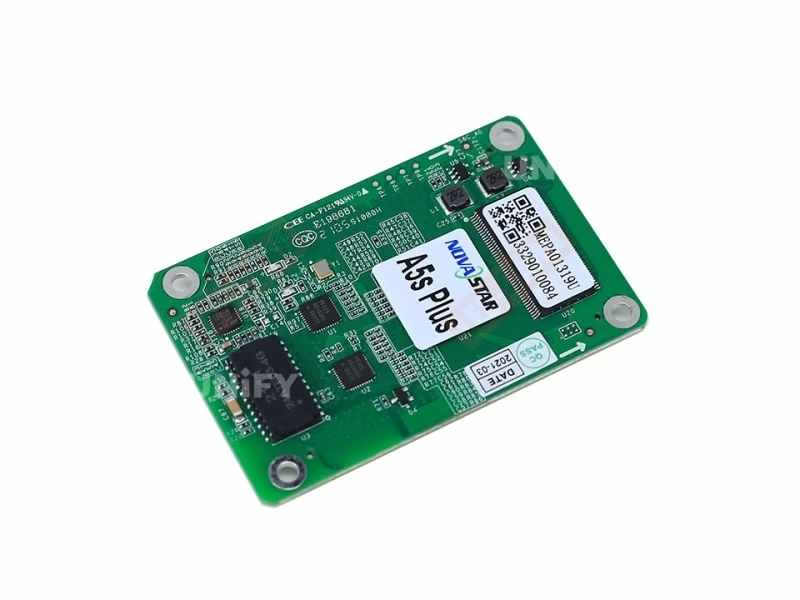
What Is the Novastar A5s Plus LED Wall Receiving Card?
The Novastar A5s Plus LED Wall Receiving Card is a compact, high-performance general-purpose receiving card developed by NovaStar for professional LED display systems. A single card supports resolutions up to 512×384@60Hz with PWM driver ICs at 8-bit color depth, or 256×384@60Hz at 10-bit and 12-bit. It delivers 32 groups of parallel RGB data (expandable to 64 serial groups, with reserved pins for 128 groups), making it one of the most versatile small-form-factor receiving cards in NovaStar’s lineup.
The A5s Plus is the upgraded version of the A5s, adding seam correction via mobile phone, enhanced color management supporting Rec.709/DCI-P3/Rec.2020 color gamuts, 18bit+ grayscale processing (4× improvement over standard), and 1-frame low latency for PWM driver ICs. It uses high-density connectors for communication — limiting the effects of dust and vibration — and is EMC Class B compliant, ensuring reliable operation in electrically noisy on-site environments.
As a critical component in the LED screen manufacturer supply chain, the A5s Plus sits between the LED sending controller and the LED modules — receiving pixel data via Gigabit Ethernet, decoding it, and driving individual LED pixels. It works seamlessly with all NovaStar sending controllers (MCTRL, VX, Taurus series) and is configured via NovaLCT software. For the complete control system architecture, see our guide on synchronous vs asynchronous LED control.
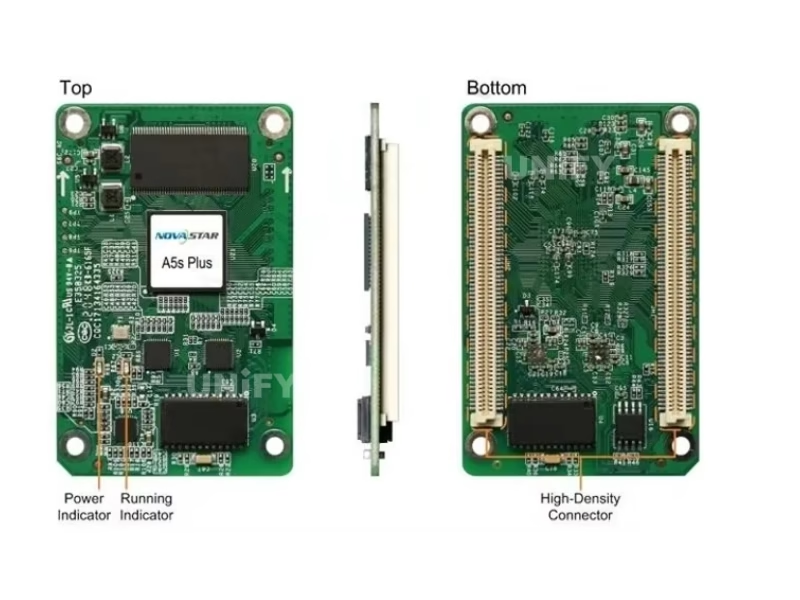
Novastar A5s Plus Technical Specifications
Verified against official NovaStar A5s Plus Receiving Card Specifications V1.3.0 (July 2024)
| Parameter | Specification |
|---|---|
| Max Resolution (PWM IC, 8bit) | 512×384@60Hz |
| Max Resolution (PWM IC, 10/12bit) | 256×384@60Hz |
| Max Resolution (Common IC, 8bit) | 384×384@60Hz |
| Max Resolution (Common IC, 10/12bit) | 192×384@60Hz |
| Parallel RGB Data Groups | 32 (64 serial, expandable to 128) |
| Input Voltage | DC 3.8 V to 5.5 V |
| Rated Current / Power | 0.6 A / 3.0 W |
| Dimensions | 70.0 × 45.0 × 8.3 mm |
| Net Weight | 16.2 g |
| Connector Type | High-density connector (dust and vibration resistant) |
| Ethernet Input | 2× Gigabit Ethernet ports with loop backup |
| Operating Temperature | –20°C to +70°C |
| Operating Humidity | 10%–90% RH, non-condensing |
| Certifications | RoHS, EMC Class B |
| Packing | 80 cards per packing box (392.0×200.0×123.0 mm) |
Novastar A5s Plus Key Features: Display Effect & Image Quality
The A5s Plus is engineered to maximize visual performance — from raw pixel data to what the audience actually sees.
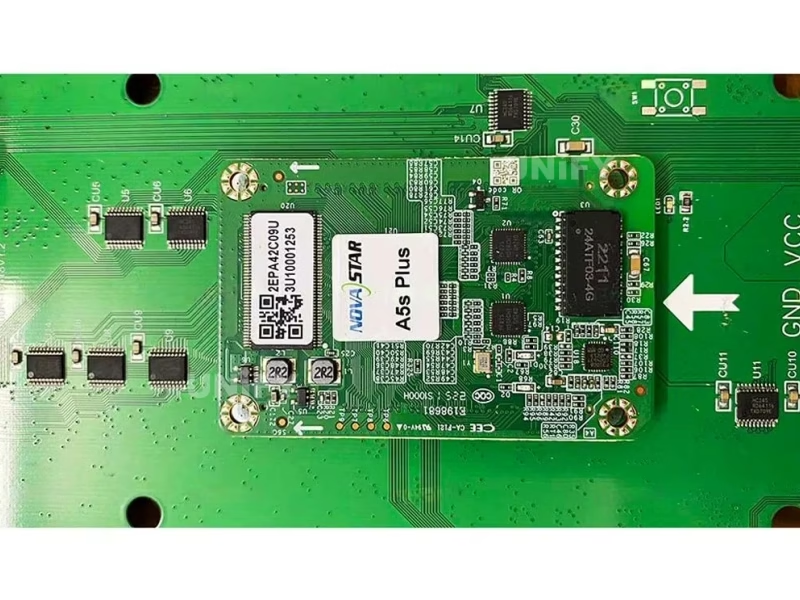
Color Management & 18bit+ Grayscale
Supports standard color gamuts — Rec.709, DCI-P3, Rec.2020 — plus custom profiles for precise color reproduction. 18bit+ processing improves LED display grayscale by 4×, eliminating grayscale loss at low brightness and delivering smoother gradients. See our LED display grayscale guide for technical background.
Pixel-Level Calibration
Works with NovaStar’s high-precision calibration system to calibrate brightness and chroma per pixel, eliminating LED-to-LED variance. Automatic Module Calibration uploads stored coefficients from replacement modules on power-up — no manual recalibration needed after LED screen maintenance swaps.
Seam Correction + Quick Line Fix
Brightness discrepancies at module/cabinet seams can be adjusted automatically or manually via mobile phone (requires TU series controller). Dark or bright lines at seams are corrected instantly in NovaLCT V5.2.0+ without changing the video source.
1-Frame Latency + 3D + 90° Rotation
Latency reduced to 1 frame for PWM driver ICs — critical for live broadcast and real-time camera feeds. 3D output with compatible controllers. Display image can be rotated in 90° increments (0°/90°/180°/270°). Individual gamma adjustment for R/G/B channels.
Novastar A5s Plus Reliability Features: Redundancy & Diagnostics
The A5s Plus includes hardware-level redundancy and monitoring — not afterthoughts, but engineered safeguards for mission-critical LED walls.
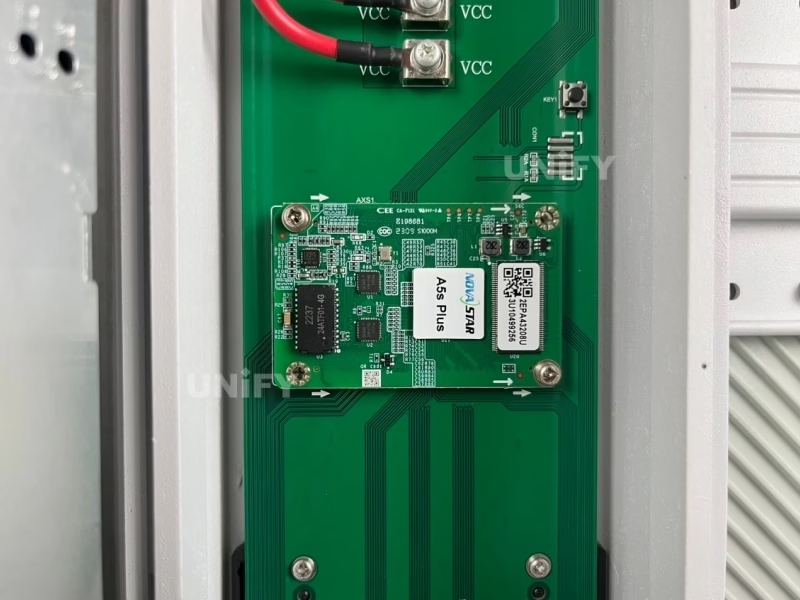
Dual Card Backup & Status Monitor
Two A5s Plus cards can be mounted on a single hub board. When the primary card fails, the backup takes over immediately — no interruption. Working status of both primary and backup can be monitored in NovaLCT V5.2.0+. Ideal for LED display system redundancy in control rooms and broadcast.
Loop Backup via Ethernet
The card and controller form a loop via primary and backup Ethernet lines. When a fault occurs at any point in the cabling chain, the screen continues displaying normally — the signal reaches all cards via the redundant path. Running indicator flashes 8×/0.5s when redundancy is active.
Dual Program & Dual Config Backup
Two firmware copies stored at factory — prevents bricking during firmware updates. Configuration parameters stored in both application and factory areas; restore factory defaults to application area if needed. Firmware and config can be read back to local PC.
Bit Error Detection & Health Monitoring
Monitors Ethernet port communication quality with erroneous packet counting. Temperature and voltage monitoring without external devices. Dual power supply status detection. Mapping 1.1 displays controller number, card number, and Ethernet port info on cabinets for easy topology identification.
Novastar A5s Plus Indicator Diagnostics & Dimensions
The single green Running indicator provides 6 distinct patterns for rapid field diagnosis — no tools required.
| Indicator | Color | Pattern | Meaning |
|---|---|---|---|
| Running | Green | Flash 1×/1s | Card normal, Ethernet OK, video source available |
| Running | Green | Flash 1×/3s | Ethernet connection abnormal |
| Running | Green | Flash 3×/0.5s | Ethernet OK, but no video source |
| Running | Green | Flash 1×/0.2s | Using backup firmware (app program failed) |
| Running | Green | Flash 8×/0.5s | Ethernet loop backup active (redundancy engaged) |
| Power | Red | Always on | Power input normal |
Physical Dimensions
| Board Size | 70.0 × 45.0 mm |
| Board Thickness | ≤ 2.0 mm |
| Total Thickness | ≤ 8.7 mm (board + components) |
| Hub Board Gap | 5.0 mm (after connector mating) |
| Net Weight | 16.2 g |
| Mounting Holes | GND-enabled, 5.0 mm copper pillar recommended |
Novastar A5s Plus Software & Calibration: NovaLCT Configuration
All A5s Plus configuration, calibration, and monitoring is handled through NovaStar’s free NovaLCT software (V5.2.0+). The official NCE training covers the complete receiving card workflow.
NovaLCT (Windows)
Free from novastar.tech. Configure receiving card parameters, upload calibration coefficients, manage rcfgx files, monitor card health, and update firmware. V5.2.0+ required for individual RGB gamma, dual card monitoring, and dark/bright line correction.
Seam Correction via Mobile
Adjust module/cabinet seam brightness automatically or manually using your phone — requires TU series controller. No PC needed for on-site fine-tuning after installation.
Firmware & Config Management
Read back firmware and configuration parameters to local PC. Quick calibration coefficient upload. One-click apply coefficients from module flash. Dual program backup prevents bricking during updates. Download from the NovaStar software page.
Novastar A5s Plus Application Scenarios: Where This Receiving Card Excels
The A5s Plus is a general-purpose receiving card — suitable for virtually any LED display. But its specific strengths make it the best choice for these scenarios.
Broadcast & Live Production LED Walls
1-frame low latency + 18bit+ grayscale eliminates camera-visible artifacts. Dual card backup ensures zero on-air failures. EMC Class B compliance prevents interference with broadcast equipment. The industry-standard choice for studio indoor LED display screens.
Stadium & Large Venue Displays
Loop backup via dual Ethernet lines means a single cable cut anywhere in the chain won’t take down a section. High-density connectors resist vibration in high-SPL environments. 32 parallel data groups handle dense pixel layouts.
Fine-Pitch Indoor Video Walls
Pixel-level brightness and chroma calibration is essential for fine-pitch displays where even 1% variance between LEDs is visible at close viewing distance. 18bit+ grayscale prevents banding in smooth gradients on conference room and lobby LED display walls.
Creative & Rotated LED Installations
90° image rotation (0°/90°/180°/270°) enables diamond-pattern and portrait-orientation creative displays without external rotation hardware. Smart Module support with temperature, voltage, and flat cable monitoring for complex LED screen installations.
Why Source Your Novastar A5s Plus from UnifyLED?
Receiving cards are the most numerous active component in an LED display — their reliability and authenticity directly determine system uptime.
Genuine NovaStar — Never Refurbished
As a professional LED screen manufacturer and authorized NovaStar distributor, every A5s Plus is sourced directly from NovaStar’s production line with original blister packaging and latest firmware. We never sell grey-market, refurbished, or batch-mixed receiving cards.
Pre-Shipment Batch Testing
80 cards per packing box. We test 10% of every batch: visual inspection, power-on indicator verification, Ethernet communication test, and calibration coefficient upload. For bulk orders (10+ boxes), full-batch testing is available upon request.
Rcfgx File & Calibration Support
Need the correct receiving card configuration file for your specific LED modules? Our engineering team provides rcfgx file preparation, calibration coefficient loading, and mapping configuration support — especially valuable for mixed-batch module deployments. Contact via WhatsApp, email, or remote desktop.
Bulk Order Logistics
80 cards per factory packing box (392.0×200.0×123.0 mm). Volume pricing available for 10+ boxes (800+ cards). Worldwide shipping from Shenzhen with full customs documentation. Standard 5–10 business days express, 15–25 days economy.
Novastar A5s Plus Pricing & Bulk Order Information
Factory-direct pricing with significant volume discounts for bulk receiving card orders.
Per-Order Specifications
- Original NovaStar A5s Plus (latest firmware)
- Blister-packaged individually
- 80 cards per factory packing box
- Batch QC test report (upon request)
- Rcfgx file preparation support
- Lifetime technical support
Need A5s or A8s instead? We stock the complete NovaStar receiving card range. Contact us for model comparison and bundle pricing across mixed card types.
Get Your A5s Plus Quote
Response within 2 hours (GMT+8)
unifyledscreen@gmail.com
WhatsApp / Phone
+86-191-18802497
Location
Changsha, Hunan, China · GMT+8
Request Quote & Availability →
Bulk orders · Rcfgx support · Mixed model bundles
Frequently Asked Questions About the Novastar A5s Plus LED Wall Receiving Card
What is the maximum resolution of the Novastar A5s Plus?
512×384@60Hz with PWM driver ICs at 8-bit. 256×384@60Hz at 10/12-bit. With common driver ICs: 384×384@60Hz (8-bit) or 192×384@60Hz (10/12-bit).
What is the difference between the A5s Plus and the standard A5s?
The A5s Plus adds seam correction via mobile phone (with TU series), enhanced color management (Rec.709/DCI-P3/Rec.2020), higher max resolution (512×384 vs 512×256 for the A5s), and EMC Class B compliance. The A5s Plus is the recommended choice for new installations.
How does dual card backup work?
Two A5s Plus cards mount on a single hub board. When the primary card fails, the backup takes over immediately with zero interruption. Both cards’ status can be monitored in NovaLCT V5.2.0+. Used in broadcast, control rooms, and mission-critical installations.
Can the A5s Plus work with non-NovaStar sending controllers?
No. Like all NovaStar receiving cards, the A5s Plus communicates using NovaStar’s proprietary protocol and requires a NovaStar sending controller (MCTRL, VX, or Taurus series). It is not compatible with Colorlight, Linsn, or Huidu controllers.
How do I interpret the Running indicator patterns?
Flash 1×/1s = normal. Flash 1×/3s = Ethernet issue. Flash 3×/0.5s = no video source. Flash 1×/0.2s = backup firmware active. Flash 8×/0.5s = loop backup engaged. The red Power indicator should always be on.
What software do I need to configure the A5s Plus?
NovaLCT V5.2.0 or later (Windows, free from novastar.tech). V5.2.0+ required for individual RGB gamma, dual card monitoring, dark/bright line correction, and mapping 1.1. Seam correction via mobile phone requires a TU series controller.
What are the power requirements?
DC 3.8 V to 5.5 V input. Rated current: 0.6 A. Rated power consumption: 3.0 W. Recommended power input is 5.0 V.
How many data groups does the A5s Plus support?
32 groups of parallel RGB data, or 64 groups of serial data (expandable to 128 via multiplexing). This is one of the highest data group counts among NovaStar’s general-purpose receiving cards.
Ready to Source the Novastar A5s Plus LED Wall Receiving Card?
512×384 loading. 32 parallel data groups. Dual card backup. Pixel-level calibration. Factory-direct pricing, rcfgx file support, global logistics. Tailored quotation within 24 hours.
unifyledscreen@gmail.com | +86-191-18802497
Technical Deep-Dive
How LED Receiving Card Choice Affects Display Quality & Reliability: The Novastar A5s Plus Engineering Analysis
Published: August 2026 | 10 min read | UnifyLED Engineering Team
The receiving card is the most overlooked component in LED display system design. B2B buyers spend weeks comparing LED module specs — pixel pitch, brightness, refresh rate — but rarely apply the same rigor to the component that actually drives those modules. Yet the receiving card is the single largest determinant of display uniformity between cabinets, and the component whose failure is most likely to cause visible artifacts on screen during live operation. This article examines how receiving card specifications — resolution capacity, grayscale processing depth, calibration pipeline, and redundancy architecture — translate directly into the visual quality and operational reliability B2B buyers actually care about.
Resolution Capacity: Why Per-Card Pixel Loading Dictates System Architecture
Every LED display is a matrix of receiving cards. The number of cards required equals the total pixel count divided by the per-card resolution capacity. A card supporting 512×384 pixels (=196,608 pixels) can drive approximately 196K pixels. For a P2.5 display measuring 5.12m × 3.84m (2048×1536 = 3,145,728 pixels), you need 16 cards (3.15M ÷ 196K). If you downgrade to a card supporting only 256×256 (=65,536 pixels), you need 48 cards — tripling the card count, tripling the hub board count, and tripling the cabling complexity. The A5s Plus’s 512×384 capacity — nearly double the previous-generation A5s’s 512×256 — directly reduces per-square-meter hardware cost and failure points.
Grayscale Depth: Why 18bit+ Matters for Low-Brightness Content
Standard LED controllers process video at 8 bits per color channel (256 levels). When brightness is reduced — for example, a display dimmed to 20% for nighttime operation — those 256 levels compress into approximately 50 usable levels. The result: visible banding in gradients, posterization on faces, and a “digital” look that screams low quality. 18bit+ processing quadruples the effective grayscale, maintaining smooth transitions even at low brightness. For premium retail, broadcast, and corporate installations, this is the difference between an image that looks natural and one that looks cheap.
Calibration: The Difference Between “Spec Sheet Brightness” and “Visual Uniformity”
LED manufacturers publish uniformity specs — typically ±0.02 nm wavelength binning and ±15% brightness binning. But even within the same bin, individual LED brightness can vary 10–15%. On a display viewed from 3 meters, this variance is invisible to the naked eye. But on a fine-pitch display viewed from 1 meter — a corporate lobby, a broadcast studio — 10% variance between adjacent pixels creates visible “clouding” that degrades perceived quality. Pixel-level calibration — measuring every individual LED at multiple brightness levels and computing correction coefficients — eliminates this variance. The A5s Plus stores these coefficients and auto-uploads them from replacement modules, meaning a swapped module doesn’t create a visible “patch” on the display. For LED display refresh rate and processing architecture, receiving card quality is the limiting factor.
Redundancy: When “Five Nines” Uptime Requires Hardware
For a control room video wall displaying 911 call data, a broadcast studio LED backdrop during a live show, or a stadium display during a televised match, a single receiving card failure that takes down one cabinet section is a visible, embarrassing, and potentially costly failure. Dual card backup — two cards on one hub board, hot-standby — eliminates this single point of failure. Loop backup via dual Ethernet lines protects against the most common failure mode in LED displays: a damaged cable. Combined, these hardware redundancies deliver the reliability that software-based “monitoring” alone cannot provide. For guidance on deployment best practices, see our LED display installation guide.
Download the Novastar A5s Plus LED Wall Receiving Card Specifications
Official NovaStar A5s Plus datasheet V1.3.0 (July 2024). Includes pinout diagrams, dimension drawings, indicator patterns, and full specifications.
A5s Plus Specifications V1.3.0
PDF · 22 pages · 512×384 pixels
Specs · Pinout · Dimensions · Indicators · Calibration
Explore the Complete Novastar Controller & Receiving Card Range
From receiving cards to multimedia players and sending controllers — find the right NovaStar hardware for your LED display project.
unifyledscreen@gmail.com | +86-191-18802497 | Worldwide Shipping