
Fine-Pitch Indoor · Flexible & Creative Shapes
P5 Indoor Flexible LED Display Collection
A P5 indoor flexible LED display is the family’s value frontier: 40,000 pixels per square meter at a true 5.00mm pitch, 800–1,000 nits, a dual refresh option no other tier offers — and the biggest curves in the catalog at the smallest price per square meter.
Definition
What Is a P5 Indoor Flexible LED Display?
Short answer: A P5 indoor flexible LED display is the value frontier of the soft-module family. Each 320×160mm module carries 64×32 pixels (2,048 dots, 40,000 per square meter) at a true 5.00mm pitch, on a 0.2mm flexible PCB with a silicone base shell, with a choice of 1,920Hz standard or 3,840Hz high refresh — the biggest curves in the catalog at the smallest price per square meter.
A P5 indoor flexible LED display runs a true 5.00mm pitch, so each 320×160mm panel carries 64×32 pixels on 24 Chipone (ICND series) driver ICs, scanned 1/16 with two of the 32 rows lit at any instant. The soft-module recipe carries over unchanged: 0.2mm flexible PCB, high-precision silicone base shell, SMD2020 black-face lamps in a rubber mask, anti-fatigue flat cables along the arc — and, unique in the family, a refresh choice: 1,920Hz standard for looping content, 3,840Hz high refresh for camera-facing shows.
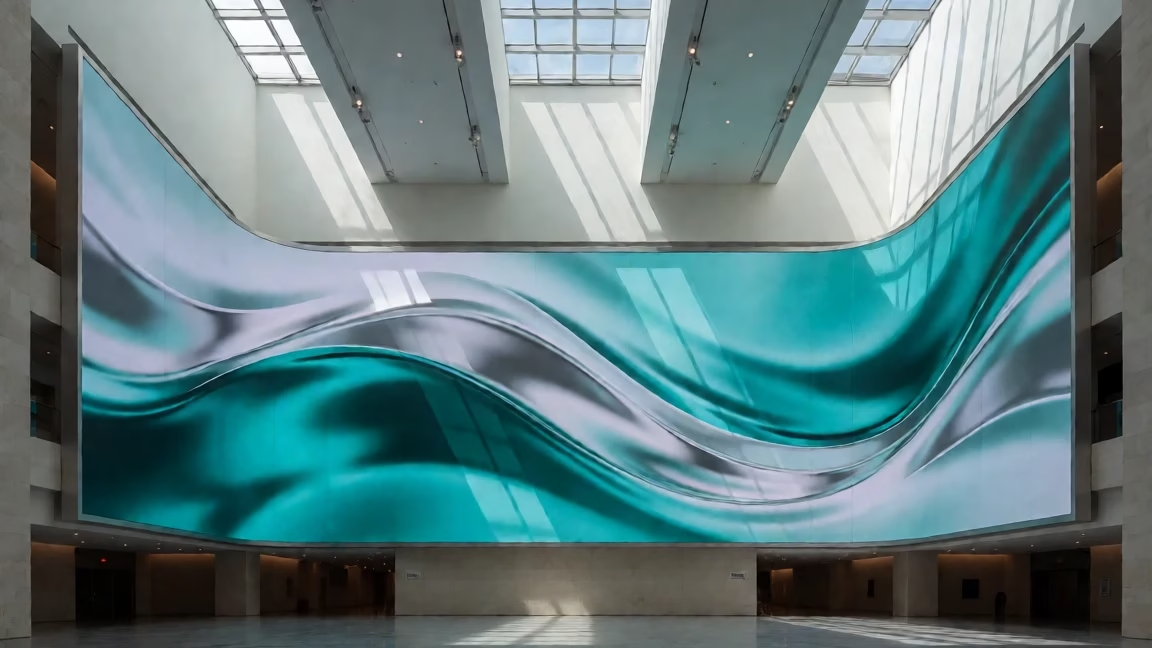
Where it wins: the biggest curves at honest distances — civic plazas, warehouse clubs, exhibition domes, worship halls — viewed from about 6m back, where the shape is the show and 40,000 pixels per square meter is exactly enough. Closer viewers belong to the P4 indoor flexible LED display and the tiers above; for the same pitch facing the weather, the rigid twin lives on the P5 outdoor LED display collection — same pitch, two lives. The pixel pitch guide maps the ladder.
Module Solutions
Which Module Sizes Does a P5 Indoor Flexible LED Display Use?
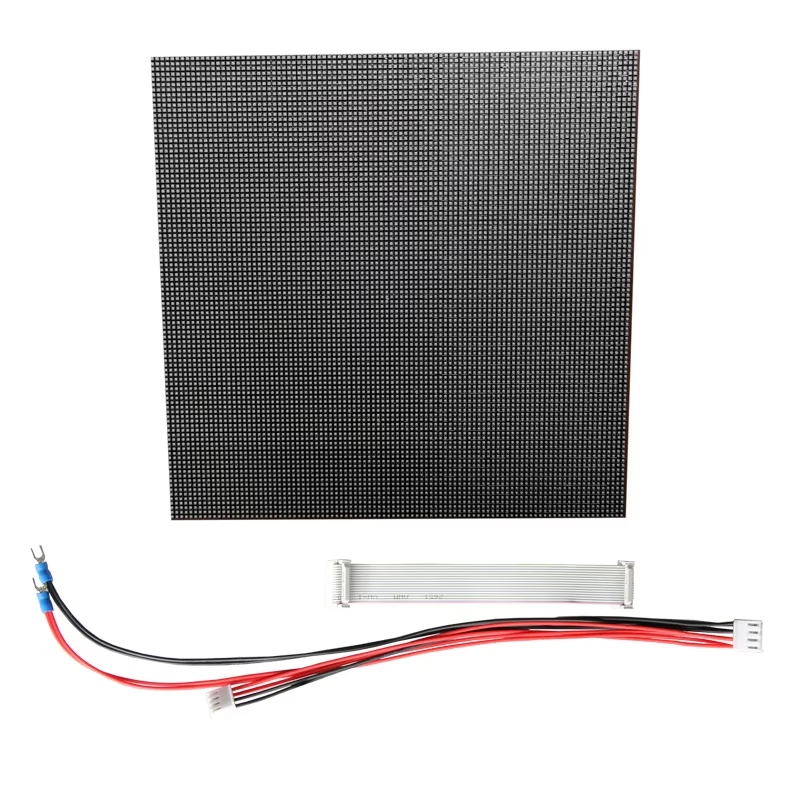
Two formats at a true 5.00mm: the industry-standard 320×160mm soft panel at 64×32, and the 250×250mm rental-cabinet panel at 50×50 — both dividing cleanly, both available in the family’s only dual-refresh configuration.
320×160mm — the Value Frontier at a True 5.00mm
The panel that opens big curves to every budget: 64×32 pixels — 2,048 dots — scanned 1/16 so two of the 32 rows light at any instant. Modules seat on custom sheet-metal frames in 640×480mm, 640×640mm or 960×960mm, rolled to the cylinder or wave radius the site needs. Specify 1,920Hz for looping walls or 3,840Hz when the cameras come.
| Parameter | Spec |
|---|---|
| Module Size | 320×160mm — industry-standard flexible format (true pitch 5.00mm) |
| Pixel Resolution | 64×32 = 2,048 dots/module |
| Scan Mode | 1/16 scan (2 rows lit) |
| Driver IC Brands | Chipone (ICND series) |
| IC Count | 24 per module |
| Lamp | SMD2020 black-face |
| Brightness | 800–1,000 nits adjustable |
| Refresh | 1,920Hz standard or 3,840Hz high refresh — optioned at order time |
| Maintenance | Strong-magnet front service — no rear access required |
| Cabinet / Uniformity | Custom sheet-metal 640×480mm (6 modules), 640×640mm (8) or 960×960mm (18), rolled to the radius + silicone shell & per-pixel calibration |

250×250mm — the Rental-Box Panel at 50×50
The panel that seats a 5.00mm canvas into 500-series curved cabinets on a perfect 50×50 matrix — an exact 5.00mm, four modules to a 500×500mm curved die-cast cabinet, eight to a 500×1000mm. Scan 1/10 with five rows lit. Angle-lock segments build the arc; the same modules fly back out in flat walls between jobs.
| Parameter | Spec |
|---|---|
| Module Size | 250×250mm — matches 500-series curved rental cabinets (true pitch 5.00mm) |
| Pixel Resolution | 50×50 = 2,500 dots/module |
| Scan Mode | 1/10 scan (5 rows lit) |
| Driver IC Brands | Chipone (ICND series) |
| IC Count | 24 per module |
| Lamp | SMD2020 black-face |
| Brightness | 800–1,000 nits adjustable |
| Refresh | 1,920Hz standard or 3,840Hz high refresh — optioned at order time |
| Maintenance | Strong-magnet front service through the cabinet face |
| Cabinet / Uniformity | 500×500mm curved die-cast aluminum (4 modules/box), 500×1000mm (8) — angle-lock builds + silicone shell & per-pixel calibration |
The curved-cabinet system behind this build is documented in full on the 500×500mm rental LED screen collection and the 500×1000mm format.
Shape Family
How Does a P5 Indoor Flexible LED Display Build Cylinders, Waves and Custom Shapes?
One panel family, four shape grammars — and at 5.00mm the grammar finally scales to the shapes civic and industrial clients actually ask for: whole-facade waves, plaza arches, dome rings. The frame does the shaping, the silicone-faced panels follow it, and the bending rules stay family-standard: curvature across the panel width, never along a lamp row.
Convex & Concave Arcs
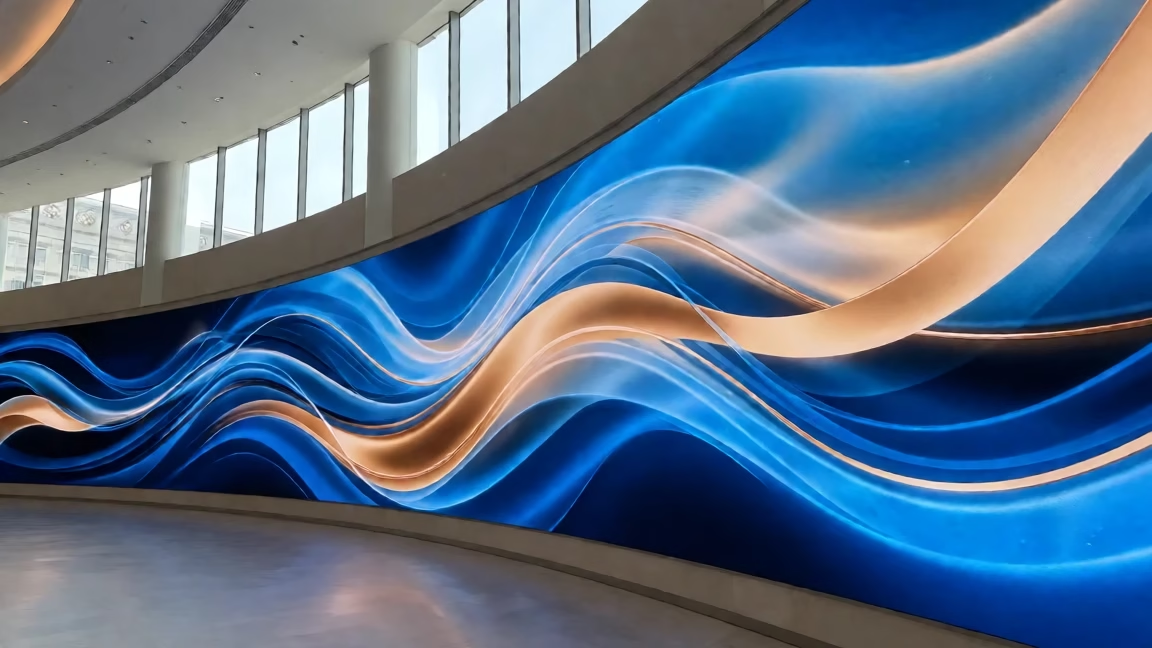
Plaza and hall arcs measured in tens of meters — the value frontier’s home ground.
Full 360° Columns
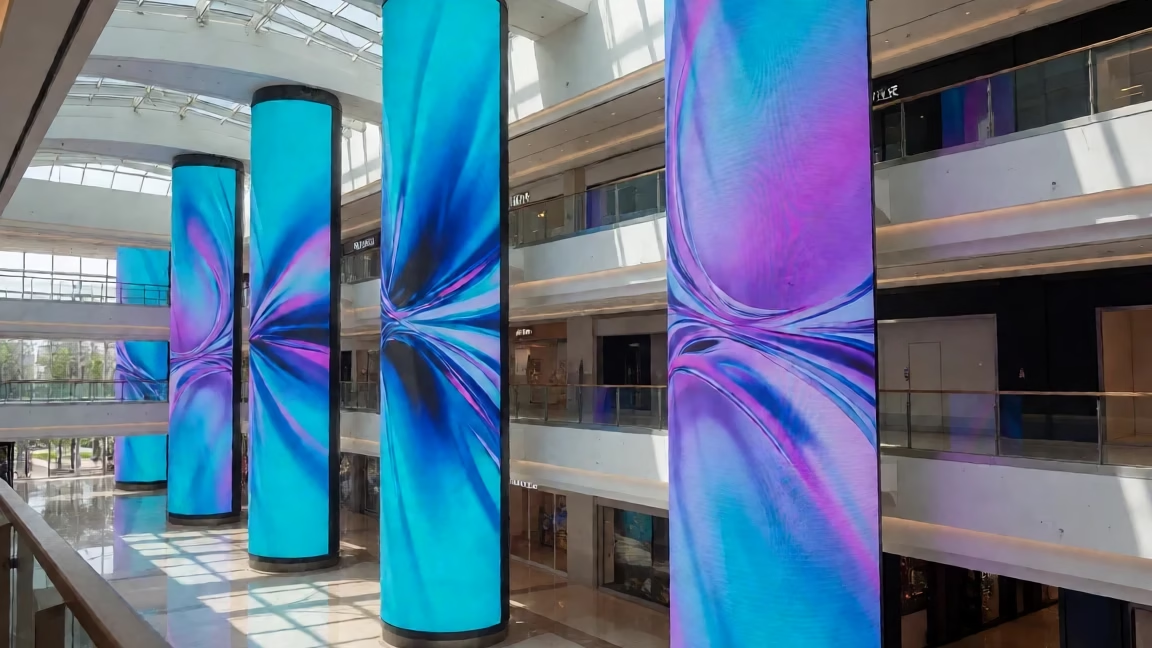
Column grids at the family floor price — a Ø1.2m column takes 12 rings of 320×160mm panels.
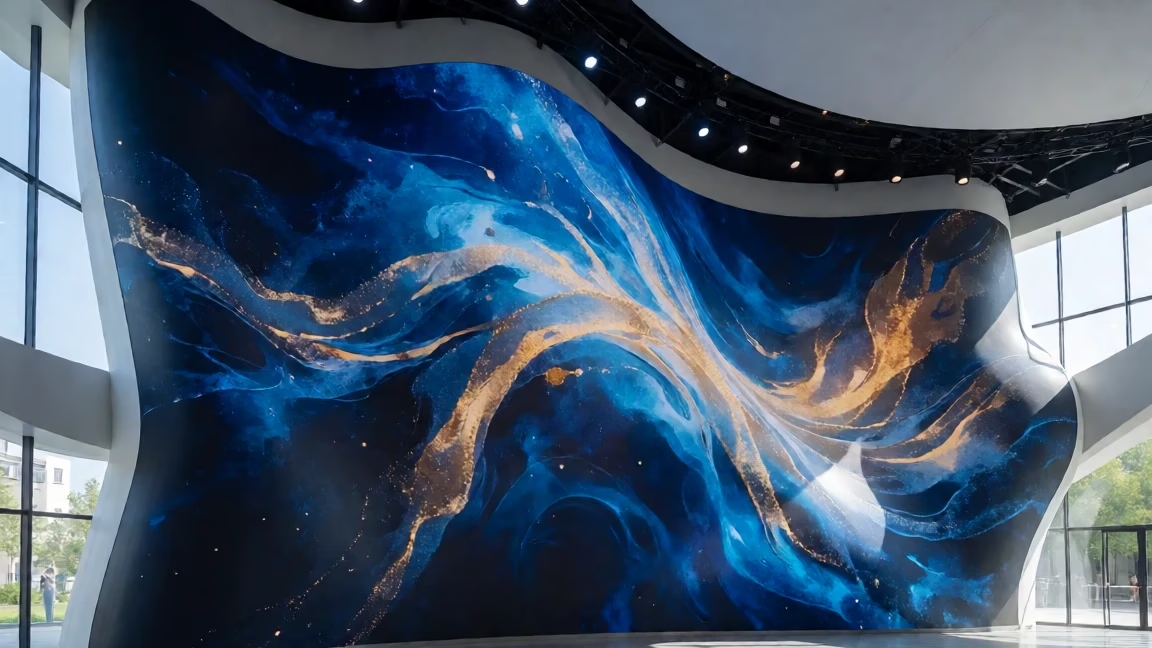
Waves & Ribbons
Whole-facade waves and dome rings — at this pitch the mega-sweep is a catalog item.
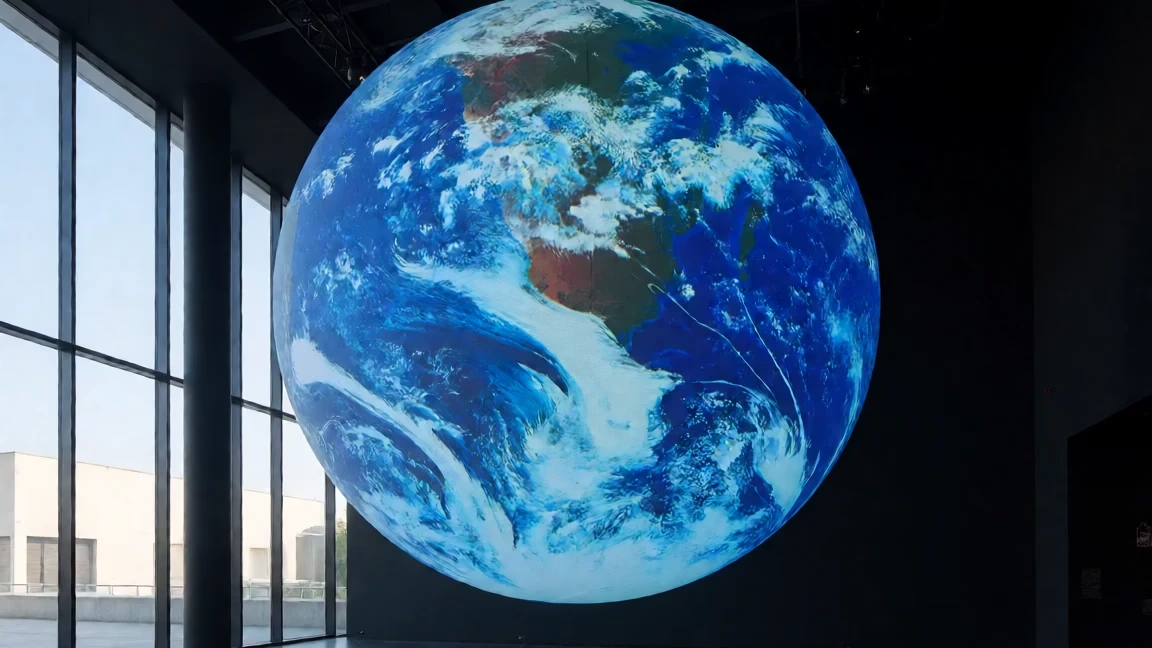
Sphere Bands & Custom
Latitude bands on big spheres and sculpture skins — pixel-mapped by a creative controller.
Bending limits, in numbers: the 320×160mm-class panel follows a minimum cylinder diameter of roughly 815mm in industry bending tests, and soft modules of this family take U-shaped bends up to 120° per panel. Wrap tighter and the lamp foot lifts off the pad — final curvature is confirmed against the project drawing before fabrication.
In Action
What Do Flexible LED Installations Look Like in Action?
Flex Engineering
What Makes a P5 Indoor Flexible LED Display Bend Without Breaking?
Four components turn a fine-pitch module into a soft one — the family recipe, unchanged from the 1.25mm tier to the value frontier because the bending physics do not read price tags.
0.2mm Flexible PCB
A polyimide FPC replaces the fiberglass board, spreading bending stress across thin-film copper instead of concentrating it at drilled holes — the reason the panel takes its rated curve for the life of the wall.
Silicone Base Shell
The precision silicone bottom case cushions the solder side and locks the optical face flat, holding long curved splices flush without shims.
Bend-Tolerant Flat Cables
Dedicated anti-fatigue flat cables carry power and signal along whole-facade arcs, spec’d for the daily flexing a big sweep takes.
Strong-Magnet Front Service
Locating pins align each module, magnets seat it, a suction tool lifts it out — on the family’s biggest walls, that service model is what keeps maintenance a two-person job.
Optically the value frontier runs SMD2020 black-face lamps on a 5000:1 contrast panel at 800–1,000 nits — the brightness big public interiors read at 6m — with 12–16 bit grayscale by IC grade. The refresh is the tier’s signature choice: 1,920Hz standard for walls that loop, 3,840Hz high refresh for shows that face the cameras. After assembly every module passes per-pixel and per-color correction, so 40,000 dots per square meter read as one continuous image across every meter of the sweep.
Power
Which Power Supplies Run a P5 Indoor Flexible LED Display?
At 40,000 pixels per square meter and 800–1,000 nits, a square meter draws roughly 250–320W at peak and 120–160W on average broadcast content — industry reference figures for this class, and the lightest load in the flexible family. A typical build carries one 5V/40A rail per square meter or less; the 4.2V/4.5V energy-saving common-cathode tier trims running cost further on always-on walls.
| Brand | Role on This Collection | Typical Rails |
|---|---|---|
| Chuanglian Power (CZCL) | Volume rails for standard 5V builds — the default on sheet-metal frame projects | 5V / 40A class |
| MEAN WELL | Spec-grade option when the project calls for a global brand on the power BOM | 5V / 40A class |
| G-Energy | Multi-voltage rails for the 4.2V/4.5V energy-saving common-cathode tier | 4.2V / 4.5V dual-rail |
Compare the full lines in the CZCL, MEAN WELL and G-Energy power collections — all three ship as standard on this collection depending on the tier you specify.
Control Systems
Which Control Systems Drive a P5 Indoor Flexible LED Display?
A 40,000-pixel curved canvas is the lightest load in the family — a single sender covers sweeps the finer tiers would split across racks. Synchronous systems from six brands drive this collection, all running the receiving-card layer of NovaStar DH7512-S or Colorlight i9 cards, all supporting the per-pixel calibration that keeps a long sweep seamless. Civic and rental builds run PC-free on the asynchronous side.
NovaStar MCTRL4K
4K canvas headroom — at this density one unit drives plaza walls the finer tiers would need racks for.



Mooncell MB401
Networked player — cluster control for civic walls that run across the whole facility.


RGBlink X1 Gen2
Multiple-output processor — one source across plaza arcs and portal walls as separate windows.

Full lineups, loading tables and selection guides live on the brand hubs: NovaStar, Colorlight, Huidu, Mooncell, VDWALL and RGBlink.
Find Your Build
Which P5 Indoor Flexible LED Display Build Fits Your Project?
Route by distance and refresh need — the value frontier covers the biggest curves, and the refresh option covers both looping walls and live shows.
| Project Geometry | Build | Why |
|---|---|---|
| Giant curves — plazas, domes, facades — viewed from ~6m | 320×160mm on rolled sheet-metal frames | True 5.00mm, the family floor price, dual refresh to match the program |
| Curved wall on existing 500-series rental stock | 250×250mm in curved die-cast cabinets | Seats into 500×500 / 500×1000 angle-lock cabinets on a perfect 50×50 matrix |
| Looping walls — civic halls, clubs, retail | 320×160mm at 1,920Hz standard | The value option: same wall, lower refresh cost, no cameras in the room |
| Viewers closer than 5m, or broadcast shows | Step up to P4 or finer / add 3,840Hz | Inside 5m the 5.00mm dot structure shows — the P4 indoor flexible LED display holds the image where this one won’t |
| The wall faces the weather | Same pitch, rigid line | The P5 outdoor LED display collection covers weather and brightness — this page covers the indoor curve |
| Pitch | Pixels per ㎡ | Closest comfortable viewing | Curves? | Price tier |
|---|---|---|---|---|
| P2.5 flexible | 160,000 | from ~3.5m | Cylinders, waves, arcs, spheres | $ |
| P3.076 flexible | 105,625 | from ~4m | Cylinders, waves, arcs, spheres | $ |
| P4 flexible | 62,500 | from ~5m | Cylinders, waves, arcs, spheres | $ |
| P5 flexible (this page) | 40,000 | from ~6m | Cylinders, waves, arcs, spheres | $ |
| Indoor Flexible Family | Formats | Best for |
|---|---|---|
| P1.25 Indoor Flexible LED Display Collection | 320×160 / 250×250 / 240×120 | Closest-view precision shapes |
| P1.53 Indoor Flexible LED Display Collection | 320×160 / 250×250 | Value curved walls from ~2m |
| P1.86 Indoor Flexible LED Display Collection | 320×160 / 250×250 | Entry curved walls from ~2.5m |
| P2.0 Indoor Flexible LED Display Collection | 320×160 / 250×250 | Scale curved walls from ~3m |
| P2.5 Indoor Flexible LED Display Collection | 320×160 / 250×250 | Volume curved walls from ~3.5m |
| P3.076 Indoor Flexible LED Display Collection | 320×160 / 250×250 | Rental curved walls from ~4m |
| P4 Indoor Flexible LED Display Collection | 320×160 / 250×250 | Giant curved walls from ~5m |
| P5 Indoor Flexible LED Display — this collection | 320×160 / 250×250 | Value-frontier curved walls from ~6m |
Pricing
How Much Does a P5 Indoor Flexible LED Display Cost?
Screen-body pricing, FOB — frames, control and freight quoted per project. The 5 series is the value frontier: the biggest curves in the catalog at the smallest price per square meter, with the refresh option as the only real cost lever.
| Build | Screen body, FOB | What moves the number |
|---|---|---|
| 320×160mm on rolled sheet-metal frames | $450–700 / ㎡ | Frame rolling complexity, quantity, refresh tier (1,920 vs 3,840Hz) |
| 250×250mm in curved die-cast cabinets | $550–900 / ㎡ | Cabinet count, angle-lock accessory sets, flight cases |
| Add-on rows | quoted | Non-standard rolled frames, creative-controller mapping, 4.2V/4.5V energy-saving supply tier |
Module-level cross-check from the same scan: 320×160mm runs about $10–28 per panel in volume (19.53 panels/㎡ ≈ $195–545 before framing); 250×250mm $20–40 (16 panels/㎡). September 2026 market listing scan — Made-in-China, Alibaba and trade price lists, factory-direct FOB.
- The 320×160mm build is the supply-depth play — the most widely stocked flexible format at the value pitch, so price, spares and lead time all sit at their floor.
- The 250×250mm build is the fleet play — the premium buys a wall that reconfigures from flat to curved using cabinets you already own.
Applications
Where Does a P5 Indoor Flexible LED Display Earn Its Keep?
Eight venues put the value frontier to work — the biggest curves indoors, viewers from 6m back, and operators for whom the dual refresh option pays for itself in the first season.
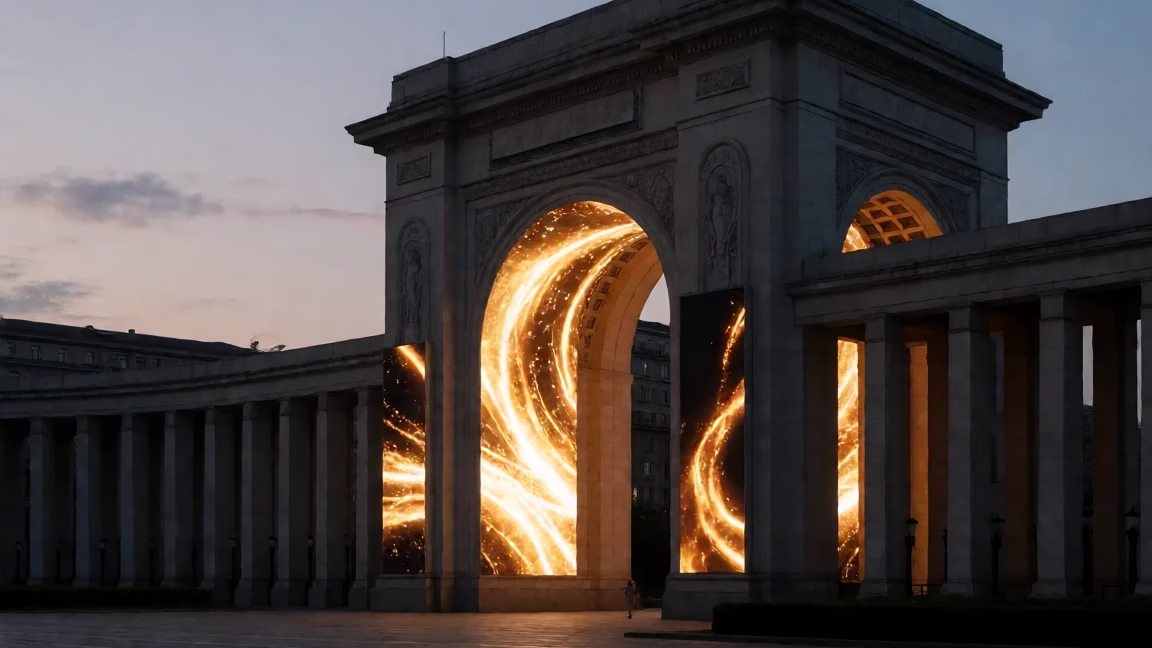
Civic Plaza Arches
Portal arches and plaza bows seen from across the square — the value tier’s signature build.
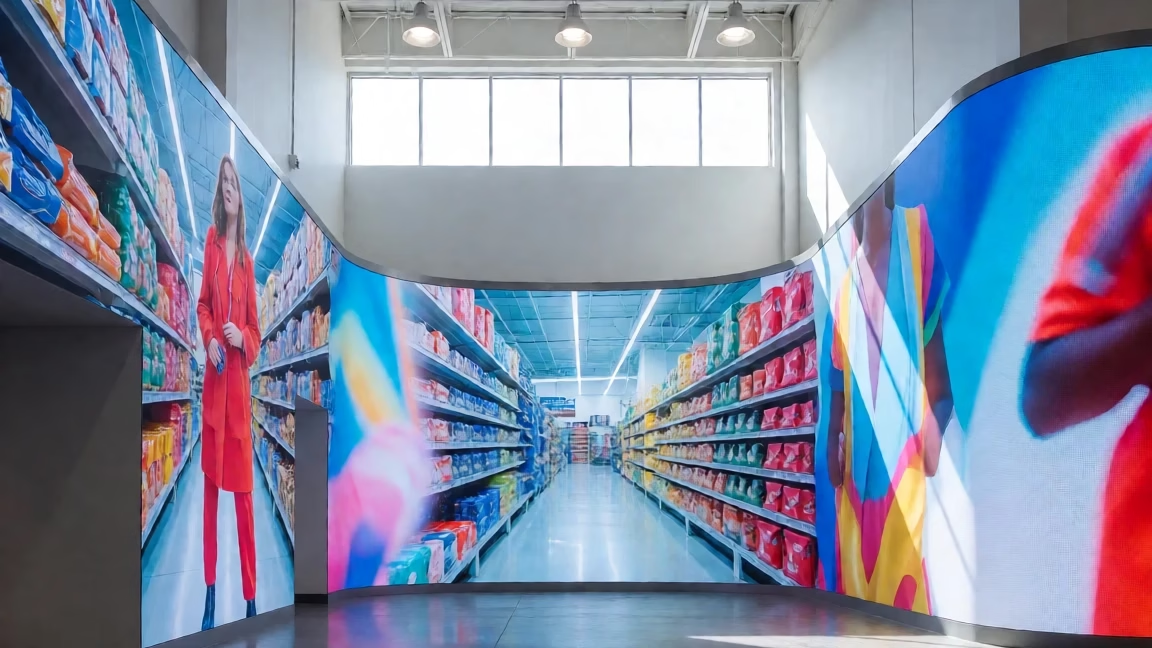
Warehouse-Club Facades
Membership retail walls that curve through the entrance hall — square meters at floor price.
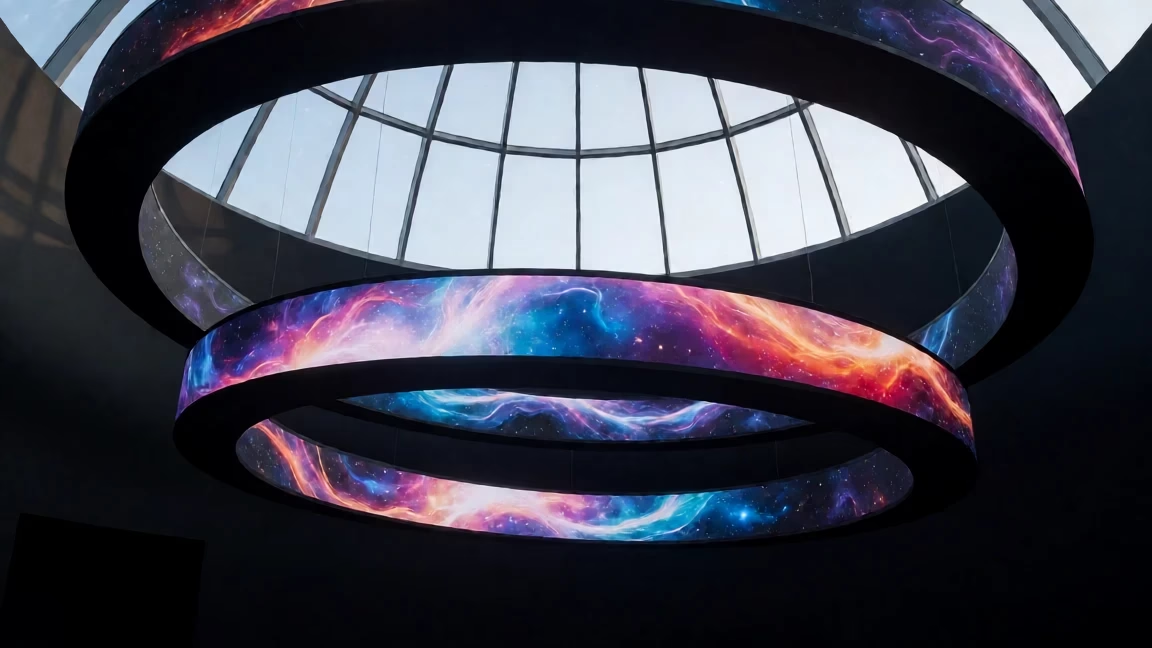
Exhibition Dome Rings
Latitude rings wrapped under domes and vaults — 40,000 pixels carry the show at 6m.
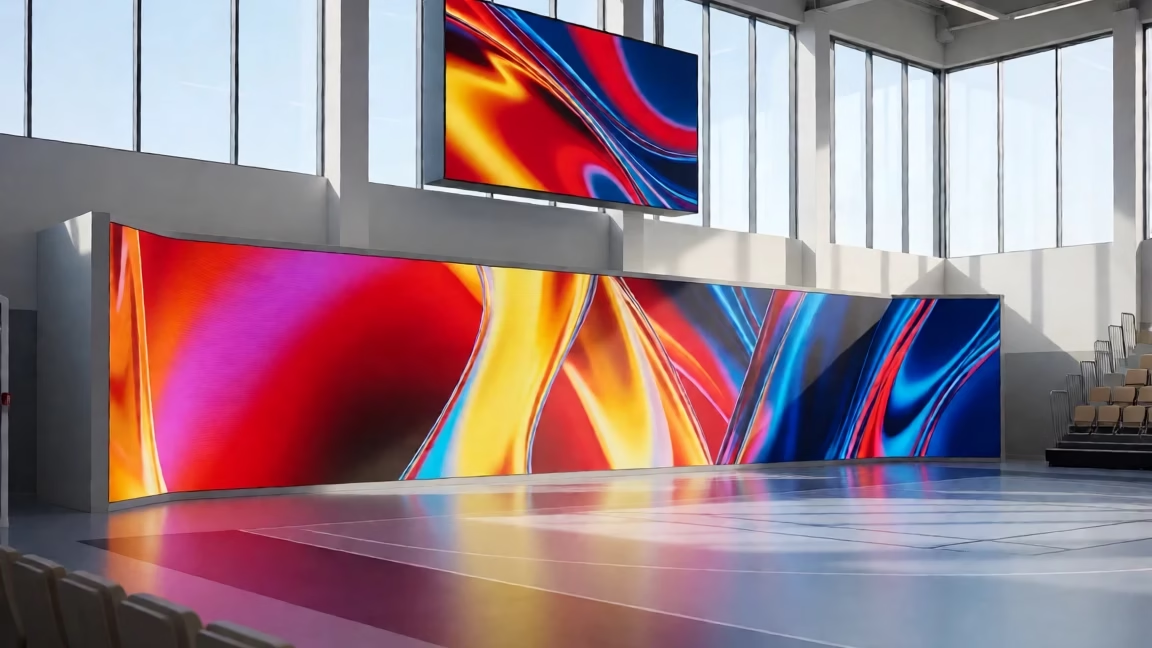
Sports-Hall Loops
Hall loops and scoreboard surrounds — the 1,920Hz standard runs the season, 3,840Hz covers the finals.
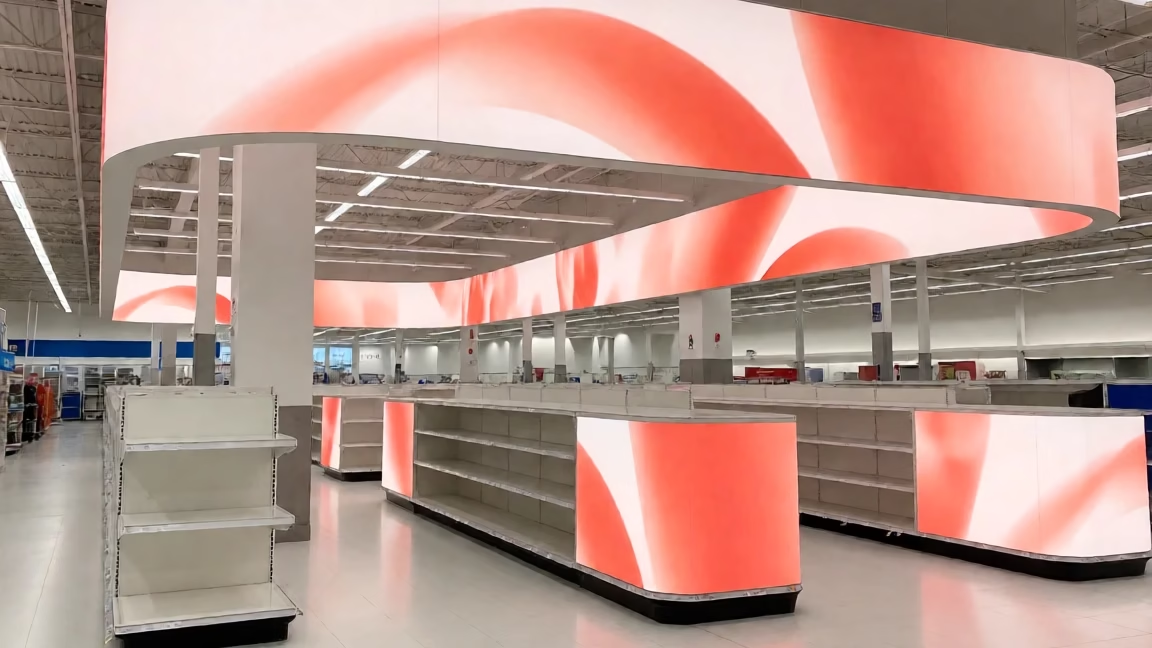
Big-Box Retail Skins
Department-store skins that curve through the aisles — floor price meets floor area.

House-of-Worship Walls
Sanctuary arcs and baptistry wraps — the budget tier that makes the curve possible.
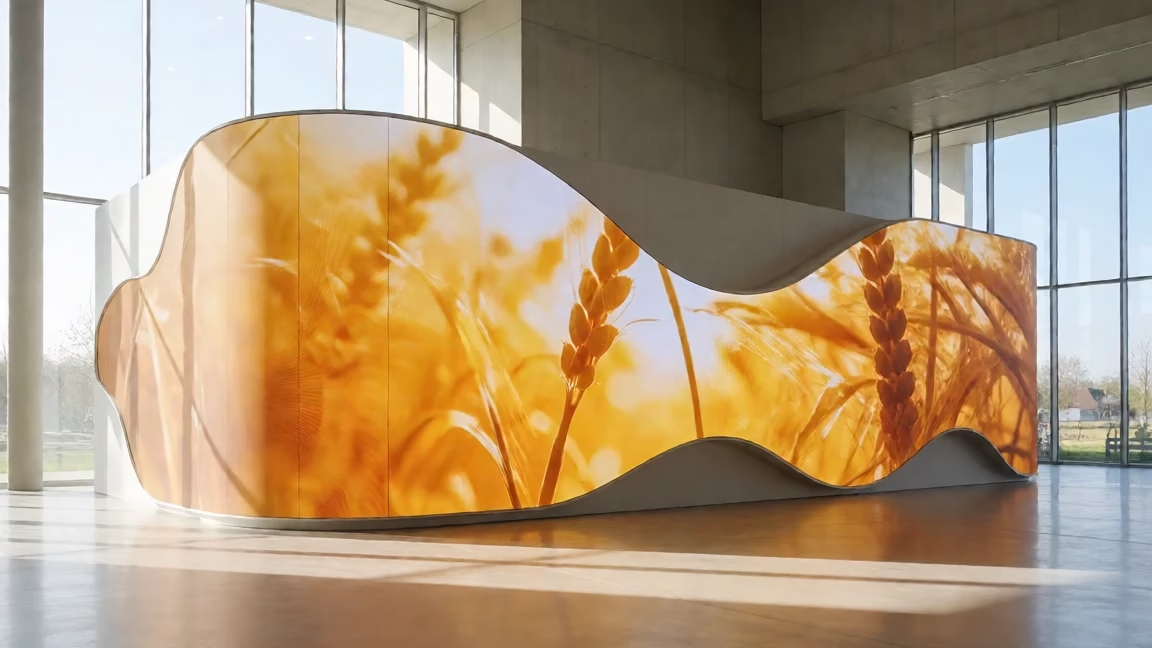
Agro-Show Pavilions
Agricultural show pavilions and stock-hall waves — seasonal curves at seasonal prices.
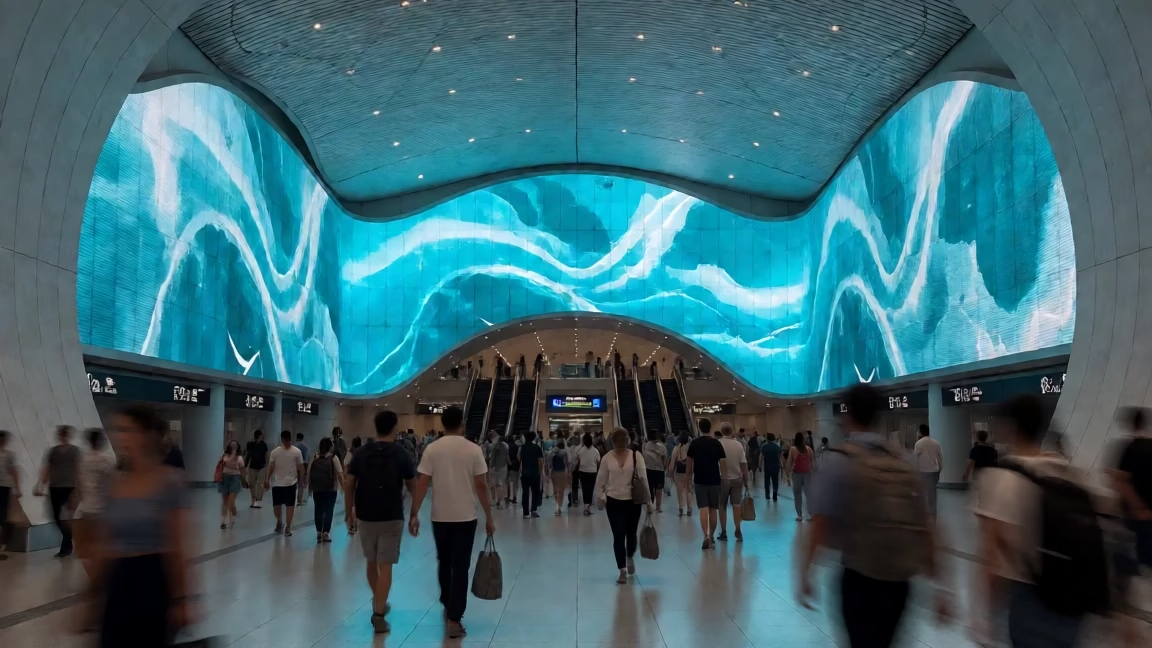
Station Far-End Waves
Concourse far-end waves viewed across the hall — 6m-plus distances are this tier’s comfort zone.
Reference Builds
What Do Typical P5 Indoor Flexible LED Display Projects Look Like?
Four build patterns this collection is engineered around — configurations and module counts as quoted on our production sheets.

Plaza Arches — Civic Program
Four portal arches on rolled frames — 320×160mm modules, 1,920Hz standard, programmed by the city’s media team.

Entrance Facade — Warehouse Club
A 24m curved facade on rolled frames — 470 modules at 1,920Hz, looping the membership loop all day.
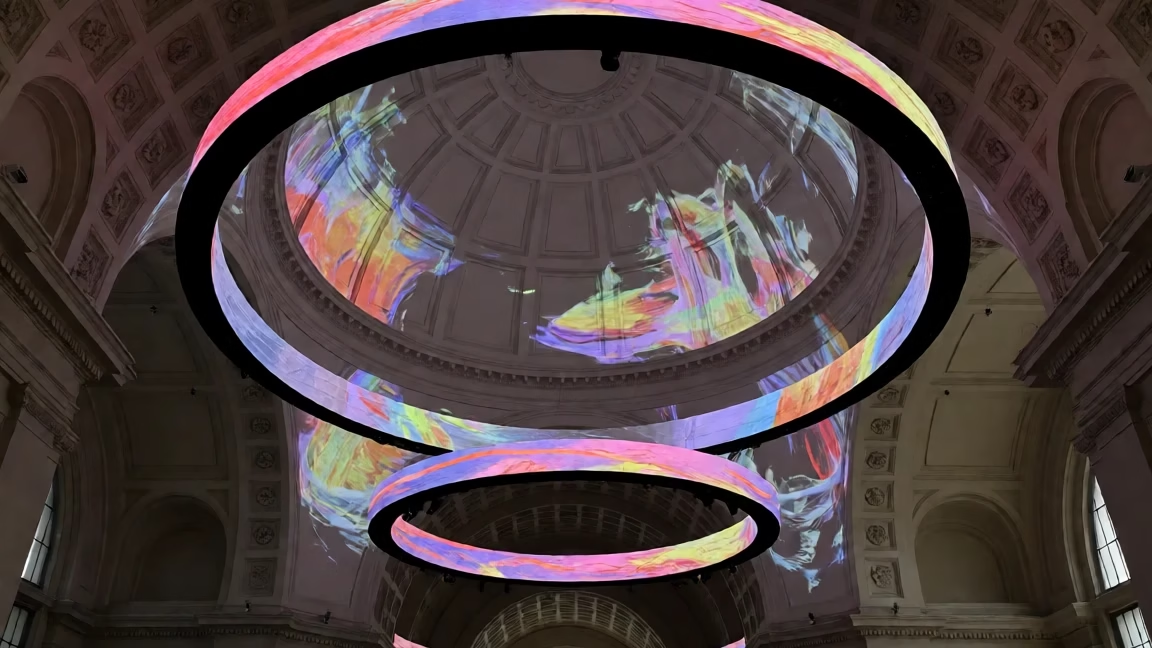
Dome Rings — Exhibition
250×250mm modules in 500×500mm angle-lock cabinets — three latitude rings under the vault.
FAQ
What Should You Ask Before Buying a P5 Indoor Flexible LED Display?
1. How far can a P5 indoor flexible LED display bend?
Soft modules of this family take U-shaped bends up to 120°, and the 320×160mm format follows a minimum cylinder diameter of roughly 815mm in industry bending tests. Curvature runs across the panel width, never along a lamp row — final radii are confirmed against the project drawing before the frame is rolled.
2. Should I order 1,920Hz or 3,840Hz refresh?
Let the cameras decide. Walls that loop brand content, wayfinding and atmosphere run perfectly on the 1,920Hz standard at the lower price; any wall that appears on broadcast cameras, livestreams or phone slow-motion should take the 3,840Hz option. It is the only real cost lever on this tier, and it is chosen at order time.
3. Is 40,000 pixels per square meter really enough?
At the distances this tier is built for, yes — from about 6m back, a 5.00mm matrix reads as a continuous image. If the closest viewer stands nearer than 5m, the drawing is asking for P4 or finer; if it says 6m-plus across a plaza or hall, 40,000 is exactly enough.
4. How much does a P5 indoor flexible LED display cost per square meter?
Screen-body pricing runs about $450–700 per square meter on rolled sheet-metal frames and $550–900 in curved die-cast cabinets, FOB — the family floor. Frames, control and freight quote per project; multi-wall programs price best of all.
5. P5 flexible or P5 outdoor — how do I choose?
Same pitch, different lives. This collection covers the indoor curve — plazas, halls, retail interiors; the P5 outdoor collection adds weather sealing, armor and daylight brightness. If the wall bends and lives indoors, buy flexible; if it faces the weather, buy outdoor.
6. Will bending damage the LEDs or create dead pixels?
Not within the rated curve. The 0.2mm FPC spreads bending stress, the silicone base shell cushions the solder side, and the anti-fatigue cables survive daily flexing. Per-pixel calibration after assembly catches any marginal joint before it ships.
7. Do the magnets really hold a module on a vertical curve?
Yes — each module weighs a few hundred grams and seats on steel locating pins held by high-pull magnets rated well beyond that load. The frame carries the structure; the magnets carry alignment. Frame tolerance is held within ±1.5mm so the silicone faces splice flush.
8. Are seams visible on a curved P5 wall?
The precision silicone shell keeps panel faces in plane without shims, and per-pixel, per-color calibration matches brightness across the canvas. From the format’s intended 6m viewing distance outward, the wall reads as one continuous image.
Buyer’s Guide
Where Does P5 Sit in the Flexible LED Family?
The 5 series is the value frontier of the indoor flexible family — the tier where the question stops being “can we afford the curve?” and becomes “how many square meters should it be?”. Above it, P4 through P1.25 trade price for pixel density as the viewing distance shrinks. At P5, the family recipe is intact — 0.2mm flexible PCB, silicone base shell, strong-magnet front service — wrapped around 40,000 pixels per square meter at a true 5.00mm pitch that reads cleanly from about 6 meters out.
What makes this tier different is not the pitch — it is the choice that comes with it. P5 is the only collection in the family that options its refresh: 1,920Hz standard for walls that loop, 3,840Hz high refresh for walls that face the cameras. On a big civic or commercial program, that single option is often worth more than any other line on the quote, because it lets the same wall serve both the daily loop and the occasional broadcast without paying the high-refresh price on every panel.
1,920Hz or 3,840Hz: How to Spend the Refresh Budget
The rule is a camera test, not a spec sheet. If the wall will ever appear on broadcast cameras, livestreams or phone slow-motion — wedding halls, houses of worship, esports and event stages — specify the 3,840Hz option and never think about scan bands again. If the wall loops content for a live audience with no camera between them and the glass — civic halls, warehouse clubs, transit concourses — the 1,920Hz standard delivers the identical picture at the family’s floor price.
The hybrid play is worth knowing too: mixed programs run the 1,920Hz standard on the far-field sweeps and the 3,840Hz option on the feature wall near the cameras, one controller mapping both. Because both options share the same module body, the same content pipeline and the same calibration profile, the fleet stays uniform even when the refresh tiers do not — and the budget only pays for refresh where refresh earns.
Same Pitch, Two Lives: Flexible Indoor vs the P5 Outdoor Line
P5 runs two full product lives at our factory, and at this pitch the contrast is the sharpest in the catalog. The P5 outdoor collection is the street life: rigid, weather-sealed, daylight-bright cabinets built for facades and billboards. This collection is the interior life: the same 5.00mm spacing in a soft body that bends around plaza arches and dome rings, front-serviced, priced for the biggest indoor curves on the market.
The buyer’s rule writes itself, and at this tier it carries the most weight: inside and bending, flexible; outside and flat, rigid. Specifying across that line pays for capability neither side needs — a flexible module in the rain, an outdoor cabinet in a civic hall. The pitches match, so creative carries between the two lives when a program runs indoor and outdoor faces on the same campaign — which, at the value frontier, is exactly the kind of program this tier attracts.
What Does Installing a P5 Indoor Flexible LED Display Involve?
The value frontier makes big curves a scheduling exercise rather than a structural one. The survey fixes each radius, the sheet-metal frames roll to match within ±1.5mm, and the modules go on front-first: locating pins align, magnets seat, anti-fatigue cables route along the sweep. Because 64×32 on a 320×160mm body divides cleanly into every frame and content map, a plaza-arch program phases bay by bay — each bay mounts, calibrates and goes live while the next rolls out of the shop.
The light power load does real work at this scale: one 5V/40A rail per square meter or less means a whole-facade wave shares the power schedule a fine-pitch wall would need twice over, and the sub-frame behind it shrinks accordingly. Commissioning closes each bay with per-pixel and per-color correction against the installed canvas — and the refresh option is set per wall, so the far-field sweeps run 1,920Hz while the camera-facing feature wall runs 3,840Hz on the same controller.
What Maintenance Does a P5 Indoor Flexible LED Display Need?
Front service carries the promise at the biggest scale: a misbehaving module comes off with a suction tool in under a minute wherever it sits on the sweep — no scaffolding drama, no rear access. And because the 320×160mm soft module is the market’s volume standard, replacement stock for a whole-facade program is a standing purchase order, not a factory inquiry. Every collection ships with 3% free spare modules, which on a civic-scale wall is a working spares bay.
Routine care is the family standard: silicone faces cleaned with soft, dry-or-damp discipline, flat cables glanced over where they exit the arc during scheduled windows, and an annual per-pixel calibration re-run that keeps the whole sweep matched as lamps age. On walls this size the calibration runs section by section — and at the value frontier, that morning of labor is what protects the biggest single line in the quote.
How Does Content and Refresh Behave at 40,000 Pixels?
At 40,000 pixels per square meter, a 1080p canvas maps onto roughly 27 square meters — which means a whole-facade wave, a dome ring set or a plaza arch program carries full-HD content natively along most of its run. From the tier’s 6m viewing distance the 5.00mm matrix reads as a continuous image; motion graphics, brand loops and wayfinding all land exactly as authored, and the 2,048-dot panel is the reason a civic-scale curve prices like a flat wall.
The refresh choice shapes the content strategy. The 1,920Hz standard is built for looping programs — brand films, wayfinding, ambient scenes that run all day with no camera between the wall and the audience. The 3,840Hz option exists for the moments the wall meets a lens: broadcast covers, livestreamed ceremonies, phone slow-motion at a wedding. Specifying per wall rather than per project is how the value frontier earns its name — refresh where the cameras are, floor price everywhere else.
The Bottom Line on the P5 Indoor Flexible LED Display
A P5 indoor flexible LED display is the tier that puts the family’s biggest curves inside the smallest budgets. The 320×160mm module covers plaza arches, dome rings and whole-facade waves at the floor price, with a dual refresh option that matches the wall to its program; the 250×250mm format seats the same 5.00mm pitch into rental ironwork on a perfect 50×50 matrix. From about 6 meters back, 40,000 pixels per square meter read as one continuous image at 800–1,000 nits — and the same pitch’s outdoor twin is already on the shelf. When the drawing calls for the biggest curve at the smallest price, this is the tier — and the pitch — that closes the family at the value frontier.
Related Collections
P4 Indoor Flexible LED Display Collection
One step finer — 62,500 px/㎡ for viewers from ~5m, the giant-shape tier.
P5 Outdoor LED Display Collection
The same 5.00mm pitch in its outdoor life — rigid, weather-sealed, daylight bright.
LED Display Collection
Indoor, outdoor, rental and poster lines from the factory — start here when the wall is flat and the budget is fixed.
Ready to Curve Your Wall?
Send the column diameter, wave profile or arc drawing — we return a module layout, frame drawing and screen-body quote from the P5 indoor flexible LED display collection within 24 hours.