
Outdoor Rental · IP65 · Touring Grade
P2.604 Outdoor Rental LED Display Collection
The outdoor twin of our finest rental pitch: the same 250×250mm module at 147,456 pixels per square meter, rebuilt for daylight — 3,500–4,500 nits on copper wire, 5,000+ on the gold-wire boost, IP65-sealed modules with triple-coated boards and aviation-grade waterproof connectors.
Definition
What Is a P2.604 Outdoor Rental LED Display?
Short answer: A P2.604 outdoor rental LED display is the daylight-rated twin of our indoor P2.604 wall — the same 250×250mm modules at 147,456 pixels per square meter, re-engineered with 3,500–5,000+ nits, IP65-sealed die-cast cabinets, triple-coated and potting-glued boards, and SMD1415/1921 waterproof lamps. It is the outdoor high-definition micro-pitch for touring stages, city plazas and festival mains.
A P2.604 outdoor rental LED display keeps the indoor twin’s geometry — 96×96 pixels per module, 2.604mm between lamps — and changes everything the weather touches. Boards are 2.0mm fiberglass with triple-protection varnish and potting glue; lamps are SMD1415 or SMD1921 outdoor-rated packages in black or white faces; every power and signal run terminates in waterproof aviation connectors. The 500×500mm die-cast cabinet seals to IP65 and carries wind-brace interfaces for the rigging plans outdoor venues demand.
Choosing between the twins is a daylight decision, not a quality ranking. If the wall works outdoors — sun on the face, rain in the forecast, crowds beyond 3m — this outdoor build is the correct tool, and at roughly $600–1,000 per square meter it prices below its indoor twin, because the larger outdoor lamps cost less than micro packages. If the wall lives indoors, the P2.604 indoor rental collection gives the same pixels in a lighter, finer-finish cabinet. The full decision table sits in the comparison section below, alongside our outdoor LED screen guide.
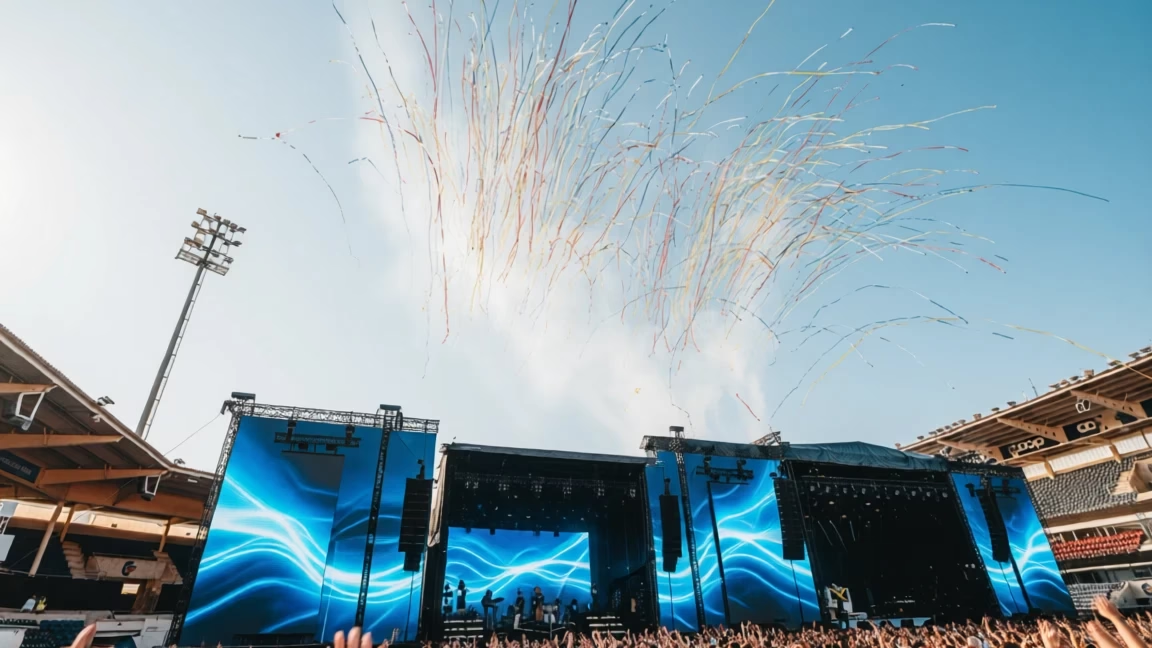
Module & Cabinet
Which Module and Cabinet Sizes Does a P2.604 Outdoor Rental LED Display Use?
The collection runs one production module — 250×250mm, shared with the indoor twin so content and pixel math carry over — in one outdoor cabinet: the 500×500mm high-strength die-cast box. Outdoor fleets standardize on the single format because every box must seal, brace and tour identically; sixteen modules build one square meter, four per cabinet.
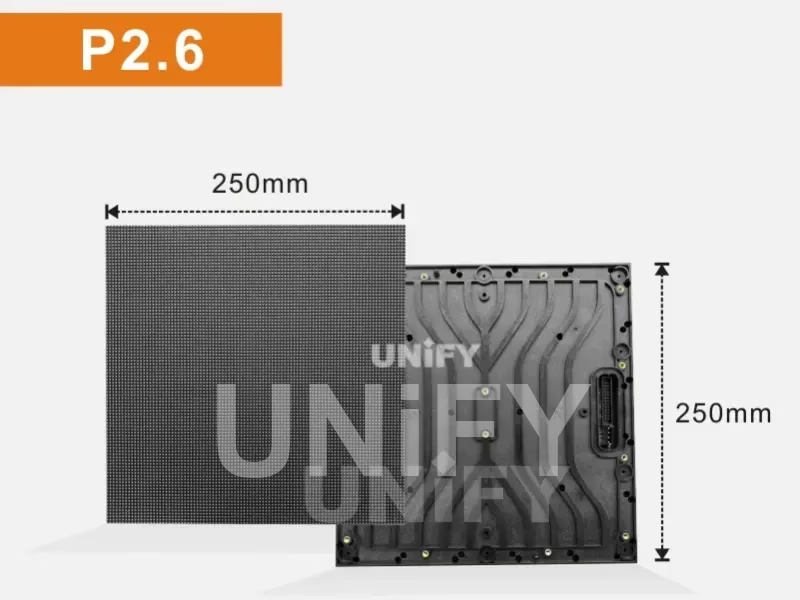
The 250×250mm Outdoor Module
Same geometry as the indoor twin — 96×96 pixels, 9,216 dots — on a 2.0mm board with triple-protection varnish and potting glue around every component. SMD1415/1921 waterproof lamps in black or white faces, binned to Grade 1 for UV and dead-lamp tolerance.
500×500mm Outdoor Die-Cast Cabinet — Sealed and Braced
Four modules per box in a high-strength die-cast aluminum shell, fully waterproofed to IP65 with a wind-brace interface for outdoor rigging. Rear service is the outdoor standard — the waterproof rear cover carries the power and aviation signal connectors — and selected premium models add screw-fixed front service for jobs where the face must be serviced from the platform.
| Parameter | Spec |
|---|---|
| Module Size | 250×250mm |
| Pixel Resolution | 96×96 = 9,216 dots/module |
| Scan Mode | 1/16 scan (6 rows lit) |
| Driver IC Brands | Chipone (ICND series) — common-cathode or conventional drive |
| IC Count | 108 per module (common-cathode option available) |
| Lamp | SMD1415 / SMD1921 outdoor waterproof, black or white face — Grade 1 to extreme UV and dead-lamp tolerance |
| Brightness | 3,500–4,500 nits (copper wire) / 5,000+ nits (gold-wire boost) |
| Maintenance | Independent waterproof rear service standard; screw front service on premium models |
| Cabinet | 500×500mm outdoor die-cast aluminum, IP65+, full waterproofing with wind-brace interface, 4 modules/box |
| Uniformity | High-contrast UV-resistant mask against local color shift + hardware per-pixel correction |
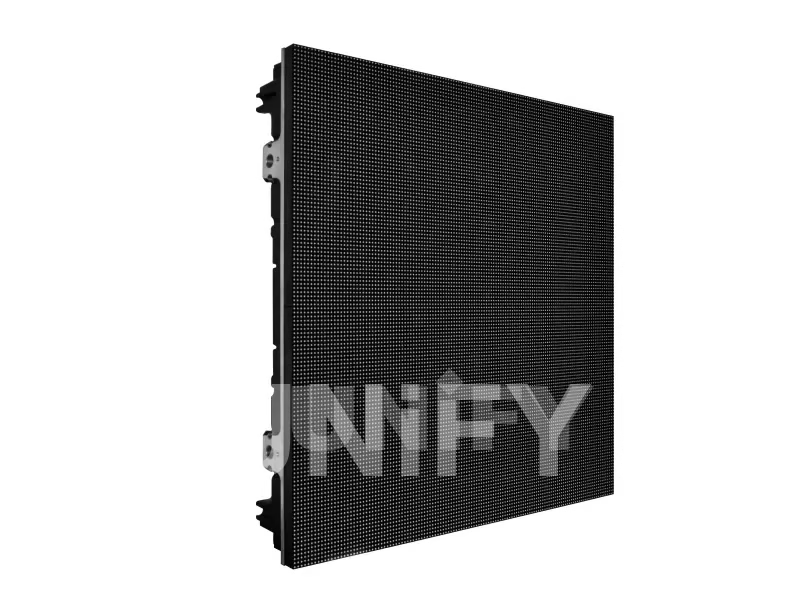
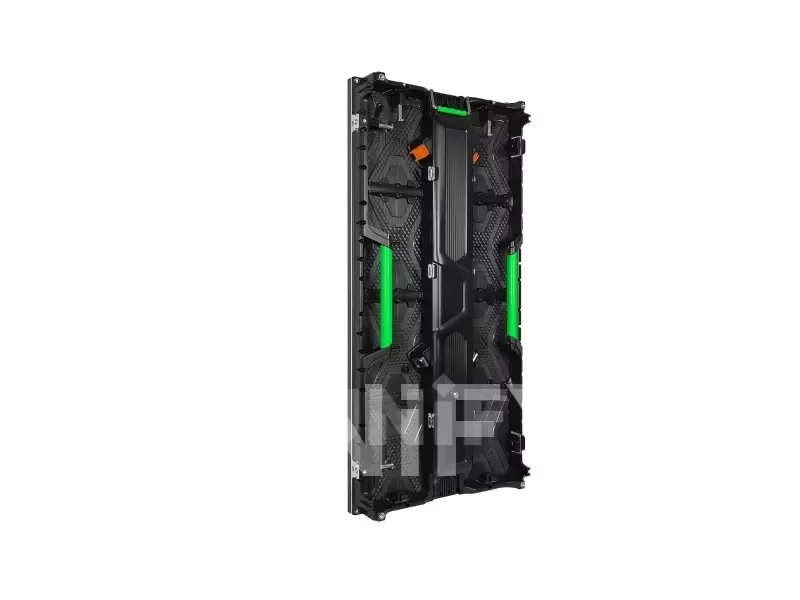
Also Available: 500×1000mm Outdoor Cabinet
The same IP65-sealed shell in the long format — eight modules per box for faster large-area outdoor builds, with the identical waterproofing stack: potting-glued boards, aviation connectors and wind-brace rigging points.
Weatherproof Build
How Is an Outdoor P2.604 Rental Wall Built to Survive Weather?
Waterproofing is layered, not sprayed on. The 2.0mm fiberglass board carries triple-protection varnish — moisture, salt-fog and dust proofing across both faces — and every driver component sits under potting glue, a poured seal that locks out water even if a gasket ages. Power and signal runs terminate in aviation-grade waterproof connectors, and the cabinet closes to IP65: see what each digit guarantees in our IP rating guide.
The lamps and the mask are the optics story. SMD1415 and SMD1921 outdoor packages come in black or white faces — black for contrast in shaded rigs, white when maximum punch matters — and Grade 1 stock is qualified to extreme UV exposure and dead-lamp tolerance, because the sun is the hardest QA engineer in the business. The high-contrast UV-resistant mask over every module is what stops local color shift after a season of sunlight, and hardware per-pixel correction through the control system holds the wall uniform. The 3,840Hz refresh is rated for daylight and camera shutter work alike — no flicker on the broadcast feed or in the crowd’s phone footage.
Power & Thermal
How Much Power Does a P2.604 Outdoor Rental LED Display Use?
Daylight brightness is the power story: 3,500–5,000+ nits is roughly four times the indoor tier, so plan supply and generator capacity for the outdoor number, not the indoor one. The common-cathode energy-saving option is available on this collection — it drops drive-rail waste as heat, which in a sealed outdoor cabinet means cooler components and longer lamp life. Our power consumption guide carries the full brightness-to-wattage arithmetic.
| Supply Brand | Typical Rail | Role in the Cabinet |
|---|---|---|
| Chuanglian Power | 5V / common-cathode | Rental-fleet standard; outdoor-rated builds for the 500×500 shell |
| MEAN WELL | 5V | Specifier-preferred option where brand approval is written into the tender |
| G-Energy | 5V / common-cathode | High-efficiency line for the 5,000+ nits gold-wire build |
All three brands mount in the same tray; the common-cathode option is the one to specify when sealed-cabinet cooling is the concern.
Control Stack
Which Control Systems Drive a P2.604 Outdoor Rental LED Display?
Outdoor venues are electrically loud — long cable runs, generator power, lighting rigs and broadcast trucks all sharing the air. This collection specifies strong synchronous loading with high interference immunity: NovaStar and Colorlight sending systems push live video to a receiving card in every cabinet and hold the picture stable through show conditions. Senders and receiving cards stay on one platform per wall.
NovaStar

The broadcast-reference stack: an NovaStar MCTRL600 sender drives the wall with hardware calibration and the interference immunity outdoor rigs need.
Colorlight
Per-cabinet receiving cards such as the Colorlight i5A-F pair with the sending range for stable outdoor loading and cloud fleet management.
Huidu

The asynchronous Huidu C16C control card runs standalone schedules — the PC-free option for plazas and semi-permanent outdoor installs.
Mooncell

The Mooncell MTB2000E master controller carries large outdoor walls with automatic recovery — built for rigs that move weekly.
VDWALL

The VDWALL LVP909 touring-rack build is the processor format road crews know — scaling and switching ready for the truck.
RGBlink
The RGBlink X3 handles multi-output scaling and switching for outdoor stages without crowding the rack.
Comparison
P2.604 Outdoor or Indoor — Which Twin Does Your Job Need?
These two collections share a module, a pixel density and a pixel math — they are twins with different jobs. The tables below settle which twin your job needs, then place both in the pitch family.
1) The twin decision — six dimensions
| Dimension | P2.604 Outdoor (this page) | P2.604 Indoor |
|---|---|---|
| Pixel density | 147,456 px/㎡ (identical) | 147,456 px/㎡ (identical) |
| Brightness | 3,500–4,500 / 5,000+ nits | 800–1,200 / 1,000–1,200 nits |
| Weather protection | IP65+, potting glue, aviation connectors | Indoor build, no sealing |
| Lamp package | SMD1415 / SMD1921 waterproof | SMD1515 / SMD2121 |
| Cabinet formats | 500×500mm only, wind-brace interface | 500×500mm + 500×1000mm |
| Price per ㎡ | $600–1,000 — larger lamps cost less | $1,050–1,800 |
When to choose which:
- Daylight on the wall, rain in the forecast, or a touring season — take the outdoor twin; nothing indoor-built survives that schedule.
- Sealed banquet halls, broadcast studios, exhibition booths — take the indoor twin; you save the sealing cost and get the finer lamp finish.
- Camera-close audiences under 2.6m — the indoor twin’s finish wins; beyond that, both render identically at this density.
- Mixed jobs across a season — many fleets hold both twins: one pixel math, two weather envelopes, zero re-training.
2) Route by viewing distance and venue
| Condition | Right Product |
|---|---|
| Indoor, under 2.6m, cameras close | P1.953 indoor rental |
| Outdoors — daylight, weather, 2.6m+ ✓ | This P2.604 outdoor rental collection |
| Indoor, 2.6–10m, no weather | P2.604 indoor rental / P2.976 |
| Outdoors, budget first, beyond 4m | Coarser outdoor pitches — P4 / P5 outdoor |
3) Where P2.604 Outdoor sits in the pitch family
| Pixel Pitch | Pixel Density | Smallest 1080p Wall | Min Viewing Distance |
|---|---|---|---|
| P1.5 | 444,444 px/㎡ | 2.88 × 1.62m | 1.5m |
| P1.8 | 308,642 px/㎡ | 3.46 × 1.94m | 1.8m |
| P1.953 indoor rental | 262,144 px/㎡ | 3.75 × 2.11m | 2m |
| P2.604 indoor rental | 147,456 px/㎡ | 5.00 × 2.81m | 2.6m |
| P2.604 outdoor — this page | 147,456 px/㎡ | 5.00 × 2.81m | 2.6m |
| P2.976 indoor rental | 112,896 px/㎡ | 5.71 × 3.21m | 3m |
| P2.5 outdoor | 160,000 px/㎡ | 4.80 × 2.70m | 2.5m |
| P3 outdoor | 111,111 px/㎡ | 5.76 × 3.24m | 3m |
| P4 outdoor | 62,500 px/㎡ | 7.68 × 4.32m | 4m |
| P5 outdoor | 40,000 px/㎡ | 9.60 × 5.40m | 5m |
| P6 outdoor | 27,778 px/㎡ | 11.52 × 6.48m | 6m |
| P8 outdoor | 15,625 px/㎡ | 15.36 × 8.64m | 8m |
| P10 outdoor | 10,000 px/㎡ | 19.20 × 10.80m | 10m |
Pricing
How Much Does a P2.604 Outdoor Rental LED Display Cost?
Short answer: market listings for P2.604 outdoor rental walls price at roughly $600–1,000 per square meter FOB (2026-09 market listing scan). At 16 modules per square meter that is about $38–63 per 250×250mm module — below its indoor twin, because the larger outdoor lamps cost less than micro packages even after the waterproofing bill.
What moves a quote inside that band:
- Lamp face and grade. Black-face SMD1921 Grade 1 (extreme UV and dead-lamp tolerance) sits at the top; white-face Grade 2 moves the price down.
- Brightness tier. The 5,000+ nits gold-wire boost costs more than the 3,500–4,500 nits copper-wire base — daytime main stages take the boost.
- Common-cathode drive. Adds supply cost, returns cooler cabinets and lower generator load.
- Rigging hardware. Wind-brace interfaces and outdoor rigging sets quote with the package.
- Order size. Volume pricing typically opens above 50㎡.
Buying vs renting — the market arithmetic: rental rates run $55–110/㎡ per day for the screen alone, $125–195/㎡ full-service (2026-09 market breakdown); around 15 event-days a year is where buying wins.
Worked example: a 6×4m festival main wall (24㎡) at band midpoint lands near $19,000 FOB — 384 modules in 96 of the 500×500mm cabinets, gold-wire boost tier. The outdoor LED screen price guide covers the full picture.
Applications
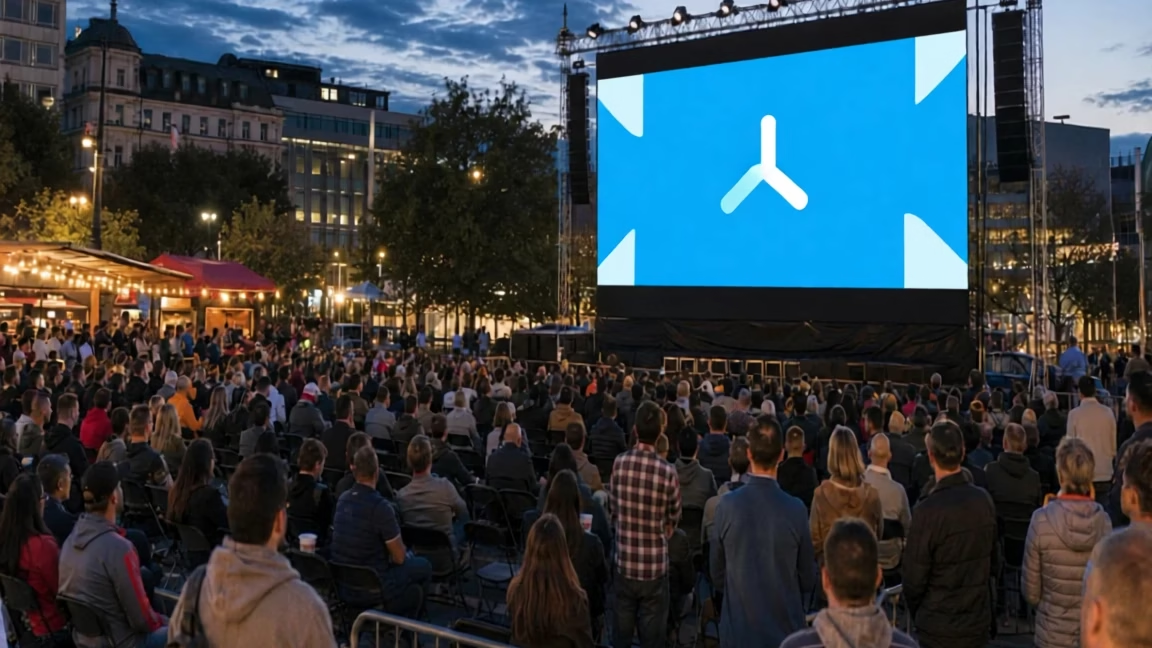
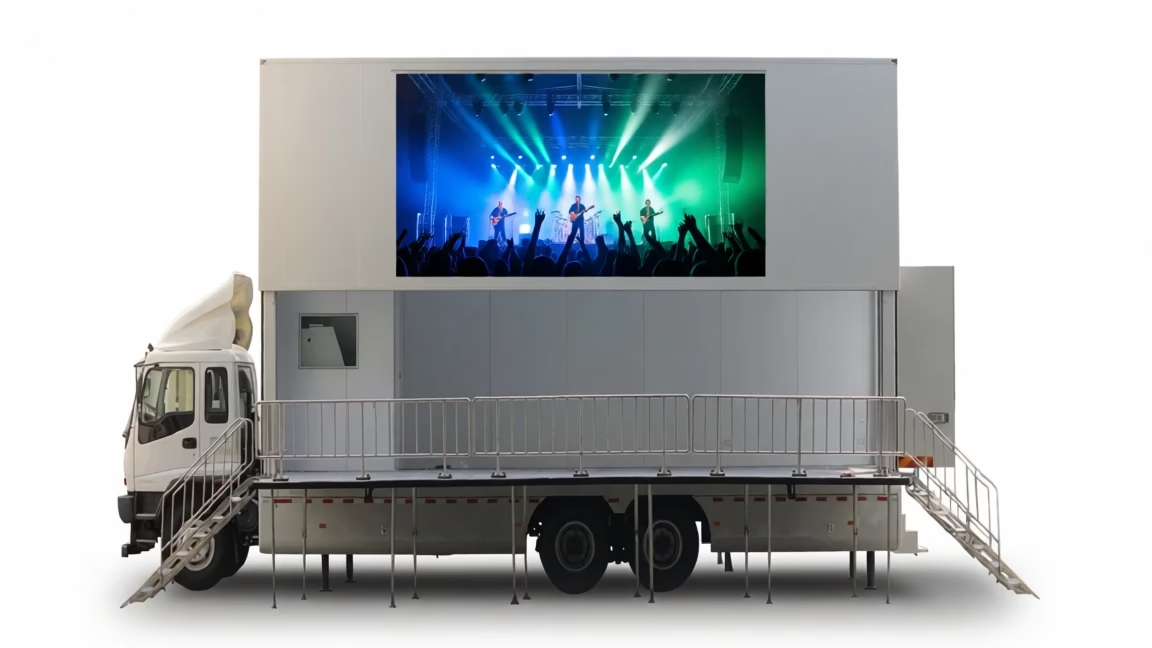
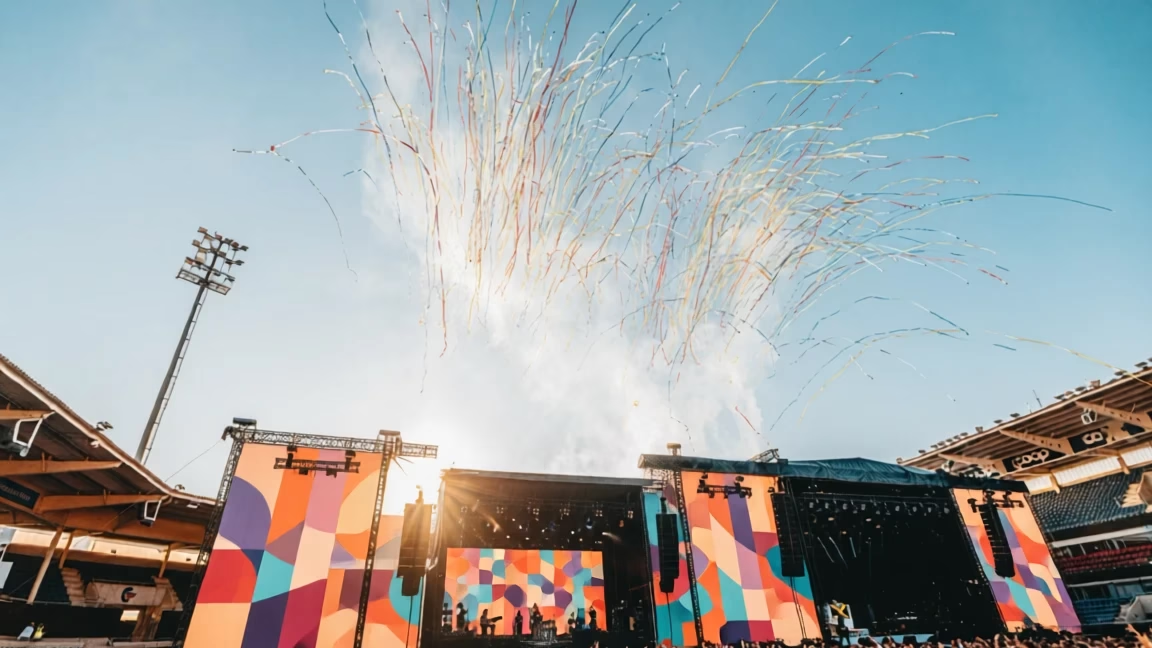
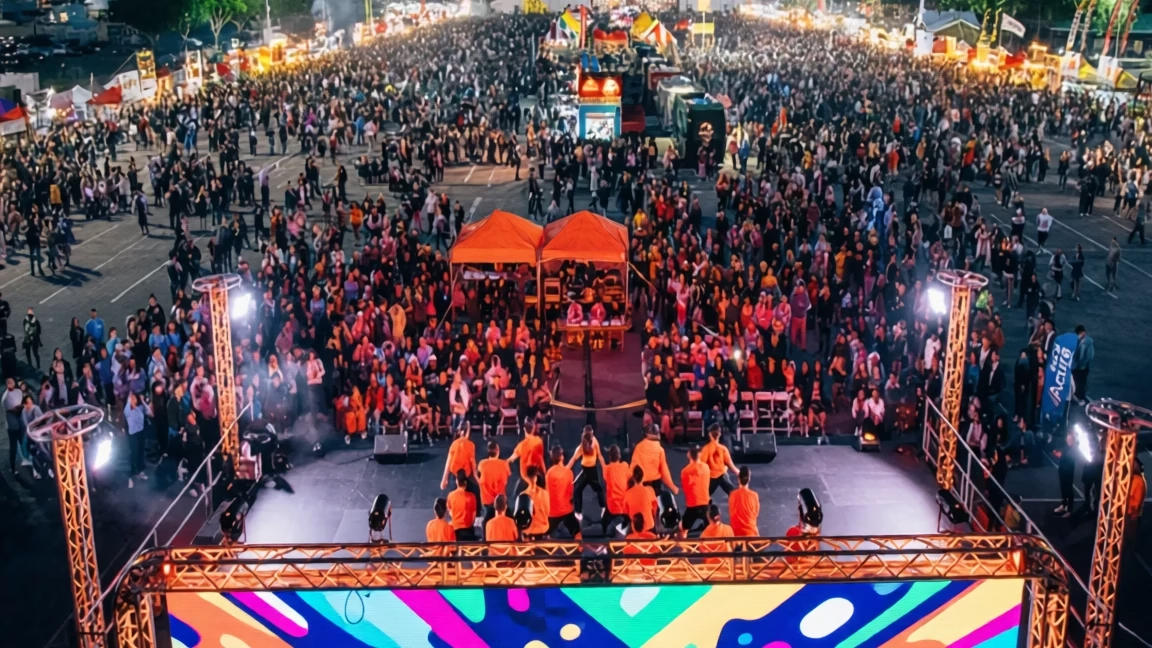
Where Does a P2.604 Outdoor Rental LED Display Deliver the Most Value?
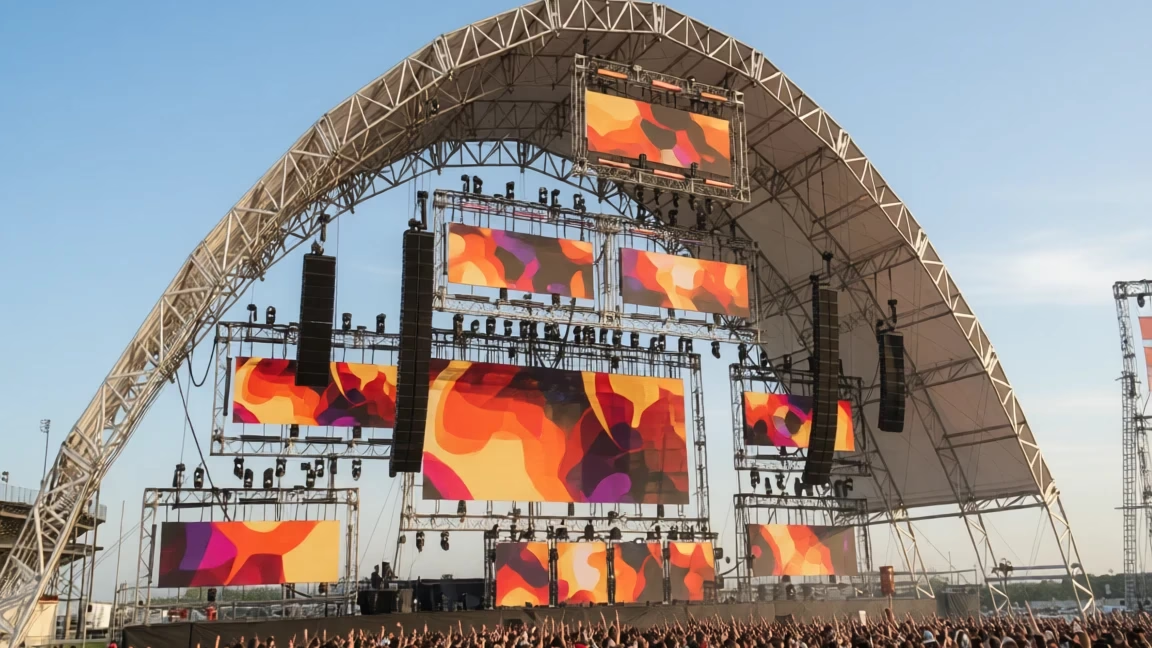
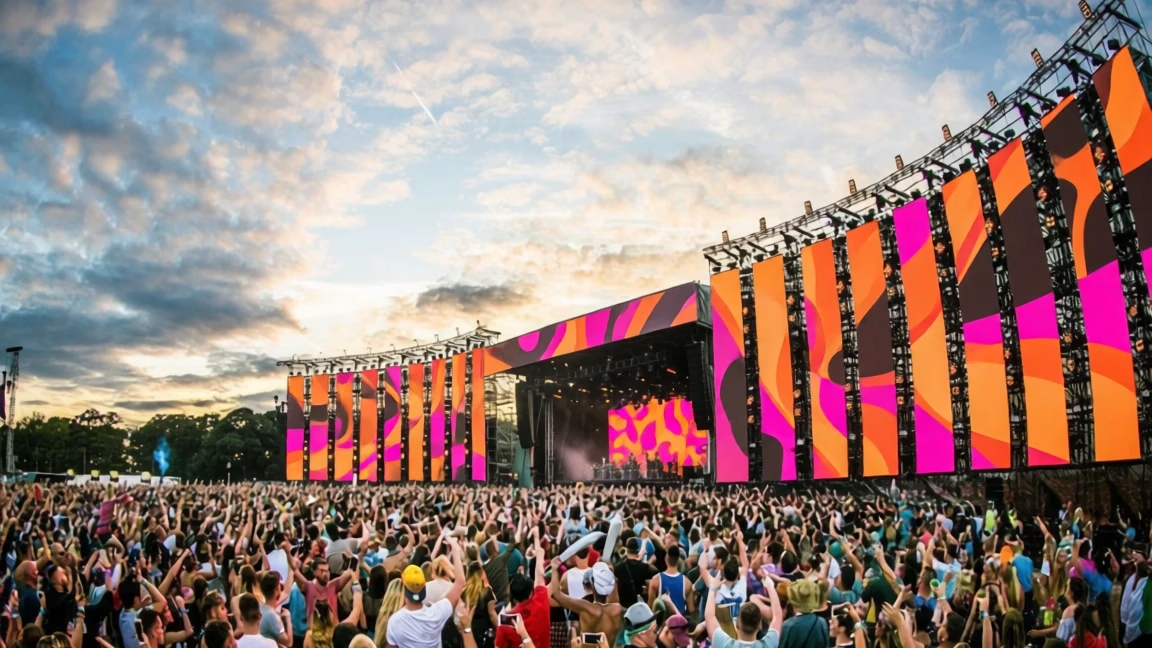
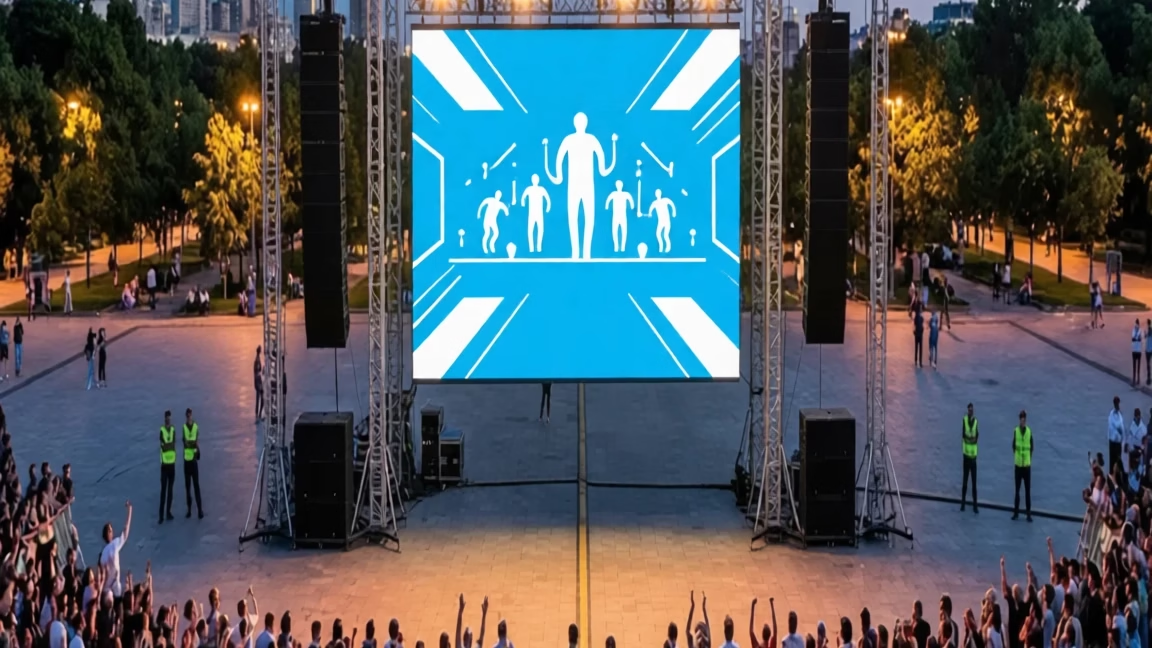
Daylight on the face, weather in the forecast, audiences from 2.6m out — the outdoor twin’s contract. Eight scenes where it is the default answer.
Reference Projects
What Have P2.604 Outdoor Rental LED Display Builds Looked Like?
Reference configurations our production floor has shipped in this spec — the outdoor packages our crews load most often:
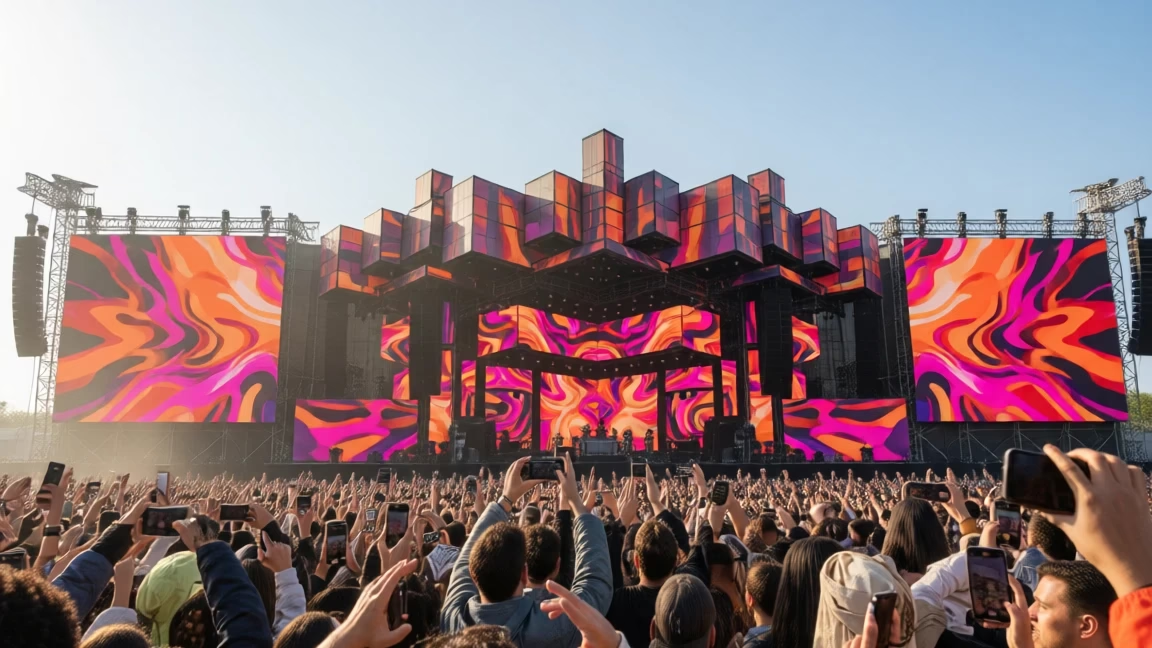
Festival Package
6 × 4m · 24㎡
384 modules in 96 of the 500×500mm cabinets. Gold-wire 5,000+ nits boost for the daytime slot, IP65 through the weather window, wind-braced rigging.
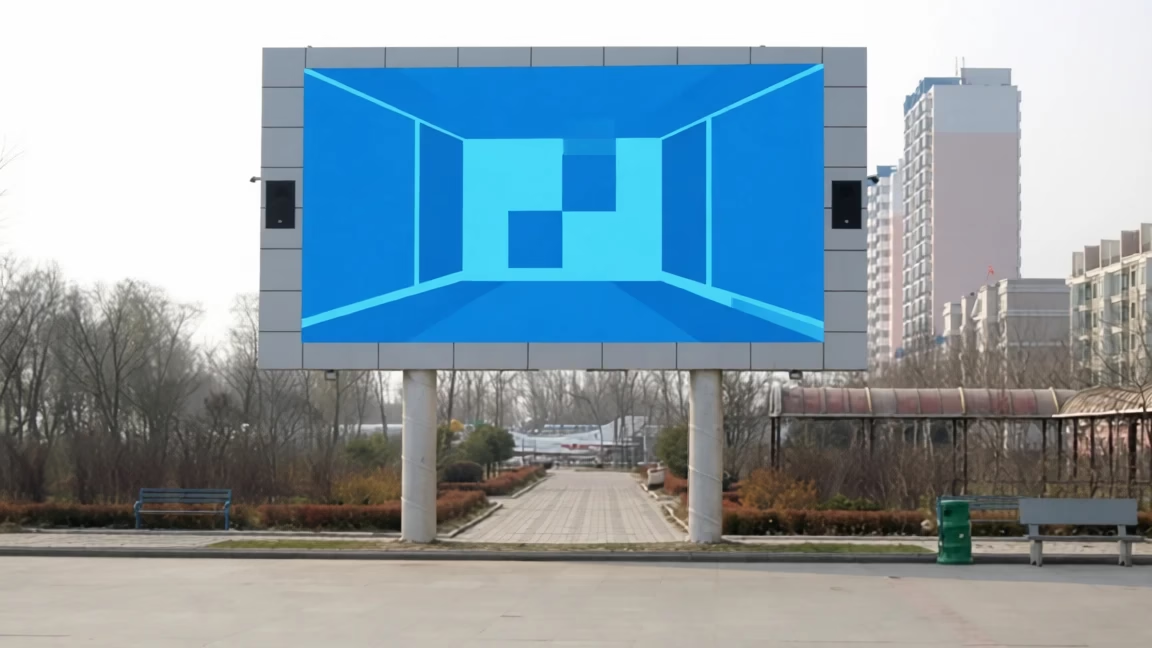
Plaza Package
8 × 4.5m · 36㎡
576 modules in 144 cabinets with the common-cathode supply — a semi-permanent plaza wall that stays cool through long public-run days.
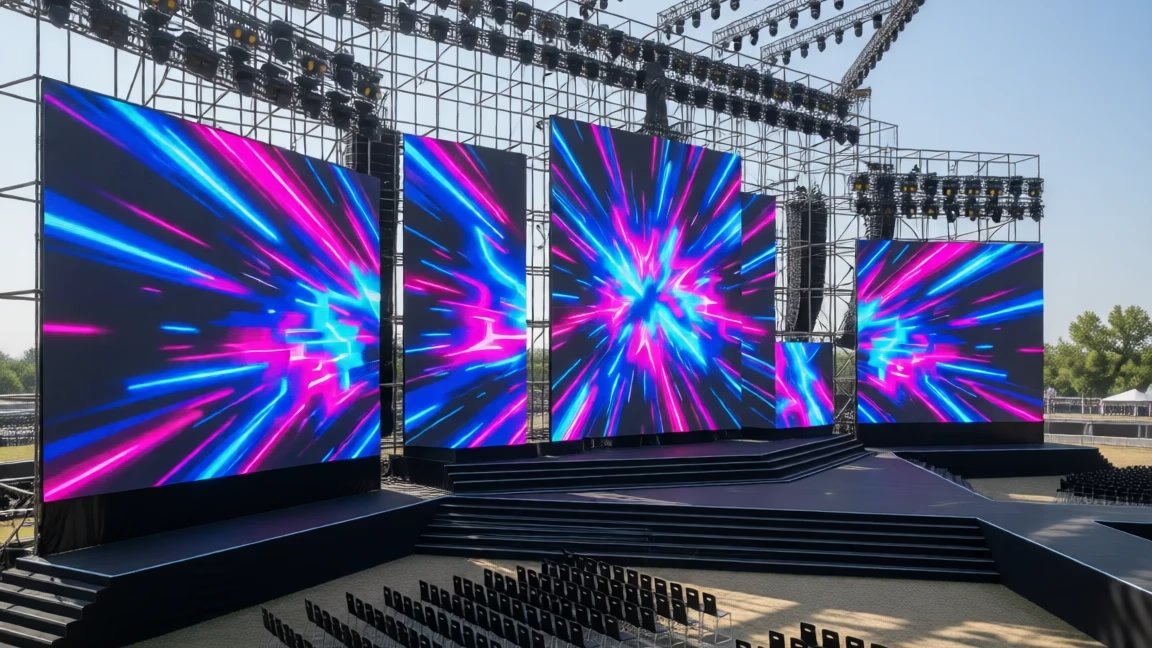
Touring Package
2 × (3 × 2m) Side Screens · 12㎡
192 modules in 48 cabinets flown as IMAG pairs — the touring build with aviation connectors and rear service for fast load-outs.
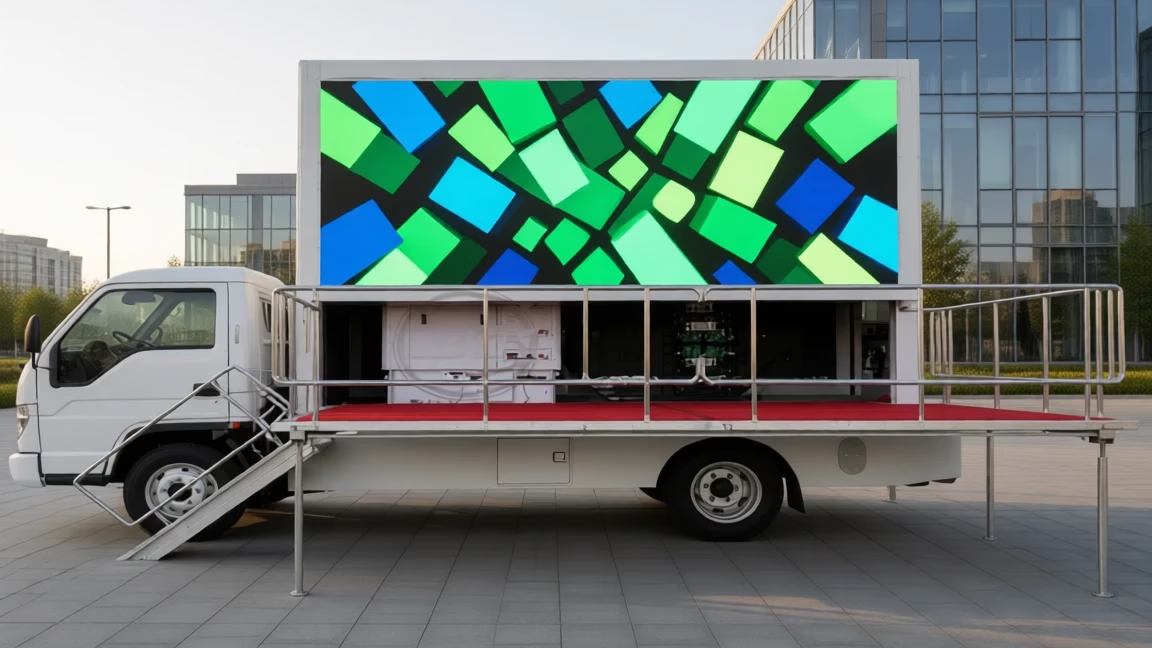
Parade Package
≈10㎡ Float-Mounted
160 modules across float and truck mounts — vibration-braced, weather-sealed and powered from the vehicle, with async playback for the route.
Named project case studies with site photography follow once client sign-offs clear — ask us for references in your region meanwhile.
FAQ
P2.604 Outdoor Rental LED Display: Frequently Asked Questions
What viewing distance does a P2.604 outdoor rental LED display need?
The pixel floor is the same as its indoor twin — about 2.6m at 147,456 pixels per square meter — but outdoor walls are usually read from farther out, in daylight, which is exactly what the 3,500–5,000+ nits brightness is for. Fine detail survives the distance; the brightness survives the sun.
How do I choose between the P2.604 outdoor and indoor twins?
By weather and brightness, never by quality — the pixel density is identical. If daylight hits the wall, rain is possible or the rig tours, take the outdoor build: IP65 sealing, potting-glued boards and 3,500–5,000+ nits. If the wall lives in sealed halls, the indoor twin saves the sealing cost and carries the finer lamp finish. Many fleets hold both — one pixel math, two weather envelopes.
Should I spec 3,500–4,500 nits or the 5,000+ nits tier?
Match the sun. The 3,500–4,500 nits copper-wire build holds its own in shaded rigs, overcast climates and evening-heavy programs. The 5,000+ nits gold-wire boost exists for main stages with direct sun on the face — daylight slots are where a wall either reads or disappears, and this is the tier that reads.
What does IP65 actually guarantee on this cabinet?
Full dust protection (6) and protection against water jets from any direction (5) — rain, wash-down spray and splashes are non-events. The sealing comes from gaskets plus the potting glue on the boards, with aviation connectors closing every cable entry. See the IP rating guide for the full scale.
SMD1415 or SMD1921 — black face or white face?
Both are outdoor waterproof packages at this pitch; the choice is optical. Black-face lamps absorb ambient light for higher perceived contrast — the pick for mixed-light venues. White-face lamps reflect more of the drive light for maximum punch — the pick where pure brightness wins. Grade 1 stock of both is qualified to extreme UV and dead-lamp tolerance.
What do the triple-coating and potting glue actually do?
The triple-protection varnish seals the board against moisture, salt fog and dust on both faces; the potting glue encapsulates the driver components so water has no path to the circuit even if a gasket ages. Together they are why these modules tour through rainy seasons and come home with their stock still healthy.
Why does the outdoor twin cost less than the indoor one?
Because of the lamps: outdoor packages like SMD1921 are larger and cheaper to build than the micro indoor packages, and outdoor rental volumes are the industry’s largest. The waterproofing bill is real but smaller than the lamp saving — which is how the outdoor twin quotes $600–1,000 per square meter against the indoor twin’s $1,050–1,800 while carrying four times the brightness and the IP65 build.
How much does a P2.604 outdoor rental LED display cost?
Roughly $600–1,000 per square meter FOB (2026-09 market listing scan) — about $38–63 per 250×250mm module at 16 modules per square meter. Lamp face and grade, the 5,000+ nits gold-wire tier, common-cathode drive and rigging hardware move a quote inside that band; the 15-events-a-year buy-vs-rent crossover applies.
Engineering Guide
Same Pitch, Two Lives — How Do You Choose Between the Indoor and Outdoor P2.604 Rental Twins?
Most pixel pitches exist once. P2.604 exists twice at UnifyLED — an indoor twin and an outdoor twin built on the same 250×250mm module, the same 147,456 pixels per square meter, the same 5.0 × 2.81m native 1080p canvas. Everything that differs between them is a lesson about what weather and daylight do to a wall. This guide is the decision walkthrough our engineers run with clients who ask the fair question: same pitch — which twin?
Daylight is a hard constraint, brightness is the answer
Start with the light. An indoor wall works at 800–1,200 nits because the room caps the ambient level; outdoors, direct sunlight measures tens of thousands of lux on the same face, and a wall that cannot answer disappears into glare. The outdoor twin runs 3,500–4,500 nits on copper-wire drive and 5,000+ nits on the gold-wire build — roughly four times the indoor tier — which is why a festival main stage at noon still reads from the back of the field. That brightness is also why the outdoor twin’s refresh is rated for daylight camera work: sun-lit walls photograph at hard shutter speeds, and the 3,840Hz standard keeps scan lines out of both the broadcast feed and the crowd’s footage.
Then check the weather, because the second difference is sealing. The outdoor twin closes to IP65 with potting-glued boards, triple-protection varnish and aviation-grade waterproof connectors — layers that make rain, dust and wash-down spray non-events. The indoor twin carries none of that, which is precisely why it is lighter, finer-finished and better value in a sealed room. The mistake to avoid is cross-shopping: an indoor wall on an outdoor job fails within a season, and an outdoor wall indoors is paying a sealing bill for a room that never rains. The twins are priced so the honest answer is also the cheap one — the outdoor build quotes $600–1,000 per square meter against the indoor twin’s $1,050–1,800, because the larger outdoor lamps cost less than micro packages even after waterproofing.
The lamps swap, the math does not
Peel the faces off the two twins and the difference is the package: SMD1515 and SMD2121 micro lamps indoors, SMD1415 and SMD1921 outdoor waterproof packages outdoors, in black or white faces. The larger outdoor lamps are cheaper to build and tougher in transit; the black-face option trades a little punch for contrast in shaded rigs. What does not change is the geometry — 96×96 pixels per module, 147,456 per square meter, content built for one twin plays on the other with no redesign. For a fleet, that is a spares and training dividend: one pixel math, two weather envelopes, zero re-learning.
Cabinet strategy differs with the weather too. The indoor twin offers two formats — 500×500mm for flexibility and 500×1000mm for build speed — because sealed rooms reward fleet options. The outdoor twin standardizes on the single 500×500mm high-strength box: every cabinet seals identically, braces identically through its wind-brace interface and cases identically for the truck. Outdoor maintenance runs through the waterproof rear cover as standard, with screw-fixed front service on premium models; uniformity is protected by the UV-resistant mask against local color shift and by hardware per-pixel correction — stored in the control equipment, not in a laptop.
Built for the touring day
A touring wall’s worst enemies are not dramatic — they are the hundred small moments between shows: the connector someone rushes in the rain, the brace point that was never rigged, the module left face-up under a sprinkler line. This collection engineers against those moments specifically. The aviation-grade connectors are keyed and threaded, so a rushed crew cannot half-seat them; the wind-brace interface gives the rigger a certified point to tie the wall down before the weather turns; the rear service cover opens the whole box without exposing the modules to the sky. Every specification on this collection exists because a touring crew somewhere asked for it after a hard day.
The same logic runs through the packaging of the job itself. Wall layout is quoted with the wind-brace plan attached; the module binning certificate travels with the fleet so any re-binning after a swap stays inside tolerance; and the 3% spare-module allowance is packed in the same flight-case family as the wall, so the spares arrive where the wall is. None of this appears on a brightness spec sheet — all of it appears in whether the wall is standing and bright when the headline act walks out.
Run the decision, then the numbers
The decision compresses to three questions. One: does daylight hit the wall? Two: is water possible? Three: does the rig move? Any yes points to the outdoor twin; three noes point to the indoor twin; a season of mixed jobs points to holding both. Then the numbers: the outdoor twin quotes $600–1,000 per square meter FOB against $1,050–1,800 indoors, while rental rates run $55–110/㎡ per day for the screen alone — so the fifteen-event crossover applies to whichever twin the weather chose. A 6×4m festival main wall (24㎡) at the outdoor band’s midpoint lands near $19,000 FOB: 384 modules in 96 of the 500×500mm cabinets, gold-wire boost tier, wind-braced and IP65 through the weather window.
The short version: a P2.604 outdoor rental LED display is the daylight twin — 147,456 pixels per square meter at 3,500–5,000+ nits, IP65-sealed with potting-glued boards and aviation connectors, SMD1415/1921 waterproof lamps, wind-braced 500×500mm cabinets — at a per-square-meter price below its indoor twin. Choose by weather and light; the pixels are already identical.
Related P2.604 Outdoor Rental LED Display Resources
P1.953 Indoor Rental LED Display Collection →
P2.976 Indoor Rental LED Display Collection →
500×500mm Rental LED Display Collection →
Outdoor LED Screen Guide →
Outdoor LED Module Guide →
IP Rating Guide →
Outdoor LED Screen Installation →
Outdoor LED Screen Price Guide →
LED Screens for Events →
Spec Your P2.604 Outdoor Rental LED Display With Our Engineers
Send us the venue, the wall size and the weather it must survive. The quote comes back itemized — lamp face and grade, brightness tier, common-cathode option, rigging hardware, control stack — factory-direct, with 3% spare modules in every order.
UnifyLED — LED screen manufacturer · unifyledscreen@gmail.com · Changsha / Shenzhen, China