
Outdoor LED Display Power Consumption: Your Pitch Sets Your Bill (2026)
Outdoor LED display power consumption follows one curve — lamp count per square meter, which falls with the square of the pitch. This guide puts the entire outdoor family on that curve in one table: P2.5 at 500–650W per square meter on mixed content down to P10 at 120–200W, with peak draw, monthly running costs and the energy-saving options that cut each pitch’s bill further. Every figure comes from the same signed September 2026 dataset as our seven pitch collections — measured, dated and cross-checked.
Short answer: The wall draws 120–650W per square meter on mixed content depending on pitch, peaking 30–60% higher on full white. P10 is the lightest at 120–200W; P2.5 the heaviest at 500–650W. Brightness scheduling after midnight cuts roughly 30% on any pitch — the largest single saving available. The 4.2V/3.8V low-rail supplies and the 320×320mm common-cathode boards cut a further 30% on the pitches that carry them.
What Does Outdoor LED Display Power Consumption Look Like in 2026?
Seven pitches, one curve, all on the same signed scan. The table below is the reference chart for the entire outdoor family — mixed-content draw, full-white peak, and the monthly running cost for a 20㎡ wall on a 12-hour daily schedule:
Every figure above is a market scan from the same signed dataset as our pitch collections — measured, dated, cross-checked. The mixed-content draw assumes typical billboard programming; the peak is the full-white ceiling that your power feed and breakers must handle.
Why Does Lamp Count Drive Outdoor LED Display Power Consumption?
Every halving of pitch roughly quadruples the LED count, and each lamp draws current to produce light and heat. The power curve tracks the density curve almost exactly: a P2.5 wall packs 160,000 lamps per square meter against P10’s 10,000 — 16 times the load. Between adjacent pitches the steps are smaller but consistent: P3 carries 44% more lamps than P4, P4 carries 56% more than P5, and so on down the ladder. This is also why the coarser pitches’ power supplies can be smaller and cheaper per cabinet — the entire family runs on the same 5V 40A supply from Chuanglian Power, MEAN WELL or G-Energy, because the lighter pitches need fewer amps, not bigger hardware.
How Much Does It Cost to Run Each Pitch Per Year?
The monthly figures in the table above scale linearly with wall size and operating hours. The annual costs below assume commercial tariffs at $0.15/kWh — adjust for your market:
The 100㎡ columns are the fleet operator’s reference — and the gap between adjacent pitches on a 100㎡ face runs 3,000–11,000 kWh a year, which is why the pitch decision is also a power decision. The pitch-specific running costs are in each collection’s price guide:
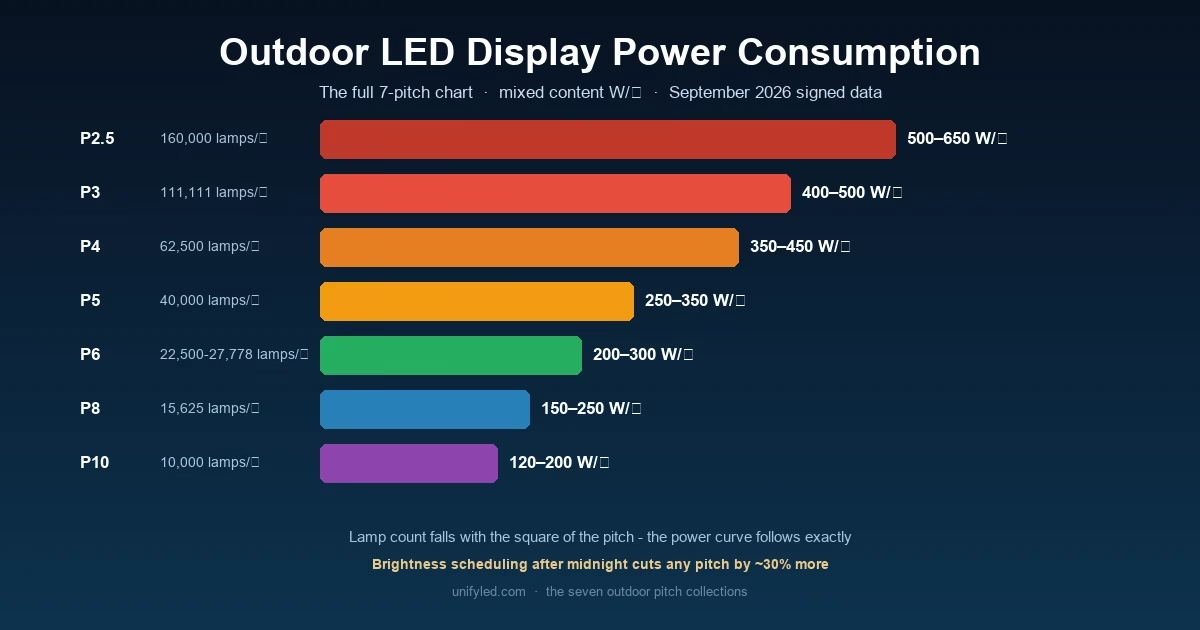
The family power ladder: one curve from P2.5’s 160,000 lamps to P10’s 10,000.
Which Energy-Saving Options Cut Outdoor LED Display Power Consumption?
Three architectures cut the bill beyond the pitch decision itself, and each lives on a different part of the ladder:
- 4.2V/3.8V low-rail supplies — available on the 320×160mm board suite across P3, P5, P8 and P10. Adds 8–12% upfront, cuts power roughly 30% by driving LEDs closer to their physical requirement. On 24/7 billboard duty it pays back within the first year in high-tariff markets.
- Common cathode (320×320mm big board) — lives on P5, P8 and P10. Goes further than a supply swap: red, green and blue channels are powered individually and precisely, which also eliminates the localized heat drift that shows as evening color patches. The 480×320mm boards on P8 carry the dual rail (4.2V/2.8V) as standard with 8,500–11,000 nits — the highest ceiling in the family.
- Brightness scheduling — not a hardware option but the largest single saving available on any pitch: dimming to 40% after midnight cuts the mixed-content draw by roughly 30%, and every wall in the family supports it through the control system.
The detail behind the common-cathode advantage:
GOB and the energy options: the protective and power lines every outdoor quote should state.
How Does Brightness Scheduling Affect Outdoor LED Display Power Consumption?
Every collection on this site repeats the same sentence — brightness scheduling after midnight moves the bill more than any hardware choice — and the arithmetic behind it is simple. Dimming to 40% after midnight cuts the mixed-content draw by roughly 30%. On a 100㎡ face running 12 hours a day with the last 4 dimmed, that is about 1,200 kWh a month saved on P6, scaling linearly across the family. The reason is physical: at night the ambient light is so low that the wall needs only a fraction of its noon brightness to hold the same perceived contrast, so every dimmed hour runs the lamps at a fraction of their full-white current. On networked fleets this is a cloud-scheduled setting, not a manual one.
The saving scales with three variables, and the first is the one buyers control: wall size. A 100㎡ P6 face saves roughly 1,200 kWh a month dimmed; a 300㎡ three-screen network saves 3,600. The second is operating schedule: a 24/7 wall dims for more hours than a 12-hour one, so the percentage saving is the same but the absolute kWh is double. The third is tariff: the same 1,200 kWh is worth $180 at $0.15/kWh and $360 at $0.30/kWh — which is why fleet operators in high-tariff markets schedule aggressively and low-tariff operators sometimes leave the walls at full brightness. The hardware option compounds the scheduling saving:
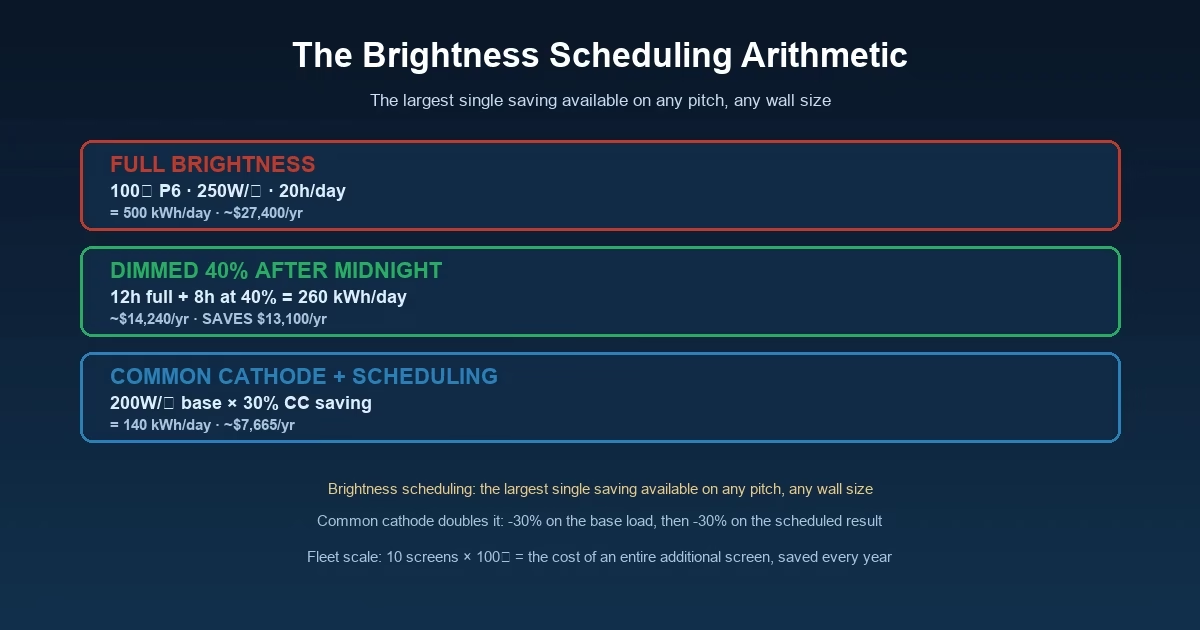
The brightness-scheduling arithmetic: the largest single saving available on any pitch, any wall size.
The durability question that follows — can the wall handle years of thermal cycling from full-noon to dimmed-night? — is the same one every outdoor build must answer:
The durability test a serious build survives — brightness scheduling only works when the hardware holds.
What Hidden Lines Sit Outside the Power Bill?
The power bill is the recurring line buyers watch, but four others sit outside a factory quote. Control hardware adds $500–2,000 per project; steel structure and installation add 20–30% of screen value locally; sea freight runs roughly $200–400 per cubic meter; and spare modules — 3% of quantity — are the cheapest insurance until the first storm ends a board. The module-granularity line is worth noting for fleet operators: a 46㎡ billboard consumes 720 P4 boards or 900 P6.67 boards, so each dead P6.67 module removes fewer pixels while it waits for replacement. Specify spares, the UV-stabilized matte mask and warranty terms in writing. The pitch-specific stacks are in the seven price guides.
For fleet operators the arithmetic compounds across screens: a ten-screen P6 network at 100㎡ per face saves 55,000 kWh a year from brightness scheduling alone — and the common cathode option on the 320×320mm boards doubles that. Those are the numbers that make the pitch decision also a power decision.
What Do Buyers Also Ask About Outdoor LED Display Power Consumption?
How much power does an outdoor LED display use per square meter?
It depends on pitch: P2.5 draws 500–650W per square meter on mixed content, P3 draws 400–500W, P4 draws 350–450W, P5 draws 250–350W, P6 draws 200–300W, P8 draws 150–250W and P10 draws 120–200W. Peak draw on full white runs 30–60% higher. The lamp count falls with the square of the pitch, and the power curve follows.
Which pitch has the lowest power consumption?
P10 draws the least: 120–200W per square meter on mixed content and 250–350W peak. But P6 is the fleet operator’s pick because it combines a light 200–300W load with 22,500–27,778 pixels that still read sharply from 6 meters — the best power-to-clarity ratio in the family.
How much electricity does a 100㎡ billboard use per year?
Running 20 hours a day at commercial tariffs: a P6 100㎡ wall at 250W average consumes about 219,000 kWh a year (roughly $32,850 at $0.15/kWh), while a P10 wall at 150W draws about 131,000 kWh (roughly $19,650). The gap between adjacent pitches on a 100㎡ face runs 3,000–11,000 kWh a year.
Does brightness scheduling really save that much power?
Yes — and it is the largest single saving available on any pitch. Dimming to 40% after midnight cuts the mixed-content draw by roughly 30%. On a 100㎡ P6 wall, that is about 5,500 kWh a year; on a P3 wall, nearly 9,000 kWh. Scheduling moves the bill more than any hardware choice.
What is the difference between 4.2V and common cathode?
Both are low-rail architectures that drive LEDs closer to their physical requirement, cutting power about 30%. The 4.2V/3.8V energy-saving supply is a power-supply swap available on the 320×160mm board suite. Common cathode goes further: red, green and blue channels are powered individually and precisely, which also eliminates localized heat drift — it lives on the 320×320mm big boards.
Why do higher-density displays use more power?
Lamp count. Every halving of pitch roughly quadruples the LED count, and each lamp draws current to produce light and heat. A P2.5 wall packs 160,000 lamps per square meter against P10’s 10,000 — 16 times the load — which is why the power curve tracks the density curve almost exactly.
How much does power cost per year for a P6 billboard?
A 100㎡ P6 wall at 250W average running 20 hours a day consumes about 27,375 kWh a month (roughly $4,100 at $0.15/kWh), or about 329,000 kWh a year ($49,350). With the brightness dimmed to 40% after midnight, the saving is roughly 5,500 kWh a year.
What power supplies does an outdoor LED display need?
One 5V 40A switching supply per cabinet from Chuanglian Power, MEAN WELL or G-Energy — one per cabinet keeps failure domains cabinet-sized. The 4.2V/3.8V energy-saving rails are available on the 320×160mm board suite across most pitches, and the 480×320mm boards on P8 and P10 carry the common-cathode dual rail as standard.
References & Sourced From: 2026 Outdoor LED Display Power Consumption Data
- Pitch power bands (P2.5 500–650W/㎡; P3 400–500; P4 350–450; P5 250–350; P6 200–300; P8 150–250; P10 120–200 mixed, peaks 30–60% higher): the seven pitch collections — P2.5, P3, P4, P5, P6, P8, P10 — September 2026.
- Energy-saving options (4.2V/3.8V low-rail −30%; common cathode −30% on 320×320mm boards; brightness scheduling −30% after midnight): the common cathode technology guide and the same collections.
- Power supplies (Chuanglian Power / MEAN WELL / G-Energy at 5V 40A; common-cathode dual rail 4.2V/2.8V on 480×320mm boards): the LED display power supply guide.
- Annual cost arithmetic: computed from the signed power bands at $0.15/kWh commercial tariff, 100㎡ wall, 12/20/24-hour schedules.
Verdict: Which Pitch Gives You the Lowest Power Bill?
P10 gives you the lowest absolute bill — 120–200W per square meter, $7,000–11,700 a year on a 100㎡ 12-hour face. But the lowest bill is not the same as the best value: the pitch you choose is decided by viewing distance, not by the power meter. What this chart tells you is the running-cost consequence of that choice — so when a client asks “how much does it cost to leave on?”, the answer is: whatever pitch your viewing distance demands, plus the 30% that brightness scheduling will save you. Request a module-level quote with the power architecture itemized — from a LED screen manufacturer that ships the entire outdoor family.
Related outdoor power and pitch guides:
P4 Outdoor LED Display Collection · P5 Outdoor LED Display Collection · P6 Outdoor LED Display Collection · Common Cathode Technology